

How to Choose a Google Ads Agency Australia
Last Updated

You're probably looking at a stack of agency proposals that all sound the same. Every deck claims strategic thinking, better leads, and transparent reporting, yet none of them answers the question that matters, who controls the account, how clean the tracking is, and whether the agency can prove it's finding real search demand instead of just spending your budget faster.
That's the trap with choosing a Google Ads agency Australia. The pitch looks polished, the certifications look reassuring, and the case studies usually look better than your own numbers. But if the agency can't show you account ownership, conversion tracking maturity, search-term hygiene, and honest reporting, you're buying motion, not performance.
Why Hiring the Right Google Ads Agency Matters
A marketing manager once told me the hiring process felt like sitting in a room where every agency had rehearsed the same speech. They all promised to “scale,” all talked about “full-funnel growth,” and all produced slick PDFs with charts that looked expensive. None of that matters if the account is built badly, if the leads aren't tracked properly, or if the agency is optimising for vanity clicks.
That scepticism is justified in Australia because search is still the biggest performance channel in the market. Australia's digital advertising market reached AUD 18.4 billion in 2025, and AUD 8.0 billion of that went to search advertising, about 43% of online ad spend, according to the source brief on Australian Google Ads statistics. That is a lot of intent-driven demand for one channel, and it's exactly why a weak account burns money fast.
A good agency isn't the one with the loudest case study. It's the one that shows you how it thinks, how it measures, and how it protects your budget when the clicks start coming in. If you want a broader service comparison before shortlisting, compare Google Ads agency services is a useful starting point because it helps separate management models from marketing fluff.
Practical rule: If the agency can't explain what happens to your data on day one, it's not ready to manage spend.
The right filter is operational, not cosmetic. Certifications help, but they don't tell you whether the team owns the account, audits conversions properly, or reviews the search terms that are wasting money every week. That's the difference between a partner and a vendor.
Understanding the Australian Google Ads Landscape
The Australian market rewards agencies that understand paid search as a money channel, not a branding side quest. The Australian Competition and Consumer Commission found that Google accounted for between 70% and 100% of impressions across the four main ad tech services it examined, and estimated that over 90% of all ad impressions traded in 2020 passed through at least one Google service. For a buyer, that's the signal, if you want scale in Australia, you need people who live and breathe Google's paid ecosystem. The ACCC report makes the point plain, Google-focused expertise isn't optional when you're competing for Australian attention.
For Australian search campaigns, the working benchmark you should care about is a 6.96% average conversion rate in 2024. Strong accounts often sit in the 5% to 8% range when tracking and targeting are set up properly, and a much lower result often points to broken measurement or landing-page problems rather than “bad ads”. The same source also gives a practical workflow, verify conversion tracking first, then tighten keywords, add negative keywords, align ad copy to search intent, and improve landing-page speed and message match. That order matters because agencies love blaming the ads when the issue is the funnel.
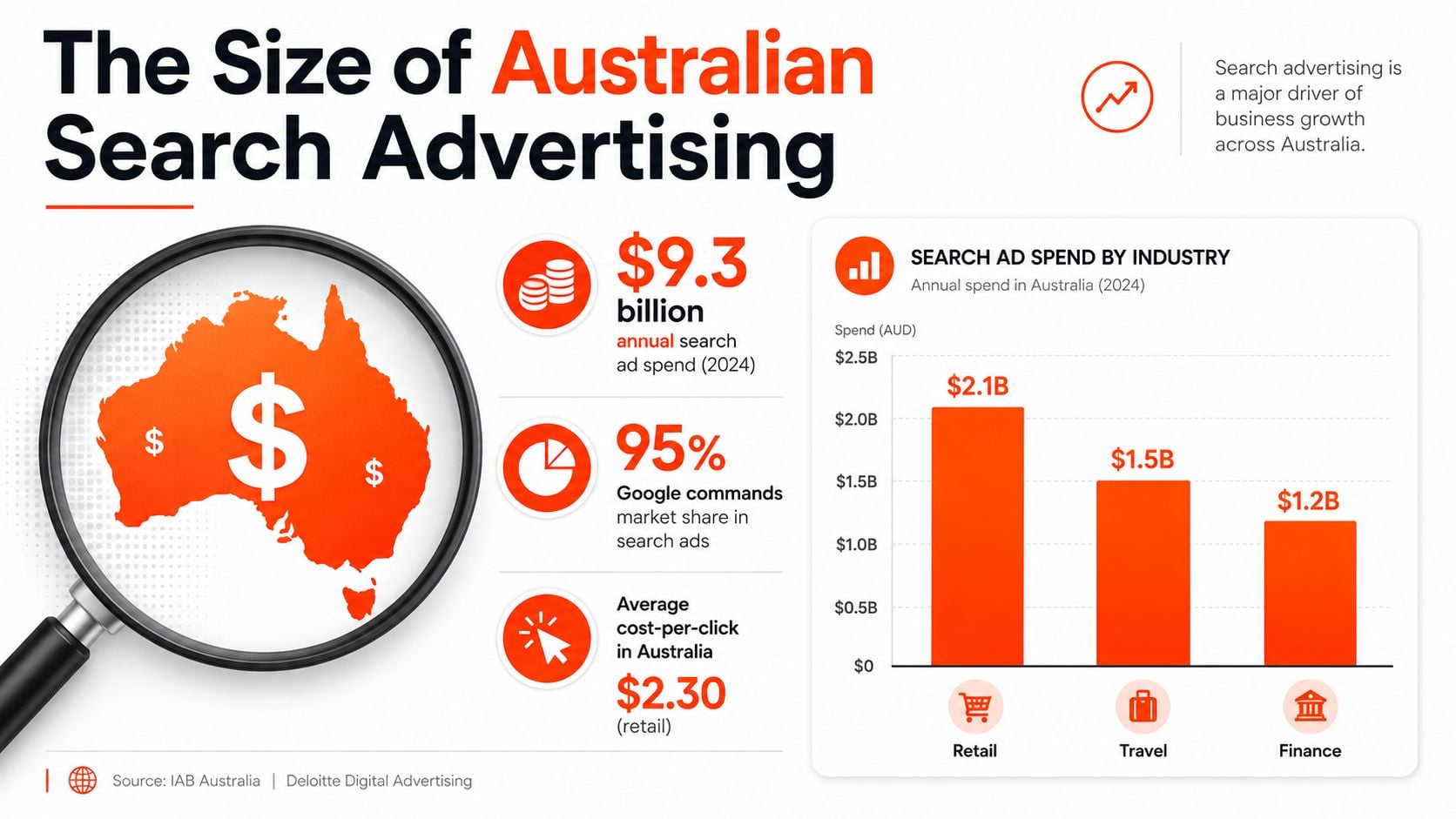
The click-through benchmark is just as blunt. Well-built commercial-intent Search campaigns in Australia usually land around 3% to 5% CTR, while below 2% often signals targeting or relevance issues. Agency teams also tend to see meaningful uplift after 14 to 30 days of a restructure, with the fuller impact compounding over the first 90 days, especially once bidding systems and testing cycles accumulate data. That's why a polished launch deck means very little. Real improvement comes from the ugly work, search-term hygiene, conversion QA, and landing-page alignment.
If you're comparing tool stacks as part of your due diligence, seo software for local businesses is relevant because it helps small teams think more clearly about where organic and paid activity overlap. That overlap matters when an agency tries to justify paid search decisions with vague “full digital” language instead of direct account evidence.
The Agency Audit Checklist You Need
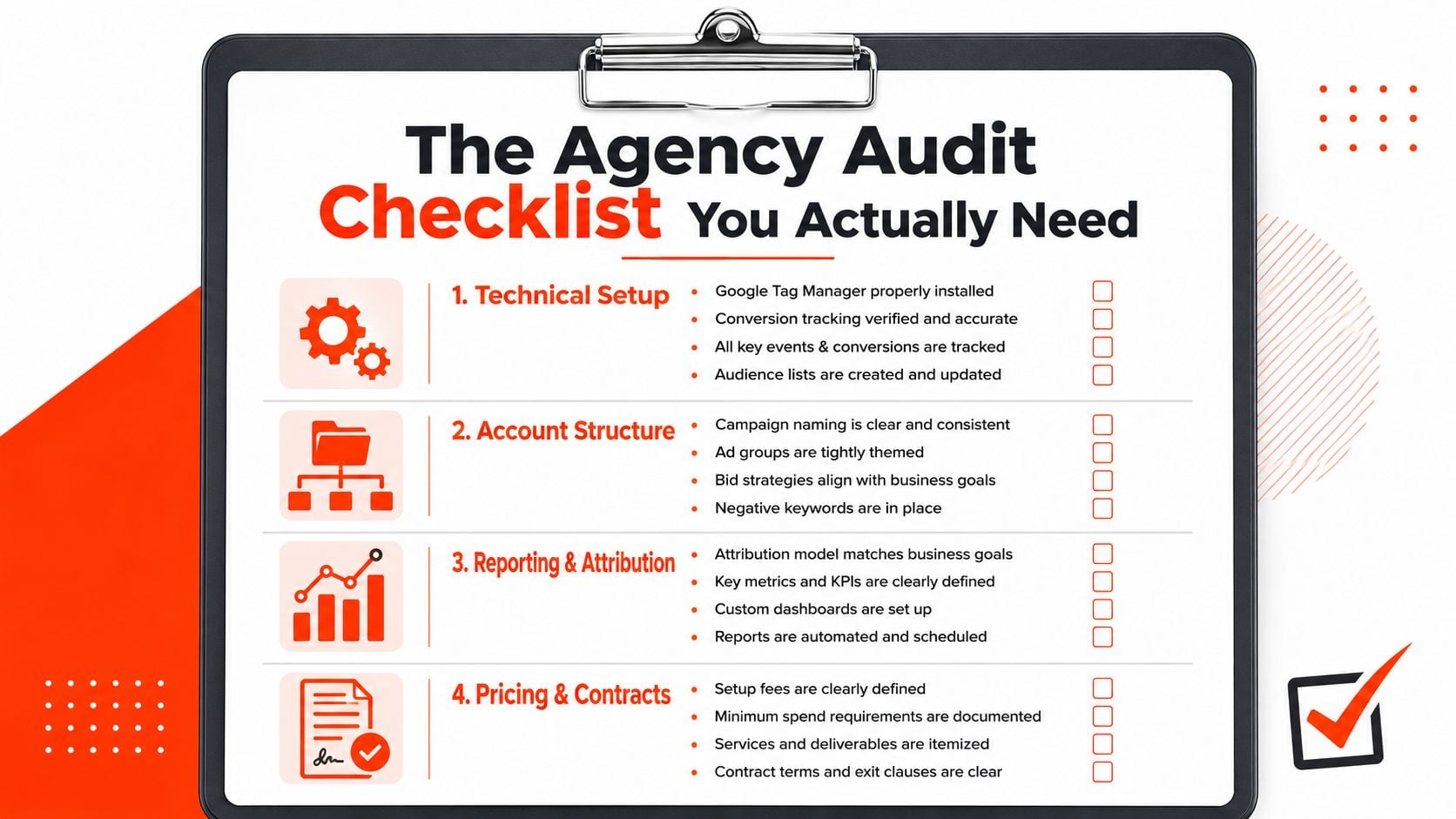
Most buyers waste the first call asking about certifications, software, and “industry fit”. Those things are fine, but they do not protect you from a bad contract. The audit is more basic and more uncomfortable. Who owns the account, what does the agency track, how often do they clean the search terms, and what do you get to see each month?
Start with ownership and measurement
Ask who owns the Google Ads account. If the agency wants to run everything inside its own account, stop there. That setup ties your history, audience lists, and learning to their business, not yours. You should own the account and grant access, not the other way around.
Then ask how they handle conversion tracking. Calls, forms, bookings, and offline conversion imports should all be explained clearly, not waved away as “handled by our team”. If they cannot describe the tracking stack in plain English, they probably cannot diagnose it when it breaks. A strong agency can show you the tags, the events, the deduplication logic, and where each lead lands in reporting.
Push on search-term hygiene and landing pages
Search-term hygiene separates a serious operator from a slide-deck agency. Ask how often they review queries, what they do with irrelevant traffic, and how they build negative keyword lists. If the answer is vague, they are probably letting waste sit in the account. Ask for examples of wasted queries they removed and what changed after that cleanup.
Landing-page alignment matters just as much. A well-written ad that lands on a weak page still loses. Ask what they check first, page speed, message match, call-to-action clarity, or mobile usability. Good agencies do not treat the landing page as someone else's problem.
Useful question: “Show me the last time you removed wasted spend because the search terms did not match intent.”
Insist on reporting you can audit
Reporting transparency should be boring in a good way. You want to see spend, conversions, and the logic behind changes, not a colourful PDF that celebrates impressions. Ask whether you will get live access to dashboards, how they explain attribution, and how often they review performance with you. If the reports are selective, the strategy usually is too.
A straightforward way to pressure-test this is to use an external audit checklist before you sign anything. The framework at this Google Ads audit guide is worth keeping next to your proposal notes because it forces the conversation back to account structure, tracking, and accountability instead of brand theatre.
Pricing Models and What Australian Businesses Should Expect to Pay
Australian PPC pricing is more varied than most buyers expect, which is why comparison shopping gets messy fast. Clutch's AU market data shows typical pricing around AUD $100 to $149 per hour, AUD $2,000 to $10,000 per month for SMB retainers, and 10% to 20% of ad spend for enterprise-style management. The right model depends on spend level, account complexity, and how much operational support you need, not on what sounds cheapest in the proposal.
Compare the models side by side
| Pricing Model | Typical Range (AUD) | Best Suited For | Key Considerations |
|---|---|---|---|
| Hourly | $100 to $149/hour | Audits, one-off fixes, senior consulting | Good when you need diagnosis, not ongoing execution |
| Monthly retainer | $2,000 to $10,000/month | SMBs that need ongoing management | Best when the agency owns optimisation, reporting, and iteration |
| Percentage of ad spend | 10% to 20% | Larger accounts and enterprise management | Easy to understand, but can create weak incentives if spend rises faster than quality |
The model itself isn't the whole story. A retainer can be fair value if the team handles conversion tracking, search-term review, and landing-page collaboration properly. A percentage model can make sense for large, complex accounts, but it can also reward volume over efficiency if the agency isn't disciplined.
Watch for hidden costs
Setup fees are where many quotes expand. Creative production, tracking configuration, landing-page work, and extra reporting layers may all sit outside the headline monthly fee. Ask what is included before you compare agencies, because one quote may look cheaper only because half the work is excluded.
Contract length matters too. A long lock-in with weak reporting is a bad trade, especially if the agency refuses to show you the account structure or the tracking setup. If you want a simple way to compare pricing models before a call, the breakdown at PPC pricing models will help you ask better questions.
My view is simple. If the proposal won't explain how the fee maps to actual work, don't assume the price is fair just because it's market standard.
Red Flags and Misleading Claims to Watch For
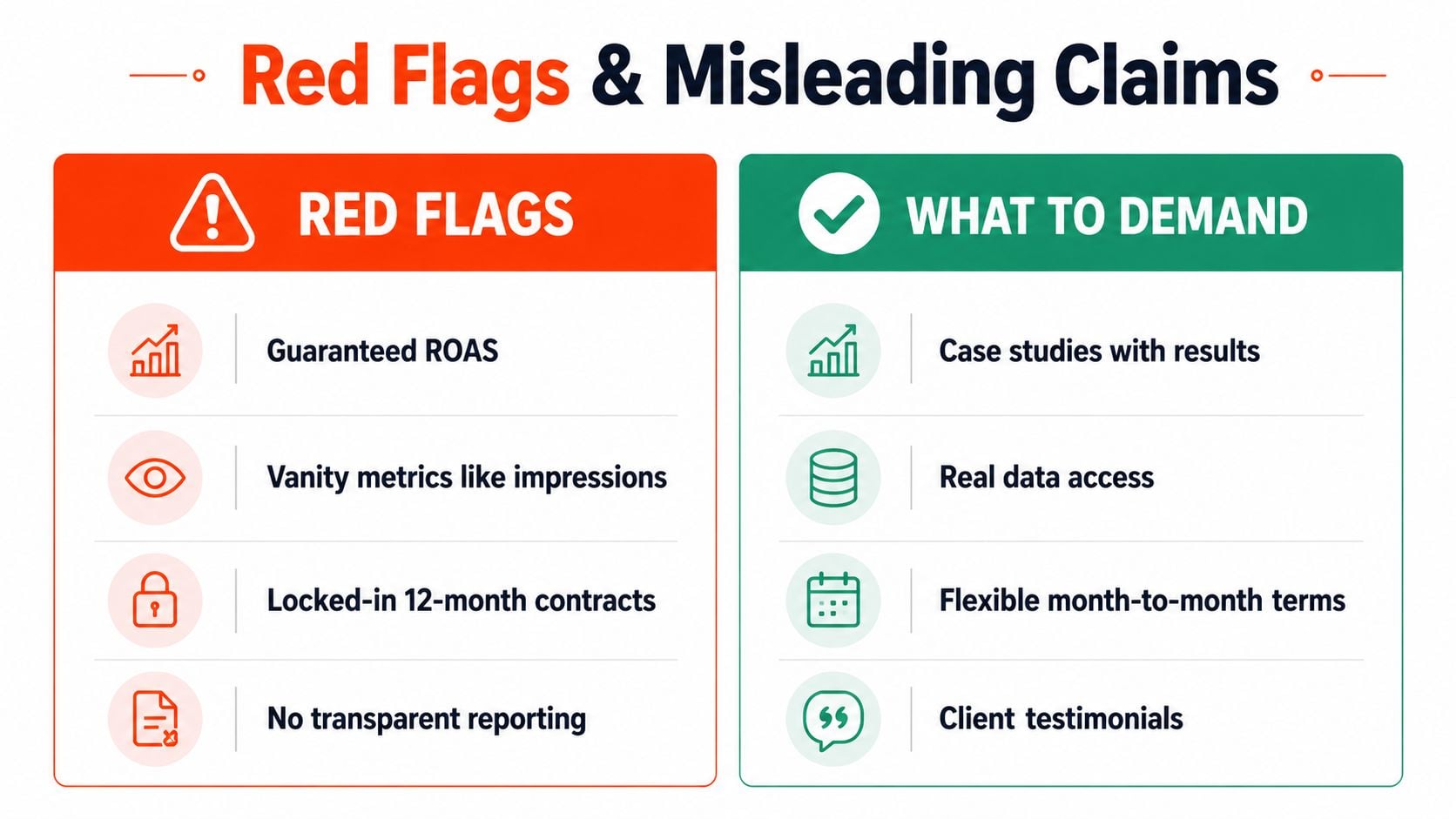
Some agency claims are so common they've become background noise. That doesn't make them harmless. Guaranteed ROAS promises, “fully managed” reporting that hides the raw data, and account access that never quite gets handed over are all signs you're being sold confidence instead of competence.
Ignore vanity signals and badge worship
Google Partner or Premier status is not a free pass. It can be useful as a credibility filter, but it doesn't tell you who will run your account, how they clean search terms, or whether they'll bother to fix broken tracking. I've seen agencies lean on the badge because it's easier than showing operational discipline.
Vanity metric reporting is another classic dodge. Impressions look impressive in a deck, but they don't pay your bills. If an agency keeps talking about reach without connecting it to leads, sales, or booked jobs, it's probably hiding weak performance behind a pretty dashboard.
Ask who really does the work
Offshore outsourcing without disclosure is common, and the buyer usually finds out too late. There's nothing wrong with distributed teams, but there is something wrong with pretending a senior strategist runs the account when the actual work is being handed to whoever is available.
Be direct. Ask who builds campaigns, who reviews search terms, who writes the ads, and who joins reporting calls. If the answer sounds generic, assume the process is generic too.
Walk-away test: If you can't get a straight answer about account access and reporting, don't sign.
A useful clue is what the agency refuses to put in writing. Good operators are happy to explain termination terms, access rights, and reporting cadence. Bad ones hide behind jargon and long contracts because they know that's where power lies.
Onboarding Timeline and What the First 90 Days Look Like
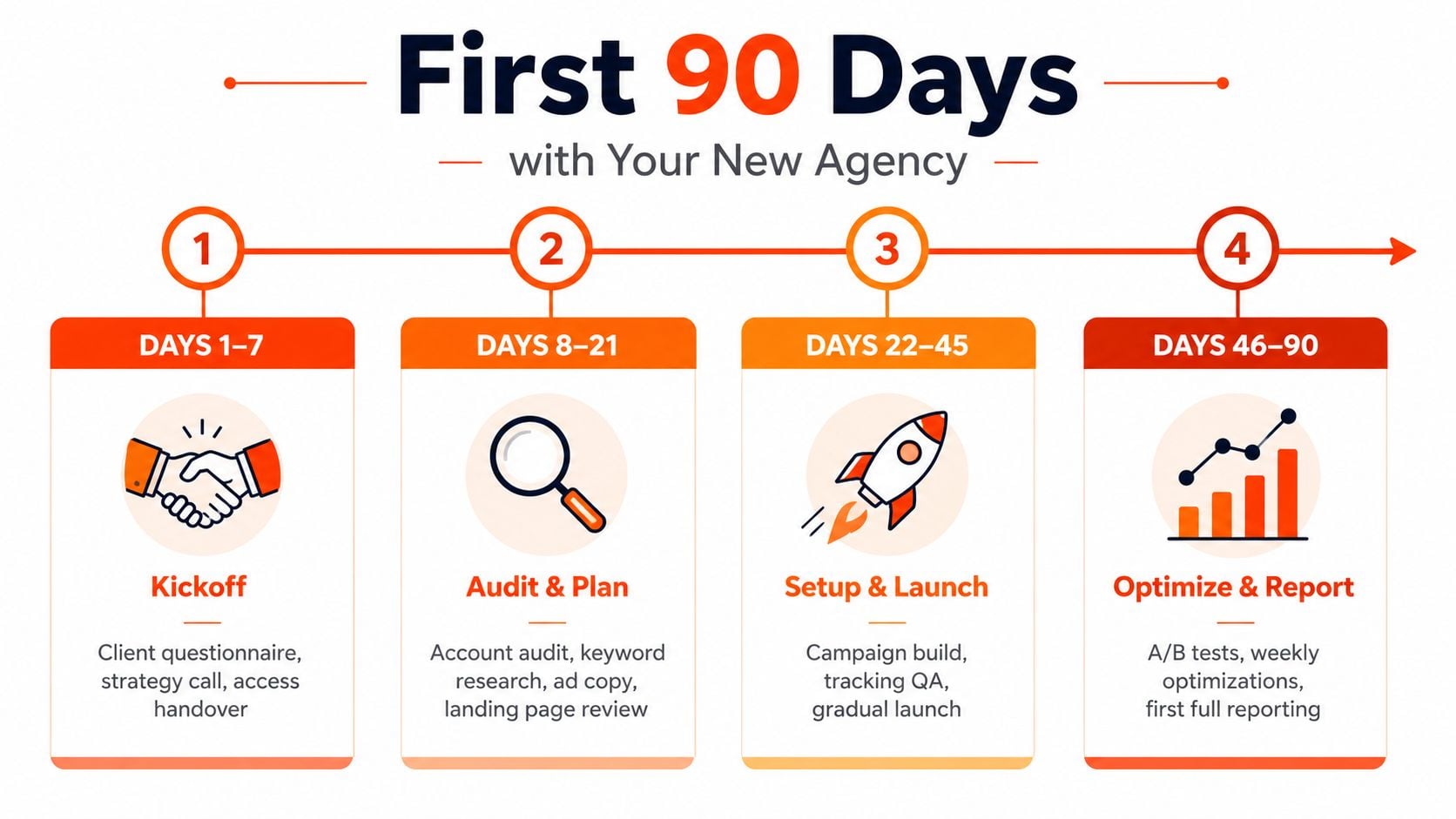
Good onboarding feels methodical, not magical. The first few weeks are mostly access, audits, and cleanup, because no serious agency should rush into scale before it knows what's broken. The source brief on Australian Google Ads management says meaningful improvements often show after 14 to 30 days, with full optimisation impact around 90 days, which is the right expectation to set with any provider.
Days 1 to 21
The process should start with a questionnaire and a strategy call. The agency should then audit the account, review conversion tracking, map keywords, and identify obvious waste. If they skip straight to campaign build without checking the measurement layer, they're guessing.
This is also the point where account access, analytics integration, and conversion QA should happen. A proper setup includes call tracking, form tracking, and any offline conversion imports that match your sales cycle. The tracking conversation should be detailed and specific, not reduced to “we'll sort that out”.
Days 22 to 90
Launch should be gradual. A good team won't flip every switch at once because that makes it impossible to know what caused the result. The first live period should focus on controlled changes, negative keywords, ad copy alignment, and search-term reviews.
By the middle of the onboarding window, weekly optimisations should be visible. That means query cleanup, bid adjustments, and testing that reflects actual account behaviour rather than theory. If you want a deeper look at the tracking layer that makes this work, Google Ads conversion tracking is the right place to start.
Your Next Steps and a Ready-to-Use RFP Template
Choose the agency that can prove three things, it owns the work cleanly, it measures the right outcomes, and it tells you exactly what it's doing with your budget. Everything else is secondary. Pricing matters, but only after you know what the fee covers and how much control you keep over the account.
Use this as your shortlist filter before you take another sales call.
- Account ownership: Confirm the account will sit under your business, not the agency's.
- Tracking maturity: Ask how calls, forms, bookings, and offline conversions are measured.
- Search-term hygiene: Get a direct answer on query reviews and negative keyword management.
- Reporting transparency: Ask for live access, not just polished summaries.
- Pricing clarity: Compare the fee against the actual work, not the headline number.
A simple RFP should ask for current account access policy, reporting sample, tracking stack, search-term review process, pricing model, contract terms, and three relevant examples of work in your industry. Don't accept vague answers. If they can't explain their process clearly before they're hired, they won't magically become clearer after.
The decision is whether you want a vendor that spends money, or a partner that can protect it. That's the line worth drawing before you sign anything.
If you want a team that manages Google Ads with transparent reporting, account access, and a practical focus on conversion quality, visit Click Click Bang Bang. They work across Google Search, Google Remarketing, and Google Shopping, and they structure onboarding around strategy, analytics, and tracking rather than guesswork.
Read NeXt
Or Read Our Latest
Click. CLick. Subscribe.
Get our best PPC insights, industry updates, and power moves delivered straight to your inbox. No fluff, just high-caliber strategies that actually work.
Don’t Leave Just Yet
Try Us For 30-Days,
Risk Free!!
We guarantee that you’ll love our work within the first 30 days, if not you’ll get your money back.
What have you got to lose?