

What Is Value Proposition? PPC & SEO Guide
Last Updated

A value proposition is a concise, customer-facing promise of measurable benefit that explains why a buyer should choose your offering over alternatives. In practice, it works only when it's specific enough to test, not when it reads like a slogan or a feature list.
That's where most businesses drift off course. A founder can describe the product in detail, but the message still sounds like a brochure because it never answers the buyer's real question, “Why should I pick you now?”
Why Most Businesses Get Their Value Proposition Wrong
A business owner will often hand over a long list of capabilities, then wonder why customers still compare them to every other vendor in the market. The offer might be solid, the service may be good, and the team may know the product inside out, but the message still misses the point. Buyers don't need a catalogue. They need a reason to believe the outcome will be better with you.
A value proposition is the concise, customer-facing statement of unique value that a company delivers, and the strongest versions are framed around the customer's benefit rather than the company's features. In Australian business contexts, that distinction matters even more because digital buyers often compare vendors quickly, so the message has to communicate outcomes, not just services. Salesforce Australia's description of a value proposition as the statement that explains why customers should choose an offering over alternatives fits this practical reality well, because it keeps the focus on choice, not just description. The broader strategy literature also treats it as measurable return or tangible positive outcome for the buyer, which is why it can't stay vague.
Slogan, tagline, and feature list are not the same thing
A slogan aims for recall. A tagline tries to make the brand memorable. A feature list explains what the product does. None of those are enough on their own if the reader still can't tell why the offer matters to them.
A strong value proposition answers the buyer's silent comparison, not your internal pride in the product.
That's the blunt test I use when reviewing PPC ads and landing pages. If the copy could sit on almost any competitor's homepage with only a logo swap, it's not a value proposition, it's generic positioning.
The practical difference is simple. A feature says what exists. A value proposition says what changes for the customer, and that change has to be relevant, believable, and commercially meaningful. If your current messaging mostly explains what you do, you've got a description. You don't yet have a proposition.
The Core Components of a Strong Value Proposition
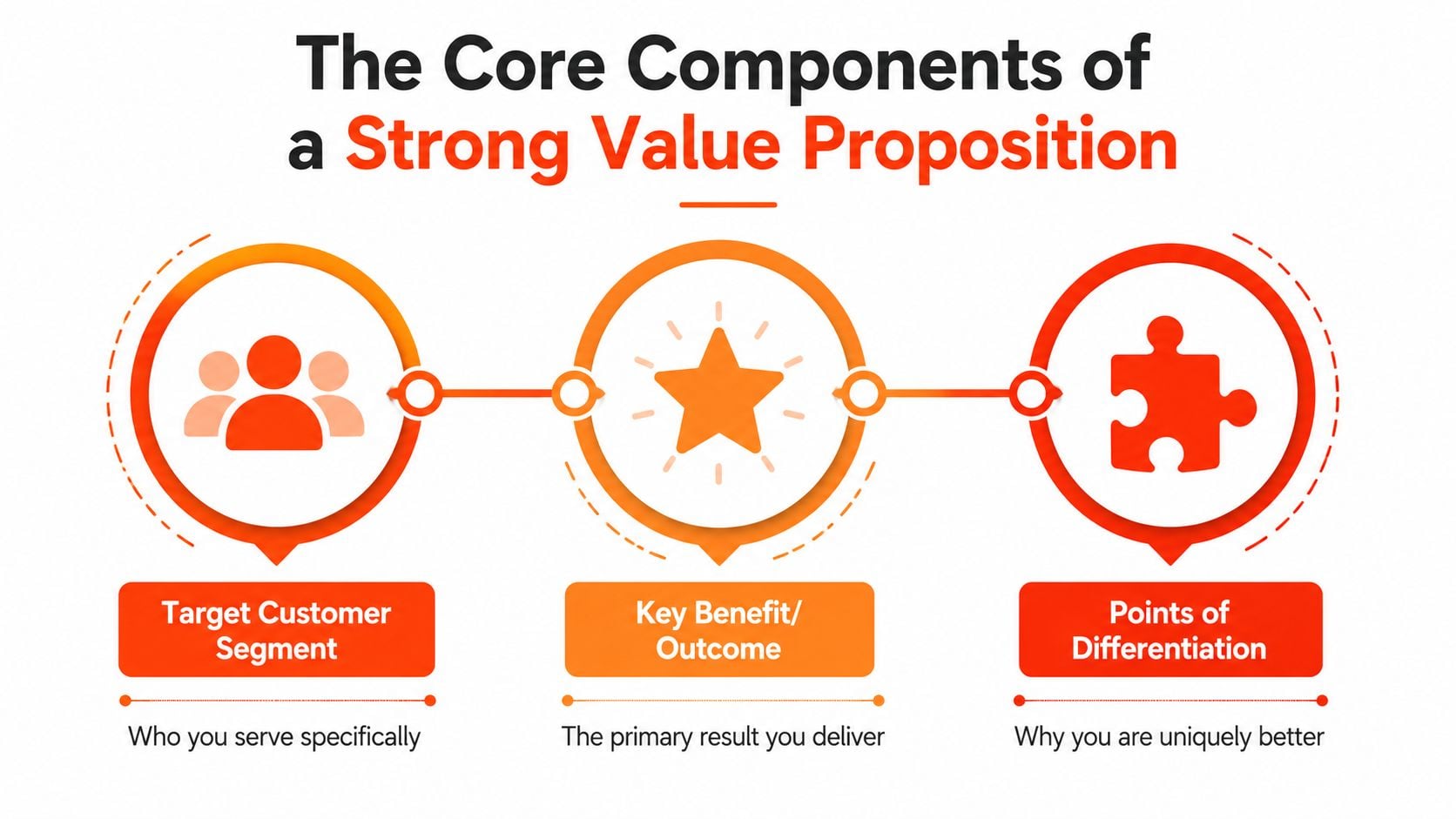
A useful value proposition has three moving parts. It names who the offer is for, what result it creates, and why it's better than the obvious alternatives. Leave one out and the message gets fuzzy fast.
Who you serve, what changes, and why you win
The first job is specificity. A message for “small business owners” is broader than a message for “independent retailers who need more qualified leads from Google Ads.” The narrower the segment, the easier it is to create relevance, because the buyer can see themselves in the copy.
The second job is the benefit. Strong propositions don't stop at “we offer SEO” or “we run campaigns.” They point to an outcome the buyer can evaluate, such as better lead quality, less wasted spend, or a clearer route to conversion. That is the commercial substance behind the statement.
The third job is differentiation. That can be a method, a process, a channel focus, a turnaround time, or a sharper fit for a specific segment. The point is not to sound clever. The point is to make the buyer feel they have a rational reason to choose you over the next tab open in their browser.
Practical rule: if you can't tell what the buyer gets, who it's for, and why your offer is different, the proposition isn't finished.
For teams validating a product or offer, it can help to validate your startup idea before you turn the message into campaigns. The same discipline applies to service businesses. If the segment is wrong, the outcome is vague, or the differentiator is imaginary, the copy won't hold up under real traffic.
For a deeper framing on audience clarity, see define target customer. That part is not a branding exercise. It's the foundation of whether the proposition can survive scrutiny in search, social, and sales conversations.
Templates and Formulas for Writing Your Value Proposition
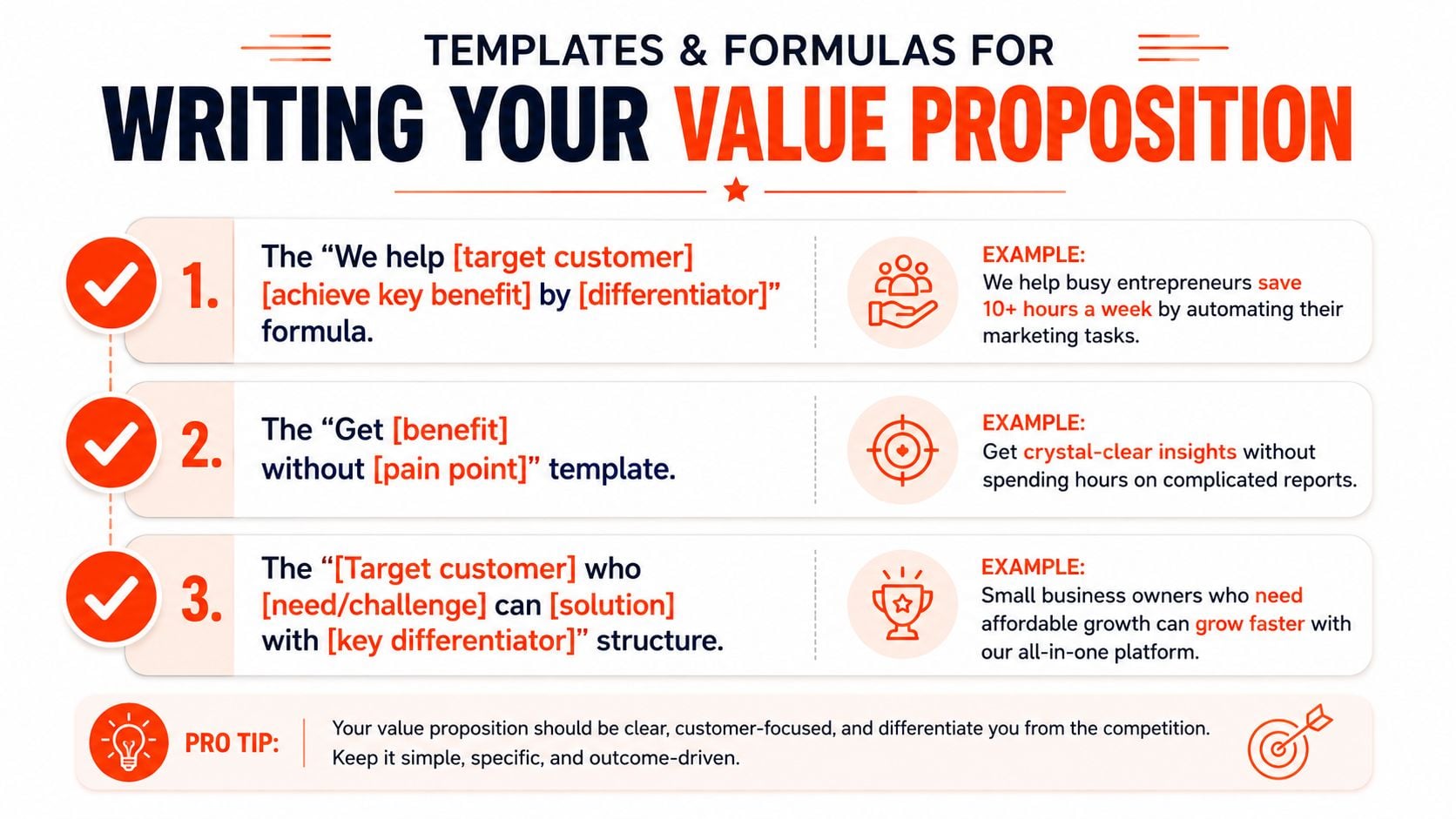
A good draft usually starts with a template. That sounds basic, but templates force discipline. They stop the message from drifting into fluffy language and push you towards a sentence a buyer can understand.
Three formulas that work in real campaigns
The first formula is straightforward, We help [target customer] achieve [specific outcome] by [unique method]. It works best when you already know your audience and can state the outcome cleanly. For example, a B2B service might say it helps marketing teams generate higher-quality inbound leads by aligning SEO and paid search around the same commercial intent.
The second formula is more comparative, Unlike [alternative], we [differentiator] so you can [benefit]. This is useful when the market is crowded and buyers already have a few providers in mind. It works because it names the trade-off instead of pretending competitors don't exist.
The third formula is the most credible when you have evidence, [Target customer] who [need or challenge] can [solution] with [key differentiator]. That structure keeps the message customer-facing and stops it from turning into a brand claim that sounds nice but proves nothing.
A quick check helps. Replace words like “better,” “faster,” and “more effective” with a specific outcome, a market comparison, or a practical proof point. Harvard Business School Online notes that a value proposition is stronger when supported with statistics and facts that prove the promise, so the sentence needs to survive contact with evidence, not just enthusiasm.
For teams that want to tighten voice after the proposition is drafted, voice and tone guidance can help keep the message consistent across landing pages, ads, and emails. The wording should still sound like the same business, even when the channel changes.
Don't force one universal sentence to do every job. A proposition for a search ad needs to be sharper than the version on a full homepage.
Value Proposition Examples for E-Commerce, B2B, and SMBs
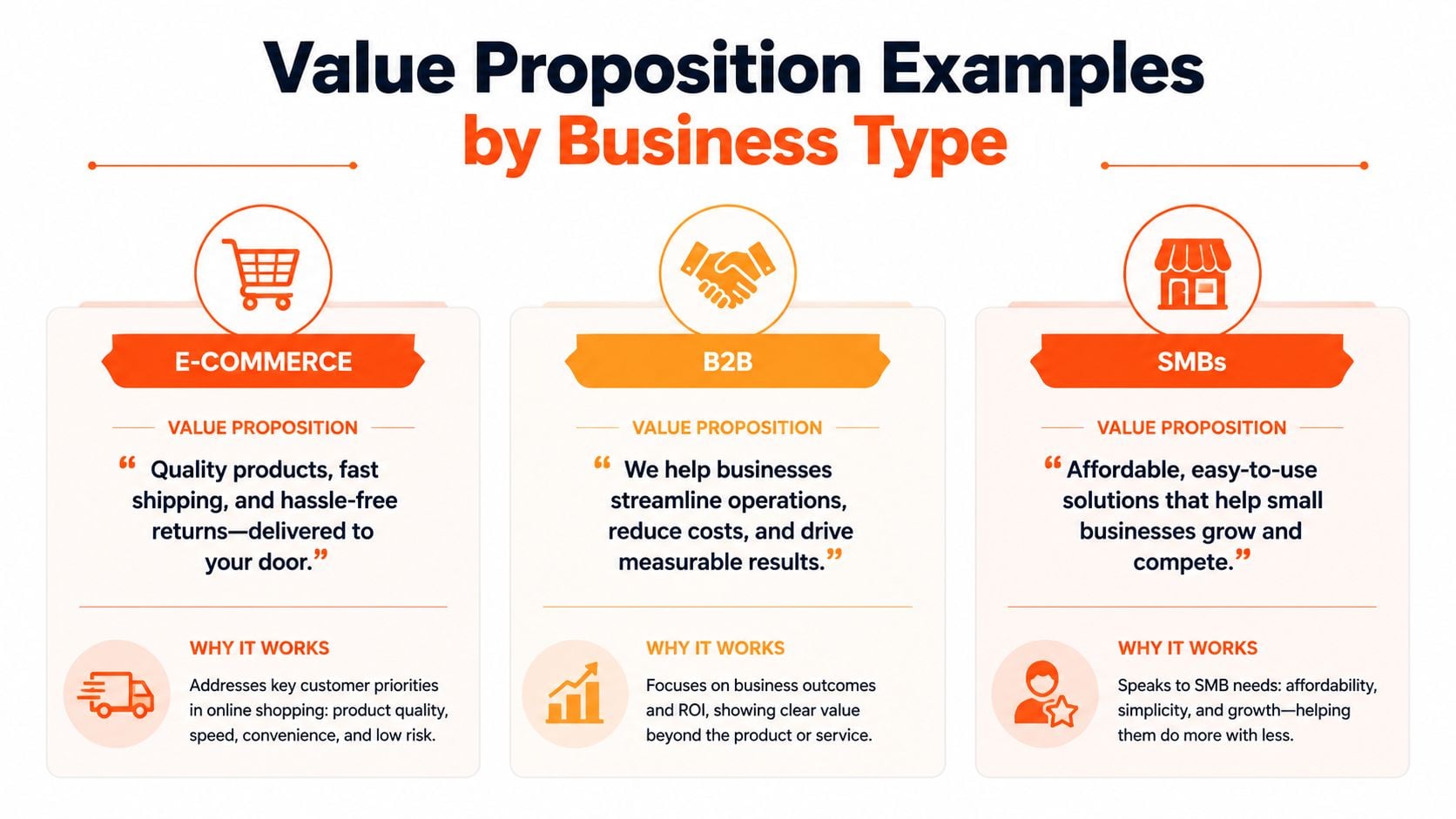
One of the fastest ways to spot weak messaging is to compare it with a stronger version in the same business type. The right proposition doesn't sound grand. It sounds useful to the exact buyer you want.
Side by side examples
For e-commerce, a weak version sounds like this. “We sell quality products with great service.” That tells me almost nothing. A stronger version sounds more like, “We help busy shoppers find the right product faster with curated collections, clear delivery options, and fewer decision points.” The second version is better because it focuses on friction, not just inventory.
For B2B, a weak version often reads, “We provide digital marketing solutions for growing companies.” That's too broad to help a buyer choose. A stronger version would be, “We help B2B teams generate more qualified leads from PPC and SEO by aligning search intent, landing page messaging, and follow-up flow.” That version fits a longer buying cycle because it speaks to the funnel, not just the service.
For SMBs, weak messaging often leans on jargon. “End-to-end integrated performance marketing for scalable growth” sounds impressive until the reader tries to decode it. A clearer alternative is, “We help small businesses turn ad spend into trackable enquiries with campaigns built around measurable conversion goals.” That sentence is easier to trust because it sounds like something a decision-maker can judge.
The contrast matters because the stronger versions give the buyer a path to evaluation. They explain the job, the outcome, and the reason the offer belongs in the shortlist.
If the reader has to translate your proposition before they can judge it, you've already lost momentum.
A useful watchpoint is that the proposition should match the buying context. A retail shopper wants fewer frictions. A B2B buyer wants confidence that the pipeline will improve. An SMB owner usually wants clarity and lower risk. Same principle, different emphasis.
Translating Your Value Proposition into PPC and SEO Messaging
A value proposition only earns its keep when it shows up in the channel where buyers see it. In PPC, that usually means headlines and descriptions. In SEO, it has to live in meta descriptions, page titles, and the hero section without sounding forced. The job is not to repeat the same sentence everywhere. The job is to keep the promise consistent while making it fit the moment.
For headline ideas, it's worth browsing compelling headline examples and then filtering them through your actual offer. Good headlines don't just sound polished. They create a clear expectation of benefit.
Channel by channel translation
In Google Search ads, the proposition has to be brutally short. Every word must earn its place because the user is scanning quickly and comparing options. Lead with the strongest outcome, then support it with the differentiator if space allows.
On SEO landing pages, the proposition needs to align with search intent. A searcher landing on a page after looking for “Google Ads agency for lead generation” should see language that matches that intent immediately. If the heading wanders into company history or generic expertise, the bounce risk goes up because the page fails the relevance test.
Hero sections are where many good propositions get diluted. The strongest version sits above the fold, then gets reinforced with a short supporting line, a proof point, or a directional call to action. If the page makes the user scroll to understand what the offer is, the page is working against itself.
For platform nuance, Meta ads often need a more conversational angle, while LinkedIn ads usually reward a more business-outcome-led statement. That's where a clear proposition becomes modular, not rigid. It stays intact, but the emphasis shifts.
If you need a reference point for how tone changes across surfaces, this voice and tone guide is useful for keeping the core message coherent while adapting the delivery. One agency detail I've seen repeatedly is that the campaigns that work best don't invent a new promise for each channel. They translate the same promise cleanly.
Testing and Measuring Value Proposition Effectiveness
A value proposition should be treated like a commercial hypothesis, not a permanent brand plaque. The fastest way to learn whether it works is to isolate it, test it, and watch what the market does. If the copy is stronger, the effect should show up in clicks, conversions, or lead quality, depending on the channel.
The benchmark worth keeping in mind is that landing pages with a clear, above-the-fold value proposition can convert 30% better than pages that lead with product features or company history, according to the source cited in the brief. That doesn't mean every page will perform that way. It does show why clarity and placement matter when the buyer is deciding in seconds rather than minutes.
What to test and what to measure
Start with the headline or hero statement. Keep the layout, form fields, imagery, and CTA constant, then change only the proposition. That isolates the variable properly. If you change too many elements at once, you won't know what moved the result.
For PPC, watch click-through rate and downstream conversion behaviour. A sharp proposition can improve ad relevance, but the key question is whether it brings in the right clicks. More traffic means nothing if the leads are poor or the sale rate drops later.
For landing pages, focus on conversion rate and form completion quality. For B2B, cohort analysis matters too. A proposition that attracts more serious buyers may not always win on raw volume, but it can improve lead quality and shorten the path to decision.
If you want a broader framework for attribution and measurement, boost marketing impact analysis is a useful resource for connecting messaging changes to business outcomes. It's especially helpful when marketing and sales need the same evidence trail.
Practical rule: if the winning variant attracts better leads, not just more leads, that's usually the stronger proposition.
For a more process-driven view, how to measure advertising effectiveness gives you the right mindset for separating signal from noise. I've seen campaigns where the “prettier” headline lost, but the more specific one pulled in buyers who were already closer to purchase.
Common Value Proposition Mistakes and How to Avoid Them
The most common mistake is leading with features. The second is trying to speak to everyone. Both weaken the proposition because they blur the one thing a buyer needs most, a reason to care right now.
A third mistake is relying on vague superlatives. Words like “best,” “leading,” and “premium” don't do much unless the buyer can verify them. They sound safe inside the business and useless outside it. A fourth mistake is copying competitor language so closely that the message becomes interchangeable.
The practical fixes
- Lead with the outcome, not the mechanism. If the sentence starts with your process, rewrite it until the buyer benefit appears first.
- Choose a narrower audience. The claim gets stronger when the segment is clear enough that the reader can self-identify.
- Replace empty claims with proof. If you can't support “best,” say what makes the offer different in a way the buyer can judge.
- Stop borrowing competitor phrasing. If the market all sounds the same, the problem is probably positioning, not copywriting.
There's also a contrarian question worth asking. Being “underserved” is not automatically a good strategy. The more useful test is whether the need is unworkable, unavoidable, urgent, and commercially reachable, not merely unserved. That's the kind of segment worth building around because it can support a proposition that holds up in market conditions.
Australian marketers are also operating in a tougher measurement environment, with privacy changes, weaker attribution visibility, and rising media costs making first-party data and clearer proof more important. In that setting, a proposition has to say what changes for the buyer in concrete terms, not just describe the offer in abstract language.
Your Action Plan for a Better Value Proposition
Start by writing one sentence that names the segment, the outcome, and the differentiator. Then cut the fluff until a buyer could repeat it back without needing your explanation. After that, adapt it for one PPC ad, one SEO landing page, and one lead form or sales intro.
If those variants all perform similarly, the problem may be deeper than copy. That usually means the positioning itself needs work, not just the wording. If the proposition is sharp but the market still doesn't respond, it's time to revisit the segment or the offer.
Click Click Bang Bang helps businesses turn that kind of message into something usable across PPC, SEO, and lead generation funnels. If you want to tighten your value proposition and test it against real traffic, visit Click Click Bang Bang to see how the agency approaches strategy, campaigns, and measurement.
Read NeXt
Or Read Our Latest
Click. CLick. Subscribe.
Get our best PPC insights, industry updates, and power moves delivered straight to your inbox. No fluff, just high-caliber strategies that actually work.
Don’t Leave Just Yet
Try Us For 30-Days,
Risk Free!!
We guarantee that you’ll love our work within the first 30 days, if not you’ll get your money back.
What have you got to lose?