

What Is Target Marketing: Build a Strategy That Converts
Last Updated

Target marketing is the process of identifying the audience segments most likely to convert, then tailoring campaigns, messaging, and channels to reach them efficiently. In Australia, that matters because the market is big enough to specialise in, with about 25.5 million people at the 2021 Census and 76.2% living in capital cities while 23.8% live in regional Australia (ABS-based Australian market analysis).
If you've ever looked at a PPC account where broad keywords burn budget or an SEO plan that attracts traffic but not buyers, you've already seen the problem target marketing solves. The work isn't “advertise to everyone”, it's build a structured audience model, then match the right offer to the right segment at the right time.
What Target Marketing Actually Means for Digital Campaigns
A lot of businesses start with broad campaigns because broad feels safer. They launch search ads to every plausible keyword, run social ads to everyone in an age bracket, and publish SEO content for topics that sound popular but don't match buyer intent. The result is usually the same, weak relevance, high waste, and a lot of traffic that never had a real reason to convert.
Target marketing fixes that by making the audience the starting point, not the afterthought. It means identifying the specific groups most likely to respond, then shaping the offer, creative, landing page, and channel choice around those groups. That's the practical difference between mass marketing and targeted marketing, mass marketing talks to a wide audience and hopes for overlap, while target marketing narrows the field until the message fits.
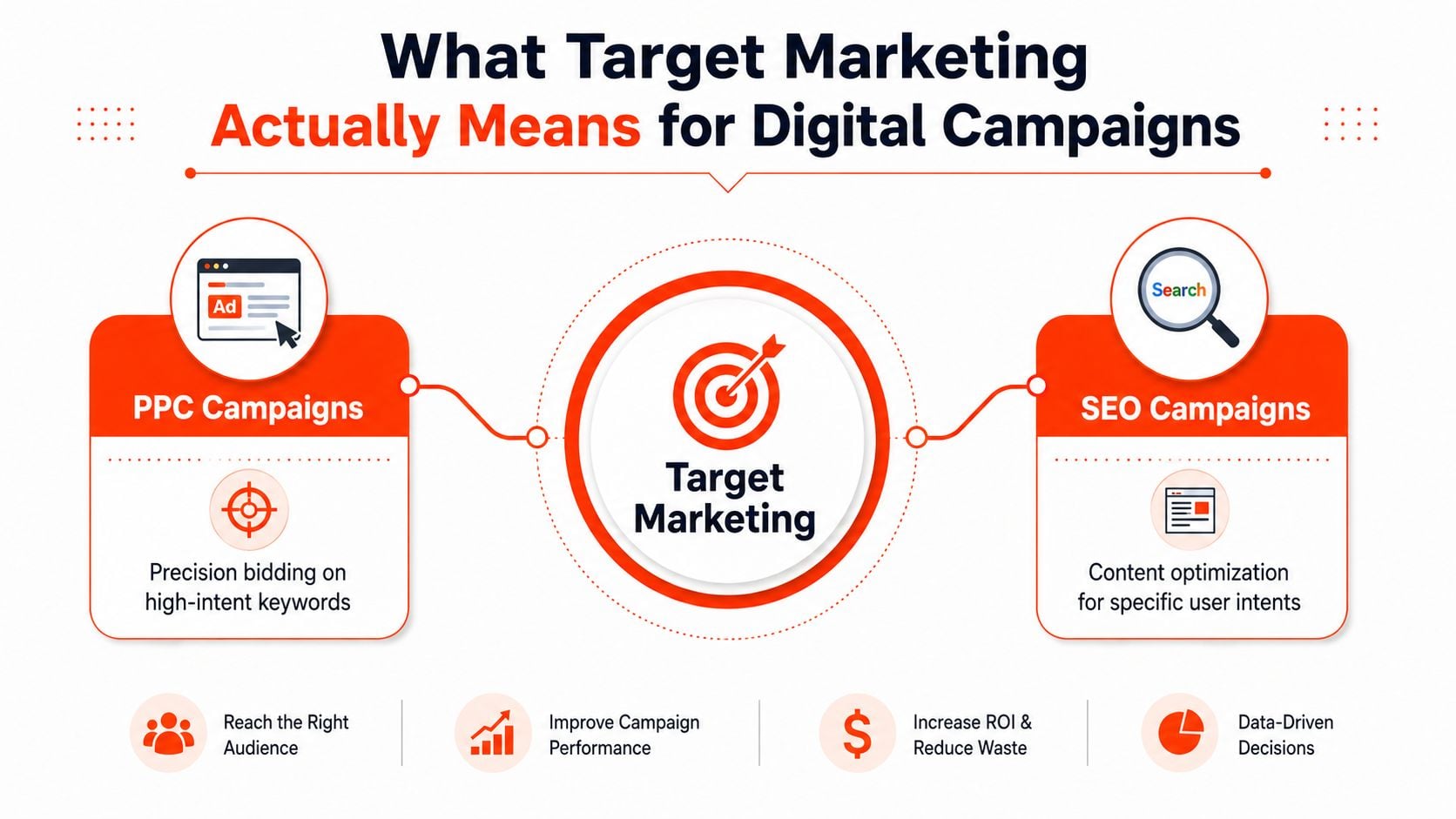
For PPC, that usually means bidding on high-intent queries, excluding low-fit audiences, and writing ad copy that speaks to a clear need. For SEO, it means choosing topics and page structures that map to specific user intent, not just broad keywords with impressive search volume. The same principle applies in both channels, precision beats noise.
Practical rule: If your ad or page could be shown to almost anyone in your industry, it's probably too broad to convert efficiently.
A good way to think about target marketing is as a fit problem. The business defines who is most likely to buy, the channel exposes that segment, and the message closes the gap between interest and action. That's why a strong target market definition is a campaign asset, not just a planning exercise. For a practical framework for defining that audience, see this target customer guide.
The Four Segmentation Methods That Drive Campaign Precision
Segmentation is where target marketing becomes operational. Instead of treating the market as one mass, you divide it into smaller groups and decide which groups deserve budget, creative attention, and SEO effort. Australia makes this especially relevant because geography matters, capital city buyers and regional buyers don't always respond the same way, and digital behaviour is now broad enough to target precisely across search, social, and remarketing.
The most useful approach is to combine four segmentation methods rather than rely on just one. Demographic and geographic filters are the easiest to set up in Google Ads, Meta, and LinkedIn. Psychographic and behavioural signals are often what make a campaign feel relevant instead of merely technically targeted.
| Segmentation Method | Key Variables | PPC Application | SEO Application |
|---|---|---|---|
| Geographic | City, state, region, metro versus regional | Set location targeting, adjust bids by area, localise ad copy | Build location pages, local landing pages, region-specific content |
| Demographic | Age, income, household type, job role | Refine audience settings and creative variants | Write content for different lifecycle stages and buying roles |
| Psychographic | Values, interests, attitudes, priorities | Shape messaging and offer angles for different motivations | Publish intent-led content that reflects audience concerns |
| Behavioural | Search intent, site visits, past conversions, engagement | Use remarketing, audience exclusions, and high-intent keyword groups | Create content clusters around observed intent and repeat queries |
Australia's digital environment makes behaviour especially useful. The ACMA reported in 2024 that 91% of Australians aged 16+ used the internet daily and 84% used social media (ACMA digital usage research). That means you can often see intent signals before a buyer ever speaks to sales, through search behaviour, site visits, video engagement, or CRM history.
If you need richer self-reported data, it helps to boost engagement with zero-party data, because direct preference capture often reveals why a segment behaves the way it does. The point isn't to collect every possible variable, it's to combine the few that change media, copy, and landing page decisions.
How to Build a Target Marketing Strategy from Scratch
Start with the customers you already have. Look for repeated patterns in CRM records, search queries, lead quality, and landing page behaviour, then turn those patterns into audience profiles that are specific enough to guide media decisions. Australian government guidance recommends testing assumptions with market research, segmenting customers by characteristics and buying habits, and writing specific customer profiles, which is the right place to begin when the data is messy or incomplete (business.gov.au guidance).
Next, turn each profile into a message hypothesis. A B2B buyer comparing vendors wants different proof than an e-commerce shopper comparing products, and a regional buyer may care about service coverage or delivery terms in ways a metro buyer doesn't. That's where landing pages and ad copy have to do real work, they need to echo the segment's need without sounding generic.
A useful shortcut is to build an ICP document before you touch media settings. If you want a structure for that, the HuntingAlice ICP template is a practical reference point because it forces you to define the right questions before launching campaigns. The goal is not perfection, it's enough clarity to stop wasting budget on audiences that were never going to respond.
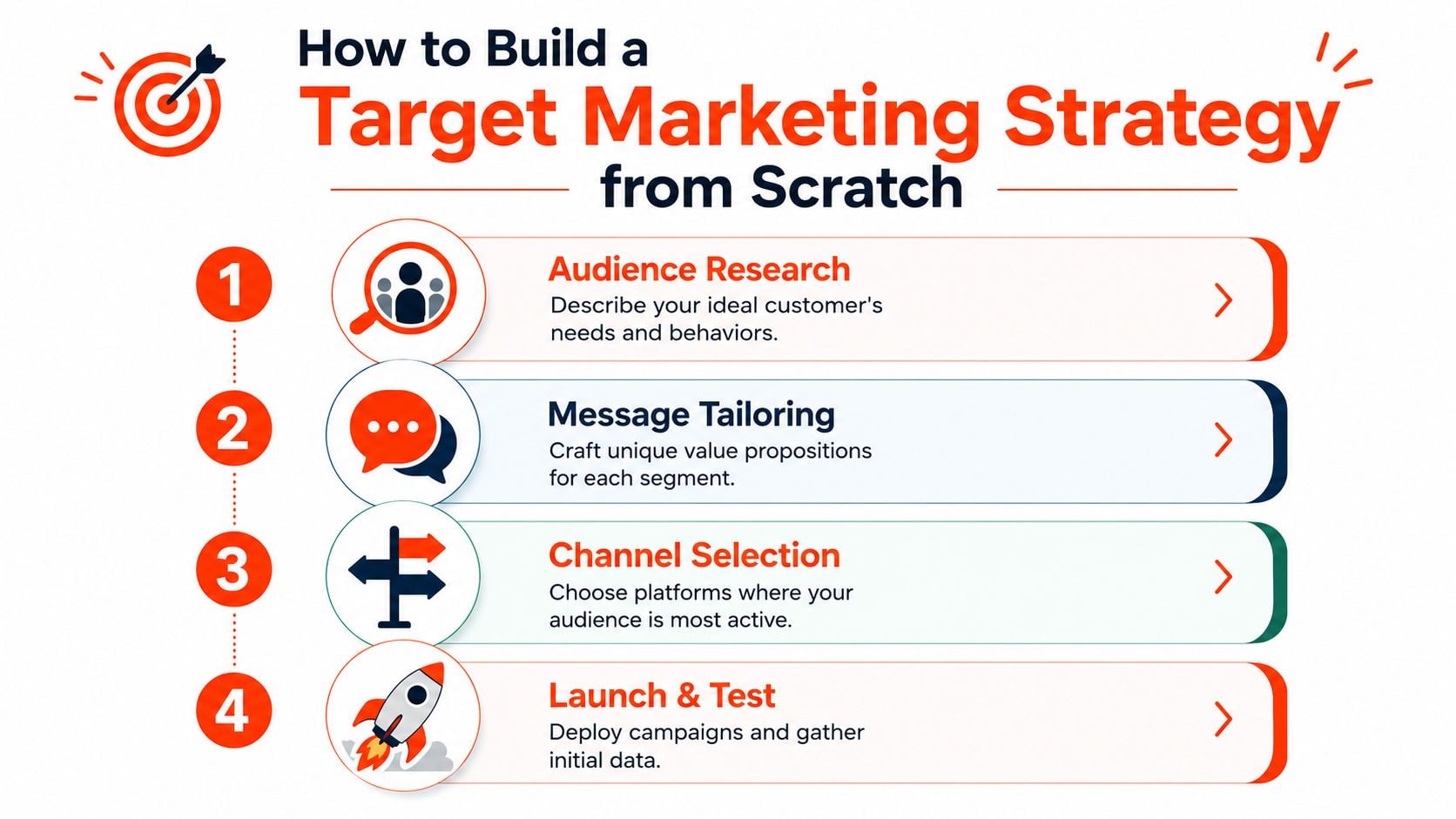
- Audience research. Pull from CRM, onsite behaviour, search queries, and customer feedback.
- Message tailoring. Write separate value propositions for separate needs.
- Channel selection. Put spend where the audience is active.
- Launch and test. Watch what the segment does, not what you hoped it would do.
Practical rule: If you can't explain why a segment should get a different ad, page, or keyword set, you probably don't have a segment yet.
Real-World Target Marketing Examples for E-Commerce B2B and SMBs
An e-commerce retailer usually gets the fastest wins from behavioural targeting. A shopper who viewed a product category, returned to the site, and didn't buy is a different audience from a first-time visitor, so the campaign structure should reflect that. Google Shopping can stay focused on high-intent catalog traffic, while remarketing can carry the more specific message, abandoned cart, category revisit, limited-stock reminder, or a product benefit that matches the page they already viewed.
A B2B company should think more in firmographic terms. Industry, company size, location, and buying role shape whether LinkedIn is worth the spend, and they also shape the lead magnet and landing page. For a deeper example of how that can look in practice, the B2B LinkedIn ad examples guide is relevant because LinkedIn works best when the offer matches the account type and the decision-maker's stage.
An SMB with a local footprint often gets more from geographic segmentation than from broad audience expansion. Regional service areas, suburb-level delivery boundaries, or city-specific promotions can make Meta campaigns far more relevant than a generic statewide ad set. The creative doesn't need to be flashy, it needs to be recognisably local, because local relevance often does more work than abstract brand messaging.
The best campaigns I've seen don't try to persuade everyone. They persuade one group clearly enough that the right people feel like the ad was written for them.
Click Click Bang Bang offers Google Search, Google Remarketing, Google Shopping, Meta, and LinkedIn advertising, which makes it possible to align channel choice with the segment instead of forcing every audience through the same funnel. That matters because a high-intent searcher, a past visitor, and a procurement lead all need different paths to conversion.
Key Metrics and KPIs to Measure Target Marketing Success
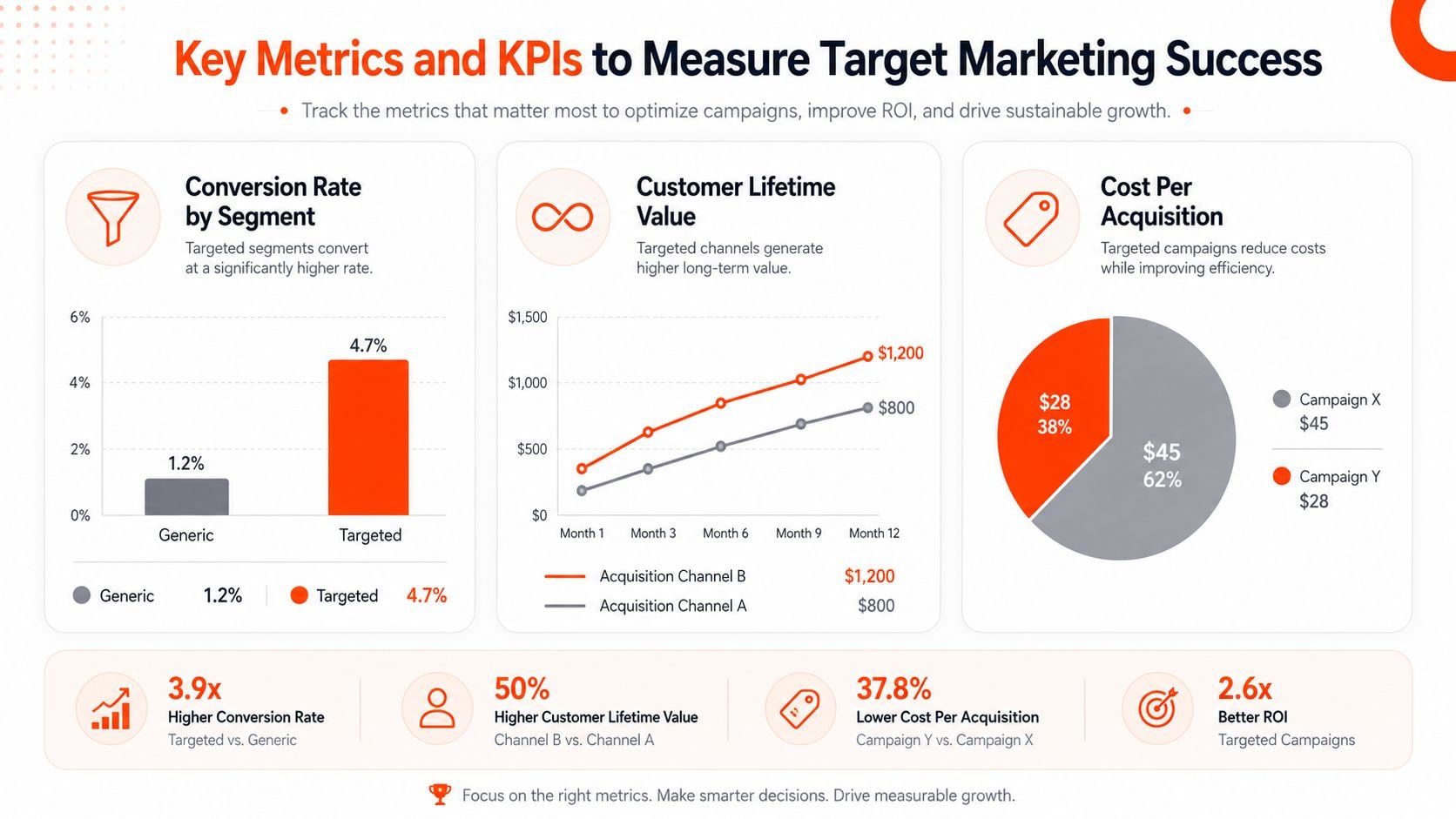
The cleanest sign that target marketing is working is not reach, it's efficiency by segment. You want to see whether one audience converts more reliably than another, whether a specific acquisition channel creates better customers, and whether the message fit improves after segmentation. For a broader framework on that, this guide to measuring advertising effectiveness is useful because measurement only matters when it changes budget decisions.
Track conversion rate by segment, customer lifetime value by acquisition channel, cost per acquisition by audience, and return on ad spend by campaign. Those are the metrics that show whether a segment is economically worth keeping, not just whether it attracted attention. If one segment creates more leads but they never close, that segment is not a win.
The work is in comparing segments over time. Audience performance drifts as markets change, offers change, and creative fatigue sets in. A segment that used to convert cleanly can become expensive without anyone noticing unless you review the data regularly and compare it against historical behaviour.
| Metric | What it tells you | What to do with it |
|---|---|---|
| Conversion rate by segment | Which audience responds best | Shift budget towards the strongest fit |
| Customer lifetime value | Which customers are worth acquiring | Prioritise segments with healthier downstream value |
| Cost per acquisition | Which segments are efficient | Tighten targeting or cut waste |
| Return on ad spend | Which campaigns produce revenue | Scale the campaigns that hold profitably |
A good quarterly review should also check revenue by segment, deal-cycle length, and whether one channel is attracting lower-fit leads than before. That kind of review keeps target marketing tied to business outcomes instead of vanity metrics.
Common Target Marketing Mistakes and How to Avoid Them
The biggest mistake is treating obvious demographics as the full answer. Age, gender, and location are easy to see, but they do not always explain why someone buys, and they can push PPC and SEO teams into campaigns that look targeted but miss the actual buying trigger. Research on underserved consumers warns that target marketing can backfire when positioning does not match the segment's actual preferences or context (academic research on underserved consumers).
That is why psychographics and behaviour matter. A segment built only on visible traits can lead to ad copy, landing pages, and keyword groups that feel reasonable internally but fail in search results and on-site engagement. The fix is to test assumptions with search data, website behaviour, customer interviews, and competitor monitoring, then revise the segment when the evidence changes.
Common mistakes and better responses
- Over-relying on obvious demographics. Use intent, past engagement, and buying context, not just age brackets or job titles. In PPC, that usually means tightening keyword themes and audience signals instead of spraying the same message across broad groups.
- Ignoring underserved segments. Look for groups whose needs are not covered well by existing competitors, then check whether search demand and conversion behaviour support a separate offer. Some of the best efficiency gains come from segments others overlook.
- Failing to update profiles. Re-check your assumptions after major campaigns, product changes, or shifts in customer behaviour. A profile that worked during one offer can mislead you once the market, pricing, or messaging changes.
- Copying a generic profile into every channel. Search, remarketing, Shopping, Meta, and LinkedIn do not need the same audience definition or the same message. A segment that performs in branded search may need a different creative angle, landing page, or exclusion set in paid social.
Australian businesses should also validate targeting against local conditions. The business.gov.au guidance on identifying your target market is clear on testing assumptions, writing specific customer profiles, and segmenting by characteristics and buying habits, which is exactly what keeps audience definitions from going stale.
Practical rule: If a segment only exists because it was easy to describe, not because it behaves differently in search or on the page, it does not deserve separate budget.
Your Action Plan for Smarter Audience Targeting
Audit your current campaigns against a simple checklist. Ask whether each audience segment has a clear business reason to exist, whether the messaging matches the segment's actual need, and whether the channel choice fits the stage of the buyer journey. If the answer is vague, the segment is probably too broad.
Then tighten the structure. Keep high-intent search campaigns focused on defined problems and defined solutions, use remarketing for people who already showed interest, and build SEO content around the terms and questions each audience uses. The goal is not more campaigns, it's cleaner segmentation and better alignment between audience, message, and channel.
Set a quarterly review cycle and use it to compare segment performance, landing page engagement, and downstream revenue. If a segment starts to drift, adjust the creative, keyword set, or audience rule before the whole account starts paying for the mismatch. That habit keeps target marketing useful long after the launch phase is over.
A strong target marketing system doesn't need more noise, it needs sharper decisions. Review the segments, cut the weak ones, and write for the audience that's most likely to buy.
If you want help turning audience segmentation into PPC and SEO that converts in Australia, Click Click Bang Bang builds search, remarketing, shopping, Meta, and LinkedIn campaigns around real buyer signals, not guesswork. Visit Click Click Bang Bang to see how a tighter target market can reduce wasted spend and improve campaign fit.
Read NeXt
Or Read Our Latest
Click. CLick. Subscribe.
Get our best PPC insights, industry updates, and power moves delivered straight to your inbox. No fluff, just high-caliber strategies that actually work.
Don’t Leave Just Yet
Try Us For 30-Days,
Risk Free!!
We guarantee that you’ll love our work within the first 30 days, if not you’ll get your money back.
What have you got to lose?