

Partnership Marketing: A Practical Guide for 2026
Last Updated

You've got paid campaigns getting more expensive, SEO still taking time to compound, and a pipeline that can't afford to wait for one channel to rescue the quarter. That's usually when partnership marketing starts looking less like a nice-to-have and more like the third lever that can carry real demand, especially in a market like Australia where digital touchpoints are everywhere and collaboration can travel fast across them (Australia's social, mobile, and internet penetration data). The hard part isn't finding another tactic. It's choosing partner activity that shows up in revenue, assisted conversions, or pipeline quality instead of vanity reach.
A good partner programme doesn't sit beside paid media and SEO, it feeds them. It creates new audiences to retarget, new content to rank, and new proof points that make paid traffic convert more efficiently. If you're trying to make that case internally, how to improve ROI in digital marketing is a useful lens because partnership work has to earn its place on the same spreadsheet as every other channel. For readers who are still working out how to lift organic visibility while building demand elsewhere, how to grow organic reach in 2026 is also worth a look.
Why Partnership Marketing Deserves a Seat at the Table
A campaign can look healthy on paper and still miss the mark. Paid media gets pricier, SEO needs time to compound, and leadership still wants demand that shows up before the quarter closes. Partnership marketing earns budget attention in that environment because it borrows trust from an audience that already exists, then pushes that trust through a trackable path into revenue, assisted conversions, or pipeline quality.
In Australia, the argument for building partnerships into performance channels is hard to ignore. There were 25.4 million social media user identities, equal to 96.0% of the population, and 33.0 million active cellular mobile connections, equal to 124.7% of the population in 2024. There were also 21.2 million internet users and 80.5% internet penetration, which gives partner-led distribution a large online audience to work with instead of leaving it inside a narrow campaign silo.
The five-partner mental model helps keep decisions honest.
Treating every partner as the same is where teams waste time. Co-marketing, affiliate, influencer, channel, and strategic alliance all sit at different points on the spectrum from transactional to highly integrated, and each one behaves differently in paid, SEO, and sales handoff. If you blur those differences, you end up measuring the wrong thing and rewarding the wrong behavior.
Practical rule: if a partnership cannot be tied to sourced revenue, influenced revenue, or quality signals downstream, it is probably a content collaboration, not a growth channel.
That distinction matters because the Australian ad market is already large and measurable. Digital advertising reached A$15.6 billion in 2023, up 7.1% year on year, with search and social still central to spend (Australian digital advertising market data). In that kind of market, partner work has to compete on attribution and downstream lift, not goodwill or visibility alone.
A programme built well gives you more than reach. It gives you a way to compare partner-acquired demand with non-partner traffic, then test whether the lift shows up in paid efficiency, search visibility, or conversion quality. That is why partnership marketing earns a place next to paid media and SEO, instead of sitting off to the side as a PR exercise.
For teams trying to defend channel spend, how to improve ROI in digital marketing is a useful frame because partnership activity has to hold up on the same spreadsheet as every other channel. If organic growth is part of the brief as well, how to grow organic reach in 2026 is worth reading for the content and visibility angle.
What Partnership Marketing Actually Means
Partnership marketing is any structured collaboration where two or more brands share audiences, assets, or distribution to drive measurable commercial outcomes. That's the important part, measurable commercial outcomes. If there's no shared accountability and no commercial goal, you're probably looking at sponsorship, PR, or a one-off content swap rather than a true partnership.
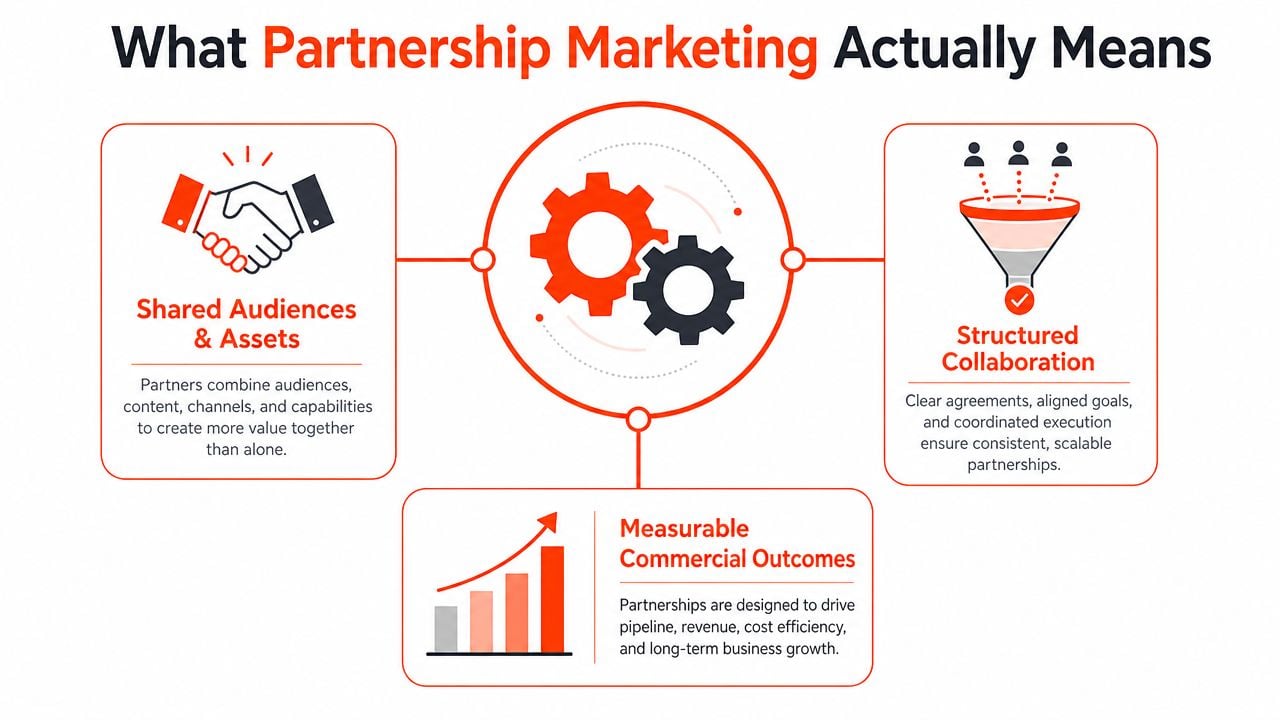
The best analogy I've found is a co-signed loan. Each party's reputation backs the promise, so both sides have to care about the result. That's why strong partnerships feel more deliberate than influencer gifting and more accountable than a logo swap on a landing page.
The five common types
- Co-marketing: Two brands create something together, usually a webinar, guide, event, or bundle, and both promote it to their audiences.
- Affiliate: A partner sends traffic or sales in exchange for a commission or fee, with tight tracking and clear attribution.
- Influencer: A creator or public figure lends audience trust and content distribution, often with stronger brand control constraints.
- Channel partner: A reseller, agency, or implementation partner brings you into deals they already own or support.
- Strategic alliance: Two businesses align around a deeper commercial relationship, often with shared positioning, integration, or go-to-market coordination.
If you're trying to work out how to approach potential collaborators, EmailScout collaboration tips is a decent practical reference point for the outreach side. The important thing is to keep the ask specific. Vague partnership proposals usually get ignored because they ask the other side to do the thinking, the planning, and the risk assessment for you.
For a PPC or SEO team, this definition matters because it draws a line between activity that looks busy and activity that can be measured. A partnership should either create a new path to demand or improve an existing one. If it does neither, it's not ready.
Comparing the Five Main Partnership Types
The cleanest way to choose a model is to compare how much control you need, how quickly you need revenue, and how much operational overhead you can tolerate. E-commerce brands often lean harder on affiliate and creator-led work because product can move fast and attribution is relatively direct. B2B teams usually get more value from channel partners and strategic alliances because the sales cycle is longer and trust has to be carried further into the funnel.
Here's a practical view of the trade-offs.
| Type | Cost to launch | Brand control | Speed to revenue | Best for |
|---|---|---|---|---|
| Co-marketing | Low to moderate | Moderate | Moderate | Audience growth, shared content, event-led demand |
| Affiliate | Low | High | Fast | E-commerce, trackable sales, lean acquisition |
| Influencer | Moderate | Lower | Fast to moderate | Awareness, creator-led demand, product discovery |
| Channel partner | Moderate to high | Moderate | Slower | B2B, referral-led pipeline, services and SaaS |
| Strategic alliance | High | High | Slower | Deep commercial alignment, joint go-to-market, complex offers |
Teams often overcorrect. They either chase the fastest revenue and ignore fit, or they build a grand alliance that takes months to launch and never reaches enough audience. The strongest programmes usually combine two or three types, then let margins, sales cycle, and available assets decide where the effort goes.
A good way to sanity-check a partner is to ask what they can change in your funnel. Can they create warm traffic that your ads can retarget? Can they produce content that supports ranking and conversion? Can they introduce you to a buyer who trusts them enough to take a sales call? If the answer is no across the board, that partnership is probably decorative.
Key takeaway: choose the type that matches your operating model, not the one that sounds best in a deck.
For inspiration on what real-world combinations look like, browse brand partnership examples after you've mapped your own constraints. The examples matter less than the pattern behind them. Good partnerships are designed around distribution, trust, and measurement, not just shared branding.
Designing a Programme That Actually Measures Lift
The difference between a busy partner programme and a useful one is measurement discipline. In Australia, this matters even more because the pressure to prove value is high in a large digital market, and recent commentary has made it clear that partnership activity gets overvalued when teams only look at clicks or content reach instead of pipeline and retention effects (measurement discipline in Australian partnership marketing). If you want a programme that survives budget scrutiny, design for incrementality from day one.
Start with the objective, not the partner list
Pick one measurable outcome first. That might be sourced revenue, qualified leads, trial starts, assisted conversions, or pipeline value. If you can't state the commercial outcome clearly, you'll end up with random collaborations that are easy to launch and hard to defend.
Build around the partner you can actually activate
The best partners are not always the biggest names. They're the ones with an audience overlap, a believable offer fit, and enough motivation to promote properly. Strong programmes usually need a partner portal, onboarding assets, automated email updates, and a self-serve registration flow, because partner attention is scarce and admin friction kills momentum (partnership marketing guide).
Instrument the programme like a revenue channel
Your attribution stack should go beyond last-click. Track sourced revenue, influenced revenue, qualification rate, partner attach rate, acquisition cost, sales-cycle length, funnel conversion rates, win rate, ACV, and LTV, because partner campaigns often affect both the first conversion and the quality of what comes later (partnership metrics guidance). That's the only way to compare partner-acquired leads against non-partner traffic without fooling yourself.
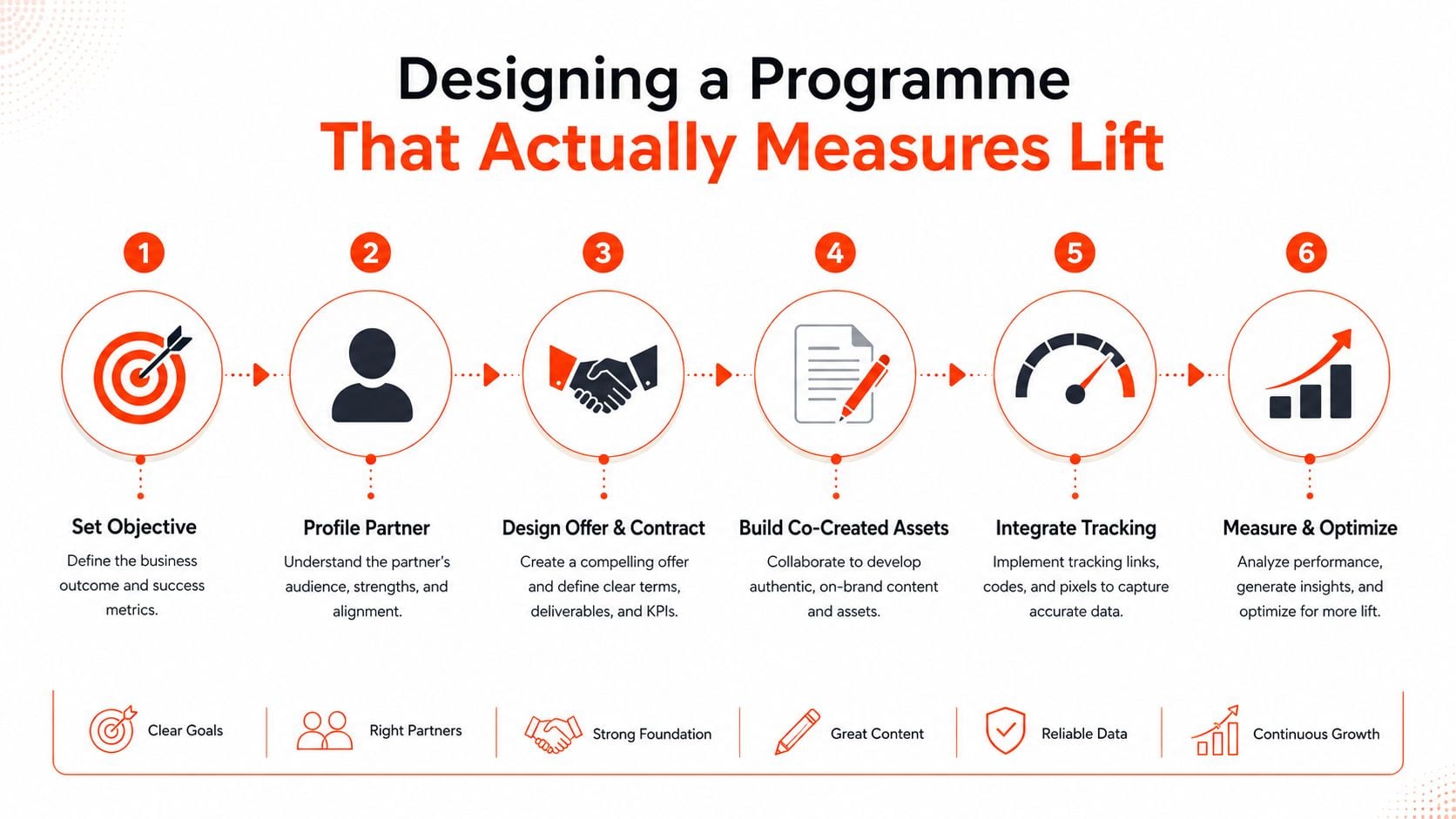
A simple operating sequence works best:
- Set the objective and define the one or two KPIs that prove lift.
- Profile the partner by audience fit, trust, and promotional capability.
- Design the offer and contract so responsibilities, approvals, and revenue logic are clear.
- Build co-created assets that both sides can use.
- Integrate tracking with UTMs, CRM fields, and post-click handoffs.
- Review quarterly and cut anything that looks active but doesn't convert.
If you're mapping the measurement layer properly, multi-touch attribution is the lens that keeps partner activity honest. A partnership programme shouldn't be judged by the cheerfulness of the launch. It should be judged by what changes in the funnel after the launch.
Sector Playbooks for E-Commerce and B2B
The same partnership model does not work the same way in every market. E-commerce needs speed, clean attribution, and a path back into media optimisation. B2B needs trust, sales alignment, and a way to move partner interest into qualified pipeline without losing context.
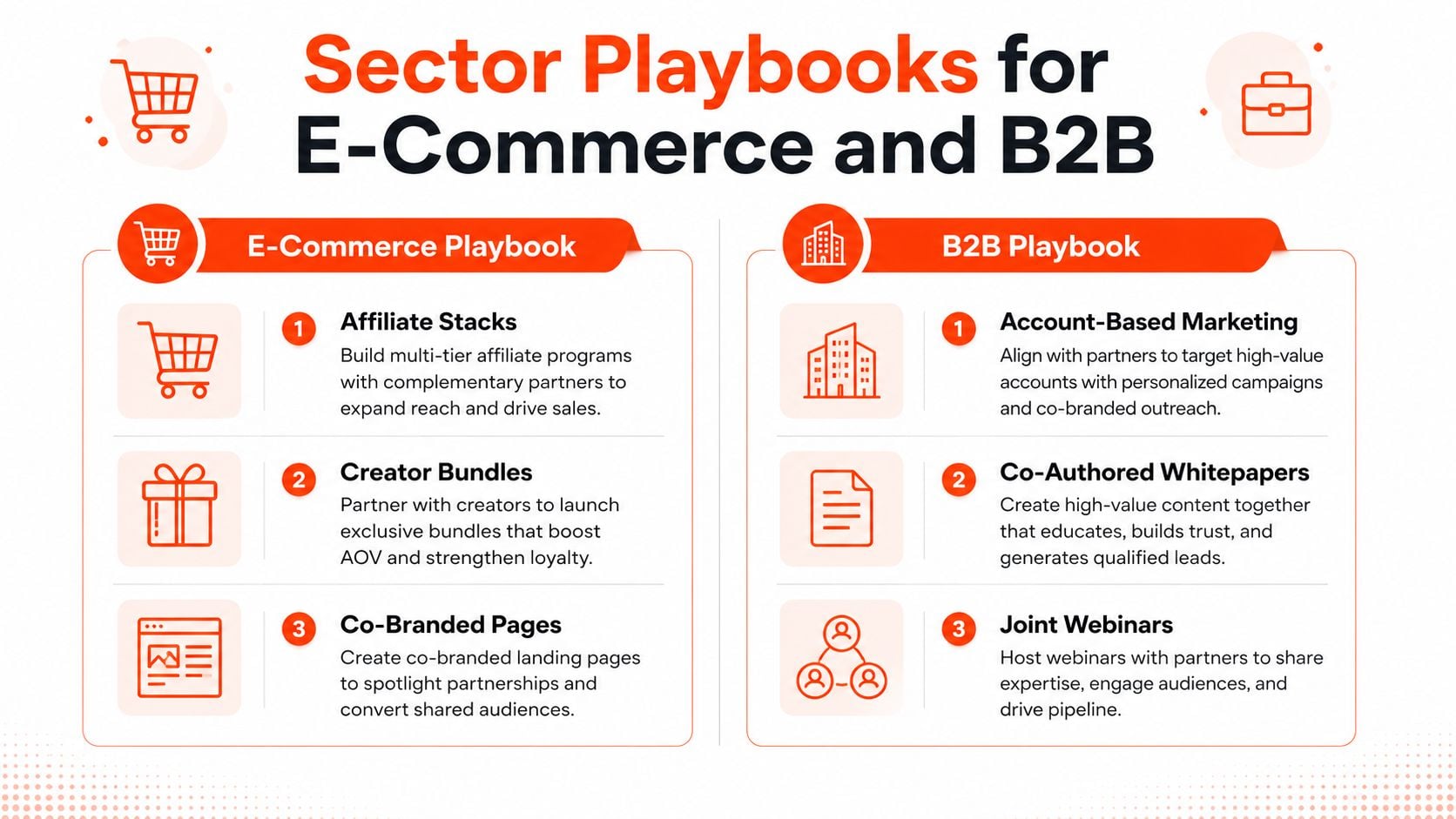
E-commerce playbook
Affiliate stacks still work because they connect partner activity directly to sales. Add creator bundles when you want more content variety and social proof, then push both into co-branded landing pages tied to seasonal demand. The landing page matters because it gives you one place to measure behaviour, build remarketing audiences, and hand traffic back into Meta and Google without losing the source.
B2B playbook
Channel partners are often the fastest route to qualified pipeline when they already own the buyer relationship. Co-marketing with SaaS tools works well when the audiences overlap but the offers differ, and joint webinars or whitepapers can support sales conversations without sounding like a product brochure. Referral programmes are strongest when the handoff is tied to sales-qualified leads rather than raw form fills.
The operational details matter more than the format. In e-commerce, commission structures and creative approvals need to be tight because margin leakage shows up quickly. In B2B, deal registration and lead routing need to be clean because sales teams won't trust partner-sourced opportunities if they arrive messy.
Good partner programs don't try to make every type work the same way. They match the motion to the buyer journey.
A useful benchmark is not some fantasy number, it's whether partner-sourced demand can be separated clearly from paid and organic, then compared on quality. If affiliate, creator, or channel activity cannot be traced into Meta, Google, Salesforce, or HubSpot in a way the team trusts, it will never scale beyond enthusiasm.
One more thing, the strongest programmes usually protect a small number of partner tiers instead of creating an endless ladder of exceptions. Fewer tiers mean cleaner expectations, faster approvals, and less admin for everyone involved.
Integrating Partnerships with PPC and SEO
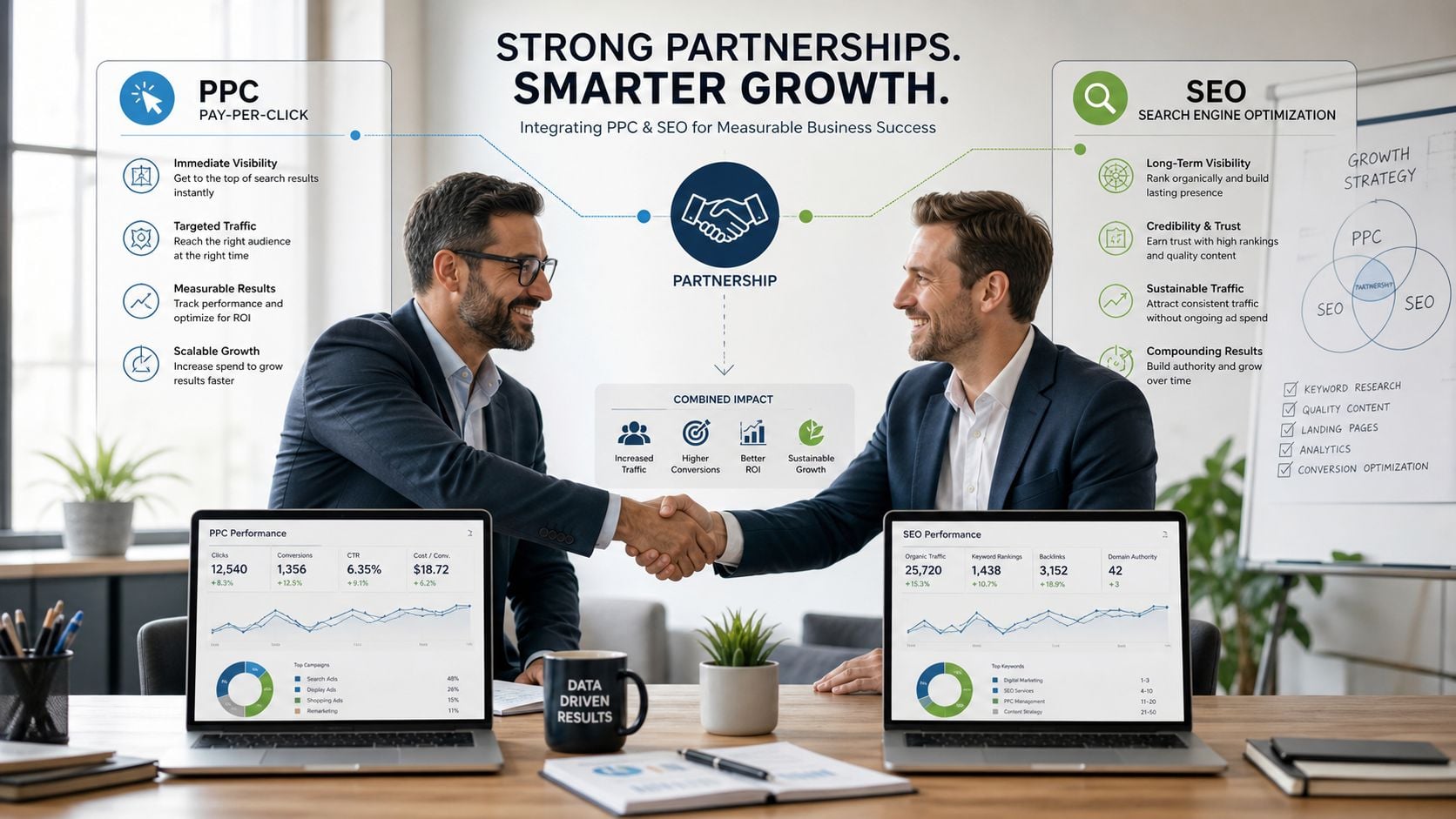
Partnership marketing performs best when it stops pretending to be a silo. Paid teams can use partner activity to seed audience pools, SEO teams can use it to build credible co-authored content, and conversion teams can use it to warm visitors who arrive with more trust than cold traffic usually has. That's where the channel starts to feel like part of the growth stack instead of a side project.
What to hand to paid media
Start with shared UTMs and make sure every partner link has a source pattern the media team recognises. Then upload partner audiences into Meta and Google where consent and policy allow, so you can retarget people who engaged with partner content but didn't convert. That lets you compare partner-referred visitors against non-partner traffic without guessing which channel deserves the credit.
What to hand to SEO
Use keyword overlap analysis before you co-create content. If the partner already owns an audience around a topic you also want to rank for, a joint guide, comparison page, or expert article can do more than earn reach, it can support topical authority and branded search demand at the same time. The best SEO partnerships don't chase generic exposure, they create a page that both parties would want indexed.
What to hand to conversion and CRM teams
Partner-referred visitors should not disappear into a generic lead bucket. Build post-click attribution handoffs so the CRM records the partner source, the content touched, and any later sale influence. If you're managing data across the stack, customer data platform thinking helps because the point is to preserve context, not just collect names.
A practical checklist keeps the handoffs clean:
- Shared UTMs: Use one naming structure so partner traffic can be compared reliably.
- Audience uploads: Build remarketing pools from partner-referred visitors where permissions allow.
- Keyword mapping: Match partner content to topics with clear search intent and commercial relevance.
- CRM fields: Capture source, partner, and campaign data before the lead moves to sales.
- Post-click review: Check whether partner traffic assists conversions, not just initial sign-ups.
The teams that get this right tend to find the same thing. Partner traffic often behaves better once it enters paid and CRM systems, because it arrives with a warmer context than cold prospecting traffic does. That doesn't mean it's automatically better. It means it should be measured with the same seriousness.
Common Pitfalls and Legal Compliance to Watch
The biggest mistake is treating partnerships like a branding exercise with no commercial spine. The second biggest is using clicks as the only proof that anything worked. Both mistakes hide the core issue, which is that partner programmes need incrementality, not applause.
Over-reliance on one partner is another easy way to create fragility. If one creator, one channel partner, or one co-marketing relationship drives most of the activity, churn becomes a business risk instead of a nuisance. Teams also forget to plan for the fact that partner attention drifts, and programmes need ongoing nurture to keep momentum.
The compliance side deserves equal care. Disclosures for endorsers and creators need to be clear, data sharing has to respect Australian privacy obligations, pricing claims can't mislead, and contracts should spell out exclusivity, usage rights, and IP ownership. If partner content touches comparisons, claims, or endorsements, legal review is not optional, it's part of protecting the commercial relationship.
Practical rule: if a partner can't describe the offer accurately without sounding exaggerated, the creative probably isn't ready.
A clean agreement should answer who owns the asset, who can reuse it, what happens if the partnership ends, and how performance is reported. That sounds basic, but basic is what keeps programmes from turning into arguments after the first campaign.
Your First 30 Days With a Partnership Programme
The first month should be a controlled pilot, not a grand launch. If you already have in-house bandwidth, start there. If you don't, bring in specialist support for tracking, partner selection, and paid or SEO integration, because those are the parts that usually break first.
Week one, lock the objective and shortlist partners by fit. Week two, draft the offer, approvals, and commercial terms. Week three, set up the portal, UTMs, CRM fields, and audience handoffs. Week four, publish the first co-created campaign and measure what changes in sourced and influenced outcomes.
Ask three questions before you scale. Did the partner bring in the right audience, did the traffic convert better than baseline, and did the campaign create assets or data the rest of the growth stack can reuse? If the answer is yes to all three, you've got something worth expanding.
If you want a partner programme that is measured properly, tied into PPC and SEO, and built to prove lift rather than just visibility, Click Click Bang Bang can help you design the tracking, media handoffs, and search strategy around it. Visit Click Click Bang Bang to see how a performance-led approach can turn partnerships into a channel your team can trust.
Read NeXt
Or Read Our Latest
Click. CLick. Subscribe.
Get our best PPC insights, industry updates, and power moves delivered straight to your inbox. No fluff, just high-caliber strategies that actually work.
Don’t Leave Just Yet
Try Us For 30-Days,
Risk Free!!
We guarantee that you’ll love our work within the first 30 days, if not you’ll get your money back.
What have you got to lose?