

Affordable PPC Management: A Practical Guide for Better ROI
Last Updated

Understanding Your Real PPC Budget in Australia
Let's cut through the noise and talk about what a Pay-Per-Click (PPC) budget actually looks like for a typical Australian business. It’s easy to get intimidated by stories of huge corporations spending fortunes, but the reality on the ground is far more relatable and, frankly, more strategic. For many small businesses, affordable PPC management isn't about having the deepest pockets; it's about making every single dollar count. The key is to land on a realistic figure that allows for learning and growth without putting your business under financial strain.
This is especially true in the current Australian market. In 2025, local businesses are on track to spend around $1.5 billion on SEO services, with a hefty slice of that going to PPC to complement organic growth. For many small outfits, a common starting point for all digital marketing, including paid ads, hovers around $1,200 per month. As detailed in these Australian digital marketing statistics from Local Digital, this shows a clear shift towards targeted, cost-effective advertising that delivers measurable results on a modest budget. That figure isn’t a magic number, but it reflects a serious commitment to investing in growth where it matters.
Setting a Practical Starting Budget
So, where do you begin? A good rule of thumb is to split your budget into two main parts: ad spend (the money paid directly to platforms like Google or Meta) and management fees (if you're working with an agency). For a startup or a small local business just dipping its toes in, the ad spend might be quite conservative at first.
For example, a local electrician in Perth might start with a $500 monthly ad spend focused squarely on their service area. Their goal isn't to compete nationally but to own searches for "emergency electrician Joondalup". In contrast, a growing e-commerce store in Melbourne selling niche handmade leather goods could allocate $2,000 a month to ad spend. Their strategy would be broader, targeting specific interests and demographics across the country.
The budget directly mirrors the business goals and market size. The most important first step is defining what success looks like for you and then working backwards to a budget that gives you enough data to make smart decisions. An initial budget that’s too small, say $10 a day in a competitive market, might not generate enough clicks to provide any real insights, leaving you guessing in the dark.
How Business Size Influences Spending
The size and stage of your business are the biggest drivers of your PPC budget. A solo entrepreneur is likely focused on survival and immediate lead generation. A more established business, however, will probably be thinking about scaling and building brand awareness.
To give you a clearer picture, here’s a breakdown of what PPC spending can look like for different business sizes in Australia.
Monthly PPC Budget Allocation by Business Size
A breakdown of typical monthly PPC spending across different business sizes in Australia
| Business Size | Monthly Budget Range | Average CPC | Expected Clicks | Focus Areas |
|---|---|---|---|---|
| Startup / Solopreneur | $500 – $1,500 | $2.50 | 200 – 600 | Hyper-local targeting, long-tail keywords, lead generation |
| Small Business (2-10 Staff) | $1,500 – $4,000 | $3.00 | 500 – 1,333 | Regional targeting, remarketing, specific product campaigns |
| Medium Business (11-50 Staff) | $4,000 – $10,000+ | $4.00 | 1,000 – 2,500+ | National campaigns, brand awareness, competitor bidding |
This table shows that more established businesses don't just spend more; they spend differently. Their larger budgets allow them to target more competitive keywords and invest in broader strategies like brand-building campaigns, which might not show an immediate ROI but pay off in the long run. For those looking for affordable PPC management, the lesson is clear: start smart, focus on a narrow, high-intent audience, and prove the model before you scale up.
Navigating Industry Costs Without Breaking the Bank
One of the biggest factors influencing your advertising spend is the industry you operate in. Not all clicks are created equal; the cost to attract a customer for a local cafe will be worlds away from what a national law firm pays. Understanding this from the start is crucial for setting realistic goals and achieving affordable PPC management, as it stops you from comparing your results to irrelevant benchmarks.
The cost landscape for PPC advertising in Australia varies widely across industries, which heavily influences how you should plan and manage your campaigns. For example, in 2025, the average cost-per-click (CPC) on Google Ads in Australia can be as low as AUD 1.82 in less competitive sectors like e-commerce. However, it can shoot up to AUD 13.37 in fiercely competitive fields like finance and insurance. You can get a broader view of these Australian marketing statistics at Eloquent to see the full picture. This massive difference means a one-size-fits-all approach is doomed to fail.
To give you a general idea, the infographic below shows some baseline PPC metrics you can aim for as you build out your campaigns.
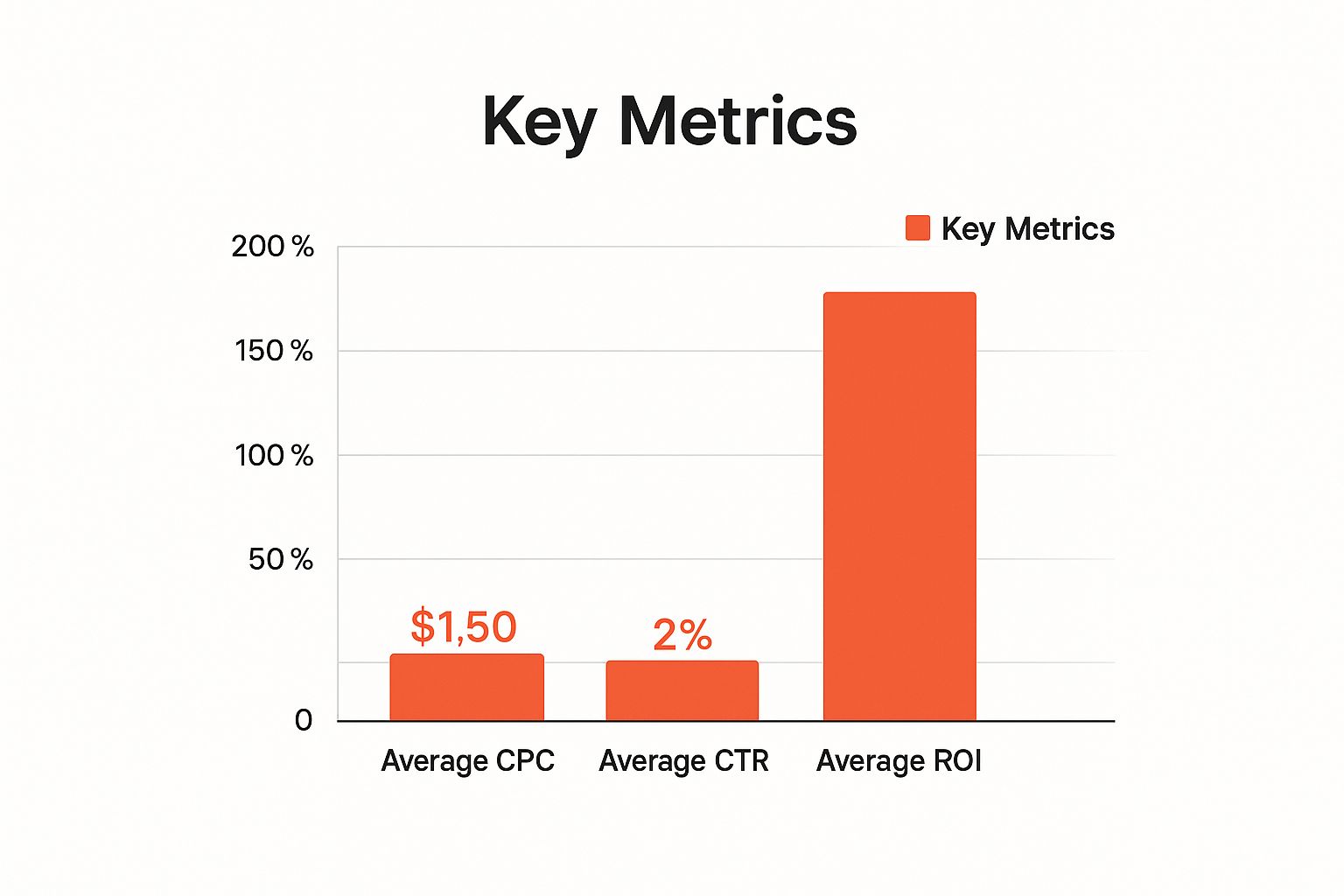
While these figures represent a healthy starting point, remember that your industry's unique environment will be the main driver of where your own numbers land.
To help you set realistic expectations and form a smarter strategy, we've put together a table comparing average CPCs across major Australian industries. It offers a snapshot of what you might face and suggests practical approaches for each.
| Industry | Average CPC (AUD) | Competition Level | Recommended Strategy | Budget Considerations |
|---|---|---|---|---|
| Finance & Insurance | $8.00 – $13.37 | Very High | Focus on long-tail keywords (e.g., "bad credit car loans Perth") and high-intent audiences. Utilise robust negative keyword lists to exclude irrelevant searches. | High CPCs demand a sharp focus on conversion value. A small budget can be drained quickly without precise targeting. |
| Legal Services | $7.50 – $12.00 | Very High | Target specific legal niches and geographical areas. Use remarketing to re-engage visitors who didn't convert on their first visit. Ad copy must be highly specific. | Similar to finance, precision is key. A higher budget is often needed to compete, but a hyper-targeted approach can still yield a positive ROI. |
| Real Estate | $2.50 – $6.00 | High | Combine broad match keywords with Smart Bidding for lead volume, but create separate campaigns for high-intent, long-tail terms to capture ready-to-act clients. | A mixed approach works well. Allocate budget to test broader terms while reserving a portion for more expensive, high-converting keywords. |
| E-commerce (General) | $1.82 – $3.50 | Moderate | Prioritise Google Shopping campaigns and focus on optimising your product feed. Test different ad copy and audience segments on the Display Network. | Lower CPCs allow for more experimentation. Focus on achieving a strong Return on Ad Spend (ROAS) rather than just a low cost-per-acquisition. |
| Local Services (e.g., Plumbers, Electricians) | $4.00 – $7.00 | High | Geo-targeting is essential. Use location-specific keywords and run ads only during business hours or when you can respond to inquiries immediately. | Budget can be managed effectively with tight geographical and time-based constraints. Focus on call tracking to measure success accurately. |
This table shows just how much competition can vary. A keyword that costs a florist $2 might cost a personal injury lawyer $12, so your strategy must be tailored to your specific field.
Strategies for High-Cost Industries
If you’re in a pricey sector like legal services, finance, or even specialised trades, the idea of affordable PPC can feel like a fantasy. But it’s not impossible; it just requires a much sharper, more surgical strategy. Instead of casting a wide net with expensive keywords, success lies in precision.
A business we worked with, a specialist mortgage broker, was facing CPCs of over $15 for general terms like "home loan". To make their budget work, we shifted their focus entirely to long-tail keywords. Instead of the main term, we targeted phrases such as "first home buyer loan broker Adelaide" and "investment property mortgage advice Sydney".
This pivot delivered two immediate benefits:
- Lower Costs: The competition for these specific phrases was much lower, which dropped their average CPC by over 60%.
- Higher Quality Leads: The people searching for these terms were much further along in their decision-making process, leading to a significantly higher conversion rate.
We also built a strong negative keyword list to filter out traffic from people looking for jobs or free financial advice. If you're new to this concept, our guide on how to use negative keywords in Google Ads is a great resource that can be a game-changer for your budget.
Finding Value in Lower-Cost Sectors
On the flip side, if you're in a less competitive industry like e-commerce for niche products or local services, you have more breathing room. However, "affordable" doesn't mean you can be careless. Here, the challenge is often about generating enough volume and standing out from the crowd.
With lower CPCs, you can afford to test more broadly. This means experimenting with different ad copy, exploring audience segments on the Google Display Network, and running shopping campaigns with a wider range of products. The goal is to find winning combinations that you can then scale up.
A key strategy here is to focus on Return on Ad Spend (ROAS). Because each click is cheaper, you can optimise for maximum revenue rather than just lead generation. This ensures your campaigns are not just active, but genuinely profitable and contributing to your bottom line.
Building Campaigns That Convert Without Burning Cash
Smart campaign setup is where affordable PPC management really starts. The decisions you make here will ripple through your entire campaign, affecting every dollar you spend. Nailing this part is what separates a campaign that pulls in quality leads from one that just quietly drains your bank account. It's all about finding that sweet spot between broad reach and sharp precision.
A classic rookie error is to skim over the initial settings, but small tweaks here can make a massive difference to your cost-efficiency. For example, a local Brisbane plumbing company that forgets to set specific location targeting could end up paying for clicks from people in Perth—a total waste of money. These little oversights are often the biggest culprits behind expensive, underperforming campaigns. The aim is to create a structure that's both logical and laser-focused on your business goals.
Structuring for Success: Ad Groups and Match Types
One of the best ways to keep costs in check is by organising your campaign into tight, thematic ad groups. Instead of dumping all your keywords into one giant bucket, you create separate ad groups for closely related sets of keywords. This lets you write super-relevant ad copy that speaks directly to what the searcher is looking for. In turn, this boosts your Quality Score and can lower your cost-per-click.
Think about a Melbourne-based online shoe store. They shouldn't have one single ad group for "shoes." A much smarter approach would be to have distinct ad groups like:
- "Men's Leather Boots Melbourne"
- "Women's Running Shoes Online Australia"
- "Kids' School Shoes Free Shipping"
This tight structure means the ad for someone searching "men's leather boots" can be about exactly that, not just a generic ad about shoes. Platforms like Google Ads reward this kind of relevance.

The Google Ads dashboard is your command centre for building these highly organised campaigns, where every detail from targeting to bidding is under your control.
Just as important as your ad group structure is your choice of keyword match types. This is a critical lever for managing your budget. There are three main types to get your head around:
- Broad Match: This casts the widest net but can trigger your ads for irrelevant searches, burning through your budget fast. Use this one carefully, ideally alongside Smart Bidding strategies.
- Phrase Match: This gives you a good balance of reach and control, showing your ad for searches that include the meaning of your keyword.
- Exact Match: This offers the most control, showing your ad only for searches with the same meaning or intent as your keyword. It usually brings in higher conversion rates but less traffic.
For any business looking for affordable PPC management, starting with Phrase and Exact Match keywords is almost always the right move. It makes sure your ad spend is channelled towards people who have the clearest intention to buy, cutting down on wasted clicks.
Smart Settings That Save Money
Beyond your keywords and structure, a few other settings can seriously boost your campaign's cost-efficiency. Think of them as the guardrails that keep your spending on the right track.
Strategic Bidding and Scheduling
Instead of letting Google spend your budget around the clock, think about when your customers are actually likely to convert. An accounting firm in Sydney probably doesn’t need its ads running at 3 AM on a Sunday. By using ad scheduling, you can set your ads to show only during business hours or at specific times when you know your target audience is online and active. This simple adjustment ensures your budget is spent when it has the best chance of generating a lead or sale.
Picking the right bidding strategy is also crucial. While automated options like "Maximise Conversions" are powerful, they need a good amount of data to work properly. When you're just starting out with a tight budget, a Manual CPC (Cost-Per-Click) strategy can give you total control over how much you’re willing to pay for a single click. This stops automated systems from overspending while they're in their learning phase and is a key part of effective, low-cost campaign management.
Finding Keywords That Deliver Value, Not Just Clicks
The right keyword strategy is the engine room of any solid PPC campaign, especially when you're managing a tight budget. It’s what separates you from attracting ready-to-buy customers versus paying for window shoppers. The objective isn't just to bid on popular terms; it’s to uncover the exact phrases people use when they’re seriously looking for a solution you offer. This means looking beyond the obvious and digging for those hidden gems your competitors might have missed.
The real gold is often found in what we call long-tail keywords. These are longer, more specific search phrases, typically three or more words long. Think "affordable waterproof hiking boots for women" instead of just "hiking boots." While the search volume is lower, the user's intent is crystal clear. Someone searching with that much detail is much further down the buying journey. As a bonus, these keywords are usually less competitive, which means they cost less per click and often bring in a much higher conversion rate. Focusing on them is a cornerstone strategy for making a modest budget punch well above its weight.
Leveraging Free Tools for Smart Insights
You don’t need to splash out on expensive software to build a strong keyword list. Google's own Keyword Planner, while part of their advertising platform, is a fantastic free resource for any advertiser. It gives you valuable data on search volume, competition levels, and suggested bid ranges, helping you make informed decisions without spending a cent on research tools.
For example, you can use it to compare the cost and search traffic of a broad term against a more specific long-tail variation.
The Keyword Planner lets you discover new keywords and get search volume forecasts to plan your campaigns. By popping in a "seed" keyword, you can get a list of related terms, which helps you pinpoint those valuable long-tail opportunities that balance user interest with affordability.
Of course, a tool is only as good as the person using it. A great starting point is to brainstorm all the ways a customer might describe their problem or your product. Put yourself in their shoes. Would they search for "Sydney emergency plumber" or "burst pipe repair near me"? Both could be valuable. For a deeper dive into practical methods, our guide to Google Ads keyword research offers actionable steps you can implement right away.
Balancing Volume, Cost, and Intent
Successful keyword selection is ultimately a balancing act. High-volume keywords are tempting because they promise a flood of traffic, but they often come with sky-high costs and poor conversion rates. On the other hand, low-volume, long-tail keywords deliver high-quality traffic but might not bring in enough leads on their own. The sweet spot for affordable PPC management is finding a smart mix of keywords that work together.
A practical way to think about this is to organise your keywords into tiers:
- Tier 1: High-Intent Long-Tail Keywords. These are your top priority. Terms like "buy organic dog food online Australia" show clear commercial intent and should be the core of your campaigns.
- Tier 2: Mid-Funnel Informational Keywords. This could include searches like "best grain-free dog food brands." While not immediately a purchase, these users are in the research phase and can be nurtured into customers with valuable content or remarketing.
- Tier 3: Broader, Higher-Volume Keywords. Use these sparingly and with a watchful eye. A term like "dog food" could be targeted in a separate campaign with a small, controlled budget, mainly to gather data or for general brand awareness.
By keeping a close watch on your campaign performance, you'll see which keywords are actually driving conversions. This data is your most valuable asset. It allows you to pause the duds and shift your budget towards the winners, ensuring your PPC efforts stay both effective and affordable.
Writing Ads That Convert on Any Budget
You don't need a Hollywood-sized creative budget to write ad copy that genuinely converts. What you really need is a solid understanding of what makes people stop scrolling, read, and most importantly, click. In the crowded space of search results, your words are your most valuable asset. The secret to effective, affordable PPC management is crafting messages that resonate with your target audience, solving their problems right there on the results page.
This is especially true in the Australian market. With over 90% of Aussies regularly online, digital advertising is a primary channel for finding new customers. PPC ads are front and centre, and stats show that roughly 65% of users will click on a paid ad when they're ready to make a purchase. This huge engagement highlights the potential for conversions if your ad copy is sharp enough to earn that click. You can get more details on why PPC is crucial for Australian businesses on Donhesh.com.au. Your mission is to make every character count and turn that potential into profit.
The Anatomy of a High-Converting Ad
A killer PPC ad is a team effort between three core parts: the headline, the description, and the call-to-action (CTA). Each piece has a specific job, and when they work in sync, they create a message that's tough to ignore.
-
Headlines That Grab Attention: You have a fraction of a second to make an impression. Your headline has to connect with what the person searched for instantly. The best headlines often include the main keyword, a key benefit, and a sense of urgency or specificity. For example, a headline like "Affordable Dog Grooming Sydney" is okay, but "Gentle Dog Grooming in Sydney | Book Online in 60 Secs" is much better. It matches the search, adds a benefit (gentle), and offers a clear, fast action.
-
Descriptions That Build Trust: The description is your chance to expand on the promise made in your headline. Use this space to answer likely questions, highlight what makes you unique (your unique selling points or USPs), and build confidence. Think about what sets your business apart. Is it free shipping, a satisfaction guarantee, or your years of local experience? A real estate agent might write: "Tired of missed opportunities? We find off-market properties in the Eastern Suburbs. Get your exclusive property list." This hits on a pain point and offers a distinct solution.
-
Calls-to-Action That Drive Action: Your CTA needs to be a clear, compelling instruction. Vague CTAs like "Learn More" have their place, but for a direct response, you need something with more punch. Try to match the CTA to what the user wants to do. If they're searching for a product, "Shop Now" or "Buy Online Today" are great. If it's a service, "Get a Free Quote" or "Book Your Consultation" are powerful commands that tell the user exactly what to do next.
Testing Your Way to Better Performance
You're not going to write the perfect ad on your first attempt, and that's perfectly okay. The real key to long-term success, especially on a tight budget, is consistent A/B testing. This simply means creating a couple of variations of an ad to see which one performs better.
Start by testing just one element at a time. For instance:
- Test two different headlines: One focused on price ("Affordable…") versus one focused on a benefit ("Premium…").
- Test two different CTAs: "Get a Free Quote" versus "Call Us Now."
By only changing one thing, you can clearly see what's making the difference. Let the test run long enough to gather meaningful data, then pause the underperforming ad and create a new version to test against your current winner. This constant cycle of testing and refining is what separates campaigns that fizzle out from those that deliver sustainable, affordable results for the long haul.
Monitoring and Optimising for Long-Term Success
Launching a campaign is just the start of your PPC journey. Truly affordable PPC management is all about what comes next. It’s a continuous cycle of monitoring, learning, and refining to make sure your budget keeps working as hard as possible for you. Think of it like keeping a high-performance car in top shape; you don't just fill it with petrol once and hope for the best. It needs regular tune-ups to keep running efficiently.
Forgetting to monitor your campaigns is like driving with a slow-leaking tyre—it might not seem like a big problem at first, but it will eventually leave you stranded and cost you more in the long run.
The trick is to look past vanity metrics like clicks and impressions. While they might make you feel good, they don’t pay the bills. Your real focus should be on the data that directly affects your bottom line. Metrics like Cost Per Acquisition (CPA) and Return on Ad Spend (ROAS) show you exactly how much you're paying for each new customer and the revenue your ad spend is generating. These are the numbers that reveal the true health and profitability of your campaigns.
Staying Ahead with Automation and Systematic Testing
One of the best ways to protect your budget is by using automated rules. Most ad platforms, including Google Ads, let you set up rules that act as your 24/7 campaign watchdogs. For instance, you could create a rule to automatically pause a keyword if its CPA climbs above a certain threshold, say $50. This simple action can stop a poor performer from draining your budget before you’ve even had your morning coffee.
Here are a few practical examples of automated rules you can put to work:
- Pause underperforming ads: Automatically pause any ad with a click-through rate (CTR) below 1% after it gets 500 impressions.
- Control overspending keywords: Get an email alert if any single keyword spends more than 20% of your daily budget.
- Capitalise on winners: Increase the daily budget by 10% for campaigns that achieve a ROAS of 4:1 or higher over the last week.
The Google Ads interface is where you'll manage these settings, turning raw data into meaningful campaign improvements.

This dashboard is your command centre for monitoring performance and making optimisations that improve cost-effectiveness. The real power comes from turning these insights into consistent action. For that, you need a systematic approach to testing. Instead of making random changes, focus on structured A/B testing. Create two versions of an ad, changing only one thing—like the headline or the call-to-action—and let them run. Once you have enough data, you'll have a clear winner.
Prioritising Your Optimisation Efforts
With so much data available, it's easy to get overwhelmed. The secret is to prioritise changes based on their potential impact. A small tweak to a high-spending campaign will almost always deliver a bigger result than a complete overhaul of a campaign with minimal traffic. Focus your energy where it matters most. For example, improving the conversion rate of your main landing page by just 1% could be far more valuable than adding dozens of new, low-volume keywords.
A crucial part of this process is accurate measurement. If you're not tracking conversions correctly, you're essentially flying blind. You won't know which ads, keywords, or audiences are actually driving sales or leads. If you need to get this foundational piece right, our guide on Google Ads conversion tracking provides a detailed walkthrough.
By understanding what truly drives results, you can confidently scale what works and cut what doesn't. This is how you transform your PPC campaigns from a monthly expense into a reliable engine for business growth.
Your Roadmap to Sustainable PPC Success
Bringing all these strategies together gives you a practical action plan for genuinely affordable PPC management. Success doesn't hinge on a massive budget; it's about being strategic, disciplined, and always improving. Whether you're starting from scratch or fine-tuning existing campaigns, the core ideas are the same: target with precision, measure what matters, and relentlessly optimise. This roadmap will help you build and maintain cost-effective, results-driven campaigns for the long haul.
Immediate Action Plan for Your Business
Your first moves depend entirely on where you are in your PPC journey. To get the biggest impact without wasting your budget, prioritise the improvements that match your specific situation.
For Absolute Beginners
If you're just starting out, your main goal is to build a solid foundation. Before spending a single dollar, focus on structure. A common mistake is cramming dozens of different keywords into one ad group, which leads to irrelevant ads and expensive, wasted clicks.
Instead, build a logical campaign with tightly themed ad groups. Then, zero in on long-tail keywords. These are specific, high-intent phrases like "emergency plumber inner west Sydney" instead of broad, pricey terms like "plumber." This tactic ensures your limited budget attracts users who are ready to make a call. Finally, start with manual bids. Don't let automated strategies take the wheel until you have enough conversion data. Setting your cost-per-click manually gives you complete control over your initial spend.
For Those Optimising Existing Campaigns
If you've already got campaigns running, it's time to get surgical with your optimisations. Start by auditing your keywords. Ruthlessly pause any keywords that are spending money without converting. At the same time, beef up your negative keyword list to stop your ads from showing up for irrelevant searches that cost you money.
Next, you should always be A/B testing your ads. Never assume your ad copy is perfect. Test one element at a time—the headline, the description, or the call-to-action—to find winning combinations that boost your click-through and conversion rates. Also, take a hard look at your landing pages. Is the page you're sending traffic to directly relevant to the ad they clicked? A high bounce rate often signals a disconnect. Make sure your page loads quickly, works perfectly on mobile, and has a clear, compelling call-to-action.
Warning Signs and Long-Term Health
Keeping your campaigns affordable requires constant vigilance. Keep an eye out for these common warning signs that things are getting inefficient:
- Rising Cost Per Acquisition (CPA): If it’s costing you more and more to get each customer, it’s time to find out why.
- Declining Click-Through Rate (CTR): This can signal that your ads are getting stale or that new competitors have entered the auction.
- High Spend on Non-Converting Keywords: Regularly dive into your search term reports to make sure you’re not haemorrhaging cash on useless clicks.
By setting realistic timelines and tracking these key benchmarks, you can build a PPC program that not only delivers immediate results but also becomes a sustainable and profitable marketing channel for your business.
Ready to take the guesswork out of your PPC and achieve measurable results without breaking the bank? At Click Click Bang Bang, we specialise in data-driven campaigns that deliver real ROI. Get started with a risk-free 30-day trial and let us build you a campaign that converts.
Read NeXt
Or Read Our Latest
- Manual vs Automated Bidding for PPC Success
- Conversion Tracking Setup: A Complete AU Guide
- Instagram Advertising Australia: Complete 2026 Guide
- Pay Per Click: A Beginner’s Guide for Australian Marketers
- Display Advertising on Google: The Complete Australian Guide
- Stakeholder Communication Plan How to Build One That Works
Click. CLick. Subscribe.
Get our best PPC insights, industry updates, and power moves delivered straight to your inbox. No fluff, just high-caliber strategies that actually work.
Don’t Leave Just Yet
Try Us For 30-Days,
Risk Free!!
We guarantee that you’ll love our work within the first 30 days, if not you’ll get your money back.
What have you got to lose?