

Display Advertising on Google: The Complete Australian Guide
Last Updated

Most advice about display advertising on Google starts with the same instruction: launch a Display campaign, maximise reach, and let Google find the right people. That can be an expensive starting point for Australian businesses. Display is a powerful buying environment, but cheap impressions, broad audiences, and attractive reach figures won't automatically produce profitable sales or qualified leads.
The better question is strategic: what job should display perform in your media mix, and is Google the right place to perform it? Australia's market is large, concentrated, and changing. The ACCC estimated that open display advertising represented approximately A$2.8 billion in 2020, about 43% of total display advertising spending of up to A$6.5 billion (ACCC digital advertising inquiry material). That creates genuine opportunity, but it also makes channel selection, inventory quality, and measurement more important than just activating another Google Ads campaign.
Why Google Display Might Not Be Your Best First Move
Google Display isn't automatically the best first move for an Australian advertiser. Search usually captures existing demand, while display creates or reactivates attention. If your offer has weak product-market fit, unclear differentiation, or a landing page that doesn't convert, buying more exposure won't solve the underlying problem.
The local market also deserves more scrutiny than most international guides provide. The ACCC described an Australian supply chain delivering near-instantaneous access to approximately A$3.4 billion of digital display advertising opportunities each year, with Google's estimated share across examined ad tech services ranging from 50–60% up to 90–100%, depending on the service (Australian Competition and Consumer Commission). That level of concentration matters because the same ecosystem can influence auction access, inventory routing, pricing signals, and reporting.
Practical rule: Treat Google Display as a media buying decision, not as a default checkbox inside Google Ads.
Start with the business job
Google Display tends to make sense when you need to:
- Re-engage known visitors: Remarketing can keep a product or service visible after someone leaves without converting.
- Build consideration: Display can introduce a category, product range, or brand before a buyer is ready to search.
- Support account-based demand: B2B advertisers can use contextual and audience signals around relevant business content, provided lead quality is measured beyond the form submission.
- Extend creative reach: Responsive, image, and video formats can carry messages that search ads can't communicate visually.
It becomes less attractive when you need immediate high-intent demand, when your audience is too narrow to support useful delivery, or when the campaign's only success measure is last-click conversion volume. In those cases, Search, Shopping, carefully selected open-web inventory, native or in-feed placements, and programmatic digital out-of-home may deserve priority.
Australian advertisers are already considering adjacent channels. Industry reporting cited in the supplied market material indicates that advertisers are increasing programmatic DOOH investment, with some budget moving from other digital and traditional channels (IAB Australia Internet Advertising Report). The strategic implication isn't that DOOH replaces Google Display. It means the same awareness objective can be pursued through different environments, each with different strengths in visibility, context, reach, and attribution.
For a practical comparison of intent-led and interruption-led media, see this guide to search ads versus display ads. The choice should follow the customer journey, not the platform login you happen to open first.
How Google Display Advertising Actually Works
A Google Display impression is created through a rapid auction. A person loads a page or app that has advertising space, the available impression is assessed, eligible advertisers enter the auction, and Google selects an ad based on factors such as bid, targeting, creative suitability, and expected value. The process happens quickly enough that the user typically sees a completed page rather than the auction itself.
A useful analogy is a stock exchange. The publisher makes an impression available, advertisers submit demand through their campaign settings, and the system matches the opportunity with an eligible bid. Unlike a share market, however, advertisers aren't buying an identical asset. Each impression has different context, audience signals, device conditions, and likelihood of action.
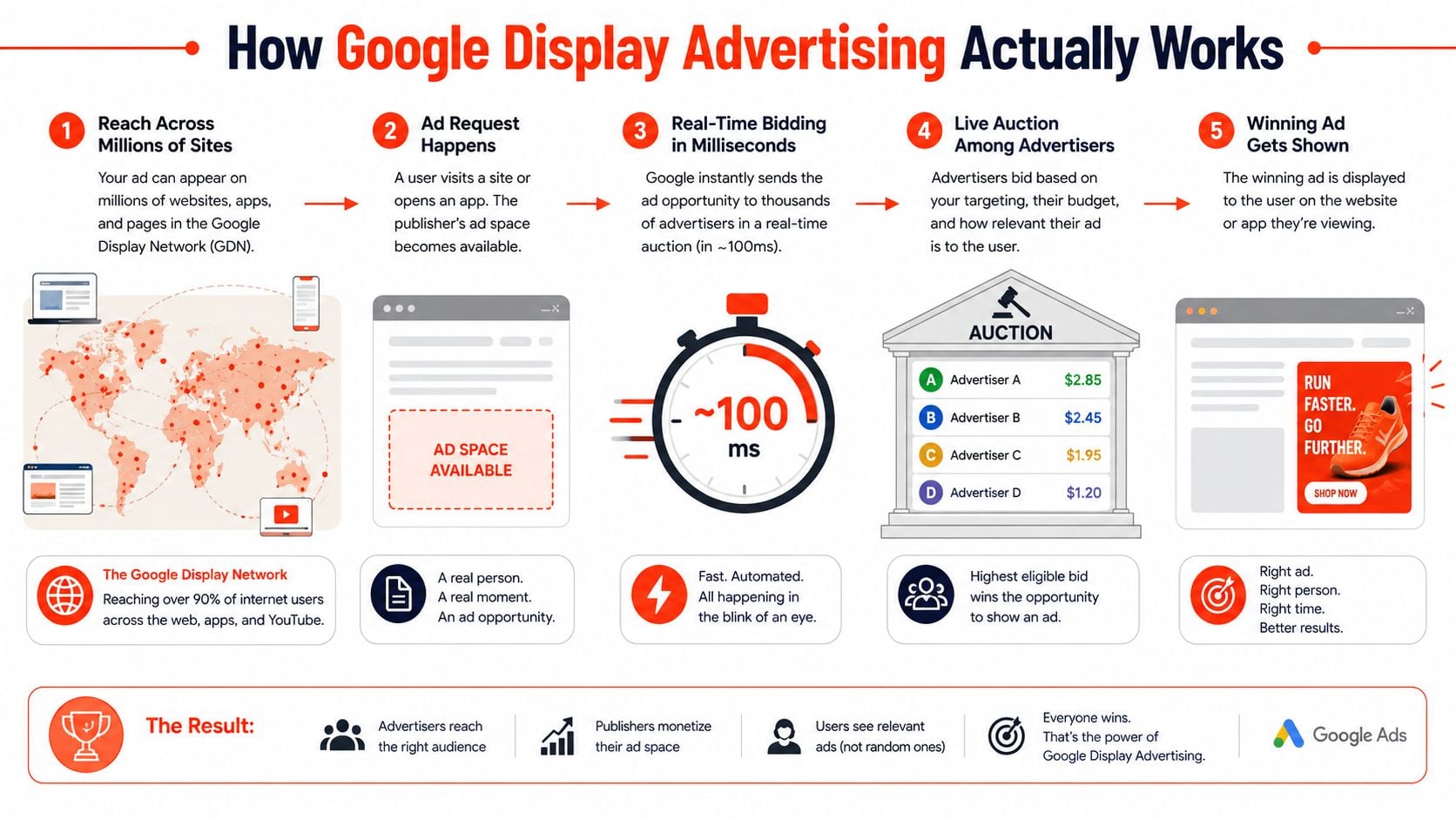
Where the ad can appear
Google Display campaigns can access a broad collection of third-party publisher environments, while Google-owned properties such as YouTube and Gmail have their own placement considerations. Those environments aren't interchangeable. A video placement may support narrative and demonstration, a Gmail placement may work as a reminder, and a publisher page may provide contextual relevance around a specific subject.
The auction also doesn't guarantee that every impression is equally valuable. An ad can technically serve below the fold, beside distracting content, inside an app, or in a context that has little connection with the offer. That's why campaign structure and placement reporting matter as much as initial reach.
Choosing the format
Responsive display ads let Google assemble combinations of supplied headlines, descriptions, images, logos, and videos. They're efficient for testing combinations and accessing varied inventory, but the advertiser gives up some layout control.
Uploaded image ads provide tighter control over design, hierarchy, branding, and calls to action. They're useful when visual consistency is critical, especially for established retail brands or regulated categories.
Video ads suit demonstrations, product education, testimonials, and brand storytelling. They need a clear first message because many viewers won't watch long enough for a late reveal.
The practical workflow is simple: provide enough credible creative variation, keep each asset understandable outside its full brand context, then judge the combinations by qualified outcomes rather than by how often they appear. A high-volume placement that attracts accidental clicks isn't a success just because the auction won.
Targeting Options That Drive Real Conversions
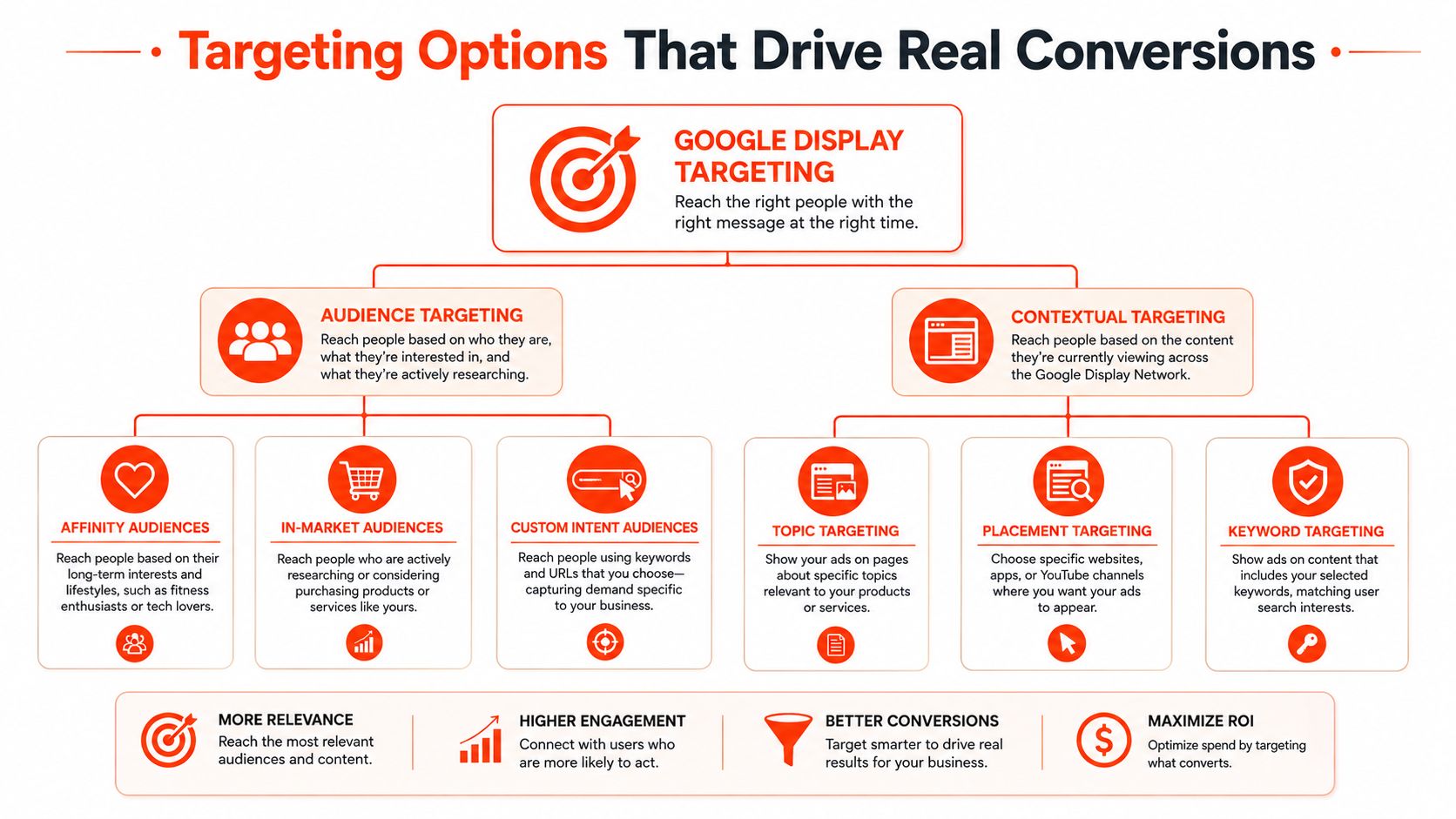
Broad targeting is easy to launch and difficult to defend. Display campaigns need enough reach for the system to learn, but they also need a clear reason why a person should see the ad in a particular context. The strongest setups usually separate prospecting, remarketing, and controlled placement tests instead of forcing every audience into one ad group.
Match the signal to the buying situation
In-market audiences can help e-commerce campaigns reach people showing active category interest. Use them with strong product imagery, a direct offer, and exclusions for existing purchasers where the objective is acquisition rather than repeat sales.
Custom intent or custom segments are more useful when the advertiser knows the language buyers use. A B2B company selling warehouse software, for example, can build audience signals around relevant search themes, competitor categories, and industry terminology, then send traffic to a page built for that problem. The audience isn't a substitute for qualification. Sales acceptance and pipeline progression still matter.
Affinity audiences can support broader awareness, but they tend to be too loose as the only signal for a direct-response campaign. They work better when creative and landing pages are designed to create familiarity rather than demand an immediate purchase.
Contextual targeting asks a different question: what is the user reading or watching now? It can be valuable for B2B advertisers whose prospects consume specialist content, and for retailers whose products naturally fit editorial subjects. A useful explanation of this approach is available in this guide to contextual targeting in advertising.
Control the environment without strangling reach
Placement targeting gives you the most direct control over selected sites, apps, videos, or other eligible environments. It can work well for a niche B2B audience or a brand that already knows which publications its customers trust. The trade-off is scale. An overly short placement list can make delivery weak and results too sparse to interpret.
Use exclusions as an operating discipline:
- Review placements: Separate sites that generate meaningful engagement from those producing clicks without commercial action.
- Exclude unsuitable environments: Remove placements that conflict with brand safety, audience relevance, or conversion quality.
- Split prospecting from remarketing: A returning visitor needs a different message from someone who has never encountered the brand.
- Test geography deliberately: Australian audiences aren't one uniform market. Compare regions and locations by lead quality, fulfilment economics, or sales outcomes.
Demographic signals can refine a campaign, but they shouldn't become a substitute for a strong proposition. For an SMB, a narrow combination of audience, context, and placement may produce fewer impressions while giving the sales team a more credible pipeline. That is usually a better trade than celebrating inexpensive traffic that never progresses.
Bidding Strategies and Budget Allocation
Bidding should match the volume and reliability of conversion data, rather than the appeal of automation. Automated systems can find patterns that manual management misses, but they still require a useful signal. If conversions are rare, tracked inconsistently, or defined too broadly, the campaign may optimise efficiently for an outcome with little commercial value.
Match the strategy to the evidence
| Strategy | Where it fits | Main trade-off |
|---|---|---|
| Manual CPC | New tests or tightly controlled placements | More control, more management |
| Enhanced CPC | Campaigns where some automation is useful but oversight remains important | Less control over individual bids |
| Maximise conversions | Accounts with a reliable conversion action and room to explore | Delivery can favour volume over lead quality |
| Target CPA | Lead generation with a stable, clearly defined acquisition event | A restrictive target can limit delivery |
| Target ROAS | E-commerce with dependable revenue values | Revenue tracking must be accurate and commercially meaningful |
A new Display campaign should begin with restraint. Confirm that the conversion action represents a genuine business result, then run a controlled audience or placement test. Manual bidding can reveal the available inventory and early cost patterns. Automated bidding becomes more useful after the campaign produces a consistent stream of trustworthy conversion signals.
For e-commerce, Target ROAS can suit campaigns with accurate purchase values and a clear view of refunds, margins, and product economics. Reporting revenue while ignoring low-margin products can make a campaign appear efficient while reducing actual contribution. For B2B, Target CPA should connect to a meaningful lead stage where possible, rather than the easiest form completion.
The right setting also depends on the job Google Display is expected to perform. If the priority is measurable response from known audiences, Display may justify its budget. If the brief is broad attention, Australian businesses should compare its reach and quality with native or in-feed placements and programmatic DOOH. Cheap impressions are not automatically efficient impressions.
Allocate by role, then test the alternative
Remarketing often warrants its own budget because it reaches people who already know the brand. Prospecting carries more uncertainty and needs a stricter test framework. A strong remarketing result should not conceal weak new-customer acquisition in a blended account total.
Keep prospecting tests separate enough to answer three questions:
- Can the audience reach relevant people?
- Does the creative earn useful engagement?
- Do those users produce qualified commercial outcomes?
Scale only when the answers are clear. Increasing budget too quickly can alter the available inventory and audience mix, producing a different campaign from the one that first performed. Review allocation against native, in-feed, and programmatic DOOH as performance evidence develops, especially where attention matters more than a directly measurable click.
Creative Best Practices for Viewability and Engagement
Impressions are delivery, not attention. Google defines a display ad as viewable when at least 50% of its area is visible for at least one second, while large display ads of 242,500 pixels or more use a 30% visibility threshold for one second (Google Ads viewability definitions). Those standards don't prove that a person noticed the message, but they provide a more useful starting point than counting every served impression equally.
Google Ads reports viewable rate as the share of measurable impressions that were viewable, and viewable CTR as clicks per viewable impression (Google Ads measurement guidance). Viewable CTR helps separate poor creative from poor exposure. A low raw CTR may be less concerning if the ad rarely had a chance to be seen, while a low viewable CTR points more directly towards message, offer, audience, or format problems.
Build creative for the job
For awareness, lead with the brand, category, and memorable visual cue. Don't hide the business identity in a small logo that disappears on mobile.
For consideration, show the product in use, explain the differentiator, and make the next step obvious. A B2B ad may offer a useful guide or consultation, while an e-commerce ad may focus on a product benefit and a clear route to the relevant collection.
For direct response, remove ambiguity. Use one primary offer, one dominant call to action, and a landing page that repeats the promise made in the ad. Multiple competing messages make responsive combinations harder to evaluate and can reduce the clarity of every assembled version.
Test combinations, not cosmetic changes
Responsive display ads work best when assets are distinct. Vary the angle, not just a single adjective. One headline can address the problem, another the outcome, and another the proof point. Descriptions should add information rather than repeat the headline.
Use the ad strength indicator as a completeness check, not as a performance verdict. A campaign can have strong asset coverage and still attract the wrong audience. Conversely, a focused message may outperform a more varied asset set when the offer is highly specific.
Creative fatigue appears when the same message keeps reaching the same audience. Watch for declining engagement alongside stable delivery, then replace the weakest concept rather than changing every asset at once. That preserves a usable learning baseline and makes the next result easier to interpret.
Measurement Challenges and Attribution Reality
Display often influences a decision without receiving the final click. A prospect may see an ad, visit later through organic search, return through branded Search, and then submit a form. Last-click reporting awards the conversion to the final interaction, which can make display appear ineffective even when it helped create familiarity.
That doesn't mean every view-through conversion proves incremental value. A person who would've converted anyway may be exposed to a display ad shortly before purchasing. The advertiser then pays for an impression while the report implies that the ad caused the outcome. The correct response isn't to accept or reject view-through conversions automatically. It's to test whether display changes behaviour beyond what would have happened without exposure.
Build a measurement hierarchy
Start with conversion actions that reflect business value:
- E-commerce: Purchases, revenue, product-level value, and post-purchase quality.
- B2B: Qualified enquiries, booked meetings, accepted opportunities, and eventual pipeline progression.
- SMB services: Calls, completed forms, and sales outcomes after contact.
Then compare multiple views of performance. Google Ads attribution reports can show how different interactions contribute across the journey, while analytics platforms can help assess landing-page behaviour and assisted paths. A useful multi-touch attribution approach should inform decisions, but it shouldn't be treated as a mathematical answer to causality.
Privacy changes and cross-device behaviour make individual journeys incomplete. Users may browse on one device and convert on another, decline tracking, or interact through environments where the advertiser can't observe every step. This is why reported conversions should be triangulated with commercial records, geographic patterns, brand-search behaviour, and controlled tests where practical.
Decide whether the channel earns more budget
Keep Google Display in the mix when it produces qualified outcomes, supports incremental reach, or improves the efficiency of the wider customer journey. Shift budget when the campaign relies on inflated view-through credit, attracts low-quality traffic, or cannot demonstrate value beyond conversions that other channels already capture.
The ACCC's findings on concentration also make measurement governance important. When platform infrastructure has substantial influence across inventory and reporting, advertisers need their own conversion definitions, exclusions, placement reviews, and commercial checks. A dashboard can describe delivery. It can't decide whether the investment was incremental.
Troubleshooting Common Performance Issues
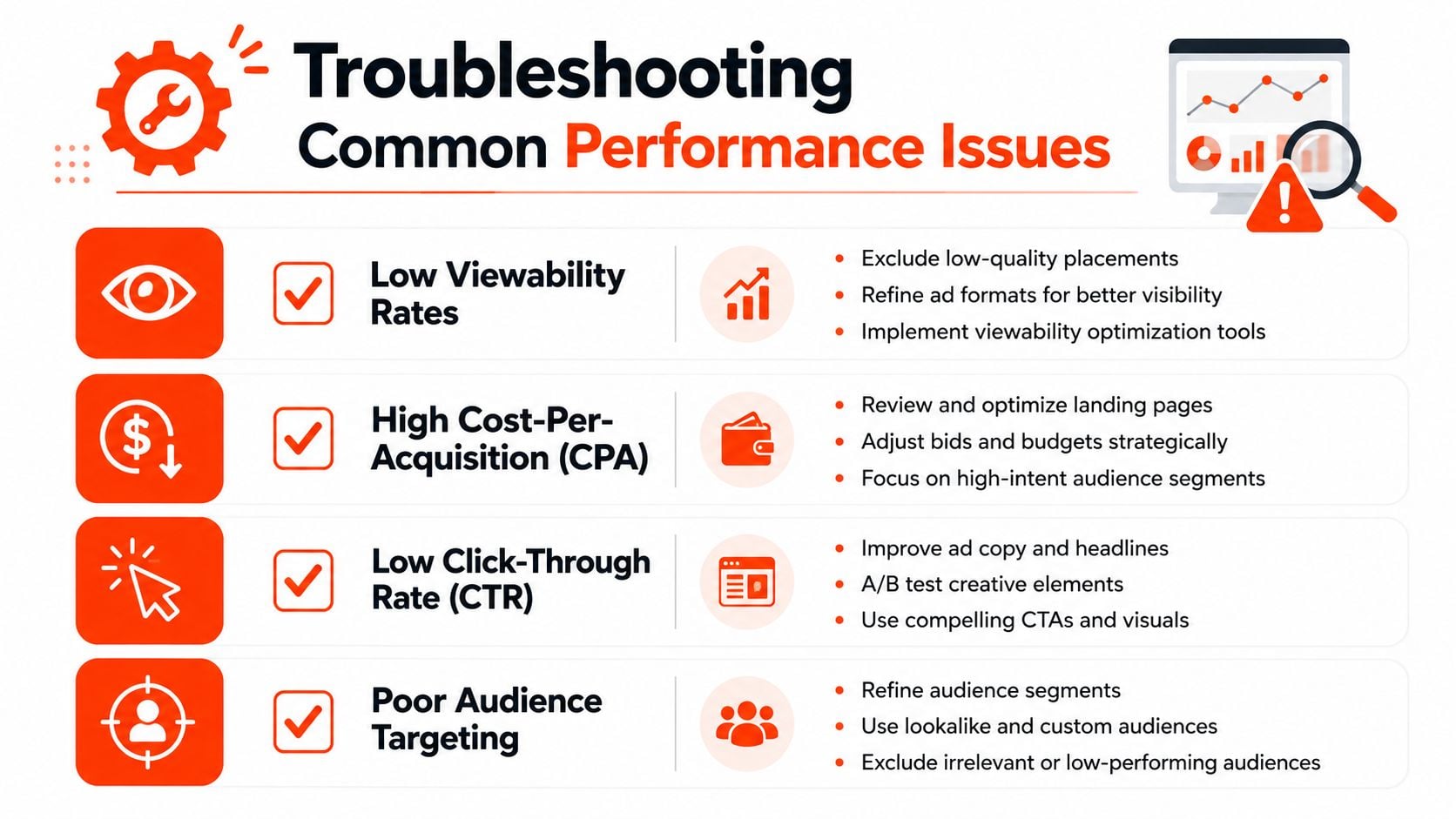
Poor Display performance usually comes from one of four areas: targeting, creative, bidding, or measurement. Diagnose the category before changing settings. Otherwise, you can lower bids to compensate for weak creative, broaden audiences to compensate for poor tracking, or replace ads when the core issue is unsuitable placement.
Work through the symptoms
- Low viewability: Review placement reports, exclude environments with weak exposure, and test formats that fit more naturally into the available inventory.
- High CPA: Tighten audience signals, separate prospecting from remarketing, inspect search terms or audience inputs used to build custom segments, and verify that the conversion action is commercially valid.
- Low CTR: Check message relevance and creative fatigue before raising bids. If viewable CTR is also weak, refresh the proposition. If raw CTR is weak but viewable CTR is healthy, investigate delivery and placement mix.
- Poor audience targeting: Compare contextual, in-market, custom, and placement-led ad groups separately. Don't let a broad campaign absorb all budget before narrower tests have been evaluated.
Change one major variable at a time. A simultaneous audience, bid, creative, and landing-page change leaves you with no reliable diagnosis.
For scaling, increase reach gradually and watch whether the new inventory changes lead quality. Test locations, devices, placements, and creative concepts as separate questions. Give each adjustment enough time to produce interpretable data, but don't preserve a weak setup just because it has been running for a long time.
For Australian businesses, the final check is channel fit. If refined targeting, credible creative, and sound measurement still produce weak commercial results, the answer may not be another optimisation. Move part of the test budget to Search, Shopping, native or in-feed inventory, or programmatic DOOH, then compare the quality and incrementality of the attention each channel creates.
Click Click Bang Bang manages Google Display alongside Google Search, Shopping, remarketing, Meta, and LinkedIn campaigns, with conversion tracking, live reporting, and data-led optimisation. If you want an Australian media mix built around qualified outcomes rather than impression volume, visit Click Click Bang Bang to discuss your campaign requirements.
Read NeXt
Or Read Our Latest
- Display Advertising on Google: The Complete Australian Guide
- Stakeholder Communication Plan How to Build One That Works
- User Generated Content Strategies That Actually Convert
- Copyright and Infringement Guide for Business Marketers 2026
- What Is Brand Positioning and Why It Drives Growth
- Push vs Pull Marketing: A 2026 Decision Guide
Click. CLick. Subscribe.
Get our best PPC insights, industry updates, and power moves delivered straight to your inbox. No fluff, just high-caliber strategies that actually work.
Don’t Leave Just Yet
Try Us For 30-Days,
Risk Free!!
We guarantee that you’ll love our work within the first 30 days, if not you’ll get your money back.
What have you got to lose?