

Manual vs Automated Bidding for PPC Success
Last Updated

A Sydney retailer can see profitable sales from one suburb and marginal orders from another, while a Melbourne B2B advertiser may generate plenty of form fills but struggle to turn them into qualified opportunities. Both may ask the same question: should they keep setting bids themselves, or let Google Ads decide at auction time?
The answer depends less on which method sounds more advanced and more on campaign objective, conversion data maturity and operating constraints. Australian advertisers also face uneven metro and regional demand, seasonal pressure around EOFY and Christmas, and offline sales that may never reach the advertising platform. Those conditions can make automation powerful in one campaign and misleading in another.
The comparison below treats manual vs automated bidding as a business decision, not a feature checklist.
Choosing Between Manual and Automated Bidding
A Sydney retailer may see profitable orders from one suburb and marginal results from another. A Melbourne B2B advertiser may generate form fills that rarely become qualified opportunities. After enhanced CPC was removed in March 2025, both businesses must choose how much bidding control to retain and whether their conversion data can support automation.
Manual bidding sets a maximum amount for a click. Automated bidding uses conversion signals and auction context to pursue a selected outcome. The practical difference concerns decision speed, accountability and management time, not only campaign settings.
Australia's paid media market already relies heavily on automated buying. Digital advertising revenue reached AUD 16.4 billion in calendar year 2024, an 11.1% year-over-year increase, according to Australian paid advertising statistics from RockingWeb. The same summary reports that over 80% of display and video investment is bought programmatically. This market direction makes automated bidding relevant, but it does not remove the need to check whether the underlying signal is useful.
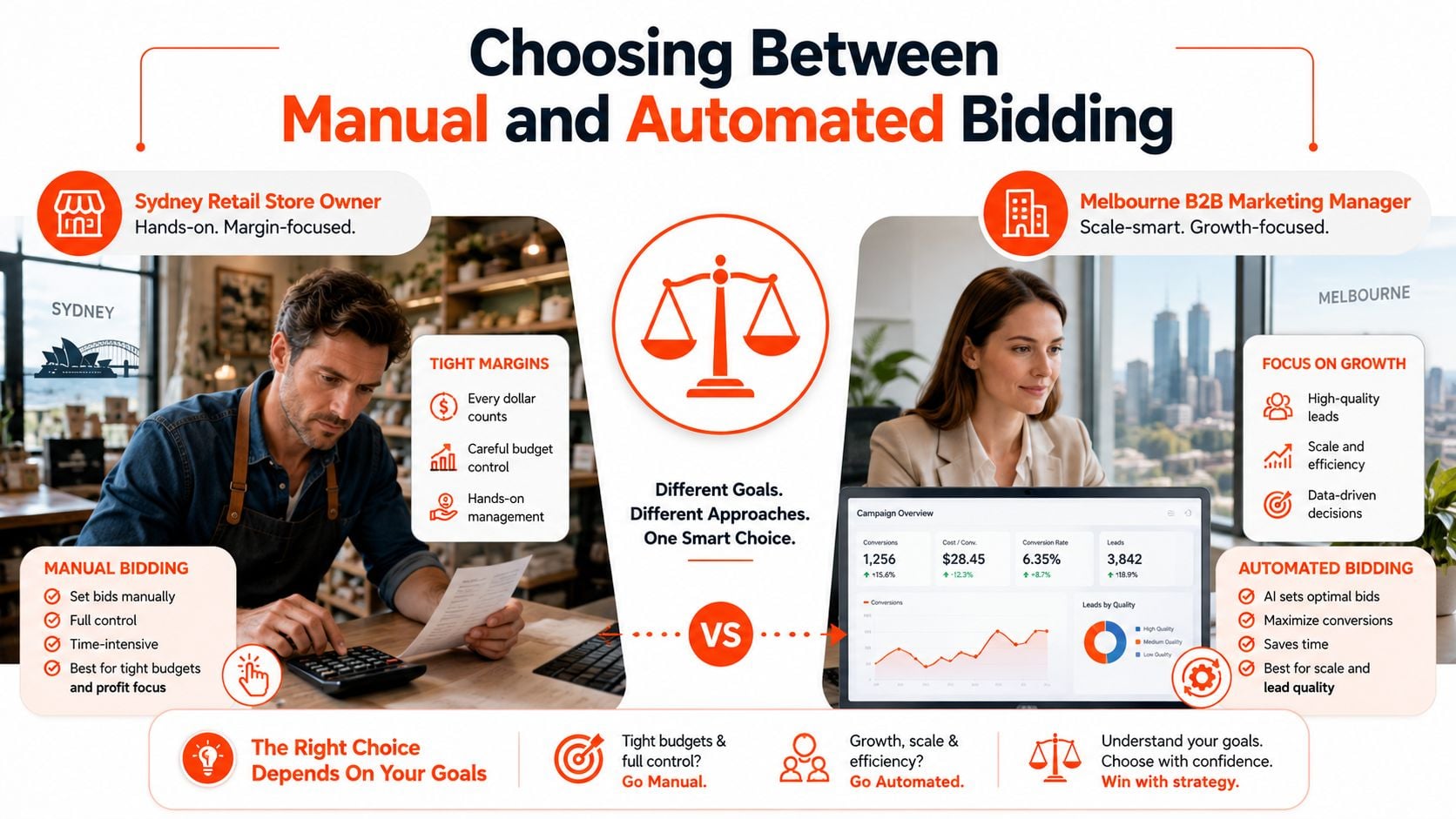
The three questions that decide the strategy
Start with the commercial objective. Ecommerce campaigns with dependable transaction values can provide a clear optimisation signal. Lead-generation campaigns require more scrutiny because a form submission may be worth far less than a sales-qualified opportunity, particularly when the final sale is recorded offline.
Then assess conversion volume and data quality. Australian guidance suggests around 15 to 30 conversions in 30 days for lead-generation campaigns, and around 50 or more conversions in 30 days before constraining value-based bidding with target ROAS. These figures come from AU-focused Google Ads experiment guidance. They are practical reference points, not guarantees. A low-volume local service campaign may need manual controls while a mature retailer can give automation more room.
Finally, price in operating constraints. Demand can differ sharply between Sydney, Melbourne and regional areas. EOFY, public holidays and Christmas can change intent, while offline sales may arrive after the platform has evaluated the click. Automation can reduce daily bid work, but it also creates a review burden when conversion tracking is incomplete or uneven. Manual bidding preserves clearer control, yet requires regular analysis and faster human intervention. The suitable choice is the one that matches signal quality, sales economics and the team's capacity to manage exceptions.
How Both Bidding Methods Work
Manual CPC
Under Manual CPC, the advertiser sets a maximum cost-per-click for a keyword, ad group or placement. Google Ads describes Manual CPC bidding as a method that lets advertisers set their own maximum CPC, making it the clearest example of hand-managed bidding.
The strategist then reviews performance and adjusts bids using available controls, such as device, location, schedule, audience and keyword intent. A retailer might bid more aggressively on a high-margin product category, while a regional service business might restrain bids where lead quality is poor. The decision remains explainable because a human chose the bid and can connect it to a visible account rule.
Manual CPC doesn't mean the auction itself is static. Google still evaluates ad eligibility, competition and relevance. Manual bidding controls the advertiser's bid input, while the auction determines whether the ad can compete and what the click may cost.
Smart Bidding
Smart Bidding uses machine learning to set bids for individual auctions. The advertiser selects an objective, such as Target CPA, Target ROAS, Maximise conversions or Maximise conversion value, and the system estimates the likelihood and value of a conversion using signals available at the time of the auction.
Those signals can include device, location, time of day, audience context, query context and prior interactions. The important distinction is that Smart Bidding doesn't assign one bid to a keyword. It evaluates the opportunity associated with each impression, which is why conversion quality and volume matter so much.
Advertisers working through Target CPA bidding principles should treat the target as a business constraint, not a guarantee for every individual conversion. The system can pursue the target across a body of auction activity, but weak tracking can direct that optimisation towards the wrong outcome.
Practical rule: Automation can only optimise what the account records. If a form fill is counted but the eventual sales qualification isn't imported, the platform may learn to value cheap enquiries rather than commercially useful leads.
The post-ECPC decision
Google removed enhanced CPC for Search and Display campaigns in the week of 24 March 2025, as documented in Google Ads' AU guidance on the enhanced CPC transition. Advertisers who didn't migrate were effectively left on Manual CPC.
That change removed a middle ground many teams used to combine manual maximum bids with automated adjustments. The practical choice is now more deliberate: retain Manual CPC for control and data collection, or move to a Smart Bidding strategy with a clearly defined objective. Advertisers can still build safeguards through campaign structure, portfolio strategies, budgets and offline conversion imports, but they shouldn't assume ECPC remains available as a default compromise.
Creative production can also affect how much management capacity remains for this work. Teams using ShortGenius automated ad generation may reduce the time spent producing video or ad variations, leaving more attention for conversion definitions, bid testing and commercial analysis.
| Dimension | Manual CPC | Smart Bidding |
|---|---|---|
| Decision maker | Advertiser sets the bid | Platform sets the auction-time bid |
| Primary control | Maximum CPC | Target or conversion objective |
| Main input | Keyword, ad group, placement and adjustment rules | Conversion and value signals |
| Strength | Transparency and direct limits | Real-time auction response |
| Main risk | Slow reaction and management load | Poor decisions when data is weak |
| Best starting point | New, low-volume or tightly controlled campaigns | Mature campaigns with reliable conversion signals |
Comparing Control, Cost and Performance
A Brisbane retailer may have strong weekend demand, while its regional Queensland traffic converts less often. A national campaign average can hide that difference. The practical comparison is therefore explicit control versus delegated optimisation, weighed against conversion volume, local demand, offline sales and the time required to manage each approach.
Manual CPC keeps the connection between a selected keyword, location or product category and its maximum click bid visible. That control suits campaigns where waste has a known source, margins differ by product or demand is too sparse for dependable automated decisions. The cost is management time. Someone must review search terms, interpret changes and apply adjustments without reacting to thin or noisy data.
Automated bidding moves the auction decision to the platform. It can respond to signals faster than a person checking reports, including device, audience and auction context. The advertiser gives up direct control of individual CPCs, however, and takes on requirements for accurate tracking, suitable conversion volume and disciplined change management. The learning period after a strategy change can also temporarily complicate performance assessment.
| Dimension | Manual CPC | Automated Bidding |
|---|---|---|
| Control | Keyword and ad-group level | Objective and budget level |
| Responsiveness | Depends on human review | Adjusts at auction time |
| Labour cost | High ongoing management | Lower bid editing, higher data governance |
| Data requirement | Can operate with limited history | Needs stable conversion signals |
| Transparency | Cause and effect is easier to inspect | Decisions are distributed across signals |
| Experimentation | Bid tests are straightforward | Tests need carefully separated strategies |
| Australian fit | Strong for sparse or tightly bounded demand | Strong for scalable, conversion-rich demand |
Seven operating trade-offs
Control matters when inefficiency is identifiable. Manual CPC lets an advertiser reduce exposure for a particular query, suburb or region immediately. Automated bidding may respond to the combined auction estimate, but that response does not always show which local segment caused the problem.
Responsiveness favours automation when the signal is reliable. Weekend intent, weather-sensitive retail demand and changing auction pressure can shift faster than a manual review cycle. Fast adjustment has limited value if conversions are tracked inconsistently or sales quality is not recorded.
Management cost changes shape. Manual bidding consumes strategist time through bid edits, rules, reviews and quality checks. Automation reduces bid editing but increases work around conversion actions, value imports, exclusions, CRM connections and safeguards. After enhanced CPC was removed in March 2025, advertisers cannot rely on that former middle ground to limit this trade-off.
Transparency is asymmetric. Manual CPC provides an intuitive audit trail from bid to traffic. Automated strategies require analysis of conversion volume, value, impression share, search terms and segment performance instead of one visible bid. That makes the strategy less inspectable at keyword level, even when it performs efficiently.
Testing requires comparable conditions. Manual bids can provide a clear baseline for early keyword and query evaluation. Automated tests need separated strategies with comparable budgets, locations and audiences. Otherwise, different traffic mixes can be mistaken for a bidding effect.
Australian geography complicates averages. Sydney, Melbourne and regional markets can have different demand patterns, competition and conversion rates. Automation may detect some of those differences, but local seasonality and uneven city-level demand still require deliberate segmentation, budgets and value definitions.
The hidden cost is a wrong objective. A low-cost form submission may look efficient while producing little sales value. A manual manager might identify the gap through CRM review, whereas automation will continue pursuing the recorded conversion until qualified outcomes or offline sales are imported.
Advertisers should also separate bid performance from ad recall and creative effectiveness. Sift AI's Facebook recollection ops illustrates why weak paid media results can reflect creative memory or audience quality, not only bidding. The same diagnostic discipline applies in Google Ads.
For teams assessing auction mechanics, this explanation of the Ad Rank formula clarifies how bidding interacts with other factors affecting eligibility and position. That distinction prevents a manual bid change or automated target adjustment from being credited with every movement in visibility.
What Performance Evidence Really Shows
Performance evidence supports a conditional conclusion. Mature accounts with frequent, reliable conversion data often give automated bidding enough feedback to adjust bids effectively. Sparse, delayed or commercially incomplete data can make the same system unreliable, while manual bidding carries a higher management cost as the number of campaigns and markets grows.
Reported efficiency improvements over Manual CPC sit around 20% to 35% in stable, high-signal environments, and an AU-focused guide cites Google data reporting about 20% more conversions on average from Smart Bidding. These figures appear in the Australian automated bidding compliance bulletin. They provide context, not a forecast for every Australian advertiser.
A national retailer with consistent purchase tracking supplies repeated examples of success. A B2B advertiser with a long sales cycle, uneven city-level demand and CRM-based qualification supplies a less complete feedback loop. Local seasonality creates another constraint: automation can react quickly when demand and value signals are represented correctly, but it may optimise toward short-term platform conversions during a temporary surge.
| Data condition | Manual Bidding Outlook | Automated Bidding Outlook |
|---|---|---|
| Clean, frequent ecommerce transactions | Useful for control tests and margin protection | Usually well suited to conversion value optimisation |
| New campaign with limited history | Strong for harvesting queries and establishing baselines | Risk of unstable learning |
| Long-cycle B2B leads | Can protect spend while sales quality is validated | Needs qualified or offline conversion imports |
| Uneven metro and regional demand | Makes local priorities explicit | Can help if regional value signals are reliable |
| Offline-heavy customer journey | Allows human judgement around incomplete data | Underperforms when offline outcomes aren't imported |
| Seasonal retail demand | Offers direct restraint during uncertain periods | Can respond quickly when seasonality is represented correctly |
Australian CPC dispersion also limits the usefulness of fixed bids across industries. Published benchmarks place Google Search CPC at about AUD 1.20 in ecommerce and retail, AUD 12.80 in legal and financial services, and an overall average near AUD 3.60. The spread shows why bid decisions must reflect margin, lead value and competitive pressure, rather than a generic account benchmark.
Attribution remains a separate test of strategy quality. Advertisers should fix attribution blind spots before judging a bid approach, particularly when phone calls, CRM stages or offline purchases complete the journey. Otherwise, a rise in platform-reported conversions can disguise weaker sales quality, and the apparent performance advantage may belong to measurement rather than bidding.
Matching Bidding to Campaign Goals
Campaign objective should set the bidding decision. An Australian advertiser may need different controls for brand defence, Shopping, lead generation and services spread across Sydney, Melbourne, regional centres and remote areas. Enhanced CPC is no longer available, so the choice now depends more directly on conversion volume, data quality and the management time required to correct poor signals.
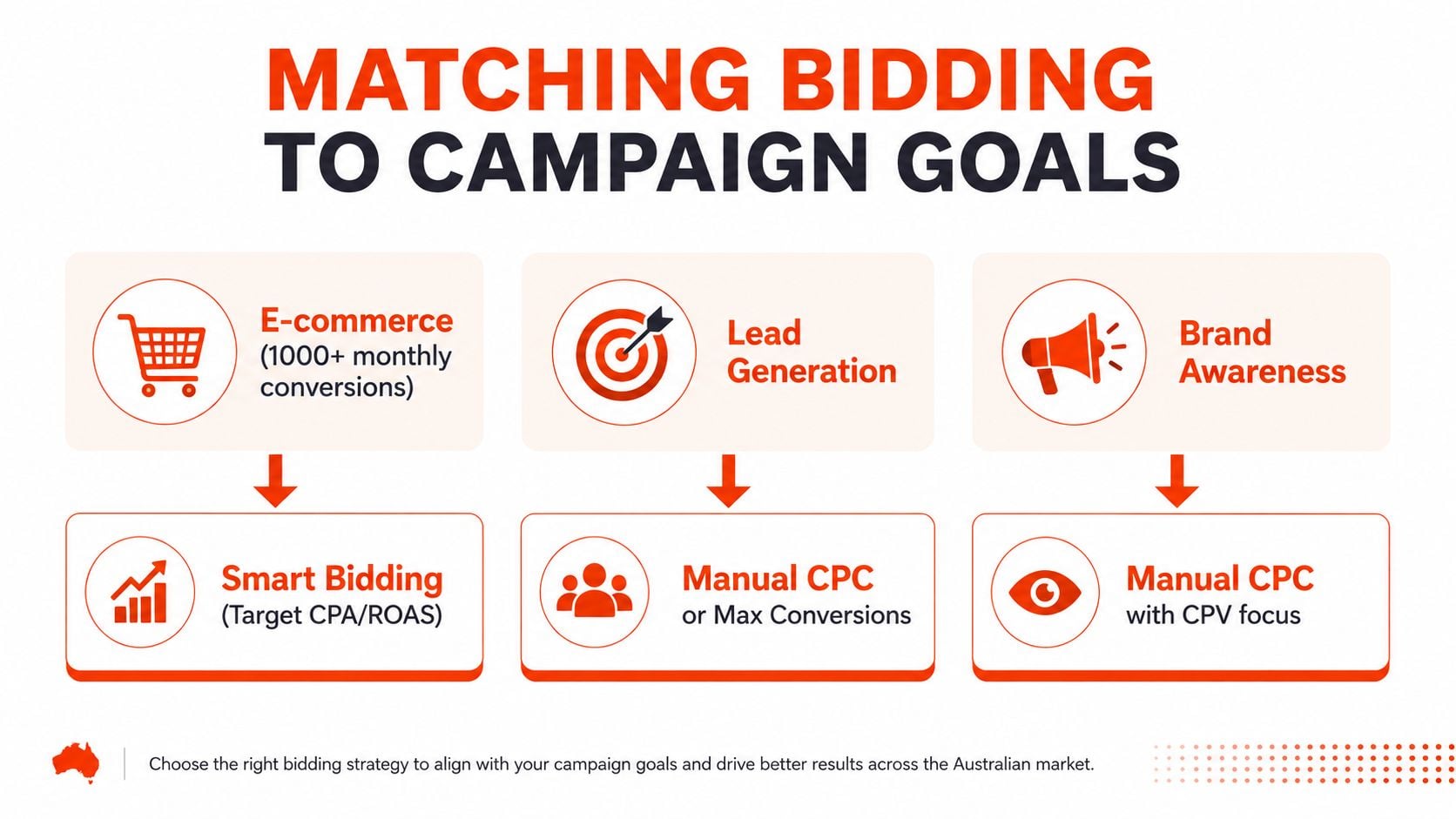
Ecommerce
Ecommerce is a strong automation candidate when purchase events, product values and revenue imports are dependable. Target ROAS or Maximise conversion value can distinguish a high-value order from a low-value order, provided the account receives enough reliable purchase data.
A reported ROAS benchmark is useful as market context, not as a target. Retailers still need to test whether advertising revenue supports margin after freight, returns, discounts and stock constraints. A campaign can meet a platform efficiency goal while reducing contribution margin if it prioritises low-margin products or expensive orders.
Manual CPC remains useful for low-volume branded search, protected product groups and early query reviews. It gives the retailer time to identify irrelevant searches before automated bidding receives more authority.
B2B lead generation
B2B accounts commonly have a gap between a platform conversion and a commercial conversion. A completed form is easy to count, while sales acceptance, opportunity creation and closed revenue may occur much later.
Manual CPC, or a tightly controlled automated test, can suit this stage while the advertiser checks lead quality. Sporadic conversions may provide too little consistent feedback for a target CPA. Offline conversion imports can improve the signal when CRM stages are mapped consistently and returned to Google Ads. They also make automation more useful for long sales cycles, where the eventual value is invisible at form submission.
Small budgets
For budgets under about AUD 3,000 per month, Manual CPC may remain preferable when granular keyword control matters. That threshold was identified in the Australian automated bidding compliance bulletin.
A smaller budget does not rule out automation. It raises the cost of weak signals, uneven city-level demand and unnecessary learning, especially when conversions are infrequent. The hidden cost is management time: manual control consumes recurring effort, while automation consumes time when tracking, values or targets need diagnosis.
Brand defence and new campaigns
Brand defence often has clear intent and a simple commercial role. Manual CPC can protect coverage while the advertiser checks competitor pressure, query quality and local demand.
New campaigns also benefit from controlled discovery. Manual bidding can gather search-term evidence and establish a baseline before testing Maximise conversions or another automated objective. The switch should follow signal quality, not a calendar.
Fragmented services
A service business serving metro and regional areas should not assume one national target reflects every market. Manual CPC preserves local priorities when demand varies sharply by city or season. Portfolio automation can work when regional conversion values are reliable, but a single target can redirect spend toward areas that generate leads rather than profitable sales.
Decision test: If the platform sees a conversion but the business sees a weak lead, the campaign is not ready for unconstrained optimisation.
Testing and Switching Without Disrupting Results
A bidding change should be treated like a controlled commercial experiment. The first task isn't choosing Target CPA. It's verifying that the account records the outcome the business wants.
Start with the measurement layer
Audit Google Ads conversion actions, GA4 events, enhanced conversions and offline imports before changing bids. Confirm that primary conversions represent real business outcomes and that value-based campaigns receive usable values. If CRM stages are delayed or duplicated, fix that workflow before asking an algorithm to optimise against it.
Document the baseline. Record spend, conversions, conversion value, CPA or ROAS, impression share and assisted conversion context for the period being used as the comparison. A single last-click metric can hide a change in traffic quality or attribution.
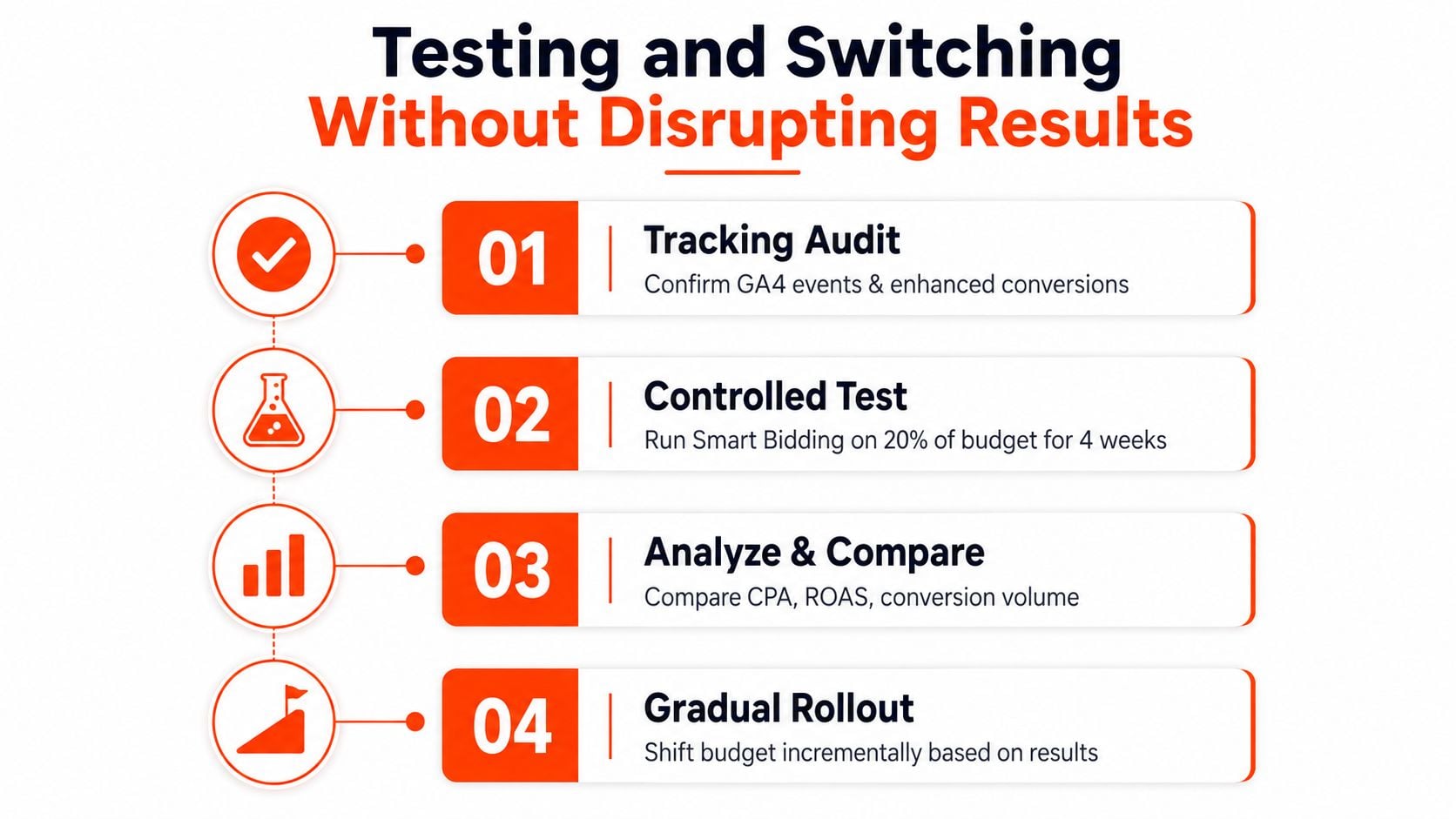
Run a bounded test
Mirror the relevant campaign conditions as closely as possible. Keep geography, audience, landing pages, creative and budget treatment comparable, then change the bidding strategy rather than several variables at once.
A learning period of roughly seven days to one to two weeks is commonly cited after a bidding change in Australian guidance, so early volatility shouldn't be treated as a final verdict. The test still needs enough conversion activity to support a meaningful comparison. If the campaign has very little signal, the correct conclusion may be that the test cannot answer the question yet.
Use switching rules
Define the decision before the results arrive. Continue the automated strategy when conversion volume improves and CPA or ROAS remains commercially acceptable. Return to Manual CPC when tracking fails, lead quality deteriorates or the system spends against a target the business cannot support.
Don't pause a test during EOFY, Christmas or another major retail peak unless the experiment was designed for that period. Seasonal demand can make a temporary shift look like a bidding effect. Where seasonality is unavoidable, annotate the account and interpret the results against the commercial calendar.
For broader campaign quality checks, use a documented Google Ads optimisation process alongside the bid experiment. That keeps landing pages, search terms, budgets and conversion tracking in the same review rather than blaming every change on bidding.
Record the operational cost
Measure strategist time as well as media efficiency. Manual CPC may deliver cleaner control but require frequent reviews. Automated bidding may reduce bid edits while demanding more tracking governance and troubleshooting. A strategy that produces similar commercial results with substantially less management effort can still be the better operating choice, provided the business retains adequate safeguards.
Building a Practical Hybrid Bidding Strategy
A hybrid account isn't a compromise built from indecision. It assigns different jobs to different controls.
Manual CPC can protect brand defence, tightly capped budgets and campaigns where a specific keyword or location needs human oversight. Smart Bidding can handle conversion-rich ecommerce, remarketing and other areas where the account has consistent, commercially meaningful signals. Portfolio structures can connect related campaigns while keeping low-conversion, high-impression activity separate from campaigns that generate dependable outcomes.
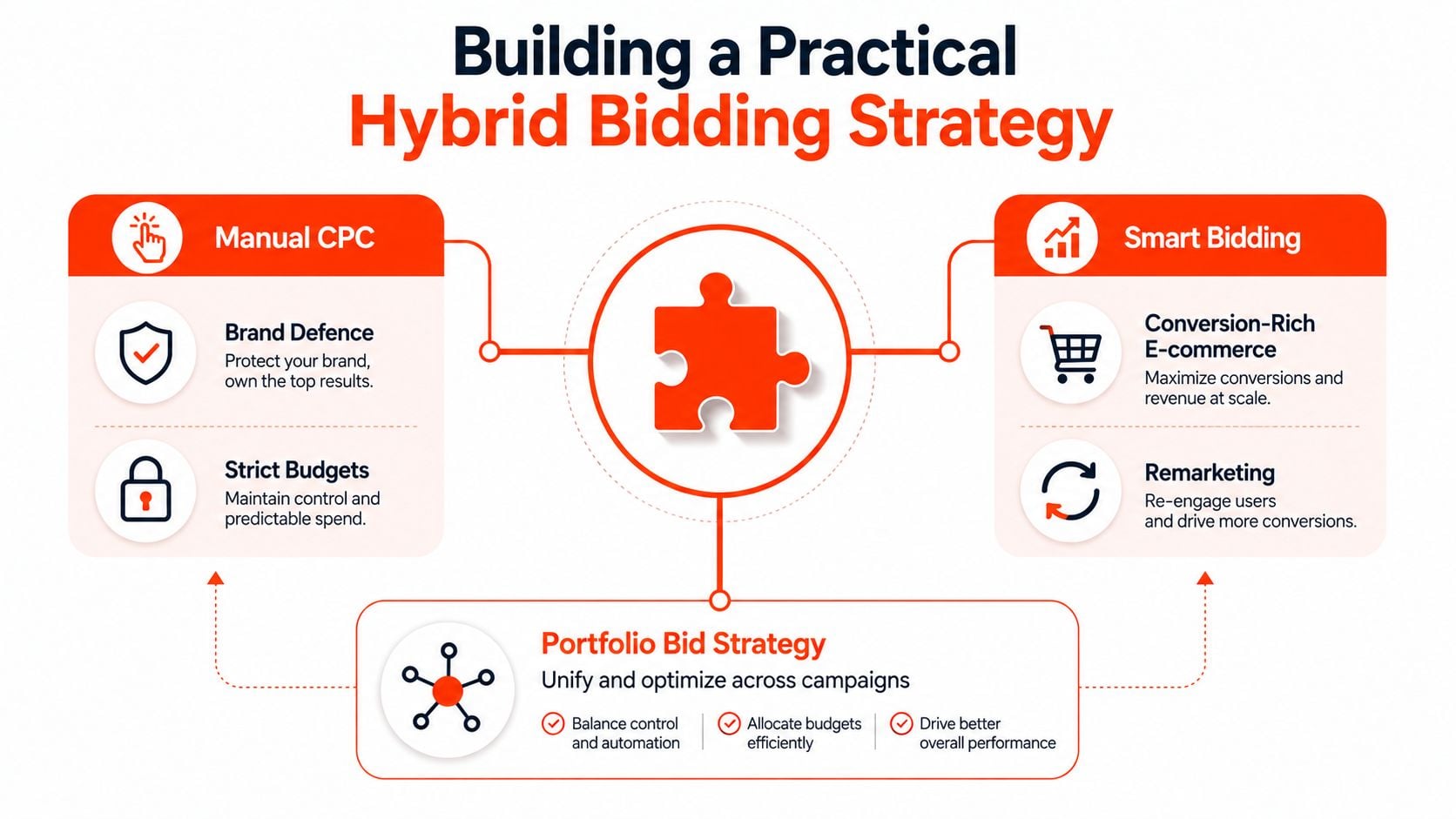
A workable account design
A retailer might use value-based Smart Bidding for product groups with reliable purchase values, Manual CPC for brand terms and a separate structure for products with thin margins. A B2B advertiser might keep prospecting on Manual CPC while testing automation only after qualified CRM outcomes are imported.
Geography should be visible in the structure when city-level economics differ materially. Separate campaigns, portfolio targets or value rules can make regional priorities explicit, but the advertiser must still validate whether those controls reflect actual profit rather than assumed market value.
The escalation rule
Move from Manual CPC towards automation when three conditions align:
- Conversion volume: The campaign has enough consistent conversions for the selected strategy to learn.
- Data quality: Primary conversions, revenue values and offline outcomes represent real business value.
- Operating capacity: The team is spending more time maintaining bids than improving the account elsewhere.
Keep Manual CPC when any of those conditions is materially absent, particularly for a new campaign, a low-volume regional service or a lead-generation journey with unverified sales quality. Test automation in a bounded segment when the account is close to readiness, rather than moving every campaign at once.
The strongest Australian bidding setup is often neither fully manual nor fully automated. It is a portfolio in which human judgement defines the boundaries, reliable conversion data guides machine learning and reporting exposes differences between metro, regional, online and offline outcomes.
Click Click Bang Bang provides PPC management across Google Search, Google Shopping, remarketing, Meta and LinkedIn, with conversion tracking, transparent reporting and campaign strategies matched to business objectives. If you're deciding whether Manual CPC, Smart Bidding or a hybrid structure fits your Australian account, visit Click Click Bang Bang to discuss a data-led approach.
Read NeXt
Or Read Our Latest
- Manual vs Automated Bidding for PPC Success
- Conversion Tracking Setup: A Complete AU Guide
- Instagram Advertising Australia: Complete 2026 Guide
- Pay Per Click: A Beginner’s Guide for Australian Marketers
- Display Advertising on Google: The Complete Australian Guide
- Stakeholder Communication Plan How to Build One That Works
Click. CLick. Subscribe.
Get our best PPC insights, industry updates, and power moves delivered straight to your inbox. No fluff, just high-caliber strategies that actually work.
Don’t Leave Just Yet
Try Us For 30-Days,
Risk Free!!
We guarantee that you’ll love our work within the first 30 days, if not you’ll get your money back.
What have you got to lose?