

Stakeholder Communication Plan How to Build One That Works
Last Updated

You can spot the breakdown fast. The update went out late, the client's asking the same question in three different channels, the internal team thinks approval is done, and someone in finance never saw the version that mattered. A stakeholder communication plan fixes that mess by making communication a controlled part of delivery, with ownership, cadence, and feedback, not a loose trail of emails.
In Australia, that shift isn't just good practice. The Australian Securities Exchange's Corporate Governance Principles and Recommendations have required listed entities since the 3rd edition in 2014 to disclose a process for communicating with shareholders and encouraging participation at general meetings, and the 4th edition in 2019 reinforced shareholder communication and electronic participation expectations, which makes communication a formal governance issue for many organisations resolution.de. If you're trying to coordinate investors, clients, delivery teams, or regulators, the key question is no longer whether to communicate. It's whether your communication system is measurable enough to stop surprises before they become expensive.
For teams working across PPC, SEO, reporting, and client management, the same problem keeps showing up in a different outfit. A useful starting point is to study how founders and operators organise early support networks, and even resources like US startup funding sources show how important it is to match the message to the audience before anyone commits attention or money.
Why a Stakeholder Communication Plan Matters Now
A project rarely fails because nobody sent an update. It fails because the right people did not get the right update in time, or they got it in a format they could not use. In agency work, that shows up fast, a client expects a launch-ready dashboard, the strategist assumes the numbers are enough, and the account manager ends up translating frustration after the fact.
A strong stakeholder communication plan stops that drift by setting who needs what, when they need it, who owns each handoff, and how you check whether the message reached the people who need it. In Australian governance contexts, that also carries formal weight, because listed entities are expected to document shareholder communication processes and support participation.
For commercial teams, the practical value is even clearer. Clear communication keeps decisions moving, protects alignment, and gives each stakeholder group a predictable rhythm instead of random bursts of attention. Without that rhythm, people fill the gap with assumptions, and assumptions are where approval delays, scope disputes, and reporting misunderstandings start.
Practical rule: if a stakeholder group cannot tell when the next meaningful update is coming, your plan is not doing its job yet.
The best plans also expose who gets left out by default channels. Executives usually want concise decisions. Delivery teams need detail they can act on. Clients want proof the work is on track without digging through noise. A partner who only checks email may miss a change buried in a chat thread, and a regional lead who is not invited into the cadence can be blindsided by decisions that affect local rollout. When those needs are built into the plan from the start, communication stops being a side task and becomes part of the delivery system.
For smaller or early-stage teams, the same discipline matters when attention and money are on the line, which is why resources like US startup funding sources can be useful as a reminder that the message has to fit the audience before anyone commits either.
Mapping and Prioritising Your Stakeholders
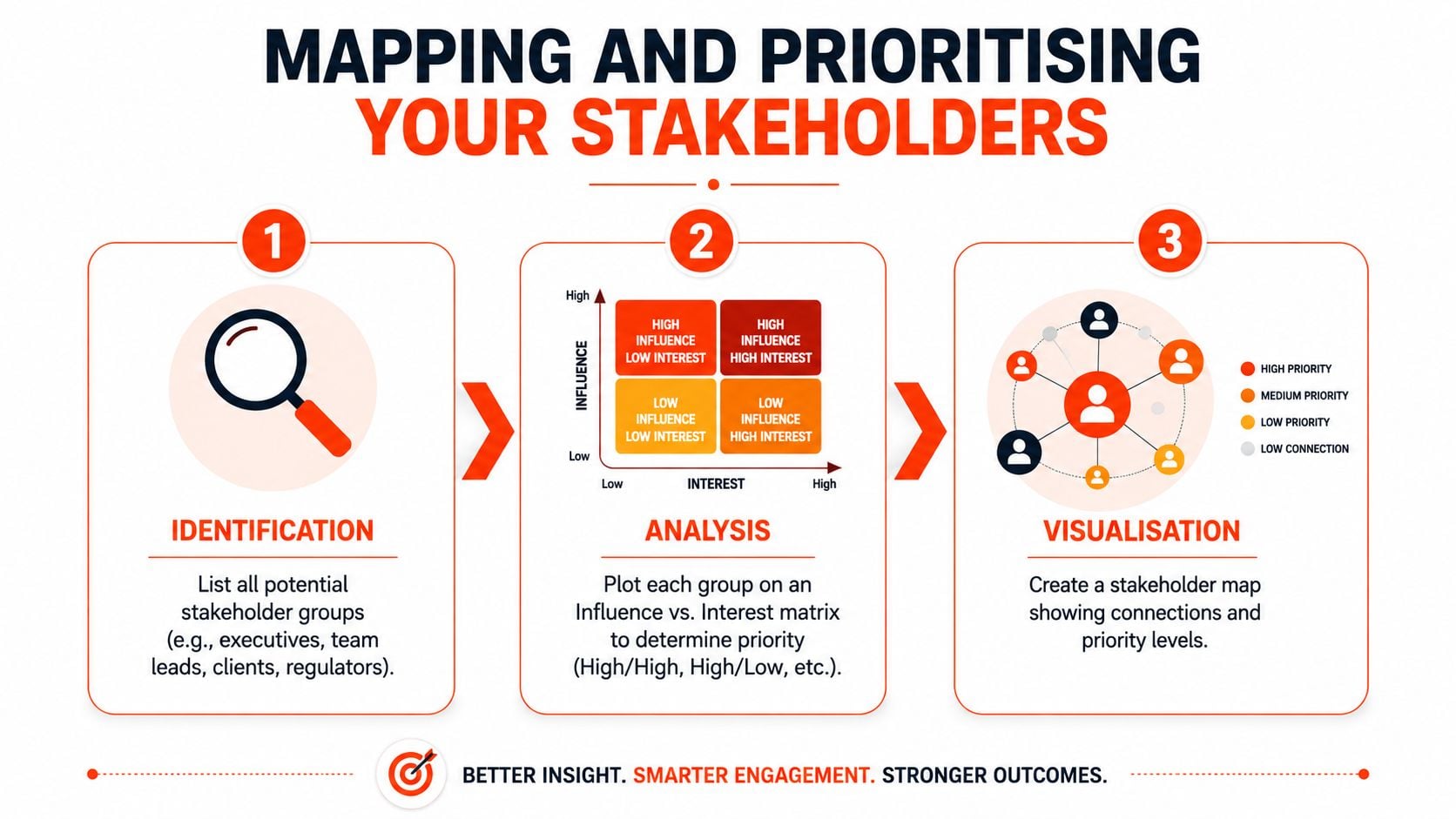
A stakeholder communication plan fails fast when the audience map is incomplete. Some people get flooded with updates they do not need, while the people who can approve, block, fund, or shape the work hear too little, too late. Start by listing every group that can influence the outcome, then sort them by influence and interest so the plan reflects where attention is needed.
Start broad, then narrow fast
Build the list in layers. Begin with executives, client contacts, project leads, operations staff, compliance teams, vendors, and any external party that affects delivery. Then add the people who are easy to miss in the first pass, the person who signs off on legal wording, the regional manager who has to roll out changes locally, or the support lead who will handle customer questions once the launch goes live.
Prioritisation comes down to effort and risk. High-influence and high-interest groups need direct, frequent contact. High-influence and lower-interest groups usually need short summaries and clear decision points. Lower-influence groups may only need scheduled visibility unless their role in the work changes.
Map relationships, not just names
PMI's stakeholder-circle model sets out a five-step workflow, identify → prioritize → map → engage → monitor PMI. The sequence matters because a name list does not show dependency or informal authority. A stakeholder map does. It shows who needs to be briefed before someone else can approve, who is likely to challenge scope, and where influence sits outside the org chart.
A simple matrix works well in practice:
| Priority zone | What it means | Communication approach |
|---|---|---|
| High influence, high interest | Can approve or derail work | Direct updates, frequent touchpoints |
| High influence, low interest | Needs confidence, not noise | Short summaries, milestone reporting |
| Low influence, high interest | Needs visibility and reassurance | Regular status updates |
| Low influence, low interest | Needs occasional awareness | Lightweight, scheduled comms |
The point is not to produce a perfect diagram. It is to make your assumptions visible so the plan can be challenged before the work is underway. That is where the control system starts, who owns the touchpoints, how often the audience hears from you, and which groups are missing from the default channels.
Setting Goals Messages Channels and Cadence
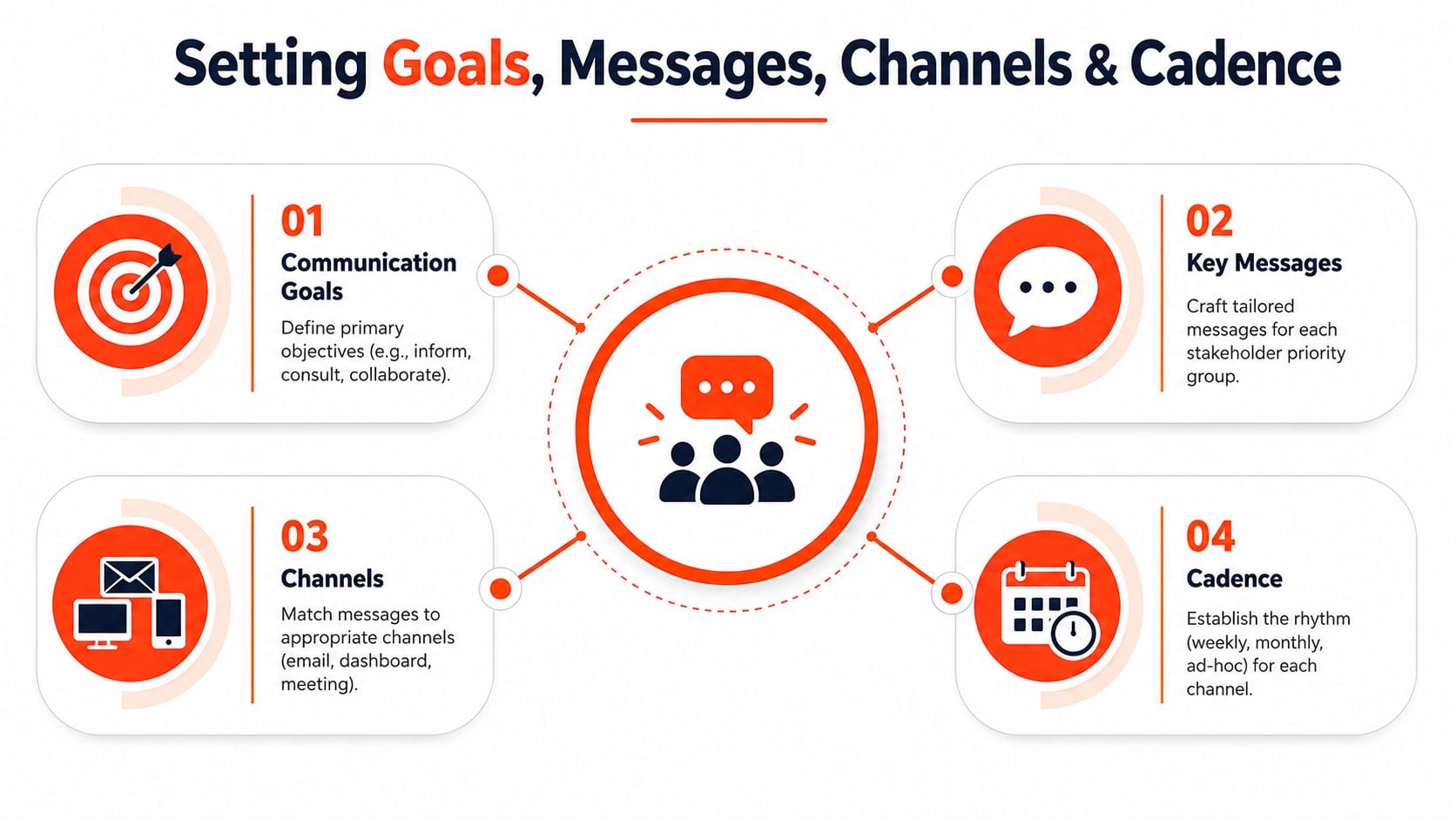
A communication plan works when each audience gets a message that matches its decision-making needs. That means the goal, the message, the channel, and the cadence all have to line up. If they don't, you end up with the classic mismatch, a detailed update sent to someone who only needed a decision, or a quick note sent to someone who needed context and risk.
Tie the message to the action you want
The cleanest way to write a message is to ask what the stakeholder should do with it. Inform them. Ask for approval. Invite input. Flag a risk. If the answer is unclear, the message will drift into vague commentary and nobody will know whether action is required.
Australian and New Zealand project frameworks emphasise identifying stakeholders, tailoring messages, and setting review points at milestones, which aligns with communication plans that specify who gets what information, how often, and through which channel simplystakeholders.com. That's the part teams often miss when they confuse “sent” with “received”.
Choose channels for response, not habit
Email is useful for traceable updates, but it's weak when you need discussion. Meetings are useful when decisions are needed, but they're wasteful if the message doesn't warrant live debate. Dashboards work when status needs to stay visible over time. A workshop makes sense when alignment is the goal and the group needs to hear each other, not just the project lead.
For hybrid teams, communication norms matter just as much as the channel itself. A practical reference on communication norms for hybrid teams is useful because mixed-location teams usually break down when expectations about response time, meeting etiquette, and follow-up aren't explicit.
Cadence should follow decision points
Cadence isn't about sending more messages. It's about sending them when they can still change the outcome. Set review points around milestones, approvals, launches, and risk gates. If the work is stable, the cadence can be lighter. If the work is volatile, the cadence needs to tighten until the risk settles.
If you want a sharper distinction between project goals and communication objectives, the internal guide on goals versus objectives is a useful companion, because the communication plan should support the objective, not just echo the project theme.
Templates Roles and Responsibilities That Make It Stick
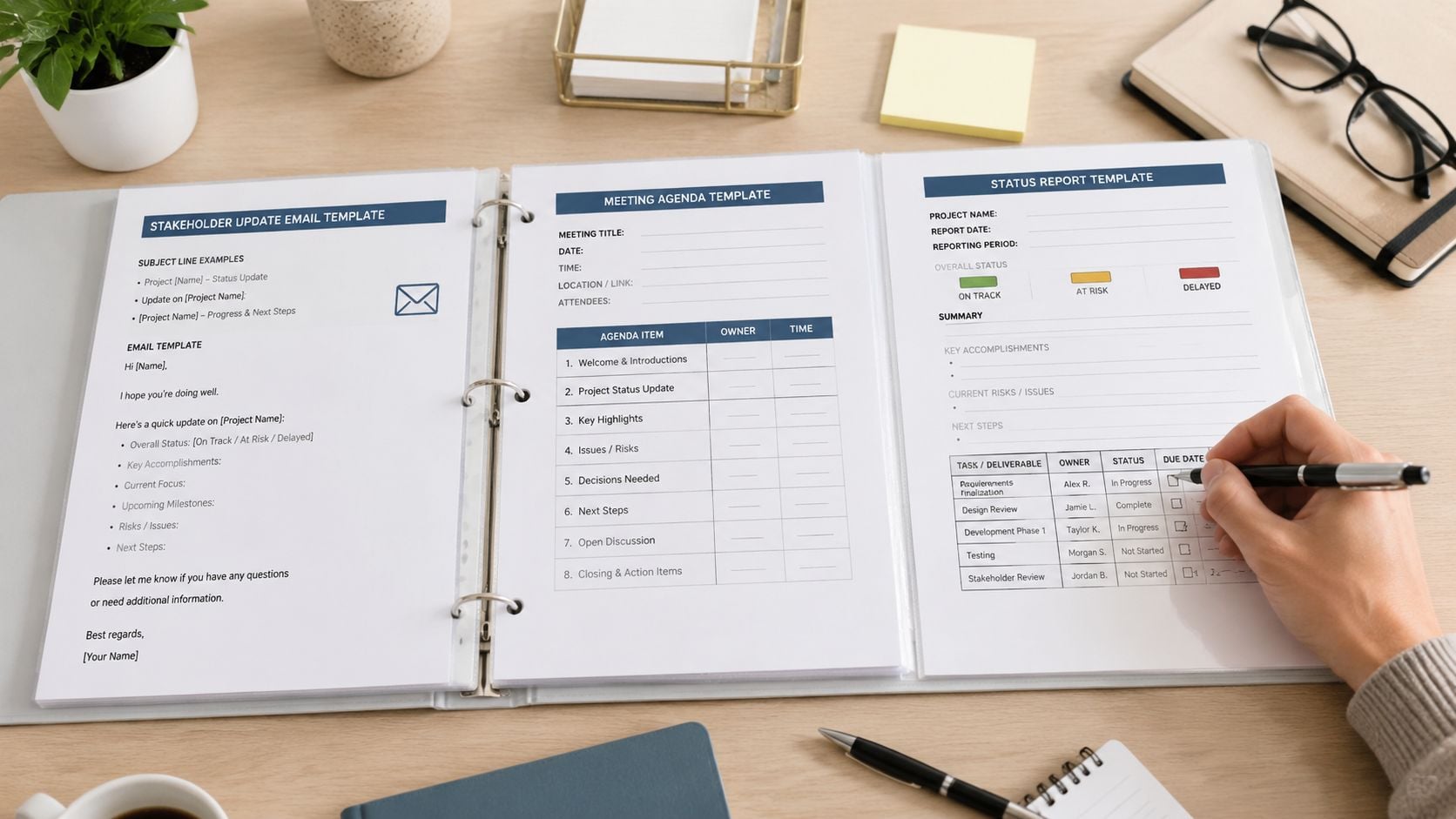
A plan falls apart when every update has to be invented from scratch. Reusable templates solve that problem because they make the output predictable, which means stakeholders know where to look and what each format is for. For a team juggling e-commerce, B2B, and reporting-heavy work, that consistency matters more than polished prose.
Build three core formats
A practical starter set is enough for most projects:
- Stakeholder update email: short context, current status, risks, next action, owner.
- Stakeholder meeting agenda: purpose, decisions needed, time boxes, follow-up owner.
- Status report: progress, blockers, milestone movement, dependencies, due dates.
The important part is not the template itself, but the discipline around it. Keep the subject line clear, the first line useful, and the decision or action near the top. If stakeholders need to read three paragraphs before they understand why the message exists, the format is already failing.
Assign ownership with no ambiguity
A RACI-style structure helps stop bottlenecks. One person drafts, one approves, one distributes, and one is informed. That sounds basic, but many teams collapse those roles into one overworked project lead. The result is late messaging, inconsistent tone, and no one checking whether the right audience received the right version.
The process also pairs well with transparent reporting. A practical PPC reporting template can be adapted into a stakeholder communication rhythm, especially when clients want campaign performance, actions taken, and next steps in one place instead of scattered across call notes and inboxes.
Keep the update format boring and the decisions clear. Stakeholders don't need a creative writing exercise, they need a document they can act on.
For meetings, make the owner responsible for circulation of notes and the action list within the agreed timeframe. For reports, set one approver and one backup. That way, the plan survives leave periods, busy weeks, and the inevitable handoff between strategy and execution.
Measuring Success and Closing Feedback Loops
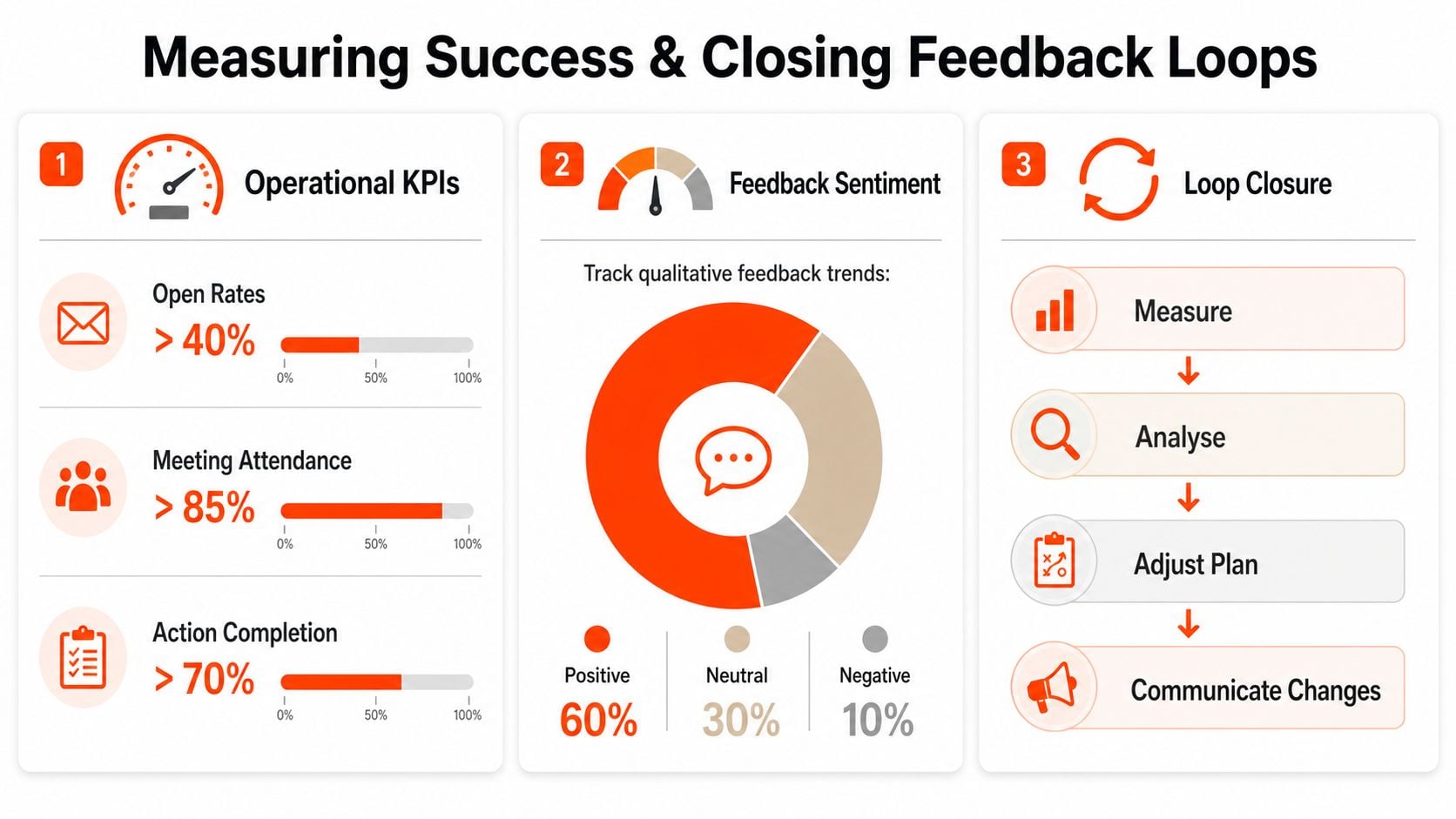
A stakeholder communication plan only works if you can tell whether it's working. Sending more messages isn't the goal. Getting the right response, at the right time, from the right group is the goal. That's why communication should be treated like a control system, not a filing system.
Track operational signals first
The most useful KPIs are the ones that tell you whether communication landed and triggered action. That includes on-time message delivery, meeting attendance, open and reply rates, and changes in stakeholder satisfaction. These are practical because they show whether the plan is reaching people and whether people are engaging with it.
PMI reports that organisations with highly effective communication have 80% of projects meeting original goals versus 52% for minimally effective communicators, with 71% vs 37% on-time delivery and 76% vs 48% within-budget delivery PMI. That doesn't mean communication alone causes every outcome, but it does show why weak communication deserves operational attention, not excuses.
Use thresholds that trigger action
A plan shouldn't wait for the post-mortem. Set simple thresholds that force review when engagement dips, attendance falls, replies slow down, or feedback turns negative. The response might be a channel change, a shorter update, a tighter cadence, or a switch from email to live discussion. The point is to correct course while the project is still moving.
Close the loop visibly
Feedback means nothing if the team never sees what changed because of it. Share the adjustment, explain why it happened, and assign ownership for the next check. That turns feedback from a symbolic gesture into a working part of delivery.
For a more dashboard-style approach to this, the internal guide on marketing KPI dashboard examples is useful because the same logic applies, the data should drive action, not sit in a report nobody revisits.
If the communication plan can't show what changed after feedback, it's not a loop. It's a log.
Sample Variations and Practical Tips for Every Project Type
A change programme, a client delivery, and a regulated build all need different communication shapes, even if the underlying framework is the same. Internal change work usually needs more room for manager briefings and adoption questions. Client-facing delivery needs tighter reporting and cleaner ownership. Regulated projects need formal checkpoints and a lower tolerance for ambiguity.
The equity check is where many plans still fail. Government template guidance warns planners to think carefully about groups that may have been historically left out, including people who speak languages other than English and families without consistent access to digital tools sgs.tea.texas.gov. In Australia, that matters because a plan that leans too heavily on email, portals, or webinars can miss rural stakeholders, time-poor SME owners, multilingual communities, or anyone who can't reliably join digitally.
That's why the best plans include fallback channels, translated assets where needed, and named intermediaries who can relay the message in a usable format. It also means treating access as a design issue, not a courtesy add-on. If the plan only reaches people who are already easy to reach, it's not a stakeholder plan. It's a convenience plan.
A few field-tested habits help across every project type:
- Keep low-interest groups light: don't flood people who only need milestone visibility.
- Escalate when access is uneven: switch formats if replies slow or attendance drops.
- Use plain language: remove internal jargon before the message leaves the team.
- Test the fallback path: make sure people outside the main channel still receive updates.
- Document who was excluded by default channels: then assign a remedy, not just a note.
The strongest plans aren't the most detailed ones. They're the ones that survive real delivery pressure, hold people accountable, and still reach the stakeholders everyone forgot to plan for.
If your stakeholder communication plan still lives in a spreadsheet and changes only after things go wrong, Click Click Bang Bang can help you turn reporting, cadence, and accountability into a cleaner operating rhythm. Visit Click Click Bang Bang to see how a data-led team can make stakeholder communication easier to manage, easier to measure, and harder to ignore.
Read NeXt
Or Read Our Latest
- Display Advertising on Google: The Complete Australian Guide
- Stakeholder Communication Plan How to Build One That Works
- User Generated Content Strategies That Actually Convert
- Copyright and Infringement Guide for Business Marketers 2026
- What Is Brand Positioning and Why It Drives Growth
- Push vs Pull Marketing: A 2026 Decision Guide
Click. CLick. Subscribe.
Get our best PPC insights, industry updates, and power moves delivered straight to your inbox. No fluff, just high-caliber strategies that actually work.
Don’t Leave Just Yet
Try Us For 30-Days,
Risk Free!!
We guarantee that you’ll love our work within the first 30 days, if not you’ll get your money back.
What have you got to lose?