

Instagram Advertising Australia: Complete 2026 Guide
Last Updated
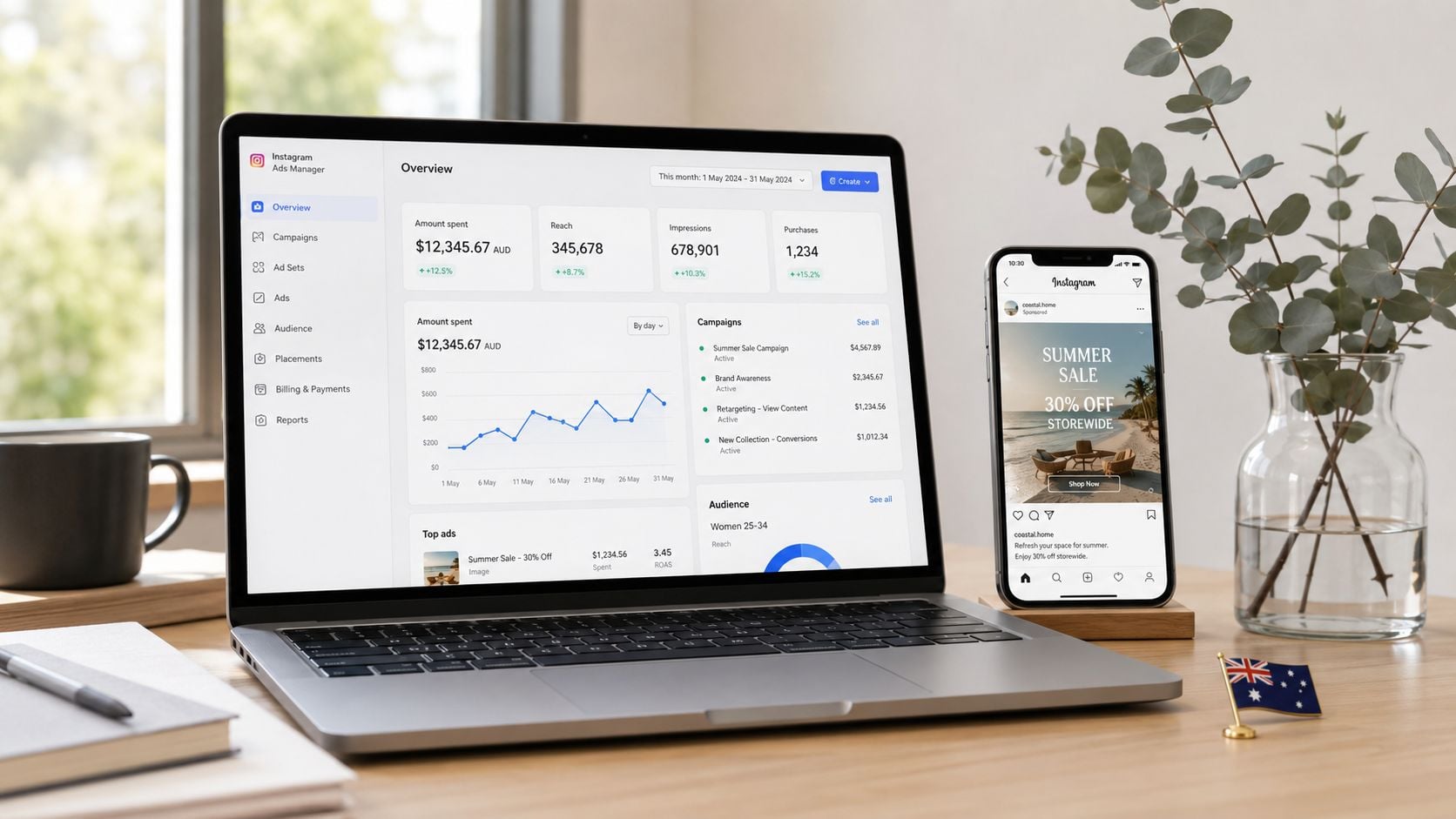
Instagram's Australian reach is far larger than many local marketing plans assume. Meta's advertising-planning data reported 15.2 million Instagram users in Australia in late 2025, equivalent to 56.0% of the total population and 66.1% of Australians aged 13 and over. The platform's ad reach also represented 57.7% of Australia's internet users, while potential ad-reach users grew by about 1.20 million, or 8.6%, between October 2024 and October 2025 (Australian Instagram audience data).
That scale makes Instagram advertising Australia a serious acquisition channel, not a decorative add-on for lifestyle brands. The challenge is that reach alone doesn't create profitable campaigns. Australian advertisers need local placement economics, age and intent segmentation, accurate conversion tracking, truthful claims, and brand-safety controls that protect the context in which an ad appears.
Why Instagram Advertising Matters for Australian Businesses
Australian Instagram advertising has enough scale to support awareness, retargeting, lead generation, and conversion campaigns. The reported 15.2 million-user audience gives e-commerce retailers, local service providers, education businesses, hospitality operators, and selected B2B companies access to a substantial pool of potential customers (Meta planning data reported by Sprout Social). Scale helps, but it does not make a campaign profitable by itself. Placement costs, audience quality, creative relevance, tracking accuracy, and brand safety still determine whether that reach produces useful results.
Instagram also operates within a mature Australian advertising market. The Australian Competition and Consumer Commission's digital platform inquiry data reported that Facebook and Instagram together generated between A$4.7 billion and A$5.1 billion in Australian advertising revenue in FY2021–22. The same source reported that between 150,000 and 200,000 Australian advertisers used Facebook and/or Instagram in September 2022. For advertisers, that adoption creates proven demand, but it also means competing for attention against established brands with strong creative and carefully managed budgets.
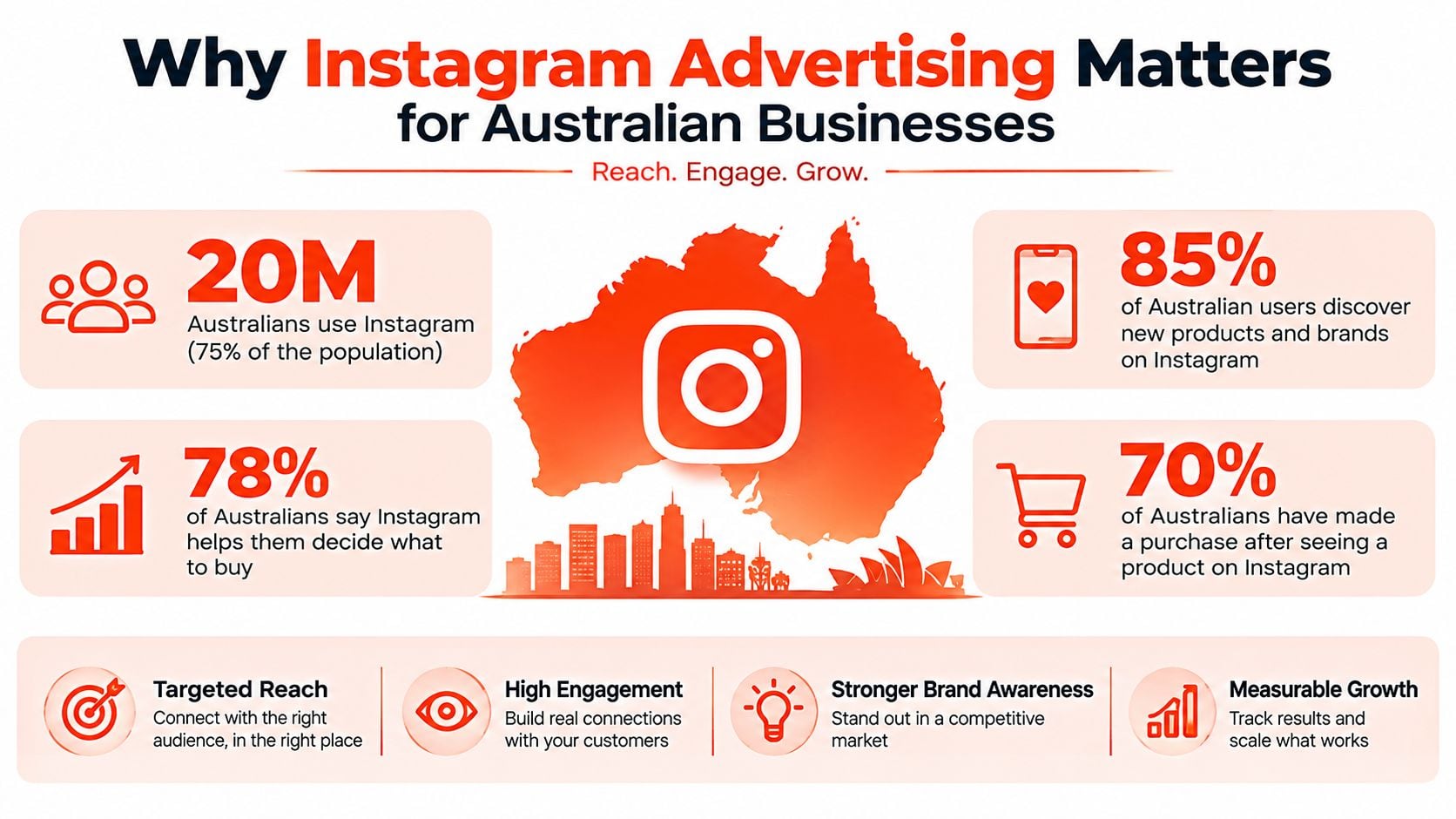
What the Australian scale means in practice
The audience is not evenly distributed by age, gender, or purchase intent. The reported adult advertising audience was 54.8% female and 44.6% male, which can inform creative testing, placement decisions, and budget allocation without replacing campaign data or customer research.
The strongest audience remains 25 to 34, while Australian digital behaviour data positions Instagram as a discovery and validation environment as well as a conversion channel (Digital 2026 Australia). A prospect might encounter a product in Reels, review the profile, compare reviews, and return through retargeting before purchasing. Last-click reporting can therefore undervalue the earlier interactions.
Strategic implication: Use Instagram for demand creation and conversion. Match the role to buyer awareness, offer complexity, trust requirements, and the placement economics of the campaign. Compliance and brand-safety controls belong in that decision, not after launch.
Setting Up Your Australian Instagram Advertising Account
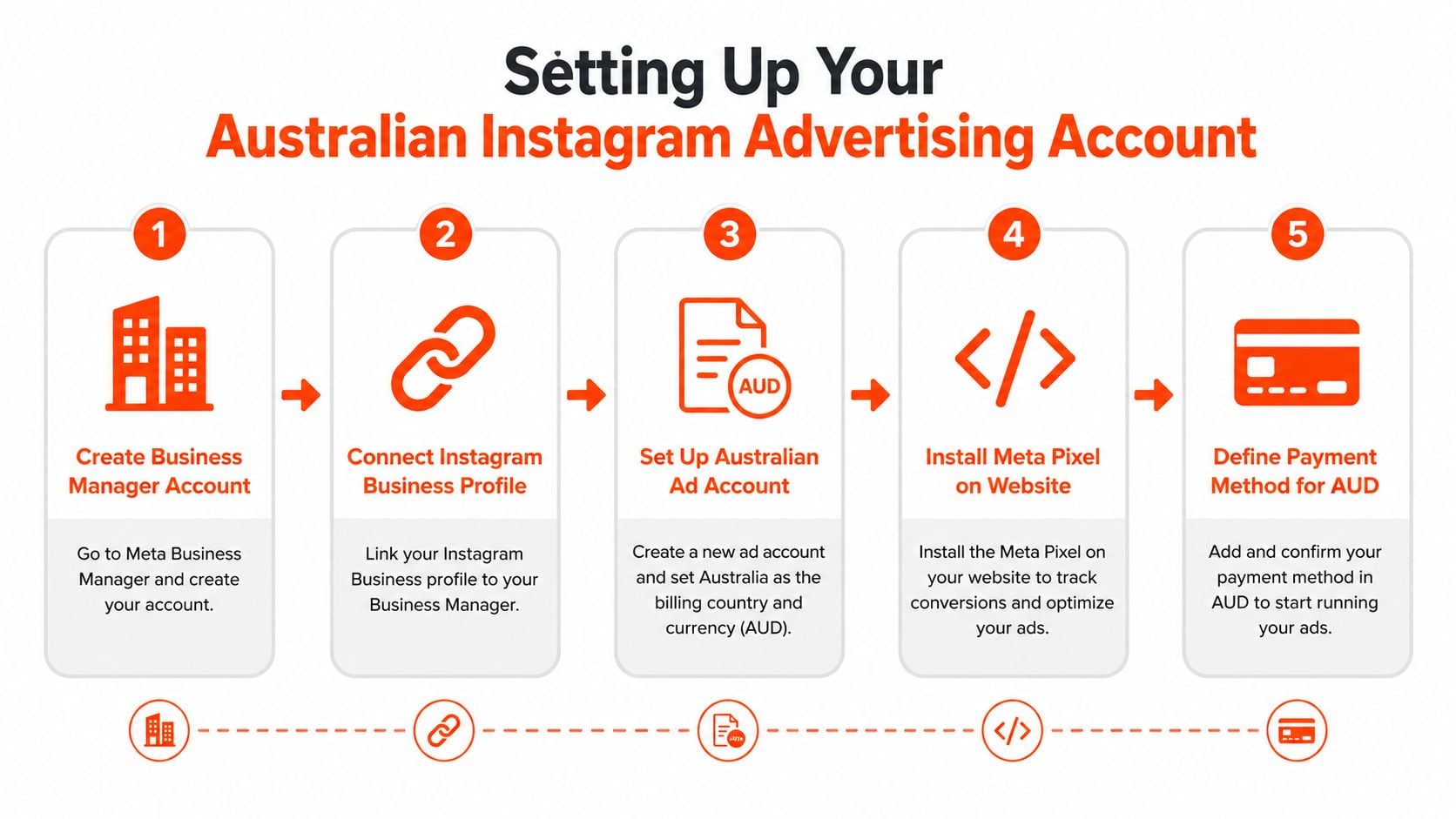
A reliable account structure prevents reporting, billing, and access problems before they affect campaign performance. Create a Meta Business account for the organisation, then assign people, Facebook pages, Instagram profiles, datasets, pixels, and ad accounts through role-based permissions. Avoid shared personal logins. They increase access risk and make it difficult to identify who changed a campaign or tracking setting.
Connect the Instagram professional account to the relevant Facebook page. Confirm that the business owns the required assets rather than having access to them. If an agency manages the campaigns, grant partner access instead of transferring ownership. The client then retains historical data, billing control, and business assets in its own environment.
Build the account around Australian reporting needs
Set the ad account to AUD as the currency and choose the correct Australian time zone before launching. These settings affect how teams read spend, invoices, budget pacing, and profitability. Use one account when the business shares a legal entity, reporting framework, and payment owner. Separate accounts can be appropriate where brands have different ownership, billing, permissions, or operating teams.
Install the Meta Pixel or dataset through the website's tag-management system. Configure events around the commercial journey, not around generic page activity. An online retailer will usually need product views, carts, checkouts, and purchases. A service business may need lead submissions, booked consultations, calls, or qualified enquiry stages.
Test the tracking before spending
Complete a test journey from ad click to confirmation page. Check event parameters, product values, transaction currency, consent handling, and deduplication. Where appropriate, compare browser-side and server-side signals, then reconcile Meta reporting with website analytics and the customer relationship management system.
Use a payment method owned by the business and monitor failed charges, spending restrictions, and verification requests. Keep a launch checklist for domain verification, event prioritisation, user permissions, naming conventions, and landing-page functionality.
In account audits, missing access, mismatched ownership, and untested tracking repeatedly create more launch friction than campaign configuration. Treat those checks as an operational control, not an administrative afterthought.
Video: a walkthrough of the account setup steps for launching Instagram advertising in Australia.
Choosing the Right Campaign Objectives for Australian Markets
A Melbourne coffee roaster launching a second location should usually start with a consideration objective, not sales. The campaign may need to build local familiarity and generate meaningful visits before enough purchase data exists for reliable optimisation. Objective choice determines which users Meta prioritises in the auction, so it should follow the business KPI rather than the most familiar setting.
Awareness suits a new brand, location, or product that needs repeated exposure. Judge it by reach, impressions, profile activity, branded search behaviour, and assisted conversions, rather than purchase efficiency. Those signals show whether the campaign is creating recognition, even though they do not prove immediate revenue.
Consideration objectives suit businesses that need an interaction before a sale. Traffic can support content discovery, but clicks may come from users with limited commercial intent. Engagement can distribute social proof and collect reactions, although inexpensive engagement does not confirm qualified demand. Lead campaigns can reduce friction for service businesses, provided sales staff review lead quality and follow-up outcomes.
Match the objective to the buying journey
For e-commerce, sales or purchase optimisation is generally the right destination once the website records reliable purchase signals and the product page converts mobile visitors. Catalogue-based or Advantage+ shopping campaigns can suit retailers with broad ranges and clean product data. Traditional conversion campaigns provide more control when the range is narrow, the offer needs separated audiences, or the advertiser requires a clearer test structure.
Australian auction costs can differ by placement and audience. Reels may deliver cheaper reach, while Feed or Stories can produce stronger intent for some offers. Treat placement performance as a testing question, not a universal rule. Compare cost per qualified action, conversion rate, and revenue by placement before shifting budget.
Service businesses need a stricter definition of success. A submitted form is not automatically a valuable lead. Add qualification questions, track booked appointments, and return meaningful downstream outcomes to reporting where the technology and consent framework support it.
Practical rule: Optimise for the event that represents business value, not the event that produces the largest dashboard number.
B2B advertisers often need patience because the sales cycle may involve several conversations. Educational creative can establish relevance, while lead forms or landing pages capture intent. A CRM connection helps distinguish an enquiry from an opportunity. Do not force every audience into a purchase objective when the offer requires research, approval, or a sales demonstration. Ensure claims and promotional conditions also meet Australian consumer-law requirements before scaling spend.
Targeting Australian Audiences Effectively
Australian Instagram targeting should reflect the path from discovery to confidence and action. The platform reaches a substantial share of local users, but audience size does not make every segment commercially useful. Earlier audience data points to 25 to 34 as a strong starting group. Test that segment first, then expand when performance and message-market fit justify broader reach.

Segment by age, geography, and intent
Age targeting should change the offer and creative, not merely the audience setting. Younger adults may respond to creator-led demonstrations, social proof, and mobile-first product education. Older audiences may require clearer value communication, stronger reassurance, simpler navigation, or a slower visual pace. Treat these as testing hypotheses rather than fixed rules.
Geography affects performance when delivery, pricing, stock, serviceability, or competition varies. Separate campaigns or ad sets can suit metropolitan areas, regional audiences, states, cities, or postcodes when the business serves them differently. A local tradie should exclude locations outside the service radius. A national retailer may use broad targeting and let creative or catalogue signals guide delivery.
Behavioural segments should follow intent. Build retargeting pools from product viewers, engaged video viewers, profile visitors, previous leads, and customers. Exclude recent purchasers from first-time-buyer campaigns unless the offer is designed for repeat purchase.
Use first-party data carefully
Customer lists and lookalike audiences can help find people resembling existing buyers or qualified leads. Source data must be permissioned, accurate, and handled within the applicable privacy framework. Keep prospecting separate from retargeting so reporting shows whether growth comes from new demand or repeated exposure to existing visitors.
A useful planning framework appears in this guide to target marketing for Australian businesses. Apply it to delivery areas, seasonal demand, purchase value, sales capacity, and the difference between an interested visitor and a ready buyer. In Australia, also check that audience exclusions, customer-data use, and advertising claims align with applicable privacy and consumer-law obligations.
Instagram supports validation as well as discovery. Australian users may inspect a brand's profile, review its creative, and compare its claims before converting. Retargeting should address those objections with proof, delivery information, or clearer terms instead of repeating the introductory message. Brand safety matters here too. Placement controls and exclusion settings can protect context, but overly narrow controls may reduce reach and raise auction pressure, so test their commercial effect rather than applying every restriction automatically.
Ad Formats and Creative Best Practices for Australian Audiences
Placement cost is one of the clearest Australian differences in Instagram campaign planning. Reported benchmarks put average CPM at about A$11.40 for Feed, A$7.60 for Stories, and A$6.20 for Reels (Australian Meta ads benchmarks). Those figures are useful starting points, not guarantees. Auction pressure, audience quality, creative relevance, seasonality, and objective can move actual costs.
| Placement | Average CPM (AUD) | Best Use Case | Typical CTR |
|---|---|---|---|
| Instagram Feed | A$11.40 | Product education, proof, considered offers | Around 1.11% Australia-wide Meta benchmark |
| Instagram Stories | A$7.60 | Fast offers, vertical demonstrations, direct response | Around 1.11% Australia-wide Meta benchmark |
| Instagram Reels | A$6.20 | Discovery, creator-style explanation, broad prospecting | Around 1.11% Australia-wide Meta benchmark |
The same benchmark source reports an Australia-wide average CTR of around 1.11% (Australian Meta ads benchmarks). CTR helps identify whether the ad earns attention, but it can't tell you whether clicks become profitable customers.
Choose the format before adapting the idea
Feed works well for products that need close inspection, comparison, or supporting copy. Stories suit a more immediate rhythm, with a strong first frame, readable overlays, and a clear tap-through action. Reels can create efficient reach, but inexpensive impressions are irrelevant if the creative attracts people who never engage with the offer.
Use platform-native production. Show the product, service, location, or result quickly, then explain why the viewer should care. Australian tone generally rewards clarity and confidence over exaggerated hype. Avoid claims that imply certainty unless the business can substantiate them, and don't use slang to appear local.
For video, build for sound-off viewing with legible text, but make the visual story understandable without reading every word. Test creator demonstrations, customer problems, product detail, founder explanations, and direct offer-led variations. Instagram Reels advertising guidance can help teams think through the format without treating Reels as a universal replacement for Feed or Stories.
Creative test: Keep the offer and landing page stable while changing the opening scene, proof point, presenter, and call to action. That isolates the reason performance changed.
Budgeting and Bidding Strategies in Australian Dollars
Set the budget from the economics of the business, not from an arbitrary platform recommendation. Begin with the value of a sale or qualified lead, the gross margin available after fulfilment, and the maximum acquisition cost the business can tolerate. For lead generation, include the sales team's capacity and the rate at which leads become revenue.
Use separate budget logic for prospecting and retargeting. Prospecting needs enough room to discover viable audiences and creative combinations. Retargeting needs restraint, because a small warm audience can receive excessive frequency if the budget grows faster than the eligible pool.
Keep the test structure intelligible
A common waste pattern is spreading a modest budget across too many ad sets, regions, age bands, objectives, and creatives. The account then produces noisy results, and the team changes settings before the system has enough information to make a useful delivery decision. Consolidate where the audience and offer are similar, then split only when the business needs a distinct message, geography, or measurement view.
Lowest-cost bidding is usually the sensible starting point when the advertiser wants delivery and has a clear conversion event. Cost-cap strategies can provide more control when the account has stable conversion history and the business needs to defend an acquisition-cost threshold, but a restrictive cap can reduce delivery and leave the campaign unable to compete.
The placement benchmarks above show why cheap CPM shouldn't become the sole allocation rule. Reels may buy lower-cost impressions than Feed, yet Feed can still produce stronger commercial outcomes for an offer that needs explanation. Judge each placement against downstream leads, qualified opportunities, purchases, revenue, and margin.
Scale with discipline
Increase spend gradually on campaigns that maintain conversion quality, rather than scaling every campaign with a low CPM or attractive CTR. Refresh creative when the audience has seen the same message repeatedly, and launch a new angle when performance falls because the offer has become familiar, not merely because one day's results look weak.
Report spend in AUD, separate media cost from production and management fees, and reconcile Meta purchases or leads with backend revenue. A clean weekly view should show delivery, cost, conversion rate, qualified outcomes, revenue, and profit contribution.
Compliance, Brand Safety, and Measurement for Australian Campaigns
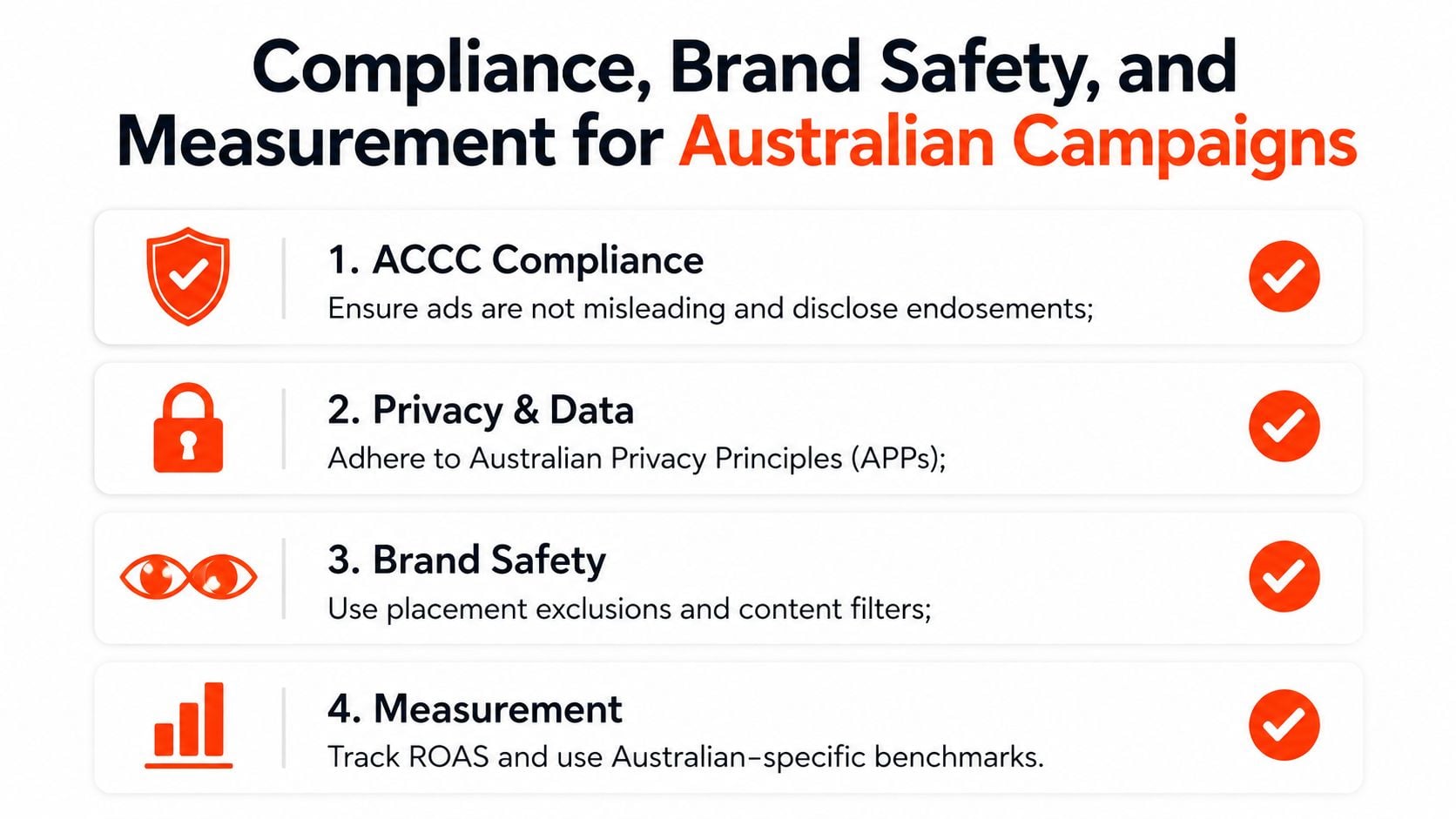
Australian Instagram advertising can fail after launch if claims, disclosures, placements, or tracking have not been checked together. The ACCC's social media promotions guidance requires social media content to be accurate and truthful and addresses influencer advertising and endorsements. Pre-approve ad claims, creator disclosures, landing-page copy, offer conditions, and evidence for any performance statement before spending begins.
Treat trust as a performance variable
An Australian IAS study found that 79% of social media users had engaged with a social media ad in the past year, while 40% said fake news had reduced their trust in ads in their feeds. The study also reported that 44% experienced negative brand perceptions when ads appeared beside inappropriate content, and 66% were unlikely to buy from ads shown beside unsafe content (IAS Australian social media advertising findings).
Creative quality cannot compensate for unsuitable placements or a damaged brand context. Set content controls and exclusions before launch, decide which sensitive environments the brand will accept, and review comments and creator partnerships throughout the campaign. A low-cost impression can become expensive if it creates negative sentiment or weakens conversion quality.
Build measurement that can survive scrutiny
Document a conversion taxonomy before campaigns run. Define each stage, from impression and click through to engaged visitor, lead, qualified lead, sale, repeat customer, and revenue. Check that Meta records the intended event, website analytics preserves source information, and the CRM stores campaign and ad identifiers where available.
The Australian privacy and data privacy compliance considerations should inform tracking design when campaigns use customer lists, lead forms, remarketing audiences, or analytics integrations. Collect only the data the business needs, explain its use clearly, and involve appropriate legal or privacy advisers for the business's circumstances.
Influencer content needs clear commercial disclosures and claim review before publication. Regulated categories may carry additional requirements, so general ACCC guidance does not replace category-specific advice. Keep an audit trail covering approved copy, landing pages, creator instructions, exclusions, edits, and reporting decisions.
Measure Instagram within the customer journey, then test platform results against analytics, CRM, and revenue data. Review assisted behaviour where available, but optimise towards outcomes the business can verify rather than using attribution language to defend weak economics.
Click Click Bang Bang can set up and manage Meta campaigns across Facebook and Instagram, including Business Manager, pixel or dataset configuration, custom conversions, creative testing, and reporting. Visit Click Click Bang Bang to discuss a PPC plan aligned with your commercial goals.
Read NeXt
Or Read Our Latest
- Manual vs Automated Bidding for PPC Success
- Conversion Tracking Setup: A Complete AU Guide
- Instagram Advertising Australia: Complete 2026 Guide
- Pay Per Click: A Beginner’s Guide for Australian Marketers
- Display Advertising on Google: The Complete Australian Guide
- Stakeholder Communication Plan How to Build One That Works
Click. CLick. Subscribe.
Get our best PPC insights, industry updates, and power moves delivered straight to your inbox. No fluff, just high-caliber strategies that actually work.
Don’t Leave Just Yet
Try Us For 30-Days,
Risk Free!!
We guarantee that you’ll love our work within the first 30 days, if not you’ll get your money back.
What have you got to lose?