

Pay Per Click: A Beginner’s Guide for Australian Marketers
Last Updated

Australia's internet advertising market reached A$18.4 billion in 2025, with search advertising taking 44% of total online advertising spend. Pay per click is therefore not a side experiment for Australian businesses, it's a foundational channel that demands disciplined budgeting, accurate tracking and a clear view of customer intent.
That scale changes the question marketers should ask. “What's the average cost per click?” sounds practical, but a blended benchmark can hide the difference between a high-intent Google Search click, a discovery-focused Meta click and a professional lead from LinkedIn. The useful question is whether a specific platform, campaign and landing page can acquire the right customer at an acceptable cost.
Understanding Pay Per Click Advertising
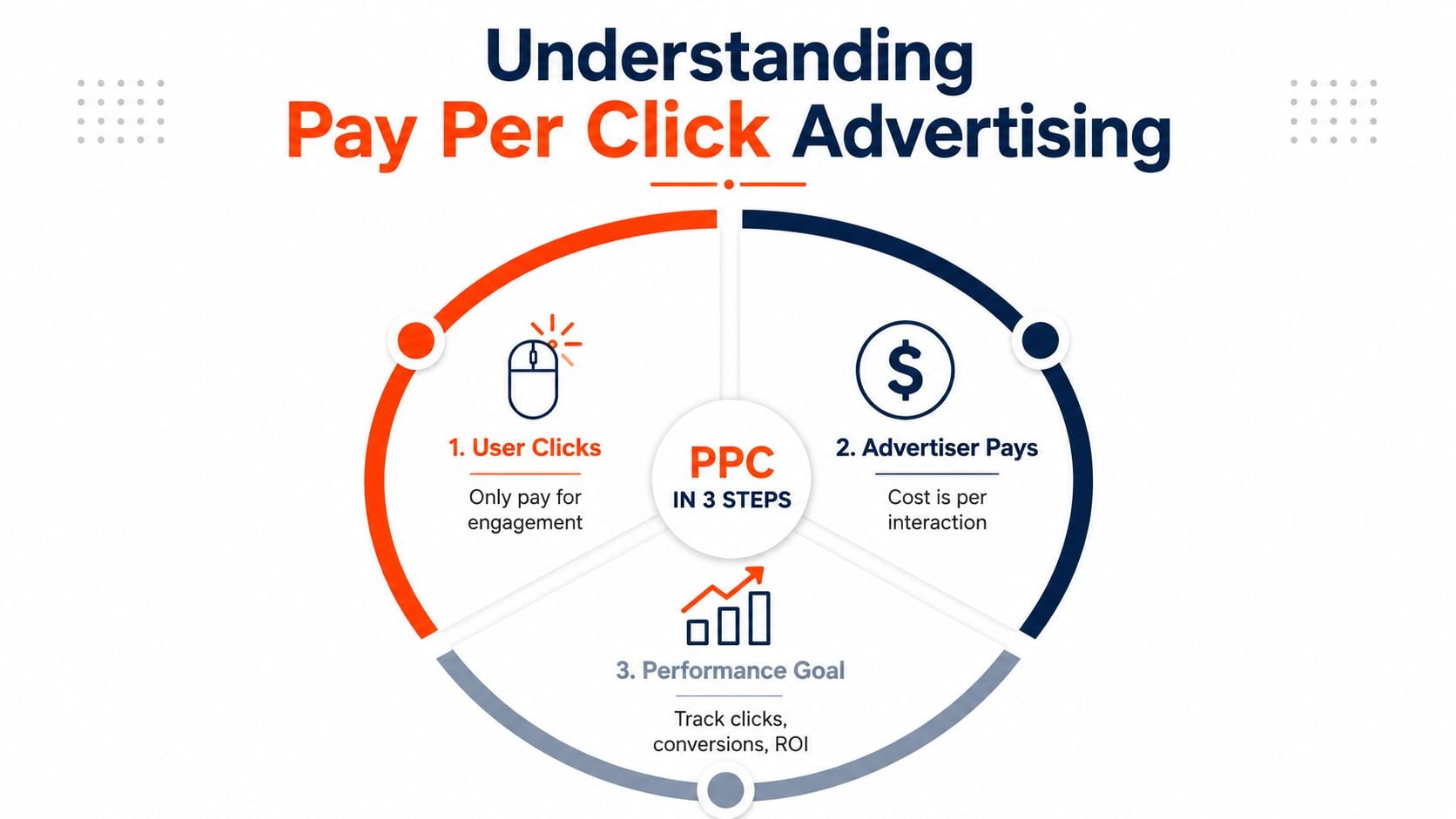
Pay per click, or PPC, is an advertising model where a business is charged when someone clicks an ad. The model connects spend to an identifiable interaction rather than relying solely on exposure, but a click is still only the start of the commercial process. The final outcome might be a purchase, enquiry, phone call, booking or qualified B2B conversation.
In Australia, search advertising reached A$8.0 billion in calendar year 2025, up 11.5% from 2024, and represented about 44% of total online advertising spend, according to the IAB Australia Internet Advertising Revenue Report prepared by PwC Australia. Search was the largest single component of a total internet advertising market worth A$18.4 billion.
That makes PPC a core part of Australian media buying. It also means competition is real. Businesses compete for attention through Google Search, Google Shopping, Meta, Instagram, LinkedIn and other placements, each with different audience behaviour and different definitions of value.
What you're actually buying
A PPC account doesn't buy traffic. It buys an opportunity to appear at a particular moment, in front of an audience selected through search intent, audience signals, location, device, remarketing status or professional attributes. The platform then decides whether the ad qualifies for an opportunity and how it compares with other eligible advertisers.
Your result depends on more than the amount you're willing to spend. Ad relevance, landing-page alignment, budget control, targeting quality and conversion measurement all affect whether clicks become useful business outcomes.
Practical rule: Treat the click as a paid entrance to your sales process, not as proof that the campaign worked.
A low-cost click can be worthless if it comes from an irrelevant search or an audience with no buying intent. A more expensive click can be commercially sensible when it leads to a valuable customer. That's why Australian PPC planning should begin with funnel stage and customer value, then move to platform and bidding decisions.
How Pay Per Click Auctions and Bidding Work
Every eligible PPC impression enters an auction. On Google Search, the highest bidder does not automatically win the top position. The platform weighs the bid alongside ad quality, query relevance and the expected usefulness of the result. Ad rank captures the practical relationship between those factors.
That distinction matters in Australia, where rising CPCs and competition in high-intent categories can make broad bidding expensive. A larger budget may still produce weak visibility when the ad misses the search intent or the landing page fails to deliver its promise. A tightly structured campaign can compete more effectively by improving relevance, targeting and the experience after the click.

For a technical explanation of the factors involved, see this guide to the Google Ads ad rank formula. The operational lesson is straightforward: higher bids cannot indefinitely compensate for weak relevance, poor creative or an unconvincing landing page.
The metrics that connect auction and revenue
CPC, or cost per click, shows what you pay for a visit. CPA, or cost per acquisition, connects that visit to a defined conversion. ROAS, or return on ad spend, compares tracked revenue with advertising expenditure. Each metric answers a different question, so using only one can hide problems in the funnel.
A campaign may achieve a strong click-through rate but a weak CPA because the landing page does not convert. It may also record a higher CPC and stronger ROAS when those clicks come from better-intent searches. Compare the path from impression to click to conversion, then judge the result against funnel stage and customer value rather than a generic CPC benchmark.
Auction data remains incomplete. Google Ads auction insights reports visibility and competitive-position signals, including impression share and outranking share, in Google's Australian auction insights documentation. It does not disclose competitors' bids, budgets, keywords or quality scores. Use the report to identify patterns, then adjust your own bids, relevance, landing page and pacing.
Major Platforms and Their Strengths
Platform choice should follow customer behaviour, not the popularity of the advertising interface. Search and social campaigns can both generate conversions, but they often reach people at different points in the decision process.
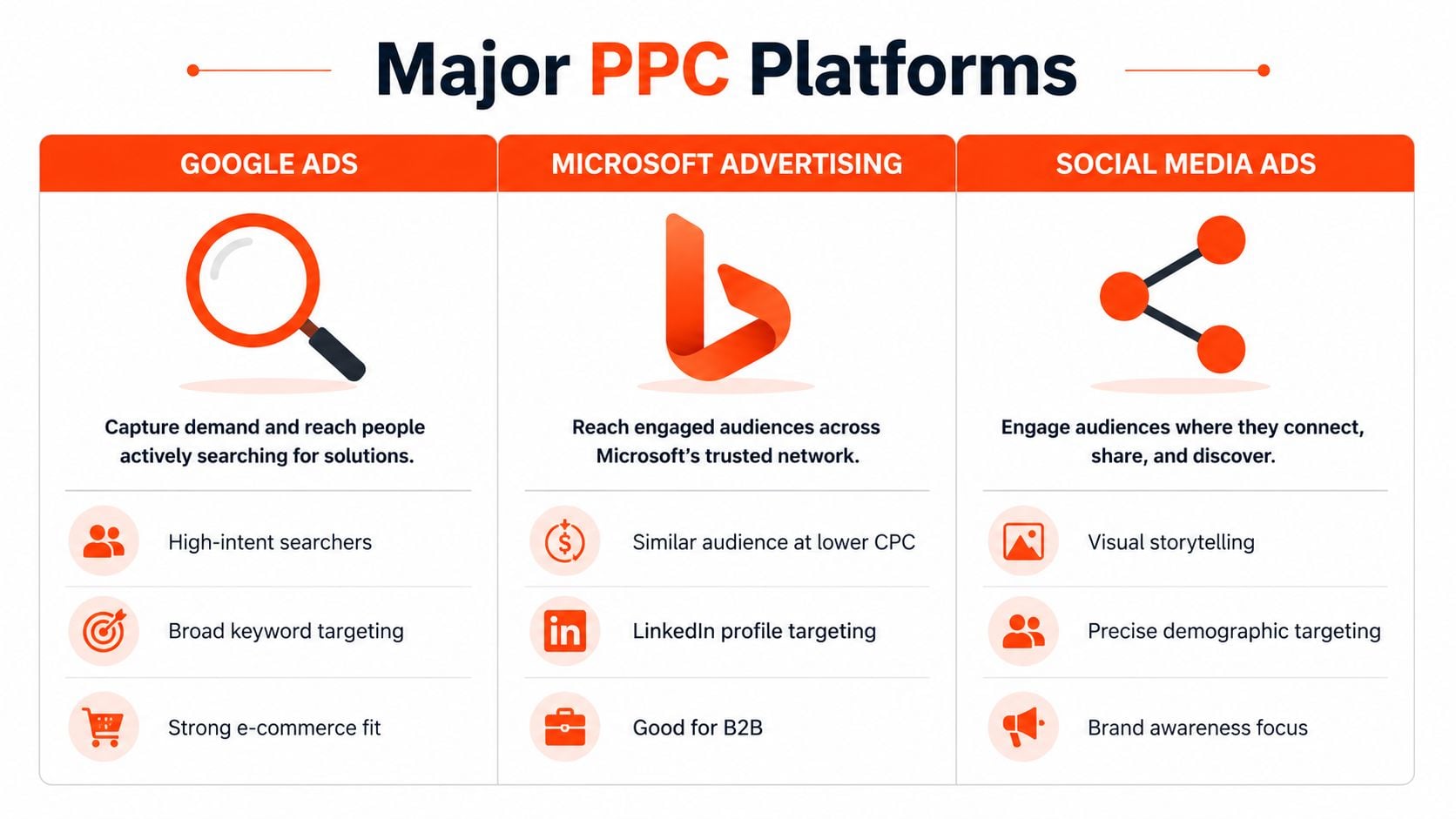
| Platform | Strongest role | Main trade-off |
|---|---|---|
| Google Search | Capturing active demand | High-intent categories can attract intense competition |
| Google Shopping | Presenting products with visual and commercial context | Feed quality and product economics matter |
| Meta and Instagram | Discovery, creative testing and remarketing | Users may not be actively shopping |
| Reaching professional audiences for B2B | Audience quality must justify potentially higher acquisition costs |
Google Search is usually the clearest starting point when a customer already knows the problem and is looking for a provider. Google Shopping can help retailers put product information directly in front of shoppers, but weak product data, inconsistent pricing or low-margin products can undermine the campaign.
Meta and Instagram are useful when creative can create demand or demonstrate a product quickly. They can support prospecting and remarketing, but a click from a browsing user shouldn't be judged by exactly the same standard as a search from someone seeking a supplier.
LinkedIn makes sense when job function, industry or company context is central to qualification. It's less suitable when a business needs broad, low-friction consumer reach.
Before connecting platforms, review an integration guide for Google Ads to understand how campaign data and systems can work together. Integration should support measurement and workflow, not encourage indiscriminate expansion across every available channel.
Campaign Types and Strategic Use Cases
Campaign format should reflect the path from intent to revenue. A local trades business, an online retailer and a B2B software company may all use PPC, but their campaigns should not share the same structure or success criteria.
A local plumber might use tightly grouped Search campaigns around urgent service queries, with location controls and phone-call measurement. The business needs qualified local enquiries, not a large audience of people researching unrelated maintenance topics. Negative keywords and clear service-area messaging protect the budget.
An e-commerce retailer has a different job. Search campaigns can capture product and category intent, while Shopping campaigns display product information before the click. Remarketing can reconnect with visitors who viewed products but left without purchasing, although the retailer still needs to monitor frequency, margins and the quality of the offer.
Matching format to funnel stage
- Demand capture: Search campaigns work best when people already express a need through their query.
- Product evaluation: Shopping supports comparison by placing product details close to the buying decision.
- Demand creation: Meta and Instagram can introduce products before a customer searches for them.
- Professional qualification: LinkedIn campaigns can focus on business roles and organisational fit.
- Re-engagement: Remarketing gives previous visitors another opportunity to return, provided the message adds a reason to act.
Performance Max can combine multiple Google inventory types, but automation doesn't remove the need for sound conversion definitions, quality creative and sensible exclusions. Give the system useful signals, then judge its contribution against business outcomes rather than accepting every reported conversion at face value.
The strategic mistake is allowing each campaign to pursue the same audience without a role. A portfolio works when Search captures existing demand, social creates or nurtures interest, Shopping supports product discovery and remarketing recovers qualified visitors.
Understanding CPC and Australian Market Costs
A single “average CPC in Australia” rarely provides a reliable budget. Australia-focused analysis notes that there is no official Australia-wide CPC dataset, while many published benchmarks draw heavily on US data. Industry, device, campaign type and search intent can change costs substantially, as explained in this Australia PPC benchmark analysis.
Published comparisons are still useful because they show how widely costs vary. 2026 Australian data places Meta CPCs around A$1.47. Finance and insurance sits around A$4.20, while entertainment and media is around A$0.43, according to the Australia Google Ads CPC statistics analysis. These figures describe different auctions, audiences and levels of intent, so they should not become interchangeable planning inputs.
CPC is only one budget variable
A lower CPC can suit an awareness campaign, while a higher CPC may be acceptable when the click comes from someone comparing providers or products. Judge each channel against conversion rate, average order value, lead quality, sales cycle and follow-up capacity.
For example, an Australian finance advertiser might pay more for competitive clicks, yet still justify that cost if qualified applications convert at a profitable rate. A retailer may accept higher Shopping costs for product-led traffic, while a B2B company may value fewer LinkedIn enquiries because they better match its target roles. The useful comparison is cost per qualified opportunity or sale, not CPC in isolation.
Competition is increasing as the market expands. Internet advertising reached A$18.4 billion in 2025, up 11.5% year on year, with search representing about 44% of spend, according to IAB Australia's 2025 market report. Set bids and budgets according to the funnel stage, margin and conversion evidence available. For practical context on paying for online advertising, review the payment models before comparing channel costs.
Setting Up Your First Campaign
A campaign can be launched quickly, but a clean measurement foundation takes more care. Start by writing the commercial objective in plain language. “Generate leads” is incomplete unless you define which lead events matter, what makes one qualified and how the sales team records the outcome.
Build the account around decisions
Use separate campaigns where budget, location, product group or business objective requires different control. Group closely related keywords and messages, but don't create so many small segments that each receives too little data to guide a decision. The account should make it easy to answer where money went and what it produced.
Before writing ads, map the landing page experience. The page should fulfil the promise in the ad, make the next action obvious and work for the devices your customers use. A persuasive ad cannot repair a confusing form, unclear service area or product page that fails to answer buying questions.
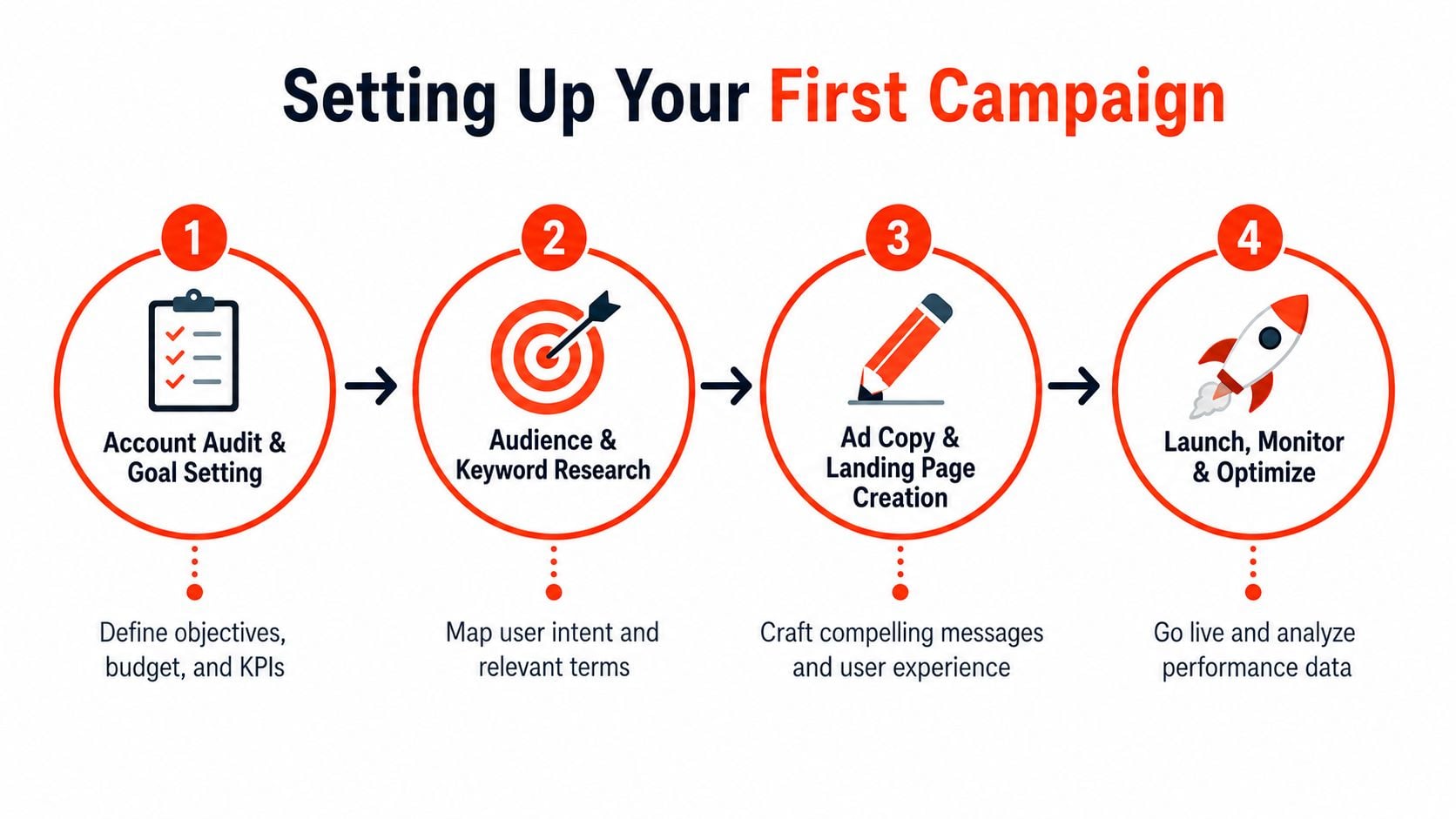
Tracking is the essential step. Google Ads records a conversion after an implemented tag detects the defined action, commonly through Google Tag Manager or a direct website tag. The conversion action must also specify a value and counting method, such as counting every conversion or one conversion, as set out in Google's conversion tracking documentation for Australia.
Measurement rule: If a form submission, purchase or phone call doesn't trigger the intended event, automated bidding receives a distorted view of campaign value.
Test each important event before launch. Then choose a bidding approach that matches the account's evidence. Automation can be useful once tracking is reliable, but it shouldn't be asked to optimise towards missing or duplicated conversions. Teams building a wider operating stack can also find tools for marketers to support research, creative production and reporting.
Optimization Tactics and Common Pitfalls
PPC optimisation depends on the relationship between ad promise, landing-page experience and conversion quality. Rising Australian CPCs make that relationship more important. A campaign can attract clicks while producing few qualified enquiries, especially when generic CPC benchmarks hide differences between brand, non-brand and high-intent searches.
Start with search terms and conversion paths. Add negative keywords when queries show irrelevant intent, remove targeting that attracts unqualified users and check location settings carefully. Review performance by funnel stage before reallocating budget. A prospecting campaign may need different efficiency expectations from a campaign targeting users ready to buy.
Where experienced operators spend their time
- Creative: Refresh messaging when response declines, while recording each change so performance comparisons remain useful.
- Landing pages: Match the headline, offer and call to action to the ad. Remove distractions that compete with the intended conversion.
- Budget pacing: Shift spend toward campaigns producing acceptable business outcomes, not more traffic. Protect budget for stages where conversion data is reliable.
- Auction diagnosis: Use auction insights to separate limited visibility from competitive pressure or budget constraints. The report can show patterns in presence and ranking, but it cannot confirm a rival's bid or budget.
- Human review: Let automation adjust bids and use audience signals, while retaining control over exclusions, positioning and commercial priorities.
The auction-insights report provides visibility indicators such as impression share and outranking share. It does not reveal competitor bids or budgets, so treat changes as evidence of market pressure rather than proof of another advertiser's strategy. As noted earlier, interpret these signals alongside search terms, conversion value and Australian location performance.
A common failure is chasing CTR because it looks healthy in a dashboard. High CTR may reflect curiosity, broad intent or compelling copy that attracts people who will not buy. Another failure is leaving a campaign untouched without checking search terms, landing-page quality and actual sales feedback.
For video and social creative, the 2026 YouTube CTR framework offers a useful way to examine click-through performance. CTR still needs to connect with conversions and customer value before it justifies more budget.
When to Handle PPC In-House and When to Hire Help
DIY PPC suits a business with a focused offer, a manageable account and someone who can review performance consistently. It also suits an owner who wants to learn the mechanics before investing in a broader programme. Start with a narrow objective, reliable conversion tracking and a budget you can evaluate without putting core operations under pressure.
External help becomes more useful when the account spans several platforms, products, locations or funnel stages. Complex attribution, large product feeds, B2B lead qualification and frequent creative testing all create work beyond changing bids. The right partner should explain decisions clearly, show what the campaigns produced and identify where the data remains incomplete.
A practical decision framework
Choose in-house management when:
- The structure is simple: One clear offer and a small number of campaign objectives are easier to govern.
- The owner is available: PPC needs regular search-term, conversion and budget reviews.
- The tracking is dependable: Decisions are only as sound as the events feeding the platform.
Consider specialist support when:
- Several channels interact: Search, Shopping, Meta and LinkedIn need coordinated budget and audience decisions.
- Lead quality matters: The business must connect ad activity with sales outcomes, not just form volume.
- Testing has become operationally heavy: Creative, landing pages, feeds and attribution require dedicated attention.
An agency is not a substitute for commercial clarity. Before hiring, ask how it handles tracking, reporting, budget changes, negative keywords, landing-page feedback and communication with sales. A PPC agency should make the account easier to understand, not hide complexity behind a dashboard.
Click Click Bang Bang offers PPC management across Google Search, Google Remarketing, Google Shopping, Meta and LinkedIn, with reporting and campaign support structured around business priorities. Its approach can suit Australian retailers, B2B teams, startups and SMEs that need a coordinated advertising process rather than isolated platform activity. For more context, review this guide to what a PPC agency does.
If you're deciding where to place your next Australian advertising dollar, Click Click Bang Bang can audit your tracking, map campaigns to funnel stage and manage Search, Shopping, Meta or LinkedIn activity around measurable business outcomes. Visit Click Click Bang Bang to discuss a PPC plan built around your actual customers, conversion process and budget constraints.
Read NeXt
Or Read Our Latest
- Manual vs Automated Bidding for PPC Success
- Conversion Tracking Setup: A Complete AU Guide
- Instagram Advertising Australia: Complete 2026 Guide
- Pay Per Click: A Beginner’s Guide for Australian Marketers
- Display Advertising on Google: The Complete Australian Guide
- Stakeholder Communication Plan How to Build One That Works
Click. CLick. Subscribe.
Get our best PPC insights, industry updates, and power moves delivered straight to your inbox. No fluff, just high-caliber strategies that actually work.
Don’t Leave Just Yet
Try Us For 30-Days,
Risk Free!!
We guarantee that you’ll love our work within the first 30 days, if not you’ll get your money back.
What have you got to lose?