

How to Measure Advertising Effectiveness: Real World Guide
Last Updated

Why Most Advertising Measurement Goes Wrong

Let's face it, measuring advertising effectiveness can be a real headache. You're drowning in data, but often it's not telling you the right story. I've spoken with countless marketing directors here in Australia, and the biggest frustration I hear is about vanity metrics. Those are the flashy numbers – impressions, clicks, likes – that look impressive in a report, but don’t necessarily impact your bottom line.
Imagine a Facebook campaign that racks up thousands of likes and shares. Looks fantastic on the surface, right? But what if those engagements aren't coming from your ideal customers? What if none of those likes convert into actual sales? Suddenly, those impressive numbers lose their shine.
This is the problem with focusing on surface-level metrics. You might think your campaign is a smashing success, while in reality, it's not delivering tangible results.
This often comes down to relying on last-click attribution, a model that gives all the credit to the final click before a purchase. In today's multi-channel world, this is rarely accurate. A customer might see your ad on Instagram, then do some research on Google, and finally buy something weeks later through a retargeting ad. Attributing everything to that last click completely ignores the valuable role played by earlier touchpoints. This flawed approach can lead to wasted budget and missed opportunities.
And this isn't just a theoretical problem. It's costing Australian businesses real money. Australia's digital advertising market is predicted to reach US$20.74 billion in 2025. It's vital to measure what actually works and maximize your return on investment. For more insights into this booming market, check out this report: Australia: Advertising Market Outlook. If you’re spending marketing dollars, you need to know they're being used effectively.
The Danger of Misinterpreting Data
One common mistake is measuring everything just because you can. This leads to a flood of data that obscures what's truly important. Instead of focusing on metrics that drive business outcomes – leads, sales, customer lifetime value – you get bogged down in irrelevant numbers.
Another trap is ignoring the human element. Data tells part of the story, but it doesn't tell the whole story. Customer feedback, brand perception, and market research are crucial for understanding the full impact of your campaigns. Are your ads resonating with your target audience? Are they building positive brand associations? These are questions data alone can't answer.
The solution is to focus on actionable metrics. These are the numbers that give you clear insights into what’s working, what's not, and what to improve. By understanding which interactions genuinely influence customer behavior, you can fine-tune your campaigns for maximum impact and ROI. This means shifting your focus away from vanity metrics and towards those that truly matter for your bottom line. And that’s what we'll dive into in the following sections.
Building Your Measurement Strategy That Actually Works
Forget the complicated jargon. Let's have a real chat about how successful marketers actually measure their advertising effectiveness. It all begins with your business objectives. What's the end game? More sales? Boosting brand awareness? Getting people to download your awesome new app?
Once you've got a crystal-clear picture of your goals, you can reverse-engineer the process to pinpoint the key performance indicators (KPIs) that actually matter. It's like planning a road trip – you need to know where you're going before you map out the route.
For example, if you're aiming to boost online sales, just counting impressions is like counting cars on the highway – it doesn't tell you how many people actually stopped at your roadside stand. You need to track metrics like conversion rate, average order value, and cost per acquisition (CPA). These tell you how effectively your ads are turning views into actual purchases, not just eyeballs on your website.
Setting realistic benchmarks is also key. What's considered a good conversion rate in your industry? What CPA can you realistically afford? Researching industry averages and factoring in your budget will help you set targets that are both ambitious and achievable for your specific business. Don't fall into the trap of measuring everything just because you can. It's better to focus on a few vital KPIs that directly align with your objectives.
Aligning KPIs With Business Objectives
The magic happens when your KPIs work in harmony with your overall business strategy. Think of it this way: your business objectives are the destination, and your KPIs are the roadmap that guides you there. Here's a simple framework to help you connect the dots:
-
Start with the "why": Clearly define your business objectives. What are you ultimately hoping to achieve with your advertising efforts?
-
Identify the drivers: What key activities or outcomes will contribute to achieving those objectives? What levers can you pull to get where you need to go?
-
Choose your metrics: Select the specific KPIs that will measure the success of those drivers. Which numbers will tell you if you're on the right track?
To help visualize this connection, take a look at the infographic below. It shows how key metrics can be displayed on a digital dashboard, making it easy to see what's working and what needs tweaking.
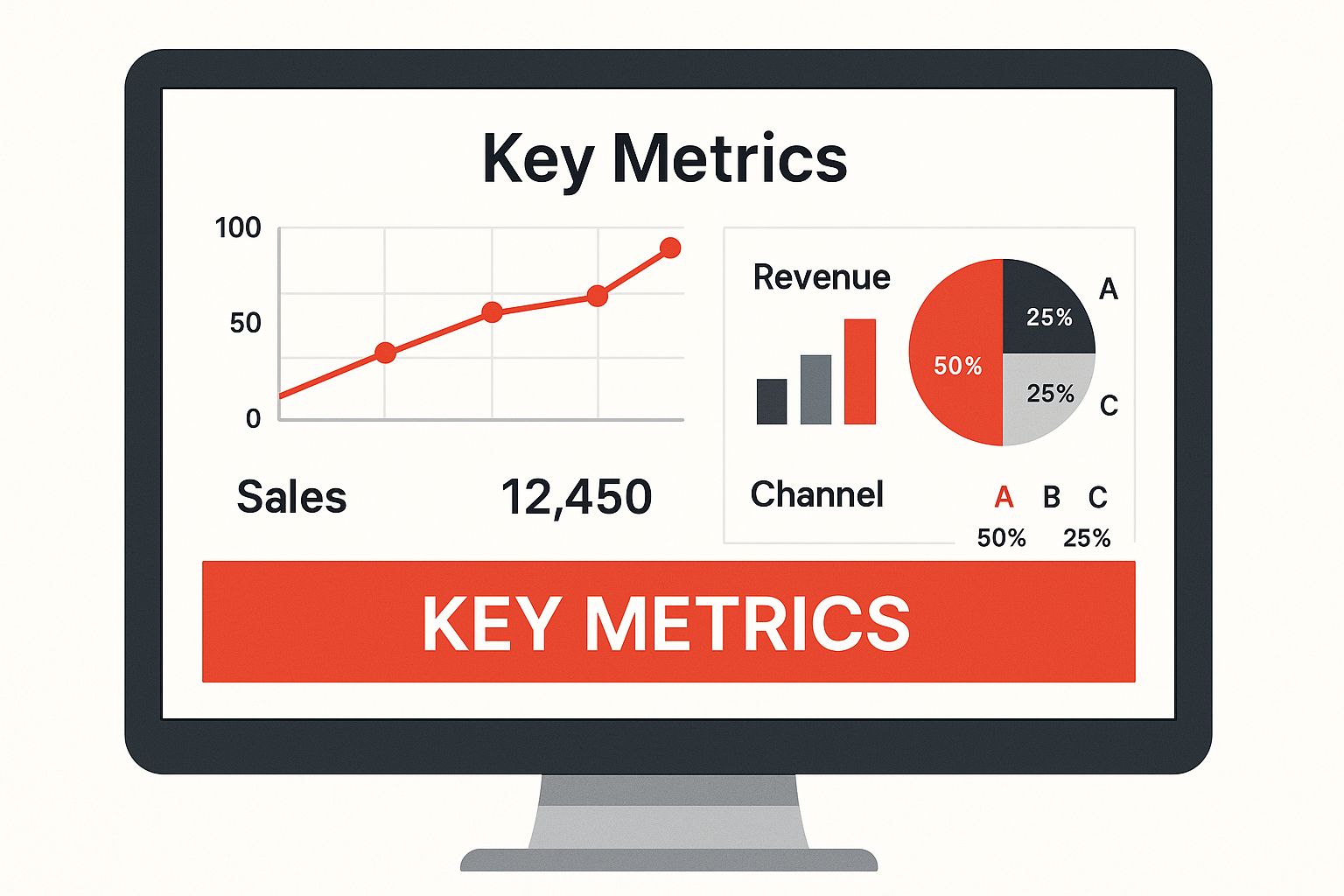
The "Key Metrics" overlay in the infographic highlights the importance of focusing on the most relevant data, rather than getting lost in a sea of numbers. By presenting the most important metrics clearly, you can quickly identify areas for improvement and make informed, data-driven decisions. It's like having a GPS for your marketing strategy!
Now, to really understand how this works in practice, let's dive into a breakdown of essential KPIs across different advertising channels. The table below provides a handy comparison and illustrates how these metrics relate to your overall business impact.
To help you get started, here's a table summarizing some Essential KPIs by Advertising Channel:
| Channel | Primary KPIs | Secondary Metrics | Business Impact |
|---|---|---|---|
| Paid Search (Google Ads) | Conversion Rate, CPA, ROAS | Click-Through Rate (CTR), Impression Share, Average Position | Driving online sales, lead generation |
| Social Media (Facebook, Instagram) | Conversion Rate, CPA, Engagement Rate | Reach, Impressions, Video Views | Brand awareness, lead generation, driving traffic |
| Display Advertising | Brand Lift, Reach, Frequency | CTR, Impressions, Viewability | Increasing brand awareness, driving traffic |
| Email Marketing | Open Rate, Click-Through Rate, Conversion Rate | Unsubscribe Rate, Deliverability Rate | Nurturing leads, driving repeat purchases |
This table highlights the fact that different channels serve different purposes, and therefore require different KPIs for effective measurement. While conversion rate and CPA are generally important across the board, secondary metrics can offer valuable insights specific to each channel. For instance, high engagement rates on social media could indicate strong brand affinity, even if direct conversions are lower than on paid search.
Getting Stakeholder Buy-In
Once you’ve nailed down your measurement strategy, it's crucial to get everyone on the same page. Share your plan with key stakeholders and explain why you've chosen these specific KPIs. This fosters understanding and ensures everyone is working towards the same goals. In my experience, presenting data visually – using charts and graphs – makes it much easier for stakeholders to grasp the key takeaways. Nobody wants to wade through spreadsheets!
Also, establish regular reporting rhythms to keep stakeholders informed of progress and allow for adjustments along the way. This could involve weekly performance updates or monthly deep dives into campaign performance. Consistent communication keeps everyone aligned and helps cultivate a data-driven culture within your organization.
Regular check-ins also create opportunities to discuss challenges and brainstorm solutions collaboratively. This proactive approach ensures your measurement strategy remains relevant and effective as your business grows and evolves.
Remember, measuring advertising effectiveness isn't a one-time project; it’s an ongoing process that requires consistent effort and teamwork. By focusing on the right metrics and communicating effectively, you can transform data into actionable insights that drive real business growth.
Solving Attribution Challenges in Multi-Channel Campaigns

Let's talk attribution. Figuring out which marketing efforts actually lead to a sale can be a real headache. Customer journeys these days aren't nice, neat little funnels. They're messy, tangled webs.
Imagine a customer sees your ad on Instagram. Later, they Google your product, chat about it with a friend, compare prices on different sites, and then, weeks later, buy it on their laptop. That initial Instagram ad was on their phone! How do you figure out what truly influenced their purchase? This multi-channel, cross-device reality is a major challenge.
Many marketers, especially in Australia, struggle to accurately attribute sales, particularly on social media, because of these complex customer journeys. You can find more about these specific Australian marketing challenges here: Australian Marketing Statistics. The old "last-click" model just doesn't cut it anymore.
Understanding Attribution Models
So, how do you measure advertising effectiveness in this chaotic world? Attribution models are the key. These are frameworks for assigning credit to different touchpoints. The trick is, there's no magic bullet. What works for one business might not work for another. Here's a rundown of some common models:
-
Last-Click Attribution: Gives all the credit to the final click. Simple, but often misleading, especially for longer sales cycles.
-
First-Click Attribution: The opposite – all credit goes to the first interaction. Highlights initial touchpoints but ignores everything else.
-
Linear Attribution: Spreads the credit evenly across all touchpoints. Recognizes multiple interactions but doesn't weigh their influence differently.
-
Time-Decay Attribution: Gives more weight to touchpoints closer to the conversion, recognizing their stronger influence.
-
Data-Driven Attribution: This uses statistical modeling and machine learning to analyze your data and assign credit based on the actual impact of each touchpoint. It's the most sophisticated option, but you need a good chunk of data for it to work well.
Choosing the right model depends on your specific customer journey and the role each channel plays. For example, if you're building brand awareness on social media and converting through search ads, a linear or time-decay model might be a better fit than last-click.
Practical Strategies for Tracking Conversions
Putting these models into practice requires some legwork. Here are some practical tips:
-
Implement Tracking Tags: UTM parameters and conversion pixels are your friends. They track traffic sources and attribute conversions to specific campaigns. Want to dive deeper into conversion tracking? Check out our guide on Google Ads Conversion Tracking.
-
Integrate Analytics Platforms: Connect your advertising platforms (Google Ads, Facebook Ads, etc.) with your analytics platform (like Google Analytics) for a complete view of your performance.
-
Track Offline Conversions: Don't forget about offline conversions like phone calls or in-store visits. Use unique phone numbers for different campaigns or ask customers how they found you.
-
Handle Long Sales Cycles: For long sales cycles, use attribution models that account for time decay and multiple interactions.
-
Make Sense of Cross-Device Behaviour: Implement cross-device tracking to see how customers interact with your brand across different devices.
By using these strategies, you'll get a much clearer picture of your marketing effectiveness and optimize for better results. Remember, attribution isn't about finding the perfect model. It's about gaining valuable insights and using them to make smarter marketing decisions.
Calculating ROI Beyond Simple Revenue Metrics
Let's talk about return on investment (ROI). Everyone thinks it's simple: revenue minus costs, divided by costs. Easy, right? Not so fast. Things get more interesting when you start thinking about brand awareness and the long-term value of a customer.
How do you measure the ROI of a campaign that's not about immediate sales? What about building your brand over time? Let's dig into that.
Imagine a new café opening in Fitzroy. They launch a social media campaign. Sure, they might not be slammed with customers in the first week. But that campaign is planting seeds. It's building brand awareness and hopefully fostering loyalty. How do you put a number on that when calculating ROI?
That’s where customer lifetime value (CLTV) comes in. Think of it this way: a regular who grabs a flat white and smashed avo every week for a year is worth way more than a one-time tourist. CLTV gives you a much clearer picture of how effective your advertising really is.
Beyond the Immediate Sale: Valuing Long-Term Growth
Calculating CLTV doesn’t need to be a headache. A simple approach? Estimate the average purchase frequency and the average customer lifespan. Multiply those by your average order value. Boom, you've got a rough estimate of CLTV. This helps you weigh the long-term benefits of brand-building against those initial campaign costs.
Another tricky thing is separating the impact of advertising from everything else affecting your business. Maybe your new winter menu is driving sales just as much as your Facebook ads. Or maybe a competitor went out of business, sending their customers your way. It’s rarely a simple equation. It’s kind of like figuring out how much of your garden's success is due to rain versus fertilizer. Both matter.
Controlled experiments can help. Try running slightly different versions of your ads in different areas or to different demographics and compare the results. This isolates the impact of your advertising.
Speaking of helpful resources, you might find our guide on Google Ads Audits useful.
Presenting ROI Data Effectively
So, you've crunched the numbers. Now, how do you present ROI data in a way that makes sense and inspires action? Nobody wants to wade through pages of formulas. Visualizations are your friend! Charts, graphs, and dashboards make complex data digestible and actionable.
Here's a table outlining different ROI approaches based on what you're trying to achieve with your campaign:
| Campaign Type | ROI Formula | Key Considerations | Typical Timeframe |
|---|---|---|---|
| Direct Response (e.g., sales promotion) | (Revenue – Cost) / Cost | Track immediate conversions and sales | Short-term (days/weeks) |
| Brand Awareness (e.g., social media campaign) | Estimate increase in brand awareness and its contribution to future sales | Difficult to quantify directly, requires estimations and assumptions | Long-term (months/years) |
| Lead Generation (e.g., LinkedIn Ads) | (Value of Leads – Cost) / Cost | Assign a value to each lead based on conversion rate and average deal size | Mid-term (weeks/months) |
This table shows how different campaigns need different ROI approaches and highlights the varying timelines involved. Direct response campaigns give you quick, measurable ROI, while brand awareness campaigns require a longer-term view.
Presenting ROI effectively is also about telling the story behind the numbers. Don't just show the data, explain what it means for the business. What actions should be taken based on these insights? This helps translate data into decisions.
This approach also helps you handle those tough conversations about campaigns that seem expensive but are actually building long-term value. By focusing on the bigger picture – CLTV, brand equity, and sustainable growth – you can prove the true value of your advertising and justify continued investment.
Choosing Analytics Tools That Actually Talk to Each Other
Picking the right analytics tools can feel overwhelming. It's easy to end up with a bunch of disconnected platforms that tell conflicting stories. Let's simplify things and build a measurement system that actually provides clear insights.
This means choosing tools that work together, not in isolation. Think of it as assembling a team – each member has their specialty but they collaborate towards a common goal.
Building Your Integrated Measurement Stack
How do you create a measurement system where your tools integrate seamlessly? It’s about selecting platforms that share data and offer a unified view of the customer journey.
Start with the foundation: website analytics. Google Analytics is the standard for many, offering a wealth of data on website traffic, user behavior, and conversions. The screenshot below shows a typical Google Analytics dashboard.
This dashboard provides a glimpse into the wealth of information available, from user demographics to traffic sources and conversion rates. Understanding these metrics is key to optimizing campaigns and improving website performance.
Next, connect your advertising platforms – your Facebook Ads Manager, your Google Ads account, your LinkedIn Campaign Manager – directly to your analytics platform. This provides a central hub to monitor all your marketing activities and see how your ads are driving website traffic and conversions.
Then, add other tools as needed. This might be an email marketing platform like Mailchimp or an attribution platform like AppsFlyer. The key is seamless integration with your existing setup. Focus on tools that address your specific needs, not the latest marketing trends.
Avoiding Data Silos and Maintaining Data Quality
One of the biggest pitfalls is data silos. This is when your data is scattered across various platforms, making it impossible to see the complete picture. To avoid this, choose tools with robust integration options, APIs, and data sharing capabilities.
Another critical element is data quality. Accurate data from the beginning is essential for reliable insights. Implement proper tracking tags, validate your data frequently, and address discrepancies promptly. Consistent data hygiene ensures your analytics tools deliver actionable information.
As your measurement system evolves, maintaining data quality becomes even more critical. Establish clear data governance processes, document your tracking, and train your team on best practices. This provides a solid foundation for effective measurement and confident decision-making. It also keeps you aligned with changing privacy regulations.
By focusing on integration, data quality, and avoiding unnecessary tools, you can build a measurement system that truly informs your strategy and maximizes your advertising impact.
Turning Performance Data Into Better Campaign Results
Data without action is just a fancy report. Many measurement efforts fall short here. Creating attractive dashboards isn't enough. You need to actually improve performance using your advertising insights.
How do you transform data into action? It begins by finding real opportunities for optimization. Look for patterns. Do your ads perform better at certain times? Are some demographics more likely to convert? These insights can guide your spending and targeting.
For example, a Melbourne florist noticed more conversions the week before Mother's Day. They boosted their ad spend during that time, focusing their creative on Mother's Day gifts, and saw a nice jump in sales. This shows how spotting a trend and acting on it can work wonders.
Distinguishing Between Noise and Signal
Not all data is equal. You need to separate meaningful insights (the signal) from random fluctuations (the noise). A small dip in click-through rate one day might be random, not a failing campaign. Look for consistent trends.
Influencer marketing adds another layer to measurement. With 48% of marketers increasing investment in creator partnerships, robust measurement strategies are even more critical. Check out more on influencer marketing in Australia here. Consider how influencer activity works with your other marketing channels and contributes to your overall goals.
Making Changes That Move the Needle
Once you've found real optimization opportunities, put them into action. Test different approaches. Try new ad copy, visuals, targeting parameters, and bidding strategies.
A Sydney clothing retailer discovered lifestyle imagery in their ads performed much better than product shots alone. They shifted their creative strategy and saw a big increase in engagement and conversions. Testing showed them what connected with their audience.
Systematic Approaches to Testing and Optimization
Don't just make random changes. Be systematic. A/B testing is key. Run two versions of an ad – one with a small change – and see which performs better. This data-driven approach takes out the guesswork.
Consider the long-term effects of your optimizations. Boosting short-term gains might hurt long-term brand building. Find the right balance. For search ads, check out our guide on negative keywords. Negative keywords can stop your ads from showing for irrelevant searches, improving your targeting and ROI.
Feedback loops are also important. Regularly review your data, analyze your test results, and adjust. This creates a cycle of improvement.
Finally, communicate your insights. Share your findings with stakeholders and explain your changes. Clear communication gets everyone on board. By turning data into action, you can transform your advertising and grow your business.
Making Measurement Your Competitive Advantage
Effective advertising measurement isn't a quick fix; it's an ongoing process that can truly set you apart from your competitors. Think of it as fine-tuning a high-performance engine—regular tweaks and adjustments are essential. This final section focuses on building a measurement-focused mindset across your organization, making data-informed decisions a regular practice, not something you do as an afterthought.
Establishing Reporting Rhythms That Inform Strategy
Ditch the reports that just tell you what already happened. Your reports should be shaping future strategy. Set up a regular reporting schedule that aligns with your business goals. This might mean weekly check-ins on core metrics or monthly deep dives into campaign performance. The frequency depends on your specific needs. A fast-paced e-commerce business might need daily data, while a B2B company with a longer sales cycle might review things monthly or quarterly.
But whatever you do, make sure your reports are clear, concise, and deliver actionable insights. What story is the data telling you? What needs tweaking? Avoid overwhelming stakeholders with mountains of data. Focus on the key takeaways and how they impact future campaigns.
Staying Ahead of the Curve: Privacy and Platform Changes
The digital advertising world is constantly changing. Privacy regulations are tightening, and platforms are always evolving. It's essential to stay informed and adapt your measurement strategies accordingly. For example, with the shift away from third-party cookies, first-party data is becoming incredibly valuable. Make sure you have a solid system for collecting and using your own customer data while respecting privacy guidelines.
This is where investing in your team's knowledge really pays off. Encourage continuous learning and experimenting with new measurement techniques. Stay up-to-date on the latest privacy regulations and industry best practices. This proactive approach will help you navigate the changing landscape and maintain a competitive edge.
Communicating Measurement Insights to Different Stakeholders
Data is only valuable if it’s understood and acted upon. You need to communicate your insights clearly to various stakeholders, each with their own priorities. For a marketing team, focus on campaign performance and areas for improvement. For the C-suite, translate those insights into business impact – revenue growth, market share, and return on investment (ROI).
Tailor your communication to your audience. Use visuals – charts, graphs, and dashboards – to make complex data easier to digest. Focus on the key takeaways and recommendations for future actions. Clear, concise communication allows everyone to make informed decisions and supports your measurement strategy.
Maintaining Data Quality and Continuous Improvement
Accurate data is the bedrock of effective measurement. Establish clear processes for data collection, validation, and maintenance. Regularly audit your tracking tags, check data integrity, and fix any discrepancies quickly. Think of it like regular car maintenance—check-ups and preventative care keep things running smoothly.
Continuous improvement should be part of your measurement process. Regularly review your key performance indicators (KPIs), assess your reporting rhythms, and get feedback from stakeholders. The best marketers are constantly learning and adapting. They use measurement insights to identify new opportunities, optimize budget allocation, and justify advertising investment.
By adopting these practices, you'll turn measurement from a reporting chore into a powerful driver of business growth. It's about making smart decisions, optimizing campaigns, and ultimately, achieving your business goals. Ready to transform your advertising with data-driven insights? Let Click Click Bang Bang guide your success.
Read NeXt
Or Read Our Latest
Click. CLick. Subscribe.
Get our best PPC insights, industry updates, and power moves delivered straight to your inbox. No fluff, just high-caliber strategies that actually work.
Don’t Leave Just Yet
Try Us For 30-Days,
Risk Free!!
We guarantee that you’ll love our work within the first 30 days, if not you’ll get your money back.
What have you got to lose?