

Multivariate Testing: A Practical Guide for High-Traffic
Last Updated

Most advice about multivariate testing jumps straight to the mechanics and skips the question, which is whether your site is ready for it at all. That's the mistake that wastes the most time. Multivariate testing is not a smarter version of A/B testing, it's a different instrument entirely, and it only pays off when the traffic, conversion volume, and team maturity are already in place.
For Australian e-commerce and B2B teams, that reality matters more than the textbook definition. Global benchmarks sound neat, but they don't tell you whether a local product page, pricing page, or lead-gen landing page can support the test load without dragging on for months. If you've already built a CRO foundation, the practical next question is whether the page has enough volume to justify the complexity, not whether MVT sounds more advanced.

Why Multivariate Testing Is Not the Default Next Step
The default assumption in optimisation circles is simple. Run A/B tests, learn a few things, then move into multivariate testing. That sounds tidy, but it skips the constraint that matters most. Traffic gets split across combinations, so MVT only makes sense when a page has enough volume to absorb the extra fragmentation without stretching the test for too long.
For Australian e-commerce and B2B teams, that gap between theory and traffic reality matters. Global advice often assumes Silicon Valley-level volume, but a local product page, pricing page, or lead-gen landing page may not generate enough conversions to support a complex factorial setup in a useful timeframe. If the page is already part of a mature CRO program and you want a wider understanding of conversion rate optimisation, the practical question is whether the volume justifies the complexity, not whether MVT sounds more advanced.
A different way to think about it
A/B testing asks a clean question, did one page beat another? MVT asks which combination of elements worked best together. Optimizely describes it as testing multiple variables modified at the same time to find the best-performing combination, which is why it can reveal interaction effects a single-variable test cannot.
Practical rule: if you still need A/B tests to settle basic page-direction questions, MVT should stay off the default path.
That is why the method fits mature programmes, not teams still deciding whether the headline or the offer is the main problem. A strong CRO programme often starts with A/B testing with Tagada to isolate obvious wins before moving to combination testing. If you are still mapping the broader optimisation process, the conversion rate optimisation overview is the more useful starting point than jumping straight to factorial design.
The strongest signal that MVT is premature is simple. If the page does not have enough traffic or conversion events to support multiple combinations, you are not testing efficiently, you are fragmenting evidence. In that situation, one focused A/B test will usually teach you more than a rushed multivariate setup.
How Multivariate Testing Differs from A/B Testing
A/B testing and multivariate testing aren't just different in scale. They answer different questions, and that changes how you plan, budget, and interpret the work. A/B testing isolates one change. MVT measures how changes behave in combination, which is useful only when interaction effects matter enough to justify the complexity.
| Dimension | A/B Testing | Multivariate Testing |
|---|---|---|
| Primary question | Which version performs better? | Which combination performs best? |
| Variables tested | Usually one main change | Multiple page elements together |
| Traffic needs | Lower | Higher because traffic is split across combinations |
| Analysis | Simpler, cleaner cause and effect | More complex, interaction-aware analysis |
| Best use case | Single-variable decisions | Pages where elements influence each other |
| Insight depth | Narrow, but clear | Broader, especially on combinations |
The big strategic difference is interaction effects. With A/B tests, you can learn whether a headline beats another headline. With MVT, you can learn whether a headline only works when paired with a specific hero image or CTA. That combination logic is why MVT can uncover optimisation paths that sequential testing may miss, but it's also why the method becomes harder to trust if your test surface is too large.
When a single-variable test is still the right call
If the business question is simple, keep the test simple. A/B testing is usually better when you need a fast decision, when traffic is modest, or when the team doesn't yet have a strong experimentation habit. It's also the safer choice when one element is clearly the likely driver of performance, such as a headline, offer, or CTA.
If the page already has a weak baseline and you're still diagnosing the problem, don't multiply variables. Find the biggest lever first.
This is also where the practical value of Shopify Plus testing from Grumspot fits into the picture, because many teams need strong single-variable discipline before they can justify combination experiments. That's especially true for e-commerce teams that are still proving which page components matter most.
MVT starts making sense when the page is already working and the remaining gains are likely to come from how elements work together. That's the line between “testing more” and “testing smarter”.
Traffic Thresholds and Statistical Requirements
Traffic dilution is the part most guides soften, but it decides whether the test is usable. Every extra variable multiplies the number of combinations, and every combination draws from the same pool of visitors. That is why multivariate testing can look clean on paper and become operationally messy fast.
A practical way to size the problem is to start with the number of experiences, then ask whether the page can support them. A 5×4 design creates 16 experiences, and that is before you account for QA, tracking checks, and the time needed to collect enough conversions to trust the result. For a mid-tier Australian e-commerce site, that can be the difference between a useful experiment and a page that spends weeks producing noise.
Varify's threshold is more useful for decision-making than abstract theory. It says MVT is generally worthwhile only after solid A/B testing experience and with at least 500,000 visitors per month on the test page or a conversion rate above 5% Varify. That is a high bar for many Australian teams, especially outside major retail brands and very high-intent lead-gen pages.
A simple go or no-go filter
Use this as the first gate before anyone builds variations:
- Enough volume on one page: The page has enough visitors to avoid starving each combination.
- Enough conversion activity: The page produces meaningful conversion events, not just passive visits.
- Enough testing maturity: The team has already run useful A/B tests and knows how to brief, QA, and interpret experiments.
- Enough patience: The business can wait for a statistically valid result without changing the page halfway through.
- Enough focus: The test is centred on a single conversion action, not a broad site-wide goal.
The Australian reality is that many sites sit below the traffic levels implied by global examples. A well-known brand can still be a poor MVT candidate if the relevant page does not carry enough intent or conversion volume. For AU e-commerce, the strongest candidates are usually product detail pages, category pages, and high-value campaign landing pages. For B2B, the better candidates are demo request pages or targeted lead-gen pages, not top-of-funnel content.
If a test will take more than 12 weeks to reach significance, Varify suggests sequential A/B or fractional factorial designs instead Varify. That is not a hard rule, but it is a useful cutoff. Once the window stretches that far, the business starts paying for delayed learning and delayed action.
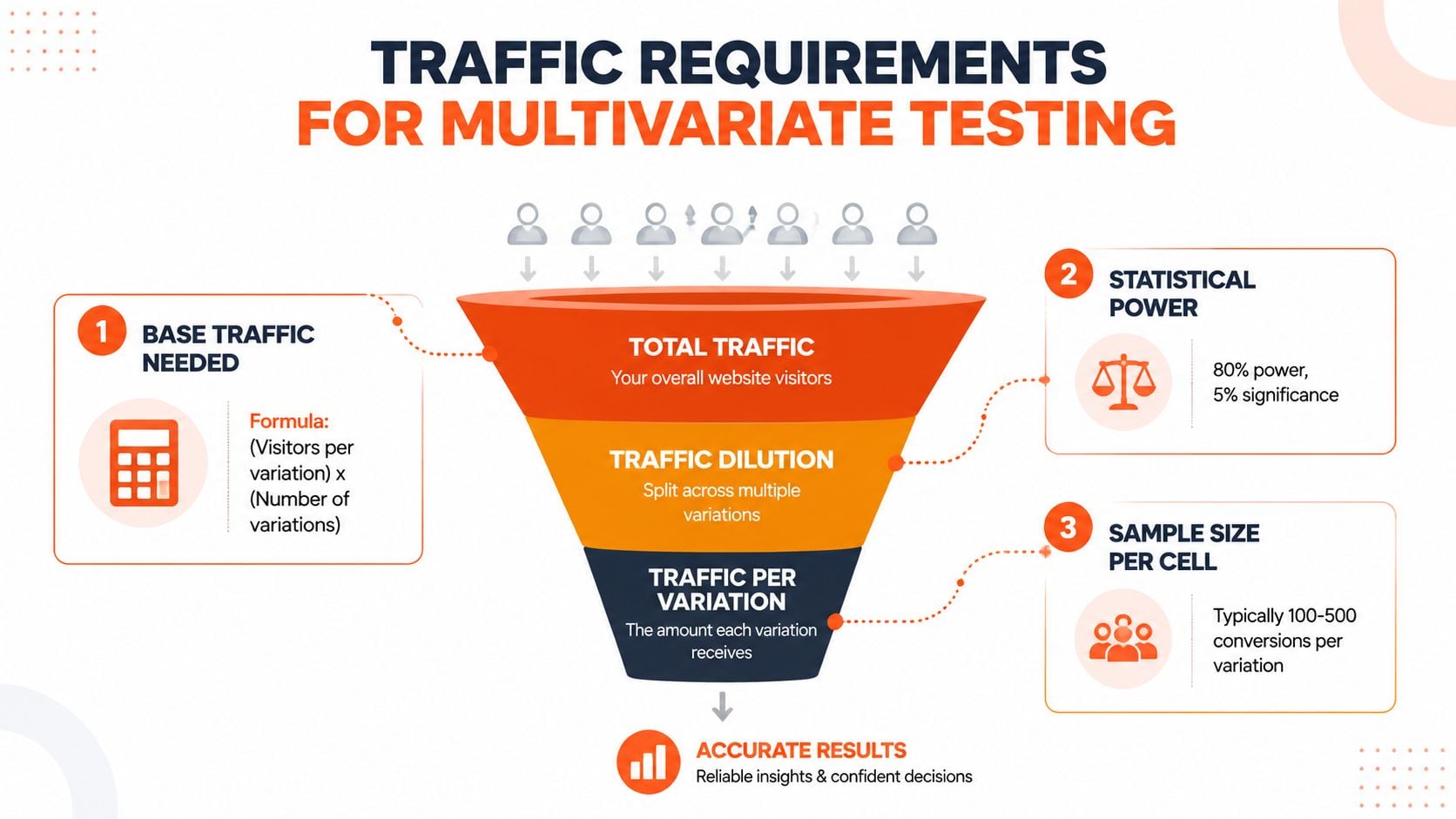
Decision rule: if you cannot see a realistic path to significance within a sensible window, do not force full-factorial MVT.
A practical threshold review should also sit inside a broader landing-page process. A landing page optimisation checklist helps teams confirm that the page, tracking, and offer are ready before they spend traffic on combination testing.
In practice, the right answer is often fractional factorial design. It samples combinations without testing every possible permutation, which gives you a more realistic route to evidence when local traffic is good, but not enormous. That trade-off matters more than the theory. A smaller, well-chosen design can teach you more than a sprawling matrix that never reaches reliable volume.
Designing and Running Your First Multivariate Test
The first mistake is trying to test too much. Good practitioners keep the setup tight, usually 2 to 3 high-impact elements with interactions that matter Userpilot. If the headline, image, and CTA do not influence one another in a meaningful way, they should not sit in the same test.
Full factorial or fractional factorial
A full factorial design tests every possible combination. That gives the cleanest answer, but it also creates the biggest traffic and QA burden. Fractional factorial designs are the more practical choice when the combination set grows quickly and you need a faster route to learning.
| Design choice | When it makes sense | Main trade-off |
|---|---|---|
| Full factorial | Small, controlled tests with enough traffic | Heavier traffic and QA load |
| Fractional factorial | Larger combination sets where speed matters | Some interaction effects stay unmeasured |
The workflow needs discipline from the start. Define the conversion goal first, then write a hypothesis for each element you plan to change. Too many teams do this backwards, they build variants before they decide what they are trying to learn.
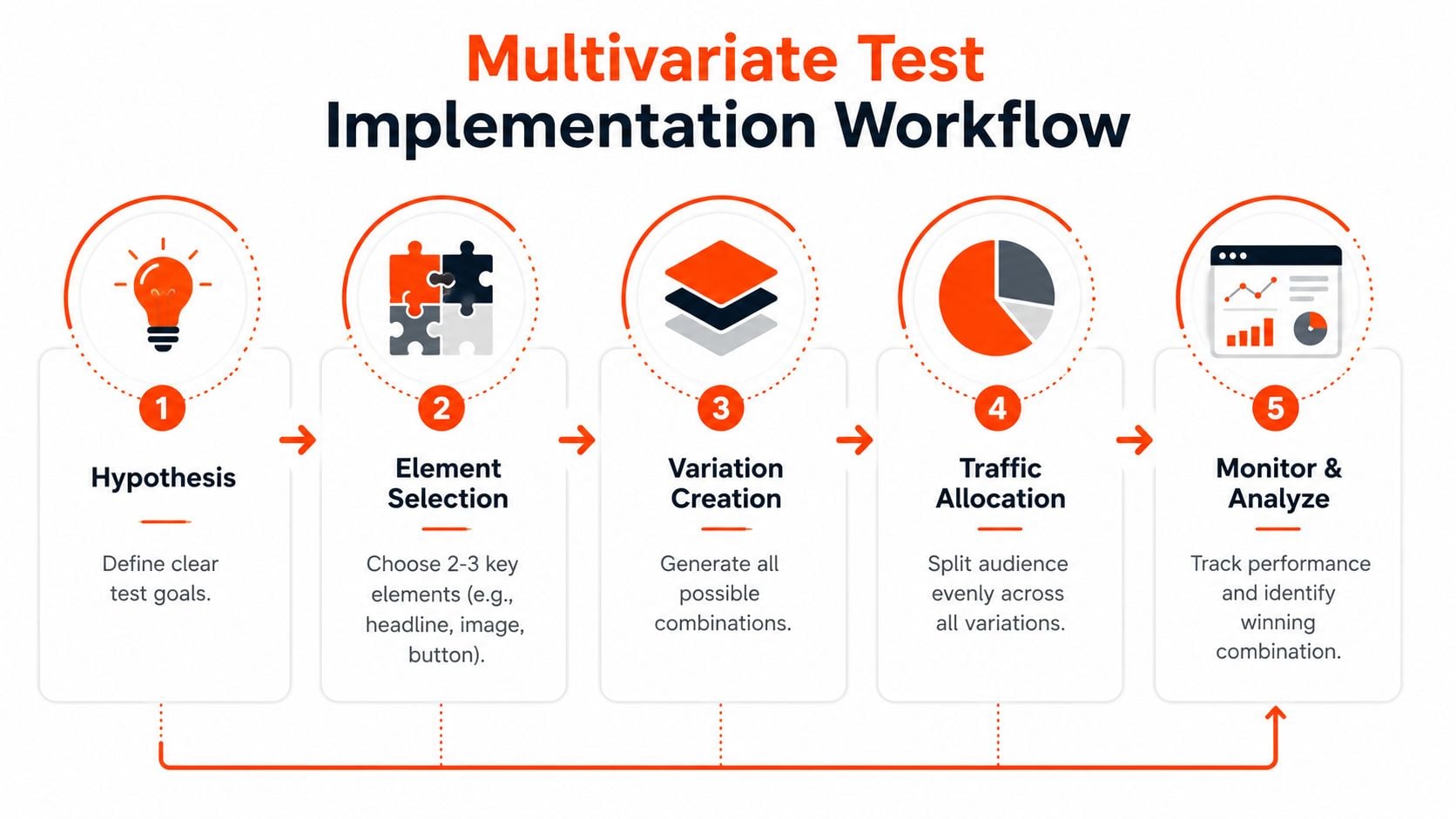
What to check before launch
- Hypothesis clarity: Every element needs a reason for being in the test.
- Logical consistency: Headline, image, and CTA should make sense together.
- QA coverage: Every combination must render correctly across key devices and browsers.
- Analytics setup: Goals, events, and segments need to be in place before traffic goes live.
- Operational stability: Do not launch during a site rebuild, pricing change, or tracking migration.
The QA burden is where MVT gets underestimated. More combinations create more ways for rendering, tagging, or layout problems to slip through, and one broken variant can contaminate several combinations at once. That risk is higher on commerce pages, where a small issue can distort the whole read on performance.
If you want a practical pre-launch check for the page itself, the landing page optimisation checklist is a useful companion. It will not design the test for you, but it will catch avoidable setup errors before they hit production.
Teams that are building a broader experimentation programme should also build a performance testing strategy. The point is not to run more tests for its own sake, it is to make sure the page, the tracking, and the offer are ready before traffic gets committed to a combination test.
Real World Applications for E-Commerce and B2B
The clearest use cases are the ones with one conversion goal and several elements that clearly affect one another. That's why multivariate testing shows up most naturally on product pages, checkout steps, and lead-gen landing pages. The method is less useful on broad content pages, because the signal gets too noisy.
E-commerce product pages
On a product detail page, the usual testable elements are the headline, hero image, and CTA copy. Each one influences the others. A benefits-led headline might work better with a lifestyle image, while a technical headline might need a product-shot hero to stay credible.
That's the kind of page where MVT can answer a real commercial question, not just a design preference. If the traffic is high enough, a retailer can test how different combinations shape purchase intent without waiting for three separate A/B tests to finish. The trade-off is that every combination must still feel like a coherent product story.
B2B landing pages
On a B2B lead-gen page, the strongest variables are often value proposition messaging, form length, and social proof placement. The combination matters because a short form can still underperform if the value proposition feels vague, while strong proof placed too low may never support the user's decision.
For teams building this kind of programme, build a performance testing strategy is a useful way to think about the page as a whole, especially when test speed and page experience both affect conversion. It's not about adding more tests. It's about making sure the page and the experiment can both hold up under scrutiny.
A strong B2B MVT is usually less about bold redesigns and more about tightening the relationship between message, proof, and friction.
For Australian teams, the business question is usually whether the page earns enough lead volume to support combination testing without stretching the programme thin. If it doesn't, a tighter A/B sequence is usually more honest and more useful. If it does, MVT can reveal which message-form-proof mix helps prospects move.
Click Click Bang Bang's own conversion workflow includes multivariate testing as part of its optimisation approach, and it can sit alongside broader tracking and CRO setup when a team needs structured experimentation. Used properly, that kind of workflow is about operational discipline, not novelty.
Common Pitfalls and How to Avoid Them
Most MVT failures are predictable. Teams either create too many combinations, wait too long for significance, or read the wrong lesson from the results. The method isn't fragile, but it does punish sloppy planning.
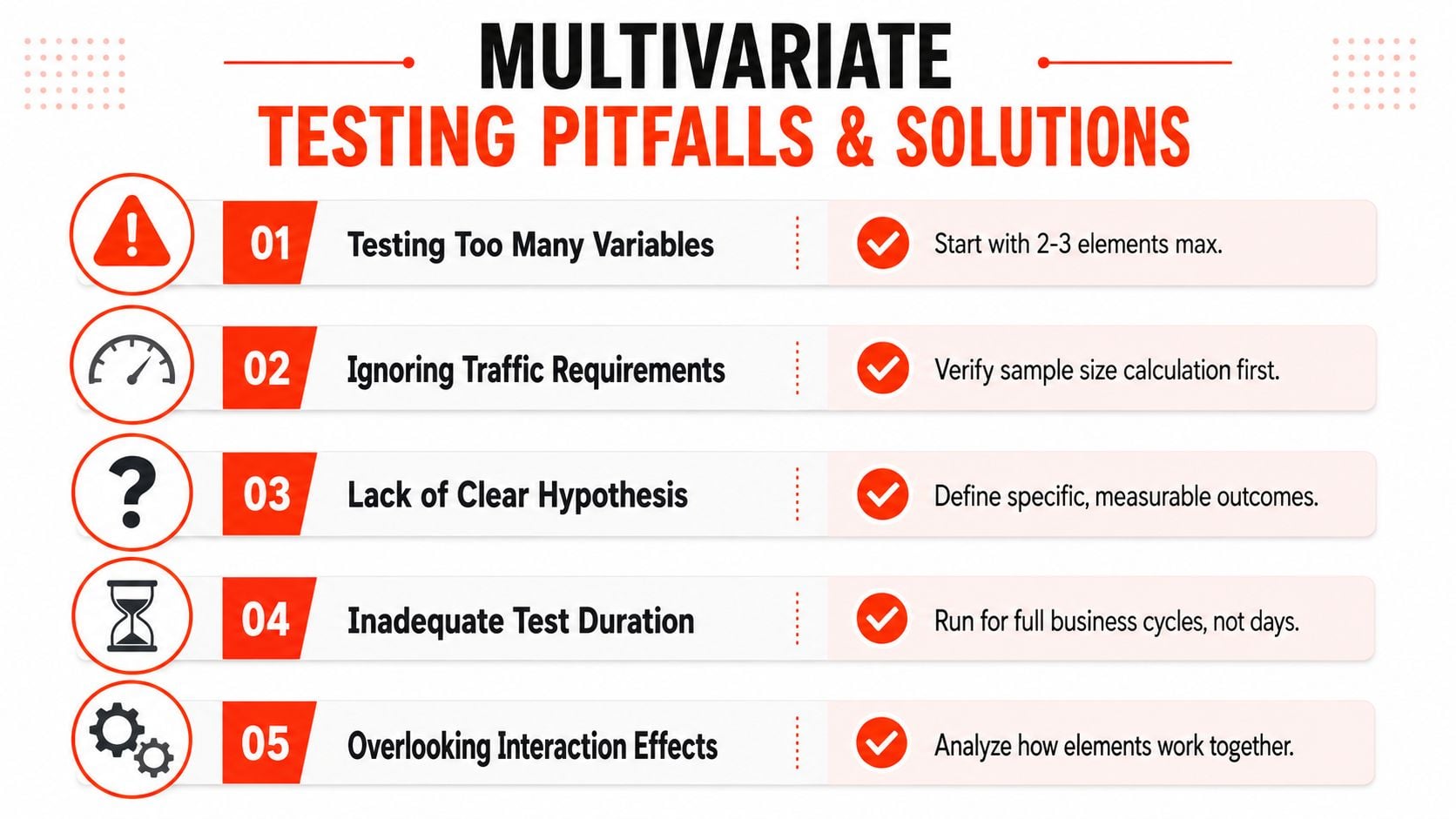
The traps worth avoiding
- Testing too many variables: Keep the test to a small set of elements that can plausibly interact.
- Ignoring traffic requirements: Check volume and conversion activity before you build the matrix.
- Weak hypothesis design: If you can't explain the mechanism, the test is probably too vague.
- Inadequate duration: Don't stop early just because one combination looks promising.
- Missing interaction effects: Analyse how the elements behave together, not just which one looks good in isolation.
The hardest trap is analytical overconfidence. MVT can show you the winning combination, but it can also obscure which element drove the lift. That's the trade-off of combination testing. You gain interaction insight, but you lose some clarity about individual causality.
Operational rule: if a test is running beyond the practical window you set at launch, the answer is usually to simplify the design, not to keep hoping the data will rescue it.
The other problem is treating MVT as a replacement for sequential A/B testing. That's backwards. Mature teams use both. A/B tests identify the big levers, then MVT explores how those levers behave together once the page is already strong.
QA is the final failure point, and it's the one most likely to be overlooked. Once the variation count climbs, a tiny rendering issue can affect multiple combinations and poison the result. That's why high-traffic pages need careful pre-launch checks, not just clever hypotheses.
Measuring Results and Reporting to Stakeholders
Reporting on MVT has to do two things at once. It needs to be statistically honest, and it needs to be understandable to people who don't live in test design every day. The cleanest way to frame the result is with effect size and a plain-language explanation of what changed.
Adobe's common effect-size benchmarks are 0.01 for small, 0.06 for medium, and 0.14+ for large effects Adobe. Those thresholds help teams avoid overreacting to noise or underplaying a meaningful result. Once the overall test shows significance, the next job is to isolate which specific element or combination drove the outcome, then decide whether that insight is transferable or only valid in the tested context.
How to brief stakeholders
- Lead with the business question: What page outcome changed, and why does it matter?
- Separate the overall result from the diagnostic detail: The winning combination is not the same thing as the winning element.
- Use plain language for significance: Say whether the result is reliable, then explain the confidence in practical terms.
- State the next action clearly: Ship, iterate, or stop.
- Show the testing logic: Keep the combination map visible so people can see what was tested.
For the reporting stack, ecommerce conversion tracking matters because MVT results are only as good as the events behind them. If the conversion event is dirty, the test story becomes dirty too.
The best stakeholder reports keep two layers visible. First, the combination that won. Second, the element-level implications, with a note that interaction effects may not transfer perfectly to another page or offer. That keeps the team from overgeneralising a single result into a universal rule.
For marketers, the value is speed of decision. If the test has a clear winner, implement it. If the signal is weak or the setup was too broad, don't force a conclusion. Use the data to tighten the next experiment instead.
ACTA for Click Click Bang Bang.
Read NeXt
Or Read Our Latest
Click. CLick. Subscribe.
Get our best PPC insights, industry updates, and power moves delivered straight to your inbox. No fluff, just high-caliber strategies that actually work.
Don’t Leave Just Yet
Try Us For 30-Days,
Risk Free!!
We guarantee that you’ll love our work within the first 30 days, if not you’ll get your money back.
What have you got to lose?