

Your 2026 Remarketing Campaign Strategy Blueprint
Last Updated

Most remarketing campaigns don't fail because the channel is weak. They fail because the setup is lazy.
You've probably seen the pattern. Traffic lands on the site, product pages get views, a few carts start, then most of those people disappear. Sales teams see demo requests stall after one visit. Ecommerce managers watch paid search do the expensive work of acquisition, then lose the buyer before checkout. The problem isn't always demand. Often, it's the lack of a disciplined remarketing campaign strategy to bring qualified visitors back with the right message.
That matters even more in Australia, where retargeted customers are 43% more likely to convert than non-retargeted visitors, and there's a 70% probability they'll buy from the original brand rather than a competitor, according to XCom Media's retargeting analysis. If you're already paying to generate traffic, letting those visitors leave without a follow-up plan is a margin leak.
The fix isn't more audience lists, more ads, or more platforms for the sake of activity. It's cleaner data, stronger intent signals, tighter exclusions, and enough campaign consolidation for the algorithm to learn.
Recapturing Lost Opportunities with Remarketing
A prospect clicks your paid search ad, reads the pricing page, then leaves to check a competitor or pull in another decision-maker. An ecommerce shopper adds a product to cart, gets distracted, and never reaches checkout. Those are not edge cases. They are the normal gaps between first interest and revenue.
Remarketing closes that gap when it is built around real intent.
The job is not to chase every past visitor with the same display ad. The job is to re-engage high-intent users with a message that matches what they already did and what is still stopping them. For a cart abandoner, that might be the exact product left behind. For a B2B buyer who visited pricing or a demo page, it often means proof, trust signals, or a simpler next step.
That distinction matters more for Australian SMEs working with limited budgets and smaller audience pools. Broad retargeting lists can burn spend fast and give the algorithm weak signals. Tighter audience rules usually outperform bloated list structures because they focus spend on users with a credible path back to purchase or enquiry.
As noted earlier, Australian retargeting benchmarks show a clear commercial upside. People who already engaged with your brand are more likely to come back and buy than cold audiences are. That is why remarketing should sit close to revenue-focused activity, not as an add-on after the acquisition budget is spent.
Practical rule: If paid media is generating qualified visits and there is no follow-up campaign for non-converters, part of the acquisition budget is being wasted.
Creative speed matters here. Teams turning around product explainers, feature clips, or proof-led ad variants often use tools like an ai product demo video maker to shorten production time when they need multiple remarketing assets tied to specific audiences. Faster production helps when performance data shows one audience needs reassurance and another needs urgency.
Execution also changes by business model. Standard display retargeting can keep your brand visible, but product-led accounts usually perform better with a tighter dynamic remarketing setup because the ad mirrors the item or category the user already viewed. That relevance tends to improve return visits and reduces wasted impressions on generic creative.
The campaigns that work usually drive three commercial outcomes:
- Recovered revenue: Product viewers, cart abandoners, and high-intent lead visitors come back and complete the action.
- Better media efficiency: More spend goes to users who already know the brand, which reduces reliance on cold traffic to hit target volume.
- Stronger retention against competitors: Buyers who were already comparing options keep seeing your offer, your proof, and your differentiators during the decision window.
Good remarketing behaves like disciplined sales follow-up. It is timely, specific, and tied to business outcomes, not just impression volume.
Building a Privacy-First Data Foundation
The strongest campaign structure won't save bad tracking.
In a privacy-first environment, audience quality starts with consent, tagging discipline, and first-party data capture. Broad “all visitors” pools used to be a common shortcut. They're now one of the fastest ways to fill campaigns with weak signals.
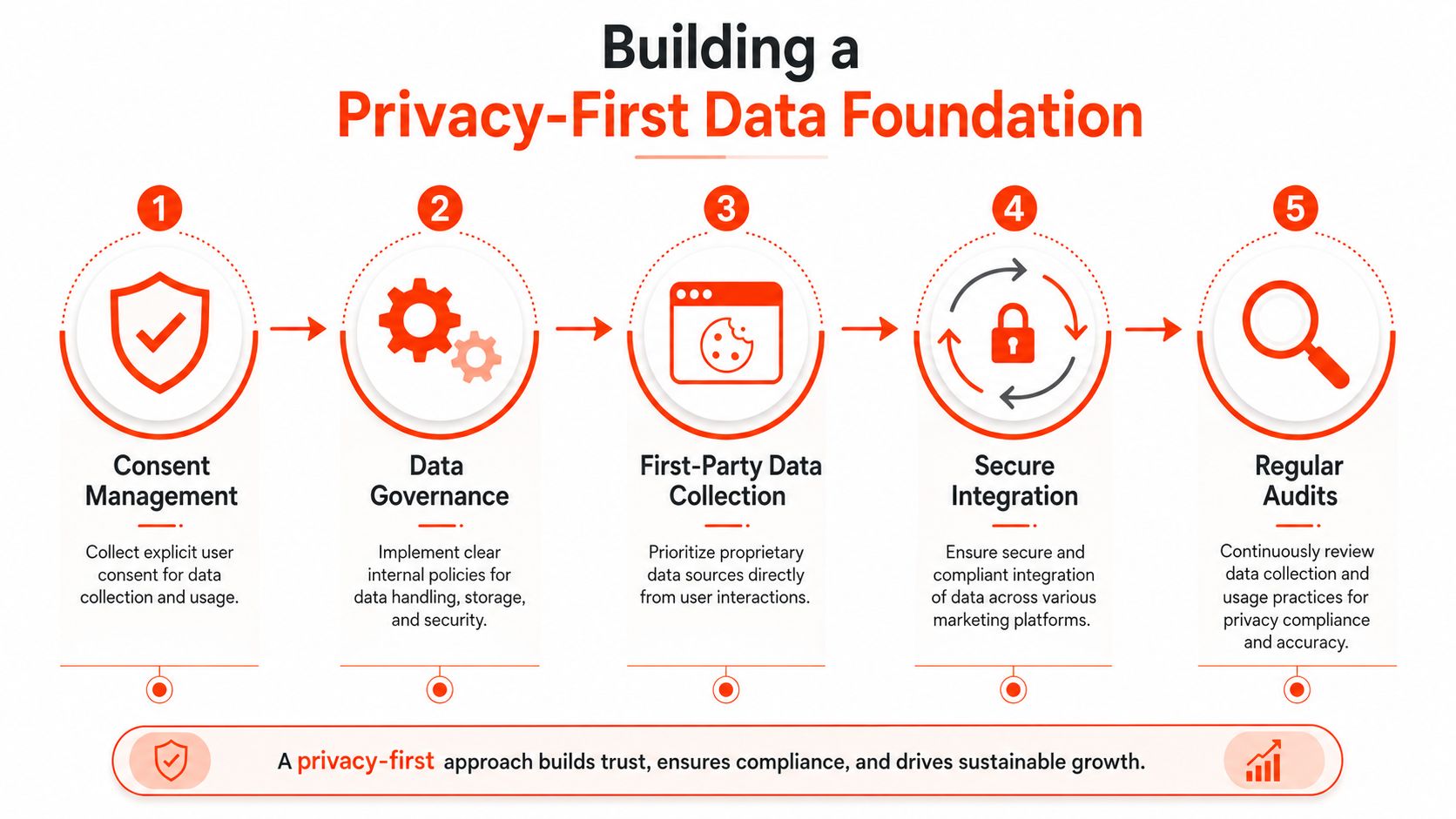
Start with tracking that can survive scrutiny
At minimum, the stack needs clean implementation in Google Tag Manager, platform pixels configured correctly, and conversion tracking that matches actual business outcomes. For lead generation, that means distinguishing a real qualified enquiry from a generic page hit. For ecommerce, that means mapping product views, cart events, checkout starts, and purchase completion properly.
One technical point gets missed too often. The Conversion Linker in Google Tag Manager needs to be active if you want more reliable attribution across browsers. When that step is skipped, reported performance gets muddy, and remarketing decisions get made on incomplete data.
A privacy-first foundation also means your CRM can't sit in a silo. If sales teams know which leads progressed, stalled, or closed, that data should inform audience creation and exclusions. A synced first-party setup gives you far better control than relying on loose behavioural pools alone. Consequently, first-party data activation becomes operational, not theoretical.
Filter for engagement, not just visits
A lot of local advice still tells marketers to build audiences from simple page visits. That's too blunt now.
Australian shopper behaviour makes that especially obvious. Generic strategies often miss the GA4 privacy wall, and broad audience rules ignore that Australian shoppers average 42 seconds on mobile product pages before bouncing due to shipping cost anxiety, which makes engagement-based audiences, such as users who stay over 60 seconds, more valuable than broad site visitor lists, according to LM Group's 2026 remarketing playbook.
That has a direct strategic implication. If someone lands, glances, and exits fast, they may not belong in your core paid remarketing pool. If someone spends meaningful time, compares multiple pages, or revisits product detail content, that's a stronger signal.
A practical audience hierarchy often looks like this:
- High engagement visitors who crossed your quality threshold
- Commercial intent users such as cart starters, pricing-page visitors, or lead form openers
- Known first-party users from CRM, email, or customer lists
- Exclusion groups including buyers, closed leads, support seekers, and irrelevant traffic
Broad lists make platforms look busy. High-signal lists make campaigns profitable.
Build audiences around business actions
The right setup mirrors your funnel, not the platform's default templates.
Use event-based logic tied to outcomes your business values:
- For ecommerce: Product viewers, cart starters, checkout abandoners, and category-specific browsers
- For B2B: Whitepaper downloaders, case study readers, pricing visitors, and demo-form openers
- For service businesses: Quote page visitors, booking starters, and repeat visitors to service detail pages
Don't overcomplicate the structure on day one. Start with the audiences that clearly map to revenue, then tighten them as you learn which combinations of intent and creative produce return visits that matter.
Strategic Audience Segmentation and Messaging
A visitor adds a product to cart on Monday, reads reviews on Tuesday, then disappears. Another lands on a blog post, skims for 20 seconds, and leaves. Putting both people into the same remarketing campaign is how budgets get spread thin and performance stalls.
Segmentation has one job. Separate weak signals from buying signals, then match the message to the reason conversion stopped.
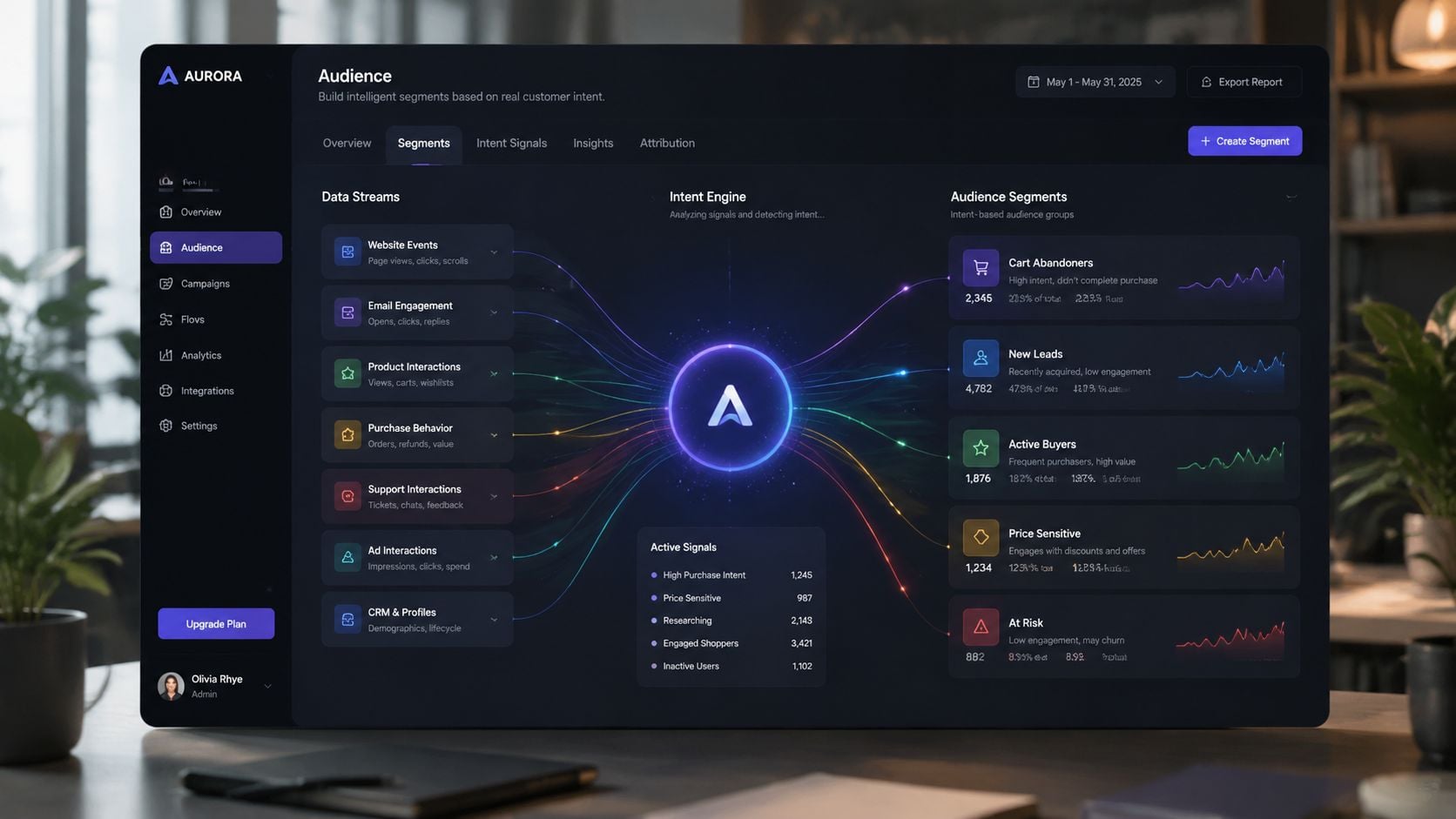
Segment by intent, not by convenience
For Australian SMEs, the usual advice to keep splitting audiences into narrower groups often backfires. Privacy limits, low traffic volumes, and short buying windows can leave each audience too small to exit learning or feed enough signal back into the platform. The better approach is to build a few high-quality audience groups based on commercial intent, then consolidate where the algorithm needs scale.
Start with the point closest to revenue. Ask what the user nearly did, and what stopped them.
| Audience type | What the behaviour suggests | Messaging angle |
|---|---|---|
| Product viewers | Early product consideration | Product fit, proof, category relevance |
| Cart abandoners | Strong purchase intent with friction | Objection handling, trust, offer clarity |
| Pricing-page visitors | Active evaluation | ROI, commercial value, differentiation |
| Content downloaders | Research interest | Education, credibility, next step |
| Past purchasers | Repeat or cross-sell potential | Complementary products, service follow-up, loyalty |
That structure is usually enough to start. It gives the platform cleaner signals and gives the creative team a clear job.
Exclusions matter just as much as target lists. PWD notes that failing to exclude people who have already converted can waste 20 to 30% of remarketing spend, and the same guide recommends planned message sequencing over time (PWD's remarketing best-practices guide). In practice, that means excluding purchasers, closed leads, job seekers, support traffic, and anyone who hit a thank-you page that marks a completed action.
Match creative to the buyer's mindset
Good audience logic still fails if every segment sees the same ad.
A product viewer usually needs a reason to care. A cart abandoner usually needs a reason to finish. A pricing-page visitor usually needs confidence in the commercial case. Those are different jobs, so the ad copy, offer, and proof point should change with the audience.
Time since visit matters as well. Early impressions should answer, “Why this brand?” A few days later, the message can shift to proof, reviews, or results. Late-stage follow-up can introduce a sharper prompt such as a quote reminder, finance option, consultation slot, or limited-time offer, depending on the business model. That progression is more useful than producing dozens of loosely related assets that dilute signal and learning.
A retailer selling office chairs might start with comfort and ergonomic benefits, then move to customer reviews, then present a return-policy reminder or bundle offer. A B2B software company might lead with feature relevance, then show case-study proof, then push a demo or pricing conversation tied to pipeline impact.
This walkthrough is useful if you want to see remarketing creative and audience logic in action:
Keep the message tied to the action taken
The ad should reflect the stage without sounding intrusive. Specificity helps. Overstatement hurts.
Messaging check: If the same ad could run to a cold audience with no loss in relevance, it is too generic for remarketing.
For cart abandoners, address checkout hesitation. For pricing-page visitors, reduce commercial uncertainty with proof, guarantees, or stronger offer framing. For lead generation campaigns, answer the question that likely blocked the enquiry, such as cost, speed, qualifications, or implementation effort.
Smaller advertisers often get better results by saying less to more qualified people. Fewer audience buckets, clearer exclusions, and messaging tied to real business actions usually outperform a complicated setup built around every pageview in the account.
When segment quality and message sequence line up, remarketing traffic does more than return. It converts at a higher rate and gives the platform better data to work with.
Cross-Platform Execution for Maximum Reach
No serious remarketing campaign strategy should rely on one platform unless the business model is unusually narrow. Buyers don't stay in one environment, and neither should your follow-up.
What matters is assigning each platform a job.
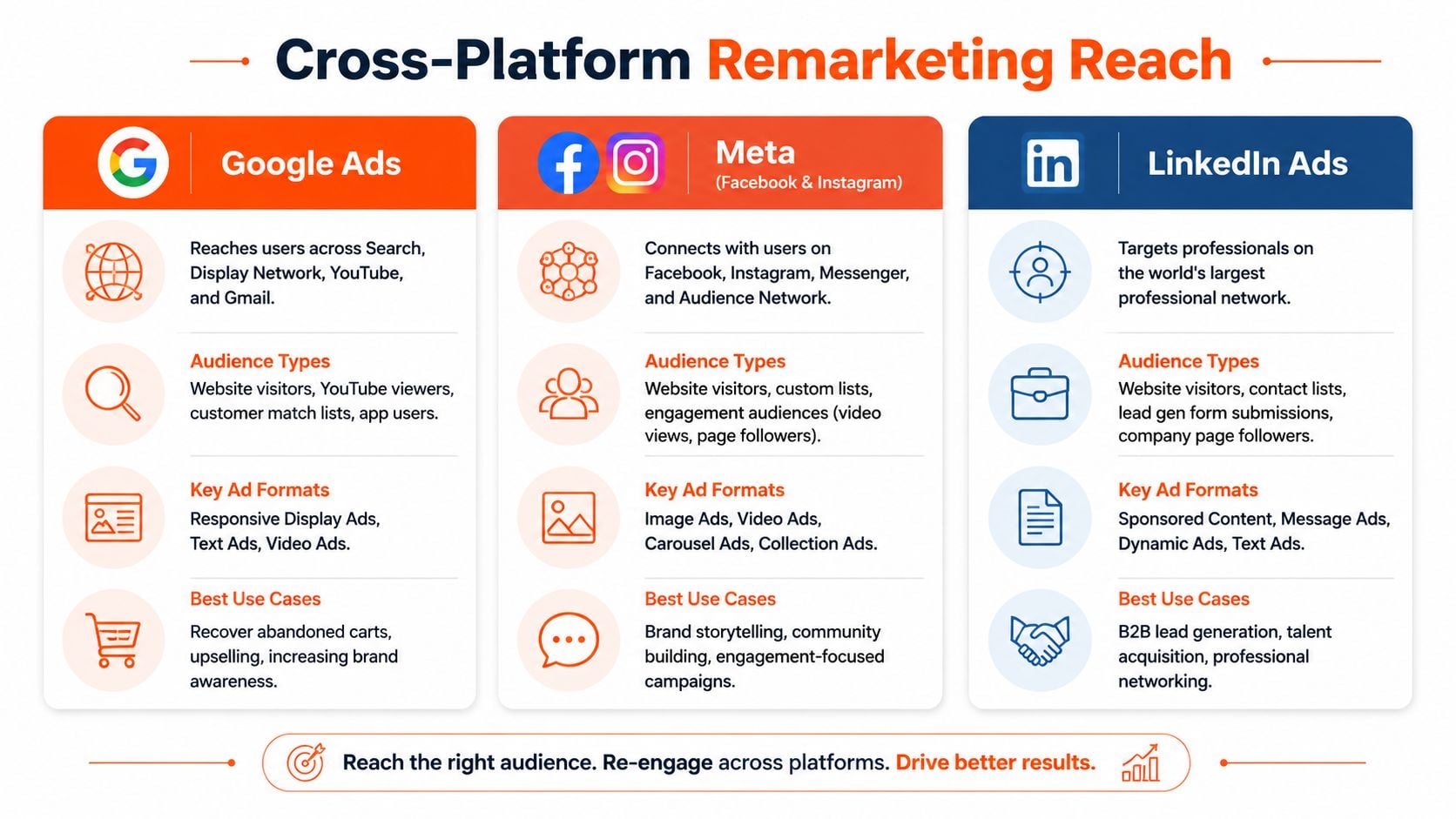
Google for intent capture and re-entry
Google remarketing is strongest when the user is already moving back toward a decision. That can happen across Display, YouTube, and Search-based re-engagement.
For ecommerce, Google is often the cleanest environment for recapturing bottom-funnel intent because the user may already be back in comparison mode. Product-led creative and dynamic formats work well here because they reconnect the search behaviour with the original item or category viewed.
Google also suits service businesses where users revisit the market before converting. If someone checked a finance, legal, or trade services page and left, Google lets you reconnect while they continue evaluating providers. Search-aligned follow-up can be especially valuable because the person is actively signalling renewed intent.
Use Google when the goal is one of these:
- Recovering carts and checkout exits
- Re-engaging product and pricing-page visitors
- Supporting return searches with stronger bid intent
- Extending reach through YouTube and Display without losing behavioural relevance
Meta for visual persuasion and repeated consideration
Meta works differently. People on Facebook and Instagram usually aren't in active buying mode the way they are on Google, but that doesn't make the channel weaker. It changes the creative role.
Meta is where brands can rebuild desire, trust, and recall through visual sequencing. Carousel ads, product-led video, founder-led explainers, customer proof, and collection-style creative all fit naturally. Dynamic Product Ads can be effective for ecommerce when the catalogue is clean and image quality is strong, but static proof-led creative often performs well too when products need context or differentiation.
A simple comparison helps:
| Platform | Best role in remarketing | Creative style that usually fits |
|---|---|---|
| Capture renewed demand | Product-specific, direct-response, intent-led | |
| Meta | Rebuild consideration | Visual storytelling, proof, offer framing |
| Nurture high-value professional leads | Credibility, business outcomes, category expertise |
Meta is also useful when the buying cycle includes hesitation that isn't solved by product data alone. That's common with lifestyle products, considered purchases, and brands where trust has to be earned over multiple exposures.
LinkedIn for high-value B2B follow-up
LinkedIn remarketing is rarely the first channel to launch, but for B2B it can be the most strategically important one.
If your sales cycle involves multiple stakeholders, budget approval, or professional credibility, LinkedIn gives you a context that Google and Meta don't. It allows remarketing around a professional identity rather than a consumer browsing moment. That changes the message.
For example, someone who visited a B2B landing page after clicking a search ad might later see a LinkedIn sponsored post built around outcomes, implementation confidence, or sector relevance. That works particularly well when the offer isn't impulsive and the decision-maker needs reassurance that your company understands their market.
Choose the mix based on sales motion
Channel mix should follow buying behaviour, not platform fashion.
If you're selling lower-friction ecommerce products, Google and Meta usually carry the weight. If you're selling B2B services with a long consideration window, Google plus LinkedIn often makes more sense, with Meta used selectively if the brand has enough creative depth.
A practical way to decide is to map each platform to one primary task:
- Google: Bring back people who are ready to resume the decision
- Meta: Keep the brand visible while trust and desire build
- LinkedIn: Re-enter the conversation in a professional context for high-value leads
That structure also helps budget discipline. Instead of duplicating the same message everywhere, you give each platform a distinct role in moving the prospect forward.
Optimising Bids, Frequency, and Measurement
A remarketing campaign can look broken in week one, then become one of the most efficient parts of the account by week three. I see that pattern often with Australian SMEs. The early data is usually thin, conversion paths are messy, and quick edits make the learning phase longer than it needs to be.
The job here is simple. Protect signal quality, control repetition, and measure contribution properly.
Give the algorithm enough stable data
Remarketing rarely rewards daily intervention. A sensible optimisation window is usually two to three weeks before making major structural calls, and the same source recommends keeping exposure controlled at around three to five impressions per user per day, as noted earlier from The Profit Platform's remarketing guidance.
That does not mean letting the account run unchecked. It means separating meaningful changes from nervous changes.
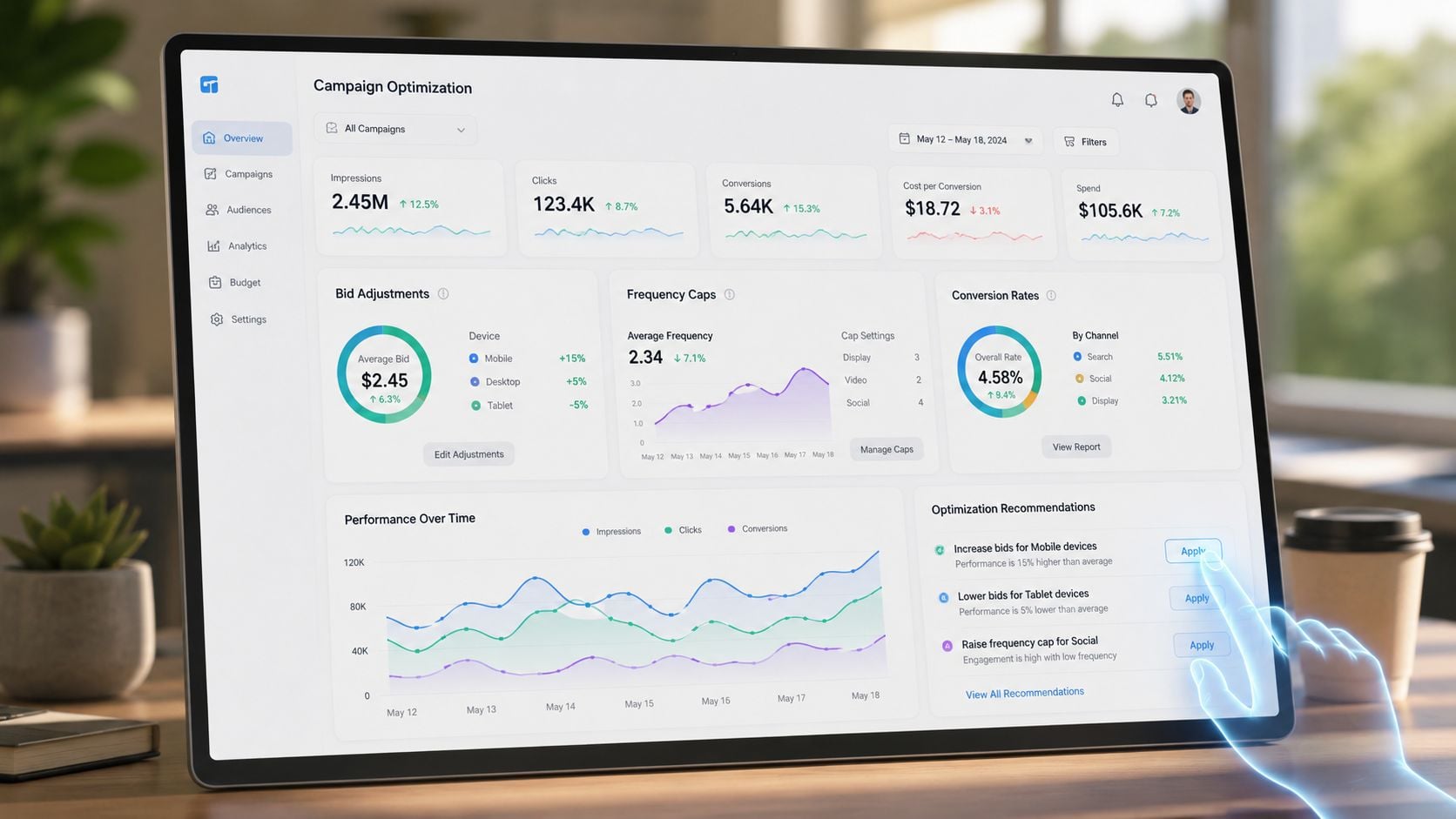
A practical review cycle usually focuses on four things:
- Bids: Check whether the strategy is finding profitable return visits, not just cheap clicks.
- Creative: Look for fatigue, weak offers, or message mismatch before blaming the audience.
- Audience flow: Confirm users are entering the right lists and leaving after conversion.
- Landing page behaviour: Watch bounce rate, form completion, and product-view depth from returning users.
Bid strategy should follow business model and data quality. For lead generation, Target CPA often works if offline conversions are fed back and low-quality enquiries are excluded. For ecommerce, value-based bidding usually gives the algorithm more useful direction, but only if revenue tracking is accurate and purchase values are passed back cleanly. For a clear breakdown of where automation fits and where it can distort performance, this guide to Target CPA bidding is a useful reference.
Cap frequency before performance slides
Frequency control matters more in smaller markets. Australian SMEs often work with tighter audience pools, so overexposure happens faster than generic US-focused guides suggest.
Three to five impressions per user per day is a reasonable starting point for most remarketing programs. High-intent cart abandoners may tolerate more. Cold site visitors with one shallow page view usually will not.
The trade-off is straightforward. Too little frequency and recall drops before the user is ready to return. Too much and CTR may hold up for a while, but conversion rate, branded search efficiency, and audience quality often start to weaken. Brand irritation is expensive, especially if your market is local and repeat exposure carries over across channels.
If engagement is falling, review the creative before expanding spend. Fresh hooks, stronger proof, and clearer offers usually do more than raising bids. For supporting ideas on ad engagement, these strategies for higher CTR can help diagnose whether the problem is attention, relevance, or message fatigue.
Measure influence, not just the last interaction
Last-click reporting understates remarketing in accounts with longer consideration cycles. That is common in B2B, higher-value services, and ecommerce categories where buyers compare options across several sessions.
Two measurements are more useful than many teams give them credit for:
- View-through conversions: These help show whether exposure influenced a later return.
- Time lag to conversion: This shows whether your audience duration and bid pressure match how people buy.
I would add one more filter. Segment returning users by lead quality or revenue, not just conversion count. A remarketing campaign that produces fewer form fills can still be the better investment if those leads close faster or produce higher average order value.
The goal is not to win inside platform attribution. The goal is to produce more qualified leads and more revenue from people who already showed intent.
Scaling Smart with Consolidation and Automation
A lot of remarketing advice assumes more segmentation is always better. For many Australian SMEs, that's wrong.
When budgets are small, splitting audiences into too many campaigns often starves the algorithm. For Australian SMEs with daily budgets under $150 AUD, fragmented segmentation can cause a 22% drop in conversion rates, while consolidating into a single high-intent campaign often performs better, according to this analysis on low-budget remarketing structure.
That's the small-budget consolidation paradox. The account looks less complex on paper, but performs better because the system gets enough data to optimise.
The practical version is straightforward:
- Combine close-intent users into one high-intent campaign when list sizes are thin.
- Segment inside the creative, not always at the campaign level.
- Use exclusions aggressively so consolidation doesn't turn into audience pollution.
- Automate list movement so users shift out after conversion or move into longer-tail nurture pools without manual cleanup.
Automation helps most when it removes repetitive operational work. Dynamic creative testing, audience rules, feed-based product ads, and scheduled checks all reduce friction. The primary gain isn't novelty. It's consistency. Teams can spend more time improving message-market fit and less time patching avoidable setup problems.
If short-form creative is part of your channel mix, approaches used in scaling TikTok ad creatives are worth studying because the same production logic can support remarketing asset turnover across other platforms as well.
A lean account with strong signals, clear exclusions, and disciplined automation will usually outperform a bloated one.
If your current remarketing setup feels fragmented, under-tracked, or too generic to drive reliable return on ad spend, Click Click Bang Bang can help you build a cleaner strategy around first-party data, stronger audience logic, and platform-specific execution that fits how your buyers convert.
Read NeXt
Or Read Our Latest
- Data Privacy Compliance: 2026 Guide for Marketers
- Your 2026 Remarketing Campaign Strategy Blueprint
- Customer Lifetime Value: Calculate & Increase It in 2026
- Contextual Targeting Advertising: A Guide for 2026
- Best Seo Agency Australia Guide 2026
- Cross Domain Tracking: A Practical Guide for GA4 in 2026
Click. CLick. Subscribe.
Get our best PPC insights, industry updates, and power moves delivered straight to your inbox. No fluff, just high-caliber strategies that actually work.
Don’t Leave Just Yet
Try Us For 30-Days,
Risk Free!!
We guarantee that you’ll love our work within the first 30 days, if not you’ll get your money back.
What have you got to lose?