

Data Privacy Compliance: 2026 Guide for Marketers
Last Updated

Your campaign dashboard looks clean until a privacy review asks a simple question. Which tags fired, what data moved, and who received it? That's usually when a marketing manager discovers that a pixel, a form embed, or a server-side route has been sending personal information further than anyone expected.
That moment is not a tooling problem alone. It's a data privacy compliance problem, a legal problem, and an operating-model problem. In Australia, the stakes are real. Mandatory breach notification has been in force since 22 February 2018, and the regime was tightened again on 13 December 2022 with higher penalties and broader OAIC powers, with current guidance pointing to penalties of up to AUD 50 million for serious or repeated privacy interferences, plus lower-tier penalties that still bite hard, and even specific health-information penalties for corporations and individuals (Linklaters summary of the Australian regime).
For marketers, the hard part is that privacy risk rarely sits in one obvious place. It shows up in tags, consent banners, CRM syncs, analytics tools, offshore recipients, and transient processing that teams assume is too brief to matter. The safest programs treat privacy as an ongoing control system, not a policy page someone wrote once and forgot.
Introduction to Data Privacy Compliance
A common failure pattern starts with a launch that looks fine from the outside. The ads are live, the landing pages convert, and the analytics events are flowing. Then someone in legal asks for the tag map, the consent logic, and the list of third-party recipients, and the team realises it can't fully explain where customer data went.
That gap is exactly where data privacy compliance becomes operational rather than theoretical. Australian public pressure reinforces that point. In the OAIC's survey work, 70% of Australians said protecting personal information was a major concern in 2020, and 59% reported problems with how their information had been handled in the prior 12 months. By 2023, 62% said protecting personal information was a major concern, 84% wanted more control over how personal information is collected and used, and the OAIC received 483 data breach notifications in the second half of 2023, up 19% from the previous period (OAIC survey and reporting).
What breaks first in real marketing stacks
The first break is usually visibility. Teams know the name of the analytics platform, but not every tag, trigger, and downstream transfer point. The second break is consent enforcement, because a banner says one thing while scripts still fire another way.
Practical rule: if you can't show the data flow on one page, you probably can't defend it in a regulator review.
The third break is documentation. A program can be technically sound and still fail because the evidence trail is thin. That's why structured records matter, and why A developer's guide for compliance is useful as a documentation mindset, not just a checklist.
Understanding Key Legal Requirements for Data Privacy Compliance
A marketing launch can look ready on the surface, then fail the moment privacy review starts. The notice says one thing, the tag manager fires another, and the CRM sync keeps sending data after consent has changed. That is the primary pressure point for data privacy compliance in marketing operations, because GDPR, the CCPA, and the Australian Privacy Act all push teams toward clearer disclosure, narrower collection, stronger user control, and better records.
Australia is the regime many local teams have to treat as the hardest test case. Breach notification has been mandatory for years, and the enforcement position has tightened enough that privacy mistakes can carry major exposure for serious or repeated interferences (Linklaters summary of the Australian regime). The practical takeaway is simple, if a marketing workflow depends on personal data, the team needs a defensible legal basis, a clear notice, and a record that shows how the workflow was controlled.
The legal pressure points that matter to marketers
Consent and notice usually break first. If a stack relies on pixels, audience syncs, profiling, or retargeting, users should be able to understand what is happening without decoding legal language. That means the notice has to describe the actual flow, not a generic promise that data may be used for marketing.
Automation creates a separate disclosure problem. DLA Piper's Australia summary highlights a 2026 development on disclosure for wholly or substantially automated decision-making that could reasonably and significantly affect a person's rights or interests (DLA Piper Australia summary). For marketers, that reaches lead scoring, audience suppression, dynamic pricing inputs, and ad decisioning, especially where a model makes a decision before a human reviews the record.
Collection is the pressure point that many teams underestimate. Even transient handling can count as a collection under the Privacy Act, so routing, enrichment, and short-lived AI processing can still trigger APP obligations. In practice, that means a tag firing for a split second is not outside scope just because the data does not sit in a warehouse for long. The privacy analysis has to follow the data as it moves through the stack.
For teams comparing rules across markets, the best approach is to test each campaign activity against the strictest standard that applies. That reduces rework later, because you are less likely to build one consent flow for Europe, another for California, and a third for Australia that all behave differently in production. Keep the privacy notice, consent flow, and downstream transfer list together in one review cycle, then document the decisions that shaped each one. That is also where A developer's guide for compliance helps, because privacy work falls apart fast when the evidence trail lives in three different places.
A practical example helps. If a team wants to activate first-party audience segments from website behaviour, the legal question is not only whether the segment is useful, it is whether the collection, disclosure, and onward transfer are all described accurately. The same review should cover whether the campaign path relies on direct identifiers, whether it reaches a vendor outside the original notice, and whether the consent state attached to the event still matches what the user agreed to. For a closer look at campaign activation decisions, see first-party data activation for marketing teams.
Mapping Your Marketing and Analytics Data Inventory
You can't protect what you haven't identified, and most privacy failures in marketing start with partial inventory. The OAIC frames privacy assessments as a four-stage cycle, targeting, planning, fieldwork, and reporting, which is a useful operating model for analytics and campaign systems because it forces teams to move from assumptions to evidence (OAIC privacy assessments guidance).
The most useful inventory is not a spreadsheet of tools. It's a map of data sources, data types, destinations, and decision points. In a Shopify plus Google Analytics environment, that means naming the storefront events, the checkout fields, the tags attached to each page, the consent state that governs each script, and every third-party endpoint that receives data.
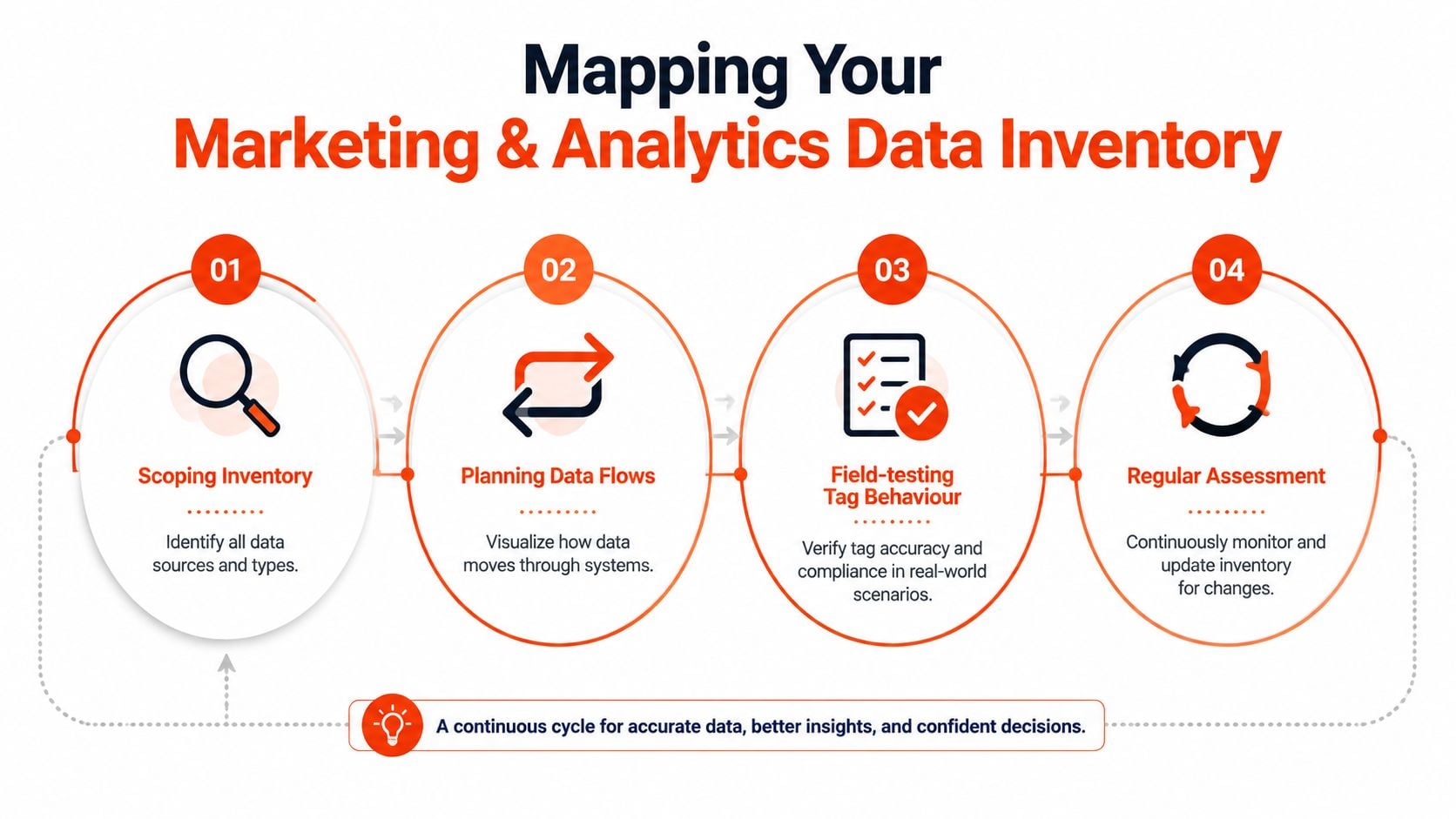
Build the inventory as a living control
Start with scoping inventory. List every pixel, API call, form embed, CRM sync, CDP connection, and offline import. Then move into planning data flows, where you record what each flow is meant to do and whether that purpose has been disclosed.
If a tag can fire before consent is settled, it belongs in your risk register, not in a “set and forget” folder.
Field-testing is where significant issues become apparent. A tag can look compliant in the manager interface and still over-collect in the browser. That's why I'd rather see a simple spreadsheet backed by live testing notes than a polished diagram with no evidence trail.
For a useful operational example, first-party data activation only works when the inventory tells you exactly which data you're allowed to use and where it can move. Without that, activation turns into exposure.
Finish with reporting. Keep remediation actions, owners, and test evidence in the same record so the inventory becomes audit-ready, not just readable.
Designing and Deploying Consent Mechanisms
A banner that asks for permission is only useful if the tag manager and CMP respect the same choice. Marketing teams feel the failure fast, because one misfired tag can collect browsing data before the preference is stored, and the user never sees the mismatch. Consent needs to govern the actual firing rules, not just the wording on screen.
Map preferences to firing rules
Keep the logic granular. Analytics, personalisation, profiling, and advertising should each have separate trigger rules, so one refusal does not accidentally block or allow everything else. If a user declines analytics, that state should stop the related tag from loading, not merely trim data after collection has already started.
A workable consent flow has four parts. The banner captures the choice, the CMP stores it, the tag manager reads it, and downstream tags respond in real time. If those parts are disconnected, the user's choice becomes decorative.
The quickest way to spot problems is a clean browser session and live tag testing. Open the site, clear any prior state, and watch what loads before and after each consent choice. If the same scripts fire regardless of the setting, the issue is implementation, not user confusion.
That testing should extend into the browser console and network requests. I look for tags that fire on page load, scripts that ignore the consent signal, and vendor calls that keep running after a rejection. A tag audit works best when it checks the firing order, the payload, and the destination, not just the banner text.
For analytics-heavy stacks, Google Analytics setup should be treated as a governance task, because the way the tag is deployed determines whether consent can control it.
Keep the preference trail intact
Store consent states in a form the team can prove later. That means timestamps, jurisdiction logic where relevant, and versioned wording for the banner copy. It also means keeping an eye on scripts that load out of order, because late-loading tags are a common place for accidental collection.
A practical record also needs enough detail to reconstruct the decision path. If a user revisits the site, the system should be able to show which preference was active, which notice text was shown, and which tags were suppressed. That is the difference between a defensible control and a vague promise.
Consent records are only part of the job. Teams also need to keep the privacy notice and banner aligned with the live stack, especially after campaign changes, pixel swaps, or new vendor scripts. If the stack changes, the wording has to change too, or the notice starts describing a system that no longer exists.
The same discipline applies to exported files and campaign reports. If a workflow produces PDFs for internal review or client handoff, teams should also clean sensitive PDF information before those files leave the privacy boundary. That avoids leaving embedded metadata behind when the visible content looks harmless.
Implementing Technical Controls for Privacy-safe Analytics
Technical controls are where privacy promises become real. A server-side setup can reduce browser exposure, but it does not solve compliance on its own. If a transient event still contains personal information, it still needs a lawful basis and a clear record of processing. Brief handling can still count as collection, so the privacy team has to treat short-lived data flow with the same care as stored records.

The practical sequence is straightforward. Route only the data you are allowed to process, suppress tags without a lawful trigger, and log the decision path. For teams running analytics-heavy content, Google Analytics setup should be handled as a governance task, not just an installation step.
Use controls that fail closed
Start with the default state. If consent is missing, the system should not send the event. If a tag needs consent but cannot read the state, it should stay silent.
That same discipline applies to metadata and file handling. If a team exports campaign reports or customer files, use a practical guide to clean sensitive PDF information before sharing those files. Privacy gaps often show up in attachments, not only in the platform.
The technical review should check three layers. First, browser behaviour. Second, server-side routing and proxy logic. Third, storage and access controls in the analytics or CRM destination.
If a team cannot explain why each tag fires, who approved it, and what consent state allowed it, the implementation is too loose. The fix is usually not a new tool. It is tighter rules, a better review process, and fewer exceptions.
Managing Vendors and Ongoing Risk Mitigation
A vendor is not low-risk just because it's popular. If a third-party platform receives campaign data, it becomes part of your compliance posture whether the legal team likes the contract or not. That's why OAIC guidance on analytics points to continuous monitoring and auditing for fairness, accuracy, and non-discrimination, not static policy statements that never get revisited (OAIC analytics guidance).
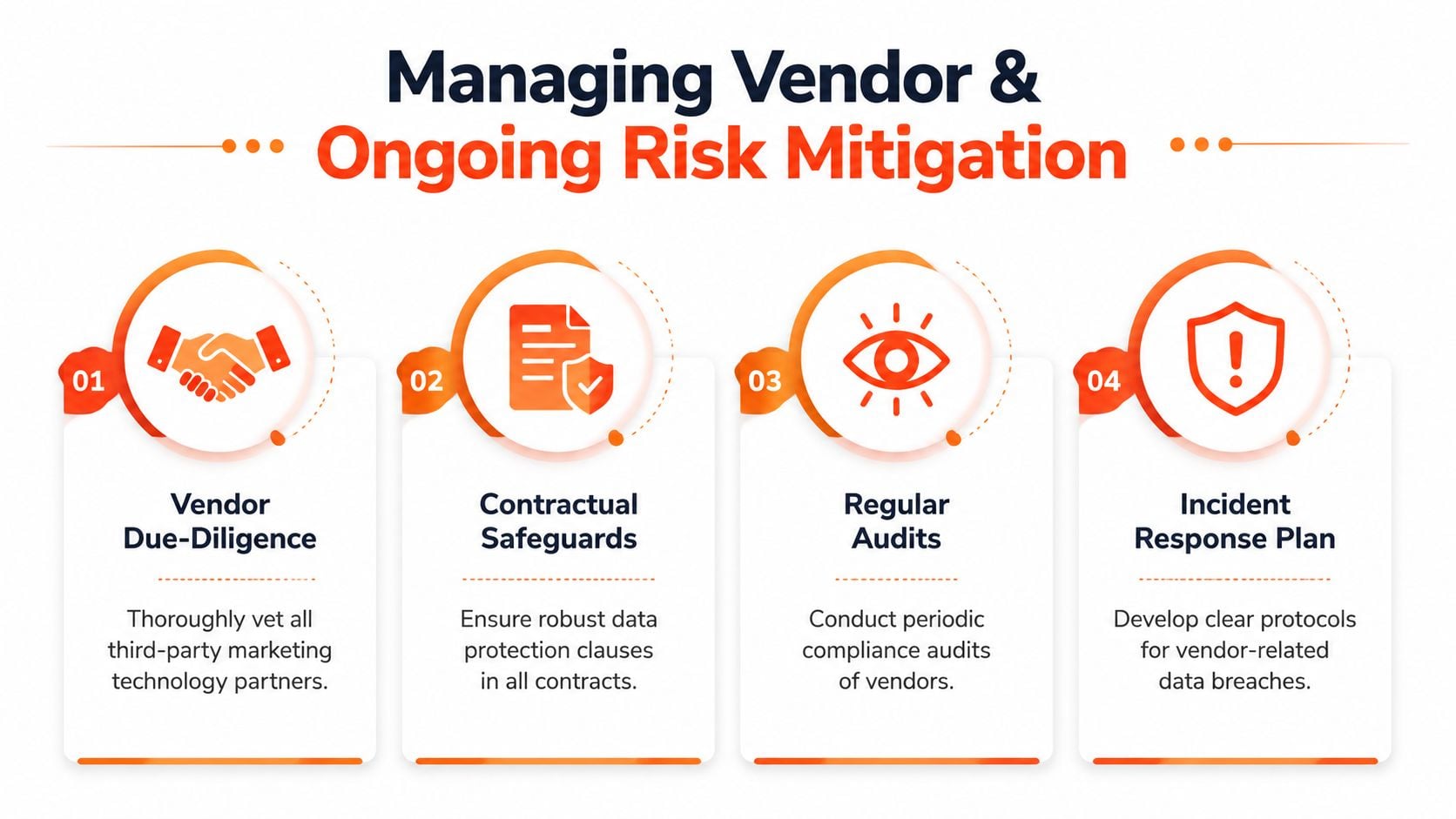
What to ask before signing
Vendor due diligence should test how the provider handles de-identification, access control, sub-processors, retention, and breach support. It should also ask whether the vendor can evidence how it audits model outputs or algorithmic decisions when those tools influence marketing or customer journeys.
For contract review, AI contract review software can help teams surface missing privacy clauses faster, but the output still needs a human decision-maker. Tools can flag clauses. They can't decide your risk tolerance.
Make the contract do real work
The contract should require privacy impact assessments for relevant projects, prompt notification of changes to processing, and evidence that offshore transfers are disclosed where needed. It should also reserve the right to audit, request technical proof, and suspend use if the vendor drifts from the agreed scope.
Practical rule: if the vendor can't explain how it enforces your consent logic, it probably shouldn't receive your marketing data.
The operational side matters just as much. Review vendor behaviour on a schedule, compare live tag behaviour against the approved inventory, and keep an incident response path ready for supplier breaches. For CDP-heavy teams, customer data platform governance only stays manageable when vendor controls are part of the same operating rhythm.
Conclusion and Practical Tips for Maintaining Compliance
A durable compliance program is boring in the best way. It gets reviewed, logged, tested, and updated before anyone in the business has to scramble. The teams that stay safest are the ones that treat privacy as a repeatable operating cycle, not a one-off legal project.
A practical quarterly checklist keeps the work real. Recheck the data inventory after every campaign launch. Test consent flows in live browsers. Review vendor changes and sub-processor updates. Re-run tag audits after major site or CRM changes. Confirm that breach notification roles are current and that audit logs are being captured.
Keep the evidence trail alive
Good documentation should answer three questions fast. What data did we collect, why did we need it, and what stopped us from collecting more than we should? If your records can't answer that, the controls may exist, but the program won't look defensible.
Use a simple rhythm to stay on top of it. Add new tags to the register before launch, not after. Schedule periodic reviews of consent wording and vendor disclosures. Keep an incident drill on the calendar so the team doesn't meet the breach process for the first time during an actual event.
Audit-readiness is less about perfect systems and more about consistent proof.
If you want help pressure-testing your marketing stack, mapping hidden data flows, or tightening tag governance across campaigns, contact Click Click Bang Bang and ask for a privacy-aware audit of your analytics and PPC setup.
Read NeXt
Or Read Our Latest
- Data Privacy Compliance: 2026 Guide for Marketers
- Your 2026 Remarketing Campaign Strategy Blueprint
- Customer Lifetime Value: Calculate & Increase It in 2026
- Contextual Targeting Advertising: A Guide for 2026
- Best Seo Agency Australia Guide 2026
- Cross Domain Tracking: A Practical Guide for GA4 in 2026
Click. CLick. Subscribe.
Get our best PPC insights, industry updates, and power moves delivered straight to your inbox. No fluff, just high-caliber strategies that actually work.
Don’t Leave Just Yet
Try Us For 30-Days,
Risk Free!!
We guarantee that you’ll love our work within the first 30 days, if not you’ll get your money back.
What have you got to lose?