

Reputation Management That Works in 2026
Last Updated

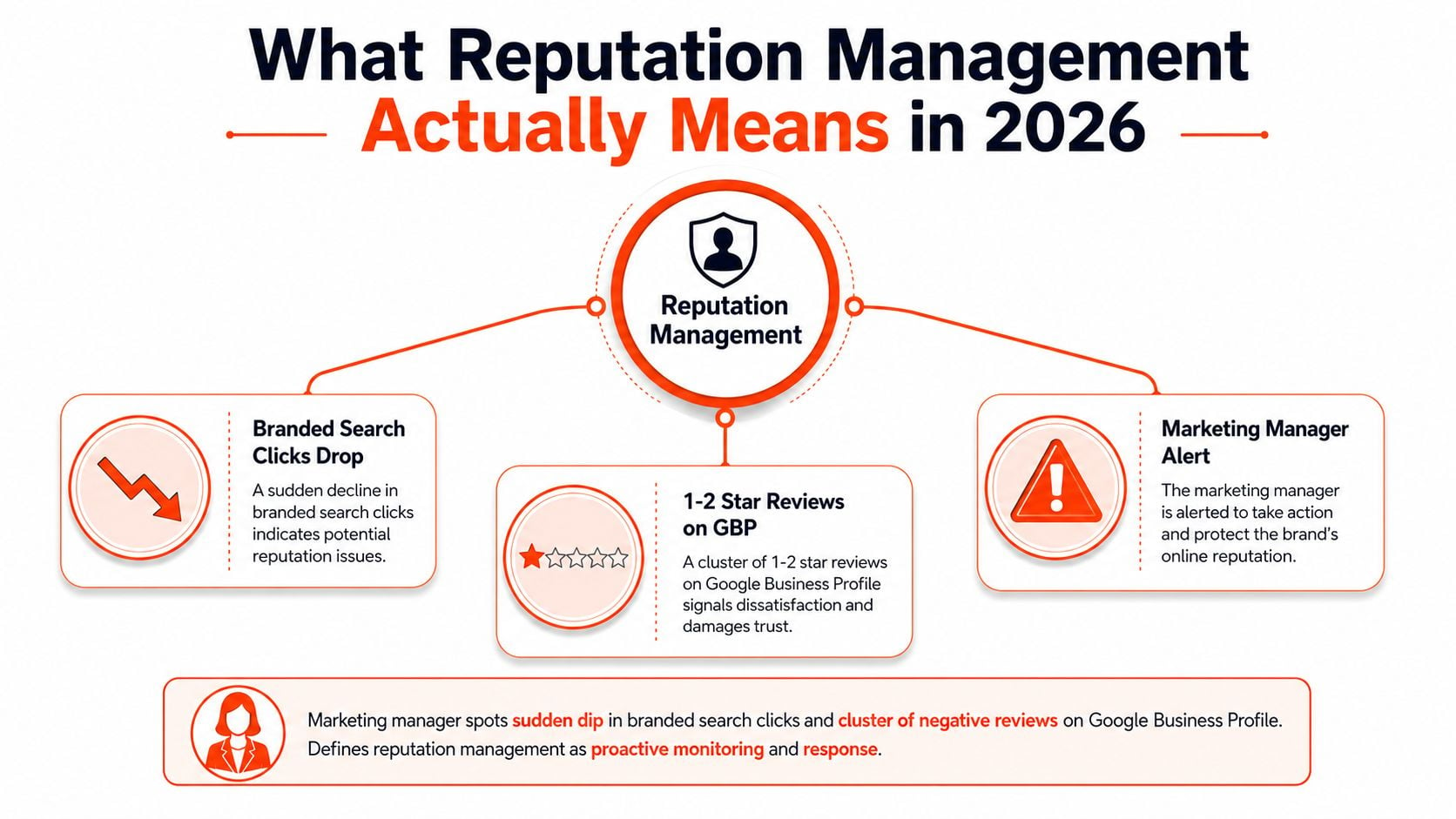
You're staring at a branded Google result that used to be clean, and now the first thing people see is a cluster of one-star and two-star reviews beside your name. Search clicks have dipped, the sales team is asking why leads feel colder, and someone in leadership still wants to call it a “PR issue”. It isn't. In Australia, reputation management is a commercial control problem, because the first page of search results, review platforms, social mentions, and news coverage all shape what buyers believe before they ever speak to your team.
What Reputation Management Actually Means in 2026
A buyer searches your brand, scans the reviews, checks the social proof, and reads the result sitting on page one. That is where reputation gets judged. In 2026, reputation management is the work of controlling that visible surface so the branded SERP, review profiles, and answer engines support revenue instead of draining it.
The market reflects that shift. The broader online reputation management market was valued at USD 6.88 billion in 2025 and is projected to reach USD 14.01 billion by 2031, a 12.59% CAGR across the forecast period, according to Mordor Intelligence. That growth is not driven by a love of brand language. It is driven by the fact that reputation now sits inside search, reviews, social, and news, which means it sits inside the buying process.
What counts as reputation in practice
Treat these surfaces as one system.
- Branded search results, because the first page is where buyers decide whether to click or leave.
- Google Business Profile and review pages, because review clusters shape trust fast.
- Social media mentions, because they spread praise and criticism in public view.
- News coverage and articles, because they often rank for brand terms and stay visible for months.
- AI-generated answers and summaries, because more users are starting with an answer layer, not a results list.
That is why I tell clients to stop separating “brand” from “performance”. If a bad result is stealing clicks from your homepage, the problem belongs in search and ads, not in a general comms plan.
For teams that still choose tools by instinct, it helps to compare brand monitoring platforms and pick the one that tracks the queries and channels tied to revenue.
If your replies, profile content, and owned pages need to sound consistent, use a clear voice and tone framework so every public touchpoint reads like one brand.
Why Reputation Management Is Now a Commercial Problem
A brand search is a buying moment. People read before they act, and public trust signals decide whether they click, call, or move on. The ACCC says 72% of consumers read reviews before making a purchase, so your review profile on a branded query can shape the outcome before your landing page even gets a chance, according to Reputation.com's guide. If the first thing buyers see looks weak, conversion intent drops fast.
Negative review clustering is a search problem as much as a trust problem. A buyer searching your brand name is already close to action, which means complaints, third-party criticism, or unresolved issues sitting above the fold can stop the sale without a single sales conversation. At that point, reputation is a funnel issue. Branded click-through and pre-sale abandonment are both exposed to the same SERP, so the branded result set needs to be managed like revenue inventory.
The market has already moved in that direction. As noted earlier, the online reputation management market is expanding, and businesses are treating reputation as an operational discipline rather than a clean-up exercise. That means monitoring, response, and sentiment analysis sit inside the commercial stack now. They are not side projects for PR.
Reputation surfaces and their conversion impact
| Surface | What it is | Conversion metric at risk |
|---|---|---|
| Branded SERP | The search results for your company name | Click-through rate |
| Google reviews | Public ratings and written feedback | Call volume and form starts |
| Local pack | Map-style business results | Store visits and direction clicks |
| Social mentions | Public posts and comments | Trust and assisted conversion |
| News coverage | Editorial or media content about your brand | First-page confidence |
The operational mistake is tracking sentiment in isolation. Sentiment helps, but it does not tell you where money is leaking. Watch review velocity, star-rating distribution, and response latency, then compare those signals with branded-search conversion rates. That is the measurable story.
Practical rule: if the first page for your brand name looks messy, fix search visibility before you argue about messaging. Buyers judge what they see, not what your slide deck says.
Paid search belongs in the same conversation. If your organic result set is under pressure, your brand campaign becomes a defensive asset, not a growth extra. I would rather see a team protect branded click-share than sit back and hope the noise passes. If you need the clearest view of how paid and organic work together under pressure, the strategic link in SEM and SEO integration is the right place to start.
The Four-Stage Reputation Management Framework
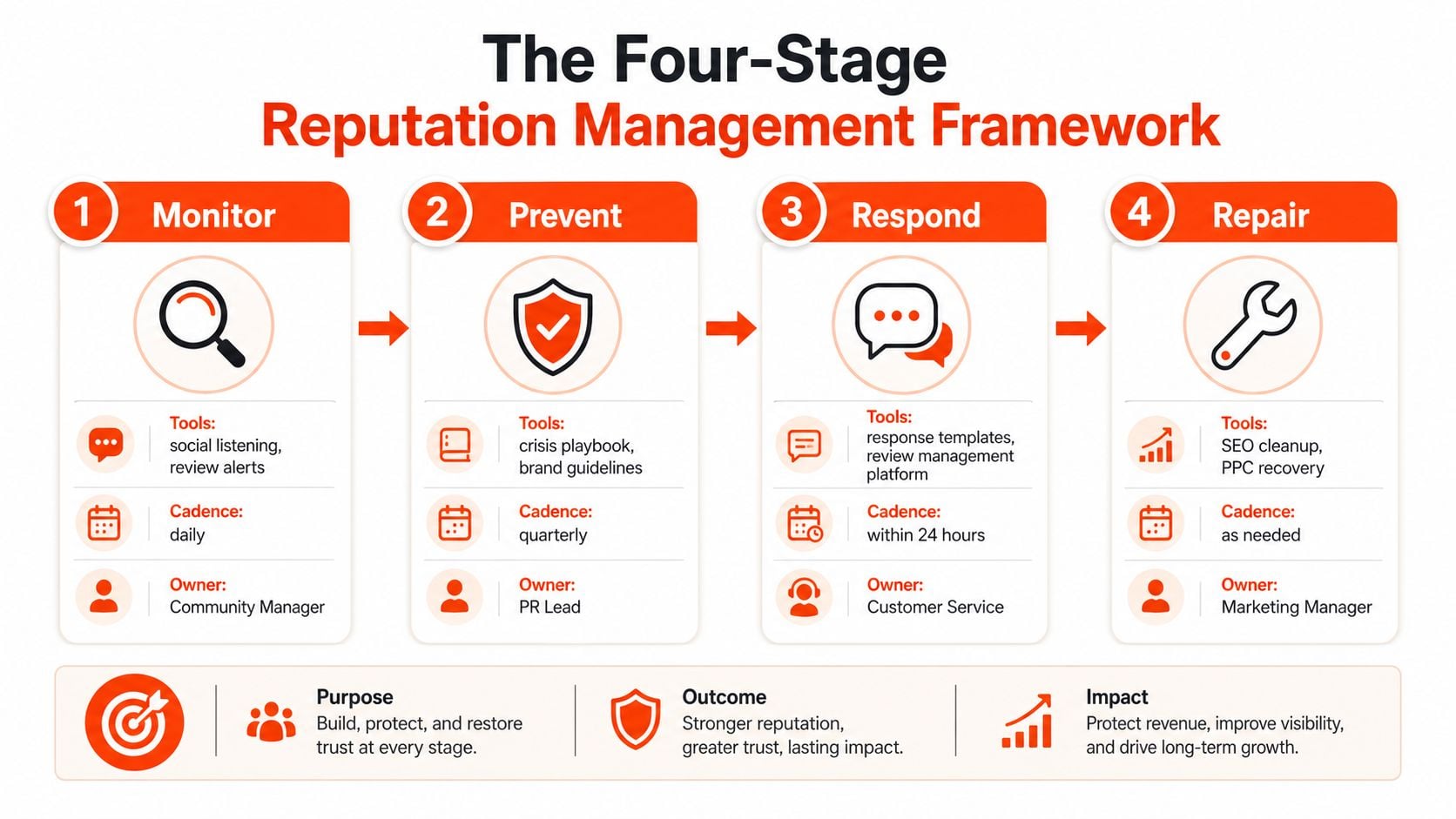
A real reputation programme has to do four things in order, monitor, prevent, respond, repair. Anything else turns into panic work. The point is to give each stage a named owner, a cadence, and a toolset, so marketing, CX, and legal don't end up fighting over the same fire.
Monitor and prevent
Monitor means daily review alerts, branded SERP checks, social listening, and AI-overview watching. The owner should be the Community Manager or whoever already lives in the mention stream. Their job is to spot shifts early, not interpret them.
Prevent is the part most brands underinvest in. It covers review-solicitation cadence, employee advocacy, and regular publishing of owned content that can rank for brand terms. The PR Lead should own the policy, but marketing has to execute it because owned pages only work if they exist and stay active.
Respond and repair
Respond needs templates, escalation thresholds, and a hard SLA. Public replies should be fast, calm, and consistent, while direct-message triage handles cases that need privacy. Customer Service should own this stage, with Marketing and Legal pulled in only when the issue crosses a threshold.
Repair is where SEO, PPC, and legal overlap. That includes SERP cleanup, corrective content campaigns, paid search defence, and removal requests where there's a legitimate basis. The Marketing Manager should coordinate this stage, because the job is to change what appears on page one.
The goal isn't to “win” every review thread. The goal is to stop isolated complaints from owning your brand query.
Don't separate these stages into different documents. Put them in one operating plan. The first time a crisis hits, you won't have time to negotiate ownership.
For agencies and in-house teams that need a stronger relationship between control, visibility, and reporting, reputation work should sit beside your attribution model, not outside it. The reason is simple, search visibility and response speed affect how demand is captured, which is why the linkage to multi-touch attribution matters in board reporting.
Where SEO and PPC Plug Into the Framework
SEO gives you long-term control of the branded SERP. PPC gives you immediate control over what people see when they search your name. During a reputation issue, both matter, but they solve different problems. SEO pushes your owned assets higher. PPC protects click-share while negative pages are still visible.
Start with owned content that can rank for brand terms. Put your effort into the pages buyers already expect to find, about pages, comparison pages, case studies, FAQs, and policy pages that make the business look more complete than the criticism around it. If negative assets sit above your homepage, the answer is not more spin, it is more authoritative owned pages that give search engines a stronger source of truth. The same logic applies to broader recovery work, including a SEM in SEO planning approach that treats paid and organic together instead of as separate silos.
What to do with paid search
Branded PPC turns defensive during a reputation problem. Use it to keep the correct destination in front of searchers, hold the brand term, and stop clicks drifting to third-party pages that are benefitting from the noise. If the story is still unfolding and media attention is hot, spend carefully. Repeated ad exposure can keep the controversy alive longer than it needs to be.
Paid search is also where you control the message while search results are unstable. Keep ad copy plain, specific, and aligned with the current situation. Do not try to outshout the issue. Use the budget to protect the query, not to pretend the problem does not exist.
Structured outreach and content placement help when you need more credible third-party coverage or supportive owned-adjacent content. A guest posting service can place useful material where it has a chance to rank, provided the content is real, relevant, and not thin reputation theatre. Use it to support search visibility, not to manufacture authority.
Technical signals that matter
- Schema and review markup help reinforce trust signals in search where they are eligible.
- Branded-page freshness tells search engines there is an active source of truth.
- AI-overview monitoring matters in 2026 because the answer layer can surface criticism, not just links.
- Budget reallocation should follow the SERP. Put money into defence when negative assets are crowding the page, then step back once owned results recover.
The mistake is to spray ads at a broken SERP with no recovery plan. That only buys more traffic to a page that still looks untrustworthy.
Reputation teams also need a clean handoff between organic and paid. SEO should keep building the pages that deserve to rank. PPC should protect the query while those pages climb. If your team treats one as a brand activity and the other as a search activity, you will waste both.
Measurement and KPIs That Prove Reputation Work Is Working
If you can't measure it, you can't defend the budget. Reputation work needs a scorecard that a CMO or GM can read in two minutes. I'd keep it to four core KPIs, because teams usually fail by tracking too much, not too little.
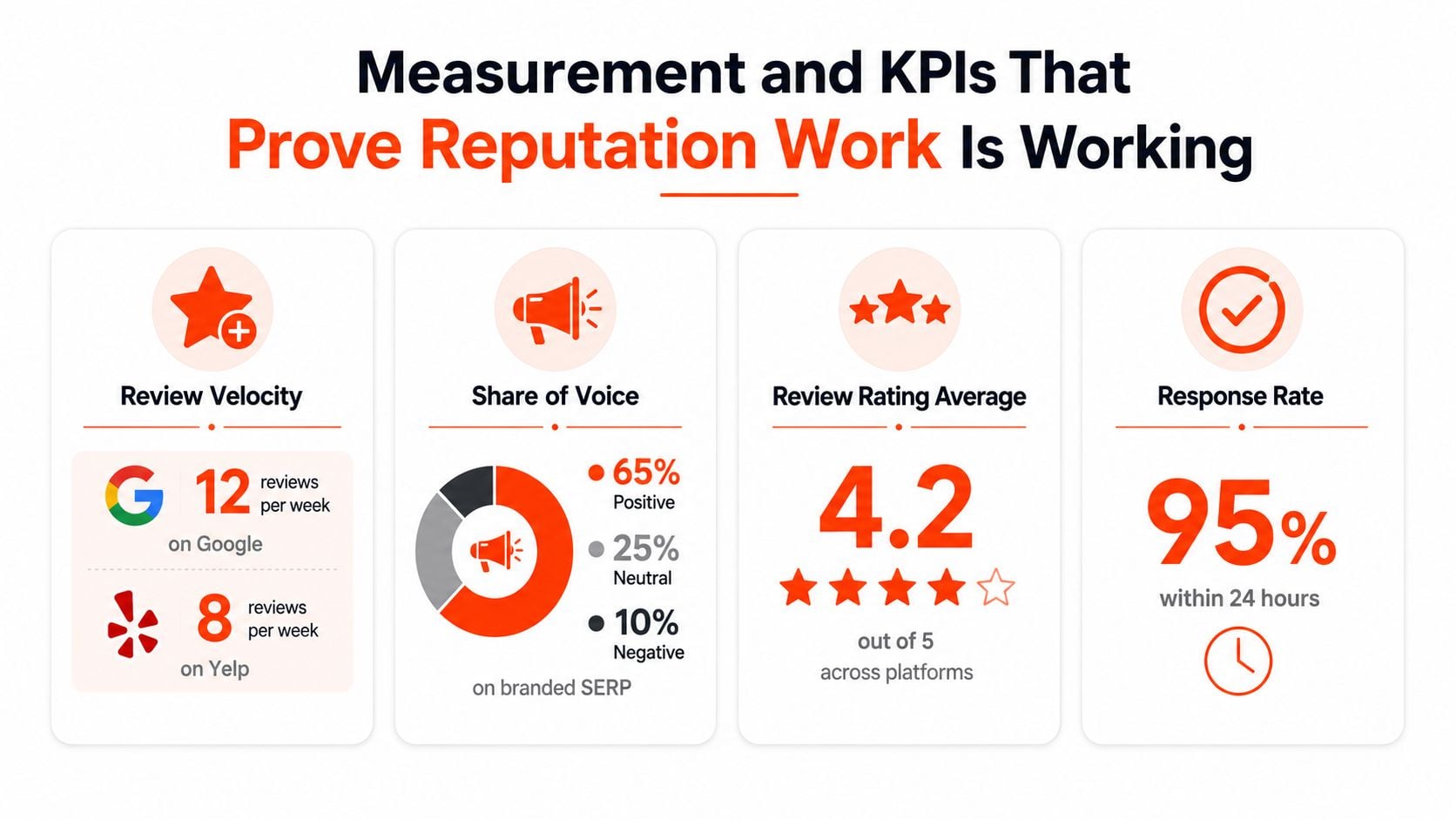
The first KPI is review velocity, which means reviews per week per platform. Track it weekly, because momentum matters more than a monthly average when you're trying to recover. If review volume falls off after a crisis, you lose the social proof needed to offset old criticism.
The second is share of voice on the branded SERP. Count how many positive, neutral, and negative assets appear in the top 10 for the brand query, then note their positions. That tells you whether your repair work is changing the search page or just generating internal activity.
The scorecard that leadership will understand
- Response latency, measured in median hours to first public reply by channel.
- Sentiment ratio, measured over a rolling 30-day window so you're not overreacting to one noisy week.
- Branded SERP share, which should be reviewed weekly by SEO or digital PR.
- Review velocity, which should be reviewed weekly by CX or community management.
The third KPI is response latency. Slow replies make a brand look absent, even when the eventual answer is good. The fourth is sentiment ratio, which gives you a broader view of whether positive mentions are starting to outnumber negative ones over time.
Operational rule: if negative assets are climbing on the branded SERP and response latency is slipping, escalate immediately. Waiting for the monthly report is how small issues become board-level messes.
Use the right tool category for each metric. Review platforms and Google Business Profile for review velocity, SERP tracking tools for share of voice, social monitoring and ticketing systems for response latency, and mention-monitoring platforms for sentiment ratio. The point isn't the tool itself, it's the accountability chain.
For founders and operators who want a practical AI-era lens on this kind of monitoring, a useful reference is the guide for founders in 2026, especially if your brand is starting to show up in AI-generated answers.
The Hidden Risk Most Reputation Playbooks Miss
Most reputation advice stops at customers. That's too narrow. Employee-generated reputation risk is one of the biggest blind spots in the whole category, because staff posts, resignations, Glassdoor-style commentary, and public workplace disputes can create searchable proof points that buyers and candidates both find.
The Australian context matters. The Fair Work Ombudsman received 39,000+ disputes and 12,980 anonymous reports in 2023 to 24, which tells you just how much workplace friction exists beneath the surface, according to Cision's reputation management insights. Not all of that becomes public fallout, but enough of it can spill into the search results, social threads, or employee review pages to matter.
Who owns the narrative when the source is internal
The wrong response is to leave this to marketing alone. The right response is to define ownership across HR, legal, and comms before a problem lands. HR holds the facts, legal sets the boundaries, and comms manages the external language.
You also need documentation standards. Capture the complaint, the timeline, the contact owner, and the approved response path. If the issue later reaches the public sphere, that record keeps the company from contradicting itself.
Ask this in the next leadership meeting, who owns our external narrative when the source is internal?
That question forces the conversation. A brand can survive a bad review. It struggles more when current or former employees provide public evidence that the culture is broken and nobody inside the company is clearly accountable.
The practical move is to treat internal friction as reputation material from day one. If HR, legal, and comms already know the escalation route, the company can answer fast and consistently instead of improvising under pressure.
Your 90-Day Reputation Management Rollout
The first 30 days are about seeing clearly. Audit every branded surface, map the top search results, tag review themes, and build a baseline for your current position. By the end of week two, you should know where the negative assets are sitting and which pages you can push up first.
Weeks three to six are for systems. Set up monitoring, write response templates, define escalation thresholds, and agree who approves what. Then build the owned-content backlog and the paid-search defence plan so the team isn't making those decisions in real time.
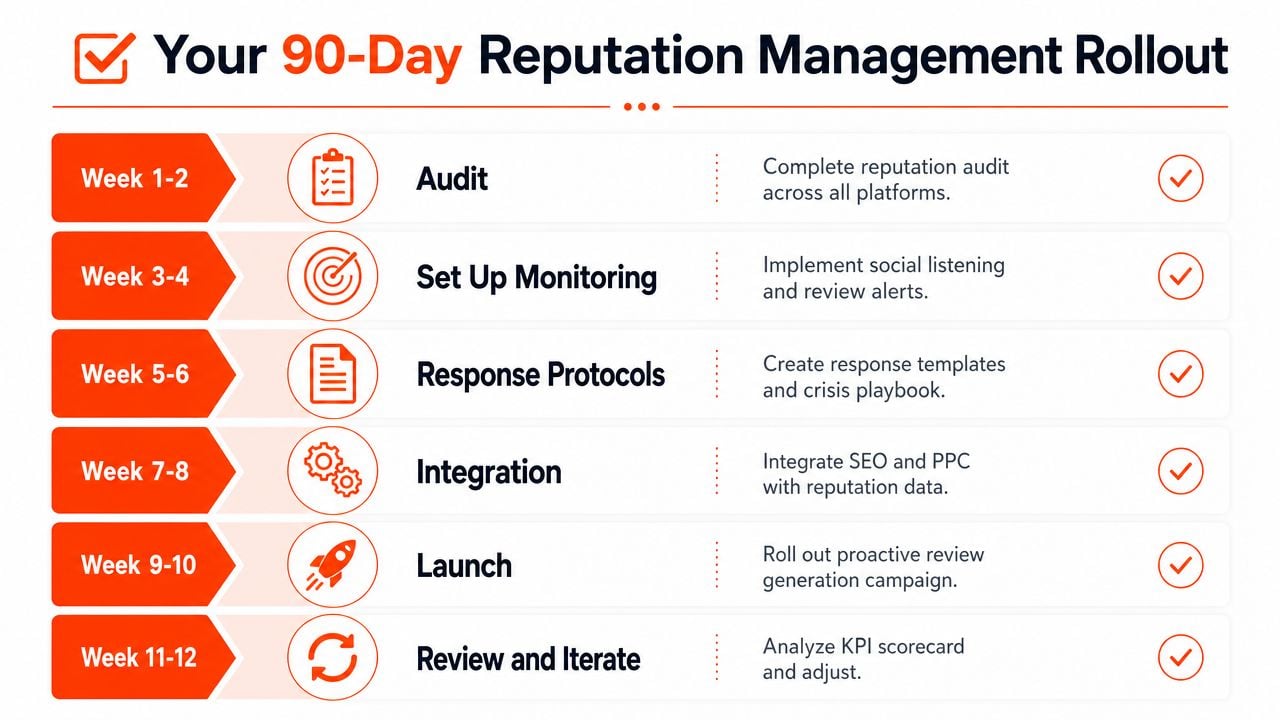
By weeks seven to twelve, you're executing repair work and reporting back. Launch the content that supports the branded SERP, keep the ad defence active where needed, and present the first monthly board report with the KPI scorecard, not a vague summary of “brand sentiment”. If you can't show movement, you probably haven't done enough on the search side yet.
By day 90, the team should have these eight artefacts:
- Monitoring dashboard
- Escalation matrix
- Response template library
- Owned-content backlog
- Branded-SERP baseline
- Paid-search defence plan
- KPI scorecard
- Cross-functional ownership memo
Do that work properly and reputation stops being a crisis topic. It becomes a managed part of growth.
If your branded SERP is already carrying the wrong story, don't wait for another review wave or another dip in clicks. Book a working session with Click Click Bang Bang and get a practical reputation recovery plan built around SEO, PPC, and the search results your buyers see.
Read NeXt
Or Read Our Latest
Click. CLick. Subscribe.
Get our best PPC insights, industry updates, and power moves delivered straight to your inbox. No fluff, just high-caliber strategies that actually work.
Don’t Leave Just Yet
Try Us For 30-Days,
Risk Free!!
We guarantee that you’ll love our work within the first 30 days, if not you’ll get your money back.
What have you got to lose?