

Your Guide to PPC Services Australia
Last Updated

PPC services in Australia give businesses a direct, lightning-fast way to connect with customers who are actively looking for exactly what they sell. Instead of waiting around for organic search rankings to build up, paid advertising can put your brand right at the top of the search results instantly. This drives highly targeted traffic and delivers measurable returns from day one.
Why Australian Businesses Invest in PPC Services
Think of Pay-Per-Click (PPC) advertising like renting a massive, dynamic billboard on Australia's busiest digital highway—Google Search. The big difference? You only pay when someone who's genuinely interested decides to pull off the exit ramp and visit your website. In a market as competitive as ours, stretching from Sydney to Perth, relying only on the slow burn of organic growth just isn't a viable strategy anymore for ambitious businesses.

PPC offers a direct line to potential customers at the exact moment they're showing intent. This immediacy is its superpower. It lets you completely bypass the long wait times tied to Search Engine Optimisation (SEO) and start generating leads or sales almost immediately.
The Power of Immediate Visibility
Let’s take a local plumber in Melbourne as an example. With a well-managed PPC campaign, their ad can show up at the very top of Google the second a homeowner searches for "emergency plumber near me." This kind of laser-focused visibility gives them a huge advantage over competitors buried pages deep in the organic results.
This ability to spend strategically is a key reason why total digital ad spend in Australia hit a staggering AUD $16.4 billion in 2024, an impressive 11.1% jump from the previous year. And PPC is a massive driver of this growth, with 65% of Australian SMBs now running active campaigns. You can dig into more paid advertising statistics to see just how dominant this trend has become.
Professional PPC services act as your expert navigators in this crowded digital space. They do a lot more than just switch on a few ads. A good agency conducts deep market research, uncovers high-value keywords, and writes compelling ad copy that’s designed to click with an Australian audience.
The goal isn't just to get clicks; it's to get the right clicks. An expert agency ensures every dollar of your ad spend is directed towards users who are most likely to convert into loyal customers, maximising your return.
Turning Clicks Into Customers
At the end of the day, investing in PPC services is all about achieving real, measurable business outcomes. It’s not just about getting more website traffic; it’s about turning that traffic into tangible results. A successful campaign delivers a clear and positive Return on Ad Spend (ROAS), transforming your advertising budget into a reliable engine for growth.
Here are the key benefits driving this investment:
- Speed to Market: You can launch campaigns and start seeing traffic and leads in a matter of days, not months.
- Hyper-Targeting: Reach specific demographics, locations (right down to the postcode), interests, and even people who have visited your website before.
- Measurable Results: Track every single dollar spent and every conversion earned. This gives you crystal-clear data on what’s working and what isn't.
- Budget Control: Set daily or monthly budgets to make sure you never overspend, with the flexibility to scale up or down whenever you need to.
By bringing in expert management, Aussie businesses can cut through the digital noise, get the most out of their ad spend, and build a predictable pipeline of new customers—setting a powerful foundation for sustainable growth.
Mastering the Australian PPC Platform Landscape
Choosing the right ad platform is a bit like picking the right tool for a job. You wouldn't use a sledgehammer to hang a picture frame, and you wouldn't use a tiny screwdriver to break up concrete. In the world of PPC services in Australia, the two biggest toolboxes belong to Google Ads and Meta Ads (which covers Facebook and Instagram).
The secret isn't figuring out which one is "better," but which one is right for your specific goal, right now. It really boils down to a simple but critical difference: one platform helps you capture existing demand, while the other helps you create it.
Google Ads: The Demand Harvester
Think of Google Ads as the ultimate tool for grabbing the attention of customers who are actively looking for what you sell. When someone in Australia has a problem, their first move is almost always to Google it. This platform lets you jump to the front of the queue, right when they need you most.
Picture this: a homeowner in Adelaide wakes up to a cold shower because their hot water system has died. They aren't scrolling through social media for fun; they're frantically typing "emergency hot water repair Adelaide" into their phone. Google Ads allows a savvy local plumber to pop up right at the top of the search results, ready to solve that urgent problem.
The whole platform is built around this idea of performance – connecting businesses with people who are looking for a solution now.
This "pull" marketing approach is incredibly powerful. It works wonders for service-based businesses, B2B companies, and e-commerce stores selling specific products that people know to search for.
The magic of Google Ads is that it connects your solution to a customer's problem at the exact moment they're searching for an answer. You're not interrupting their day; you're offering a helping hand.
Here’s why it’s so effective:
- High Purchase Intent: You’re talking to people who have already put their hand up and said, "I need this." They are actively looking to buy or book something.
- Massive Reach: Google handles over 90% of all search queries in Australia. The potential audience is enormous.
- Diverse Ad Formats: You're not just limited to text. You can run visually rich Shopping ads for products, engaging video ads on YouTube, and much more.
Meta Ads: The Demand Creator
While Google is busy capturing existing demand, Meta's platforms—Facebook and Instagram—are masters at creating it. This is "push" marketing. You’re not waiting for someone to come looking for you; you’re putting your product in front of a carefully selected audience you think will love it.
Let's imagine a boutique fashion label in Sydney launching a new line of sustainable activewear. Their ideal customer probably isn't searching for "eco-friendly leggings" today. But with Meta Ads, that label can get incredibly specific, targeting users based on their interests (like yoga, sustainable living, or fitness influencers), their demographics (age and location), and even their online behaviour.
A stunning video ad can then appear in their Instagram feed, stopping them mid-scroll. Suddenly, they're introduced to a product they didn't even know they wanted a minute ago. That’s how you build desire and create new customers from scratch.
Choosing Your Platform: It's a Strategic Decision
The best part? This doesn't have to be an either/or choice. In fact, the most powerful PPC strategies almost always use both platforms in harmony. The key is to match the platform to your immediate business goal.
- Need leads and sales right now from customers with a clear need? Start with Google Ads.
- Want to build brand awareness or create buzz for a new or highly visual product? Start with Meta Ads.
As your strategy matures, you’ll start to see how beautifully they work together. You might run a Facebook video campaign to introduce your brand to a new audience. A week later, when some of those people start searching for your product category on Google, your search ad is waiting there to close the deal. This is exactly how expert PPC services in Australia build a full-funnel approach, guiding a customer all the way from their first curious glance to the final purchase.
Budgeting for PPC Costs and ROI in Australia
Let's get straight to it. The biggest hurdle for most Aussie businesses diving into Pay-Per-Click is the money question. How much is this going to cost, and is it actually going to make me any money?
There's no single, clean answer, because your total investment is always made up of two parts: the ad spend and the agency management fee.
Think of it like building a new deck. Your ad spend is the budget for the timber, screws, and stain—the raw materials you buy directly from platforms like Google or Meta to get clicks and traffic. The management fee is what you pay the expert chippie to design the plans, do the hard yards, and make sure the whole thing doesn't fall over.
Understanding Agency Fee Structures
When you bring a professional PPC agency on board, you’ll run into a few common ways they charge for their work. Knowing the difference is key to finding a partnership that fits your budget and your business.
Each model has its pros and cons, and you can get a deeper dive into the different PPC pricing models to see which one suits you best. The most common ones you'll see are:
- Fixed Monthly Retainer: Simple and predictable. You pay a set fee each month for your campaigns to be managed. This is fantastic for budgeting because there are no surprises.
- Percentage of Ad Spend: The agency takes a cut of your total monthly ad spend, usually somewhere between 10-20%. This model scales as you grow, so the agency is incentivised to make your campaigns bigger and better.
- Performance-Based Fee: This one's less common but ties the agency’s fee directly to results, like the number of qualified leads or sales they generate for you.
This infographic shows how different platforms capture what your customers are thinking, which has a massive impact on your costs and what you can expect in return.
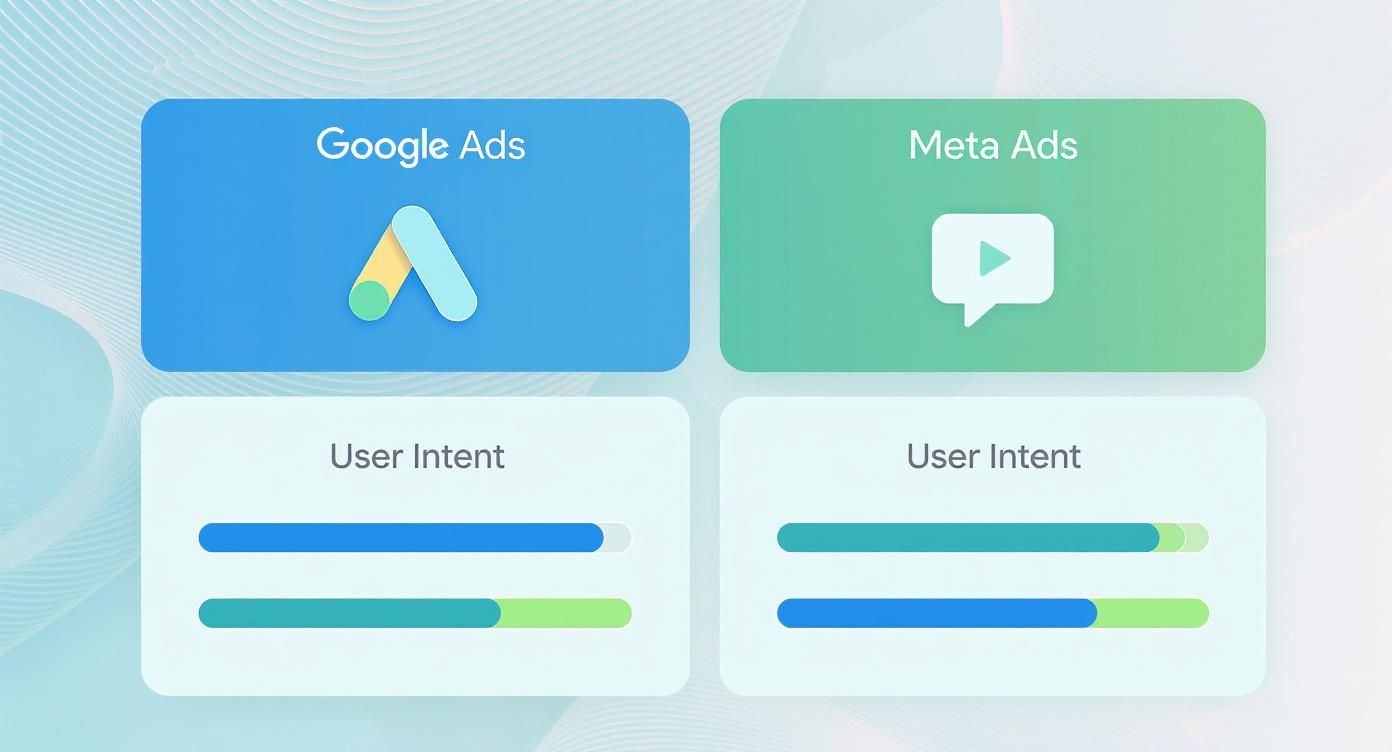
As you can see, Google Ads is brilliant for grabbing people who are actively searching for a solution right now. Meta Ads, on the other hand, is more about getting your name out there to people who don't yet know they need you.
What Influences Your Ad Spend in Australia
The actual price you pay for ads isn't set in stone. It's a dynamic auction, and a few key factors will push your costs up or down.
Competition is the big one. If you're a divorce lawyer in Sydney, you’re up against hundreds of other firms bidding on the exact same keywords. That competition drives the price of every single click way up.
Industry also plays a huge role. We've created a quick table to give you a ballpark idea of what you might expect to pay across different sectors here in Australia.
Average PPC Costs Across Key Australian Industries
This table gives you a snapshot of typical Cost-Per-Click (CPC) and what you might expect to pay to get a new customer or lead in some popular industries. Use it as a rough guide to see how your sector stacks up.
| Industry Sector | Average Google Ads CPC (AUD) | Average Meta Ads CPC (AUD) | Typical Cost Per Lead/Sale (AUD) |
|---|---|---|---|
| E-commerce & Retail | $1.82 | $1.95 | $30 – $80 |
| B2B Services | $4.55 | $3.10 | $100 – $350 |
| Finance & Insurance | $13.37 | $4.80 | $150 – $500+ |
| Real Estate | $3.15 | $2.50 | $80 – $250 |
| Healthcare | $4.10 | $2.90 | $90 – $300 |
| Legal Services | $9.21 | $4.25 | $200 – $600+ |
As you can see, costs vary wildly. A small budget in a hyper-competitive space like finance or legal is going to get chewed up pretty fast, which makes having a sharp strategy absolutely essential.
Calculating Your Return on Investment
At the end of the day, the costs only matter if you’re making more back. This is where tracking your Return on Investment (ROI) becomes non-negotiable. If you're running any kind of digital marketing, knowing how to calculate marketing ROI is fundamental.
In the PPC world, we often use a more specific metric called Return on Ad Spend (ROAS). It’s a dead-simple calculation that tells you exactly how hard your ad budget is working.
ROAS = Total Revenue from Ads / Total Ad Spend
Let’s say a Perth-based online store spends $2,000 on a Google Shopping campaign and generates $10,000 in sales directly from those ads.
Their ROAS is 5:1.
It means for every single dollar they put into ads, they got five dollars back in revenue. This simple number cuts through the noise and helps you make smart, data-backed decisions about where to put your marketing dollars for the biggest bang.
The PPC Agency Journey from Strategy to Success
Hiring a PPC agency can feel like a big leap of faith. You're handing over your advertising budget and trusting a team of experts to turn it into genuine business growth. So, what actually happens after you sign on the dotted line?
It’s not magic. The process is a structured journey designed to move from your broad business goals to precise, profitable advertising that delivers results.

It all begins with a deep dive into your business. A good partnership isn't transactional; it's collaborative. The agency needs to understand your world inside and out before a single dollar is spent on ads. This initial phase is all about alignment, making sure the agency's strategy will directly support what you're trying to achieve.
Phase 1: The Discovery and Audit
The whole journey kicks off with a discovery call or meeting. This is much more than a sales pitch. Think of it as a fact-finding mission where the agency learns about your business, your ideal customers, your revenue goals, and what you’ve tried in the past.
Next, they’ll conduct a thorough audit of your existing digital assets. This isn't just a quick glance; it’s a proper forensic analysis.
- Current Ad Accounts: They'll dig into past and present campaigns to see what worked, what bombed, and where money was likely wasted.
- Website & Landing Pages: Your website is put under the microscope to assess its ability to convert traffic. They’re looking at things like page speed, the clarity of your messaging, and how effective your calls-to-action are.
- Competitor Analysis: The agency will investigate what your key competitors are doing in the paid search space, identifying their strategies and uncovering potential opportunities you can exploit.
This audit provides the essential baseline for building a winning strategy from the ground up.
Phase 2: Strategy and Campaign Buildout
With a solid understanding of your business and the competitive landscape, the agency moves into the strategy phase. This is where the real expertise of professional PPC services in Australia comes to life. It’s where data meets creativity.
The team will map out a complete game plan, outlining which platforms to use, exactly who to target, and what the key messaging will be. This detailed blueprint is crucial for success.
A PPC strategy isn't just about picking a few keywords. It's about building a complete customer journey, from the first ad they see to the final thank-you page after a purchase. Every single step must be planned and optimised.
Once you’ve given the strategy the green light, the campaign buildout begins. This is the hands-on part:
- Keyword Research: Uncovering the high-intent keywords that Australian customers are actively searching for right now.
- Ad Copywriting: Crafting compelling, persuasive ad copy that speaks directly to your target audience and makes them want to click.
- Audience Targeting: Defining precise audiences based on demographics, interests, online behaviour, and other signals.
- Conversion Tracking Setup: Making sure every lead, sale, or phone call is accurately tracked so you can measure what’s actually working.
Phase 3: Ongoing Management and Optimisation
Launching a campaign is just the beginning. The real work happens in the relentless, day-to-day management and optimisation. PPC is not a "set and forget" activity; it’s a dynamic process of continuous improvement.
Your agency's specialists will be constantly monitoring your campaigns, hunting for ways to improve performance. It’s a constant cycle of testing, analysing, and refining. They’ll be tweaking bids, testing new ad variations, adjusting targeting, and shifting budget to the best-performing areas of your campaigns.
This proactive management is what separates a professional agency from a DIY approach. It ensures your budget is always working as hard as possible to hit your goals.
Phase 4: Reporting and Analysis
Finally, transparency is the bedrock of a healthy agency-client relationship. You need to know exactly how your investment is performing, without the confusing jargon. A quality agency provides clear, insightful reporting that goes beyond vanity metrics.
Your reports should focus on the key performance indicators (KPIs) that actually matter to your business growth—like Cost Per Acquisition (CPA), Conversion Rate, and Return on Ad Spend (ROAS). This data tells the true story of your campaign's success and provides the insights needed for future strategic decisions, ensuring your PPC journey is always moving in the right direction.
Essential Metrics for Measuring PPC Performance
Running a PPC campaign without tracking the right metrics is like trying to drive from Melbourne to Brisbane without a map. You’re burning through fuel (your ad budget), but you have absolutely no idea if you’re getting any closer to your destination. Let's cut through the confusing jargon and translate your PPC reports into clear, actionable business insights.
We’re going to move past the vanity metrics and focus on the numbers that tell the real story of your campaign’s health and profitability. Understanding these key performance indicators (KPIs) is what empowers you to ask the right questions and truly gauge the success of your investment in PPC services Australia.
Foundational Engagement Metrics
Before you can even think about sales or leads, you need to know if people are paying attention to your ads. These initial metrics are like a pulse check, telling you how well your audience is engaging and if your ads are relevant.
-
Clicks: This one is simple enough—it’s the number of times people have actually clicked on your ad. While it’s a basic metric, it's the very first sign that your message was compelling enough to make someone want a closer look.
-
Impressions: This is just the total number of times your ad was shown on a screen. A huge number of impressions but very few clicks is a major red flag, often signalling that your ad copy or targeting just isn't hitting the mark.
-
Click-Through Rate (CTR): Calculated as (Clicks ÷ Impressions) x 100, your CTR is a crucial measure of your ad's relevance. A high CTR tells platforms like Google that your ad is a great match for what people are searching for, which often leads to lower ad costs and better ad positions.
Think about an e-commerce store in Sydney running an ad for "handmade leather boots." A high CTR here shows that people searching for those boots find the ad appealing and are keen to see the products.
Efficiency and Profitability Metrics
Getting clicks is nice, but it doesn't pay the bills. The following metrics are where the rubber meets the road, connecting your ad spend directly to real business outcomes. They show you whether your campaigns are efficient and, most importantly, profitable.
A successful PPC campaign isn't about getting the most clicks; it's about getting the most profitable conversions. The real goal is to turn advertising spend into a reliable engine for business growth, not just website traffic.
These are the numbers your agency should be obsessed with optimising:
-
Conversion Rate: This is the percentage of clicks that result in a desired action—like a sale, a form submission, or a phone call. A strong conversion rate is a sign that your landing page is doing its job and effectively turning visitors into customers.
-
Cost Per Acquisition (CPA): This is the average amount you spend to get one new customer or lead. If you sell a product for $200 and your CPA is $50, you’re in a great spot. But if that CPA creeps up to $190, your profit margin is paper-thin, and that campaign needs urgent attention.
-
Return on Ad Spend (ROAS): This is the ultimate bottom-line metric. It measures the total revenue you generate for every single dollar you spend on ads. Understanding what is ROAS in marketing is non-negotiable, as it directly reflects your campaign's financial success. A ROAS of 5:1 means you're making $5 in revenue for every $1 you spend.
Tracking these numbers is critical, and using a structured approach is key. To keep everything organised, you might find a comprehensive PPC reporting template helps to keep all your essential data in one clear, easy-to-read format.
How to Choose the Right Australian PPC Partner
Choosing an agency to manage your advertising budget is a massive business decision. It’s not just about hiring a supplier; you’re looking for a genuine growth partner who gets your vision and has the skills to help you nail it.
Get this right, and you can unlock serious growth. Get it wrong, and you're looking at wasted ad spend and months of frustration. To make the right call, you need to push past the slick sales pitch and ask the tough, specific questions that reveal an agency's true stripes. Think of it like hiring a key team member—you need to verify their experience, understand their process, and make sure they’re a good fit.
Your Vetting Checklist for PPC Agencies
Before you even think about signing a contract, you need to do your homework. A good agency will welcome your questions and give you straight, detailed answers. Their goal should be to build trust and show their value from that very first chat.
So, how do you sort the experts from the cowboys? Below is a simple checklist of questions to guide your conversations and help you compare potential partners.
Vetting Checklist for Australian PPC Agencies
Use these key questions to evaluate potential PPC service providers and ensure you find the right partner for your business.
| Area of Inquiry | Key Question to Ask | What to Look For in the Answer |
|---|---|---|
| Industry & Local Experience | "Can you show us case studies from businesses similar to ours here in Australia?" | Proven success in your specific sector and a deep understanding of local market nuances, whether you're targeting customers in Brisbane or Perth. They should "get" your customer. |
| Strategy & Onboarding | "What does your strategy and onboarding process look like for a new client?" | A structured process that starts with a deep dive into your business goals, not just a one-size-fits-all template. They should be asking you lots of questions. |
| Communication & Reporting | "Who will be my day-to-day contact, and what can I expect from your reporting?" | A dedicated point of contact and reports that focus on business metrics like leads and Return on Ad Spend (ROAS), not just vanity metrics like clicks and impressions. |
A solid set of questions like these will quickly separate the serious agencies from those just looking for a quick sale. It forces them to demonstrate substance over style.
A true PPC partner functions as an extension of your marketing team. They should be proactive, transparent, and completely focused on the KPIs that matter most to your bottom line.
Red Flags to Watch For
Just as important as knowing what to look for is knowing what to avoid. Some agencies make bold promises they simply can't keep. If you're exploring different types of AdWords management companies, keep an eye out for these classic red flags:
-
Guaranteed #1 Rankings: This is impossible. No one can guarantee top rankings on Google. The ad auction is dynamic and depends on dozens of constantly changing factors. Anyone promising this is either inexperienced or being dishonest.
-
Lack of Transparency: If an agency is vague about their fees, won't give you full access to your own ad accounts, or uses confusing jargon to obscure results, it's a huge warning sign. You should always own your accounts and understand exactly what you're paying for.
-
Long-Term Lock-In Contracts: Confident agencies prove their worth every single month. Be very cautious of any provider demanding a 12-month contract from the get-go without a trial period or a clear exit clause.
By asking the right questions and staying alert for these warning signs, you can confidently select a trustworthy Australian PPC partner who will genuinely help your business succeed.
Still Have Questions? Here Are a Few We Get All the Time
Diving into paid advertising for the first time? It's natural to have a few questions. Let's tackle some of the most common queries we hear from Aussie business owners, giving you the straight answers you need to move forward.
How Quickly Will I Actually See Results?
This is where PPC really shines. Unlike SEO, which is a long game that can take months to build momentum, a well-built PPC campaign can start funnelling traffic and leads your way within days of going live.
That first month is all about data gathering. Think of it as the reconnaissance phase. Your agency will be testing ads, learning what your audience responds to, and sharpening the strategy. You’ll see clicks and traffic almost right away, but the real magic—the optimised, profitable results—usually starts kicking in from the second or third month onwards. That's when enough data has come through to make smart, performance-boosting adjustments.
The first month is like building the engine. The months that follow are all about fine-tuning it for maximum horsepower. You get immediate traction, but peak performance is a result of time and data.
Is My Business Too Small for PPC?
Not a chance. In fact, one of the best things about PPC is how scalable it is. You don’t need a massive corporate budget to make a real impact. For many small and medium-sized businesses across Australia, PPC is the secret weapon for growth.
The trick is to be laser-focused. A smaller budget just means you need a smarter strategy.
- Go Hyper-Local: A local sparky in Brisbane doesn't need to advertise to all of Queensland. They can target specific postcodes, making sure every single cent of their budget is spent reaching potential customers right in their service area.
- Get Niche with Keywords: Instead of battling giants for broad terms, focus on specific, long-tail keywords. Something like "eco-friendly kids shoes Melbourne" will almost always have lower costs and attract far more qualified buyers.
A good agency knows how to make a smaller budget punch well above its weight, ensuring every dollar is invested where it counts the most.
If I'm Doing PPC, Do I Still Need to Bother with SEO?
Yes, 100%. Thinking of PPC and SEO as competitors is a common mistake. They’re actually two sides of the same coin—a powerful tag team that works together to help you dominate the search results page.
PPC is your sprinter, delivering immediate visibility and quick wins. SEO is your marathon runner, building long-term, sustainable organic traffic and establishing your authority over time.
Better yet, the data you get from PPC (like which keywords are converting into actual sales) is pure gold for your SEO strategy. It tells you exactly where to focus your long-term efforts. Running both at once creates a powerful, holistic approach that captures customers no matter where they are in their buying journey.
Ready to see what a precision-driven PPC strategy can do for your business? The team at Click Click Bang Bang is here to help you get seen by the right customers, right now. Start your 30-day risk-free trial today!
Read NeXt
Or Read Our Latest
- Search Ads Optimisation: A Practical Guide for 2026
- Manual vs Automated Bidding for PPC Success
- Conversion Tracking Setup: A Complete AU Guide
- Instagram Advertising Australia: Complete 2026 Guide
- Pay Per Click: A Beginner’s Guide for Australian Marketers
- Display Advertising on Google: The Complete Australian Guide
Click. CLick. Subscribe.
Get our best PPC insights, industry updates, and power moves delivered straight to your inbox. No fluff, just high-caliber strategies that actually work.
Don’t Leave Just Yet
Try Us For 30-Days,
Risk Free!!
We guarantee that you’ll love our work within the first 30 days, if not you’ll get your money back.
What have you got to lose?