

Google Local Services Ads: Your Guide to Paying for Leads
Last Updated
You're probably in one of two spots right now.
Either you're already running Google Ads for a local service business and you're tired of paying for traffic that looks busy in the dashboard but weak on the phone. Or you've heard that google local services ads let you “pay only for leads” and you're wondering if this is the fix.
Both reactions are fair. LSAs can be a strong channel. They can also waste time if you treat them like a normal PPC launch and ignore the operational side. In Australia, the main question usually isn't “Should I try LSAs?” It's “Can my business qualify, get verified, answer leads quickly, and turn Google-managed enquiries into booked work?”
That's the difference between an account that goes live and produces useful demand, and one that stalls during screening or leaks value after launch.
Tired of Paying for Clicks That Don't Convert?
Monday starts with three form fills, two calls, and a search campaign that looks busy in the dashboard. By Friday, one enquiry was a real job, one was price shopping, and the rest went nowhere. The clicks were real. The revenue gap was real too.
That pattern is common in local service PPC because standard search ads charge for the visit, not for the conversation. A click can still be useful. It can also come from someone comparing options, misreading the ad, or looking for information instead of booking work. If your margins are tight or your team is small, that gap adds up fast.
Google local services ads change the commercial model. The pitch is simple: pay for leads rather than clicks. The part many businesses miss is what follows. You are no longer just buying traffic. You are stepping into a Google-controlled lead flow that rewards businesses with the right paperwork, the right service setup, and the right response process.
Why that matters for local operators
For a plumber, electrician, cleaner, lawyer, or removalist, intent matters more than traffic volume. A call from someone ready to book is worth far more than ten visits from people still browsing.
That is why LSAs can work well alongside local SEO for business. SEO helps you build long-term local visibility. LSAs are built for short-list decisions and immediate contact. They solve different problems.
The trade-off is stricter than many advertisers expect. With search ads, a mediocre operation can still buy clicks and stay live. With LSAs, weak admin, patchy compliance records, slow call handling, or unclear service areas can stop the account before it starts, or drag lead quality down once it is live.
Practical rule: LSAs suit businesses that can verify the company properly, answer fast, and qualify enquiries consistently. If those basics are shaky, the pay-per-lead model will not rescue the campaign.
That is the real filter in Australia. The headline promise gets attention, but operational readiness is what decides whether LSAs become a profitable channel or a frustrating one.
Deconstructing Google Local Services Ads
A customer searches “emergency electrician near me” at 7:10 pm. They do not want to compare five landing pages, read a brand story, and fill out a form. They want a provider who looks legitimate, covers the suburb, answers fast, and can take the job.
That buying situation is what google local services ads are built for.
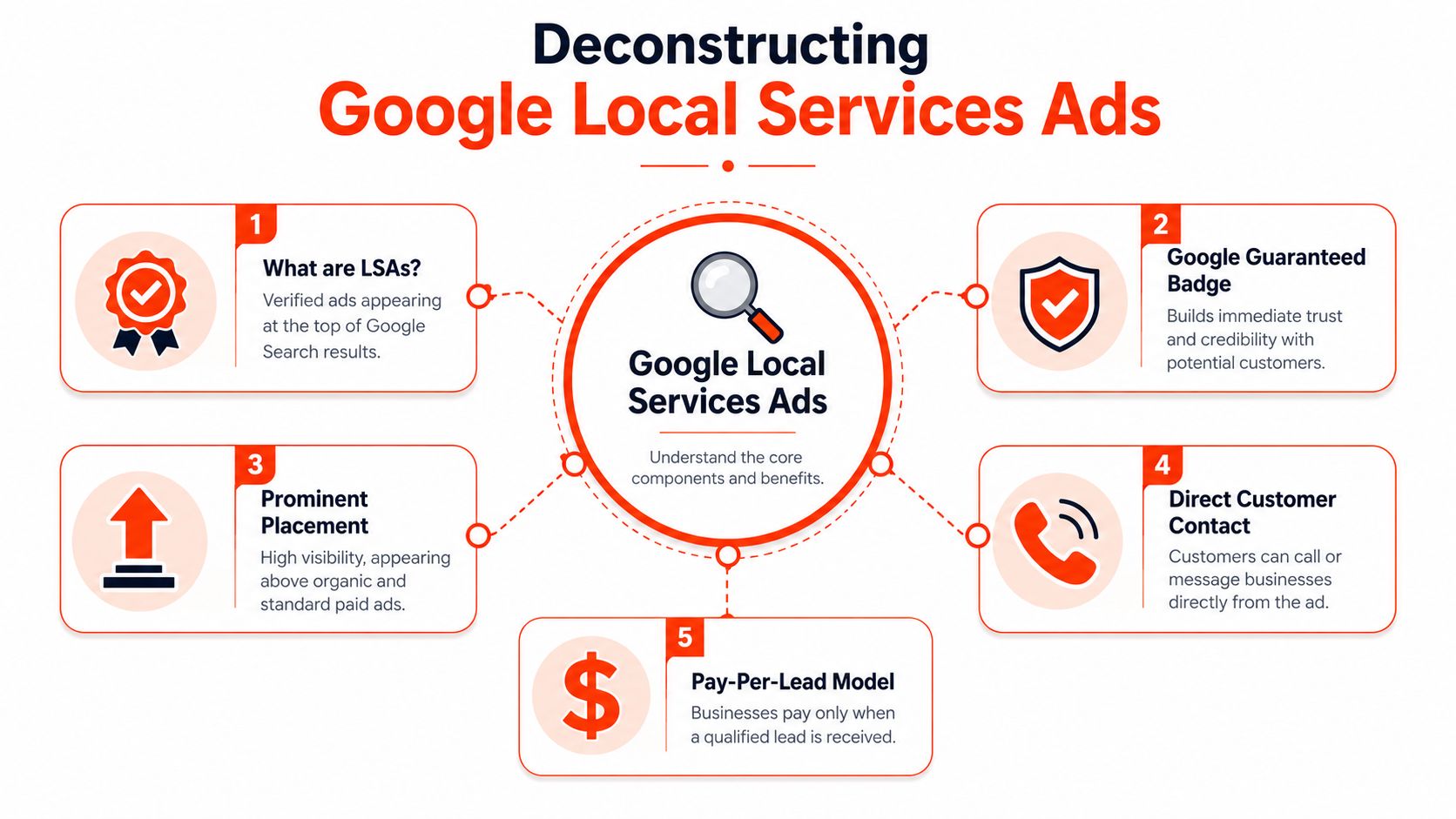
They sit inside Google Search, but they do not work like standard search engine marketing campaigns. LSAs are a structured lead intake system. Google controls much of the format, highlights trust signals, and gives the searcher direct ways to call, message, or book.
What the customer sees
From the user's side, the ad is designed to shorten the shortlist. Business name, review signals, service match, hours, location fit, and trust badges such as Google Guaranteed or Google Screened do a lot of the decision-making work upfront.
That changes the click path. In a normal paid search ad, the user clicks through and your website has to persuade them. In an LSA, Google tries to do more of that filtering before the lead ever reaches you.
What the advertiser is actually buying
The headline is “pay per lead,” but that description is too loose to be useful on its own.
Google's official Local Services Ads Help page on lead charges and disputes explains the model more clearly. Businesses are charged for eligible leads connected through the ad, not for every impression or website visit. In practice, that means the billing event is closer to a contact opportunity than a click.
That distinction matters. Search ads let you buy attention and shape the journey with keywords, ad copy, landing pages, and audience signals. LSAs buy access to a Google-managed enquiry stream, where your service categories, service areas, verification status, reviews, and response handling have a direct effect on what comes through.
A simple way to frame it is this:
- LSAs work like a dispatcher. Google tries to route a ready-to-contact customer to a provider that fits the job and area.
- Search ads work like a listing with persuasion built in. You win the click, then your site and offer do the sorting.
Neither is better by default. The better system depends on how tightly the business can handle inbound demand.
Where LSAs sit in the buying journey
LSAs are strongest at the point where the customer has already decided they need help and is choosing who to contact. That makes them a strong fit for urgent, local, high-intent services.
They are weaker when the business needs education, nuanced messaging, or tight control over search intent. If someone is still researching options, comparing methods, or trying to understand pricing, standard search ads usually give you more room to guide that decision.
What LSAs simplify, and what they expose
LSAs remove some of the moving parts that make traditional PPC labour-heavy:
- No keyword architecture to build: Google handles much of the matching logic.
- Less reliance on landing pages: A lead can come in without a site visit.
- Less ad copy testing: The format is more fixed and platform-led.
The trade-off is reduced control and more operational scrutiny:
- Less control over messaging: You cannot shape the ad experience the way you can in Google Ads.
- Less visibility into query handling: Google decides more of the matching process.
- More dependence on business readiness: Wrong service areas, weak review profiles, incomplete verification, or poor lead handling can limit performance before campaign optimisation even starts.
That is the part many advertisers underestimate in Australia. LSAs are not just an ad product. They are a screening and lead-routing system that rewards businesses with clean admin, clear service definitions, and a team that treats every inbound contact like a booked job waiting to happen.
LSA vs Google Search Ads A Head-to-Head Comparison
If you're deciding between LSAs and standard PPC, the wrong question is “Which one is better?” The right question is “Which one fits how this business sells?”
Search ads and LSAs can coexist. In many accounts, they should. But they behave differently enough that the trade-offs need to be clear from the start.
Local Services Ads vs. Google Search Ads
| Feature | Google Local Services Ads (LSA) | Google Search Ads (PPC) |
|---|---|---|
| Cost model | Pay per lead | Pay per click |
| Placement | Prominent placement at the top of local search results | Typically below LSAs and alongside other paid results |
| Targeting logic | Service area and job type driven | Keyword driven |
| Ad format | Structured, platform-led format | Customisable headlines and descriptions |
| Website dependency | Lower, because users can contact directly from the ad | Higher, because landing page quality affects outcomes |
| Setup barrier | Verification and screening heavy | Campaign build and tracking heavy |
| Ongoing management | More operational and lead-management focused | More optimisation and media-management focused |
| Best fit | Immediate-intent local service demand | Broader search coverage and message control |
Where LSAs win
LSAs usually make more sense when the business has clear service boundaries, handles inbound enquiries well, and wants a channel centred on direct leads rather than website traffic.
They can also reduce some of the usual PPC friction. You're not constantly rewriting ad copy, rebuilding keyword themes, or patching weak landing pages just to stop irrelevant clicks. For operators who want simpler demand capture, that's attractive.
Where Search ads still win
Search campaigns give you much more strategic control. You can choose the keywords, shape the message, segment by intent, route users to specific pages, and build out campaign structures around commercial priorities.
That matters when your service mix is broad or your sales process needs more explanation. It also matters when your brand needs stronger narrative control than the LSA format allows.
If you need a refresher on how standard paid search works at a broader level, this overview of what is SEM gives useful context for the role search ads play outside the LSA environment.
The real decision criteria
Use LSAs if most of these statements are true:
- Your customers want fast contact: Calls and direct messages matter more than content exploration.
- Your business has narrow service intent: A person usually knows what they need when they search.
- Your team can answer quickly: Delayed follow-up weakens the value of the channel.
- Your credentials are in order: Verification won't become a bottleneck.
Use Search ads if these are more true:
- You need keyword control: Intent varies a lot and needs active management.
- You sell nuanced services: Buyers need more education before enquiring.
- Your website does real sales work: Landing pages are part of conversion, not just a formality.
- You want granular testing: Messaging, offers, and audience signals all matter.
If your internal process is messy, LSAs won't hide it. They expose it faster because the platform is built around immediate contact, not gradual nurturing.
Qualifying for the Google Guarantee Badge
It's often at this stage that many businesses discover that google local services ads aren't just another ad product.
You can't brute-force your way into LSAs with a bigger budget. In Australia, eligibility depends on business category, region, and successful screening, and Google states that providers may need to pass checks involving licences, insurance, and other requirements that vary by category and region in Google's Local Services Ads eligibility guidance.
That means the first job isn't campaign setup. It's compliance readiness.
Treat eligibility like a pre-launch audit
Before anyone worries about budgets or lead volume, the business should confirm four things.
- Category fit: LSAs aren't open to every type of business. Availability depends on the kind of service you provide.
- Region fit: A service category may be eligible in one area and unavailable in another.
- Documentation fit: Business details must align with the records Google checks.
- Operational fit: The business must be capable of handling the leads generated if approved.
Google has also expanded LSAs to more than 70 business types, including categories such as education, people care, pet care, wellness, and health care, as outlined in Google's announcement on Local Services Ads expansion. That wider category coverage is encouraging, but it doesn't remove the need to verify your exact niche and service area.
What usually holds businesses back
In practice, the biggest delays don't come from advertising decisions. They come from paperwork and consistency problems.
A business name mismatch, an outdated licence, incomplete insurance documentation, or unclear service-area setup can stop momentum quickly. None of that is glamorous, but it's the work that decides whether the account can activate.
A simple checklist helps:
- Business identity: Your registered trading details should be accurate and consistent everywhere they appear.
- Licensing: If your service category requires licences or trade credentials, have them ready and current.
- Insurance: If insurance is required, make sure policy details are valid and match the entity applying.
- Team readiness: If Google needs checks related to people delivering the service, don't leave that admin until the last minute.
Reviews matter, but they don't replace verification
Many business owners focus on badges and reviews before they've sorted the basics. That's backwards.
A strong review profile helps trust once you're eligible, but it won't bypass compliance. If you are tightening up your review process at the same time, Exclusive Addons' guide to Google reviews is a useful walkthrough for understanding how review display and management fit into your wider presence.
The businesses that launch smoothly usually aren't the flashiest marketers. They're the ones with organised records, accurate business details, and someone internally responsible for getting verification over the line.
Your Onboarding and Activation Guide
Once eligibility looks realistic, the next step is execution. During this phase, many accounts either move cleanly toward launch or get bogged down by missing documents, inconsistent details, and poor service-area choices.
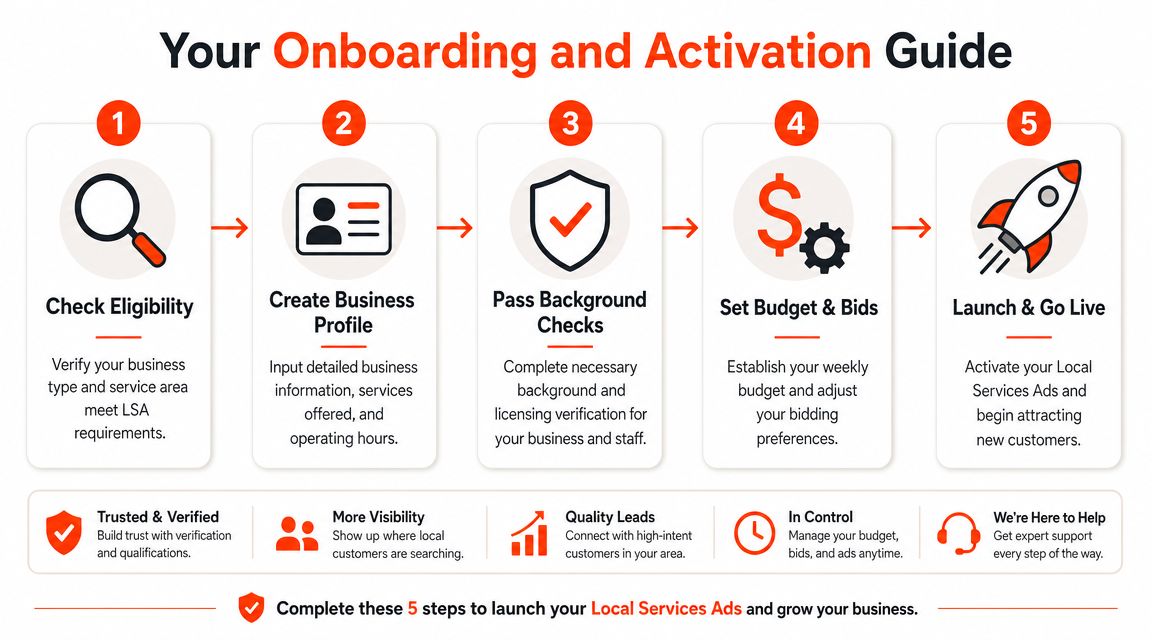
Google describes the LSA flow as four steps: add business details, set a budget, complete screening, and go live, according to Google's Local Services Ads setup page. That sequence is important to follow. Screening sits before delivery, not after.
A visual guide helps make the order of operations clear.
Start with the parts you can control
Before you submit anything, make sure the account inputs are clean.
-
Business details
Enter the business name, service type, and location carefully. This isn't the place for rough approximations. The details need to line up with the documentation Google will review. -
Service areas
Don't overreach. Choose service areas your team can cover effectively. A broad map looks ambitious, but weak response capability across a wide area often creates avoidable lead quality problems. -
Job types
Define what work you do with discipline. If your business only wants profitable callouts or certain service categories, don't leave the setup vague and hope to sort it out later.
Prepare for screening before you hit submit
Most delays happen because the screening step is treated like an afterthought.
Have your licensing, insurance, and business records ready before activation begins. Check dates, names, and entity details. If one document uses a different business variation than the one in your application, you're inviting extra back-and-forth.
Field note: The fastest LSA setups aren't always from bigger businesses. They're usually from businesses where one person owns the paperwork and chases every dependency early.
A short explainer can help if you want to see the process in motion.
Budget comes after fit
A common misconception is that budget is the main lever at launch. It isn't.
Budget matters once the account is eligible and live, but no budget setting can override incomplete screening. That's one of the biggest differences between LSAs and standard Google Ads, where access to auction traffic is much more immediate.
Use this activation sequence:
- Check fit first: Confirm the category and region are supported.
- Build the profile properly: Business details, service areas, and job types should be precise.
- Submit complete documents: Avoid partial submissions that trigger delays.
- Set budget with realism: Base it on what your team can service, not just what you'd like to receive.
- Monitor status closely: If verification stalls, investigate the admin trail before touching anything else.
That's how you get to launch without turning a straightforward setup into a drawn-out compliance project.
Understanding the LSA Lead and Billing Model
The phrase “pay per lead” sounds simple. It usually isn't.
With google local services ads, the right question isn't just what a lead costs. It's what Google counts as a lead, what happens when that lead is low quality, and whether your internal process can separate useful enquiries from noise.
What you're actually paying for
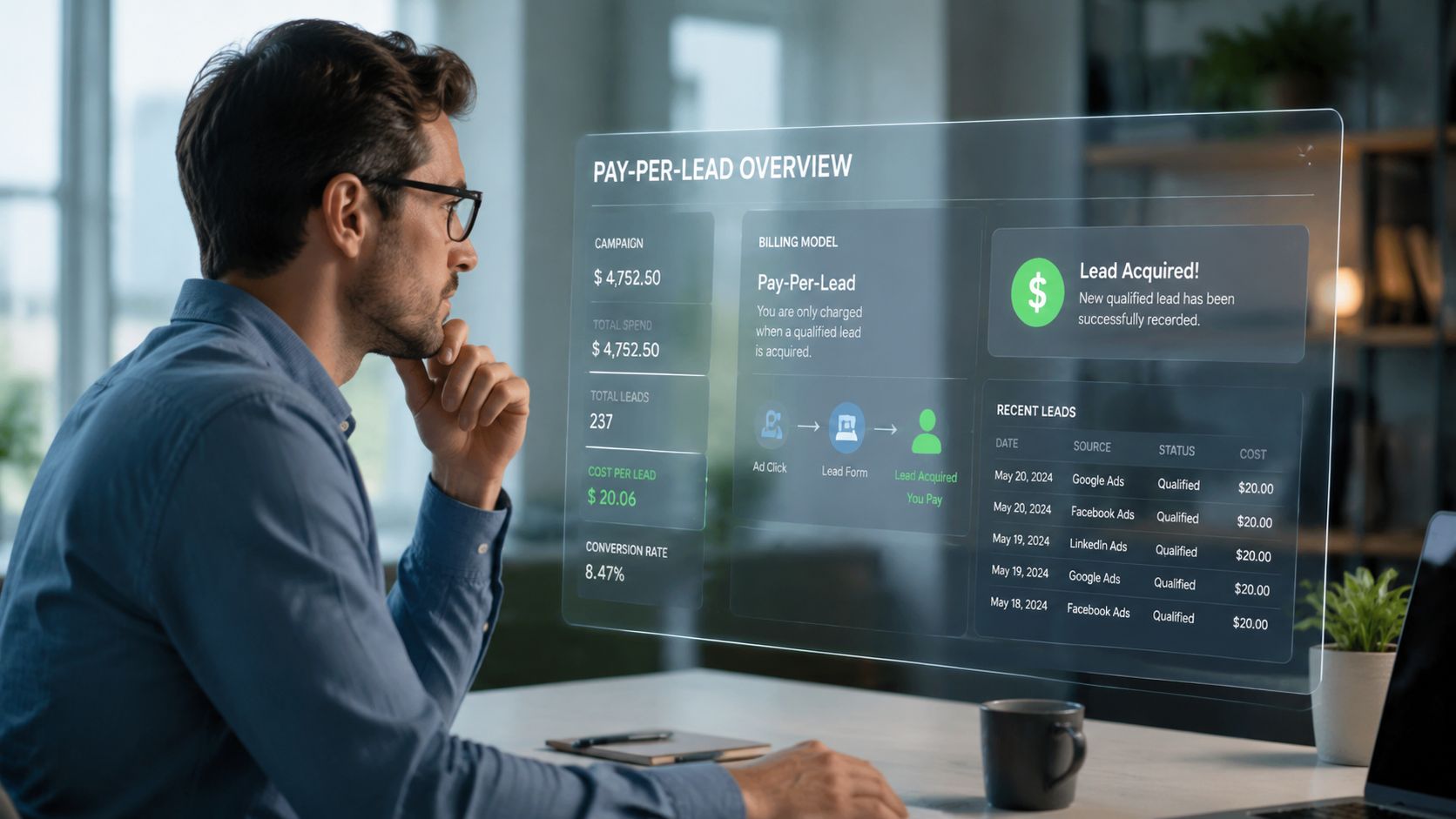
Google's LSA system allows customers to contact businesses directly through the ad experience, and leads can be managed within the platform, as noted in Google's Local Services lead management help documentation.
In practical terms, that means you're paying for direct connection opportunities such as calls, messages, or bookings generated through the LSA unit. That's different from buying website visits.
For many service businesses, that's the appeal. The spend is tied more closely to contact intent than standard click traffic.
What lead costs can look like
Lead pricing varies sharply by category. Industry benchmark figures reported by The Media Captain's Google Local Services Ads statistics show cost per lead figures of $249 for personal injury, $162 for roofers, $80 for HVAC, $69 for plumbing, $40 for painters, $34 for locksmiths, and $30 for dog training.
Those numbers matter for two reasons.
First, they show that “pay per lead” doesn't always mean “cheap”. Some categories are expensive enough that poor follow-up or weak qualification becomes a direct profit problem. Second, they help set realistic expectations before launch. If your category tends to generate higher-cost leads, your sales handling needs to be stronger.
The overlooked part of net acquisition cost
The same benchmark source reports that businesses often receive 6% to 7% of LSA spend back in credits for unqualified leads. That means disputing invalid leads isn't a side task. It's part of cost control.
Use a simple review process:
- Check every lead promptly: Confirm whether it matches your services and area.
- Flag weak-fit enquiries: Wrong service, irrelevant job type, or obvious spam should be reviewed.
- Keep internal notes: You'll want a clear reason when assessing lead quality.
- Watch net cost, not just gross spend: Credits affect the true acquisition picture.
If you're comparing channels, it also helps to understand how different billing models behave more broadly. This breakdown of PPC pricing models gives useful context for evaluating when pay-per-lead is more efficient than pay-per-click.
Cheap leads can be unprofitable. Expensive leads can be excellent. The deciding factor is whether your team can qualify fast, sell well, and dispute the junk.
How to budget without fooling yourself
Don't set LSA budgets in isolation from operational capacity.
A business that can answer and book quickly may be able to handle a stronger lead flow. A business that misses calls, replies late, or sends all enquiries to a busy owner after hours will struggle even if the platform is delivering decent opportunities.
The cleanest budgeting approach is to work backwards from service capacity, lead handling, and close discipline. Otherwise, the dashboard may look active while the commercial outcome stays flat.
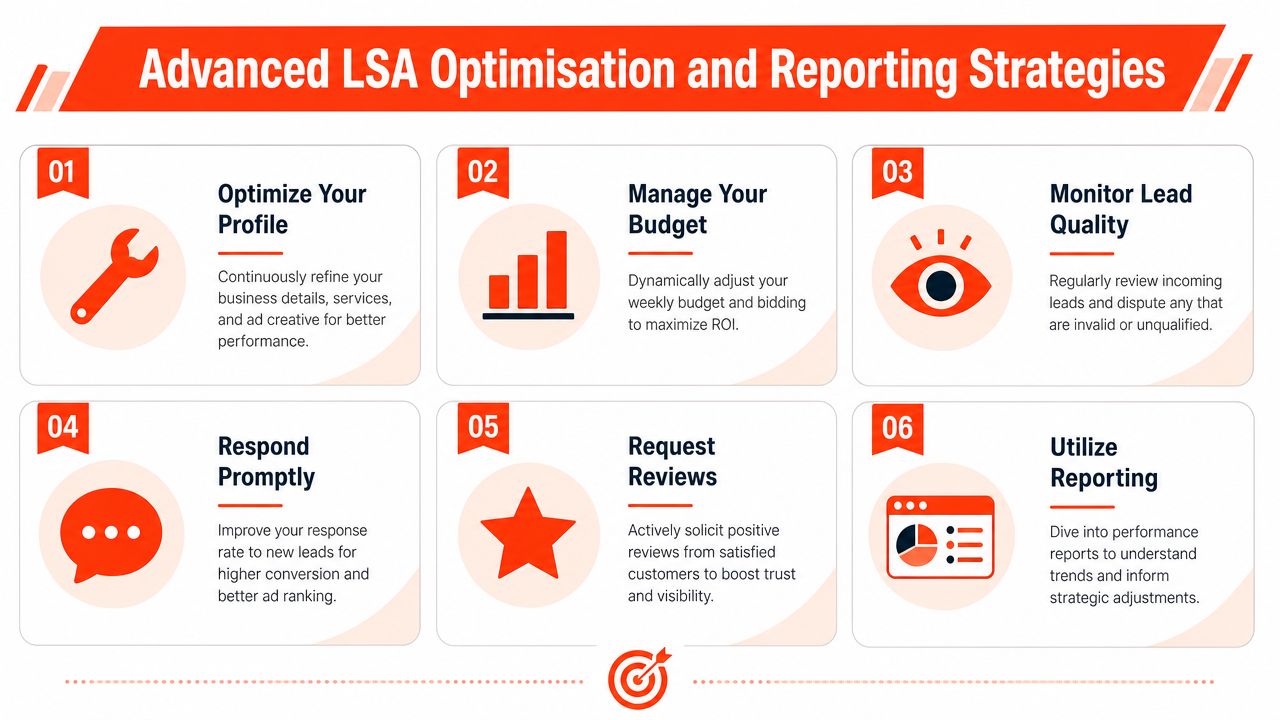
Advanced LSA Optimisation and Reporting Strategies
Once the account is live, most advertisers focus on the obvious levers first. Budget. Coverage. Lead volume.
Those matter, but the longer-term gains usually come from a different place. Operational behaviour drives a lot of LSA performance. A well-configured account can still underperform if the business answers slowly, accepts poor-fit leads without review, or can't trace enquiries through to booked work.
Optimisation starts outside the ad interface
LSAs don't give you the same keyword and creative controls you'd use in Search campaigns, so the optimisation mindset has to shift.
Focus on the things that move outcomes:
- Job type discipline: Remove categories that generate poor-fit work.
- Service-area realism: Tighten areas where lead quality drops or service delivery becomes awkward.
- Budget pacing: Support the periods your team can service well.
- Review strength: A solid review profile helps trust and click confidence.
- Response speed: Fast contact handling often separates booked jobs from lost ones.
That last point is routinely underestimated. In local services, the provider who answers first often gets the conversation that matters.
Report on business results, not platform activity
A major challenge in LSA management is measuring qualified lead rate and booked-job rate, not just raw lead volume. Google lets advertisers manage leads in-platform, but reconciling LSA data with a CRM or other analytics tools is necessary to avoid over-crediting the channel and to compare it fairly with other marketing activity, as noted in the earlier Google help reference on lead management.
Here, weak reporting creates fake confidence.
If a lead appears in LSAs and your call tracking or CRM also records the same customer journey elsewhere, you can end up counting one opportunity multiple times. That makes the channel look stronger than it is.
A practical reporting framework
Use a simple reporting chain that follows the lead beyond Google:
| Stage | What to record |
|---|---|
| New lead | Source, service type, location, time received |
| Qualified lead | Was it a real fit for your business |
| Booked job | Did the enquiry convert into scheduled work |
| Completed work | Did the job actually happen |
| Revenue outcome | What commercial value did it produce |
Track the lead until money changes hands, or until the lead is clearly lost. Anything less is channel reporting, not performance reporting.
What strong LSA businesses do differently
The best operators treat LSAs as a shared system between marketing and operations.
Marketing keeps the profile tight. The office team answers quickly. Sales or service staff qualify properly. Finance reviews disputed leads and net cost. Management looks at booked-job outcomes, not just platform totals.
That's the mature way to run google local services ads. Not as a magic lead tap, but as a high-intent channel that rewards businesses prepared to handle demand properly.
If you want help deciding whether google local services ads fit your business, or you need a PPC team that can connect lead generation with proper tracking and reporting, Click Click Bang Bang can help. They manage data-led PPC campaigns across Google and other major platforms, with clear reporting and a practical focus on leads that turn into real business.
Read NeXt
Or Read Our Latest
- Manual vs Automated Bidding for PPC Success
- Conversion Tracking Setup: A Complete AU Guide
- Instagram Advertising Australia: Complete 2026 Guide
- Pay Per Click: A Beginner’s Guide for Australian Marketers
- Display Advertising on Google: The Complete Australian Guide
- Stakeholder Communication Plan How to Build One That Works
Click. CLick. Subscribe.
Get our best PPC insights, industry updates, and power moves delivered straight to your inbox. No fluff, just high-caliber strategies that actually work.
Don’t Leave Just Yet
Try Us For 30-Days,
Risk Free!!
We guarantee that you’ll love our work within the first 30 days, if not you’ll get your money back.
What have you got to lose?