

Become an SEO Service Reseller: Guide to Growing Your Agency
Last Updated

A lot of agencies arrive at the same point the same way. A client asks for SEO. You do web design, paid media, creative, automation, or social well enough to win the account, but you don't have a technical SEO team sitting there ready to take over. If you say no, you leave money on the table and make it easier for another agency to wedge itself into the relationship.
That's where the seo service reseller model becomes commercially useful. Not because it sounds clever, but because it lets you keep the client, widen your offer, and avoid building a delivery department before demand is stable.
In Australia, that decision sits inside a real market, not a side hustle. The Australian SEO services market is estimated at USD 1.73 billion in 2026, and the broader market is projected to grow at a 12.12% CAGR globally across 2026-2031, according to Mordor Intelligence's SEO market analysis. That matters because SEO isn't a novelty service anymore. Buyers increasingly treat it as an ongoing managed service, and they expect reporting, process, and accountability.
What Is an SEO Service Reseller?
An seo service reseller is a business that sells SEO under its own brand while another specialist provider does the fulfilment in the background. The reseller owns the client relationship. The provider handles delivery. The client sees one agency.
The easiest way to think about it is a building contractor. A builder may manage the job, quote the client, set the schedule, and take responsibility for the finished result. But the builder still brings in a licensed electrician or plumber for specialist work. SEO reselling works the same way when it's done properly.
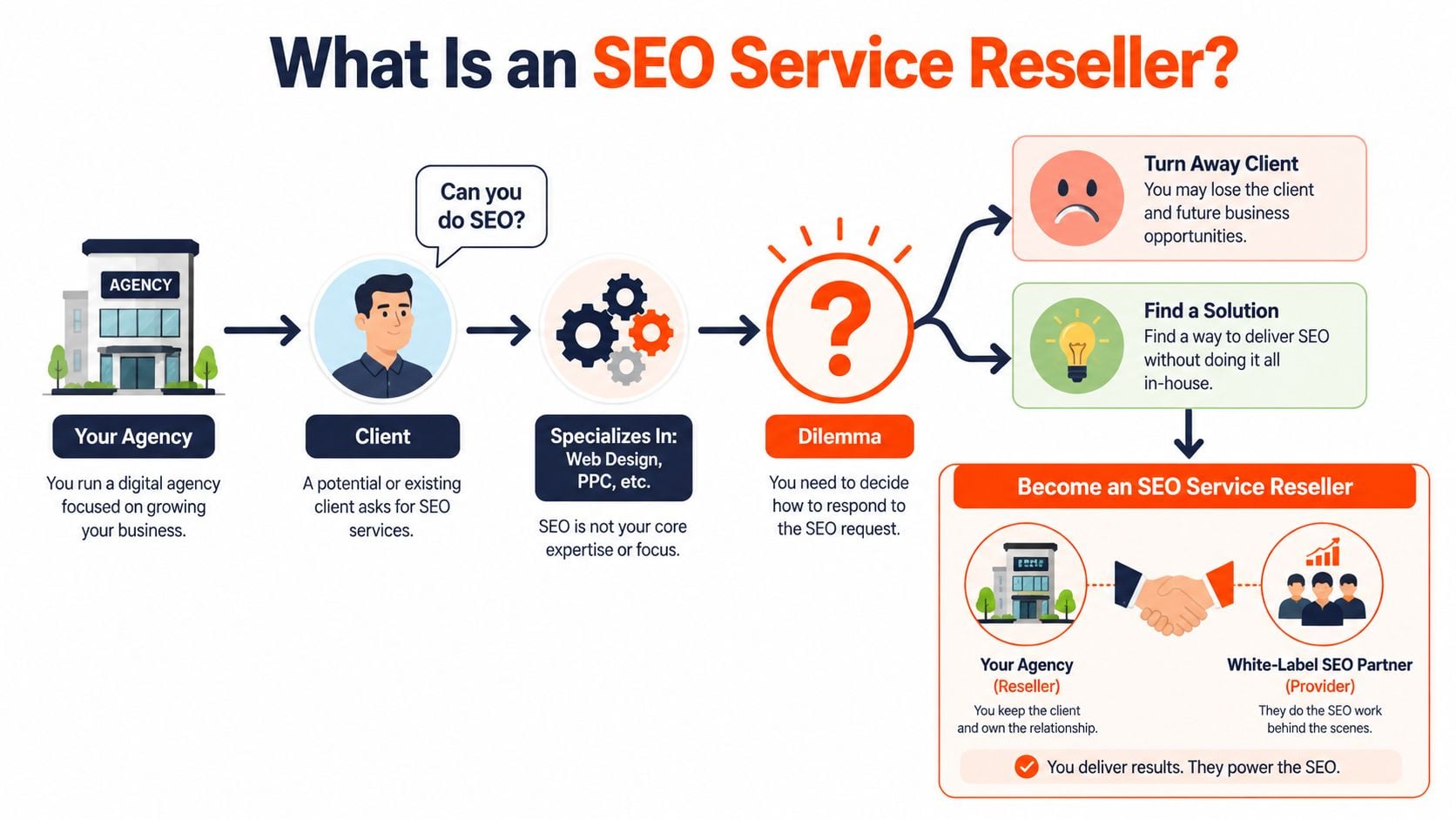
What you actually sell
You're not selling “someone else's package”. You're selling an outcome under your agency's commercial umbrella. That usually means:
- Your agency sells the strategy: You run discovery, define scope, set expectations, and position the work against the client's goals.
- The provider fulfils specialist tasks: Technical audits, on-page changes, keyword research, content briefs, reporting, and other SEO work happen behind the scenes.
- You control presentation: Reports, calls, updates, and account management stay with your agency.
- You carry the relationship risk: If delivery is poor, the client won't blame the anonymous provider. They'll blame you.
That last point is the one agencies often underestimate.
Why agencies use this model
For most agencies, the reseller model solves a timing problem. Clients want SEO now. Hiring takes time. Training takes time. Building SOPs takes time. SEO tools and technical QA also need oversight. A reseller arrangement closes that gap.
It also lets you test demand before committing to headcount. If SEO becomes a meaningful part of your revenue mix, you can keep the reseller model, hybridise it, or build internal capability later.
Practical rule: Resell SEO only if you're prepared to manage it like a service line, not like a referral fee.
If you want a useful benchmark for how specialist providers package and communicate modern SEO delivery, it's worth reviewing examples of award-winning SEO strategies. Not to copy them blindly, but to see how mature providers frame scope, process, and commercial value.
What clients expect now
Australian buyers generally don't want mystery SEO. They want consistent work, clear updates, and monthly accountability. That's why the reseller model works best when the agency treats SEO as a managed service with recurring reporting and an explicit operating process.
What doesn't work is bolting “SEO available” onto your website and hoping a backend vendor will somehow protect your brand for you. Reselling SEO can expand your agency fast. It can also expose weak operations just as fast.
Exploring Reseller Models and Profit Margins
Not every seo service reseller arrangement works the same way. Agencies usually end up in one of two camps. They either send leads to a provider and collect a fee, or they sell SEO as their own service and manage the account while a white-label partner fulfils it.
Those are very different businesses.
Referral model versus white-label model
In a referral partner model, you introduce the client to the SEO provider. The provider usually handles the sales process, proposal, delivery, and reporting. You stay involved lightly, or not at all.
In a white-label reseller model, you keep the client under your brand. You set pricing, issue the proposal, manage communication, and decide how the service is positioned inside your broader offer.
Here's the practical comparison.
| Metric | Referral Partner Model | White-Label Reseller Model |
|---|---|---|
| Client relationship | Usually shared or handed to provider | Owned by your agency |
| Brand control | Low | High |
| Pricing control | Limited | Strong |
| Delivery responsibility | Mostly provider-facing | Agency-facing to the client |
| Operational load | Light | Moderate |
| Margin structure | Finder's fee or agreed commission | Mark-up on fulfilment cost |
| Best fit | Agencies that don't want to manage SEO | Agencies that want SEO revenue and retention benefits |
Where agencies get the economics wrong
A referral model looks easy because it is easy. There's less admin, less client pressure, and less need to understand technical delivery. The trade-off is obvious. You usually give up control over pricing, retention, upsells, and account positioning.
A white-label model gives you more room to build margin because you control the commercial wrapper. But it also creates real obligations. You need to know what the provider is doing, how long tasks take, how to explain delays, and how to spot poor work before the client does.
Cheap fulfilment can destroy margin faster than expensive fulfilment if it creates churn, rework, or client distrust.
A better way to think about margin
Most agencies focus on mark-up. That's too narrow. Margin in a reseller setup comes from four moving parts:
-
Scope discipline
If your SEO proposal is vague, clients will assume extra work is included. -
Communication efficiency
Accounts that require endless clarification calls become unprofitable quickly. -
Fulfilment consistency
Missed deliverables lead to credits, awkward calls, and wasted account management time. -
Retention
Monthly services become valuable when they stay monthly.
Which model fits which agency
A referral setup is usually better when your agency has no appetite to own SEO delivery. You want some participation in revenue, but you don't want service accountability.
A white-label reseller setup is better when SEO can support your core services. Web design agencies use it to retain post-launch clients. PPC agencies use it to improve blended search visibility. Brand and dev shops use it to stop losing accounts once site builds are complete.
If you want SEO to be part of your agency's commercial engine, referral is often too thin. If you don't want delivery risk, white-label is often too exposed. The right model depends less on theory and more on how much operational responsibility you're willing to hold.
The Strategic Benefits and Hidden Business Risks
The upside of becoming a seo service reseller is obvious. You can widen your service mix without hiring an internal SEO department. You can protect accounts that would otherwise drift to another supplier. You can turn one-off project clients into recurring monthly revenue.
Those are real advantages. But in practice, agencies usually struggle with the risks they didn't model at the start.
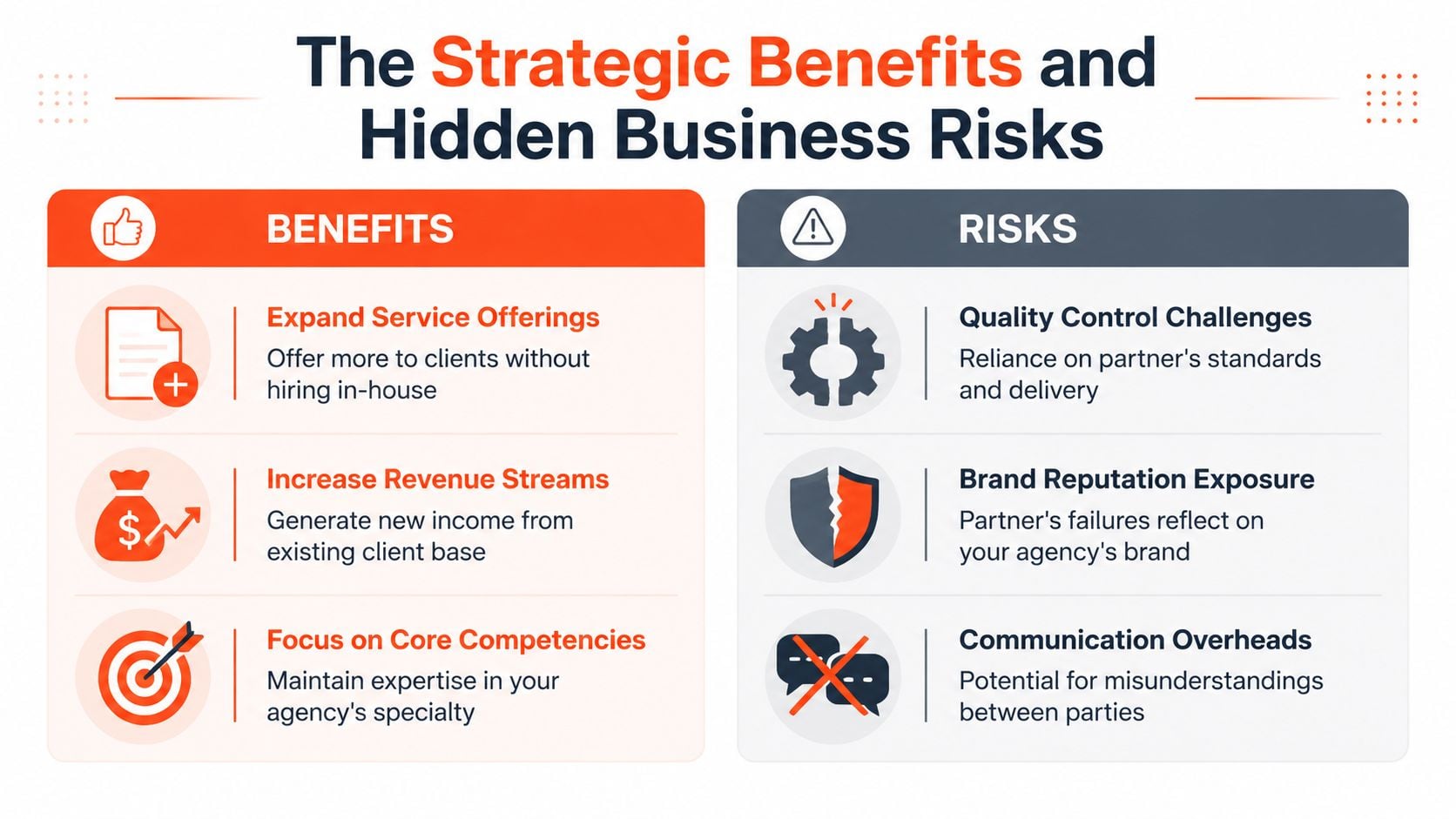
The upside agencies care about
A reseller model works best when it strengthens your main business, not distracts from it.
- Retention benefit: Clients prefer fewer suppliers. If you already run ads, websites, or creative, SEO gives clients one more reason to stay.
- Revenue quality: SEO usually lends itself to monthly retainers rather than sporadic project billing.
- Commercial positioning: Full-service agencies often win work more easily than narrow specialists when buyers want one accountable partner.
- Focus preservation: You can keep your core team focused on what they do best while specialists handle deep SEO work.
That all sounds attractive because it is.
Where the real risk sits
The hidden risk isn't “SEO might not work”. The hidden risk is that your brand becomes the legal and commercial front for work you don't fully control.
That matters a lot in Australia. The Umbrella US guide discussing SEO reseller responsibilities in the Australian context highlights a gap many reseller pages skip entirely. If your reseller or provider handles client analytics access, CRM data, form data, or other personal information, the Privacy Act 1988 becomes relevant. You need a clear contract covering data ownership, access controls, and which party is the primary data processor.
If that isn't defined up front, trouble starts quickly.
- A provider requests broad account access with no access matrix.
- A client asks who can see their lead data.
- A contract dispute arises after the relationship ends.
- A provider keeps working files or data exports with no agreed ownership clause.
That isn't a marketing issue. It's governance.
Here's a useful discussion starter before you sign anything.
The risks that damage agencies fastest
If the provider disappears, underdelivers, or mishandles access, the client won't say, “our white-label partner failed”. They'll say, “your agency failed”.
The common failure points are usually operational:
- Brand exposure: Poor work reflects on you, even if you didn't do it.
- Loss of control: If the provider controls too much communication or tooling, you stop owning the client experience.
- Compliance gaps: Privacy, consent, and account access are often left vague.
- Scope drift: SEO requests spread into dev, content, tracking, and CRO unless the agreement is tight.
- Reporting weakness: If you can't explain what happened this month, trust drops fast.
The best agencies treat reseller SEO as a governance decision first and a margin decision second. That mindset avoids a lot of expensive mistakes.
How to Select the Right White-Label SEO Partner
Most agencies ask weak questions when they vet a white-label provider. They ask whether the provider “does technical SEO”, “offers reports”, or “has experience”. Every sales team says yes to that.
The better approach is due diligence. You're not hiring a supplier. You're selecting a delivery partner that will sit behind your brand.
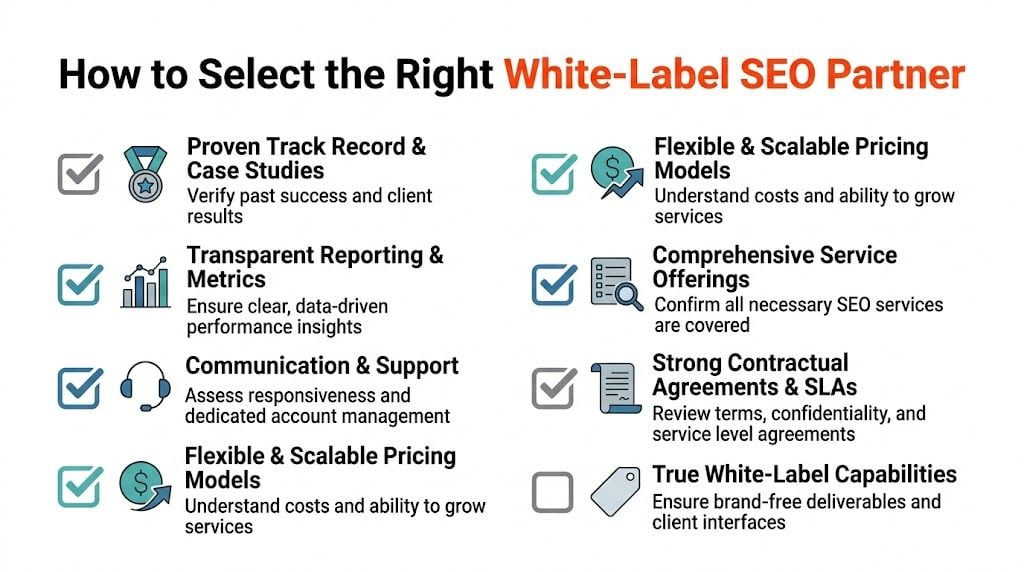
Check technical competence first
A serious partner should be able to show how they handle technical SEO foundations, not just promise rankings. In the Australian market, valuable providers prioritise crawler accessibility, clean site architecture, and Core Web Vitals performance, including keeping key pages at roughly under 3 seconds load time, according to ALM Corp's guide to SEO reseller service delivery.
Ask for proof of process, not a pitch deck.
- Ask for a sample technical audit: You want to see crawl issues, indexation checks, internal link findings, and prioritised fixes.
- Ask how they handle mobile-first indexing: Their answer should include responsive design, template performance, and usability issues.
- Ask what happens after the audit: Good partners can explain implementation pathways, dependencies, and how they validate changes.
- Ask for pre and post benchmarks: If they can't document technical fixes with crawl reports or performance benchmarks, they're probably over-relying on ranking screenshots.
Test reporting before you sign
Reporting quality tells you a lot about maturity. Weak providers send generic rank reports. Strong providers explain what changed, why it mattered, and what comes next.
If you want to compare how reporting systems can be packaged for agencies, this guide on how to streamline agency SEO reports is useful because it shows the sort of dashboard thinking that makes white-label delivery easier to manage.
You should also review examples of local providers that package white-label services clearly, such as white-label SEO solutions, to benchmark how scope and service expectations are framed in practice.
Probe strategy and communication
Many partnerships break under these conditions.
Ask questions like:
- How do you map keyword research to search intent?
- How do you handle pages that should be updated, consolidated, or removed?
- What's your communication cadence when an account goes off track?
- Who writes recommendations, and who explains them to us?
- What happens if our client asks a technical question mid-month?
A provider that only talks about keywords and backlinks is usually hiding a weak operating model.
Review commercial terms like a sceptic
Don't rush the contract. Read it as if the relationship has already gone wrong.
Look for:
- Exit terms: Can you leave without chaos?
- IP ownership: Who owns content, audits, briefs, and account assets?
- Access control: Who gets admin access and when is it revoked?
- SLA language: What is guaranteed, and what isn't?
- Non-solicitation terms: Your clients should remain your clients.
The right provider should make your agency look more capable. They shouldn't make your risk profile worse.
Operational Setup Your Onboarding and SLA Checklist
Choosing a provider is the easy part. Running the service cleanly is harder. Most reseller arrangements fail in the handover between sales and delivery, where assumptions replace process and nobody is fully sure who owns what.
That's why the operational setup matters more than the sales deck.
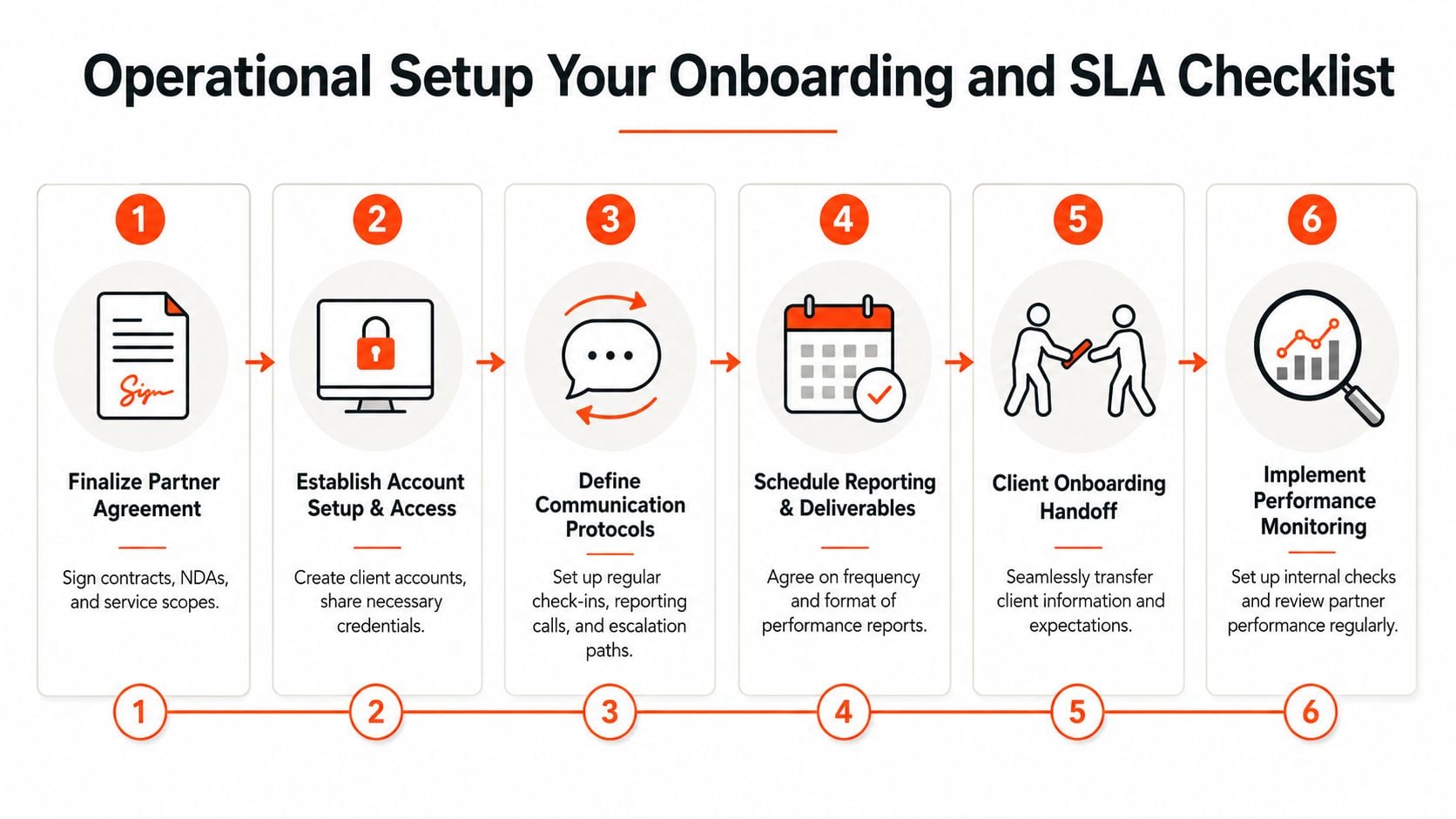
What your SLA must include
A useful SLA doesn't just say “monthly SEO services”. It defines how the relationship works under pressure.
Your checklist should cover:
- Scope boundaries: What's included, excluded, and treated as additional work.
- Turnaround times: Not vague promises. Actual timelines for audits, recommendations, content, and reports.
- Communication channels: Email only, Slack, project board, scheduled calls, or a combination.
- Escalation path: Who gets involved when deadlines slip or the client is unhappy.
- Approval rules: Who signs off on content, recommendations, and implementation.
- Access and revocation: How accounts are created, who can use them, and what happens when the engagement ends.
Build onboarding around evidence
Strong reseller programs rely on auditable outputs. According to Softtrix's overview of effective SEO reseller programs, that includes technical audits, search intent mapping, and branded reporting dashboards that connect work to outcomes like impressions, click-through rate, and qualified leads.
That point matters operationally. If your process doesn't produce evidence, your client will eventually feel like they're paying for invisible effort.
A practical way to support onboarding is to start with a proper diagnostic process, such as a structured website audit service, before ongoing work begins. It gives both the agency and the provider a shared baseline.
A simple handoff sequence
Use a sequence like this for every new account:
-
Commercial handoff
Proposal accepted, invoice terms confirmed, scope locked. -
Access handoff
Analytics, Search Console, CMS, tag management, and any approved platform access collected. -
Baseline review
Site audit, existing content review, location structure review if relevant, and key risk identification. -
Priority roadmap
What happens in month one, what waits, and what depends on client approval or dev support. -
Reporting setup
Dashboard format, branding, reporting date, and approval workflow confirmed. -
Internal QA
Someone on your side checks that the provider's deliverables match what was sold.
Don't onboard the client until your agency can explain month one in plain English.
What usually goes wrong
The common mistakes are predictable. Sales promises work that delivery never scoped. Access arrives late. Nobody defines who writes to the client. Reports become a list of tasks instead of a story about progress.
Operationally mature agencies avoid that by forcing clarity early. The better your onboarding, the less margin gets chewed up by confusion later.
Marketing and Selling Your New SEO Services
The easiest SEO sale usually isn't a cold lead. It's the client who already trusts you.
If you already manage paid media, design, development, or creative, you have context a new provider doesn't. You know the offer, the seasonality, the product margins, the lead quality issues, and the internal politics. That makes the SEO conversation shorter and more credible.
Start with existing clients
Don't pitch SEO as a random add-on. Tie it to a problem the client already feels.
Use language like this:
“We're seeing your paid search and website work doing the heavy lifting, but you're still relying on channels you have to keep funding every month. SEO gives you a stronger non-paid acquisition base and supports the pages that already matter to your business.”
Or this:
“You've already invested in the site. The next question is whether the right pages are being found, indexed, and matched to the searches your buyers are making.”
That framing works because it connects SEO to current spend and current goals.
What not to do in the sales process
Agencies often oversell SEO with vague promises. That creates friction later.
Avoid:
- Guaranteed ranking language: It weakens trust with experienced buyers.
- Mystery packaging: If the client can't tell what happens each month, the service will feel flimsy.
- Overloaded proposals: Too many deliverables make SEO look complicated instead of useful.
- Lead gen tunnel vision: SEO should support revenue goals, not just vanity metrics.
That same principle applies across service expansion generally. If you've seen agencies stumble when adding adjacent offers, this piece on outsourcing B2B lead generation mistakes is a good reminder that poor positioning and weak handoffs usually hurt more than the fulfilment model itself.
Turn fulfilment into proof
Once the first few accounts are live, use the work to sharpen your sales process.
A strong sales asset stack includes:
- A short diagnostic offer: Audit first, retainer second.
- One-page scope summaries: Buyers want clarity fast.
- Sample monthly report views: Show how progress will be explained.
- A lead capture path on your site: Something like this guide to generate SEO leads is useful as a reference point for shaping that funnel.
Positioning that wins better clients
You don't need to present yourself as “the best SEO agency in Australia”. That's generic and hard to defend.
You're usually better off saying something more specific:
- You help ecommerce brands improve category and product visibility.
- You help service businesses fix technical issues and capture non-brand demand.
- You help PPC clients build stronger organic support around converting pages.
That position is easier to sell because it sounds like a business service, not a commodity.
Frequently Asked Questions for SEO Resellers
Who owns the client relationship
Your agency should. The contract, billing relationship, reporting presentation, and strategic communication should stay with you. If the provider owns too much direct contact, you're not reselling. You're introducing.
Who's responsible if the provider makes a mistake
The client will usually hold your agency responsible first. That's why your agreement with the provider needs clear liability language, escalation steps, and quality controls. White-label doesn't remove accountability. It shifts how you manage it.
How should I price the service
Price from scope, account load, and risk, not just fulfilment cost. A low-cost package that creates constant back-and-forth is often less profitable than a better-priced package with tighter process and clearer boundaries.
Should I tell clients I use a white-label partner
That depends on your commercial model and your brand positioning. Some agencies keep the backend invisible. Others explain that specialist partners support parts of delivery. The important thing is consistency. Don't imply fully in-house delivery if your contracts and operations don't support that claim.
What should I ask for every month from the provider
At minimum, you want completed work, current priorities, known blockers, and reporting that links activity to meaningful performance indicators. If the provider only sends task lists and ranking snapshots, you'll struggle to defend value over time.
When should I stop using a provider
Stop when communication becomes unreliable, quality becomes hard to verify, or you find yourself rewriting their work before it reaches the client. If you're spending too much time insulating clients from the provider, the partnership is already costing more than it's worth.
If you're weighing whether to build, resell, or hybridise your SEO offer, Click Click Bang Bang is worth a look. They focus on PPC and AI-first SEO with transparent reporting, flexible plans, and a practical approach that suits agencies and brands that care about accountability, not fluff.
Read NeXt
Or Read Our Latest
- Manual vs Automated Bidding for PPC Success
- Conversion Tracking Setup: A Complete AU Guide
- Instagram Advertising Australia: Complete 2026 Guide
- Pay Per Click: A Beginner’s Guide for Australian Marketers
- Display Advertising on Google: The Complete Australian Guide
- Stakeholder Communication Plan How to Build One That Works
Click. CLick. Subscribe.
Get our best PPC insights, industry updates, and power moves delivered straight to your inbox. No fluff, just high-caliber strategies that actually work.
Don’t Leave Just Yet
Try Us For 30-Days,
Risk Free!!
We guarantee that you’ll love our work within the first 30 days, if not you’ll get your money back.
What have you got to lose?