

Search Ads vs Display Ads: Which to Use & When in 2026
Last Updated
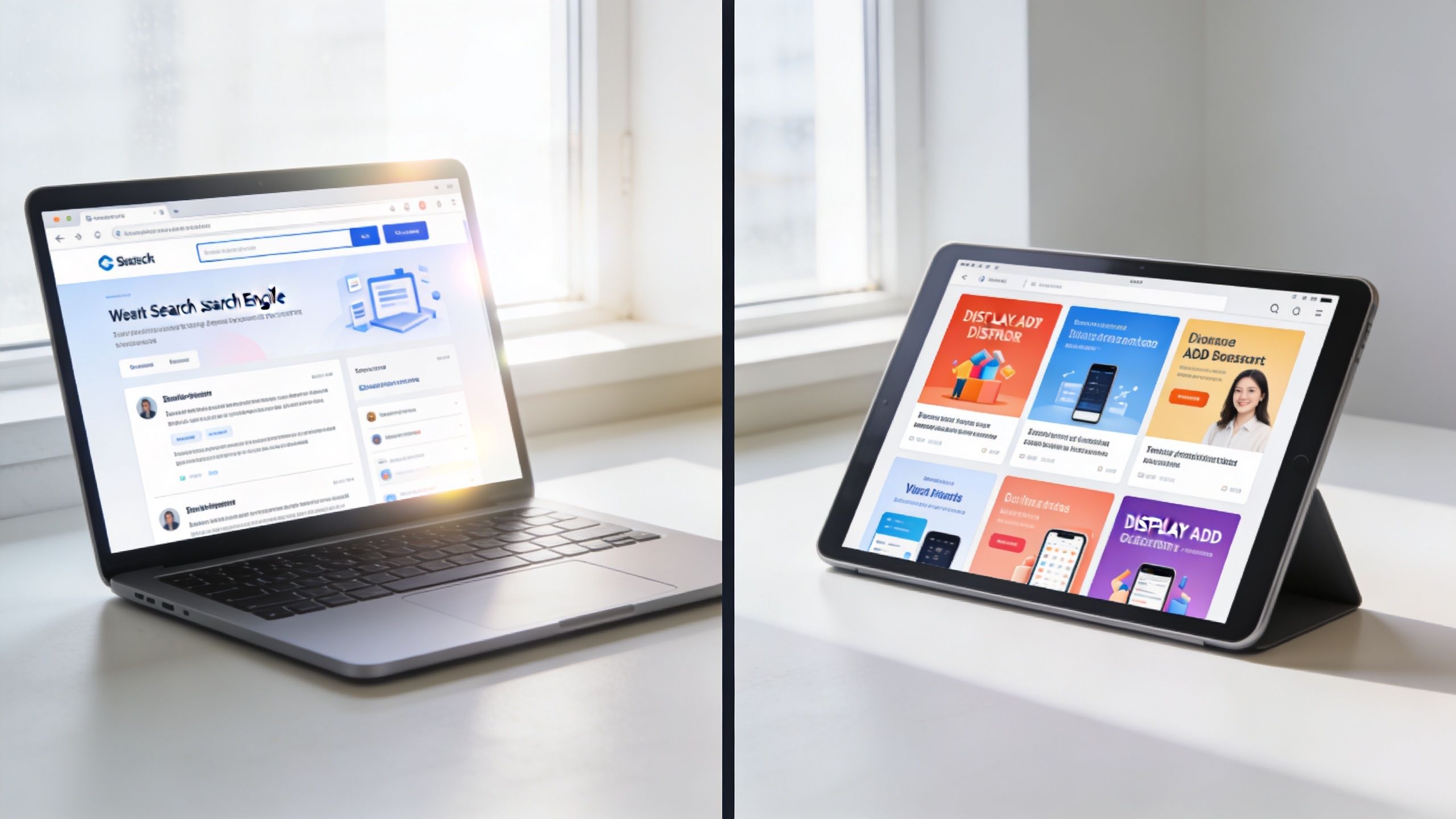
Your Google Ads budget is live, leads need to land this month, and every platform rep seems to have a different opinion about where the next dollar should go. Search says it will capture demand already in market. Display promises reach, remarketing, and cheaper clicks. Both are right, but they solve different problems.
That's why the ultimate question in search ads vs display ads isn't which one is better in the abstract. It's which one fits the job in front of you, how much budget each channel deserves, and how you'll measure success without fooling yourself with last-click reporting.
For Australian businesses, that decision has become harder. Search remains the clearest route to high-intent acquisition, but rising click costs put pressure on efficiency. At the same time, AI-driven search results and automated ad systems are changing how people discover brands and how platforms distribute impressions. If you treat search and display like a simple head-to-head contest, you'll miss how they work together.
| Channel | Best use | User mindset | Typical strength | Common mistake |
|---|---|---|---|---|
| Search ads | Lead generation, ecommerce sales, branded defence | Actively looking for a solution | Strong conversion intent | Expanding too broadly and paying for weak queries |
| Display ads | Awareness, remarketing, audience seeding | Not actively searching right now | Broad reach and repeat visibility | Judging success only on last-click conversions |
The Core Digital Advertising Dilemma
Most marketing managers hit the same wall eventually. Search campaigns are producing the most obvious conversions, so the instinct is to keep feeding them budget. Then performance starts to flatten, branded traffic carries too much of the account, and the business realises it's harvesting demand faster than it's creating it.
That's where display enters the conversation. Not as a replacement for search, but as a way to support future conversion volume, keep your brand in front of warm audiences, and reduce over-reliance on the handful of terms that already work.
Why this choice affects ROI
The split between search and display shapes more than media placement. It affects:
- How quickly you can generate leads. Search usually responds faster because the user already has intent.
- How much patience your measurement model needs. Display often influences conversion earlier in the journey.
- How creative your campaign has to be. Search relies on message relevance. Display relies on visual stopping power and frequency control.
- How easily budget can be wasted. Search wastes money on poor query matching. Display wastes money on weak audiences and vague objectives.
A lot of underperforming accounts don't have a platform problem. They have a channel-role problem. Teams ask display to close cold traffic immediately, or they expect search to keep scaling after demand has already been saturated.
Search and display don't compete for the same job. One captures active intent. The other helps create and recover future demand.
That distinction matters even more in Australia, where budgets are often tighter than large overseas advertisers assume, and where many businesses need every campaign to prove commercial value quickly. The smartest media plans don't treat this as a binary choice. They assign each channel a clear role, then measure each one according to that role.
Capturing Demand vs Creating It
The cleanest way to understand search ads vs display ads is to stop thinking about format first and start with intent.
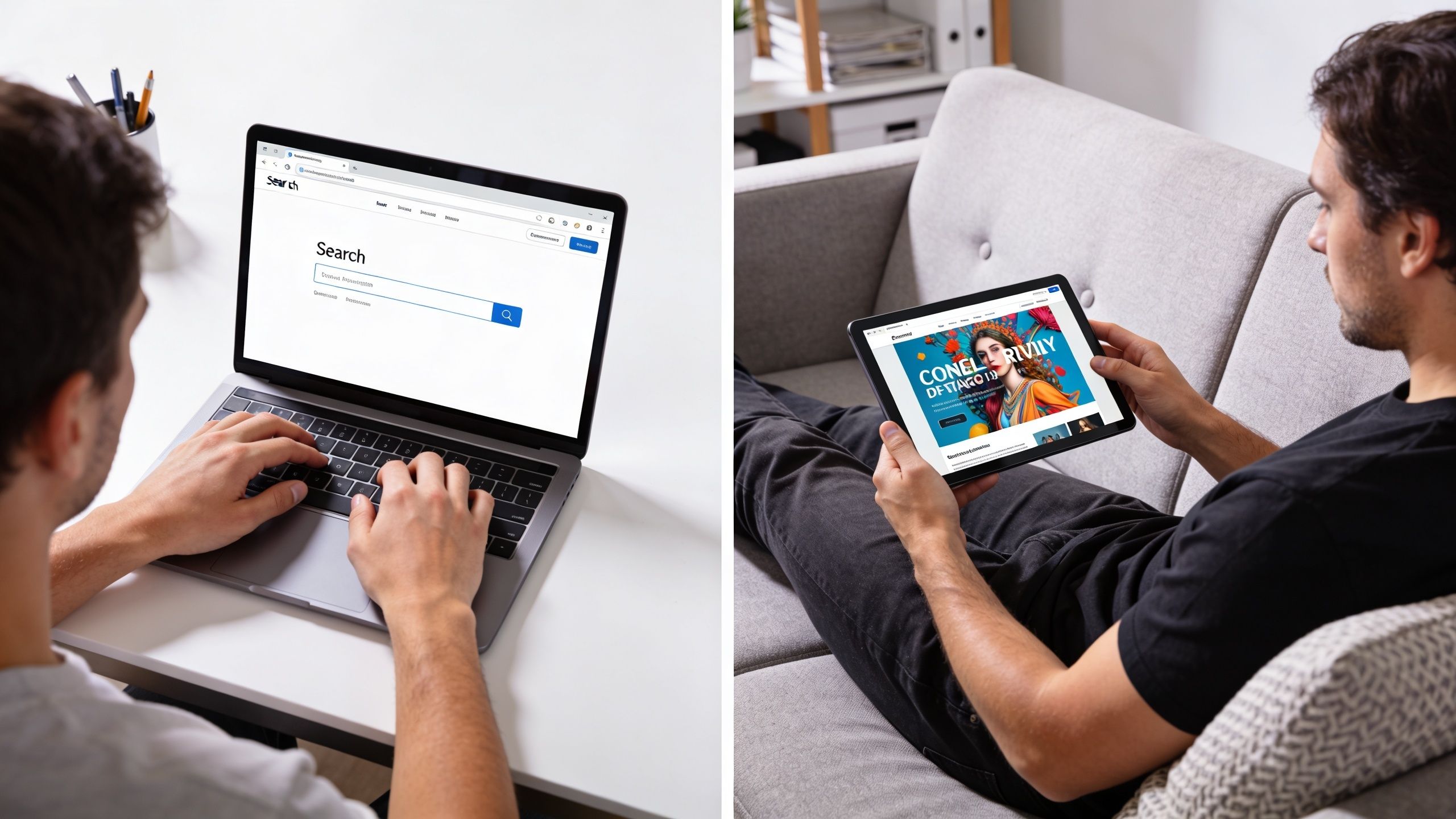
Search is a pull channel. Someone types a query into Google because they want something now. Maybe it's a local electrician, a CRM platform, or a specific product model. The user raises their hand first. Your job is to appear at the right moment with the right offer.
Display is a push channel. Your ad appears while the person is reading an article, using an app, watching content, or browsing another site. They didn't ask for your brand in that moment. You're interrupting, or at least inserting yourself into, their attention.
Why intent changes everything
That one difference explains why the channels behave so differently on cost, click-through rate, conversion rate, and reporting.
For AU advertisers, one of the most useful benchmarks comes from an Instapage comparison of search and display performance, which reports average Google Search conversion rates of about 4.40% versus 0.57% for Display, while Search CPC averages about $2.41 compared with $0.59 for Display.
Search costs more per click because the traffic is more valuable. The user is closer to action. Display costs less per click because reach is broader and intent is weaker.
If you need a plain-English primer on how paid search fits into the wider channel mix, this breakdown of what SEM is is useful background before you get into budget decisions.
Rule of thumb: use search to harvest demand that already exists. Use display to plant demand, stay visible, and bring people back.
What works and what usually doesn't
Search works when the offer matches a clear query. It performs best when account structure is tight, search terms are controlled, and landing pages are built to convert a person who already has intent.
Display works when the objective matches the medium. That usually means one of three roles:
- Awareness for audiences that don't know you yet
- Remarketing for visitors who already engaged
- Demand generation where the buying cycle is longer and repeated exposure matters
What usually fails is using display like cheap search. If you launch broad display prospecting and expect direct-response efficiency immediately, the channel will look worse than it should. You're asking a demand-creation tool to behave like a demand-capture tool.
The same mistake happens in reverse. Teams often push more money into search after the obvious high-intent terms are already covered. Then they wonder why cost rises and lead quality gets patchy. In many accounts, the issue isn't the platform. It's that search can only capture what people are already searching for.
A Detailed Comparison of Search and Display Ads
Once intent is clear, the operational differences become easier to judge. The mechanics of targeting, bidding, creative and reporting are not small details. They determine whether the campaign fits the commercial job.
Targeting mechanics
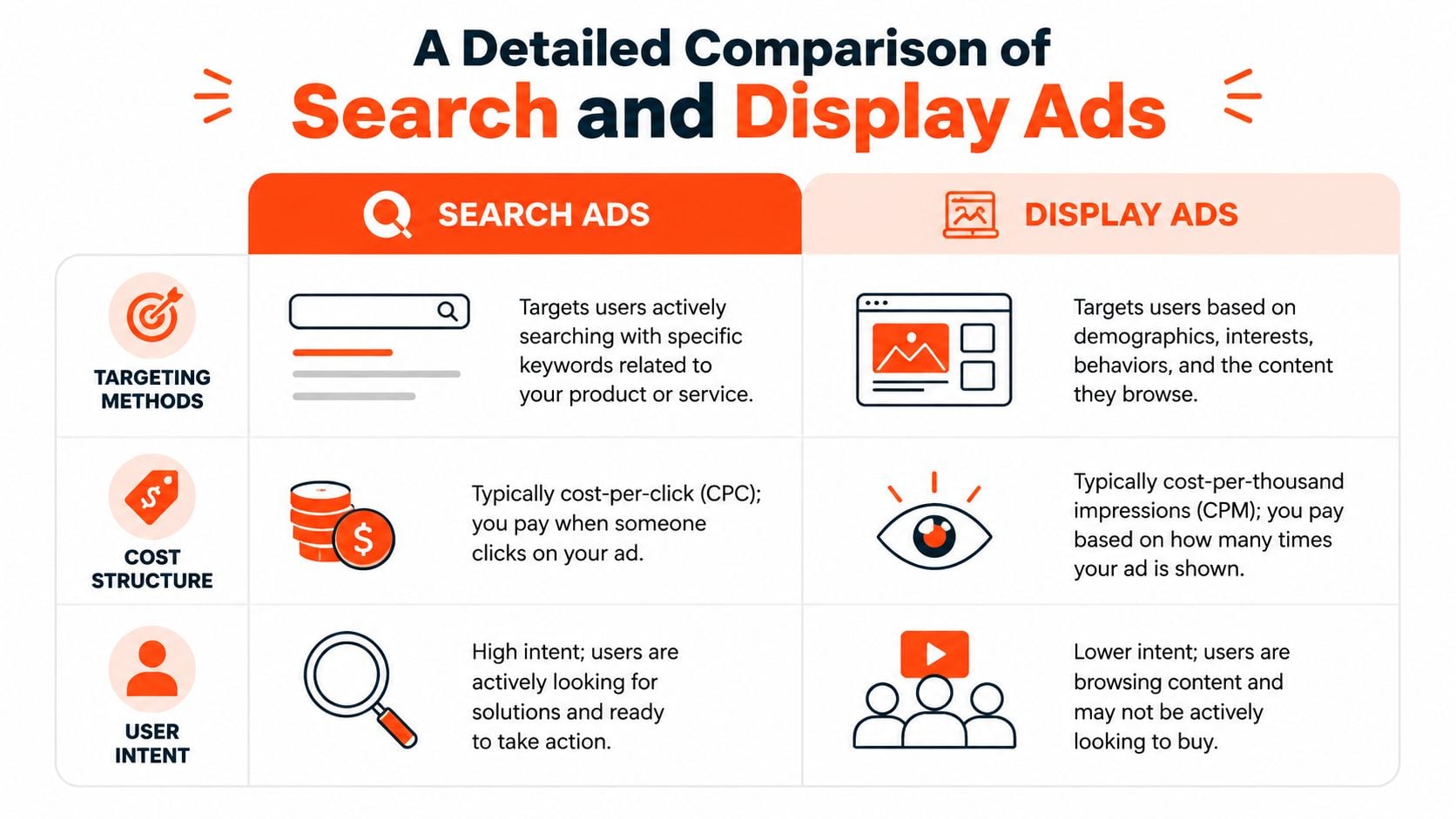
Search ads are primarily triggered by keywords and shaped by match type, query intent, geography, device, and audience overlays. You're matching your ad to a user's expressed need.
Display ads lean on audiences, placements, topics, contextual signals, and remarketing lists. You're predicting relevance rather than waiting for a user to declare it.
Strategic takeaway: choose search when you know the buyer's query. Choose display when you know the buyer profile but not the exact moment they'll search.
Cost structure and efficiency
Search traffic is usually more expensive because advertisers bid aggressively on commercial terms. That doesn't automatically make search less efficient. Expensive clicks can still produce better economics when the traffic is highly qualified.
Display traffic is cheaper to buy, which makes it useful for reach and repeated exposure. But lower CPC can be misleading if the campaign isn't influencing meaningful action.
According to a 2026 Google Ads benchmark summary from Store Growers, Search CTR is around 3.17% versus 0.46% for Display, with CPCs of roughly $2.69 and $0.63 respectively, and ecommerce conversion rates of 2.81% for Search versus 0.59% for Display.
| Dimension | Search ads | Display ads |
|---|---|---|
| Targeting | Keywords and query intent | Audiences, placements, context |
| Click economics | Higher CPC, usually stronger intent | Lower CPC, broader reach |
| CTR pattern | Higher because the user initiated the action | Lower because the ad interrupts browsing |
| Conversion pattern | Better for direct response | Better as an assist, reminder, or nurture layer |
A useful operational reference for campaign setup differences is this overview of Google Display Ads, especially if you're weighing remarketing against broader audience targeting.
Creative demands
Search creative is constrained, which is often a good thing. The work happens in message alignment. Headlines must reflect the query, filters must remove poor traffic, and the landing page has to continue the same promise.
Display creative has more room but also more ways to go wrong. Static banners, responsive display assets, animated units, and video all depend on visual hierarchy, brand recognition, and repetition. Weak creative kills display faster than weak copy kills search.
Search wins with relevance. Display wins with memory.
Reporting and optimisation
Search optimisation is usually more direct. You can inspect search terms, ad groups, keyword themes, device splits, and conversion behaviour with relatively clear intent signals.
Display requires more patience and stronger controls. Frequency, exclusions, placement quality, audience freshness, and post-click behaviour matter a lot. If you optimise it only on last-click CPA, you'll often cut the campaigns that are doing useful upper-funnel work.
Strategic takeaway: search gives faster feedback loops. Display needs a broader lens, or it will be underfunded for the wrong reasons.
Strategic Use Cases for Australian Businesses
The easiest way to decide between search and display is to stop thinking in channels and start thinking in buying situations. Different business models create different media priorities.
Ecommerce retailer
An online retailer selling products with clear demand should usually start with search. Product-specific queries, brand terms, category terms, and shopping behaviour all line up well with bottom-funnel intent. If someone knows what they want, search is where you want to intercept them.
A broader display push can still matter, but usually after the account has reliable search coverage. The first display job is often remarketing abandoned browsers, cart visitors, and previous purchasers with specific creative. After that, prospecting can make sense if the catalogue, margins, and creative are strong enough to support it.
Search still earns that first allocation because it remains a mature performance channel. A 2025 Google Ads benchmark dataset from WordStream reports an average Google Ads conversion rate across industries of 7.52%, which is one reason many advertisers still lean on search when they need measurable lead volume quickly.
B2B service provider
A B2B firm selling consulting, software, finance, or specialised services should usually put early budget into search for bottom-funnel terms. Queries around pricing, providers, software type, implementation, or service location often signal a buyer who is already moving.
Display still has a role, but not as random banner coverage. It works better when paired with a real nurture asset, such as a webinar, guide, comparison page, or category explainer. The goal isn't just to get a click. It's to stay visible across a longer buying cycle and bring decision-makers back after the first site visit.
If your display creative is weak, video often gives you a better chance to explain the offer. Teams exploring that route can learn a lot from this guide to creating high-performing Facebook video ads, especially around message structure and thumb-stopping creative.
Local SMB
For local trades, clinics, law firms, or service businesses, search is often the first dollar to spend. If someone needs help now, they search. That urgency lines up with paid search better than broad display awareness.
Display becomes useful once the core search engine is built. A local business can use it to stay in front of previous visitors, reinforce brand familiarity in a service area, or support categories where people compare providers over time rather than booking immediately.
A simple way to prioritise looks like this:
- Start with search first when the service solves an urgent problem, the demand already exists, or lead quality matters more than reach.
- Add display second when you need remarketing, repeated exposure, or brand recall across a longer decision cycle.
- Expand cautiously if search volume is limited. Don't force scale by loosening keyword quality too quickly. In many cases, display is the cleaner way to broaden the account.
Australian advertisers often do better when they respect sequence. Capture the demand that already exists. Then build the systems that generate more of it.
Measuring What Truly Matters
A lot of bad budget decisions come from one reporting habit. Teams judge every channel by last-click conversions, then assume the channel with the cleanest final interaction is the one doing all the work.
That approach naturally favours search. Search often appears near the end of the journey because that's when users actively seek a brand, a provider, or a product. Display often influences the journey earlier, then disappears from credit when another channel gets the final click.
Why last-click distorts reality
If a person sees your display ad, visits the site, leaves, comes back later through a branded search and converts, last-click reporting usually rewards search and ignores the nudge that kept your brand familiar.
That doesn't mean every display campaign deserves credit. Plenty of them are wasteful. It means the measurement model has to match the role of the channel.
Look beyond platform-reported conversions and check signals such as:
- Assisted conversions that show whether display appears earlier in converting paths
- View-through patterns where ad exposure appears to influence later action
- Branded search movement after sustained display activity
- Audience return behaviour from site visitors who were re-engaged
A practical framework for this sits in broader guidance on how to measure advertising effectiveness, especially when channel roles differ.
If display is only judged on the same last-click basis as search, it will almost always look worse than its real contribution.
Incrementality matters more than attribution arguments
The harder question is whether display is creating net-new demand or merely touching people who would have converted anyway. That's the core commercial issue, especially for SMBs that can't afford vanity reach.
An Australian-focused guide from Higher Ranking highlights this exact issue by pointing to incrementality as the key test for whether display is adding new demand rather than just harvesting existing intent from people who were already on their way to converting. You can read that discussion in its guide to display ads vs search ads for Australian marketers.
In practice, that means setting up campaigns so you can compare exposed and unexposed audiences, monitor branded search behaviour, and separate remarketing from prospecting. Don't lump every display impression into one bucket and ask whether it “worked”. Ask what part of display worked, for whom, and at what stage.
The marketers who get this right don't just report conversions. They report contribution.
Hybrid Strategies for Maximum Impact
The strongest accounts rarely treat search and display as isolated channels. They combine them into a system.
Search captures the high-intent user who is ready now. Display keeps your brand present after the first visit, reintroduces products or services to warm audiences, and supports future search demand. When those roles are clear, the channels stop cannibalising each other and start compounding.

The classic hybrid play
The most dependable combination is still straightforward:
- Run search for high-intent queries that map closely to your products or services.
- Build remarketing audiences from visitors who viewed key pages, added to cart, or started a lead action.
- Serve display ads back to those audiences with tighter messaging, stronger proof, or a clearer offer.
- Separate prospecting display from remarketing display so you don't confuse awareness spend with recovery spend.
This setup works because each channel picks up where the other leaves off. Search starts the relationship. Display helps continue it.
Why AI changes the decision
The old split between “keyword channel” and “audience channel” is getting less neat. Automation now influences bidding, matching, audience expansion, creative combinations and placement selection across Google's inventory.
That shift is why the more relevant question is increasingly about resilience. As noted in this discussion of AI and the changing search vs display decision, the practical challenge is moving from “which format?” to “which format remains resilient as clicks shift to AI Overviews and automated placements?”
That doesn't make channel strategy irrelevant. It makes it more important. You need stronger creative assets, cleaner conversion tracking, tighter audience definitions, and a clear view of where automation helps versus where it hides waste.
Hybrid strategy works when each campaign has a job, a feedback loop, and a measurement model that matches its role.
Sample Campaign Blueprints
These aren't rigid formulas. They're sensible starting points you can adapt once real account data comes in.
Lead generation starter
For a B2B service business, start with a search-heavy split, often around 80/20 in favour of search. Put the majority into non-brand and brand search campaigns built around high-intent service terms. Use the smaller display portion for remarketing site visitors and re-engaging users who reached pricing, contact, or service-detail pages but didn't convert.
Watch lead quality closely. Don't optimise only for form volume. Check whether enquiries are commercially relevant, whether branded search is carrying too much of the account, and whether remarketing audiences are returning through stronger paths.
Ecommerce growth engine
For a retailer, start more evenly. Search should still own the highest-intent product and category demand, but display deserves a meaningful share for dynamic remarketing, cart recovery, and controlled prospecting to new audiences.
The account structure matters more than the exact split. Separate branded search, non-brand search, shopping activity if relevant, remarketing display, and prospecting display so each stream can be judged fairly. If you blend them together, reporting gets muddy fast.
The practical rule is simple. If you need immediate action, weight spend toward search. If you need future demand, repeat visibility, or recovery of missed conversions, give display a defined role and measure it accordingly.
If you're weighing budget splits across Google Search, Display, Shopping, or remarketing, Click Click Bang Bang manages PPC programs with conversion tracking, reporting, and channel-specific strategy built around measurable business goals.
Read NeXt
Or Read Our Latest
- Manual vs Automated Bidding for PPC Success
- Conversion Tracking Setup: A Complete AU Guide
- Instagram Advertising Australia: Complete 2026 Guide
- Pay Per Click: A Beginner’s Guide for Australian Marketers
- Display Advertising on Google: The Complete Australian Guide
- Stakeholder Communication Plan How to Build One That Works
Click. CLick. Subscribe.
Get our best PPC insights, industry updates, and power moves delivered straight to your inbox. No fluff, just high-caliber strategies that actually work.
Don’t Leave Just Yet
Try Us For 30-Days,
Risk Free!!
We guarantee that you’ll love our work within the first 30 days, if not you’ll get your money back.
What have you got to lose?