

Choosing Adwords Management Companies in Australia
Last Updated
An AdWords management company is essentially a specialist agency that lives and breathes pay-per-click (PPC) advertising on Google Ads. They’re the experts who plan, build, and constantly fine-tune your campaigns. Their job is to make sure your ad budget is actually working for you, driving real returns instead of just getting spent.
Why You Need a Specialist AdWords Management Company

Trying to manage a Google Ads campaign in-house can feel like navigating a maze blindfolded. You know your business inside and out, sure, but Google's platform is a different beast altogether. It's a world of constant algorithm updates, complex bidding options, and fierce competition that can quickly lead to some very costly mistakes.
This is where bringing in a dedicated partner really shows its value.
For those attempting the DIY route, the pitfalls are pretty common:
- Wasted Ad Spend: It’s incredibly easy to burn through your budget by targeting broad, irrelevant keywords that get you plenty of clicks but zero conversions.
- Dismal Conversion Rates: Writing generic ad copy that doesn't really speak to your ideal customer is a recipe for low engagement and even lower sales.
- Losing Ground: Your competitors are likely using advanced strategies you just don't have the time to learn, letting them pull ahead while you're stuck trying to figure out the basics.
A specialist agency flips the script. They turn your advertising from a reactive, time-consuming task into a proactive growth engine. They aren't just setting up campaigns and walking away; they're deep in the data, spotting market trends, and constantly refining your strategy to keep you ahead of the curve.
The Strategic Advantage in Action
Let’s look at a real-world scenario. Picture an Australian e-commerce business selling handmade leather goods. They started out managing their own campaigns and were seeing pretty minimal returns for their efforts. Frustrated, they decided to partner with an agency, who came in and completely overhauled their strategy.
The agency dug deep, identifying highly specific, long-tail keywords that their ideal customers were actually searching for. They rolled out sophisticated bidding strategies for the most profitable products and wrote compelling ad copy that highlighted the brand's unique craftsmanship.
The result? Within six months, they had doubled their return on ad spend (ROAS) and achieved a 35% reduction in their cost-per-acquisition.
This story gets to a crucial point: Professional PPC campaign management isn't just another business expense; it's an investment in efficiency and growth. It's about turning raw data into profitable customer actions.
Tapping into a Growing Market
It's no surprise that the demand for this kind of expertise is surging. The Australian Digital Advertising Agencies market hit a valuation of approximately $3.6 billion in 2024 and is projected to climb to around $3.7 billion in 2025.
This growth tells us one thing loud and clear: more and more businesses are realising they need specialised digital advertising skills to actually win in today's market.
Ultimately, a specialist AdWords management company does more than just manage your ads. They help you navigate the complexities of the platform and implement proven strategies to reduce customer acquisition cost, making sure you get a much healthier return on your investment.
If you're looking for similar results, a great first step is to get familiar with the fundamentals of professional PPC campaign management.
Define Your Goals and Budget Before You Even Start Looking

Before you even think about Googling "AdWords management companies," you need to do some prep work. Honestly, this is the most critical part. Walking into discovery calls without a clear idea of what you want to achieve is a fast track to mismatched expectations and wasted time.
The best agencies can't read minds. They need your input—your vision—to build a strategy that actually wins. The clearer you are upfront, the better partner you'll find.
What Does Success Actually Look Like for You?
First things first, you need to define what a "win" means for your business. Just saying "I want more sales" isn't nearly specific enough. A skilled agency needs something tangible to build a campaign around.
Think about your main business objective. Different goals demand completely different campaign structures, keywords, and ad formats. Are you trying to:
- Generate Qualified Leads? This is the bread and butter for most service-based businesses. A local plumbing company wants more phone calls, while an IT firm is chasing demo requests. The goal isn't just any lead; it's a good lead.
- Boost E-commerce Sales? If you run an online store, your world revolves around driving direct revenue. Your key metrics will be things like Return On Ad Spend (ROAS) and the total number of transactions.
- Increase Brand Awareness? Maybe you're a new business that just needs to get its name out there. In this case, success might be measured in impressions, reach, and a general uptick in website traffic.
Once you’ve nailed down your main objective, get specific. Think SMART goals (specific, measurable, achievable, relevant, and time-bound). Instead of "more leads," a much better goal is, "Generate 25 qualified leads per month through our contact form within the next quarter."
Having clear, documented goals before you talk to any AdWords management companies ensures everyone is running towards the same finish line. It turns the relationship from a simple service into a real strategic partnership.
Demystifying Your Advertising Budget
Budget talks can get confusing fast, so it’s vital to understand the two main parts before you speak with an agency. You need to separate your ad spend from their management fee.
They are not the same thing.
- Ad Spend: This is the money that goes directly to Google for every click or impression your ads get. You have total control over this amount, and it’s what fuels the campaign.
- Management Fee: This is what you pay the agency for their expertise, strategy, and the time they spend managing everything. It’s the cost of having an expert in your corner.
Figuring out a realistic ad spend really depends on how competitive your industry is and what you're trying to achieve. A good starting point is to get a handle on your numbers, especially your customer acquisition cost (CAC). Knowing how much you can afford to pay for a new customer is crucial for setting a budget that actually drives profitable growth.
If you’re not sure where to start, you can learn more about how to calculate customer acquisition cost to get prepped for these conversations.
With a clear budget and well-defined goals, you're now properly equipped to find an agency that’s the perfect fit.
What You Absolutely Must Ask Every Potential AdWords Agency
So, you've narrowed it down to a few promising AdWords management companies. Now for the most important part: the interview. This is where you get to peel back the curtain on their slick sales pitch and see how they actually work. Getting this right is the difference between finding a true partner who drives growth and getting locked into a frustrating, wallet-draining contract.
Generic questions like "Tell me about your experience" are a waste of time. They'll just give you a pre-packaged, generic answer. You need to dig deeper. You want to understand their strategic thinking, their commitment to transparency, and how they approach problem-solving. Honestly, the best agencies love being grilled with detailed questions because it gives them a chance to flex their expertise.
Before we dive into the specific questions, remember the core of what you're hiring them for.
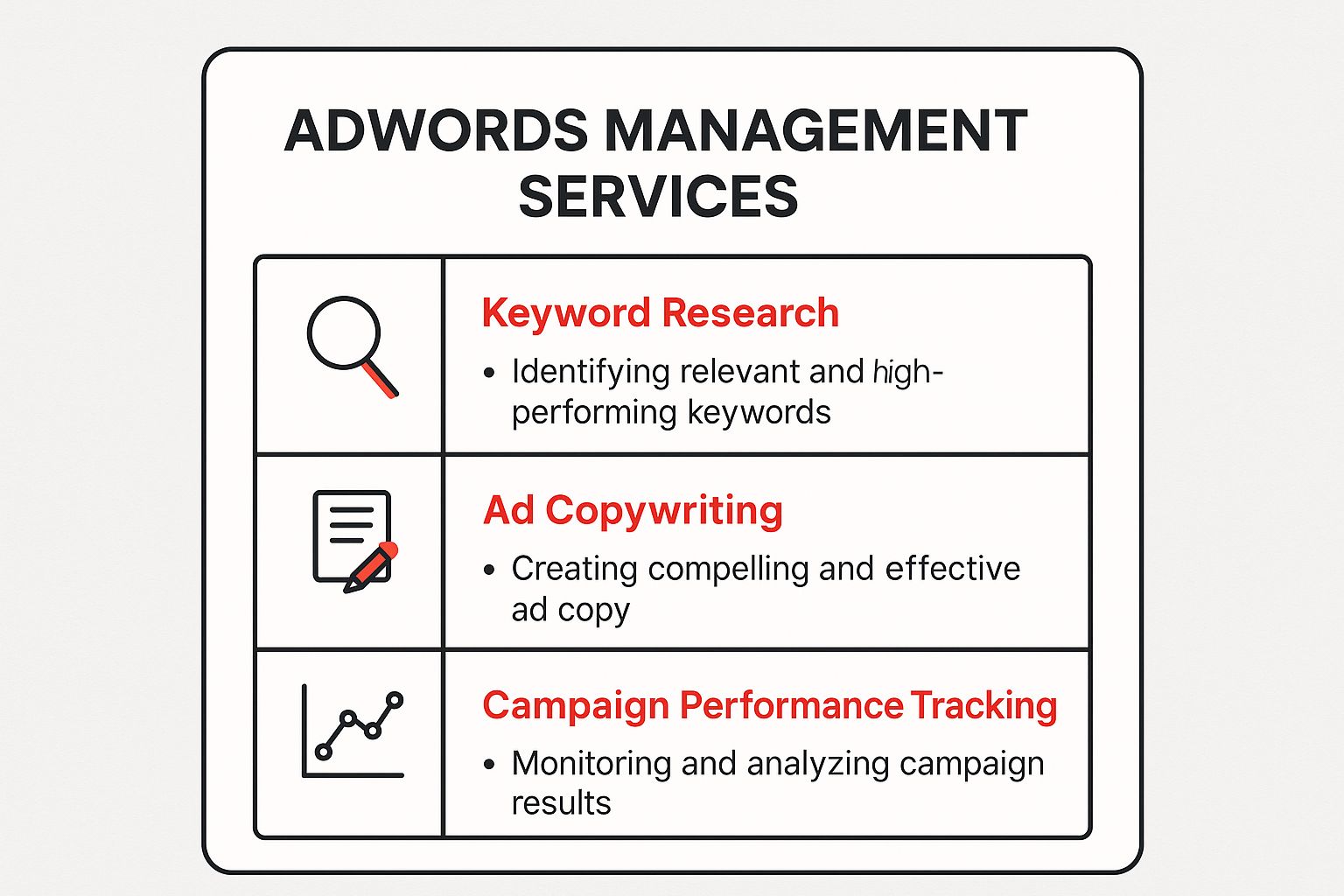
These three pillars—keywords, creative, and tracking—are the engine of any successful Google Ads campaign. Keep them front of mind as you evaluate each agency.
Getting a Feel for Their Strategy and Process
Let’s start with their fundamental approach. You're not just buying a list of tasks; you're buying a brain. These questions get to the heart of how they think and manage campaigns day-to-day.
-
How would you structure our campaigns? A top-tier agency won’t just mumble something about "best practices". They’ll immediately start talking about structuring campaigns around your specific services, products, or even customer personas. Listen for terms like themed ad groups and tightly controlled keyword lists. If their answer is vague and doesn’t connect directly to your business model, that’s a big red flag.
-
Walk me through your keyword research process. If their answer starts and ends with Google's Keyword Planner, you can probably end the interview there. A real pro will talk about digging into competitor analysis, mining your own website’s search query data, and, most importantly, focusing on user intent, not just raw search volume. It's about finding the people ready to buy, not just the people browsing.
-
How do you handle A/B testing for ad copy and landing pages? The magic word here is methodology. A sharp agency will describe a structured process. They'll talk about testing one variable at a time—a headline, a call-to-action, an image—and having a clear hypothesis for every single test. If their response is a lazy "we just test things to see what works," push them for specifics. No clear process means no real learning.
Talking Transparency and Reporting
This is where you figure out if you're getting a partner or a black box. The way an agency handles reporting, data, and account access says everything about their confidence and integrity. You don't want a partner who hides behind confusing dashboards and vanity metrics.
A great AdWords management company should feel like an extension of your own team. This means you must always retain full ownership of your Google Ads account and have 100% unrestricted access to your own data. No exceptions.
Here are the non-negotiables:
-
Who actually owns the Google Ads account? The only correct answer is you. A reputable agency will either work within your existing account or help you set up a new one that is owned by you from day one. If an agency insists on creating the account under their own name, run. It's a massive red flag. Why? Because if you ever decide to leave, they could hold all of your valuable campaign history hostage.
-
What level of account access will our team have? You need full administrative access, period. They only need standard or manager-level access to do their job. Any hesitation or pushback on giving you the keys to your own house is a serious warning sign.
-
Can I see a sample report? And how often do you send them? Ask them to walk you through a real (anonymised) client report. It should be clean, clear, and focused on the metrics that actually matter to your business goals—things like cost-per-lead or ROAS (Return On Ad Spend). If it's just a wall of vanity metrics like clicks and impressions, they're hiding what's important. At a minimum, you should expect monthly reporting, but the best agencies also provide a live dashboard for you to check in on performance any time you want.
Putting It All Together: Your Agency Vetting Checklist
Juggling conversations with multiple agencies can get confusing. I recommend using a simple scorecard or checklist to keep your thoughts organised and compare them on an apples-to-apples basis.
This table will help you systematically evaluate each contender.
| Evaluation Criterion | Agency A | Agency B | Agency C |
|---|---|---|---|
| Clear Campaign Structure | |||
| In-Depth Keyword Process | |||
| Methodical A/B Testing | |||
| You Own the Ads Account | |||
| Full Admin Access Granted | |||
| Clear, Goal-Focused Reporting | |||
| Cultural Fit / Communication | |||
| Industry Experience | |||
| Transparent Pricing | |||
| Overall Score |
As you fill this out after each call, a clear winner will often emerge, making your final decision much easier and more data-driven.
How to Evaluate Case Studies and Client References

Past performance is often the best predictor of future results, but only if you know how to read between the lines. Every agency is going to show you their shiniest wins. Your job is to look past the glossy testimonials and analyse their track record with a critical eye.
A compelling case study is more than just a success story; it's a blueprint of the agency's strategic thinking. Don't get distracted by impressive brand logos. Instead, you need to zero in on the details that actually matter to your business.
Decoding Agency Case Studies
When an agency hands you a case study, they’re showing you their proudest work. Your task is to figure out if that work genuinely aligns with your goals. Look for clear, quantifiable results that go beyond vague claims of "increased traffic."
Specifically, you want to see proof of:
- Meaningful Metrics: Look for hard numbers that tie back to your primary business goals. If you're an e-commerce store, a case study showing a 25% decrease in cost-per-acquisition is far more valuable than one bragging about a million impressions.
- Industry Relevance: Have they worked with businesses like yours before? While it's not always a deal-breaker, experience in your sector means they already understand your customer base, competitors, and market challenges. They won't be learning on your dime.
- The Problem and The Fix: A great case study clearly outlines the client’s initial problem, the strategy the agency developed to solve it, and the specific actions they took. This is where you see their problem-solving process in action.
The AdWords management market in Australia is quite strong, with plenty of agencies demonstrating tailored strategies that have driven major client growth. This means finding a partner with relevant experience is very achievable. You can explore a variety of Australian Google Ads agencies to get a feel for the calibre of work being produced.
Don't just accept case studies at face value. Ask follow-up questions. "What was the biggest challenge you faced during this campaign?" or "How did you adapt when the initial strategy wasn't working?" Their answers will reveal their agility and honesty.
Getting Real Insights from Client References
Case studies are the polished version of the story; client references give you the unfiltered truth. When an agency provides references, it’s a sign of confidence. Be prepared with specific questions designed to uncover the reality of the partnership.
Move beyond the generic "Were you happy with them?" and dig into questions that reveal their day-to-day working style:
- How was their communication? This tells you about their responsiveness and proactivity. Were reports clear and delivered on time? Did you have a dedicated point of contact you could rely on?
- How did they handle challenges or underperformance? No campaign is perfect. A great agency owns its mistakes, flags problems early, and comes to the table with a plan.
- Would you describe them more as a service provider or a strategic partner? This simple question is incredibly revealing. It uncovers whether they just follow instructions or actively contribute ideas to help you grow.
Gathering this authentic, unbiased information is the final piece of the puzzle. It ensures you’re not just hiring an agency, but choosing a partner who is genuinely invested in your success.
Getting to Grips with Agency Pricing Models and Contracts
Let's talk money. Navigating the financial side of hiring a new agency can feel like the trickiest part of the whole process. When the quotes start rolling in, you’ll quickly notice they vary—a lot. This makes a simple side-by-side comparison almost impossible.
To find a fair and transparent partner, you first need to understand the common pricing models and what to look for in the contract. The right fit for your business really boils down to your budget, how much risk you're comfortable with, and what you’re trying to achieve.
Common Agency Pricing Structures
Every pricing model has its upsides and downsides. Knowing what they are helps you ask smarter questions and figure out which structure actually aligns with your financial strategy.
- Percentage of Ad Spend: This is probably the most common model you'll see. The agency takes a cut of your monthly ad spend, usually somewhere between 10-20%. It’s simple and scales as you invest more, but there’s a catch. It can sometimes incentivise an agency to just spend more of your money, rather than focusing on making every dollar work harder.
- Flat-Rate Retainer: With a flat monthly fee, you get predictable costs, which makes budgeting a breeze. This model encourages the agency to squeeze the best possible results out of a fixed budget. The key here is to make sure the scope of work is crystal clear so you know exactly what that retainer gets you.
- Performance-Based: This one sounds appealing because you only pay for tangible results, like cost-per-lead or a specific return on ad spend (ROAS). The agency’s fee is tied directly to hitting certain targets. While it aligns your goals perfectly, these agreements often come with the potential for much higher fees and require complex tracking to get right.
Here in Australia, you can expect top-tier AdWords management companies to charge hourly rates anywhere from AUD 100 to AUD 199. Many firms also have minimum project fees starting around AUD 1,000 and prefer to work with ad budgets of AUD 5,000 or more per month. This just highlights the level of investment needed to get professional PPC management.
If you want to go deeper into how these structures work in the real world, check out our detailed guide on PPC pricing models.
Key Contract Terms to Scrutinise
The proposal and the price are only half the story; the contract is the other. This document sets out the rules for your entire relationship, and a few key clauses can make or break the experience. Don't sign anything until you're 100% clear on these points.
Your contract should be a document that protects both you and the agency. It’s a sign of a professional partnership, not a trap. Pay close attention to the details before you commit.
Here’s what to look for:
- Contract Length and Cancellation: Be wary of getting locked into a long-term, 12-month contract right out of the gate. A reputable agency that’s confident in their ability to deliver results will often offer a month-to-month agreement or a shorter initial term, like three months, with a clear 30-day cancellation notice.
- Account Ownership: This one is a deal-breaker. The contract must state that you retain 100% ownership of your Google Ads account and all its historical data. If you ever decide to part ways, that data is an incredibly valuable asset that belongs to you.
- Reporting and Transparency: A good contract will clearly spell out how the agency will report on key digital marketing performance metrics. This is all about ensuring transparency and accountability. It should specify how often you’ll get reports (e.g., monthly) and which KPIs will be tracked.
Common Questions Before You Hire an AdWords Agency
As you get closer to picking an agency, a few practical questions almost always pop up. Getting straight answers to these is the last piece of the puzzle, making sure you move forward with confidence and avoid any surprises after signing on the dotted line.
Let's run through some of the most common questions we hear from businesses at this stage.
How Quickly Can We Expect to See Results?
This is easily the question we get asked the most, and the honest answer is: it takes time. You’ll see data like impressions and clicks almost right away, but the meaningful business results—consistent leads, actual sales—typically need three to six months to really start flowing.
Think of it in phases:
- Month 1: This is all about setup, deep-dive research, and gathering baseline data. The agency is laying the foundation and getting a feel for what works with your audience.
- Months 2-3: Now we're in the optimisation and learning phase. The agency uses that initial data to sharpen targeting, test different ad copy, and cut out any wasteful spend.
- Month 3 onwards: By this point, a well-run campaign should start delivering a much more predictable return on your investment as the strategy matures.
Patience is everything in the early days. A frantic rush for immediate results often leads to bad decisions and a torched budget. Trust the process and keep your eyes on the long-term trend.
Agency vs Freelancer: What’s the Real Difference?
The main distinction boils down to resources and the sheer breadth of expertise. An agency brings a whole team of specialists to the table—strategists, copywriters, data analysts—which provides a built-in safety net. If your main point of contact is away, the work carries on without a hitch.
A freelancer, on the other hand, can offer a super personalised service and potentially lower costs. The catch? You're relying entirely on one person's skills and availability. For businesses that need a comprehensive strategy, room to scale, and solid support, an agency is usually the more reliable choice.
Should I Grant an Agency Full Account Access?
Yes, but with one critical condition: you must always remain the account owner. A reputable agency absolutely needs administrative or standard-level access to your Google Ads account to do their job properly. During onboarding, just make sure they're added as a manager or user under your business's ownership.
This structure guarantees you keep all your historical data and hold the ultimate control if you ever decide to part ways. Never, ever let an agency create the account in their own name.
What Should I Budget for Management Fees in Australia?
Management fees can vary quite a bit, so it pays to understand the common models. Many adwords management companies charge a percentage of your monthly ad spend, which usually falls somewhere between 10% and 20%.
Others work on a flat monthly retainer, which could be anything from $750 for a small, local business to over $5,000 for a larger, more complex account. Always get clarity on exactly what that fee covers—strategy, hands-on management, reporting, meetings—so you can accurately compare proposals and make sure there are no hidden costs down the track.
At Click Click Bang Bang, we offer transparent, flexible PPC management plans with no lock-in contracts. If you’re ready to partner with an agency that delivers clear results, explore our services.
Read NeXt
Or Read Our Latest
- Manual vs Automated Bidding for PPC Success
- Conversion Tracking Setup: A Complete AU Guide
- Instagram Advertising Australia: Complete 2026 Guide
- Pay Per Click: A Beginner’s Guide for Australian Marketers
- Display Advertising on Google: The Complete Australian Guide
- Stakeholder Communication Plan How to Build One That Works
Click. CLick. Subscribe.
Get our best PPC insights, industry updates, and power moves delivered straight to your inbox. No fluff, just high-caliber strategies that actually work.
Don’t Leave Just Yet
Try Us For 30-Days,
Risk Free!!
We guarantee that you’ll love our work within the first 30 days, if not you’ll get your money back.
What have you got to lose?