

Target CPA Bidding: Your Definitive 2026 Guide
Last Updated

You're probably in one of two situations right now.
Either your Google Ads account is producing conversions, but the cost swings too much from week to week and you want more control. Or you've been told to “switch on smart bidding” and use target cpa bidding, but you're not convinced the machine has enough clean data to make good decisions, especially now that GA4, consent settings, and modelled conversions have made reporting less straightforward.
That hesitation is healthy. Target CPA can work very well. It can also choke a campaign if you apply it too early, feed it weak conversion signals, or set a target based on what you wish CPA was instead of what your account can currently support. True skill isn't knowing the definition. It's knowing when to trust the system, when to hold back, and how to read performance without overreacting.
Demystifying Target CPA Bidding and Its AI
You switch a campaign to target cpa bidding because lead costs need to settle down. A week later, CPA is uneven, conversion reporting is partly modelled, and the usual question lands in the meeting. Is the bidding strategy working, or is it reacting to flawed data?
That is the primary 2026 challenge. Target CPA is not hard to define. The harder job is judging how much trust to place in Google's bidding decisions when GA4 setup, consent mode, and import quality can all affect the conversion signal the system learns from.
What the system is actually doing
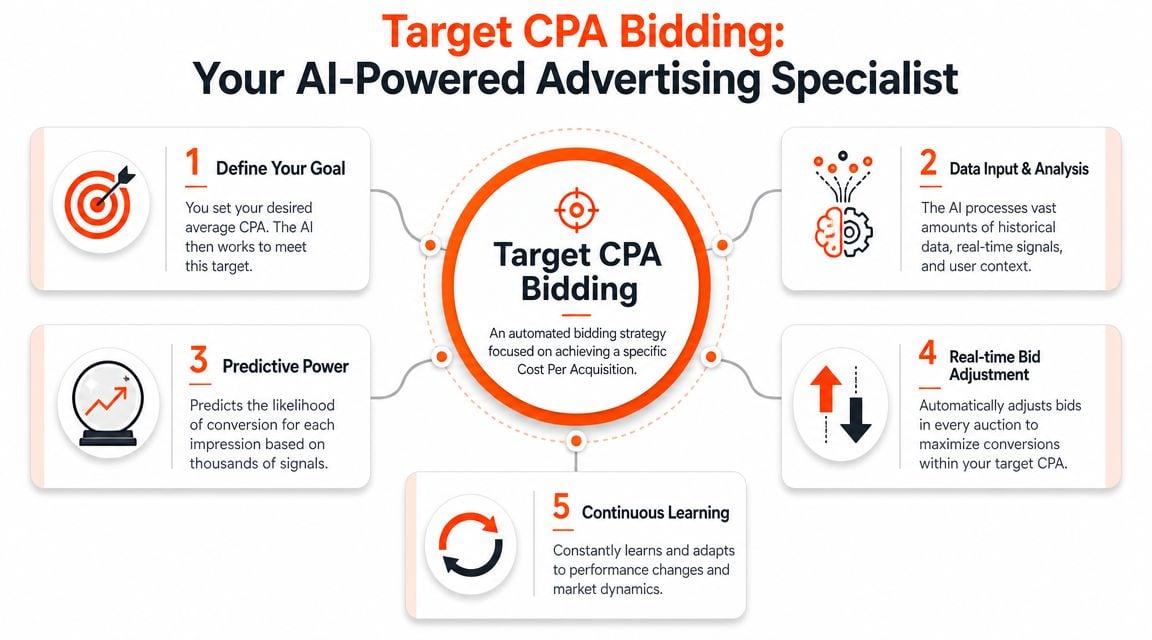
Target CPA tells Google Ads to aim for conversions at an average acquisition cost close to the target you set. It does that by changing bids at auction level, based on how likely a click is to convert under that specific set of conditions.
Google weighs signals such as device, browser, location, time of day, query context, and audience behaviour. So the same keyword can attract very different bids across two searches that look similar on the surface. If you want broader context on how these systems work across channels, this overview of AI-driven advertising systems is a useful reference.
In practice, the platform is making three constant judgement calls:
- Where conversion intent looks stronger: bids can rise to stay competitive.
- Where confidence is lower: bids may be reduced, or the system may bid less aggressively.
- Where patterns change: bidding updates continuously rather than following one fixed rule for the whole ad group.
That sounds straightforward. The catch is that Smart Bidding can only optimise to the conversion data it receives. If your primary action mixes strong leads with weak enquiries, or if consent settings suppress part of the path, the system still optimises. It just optimises against a noisier version of reality.
Why the AI can feel smart one week and unreliable the next
Target CPA often looks inconsistent because advertisers judge it against reported CPA alone, while Google is bidding from a broader mix of observed and modelled signals. In Australian accounts, that gap matters. Lower volume, state-based fragmentation, and offline sales steps can make performance look patchier than the bidding logic behind it.
The common mistake is changing too much at once. Teams switch bid strategy, then edit budgets, audiences, ad copy, geo settings, and targets within days. At that point, you are no longer assessing Target CPA. You are assessing a campaign with moving inputs and an unstable conversion signal.
Practical rule: after a major bidding change, protect the observation window. Review search terms, lead quality, and conversion tracking first. Change the CPA target only after you can separate normal learning volatility from actual signal problems.
Another point gets missed. Target CPA manages to an average, not a flat price on every conversion. Some leads will come in above target. Some will come in below it. That trade-off is normal if the overall mix is commercially sound.
The strategic question is whether your reported conversions are trustworthy enough to support that trade-off. If they are, Target CPA can save a lot of manual bid work. If they are not, automation can scale the wrong behaviour faster than manual bidding ever could.
The same principle shows up outside Google Ads. The logic behind optimizing Amazon CPA is a useful parallel. In both cases, CPA control depends less on the platform label and more on whether the conversion event reflects real commercial value.
Choosing Your Bidding Strategy Wisely
The wrong way to choose a bid strategy is to ask, “Which one is smartest?”
The right question is, “Which one fits the data quality, maturity, and business goal of this campaign right now?” That matters far more in Australian accounts where conversion volume can be split across states, service areas, devices, and smaller audience pools.
When Target CPA makes sense
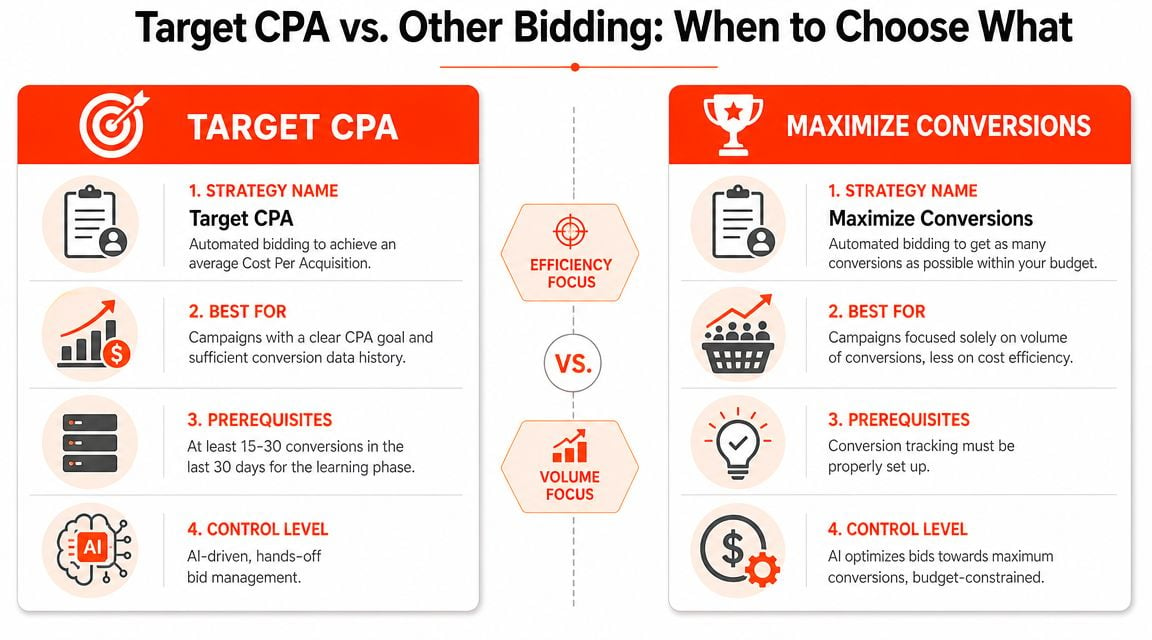
Target cpa bidding is a control strategy. You use it when conversion cost matters enough that you want Google to optimise around an average CPA target, not just chase as much volume as possible.
It fits best when:
- You already know your acceptable CPA: Finance, sales, and marketing agree on what a lead or acquisition can cost.
- The campaign has enough data to stabilise: Real-world guidance for Australian advertisers commonly points to 30 to 50 conversions per month as a more stable operating zone when tracking quality is strong, especially given privacy-related signal loss noted in Google's Smart Bidding support context.
- Your conversion values are relatively consistent: If one conversion is broadly comparable to another, CPA is easier to manage than revenue-based bidding.
When another strategy is the better call
If your campaign is still finding its feet, Maximise Conversions often gives the system more room to explore. If tracking is patchy, or the account is low volume, manual controls can still be useful for diagnosis. If conversion values vary materially, Target ROAS may be the better framework.
A simple comparison helps:
| Strategy | Best fit | Main risk |
|---|---|---|
| Target CPA | Mature campaigns with a clear cost-per-lead goal | Over-constraining delivery if target is too aggressive |
| Maximise Conversions | Accounts prioritising more conversion volume within budget | Can pursue volume without enough cost discipline |
| Manual CPC | Diagnostic phases, sparse data, or tightly controlled testing | Slower optimisation and less auction-time adaptability |
| Target ROAS | E-commerce or lead values that vary meaningfully | Needs trustworthy value tracking, not just conversion counts |
The GA4 and consent-mode question
This is the strategic issue most generic guides skip.
Google says Smart Bidding can operate even without conversion history. In practice, the question for Australian advertisers isn't whether tCPA can technically run. It's whether the conversion data feeding it is trustworthy enough to guide bids sensibly when GA4, consent mode, or delayed reporting introduce uncertainty.
If your account relies heavily on partial, delayed, or modelled signals, don't ask whether tCPA is available. Ask whether the inputs reflect business reality closely enough to justify giving it control.
That leads to a straightforward decision framework:
- Use target cpa bidding now when conversion tracking is reliable, primary actions are clearly defined, and recent volume is healthy.
- Hold off and use broader bidding when tracking is incomplete, lead quality is inconsistent, or volume is too thin to support stable learning.
- Stage the rollout when some segments are ready and others aren't. Branded search, high-intent non-brand, remarketing, and broad prospecting often shouldn't all move at once.
Your Pre-Flight Checklist for Target CPA
A campaign can look ready for Target CPA in the Google Ads interface and still be a poor candidate in practice.
That happens all the time with Australian accounts using GA4 imports, consent mode, offline CRM uploads, or a mix of all three. The bidding strategy is only as useful as the conversion signal it receives. If the signal is delayed, partial, or inflated by low-value actions, Target CPA will optimise with confidence in the wrong direction.
Check the foundations first
Before switching bidding strategy, confirm that the campaign has enough recent conversion history to give the system a pattern to work from. It is also vital to confirm that those conversions represent business outcomes you want more of.
In 2026, that second point matters more than many teams realise. A campaign with clean form submissions and sales-qualified lead imports is in far better shape than one with higher reported volume built on page views, calls under 10 seconds, or consent-affected GA4 events that never reconcile with the CRM.
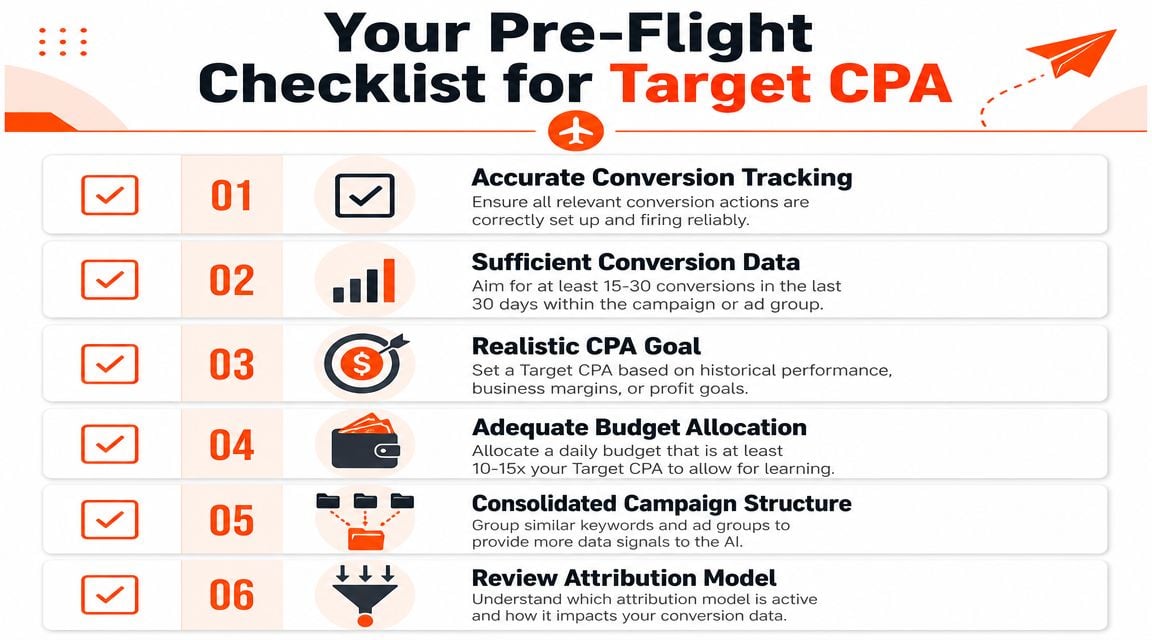
Use this checklist before launch:
- Primary conversion quality: Set one clear primary action for bidding. If tracking needs work, fix the Google Ads conversion tracking setup before handing control to automation.
- Recent usable volume: The campaign needs enough recent conversions to form a stable pattern. If volume is thin or erratic, wait or test on a stronger segment first.
- Target realism: Start from recent actual CPA and margin tolerance. A target picked to satisfy a forecast spreadsheet will often choke delivery.
- Budget headroom: If budget is already tight, the system has less room to test auctions and find conversion opportunities at your target.
- Campaign cleanliness: Consolidated structures usually perform better than fragmented campaigns full of overlapping themes and mixed intent.
- Attribution and delay awareness: Know how conversions are credited, how long they take to appear, and whether reported numbers line up with sales or lead quality downstream.
A short walkthrough can help if you want the interface view before making changes:
What often breaks the launch
The first failure point is usually the target itself. Set the CPA too low and the campaign becomes overly selective, enters fewer auctions, and loses the data it needs to improve. The symptoms are familiar. Lower impression share, weaker click volume, and a sudden drop in conversions that gets blamed on automation.
Bad Target CPA performance usually comes from poor inputs and tight constraints.
The next problem is mixed conversion intent. If one campaign is optimising towards quote requests, brochure downloads, and soft engagement events at the same time, Google Ads cannot distinguish between a lead that helps revenue and one that only pads the reporting.
There is also a trust issue that generic checklists miss. If consent mode modelling or GA4 imports make reported conversions directionally useful but not fully reliable, treat Target CPA as a controlled test, not an account-wide default. Start where data quality is strongest, compare platform results against CRM or sales outcomes, and only expand once the bidding behaviour matches commercial reality.
Setting Up and Launching Target CPA Campaigns
The cleanest way to launch target cpa bidding is usually on an existing campaign with stable conversion tracking and enough history. You can start a new campaign on it, but that's a higher-trust move and only makes sense when the account already has closely related data the system can lean on.
Start with campaign selection
Pick campaigns where buyer intent is reasonably consistent and conversion tracking is already dependable. Search campaigns usually give the clearest testing ground because query intent is easier to read than in broader display or mixed-inventory environments.
Before changing the bid strategy, sanity-check the campaign structure. If the account is bloated with overlapping ad groups, duplicate themes, or very thin segmentation, fix that first. A practical reference point is this Google Ads campaign structure template, which helps simplify the architecture before Smart Bidding is asked to interpret it.
Launch process that avoids self-sabotage
A disciplined rollout looks like this:
-
Choose one stable campaign or segment first
Don't flip the entire account in one afternoon. Start where conversion quality is strongest and traffic intent is most reliable. -
Set the bid strategy at the right level
Campaign-level targets are simpler and usually easier to manage. Segment-level targets can work, but only if there's a real business reason to separate them. -
Use a commercially sensible target
The target should reflect what the account has shown it can do, not the number someone wants on a slide deck. -
Leave other variables alone during early learning
Don't pair a bid strategy change with new landing pages, new ad messaging, broad keyword expansion, and a budget rewrite. If performance shifts, you need to know what caused it. -
Watch delivery as well as CPA
A lower CPA isn't useful if lead volume falls and impression share collapses.
A practical rollout approach for Australian accounts
Australian campaigns often have uneven volume across states, metro areas, and service regions. That makes staged rollout more than a caution. It's how you avoid drawing the wrong conclusion from noisy data.
If one segment has stronger intent and cleaner volume, start there. Let that campaign establish a pattern before rolling target cpa bidding into thinner geographies or lower-intent traffic pools.
For teams that want outside management rather than in-house monitoring, agencies such as Click Click Bang Bang offer PPC campaign execution that includes conversion tracking integration and live reporting. That matters because Smart Bidding only becomes useful when the measurement layer is dependable.
Advanced Tactics for Optimising Target CPA
Once target cpa bidding is live and stable, the job changes. You're no longer asking, “Should we use it?” You're asking, “How do we feed it better signals and remove the traffic that keeps dragging CPA sideways?”
That second phase is where most performance gains happen.
Adjust the target carefully
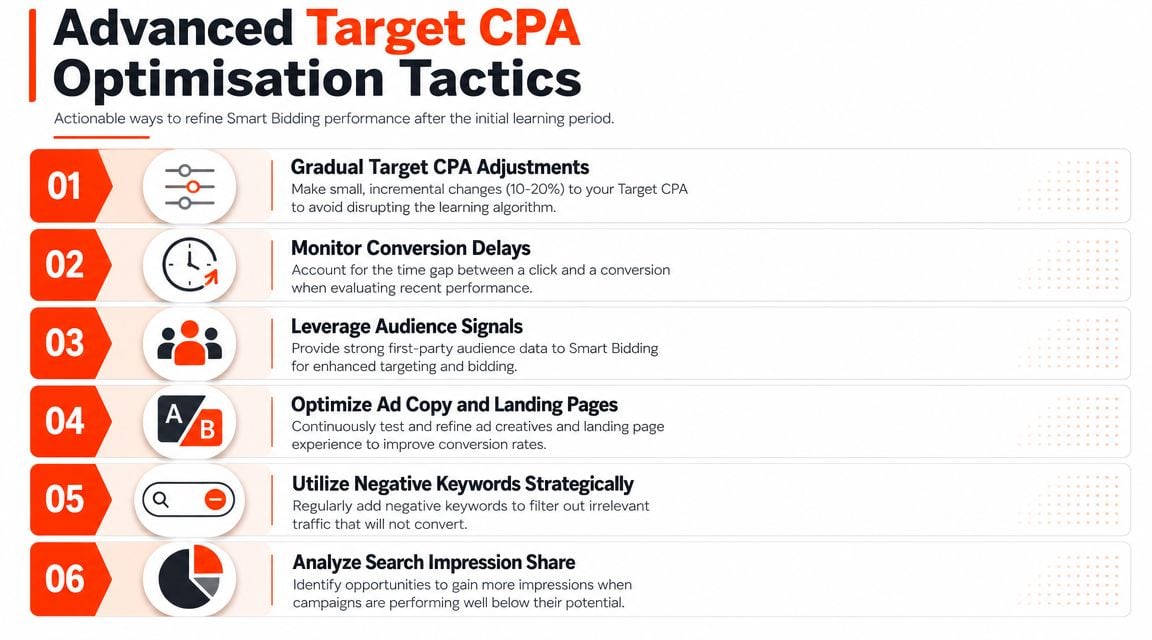
A common mistake is treating the target like a volume knob. Teams slash it when they want cheaper leads, then raise it sharply when volume drops. That creates instability and makes diagnosis harder.
A better approach is gradual adjustment based on actual account behaviour.
- If CPA is acceptable but volume is weak: loosen the target modestly and watch whether stronger auction participation restores scale.
- If volume is solid but efficiency has drifted: tighten the target carefully, then assess whether lead quality and delivery remain healthy.
- If performance is mixed across segments: adjust by campaign group rather than forcing one target onto very different intent profiles.
Improve the signals, not just the bids
Smart Bidding only sees what the account records. If you want better decisions, improve the quality of the conversion environment around it.
That usually means:
- Refining primary conversions: make sure the chosen action reflects genuine commercial value.
- Strengthening first-party audiences: remarketing lists and customer data can give the system stronger context around likely converters.
- Improving landing page alignment: better intent matching raises conversion probability, which gives the algorithm more useful feedback.
- Cleaning search traffic: negative keywords remain one of the most underrated supports for automated bidding.
The best Smart Bidding accounts don't “let AI figure it out”. They give the system a cleaner brief.
Use exclusions to shape the machine
Automation doesn't replace account hygiene. It amplifies it.
If poor search terms, irrelevant placements, or low-intent audience pathways are still active, target cpa bidding can spend efficiently inside an inefficient traffic pool. That looks fine on paper for a while, then stalls.
A practical optimisation rhythm looks like this:
| Lever | What to review | Why it matters |
|---|---|---|
| Search terms | Relevance and intent patterns | Removes demand that is unlikely to convert |
| Audience overlays | Remarketing and first-party segments | Strengthens predicted conversion probability |
| Ads and landing pages | Message match and friction points | Improves post-click conversion rate |
| Impression share trends | Lost opportunity versus budget or rank | Reveals whether target settings are too restrictive |
The point isn't to outsmart the algorithm. It's to stop forcing it to work with avoidable noise.
Target CPA in Action Examples
The best way to judge target cpa bidding is by business model. The same strategy behaves differently in e-commerce, B2B lead generation, local services, and multi-client agency environments because the conversion event means something different in each case.
E-commerce retailer with margin pressure
An online retailer usually doesn't just want more purchases. They want purchases that stay within acceptable acquisition cost relative to margin.
In that situation, target cpa bidding can work well when the business treats the conversion as a clean purchase action and separates product groups or campaign themes that behave similarly. If the account mixes high-margin and low-margin products in one pool, the average CPA target can hide profitability problems.
The practical move is to segment campaigns by commercial logic, not by arbitrary catalogue preferences. Then judge whether CPA discipline is helping the right products scale without forcing everything into the same cost target.
B2B lead generation with uneven lead quality
B2B marketers often get into trouble by optimising toward lead form completions before they've verified whether those leads are useful.
If sales says the lead quality is inconsistent, don't hand full control to target cpa bidding yet. First tighten the definition of the primary conversion. In many accounts, the strategy improves once the conversion event represents a genuine qualified action rather than every form fill.
The strongest B2B use case is where one lead is broadly similar in value to another and the sales process is consistent enough that CPA remains a meaningful operating target.
Small business with limited budget
For small Australian businesses, the danger isn't usually overspending. It's under-learning.
A local service business may only generate a modest stream of trackable enquiries, especially if demand is fragmented across suburbs, mobile behaviour, and business hours. In that environment, target cpa bidding can become too restrictive if the target is set aggressively from day one.
A safer approach is to start on the most proven, high-intent campaign segment first. Keep the conversion action tight. Don't force the whole account into automation before the data supports it.
Small-budget accounts can use target cpa bidding successfully, but they need sharper restraint on rollout and cleaner conversion definitions than larger accounts do.
Agency management across multiple clients
Agencies run into a different issue. They don't just manage the campaign. They manage expectations.
For target cpa bidding, the most important client conversation is upfront. Explain that the strategy is optimising toward an average acquisition cost over time, not producing identical daily CPA. Then report on the relationship between cost control, conversion volume, and delivery trends, not just whether a single reporting period sat above or below target.
For multi-account management, consistency matters more than fancy tactics. Use similar conversion standards, rollout logic, and reporting language across clients so performance reviews stay grounded in the same framework.
Troubleshooting Pitfalls and Measuring True Performance
When target cpa bidding struggles, the symptoms are usually obvious. Impressions drop. Spend slows. CPA runs hot. Conversion volume softens. The mistake is diagnosing all of those as “Google got worse”.
The better approach is to separate symptom from cause.
Problem one is shrinking delivery
If impressions and spend fall after switching to target cpa bidding, the first diagnosis is over-constraint. The target may be too low for current auction conditions.
That doesn't always mean the strategy is wrong. It often means the target is mismatched to the market, the campaign has weak data density, or the traffic pool is too fragmented to support that level of cost discipline. Check whether delivery dropped only in specific geographies, devices, or time windows. That usually points to where the bidding pressure is being felt.
Problem two is CPA staying above target
A lot of marketers treat this as immediate proof of failure. It isn't.
When using Target CPA, individual conversions will naturally come in above and below the target. The more reliable way to evaluate performance is with the Avg. Target CPA metric, because it shows the traffic-weighted average target applied over time, as explained in this overview of how Avg. Target CPA works in practice.
Problem three is “good CPA, bad business result”
This is more common than people admit.
A campaign can hit the target and still underperform commercially if the conversion being optimised isn't the one the business values. That's why the best troubleshooting step is often outside the bidding menu. Revisit conversion definitions, lead quality feedback, landing page intent match, and search term quality.
Use this quick diagnostic sequence:
- If volume dropped first: review target tightness and structural fragmentation.
- If CPA drifted first: inspect conversion quality, traffic quality, and recent account changes.
- If reports look fine but sales disagree: audit what the campaign is counting as success.
The smartest accounts don't judge target cpa bidding by daily volatility. They judge it by whether it maintains commercially acceptable acquisition costs while still letting the account participate in enough good auctions to grow.
If your team wants help deciding whether target cpa bidding is ready for your account, or whether GA4 and consent-mode data quality is making Smart Bidding less trustworthy than it looks, Click Click Bang Bang can audit the setup, tighten conversion tracking, and map out a bidding approach that fits the account's actual maturity rather than forcing automation too early.
Read NeXt
Or Read Our Latest
- Manual vs Automated Bidding for PPC Success
- Conversion Tracking Setup: A Complete AU Guide
- Instagram Advertising Australia: Complete 2026 Guide
- Pay Per Click: A Beginner’s Guide for Australian Marketers
- Display Advertising on Google: The Complete Australian Guide
- Stakeholder Communication Plan How to Build One That Works
Click. CLick. Subscribe.
Get our best PPC insights, industry updates, and power moves delivered straight to your inbox. No fluff, just high-caliber strategies that actually work.
Don’t Leave Just Yet
Try Us For 30-Days,
Risk Free!!
We guarantee that you’ll love our work within the first 30 days, if not you’ll get your money back.
What have you got to lose?