

Enterprise PPC Management An Expert Guide for 2026
Last Updated

Your paid media program probably doesn't feel like a single program.
It feels like a set of moving parts that never quite line up. Google Ads is chasing demand capture. Meta is driving remarketing and prospecting. LinkedIn is feeding lead gen. Shopping campaigns need constant feed attention. Reporting comes from three dashboards, four spreadsheets, and a CRM view that still doesn't match platform numbers. Finance wants confidence in spend pacing. Sales wants lead quality fixed. Brand wants tighter controls. Leadership wants a simple answer to a difficult question: what's working, what's wasting budget, and what should happen next?
That's the point where enterprise ppc management stops being a channel task and becomes an operating model. The work is no longer just campaign setup, bid changes, and ad testing. It's governance, measurement, decision rights, and execution discipline across multiple teams and platforms.
Beyond Campaigns A New Framework for Growth
A lot of enterprise advertisers come in with the same frustration. They don't lack activity. They lack control.
Campaigns are live. Budgets are substantial. Agencies or internal teams are producing reports. But the system behind the work is weak. Naming conventions drift. Conversion actions multiply. Brand and non-brand get blended together. Meta gets judged on a different standard than search. Regional teams run local variations without shared guardrails. The result is busy accounts with low trust.
That problem gets sharper in Australia because the market is large enough to punish sloppy management quickly. Australia's internet-advertising market reached A$16.4 billion in the 2024 financial year, according to the Searchbloom enterprise PPC guide. In a market operating at that scale, bigger spend doesn't solve weak structure. It exposes it.
Enterprise PPC is an operating system
The right way to think about enterprise ppc management is as an operating system for paid media.
An operating system does a few things well. It sets rules. It allocates resources. It standardises inputs. It allows specialised applications to run without breaking the whole machine. That's how large paid media programs should work. Search, Shopping, Meta, LinkedIn, remarketing, and new channels can all run inside the same framework, but they need shared governance.
That means clear ownership, consistent measurement definitions, approval workflows, budget controls, and reporting standards that tie ad spend back to business outcomes.
Practical rule: If your team can't answer who owns budget shifts, who signs off on conversion definitions, and which dashboard is the source of truth, you don't have enterprise PPC management yet. You have enterprise PPC activity.
What growth looks like in practice
In smaller accounts, a good operator can often outperform through speed and sharp campaign tactics alone. Enterprise accounts don't work that way for long. The gains usually come from reducing friction between strategy and execution.
That shows up in areas like:
- Budget governance: Teams know how much can move, how fast, and under what conditions.
- Measurement integrity: Platform conversions are checked against backend or CRM outcomes before major reallocations.
- Channel coordination: Search captures intent while paid social and display support audience building, remarketing, and message reinforcement.
- Executive reporting: Leadership sees revenue impact, customer acquisition efficiency, and conversion quality, not just channel-level vanity metrics.
The strongest enterprise programs aren't the loudest or most complex. They're the most organised. They make it easier to scale because the process holds when the spend, channel mix, and stakeholder count all increase at once.
What Makes Pay-Per-Click Enterprise Level
The difference between standard PPC and enterprise PPC isn't just budget size. It's operational complexity.
A small account is like flying a single aircraft on a short route. You can react quickly, make manual adjustments, and keep most decisions in one person's head. An enterprise account is closer to running an airline. There are more routes, more crew, more compliance, more coordination, and far more ways for a small failure to create expensive consequences.

Scale changes the job
One useful marker is spend level. In 2026 benchmarking, enterprise PPC spend is commonly cited at A$100,000+ per month, while SMB budgets sit much lower, according to Digital Applied's PPC statistics summary. The same source notes that 23% of PPC budget is typically wasted on poor targeting or fraud, which is exactly why enterprise controls matter.
At that level, the risk profile changes. Waste that looks tolerable in a smaller account becomes expensive very quickly. So does inconsistency.
You can't run enterprise PPC on instinct alone. You need structure for:
- Cross-platform alignment: Search, Shopping, Meta, and LinkedIn can't be managed as isolated islands.
- Stakeholder coordination: Marketing, sales, finance, legal, and brand all influence outcomes.
- Compliance: Ad copy, audience usage, claims, and tracking often require review.
- Operational resilience: Staff changes, agency transitions, and product launches shouldn't break the system.
Enterprise is complexity, not prestige
Some teams call themselves enterprise because the account is large. That isn't enough.
A true enterprise environment usually has several of these characteristics:
| Enterprise PPC signal | What it means in practice |
|---|---|
| Multiple business units | Campaign goals and reporting need segmentation, not blended averages |
| Shared budgets | Budget shifts affect more than one product, region, or stakeholder |
| Regional variation | Messaging, offers, and compliance rules change by market |
| Long sales cycles | Lead quality and offline conversion data matter more than platform lead counts |
| High brand sensitivity | Creative and search queries need tighter oversight |
Running enterprise PPC without governance is like giving every department access to the cockpit.
The tactical work still matters. Keywords matter. Feed quality matters. Creative testing matters. But those aren't what make an account enterprise level. The defining feature is the need for an operating model that can hold together under pressure.
What stops working at this level
Several habits break as accounts grow:
- Blended reporting: It hides where profit and waste sit.
- Platform-by-platform decision-making: It creates channel conflict instead of coordinated growth.
- Loose naming conventions: It makes reporting and auditing slower than they should be.
- One-size-fits-all targets: Different campaign types need different expectations.
- Manual dependency: If performance collapses when one specialist goes on leave, the system is fragile.
Enterprise PPC management starts when the organisation accepts that complexity needs design, not just effort.
Choosing Your Organisational Model
How you structure the function matters almost as much as how you run campaigns. A weak model creates delays, duplicated work, and blurred accountability. A strong model makes decision-making faster because people know what they own.
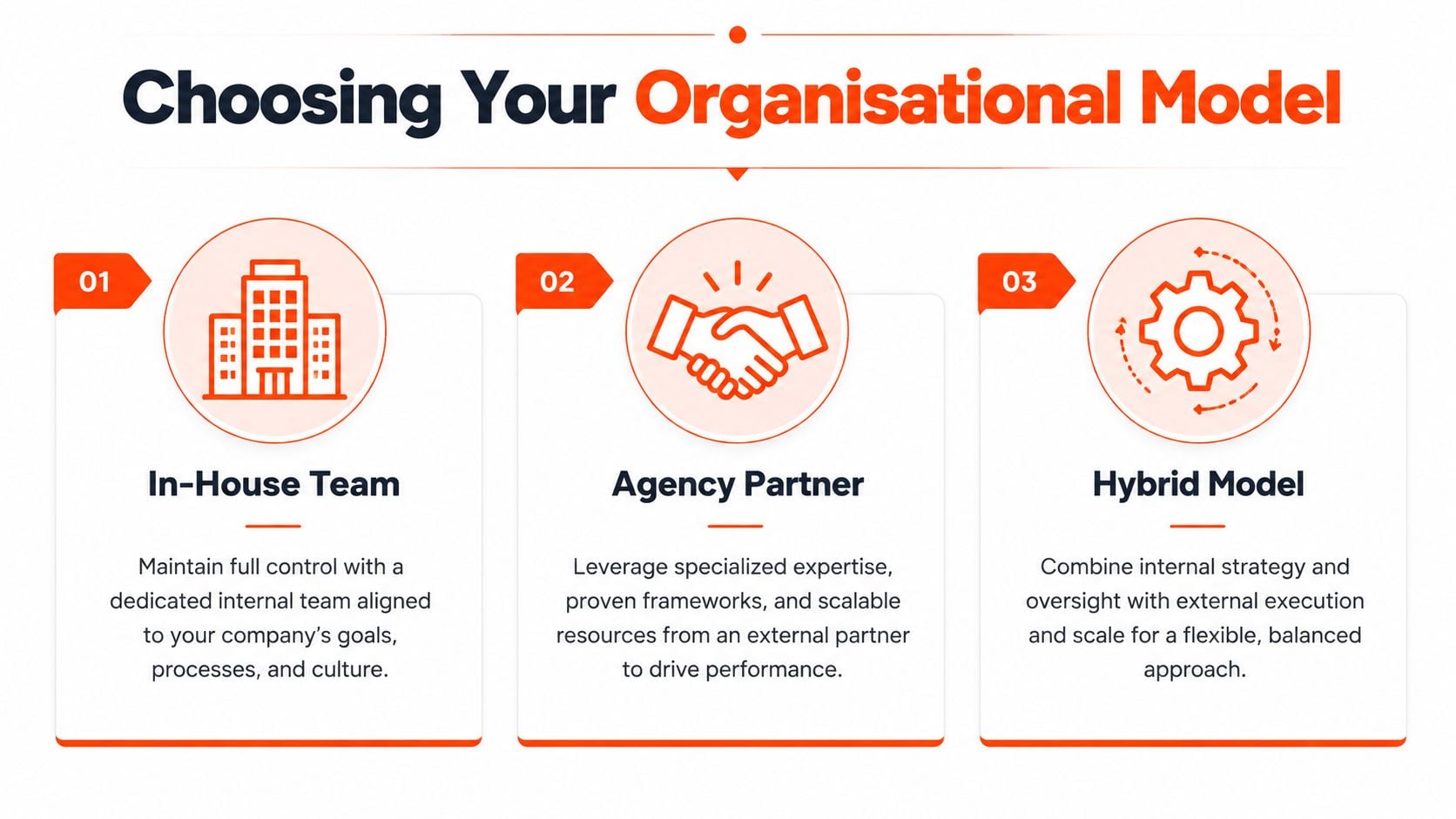
There are three common ways enterprise teams organise paid media. None is universally right. The right choice depends on internal capability, appetite for control, speed requirements, and how much specialist depth the business needs.
The three operating models
Fully in-house gives the business direct control. Strategy, execution, data coordination, and reporting all sit inside the company. This can work well when the organisation already has strong channel specialists, analytics support, and management discipline.
Fully outsourced to an agency shifts execution and much of the specialist strategy to an external partner. This often suits teams that need broader cross-platform capability, faster rollout, or support across technical areas they can't cover internally.
Hybrid combines internal ownership with external execution or specialist support. In practice, this is often the most durable model for large advertisers because it keeps business context close to the company while bringing in external depth where it's most valuable.
Enterprise PPC Organisational Model Comparison
| Criterion | Fully In-House | Fully Outsourced (Agency) | Hybrid Model |
|---|---|---|---|
| Control | Highest direct control over priorities and approvals | Lower direct control over day-to-day work | Strong control over strategy with shared execution |
| Speed of execution | Can be fast if team is well staffed | Often fast once workflows are established | Depends on clarity of roles |
| Access to specialist expertise | Limited by hiring success and internal breadth | Broader channel and technical expertise | Best when specialist gaps are clearly defined |
| Scalability | Harder if growth outpaces hiring | Easier to add support across channels and markets | Scales well when governance is mature |
| Organisational learning | Deep internal knowledge retention | Knowledge can sit with the partner if not documented well | Shared learning if documentation is disciplined |
| Risk | Key-person dependency if capability is concentrated | Risk of distance from internal context | Coordination risk if ownership is vague |
What each model gets right and wrong
An in-house team usually understands product nuance, commercial realities, and internal politics better than anyone else. The trade-off is coverage. Many internal teams are strong on one or two channels and weaker on attribution, feed operations, creative testing systems, or advanced reporting.
A fully outsourced model can solve that breadth problem. It can also create a different one. If the agency owns too much of the process and the client owns too little of the operating model, decisions get slower and reporting can become something the business receives rather than something it uses.
The best model is the one that makes accountability obvious. If two teams both think the other team owns performance diagnosis, nobody owns it.
The hybrid model works best when responsibilities are explicit. Internal teams often own commercial priorities, product knowledge, legal approvals, and CRM context. External partners often own campaign operations, technical implementation support, testing workflows, and platform-specific insight.
How to decide without overcomplicating it
Use these questions to pressure-test the fit:
- Where is your bottleneck today: strategy, execution, measurement, or stakeholder alignment?
- What knowledge must stay inside: pricing, product launches, sales feedback, or compliance review?
- What's hard to hire for: advanced Google Ads operations, paid social creative systems, feed management, or analytics integration?
- How often do priorities change: weekly, monthly, or quarterly?
- Can your current structure absorb growth without adding confusion?
If the answer to that last question is no, the model needs work before the media plan does.
A Unified Process for Scaling Across Platforms
Most enterprise teams don't struggle because they lack channels. They struggle because each channel develops its own logic, its own reporting style, and its own version of success.
That's why scaling across platforms needs a single process. Not identical tactics. A shared operating rhythm.
Stage one centralise strategy and governance
Start above the platform level.
Enterprise accounts need a central layer where the business defines campaign goals, budget rules, audience priorities, promotional calendars, reporting definitions, and approval processes. In this space, you decide what counts as a qualified lead, how brand and non-brand are separated, which regions get local flexibility, and which claims require legal review.
Without that top layer, each platform team interprets the brief differently. Search optimises for high-intent capture. Meta chases cheaper conversions. LinkedIn focuses on form fills from senior job titles. Everyone looks busy, but the program loses coherence.
A central governance layer should lock down:
- Measurement definitions: one agreed view of primary and secondary conversions
- Creative guardrails: approved offers, claims, tone, and exclusions
- Budget movement rules: who can shift spend, between which campaigns, and when
- Segmentation logic: product lines, regions, customer types, or funnel stage
Stage two adapt to the platform, not away from the strategy
The brief stays consistent. The execution doesn't.
A retail promotion might show up as product-led pricing and feed optimisation in Google Shopping, urgency-driven remarketing on Meta, and category-specific search coverage in Google Ads. A B2B offer might become intent-based search campaigns, retargeting sequences on Meta, and role-specific lead gen on LinkedIn.
That's the discipline. You translate one strategic intent into channel-native execution.
For example:
| Strategic input | Google Search or Shopping | Meta | |
|---|---|---|---|
| New product launch | Capture active demand and product-specific queries | Build audience familiarity and remarket site visitors | Reach relevant roles with category framing |
| End-of-quarter pipeline push | Focus on high-intent commercial terms and lead actions | Re-engage warm audiences with stronger offer hooks | Push direct-response lead gen to selected accounts |
| Margin protection | Prioritise profitable categories and tighter query control | Exclude low-value audience pools | Concentrate on higher-value segments and stronger qualification |
One practical test helps here. If the same message has been copied into every platform with no adaptation, the team is being efficient in the wrong place.
A useful outside example sits in retail media. Teams that already manage my ads on Walmart as part of a broader commerce mix face the same challenge. The platform changes, but the operating principle doesn't. Central rules first. Native execution second.
Stage three build cross-platform intelligence loops
This is the part most accounts miss.
Enterprise programs improve faster when information moves between channels. Search query data should influence paid social messaging. CRM sales feedback should reshape lead scoring and audience exclusions. Shopping feed issues should inform promotional planning. LinkedIn quality signals should affect how remarketing pools are built elsewhere.
Good platform teams optimise their own channel. Strong enterprise teams build feedback loops between channels.
A simple operating rhythm often works better than complex theory:
- Weekly channel review for execution issues, spend pacing, and major anomalies.
- Fortnightly cross-channel review for audience overlap, creative learning, and channel interaction.
- Monthly business review tying paid media performance back to pipeline, revenue, or ecommerce outcomes.
When that rhythm is in place, the program stops acting like separate media buys and starts behaving like a coordinated growth system.
Building Your Enterprise PPC Technology Stack
Technology doesn't replace strategy, but at enterprise scale it determines whether the strategy can execute.
The stack should do four jobs well. It should help the team execute bidding decisions, measure outcomes, report performance clearly, and maintain asset quality across campaigns. If one of those layers is weak, the whole program slows down.
Bidding and automation systems
At enterprise level, bidding isn't just about setting targets inside one ad platform. It's about deciding how much automation you trust, where you constrain it, and which signals feed it.
Teams commonly use native platform automation in Google Ads, Meta, and LinkedIn. Some also use management layers such as Search Ads 360 when they need broader workflow control, shared bidding logic, or more formal governance over large search programs.
The mistake is treating automation as self-managing. It isn't. It still needs:
- Clean conversion inputs
- Stable campaign structures
- Clear segmentation
- Business rules around budget and target changes
If those foundations are weak, automation scales confusion.
Analytics and attribution infrastructure
This layer matters more than organizations typically realize. Platforms can report lots of conversions while the business still has low confidence in what those conversions mean.
A mature stack usually combines ad platform data with analytics platforms, CRM systems, and backend revenue or lead-status data. GA4 is often part of that setup. So are offline conversion imports, enhanced conversion methods, and CRM connectors.
The goal isn't more dashboards. It's a cleaner line between ad interaction and commercial outcome.
If your bidding system learns from the wrong conversion event, it will optimise efficiently toward the wrong goal.
Reporting and visualisation
Reporting should reduce debate, not create more of it.
For most enterprise teams, the most useful reporting environments are the ones that pull data into a central view and preserve segmentation. Looker Studio is common for flexible dashboards. Some organisations use broader BI environments as well. The exact tool matters less than the reporting design.
Good reporting answers questions in layers:
- Executive layer: commercial outcomes, pacing, major shifts, and risk areas
- Management layer: channel and segment performance by audience, device, campaign type, and market
- Operator layer: search terms, ad asset performance, feed diagnostics, audience fatigue, and conversion path detail
Blended averages hide too much. A useful dashboard makes segmentation easy to inspect.
Creative and feed operations
Enterprise PPC often falls apart in the asset layer long before anyone notices. Product feeds break. Naming conventions drift. Approved offers get used inconsistently. Creative variants aren't mapped to audience intent.
That's why the stack also needs practical support for feed management, creative collaboration, and asset review. In ecommerce, feed quality directly affects Shopping and other commerce campaigns. In lead gen, offer and landing page alignment matter just as much.
AI is changing this layer quickly. Teams are using it to speed up ideation, draft ad variants, cluster search themes, and improve reporting workflows. For a grounded look at where that fits inside modern ad operations, Click Click Bang Bang has a useful piece on artificial intelligence in ads.
Stack design principle
Don't build the stack by chasing tools one by one. Build it around decisions.
Ask which systems support budget decisions, creative decisions, attribution decisions, and performance diagnosis. Then check whether those systems connect cleanly enough for operators and leaders to trust what they see.
A smaller, well-integrated stack usually beats a sprawling one full of partial overlap.
Mastering Budget Governance and Attribution
Quarter close is two days away. Paid search is pacing ahead in one region, branded traffic is making account-wide ROAS look healthier than new customer acquisition really is, and finance wants an answer on whether more budget will produce profitable growth or just more reported conversions. At enterprise scale, this is not a campaign problem. It is an operating system problem.
A large paid media program needs rules for how money moves, how credit is assigned, and who can approve material changes. Without that structure, teams end up arguing over platform numbers instead of making allocation decisions with confidence.

Budget control depends on governance, not good intentions
Enterprise budgets rarely fail because no one checked spend. They fail because no one defined the rules in advance.
That usually shows up in familiar ways. Brand absorbs more budget because it converts faster. One market overspends while another misses volume targets. A product line with better margin gets treated the same as one with weaker economics. Then leadership sees blended efficiency and assumes the account is under control.
The better approach is to govern budget at the same level the business makes trade-offs. HawkSEM's enterprise PPC guidance points in the right direction with pacing discipline and segmented analysis across account layers. In practice, that means setting controls around how budget is distributed by market, campaign type, product category, audience, and acquisition objective, then documenting what can shift automatically and what needs approval.
Strong budget governance usually includes four working rules:
- Pacing windows: daily checks for delivery risk, weekly checks for directional movement, monthly checks against commercial targets
- Protected allocations: budgets reserved for priority markets, launches, or high-margin product groups so broad campaigns do not absorb all available spend
- Reallocation thresholds: clear trigger points for when performance justifies moving budget across channels or business units
- Escalation paths: named approvers for material spend changes, with timelines that match how quickly the platform can spend
This is how enterprise PPC starts to work like an operating system. Governance reduces avoidable volatility and makes budget movement intentional.
Blended ROAS hides the wrong things
Account-level efficiency metrics still matter. They just cannot carry the whole decision.
A blended ROAS target can hide weak prospecting behind efficient brand demand. A strong CPA can mask poor lead quality if the CRM shows low progression to pipeline or revenue. Teams that report only at account level usually miss where performance is being subsidised.
That is why return metrics need context by segment and by business objective. For internal stakeholders who need a baseline definition before those conversations get more technical, this explainer on what ROAS means is a useful reference.
The practical question is not whether ROAS or CPA is the right metric. The practical question is which version of those metrics should govern which budget decision. Enterprise teams often need one set of efficiency thresholds for brand protection, another for growth campaigns, and another for markets with long sales cycles or incomplete online conversion data.
Attribution quality comes from process and implementation
Attribution debates often sound strategic, but the failure points are usually operational.
If consent settings are inconsistent, offline conversions arrive late, CRM stages are mapped poorly, or platform events are not validated against actual revenue outcomes, reported performance drifts. The account can still look orderly in the ad platform while the organisation makes budgeting decisions on partial data.
For AU enterprise PPC, this matters even more because measurement sits inside both a technical setup and a privacy requirement. Teams need consent-aware tagging, sensible attribution windows, offline conversion handling where sales happen outside the platform, and a routine for reconciling ad platform data with CRM or finance data.
Attribution is part modelling, part data collection, and part governance.
That is also why attribution should be owned as a cross-functional process, not left sitting inside the media team alone. Paid media, analytics, CRM, sales ops, and legal often influence whether conversion data is usable enough for budget decisions. If your team is reviewing different models across channels and touchpoints, MarTech Do gives a clear overview of multi-touch attribution basics.
A quick primer helps anchor the discussion:
Reporting should support action, not just visibility
Enterprise reporting has to do more than summarise last month.
Leaders need to know whether spend is on plan, whether measurement can be trusted, and what action follows from the analysis. Operators need enough segmentation to diagnose the cause, not just describe the symptom. Finance needs to see how paid media performance connects to revenue quality, margin, or pipeline contribution.
That is why stronger reporting packs are built around decisions:
| Reporting question | Better enterprise answer |
|---|---|
| Are we on target? | Show pacing, variance, and forecast by major budget segment |
| Where did efficiency change? | Break out changes by campaign type, market, audience, and customer stage |
| Can we trust the conversion data? | Reconcile platform conversions against CRM outcomes or revenue records |
| What action should follow? | Recommend specific reallocations, with approval status and expected trade-offs |
That reporting model reflects how mature enterprise PPC programs are run. Budget governance, attribution, and reporting are not separate workstreams. They are core parts of the operating system that keep a large advertising program controllable as spend, channels, and stakeholder demands increase.
How to Choose the Right PPC Partner
A common enterprise scenario looks like this. The brand has capable internal stakeholders, several active platforms, a CRM, analytics tooling, legal review, finance scrutiny, and regional pressure to hit targets. What slows progress is not a lack of campaign ideas. It is the absence of a partner who can run paid media as a controlled operating system.
That is the standard to use when evaluating agencies.
A suitable enterprise PPC partner should improve decision quality, reduce operational friction, and make performance easier to trust across teams. Strong agencies can explain how work gets prioritised, how changes are approved, how measurement is checked, and how reporting supports executive decisions. If those answers stay at the level of bid adjustments and ad tests, the partner is too tactical for the job.
The shortlist criteria that matter
Review agencies against five areas that show whether they can support a large advertising program, not just manage an account.
- Measurement competence: They need working knowledge of consent-aware tracking, server-side approaches, offline conversion imports, and routine data validation.
- Cross-channel operating discipline: They should understand how search, paid social, remarketing, and feed-based activity affect one another, even if they do not manage every channel in-house.
- Reporting for different audiences: They should be able to produce operator-level diagnostics and executive-level summaries without blurring the two.
- Process control: Ask how they manage approvals, naming standards, budget changes, testing rules, and change logs.
- Commercial fluency: They should connect media performance to lead quality, revenue quality, margin, sales feedback, and customer value.
In Australian enterprise PPC, that measurement standard matters for a practical reason. If consent settings, tag governance, and offline event handling are weak, reported CPA and ROAS can drift far enough from reality that budget decisions become unreliable.
Questions worth asking in the pitch process
Good pitch questions test operating maturity under pressure, not presentation quality.
Ask for direct answers to these:
- How do you separate strategic recommendations from platform defaults?
- How do you validate lead quality or revenue quality beyond platform conversion counts?
- What happens to pacing and allocation when demand changes halfway through the month?
- Who owns tracking governance, and how are changes documented and checked?
- How do you structure reporting for practitioners, executives, and finance?
- What do you need from our internal team for a hybrid model to work properly?
The quality of the answer matters more than the answer itself. Strong partners speak in workflows, examples, ownership, and trade-offs. Weak partners fall back on slogans, broad claims, or platform language.
One useful comparison point is whether the agency treats setup, management, tracking, and reporting as connected functions, as shown on this PPC marketing agency page. Enterprise programs usually fail at the joins between those functions, not inside any one task.
What onboarding should look like
Onboarding should establish control early.
A good transition starts with business goals, account structure, tracking status, CRM flow, historical performance, internal constraints, and approval rules. Before major changes go live, the partner should confirm conversion logic, define responsibilities, set reporting expectations, and prioritise the first round of fixes. This protects the account from the common enterprise mistake of changing structure before measurement and ownership are clear.
A healthy onboarding sequence often includes:
- Access and audit: platform accounts, analytics, CRM visibility, feed review, historical settings
- Measurement review: primary conversions, attribution setup, consent handling, offline event flow
- Structural recommendations: campaign segmentation, budget logic, naming conventions, exclusions
- Decision framework: who approves what, when reviews happen, how issues escalate
- Launch roadmap: immediate fixes, medium-term tests, and strategic opportunities
Red flags that are easy to miss
The biggest warning signs are usually process gaps disguised as confidence.
Be cautious if a partner avoids tracking detail, pushes a standard playbook before learning internal constraints, reports mainly on clicks and top-line conversions, or cannot explain how they separate real performance change from normal account noise. It is also a concern if they treat legal, brand, sales, or product teams as obstacles. In enterprise PPC management, those groups are part of the operating environment.
The right partner gives the business more control as scale increases. That is the difference between an account that stays active and a paid media program that leadership can rely on.
If your team needs a more organised way to run paid media across Google, Meta, LinkedIn, Shopping, and remarketing, Click Click Bang Bang can support that with multi-channel PPC management, analytics integration, conversion tracking, and reporting built for ongoing decision-making rather than one-off campaign snapshots.
Read NeXt
Or Read Our Latest
- Manual vs Automated Bidding for PPC Success
- Conversion Tracking Setup: A Complete AU Guide
- Instagram Advertising Australia: Complete 2026 Guide
- Pay Per Click: A Beginner’s Guide for Australian Marketers
- Display Advertising on Google: The Complete Australian Guide
- Stakeholder Communication Plan How to Build One That Works
Click. CLick. Subscribe.
Get our best PPC insights, industry updates, and power moves delivered straight to your inbox. No fluff, just high-caliber strategies that actually work.
Don’t Leave Just Yet
Try Us For 30-Days,
Risk Free!!
We guarantee that you’ll love our work within the first 30 days, if not you’ll get your money back.
What have you got to lose?