

What Is SEM Your Simple Guide to Search Engine Marketing
Last Updated
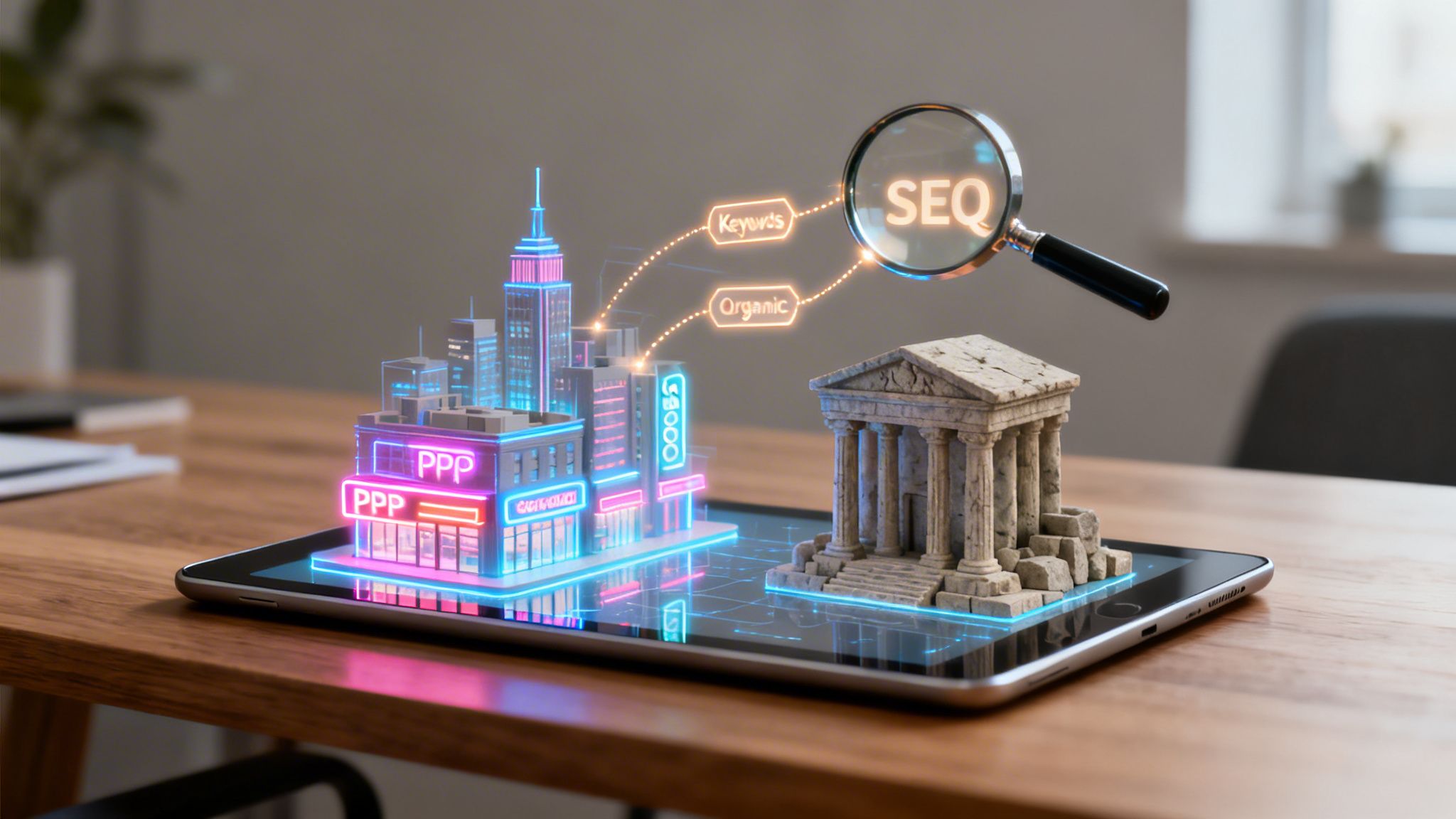
Search Engine Marketing, or SEM, is a digital marketing strategy that’s all about getting your website seen on search engine results pages (SERPs). It's a broad umbrella term that covers both your paid search advertising and your organic search engine optimisation (SEO). Think of it as the complete playbook for getting found on Google.
Demystifying Search Engine Marketing
Let’s cut through the jargon. What is SEM, really? Imagine search engines like Google are a massive, bustling digital city. Search Engine Marketing is simply your complete set of tools for making your business the most visible and accessible destination in that city.
It’s not just one tactic; it's a comprehensive strategy that pulls together two powerful, yet very different, approaches.
The Two Pillars of SEM
On one side, you have Paid Search, which you'll often hear called Pay-Per-Click (PPC). This is like paying for a prime, high-traffic storefront with flashy signs right on the main street. You pay to place your ads at the top of the search results, getting you immediate visibility for the exact keywords you’re targeting.
On the other side, you have Organic Search, better known as Search Engine Optimisation (SEO). This is more like building a trusted, landmark building that people naturally flock to because of its reputation, authority, and the value it provides. You earn your high ranking over time by creating excellent content and building a credible, authoritative online presence.
The core idea of SEM is to put your business directly in front of potential customers at the exact moment they're actively searching for the products or services you offer. It blends the speed of paid ads with the long-term trust of organic results.
This dual approach lets you capture attention from every angle. While PPC gives you quick wins and laser-focused targeting, SEO builds a sustainable foundation of traffic that doesn’t just vanish the moment you stop paying for ads.
In fact, many users have a strong preference for organic results. Research shows that SEO can be 5.66 times more effective than paid search, mainly because users place a higher degree of trust in non-ad listings.
This trust is driving some serious investment. Australian businesses poured a massive $1.5 billion into SEO services last year—a figure that jumped 12% from 2024. It’s a clear signal that even as ad costs rise, businesses are committed to earning that organic visibility. You can get a deeper look into Australia's search market share and user behaviour to understand these trends better.
Ultimately, a strong SEM strategy isn't about choosing between paid and organic. It’s about making them work together. By using both, you can dominate the search results page, using the valuable data from your PPC campaigns to inform your long-term SEO efforts. This creates a powerful, self-reinforcing cycle of growth.
SEM at a Glance: Paid vs Organic Search
To truly get a handle on SEM, it helps to see its two core components side-by-side. While both aim to drive traffic from search engines, they operate in fundamentally different ways. The table below breaks down the key distinctions between Paid Search (PPC) and Organic Search (SEO).
| Aspect | Paid Search (PPC) | Organic Search (SEO) |
|---|---|---|
| Cost | You pay for every click or impression (e.g., Google Ads). | The traffic is "free," but it requires investment in content, technical optimisation, and time. |
| Speed of Results | Almost immediate. You can see traffic as soon as your campaign is live. | Takes time. It can take months to see significant results from your efforts. |
| Position on SERP | At the very top or bottom of the page, marked with an "Ad" label. | Below the paid ads, in the main "organic" listings. |
| Traffic Longevity | Traffic stops as soon as you stop paying for your ads. | Creates a long-term, sustainable source of traffic that can last for years. |
| Targeting | Highly specific. You can target by keywords, demographics, location, and user behaviour. | Less direct. You optimise for keywords and topics to attract a relevant audience. |
| Measurement | Easy to track ROI. You can directly measure clicks, conversions, and cost-per-acquisition. | More complex to measure direct ROI, but you can track rankings, traffic, and leads over time. |
While paid search delivers speed and control, organic search builds long-term authority and trust. A winning SEM strategy doesn’t treat these as separate channels but as two sides of the same coin, working in concert to maximise your visibility.
The Core Components of a Winning SEM Strategy
To really get what SEM is, you need to lift the bonnet and look at the moving parts. A successful search marketing strategy isn’t just one thing; it’s a machine built from several essential components working together to grab your audience's attention at just the right moment. These are the tools and tactics an expert agency uses to build your digital presence and drive real results.
This diagram breaks down the two main arms of SEM—Paid Search and Organic Search—which form the foundation of any complete strategy.

As you can see, both paths lead to the same goal: greater visibility on search engines. But they get there in very different ways. One is a direct, paid shortcut, while the other is about earning authority over the long haul.
Keywords: The Language of Your Customer
At the absolute heart of any SEM effort, you'll find keywords. These are the words and phrases people type into Google when they’re looking for something—whether that's a product, an answer, or a service. Think of keywords as the bridge connecting your business to your customers' needs.
Picking the right ones is everything. You might target broad terms like "women's shoes" to cast a wide net, or you could go after more specific, long-tail keywords like "waterproof running shoes for wide feet" to capture someone much closer to making a purchase.
Solid keyword research is the critical first step in both SEO and PPC. Get this wrong, and everything that follows will be built on a shaky foundation.
Paid Search: The Auction and Ad Quality
On the paid side of SEM, having the biggest budget doesn't guarantee success. It all comes down to winning the Google Ads auction—a real-time contest that decides which ads get shown and where they rank.
Your position isn’t just based on how much you bid. It’s massively influenced by your Quality Score.
Quality Score is Google's rating of the quality and relevance of your keywords and PPC ads. A high Quality Score tells Google your ad is a great match for what the user is searching for, and you get rewarded with lower costs and better ad positions.
A higher score can actually help you outrank a competitor, even if they’re bidding more than you. This is exactly why a well-optimised campaign, focused on ad relevance and landing page experience, is so vital for getting the best possible return on your ad spend.
Organic Search: The Pillars of SEO
With organic search, visibility is earned, not bought. It’s a long-term game that rests on three core pillars:
-
On-Page SEO: This is all about optimising the content and structure of your website's individual pages. It involves using your target keywords naturally, writing compelling title tags and meta descriptions, and organising your content with clear, logical headings.
-
Technical SEO: This pillar ensures your website is technically sound, so search engines can crawl and index it without any roadblocks. Key elements here include site speed, mobile-friendliness, a clean site structure, and a secure (HTTPS) connection.
-
Off-Page SEO (Backlinks): This is about building your website’s authority across the web. The main way you do this is by earning backlinks—links from other reputable websites pointing to yours. Google sees these as votes of confidence, signalling that your content is trustworthy, valuable, and deserves to rank higher.
Understanding the Google Ads Auction

So, how does Google actually decide which ad gets the top spot? There's a common myth that it's a simple case of the highest bidder winning. The truth is much more nuanced and strategic, all boiling down to a rapid-fire process known as the Google Ads auction.
This isn't a slow, gavel-banging affair. The auction runs millions of times every single second—literally every time a person hits 'search'. It's a clever contest that weighs two critical things: how much you're willing to pay for a click (your bid) and the actual quality of your ad. This is Google's way of ensuring users see genuinely helpful ads, not just those from companies with the biggest wallets.
The winner of this split-second auction is decided by a metric called Ad Rank.
Decoding Ad Rank and Quality Score
Ad Rank is the formula Google uses to determine your ad's position on the results page. It's not just about your bid; the calculation is heavily influenced by your Quality Score. Think of Quality Score as Google's report card on the overall quality and relevance of your ad experience, from keyword right through to the landing page.
Google calculates your Quality Score by looking at a few key factors:
- Expected Click-Through Rate (CTR): Based on past performance, how likely is your ad to be clicked when shown for a particular keyword?
- Ad Relevance: Does your ad copy directly line up with what the user was searching for?
- Landing Page Experience: Is the page you send users to relevant, easy to use, and does it load quickly?
A high Quality Score is your signal to Google that you’re delivering a great, relevant experience for searchers. And Google rewards you for it, giving your Ad Rank a serious boost.
The most important takeaway here is this: a high Quality Score can earn you a better ad position for a lower cost. It's entirely possible for a business with an excellent Quality Score to pay less per click than a competitor sitting in a higher spot.
This is exactly why focusing on relevance is the cornerstone of any effective SEM strategy. We break down how to improve these elements in our guide on how to optimise Google Ads campaigns.
Ultimately, the auction is engineered to reward advertisers who create helpful, relevant, and user-friendly ad experiences. For any business owner or marketer, grasping this dynamic is the real key to making your ad budget work harder and achieving a solid return on your paid search efforts. It’s what turns SEM from a simple spending game into a game of strategy.
Choosing Between PPC and SEO
One of the most persistent questions in digital marketing is where to put your money: paid ads or organic SEO? It's often framed as a "PPC vs. SEO" showdown, but that’s a flawed way to look at it. The smartest marketers don't choose one over the other; they figure out how PPC and SEO can work together in a single, powerful SEM strategy.
Think of them as two distinct tools in your toolkit, each built for a different job. You wouldn't use a hammer to cut wood, and you wouldn't use a saw to drive in a nail. Both are critical, but they shine in different scenarios.
The Sprinter vs. The Marathon Runner
PPC is the sprinter of the marketing world. It’s all about speed and getting immediate results. The moment you launch a PPC campaign, your ads can show up at the very top of Google’s search results. It’s almost instant visibility.
This makes PPC the perfect choice for short-term goals:
- Launching a new product: You can generate instant buzz and drive those crucial first sales.
- Running a time-sensitive promo: Got a Black Friday sale or a limited-time offer? PPC gets the word out fast.
- Testing new markets: You can gather quick data on customer interest without having to wait months for your SEO to gain traction.
SEO, on the other hand, is the marathon runner. It doesn't deliver that instant hit of gratification, but it builds incredible long-term strength and endurance. Through consistent, dedicated effort—like creating genuinely valuable content, earning quality backlinks, and keeping your site’s technical health in check—you build a trusted presence online.
This work cultivates an authoritative reputation that drives sustainable, "free" traffic for years. It’s the difference between renting a billboard and becoming a trusted local landmark that people seek out because they know and trust your brand.
The core difference is simple: PPC buys you visibility, while SEO earns you credibility. One delivers immediate traffic, and the other builds a lasting asset.
PPC vs SEO: Which Strategy Fits Your Goal?
Deciding how to balance paid and organic search really comes down to your business goals, budget, and timeline. The best strategy isn't about picking one, but about creating an integrated plan where each channel strengthens the other.
For example, the data you get from your fast-moving PPC campaigns—like which keywords actually lead to conversions—is gold. You can feed those insights directly into your slower-paced, long-term SEO content strategy. This powerful combination ensures you're capturing attention both now and in the future, maximising your overall footprint on the search results page.
The table below breaks down the primary characteristics of each to help you find the right mix for your business.
| Characteristic | Paid Search (PPC) | Organic Search (SEO) |
|---|---|---|
| Speed | Near-instant results; visibility starts as soon as campaigns are live. | Slow and steady; can take months to see significant results. |
| Cost | You pay for every click or impression, requiring an ongoing budget. | "Free" traffic, but requires significant investment in time, content, and expertise. |
| Positioning | Ads appear at the top and bottom of the search results page, marked as "Sponsored". | Organic listings appear below the paid ads, based on relevance and authority. |
| Control | High level of control over ad copy, targeting, landing pages, and budget. | Less direct control; you influence rankings, but Google's algorithm has the final say. |
| Longevity | Traffic stops the moment you stop paying. | Builds long-term, sustainable traffic that can last for years. |
| Testing | Excellent for A/B testing ad copy, offers, and landing pages quickly. | Slower to test and measure; changes can take weeks or months to show an impact. |
| Best For | Short-term goals, promotions, product launches, testing keywords. | Building brand authority, long-term growth, and generating consistent inbound leads. |
Your First Steps in Search Engine Marketing

Jumping into search engine marketing can feel like a lot to take on. The good news? You can make it far more manageable by breaking it down into a few clear first steps. Before you even think about spending a dollar, you need to decide what success actually looks like for your business.
Are you trying to drive immediate online sales? Generate qualified leads for your service team? Or are you simply trying to get your brand name out there?
Your answer to that question is the foundation of your entire strategy. Once you have that clarity, you can pick the right platforms and tactics from the get-go, making sure your efforts are always tied to a real business outcome.
Tailoring Your Approach
How you get started with SEM depends entirely on your business model. The game plan for an e-commerce store is worlds apart from a B2B service provider, and your first campaigns need to reflect that.
For e-commerce businesses, a Google Shopping campaign is a fantastic place to start. These are the visually-driven ads that pop up with product images and prices right in the search results. You'll want to focus on high-intent product keywords like "women's black leather ankle boots" instead of broad terms like "shoes." This helps you attract shoppers who are already in buy-now mode.
If you’re a B2B service provider, your goal is lead generation. Your first search ads should target people actively looking for solutions, using search terms like "cloud security consulting services" or "CRM software for small business." The ad copy must speak directly to a business pain point and send users to a landing page with a valuable offer—like a whitepaper or a demo—in exchange for their details.
The single most critical step you can take from day one is implementing conversion tracking. Without it, you’re flying blind. Tracking ensures you know exactly which keywords and ads are driving actual sales or leads, allowing you to optimise your budget for what truly works.
Setting Your Budget and Tools
Okay, let's talk money. Deciding on a budget is another key first step, and there’s no magic number here. A realistic starting point depends on how competitive your industry is and what you're trying to achieve. The best advice is to start small, measure everything, and then scale up the campaigns that prove to be profitable.
The opportunity is massive. The Australian digital advertising market is projected to hit US$16.88 billion in 2026 and rocket to $25.38 billion by 2029.
As you get started, it's also worth exploring tools that can help with keyword research, competitor analysis, and campaign tracking. These platforms are crucial for making informed decisions, with some options covered in this in-depth SE Ranking review.
Measuring SEM Success with Metrics That Matter
So, you’re running campaigns and spending money. But how do you know if any of it is actually working? To figure that out, you need to look past the surface-level numbers and zero in on the key performance indicators (KPIs) that connect your marketing spend to real business outcomes.
Effective measurement is all about holding your campaigns—and your agency—accountable. It’s the only way to be sure every dollar is pulling its weight and contributing to your bottom line, allowing you to make smart, data-driven decisions that actually fuel growth.
When it comes to paid search, tracking the right numbers is everything. Vague metrics like “impressions” don’t tell you much. Instead, you need to obsess over the KPIs that directly measure profitability and efficiency.
Key Metrics for Paid Search Campaigns
Your success in paid search really boils down to a handful of core metrics. These are the numbers that reveal the true health and profitability of your advertising, and they’re the ones that matter most.
-
Return On Ad Spend (ROAS): This is the ultimate measure of profitability. It tells you exactly how much revenue you’re generating for every single dollar you spend on ads. A ROAS of 4:1, for instance, means you're making $4 for every $1 spent. Simple.
-
Cost Per Acquisition (CPA): This metric shows you, on average, how much it costs to get a new customer or generate a lead. Keeping a close eye on your CPA helps you understand the efficiency of your campaigns and ensures you're not paying more for a customer than they're worth.
-
Conversion Rate: This is the percentage of people who take the action you want them to (like making a purchase or filling out a form) after clicking your ad. A high conversion rate is a great sign that your ads and landing pages are hitting the mark. To really get this right, you can learn more about proper Google Ads conversion tracking.
To monitor these metrics properly, you need the right tools in your corner. Marketers are increasingly using advanced solutions, including AI search tracker tools, to get deeper insights into what’s really driving performance.
When it comes to knowing what SEM success looks like, it's not about driving clicks; it's about driving profitable outcomes. If a campaign isn't boosting your ROAS or is blowing out your target CPA, it’s time to pull it apart and figure out why.
Ultimately, tracking these KPIs is what empowers you to optimise your campaigns with precision. It’s how you turn raw data into measurable, tangible business growth.
Common SEM Questions Answered
When you're first diving into SEM, a few questions always seem to pop up. These are the practical, "rubber-meets-the-road" queries that every business owner asks. Getting straight answers is key to mapping out your strategy and knowing what to expect. Let's get them sorted.
How Much Should I Budget for SEM?
There’s no magic number here. Your budget really comes down to your industry, your goals, and just how crowded the field is for your target keywords.
For paid search (PPC), a small local business might dip its toes in the water with $500-$1,000 per month. On the other end of the spectrum, a national company in a cut-throat market could easily be looking at $10,000 or more just to compete effectively.
With SEO, the spend isn't on ads but on expertise and effort. Think of it as having a specialist on retainer. The monthly cost often lands in a similar ballpark to a modest PPC budget, but the payoff is measured over a much longer horizon.
Think of your initial budget as an investment in data, not immediate profit. Start with an amount you're comfortable using to learn what works—which keywords actually convert and what your real cost to acquire a customer is.
How Long Does It Take to See Results?
This is where the two sides of SEM couldn't be more different. The timelines are worlds apart, and it’s vital to have the right expectations for each.
-
PPC Results: Paid search is all about speed. You can get your ads showing at the top of Google and start pulling in clicks, traffic, and leads almost immediately. We’re talking hours, not weeks, from the moment you launch a campaign.
-
SEO Results: Organic search is the long game. Building the authority and trust needed to earn top rankings takes serious time and consistent effort. You'll typically start to see some noticeable movement in your traffic and rankings within 3 to 6 months, but the significant, lasting results often take 6 to 12 months or more to fully materialise.
Should I Do SEM Myself or Hire an Agency?
Deciding whether to go it alone or bring in the pros boils down to three resources: your time, your expertise, and your money.
A DIY approach can save you cash upfront and gives you total control. The trade-off? A very steep learning curve and a massive time commitment to run campaigns that actually get results. It's a full-time job in itself.
Hiring an agency, on the other hand, gives you instant access to a team of experts, sophisticated tools, and proven playbooks. While it requires a bigger budget, it often generates a far stronger return on investment and, crucially, frees you up to do what you do best: run your business.
Ready to let the experts handle your SEM and drive real results? Click Click Bang Bang specialises in precision-driven PPC and AI-first SEO campaigns that deliver measurable growth. Start with our risk-free trial and see the difference data-focused advertising can make. Learn more and get started at https://clickclickbangbang.com.au.
Read NeXt
Or Read Our Latest
- Manual vs Automated Bidding for PPC Success
- Conversion Tracking Setup: A Complete AU Guide
- Instagram Advertising Australia: Complete 2026 Guide
- Pay Per Click: A Beginner’s Guide for Australian Marketers
- Display Advertising on Google: The Complete Australian Guide
- Stakeholder Communication Plan How to Build One That Works
Click. CLick. Subscribe.
Get our best PPC insights, industry updates, and power moves delivered straight to your inbox. No fluff, just high-caliber strategies that actually work.
Don’t Leave Just Yet
Try Us For 30-Days,
Risk Free!!
We guarantee that you’ll love our work within the first 30 days, if not you’ll get your money back.
What have you got to lose?