

Local SEO Sydney: Your 2026 Guide to Dominating Local Search
Last Updated

Your business might be well known on one side of the suburb and almost invisible online two streets over.
That's the Sydney problem. A plumber in North Sydney isn't really competing with every plumber in Sydney. They're competing for searches coming from North Sydney, Neutral Bay, Kirribilli, Crows Nest, and the exact intent behind each query. A café in Newtown has a different search reality from a café in Double Bay, even if both sell great coffee and both have decent websites.
Most local campaigns fail because they target “Sydney” as if it's one market. It isn't. It's a stack of micro-markets, each with its own competitors, landmarks, search modifiers, review patterns, and customer expectations. If your local SEO strategy doesn't reflect that, Google has no reason to rank you above businesses that look more locally relevant.
Why Your Sydney Business is Invisible to Local Customers
A trades business in Inner West can dominate searches around Marrickville and still barely appear in Ashfield. A clinic doing steady work in Bondi Junction can disappear from local results a few suburbs away. That gap usually has nothing to do with service quality. It comes from weak suburb-level relevance.
Sydney rewards precision.
Many businesses have covered the basics. They have a website, a claimed Google Business Profile, and a few suburb names dropped into title tags. Then rankings stall because the local signals are too broad, too thin, or too inconsistent to compete in a specific Sydney pocket.
The primary challenge is how Google aligns intent by micro-market. A search for "electrician Newtown" is a different contest from "electrician Erskineville" or "electrician Alexandria", even if the suburbs sit close together. The businesses, review profiles, service cues, and on-page relevance can shift fast across those borders.
Sydney isn't one market
Ranking in Surry Hills does not mean you will rank in Parramatta. Strong visibility in Bondi does not carry into Randwick or Maroubra. Google weighs local relevance heavily, and Sydney gives it plenty of suburb signals to work with.
That changes how local seo sydney should be built.
- Service intent changes by suburb. CBD searchers often want speed, proximity, and immediate availability. In the Hills District, searchers often spend longer comparing reputation, service coverage, and trust signals.
- Competitor sets change block by block. The map pack for "dentist Chatswood" can look very different from the businesses showing for "dentist Lane Cove".
- Location language changes too. Some searchers use the suburb name. Others search "near me". Others add service qualifiers that imply location without stating it.
If your website and Google profile only talk about "Sydney", Google has to work out which local market you serve. That guess rarely goes in your favour.
Why generic local SEO underperforms
I see the same pattern across Sydney campaigns. Businesses target the whole metro area, then wonder why they are invisible in the suburbs that drive revenue.
| Common approach | Why it fails in Sydney |
|---|---|
| One “areas we service” page | It rarely carries enough detail to rank for suburb-specific searches |
| Reused copy across suburb pages | The pages look interchangeable, so local relevance stays weak |
| Inconsistent business details across listings | Trust drops and ranking signals lose clarity |
| Broad keywords only | You miss the searches that show clear suburb intent and stronger buying intent |
There is also a reputation problem. In tighter micro-markets such as Mosman, Coogee, Chatswood, or Balmain, review quality and review context often separate the businesses that show from the ones that do not. A business with generic reviews from all over Sydney can look less locally relevant than a competitor with fewer reviews that mention a suburb, service type, and real customer experience. That is why a structured Google review strategy for local businesses matters more than most owners expect.
The fix is straightforward, but it takes discipline. Clean business data. Clear suburb targeting. Pages built around real service areas. Local authority signals that match the part of Sydney you want to win.
Sydney businesses go invisible when they market to the city as a whole. The ones that gain visibility commit to the suburb, the neighbouring suburbs, and the intent behind each search.
Mastering Your Digital Shopfront on Google
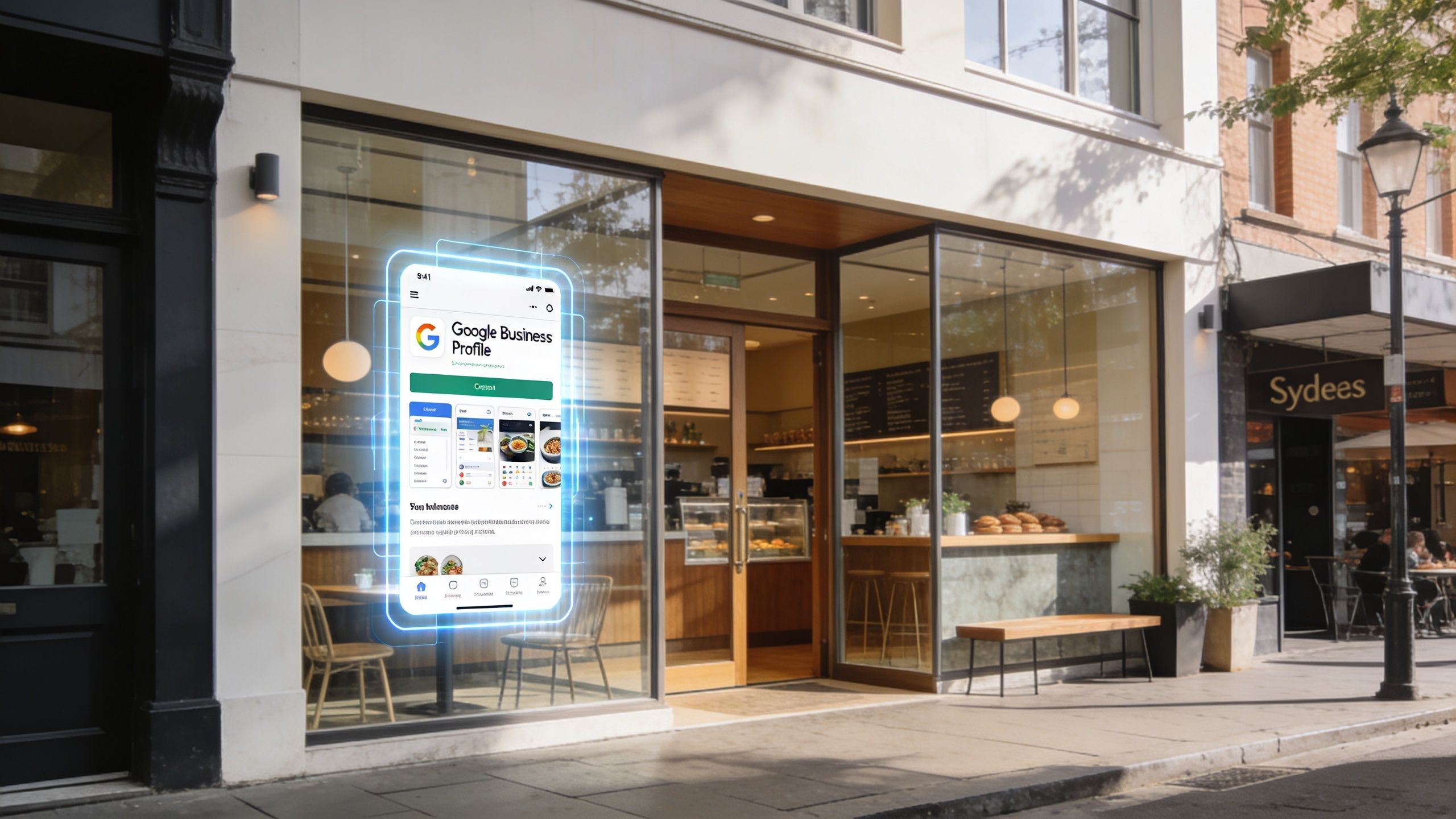
Your Google Business Profile is the first asset I'd fix in almost every local seo sydney campaign. Not because it's the only thing that matters, but because weak profiles waste demand you're already close to winning.
Treat it like a digital shopfront, not a directory listing.
Choose categories with discipline
Your primary category does heavy lifting. Don't get clever with it. Pick the category that matches the core service customers search for most often. Then use secondary categories to capture adjacent services without muddying the profile.
A common mistake in Sydney is category inflation. Businesses add everything remotely related to what they do. That usually weakens relevance rather than expanding it.
For a service business operating across multiple suburbs, category choices should line up with your highest-converting service lines and your strongest suburb pages. If your site is built around emergency plumbing, blocked drains, and hot water repairs, your profile should reinforce that reality.
Set service areas like an operator, not a dreamer
Businesses lose focus when they claim every suburb from Palm Beach to Campbelltown. That doesn't make you look bigger. It makes your local footprint look vague.
Use service areas that reflect where your team works, where travel times are reasonable, and where you can support the profile with landing pages, reviews, and local references. Micro-market logic matters here. A business based in Alexandria might actively target Zetland, Waterloo, Rosebery, and Redfern before trying to stretch into the North Shore.
The strongest profiles don't try to own all of Sydney. They build relevance around the cluster of suburbs they can actually serve well.
Fill the fields most businesses ignore
A half-complete profile can still appear. It won't compete well.
Focus on the details customers use when they're close to choosing:
- Business description. Write it for real searches and real buyers, not for branding fluff.
- Attributes. If accessibility, payment options, outdoor seating, pickup, or service-area delivery matter, add them.
- Opening hours. Keep them current, especially around public holidays.
- Products and services. Break these out properly instead of lumping everything into one generic summary.
The Q&A section is underused. Add common pre-sale questions yourself and answer them clearly. That helps both conversions and relevance. Think suburb-specific concerns too, such as parking, same-day availability, apartment access, or service coverage.
Use posts and photos to prove local relevance
Google posts won't save a weak campaign on their own, but they can strengthen freshness and improve the quality of your profile. Use them to highlight service updates, seasonal offers, local work, or suburb-specific announcements.
Photos matter more than most businesses realise. Don't upload random stock-style images. Add real photos of the shopfront, team, vans, fit-outs, completed jobs, menu items, or treatment rooms. Sydney users often compare listings fast on mobile. Real images help them decide you're legitimate.
Reviews sit inside this system too. A steady stream of genuine feedback makes the profile more persuasive. If you need a cleaner process for asking customers, this guide to earning a 5-star Google review is a practical starting point.
A strong profile does three jobs
It should do all of this at once:
- Match the search intent with accurate categories and services.
- Show geographic fit through service areas, photos, and local cues.
- Convert the click with trust signals, complete information, and strong review coverage.
If your Google profile is vague, your suburb strategy will always struggle. If it's sharp, everything else you do has a much better chance of sticking.
Optimising Your Website for Sydney Suburbs
Most businesses don't need more pages. They need better local pages.
If you want local seo sydney to work across micro-markets, your website has to show Google exactly which suburb-service combinations matter. That means building pages around real demand and real service coverage, not cloning one template across half the city.
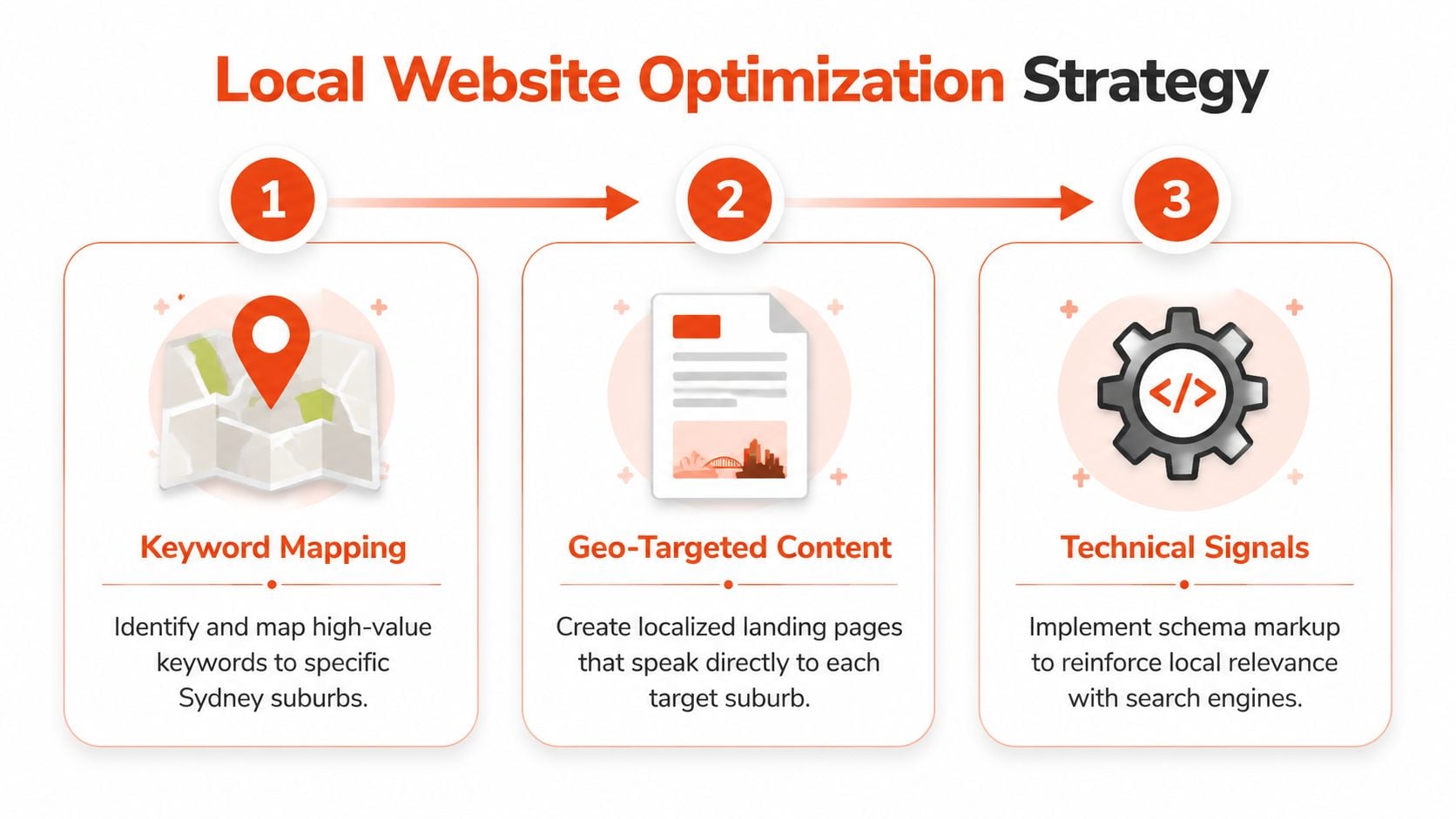
Sydney-focused guidance recommends this technical sequence: clean up NAP consistency across Google Business Profile, website, and major directories; implement suburb or service-area landing pages; add local schema; and build local authority signals through citations and location-relevant content. The same guidance also stresses that NAP inconsistencies damage rankings, mobile optimisation matters, neighbourhood-specific long-tail keywords tend to convert better, and quality local backlinks from Sydney organisations improve domain authority. That sequence is outlined in Sydney SEO's local SEO guidance.
Build suburb pages that deserve to rank
A page for “electrician Parramatta” should not be a copy of “electrician Bondi” with the suburb name swapped out. Google has seen that trick for years. More to the point, users can tell.
Each suburb page should include a different mix of:
- Local service context such as common property types, access issues, or service demand in that area
- Specific service coverage so the page matches what your team delivers there
- Relevant landmarks or nearby areas where that helps orientation naturally
- Unique proof points like reviews, project references, FAQs, or examples tied to the area
Good suburb pages feel like local landing pages. Bad ones feel mass-produced.
A North Shore plumbing page, for example, might mention apartment access, strata coordination, and tight parking. If you want a reference point for how a trade business frames a tightly targeted suburb service, look at this example of reliable local North Sydney plumbers. The value isn't the design. It's the geographic specificity.
Map keywords by suburb cluster
Don't start by writing pages. Start by grouping intent.
A simple structure looks like this:
| Suburb cluster | Likely page focus |
|---|---|
| Inner West | Emergency, same-day, terrace homes, apartment access |
| Eastern Suburbs | Premium service, parking constraints, fast response |
| North Shore | Strata, family homes, ongoing maintenance |
| Western Sydney | Larger service areas, practical pricing cues, broader coverage |
This stops you from building pages in a vacuum. It also helps you prioritise the suburbs where your offer, operations, and demand line up best.
Local schema and internal linking
Schema doesn't replace strong content, but it helps search engines parse who you are, where you are, and what you offer. At minimum, your local business details should be consistent and clearly marked up, including business name, address or service area logic, phone number, and opening details where relevant.
Then connect the dots internally. Your service pages should link to your suburb pages. Your suburb pages should link back to core services. If you publish local guides or FAQs, they should support the pages that drive enquiries.
Operator note: Internal links are where a lot of local campaigns leak authority. Businesses publish suburb pages and then bury them in the footer.
Mobile UX is part of local SEO
A large share of local search happens on phones, usually when someone wants a quick answer, a call button, directions, or immediate reassurance. If your mobile site is slow, cluttered, or hard to use, rankings aren't your only problem. Conversion rate drops too.
Check these basics:
- Tap targets should be easy to use on smaller screens
- Call buttons should appear early on key local landing pages
- Forms should be short enough to finish on mobile
- Page speed should support quick loading across variable mobile connections
If you're cleaning up local pages and technical issues together, a structured review helps. A proper website audit can surface the hidden blockers, especially around page duplication, internal linking, mobile UX, and weak location signals.
Building Authority with Local Citations and Reviews
Google trusts businesses that other sources can consistently verify. In local SEO, that trust usually shows up through citations and reviews.
That sounds basic. In practice, it's where a lot of Sydney campaigns break down.
Citation accuracy is a trust signal
Your business name, address, and phone number need to match across your website, Google Business Profile, and the main directories where your business appears. Even small inconsistencies create friction.
Businesses often get sloppy here. One listing has “Suite 2”. Another has “Ste 2”. One uses an old tracking number. Another has an outdated trading name from a rebrand two years ago. Humans might understand it's the same business. Search engines aren't always that forgiving.
Start with an audit of every place your business appears. Then fix the highest-value listings first.
A practical list often includes:
- Google Business Profile as the central reference point
- Your website contact page and footer details
- Yellow Pages and TrueLocal
- Industry directories relevant to your trade or profession
- Local association listings where applicable
Reviews influence rankings and conversions
Reviews aren't just reputation assets. They also shape how likely someone is to click, call, or trust your listing when comparing options in the same suburb.
The wrong way to handle reviews is to ask nobody, then panic when a bad review lands.
The right way is to build a repeatable request process into operations. Ask after a successful job, a completed booking, or a resolved support interaction. Keep the request short. Make it easy. Don't script fake enthusiasm.
Here's the pattern that works well:
- Send the request while the experience is fresh
- Use the same staff checkpoint every time, such as invoice completion or job closeout
- Direct customers to one primary review platform first
- Respond to every review, including the awkward ones
A business with uneven reviews and thoughtful replies often looks more credible than a business with silence or obvious review gating.
What to say in review responses
You don't need polished PR language. You need calm, clear communication.
For positive reviews:
- Thank the customer.
- Reference the service they used.
- Reinforce something local if relevant, such as turnaround or suburb coverage.
For negative reviews:
- Acknowledge the issue without arguing in public.
- Offer an offline path to resolve it.
- Keep the tone professional, even if the review is unfair.
A response like “Please contact us so we can make this right” is fine. A response that blames the customer, debates details, or sounds defensive can do more damage than the original review.
Here's a useful explainer before you tighten your review workflow:
Citations and reviews work together
A clean citation profile tells Google your business details are reliable. Reviews tell both Google and customers that people use and trust the business.
Those signals are especially important in Sydney micro-markets, where buyers often compare several similar providers in a tight geographic area. If your details are inconsistent and your review profile looks neglected, a competitor with a cleaner local footprint usually wins the click.
Creating Content and Links That Resonate Locally
Most local content fails because it's written for keywords, not for neighbours.
The easiest way to stand out in local seo sydney is to publish material that makes sense for a specific suburb, not just for a search engine. That means content with local texture, local vocabulary, and local usefulness.

Content that actually fits a micro-market
A Newtown café doesn't need a generic blog on “best coffee beans”. A much stronger asset is a local guide, a neighbourhood event post, or a piece of content tied to the area people already associate with the business.
Examples that work:
- A physio in Bondi publishing recovery tips for runners using local coastal routes
- A real estate agency in Marrickville creating a suburb guide for buyers with pets, families, or commuters
- A trade business in the Hills District explaining common home maintenance issues seen in local housing stock
- A restaurant in Surry Hills posting pre-theatre dining advice or event-night booking tips
These pieces do two jobs. They rank for long-tail local intent, and they give other local sites a reason to link to you.
Local links aren't built like national links
For local campaigns, relevance usually beats scale.
You don't need abstract “authority” from random websites. You need links that make geographic sense. That can come from local sponsorships, supplier relationships, business associations, neighbourhood publications, community pages, or collaborations with complementary businesses.
A few examples:
| Link opportunity | Why it matters |
|---|---|
| Local sports club sponsorship page | Geographic relevance and real community signal |
| Chamber or business association profile | Trust and local legitimacy |
| Neighbourhood blog feature | Contextual local audience |
| Partner business referral page | Service relevance and conversion value |
Local link rule: If the link would still be worth having without SEO, it's usually the right kind of local link.
A Sydney example of what hyper-local execution can do
Click Click Media's local SEO case study for Aussie Home Services, a Sydney-based plumbing and electrical provider, reports that keyword visibility grew from 216 to 860+ in one month, while organic traffic increased by 81%. The strategy included suburb-level landing pages and authority building, which is exactly the kind of micro-market work that tends to move the needle in Sydney's competitive service sectors. You can review that case in Click Click Media's page on local SEO campaign results.
That case matters because it reflects how local growth often happens in practice. Not through one giant homepage. Through many smaller signals working together across suburb targeting, page structure, and authority.
Turn content into an asset, not a publishing chore
If you want local content to support rankings, links, and leads, build it around what customers already ask.
Use your sales calls, front-desk questions, job notes, and quote requests as prompts. Then package those answers in suburb-aware formats:
- Service FAQs customized for local conditions
- Area guides tied to the customers you want most
- Comparison pages for service options in different parts of Sydney
- Project write-ups showing work completed in actual service areas
If you need help turning those ideas into a consistent outreach and acquisition process, local link building services are one option for structuring the work around relevant placements rather than chasing generic backlinks.
Measuring Success and Amplifying with Local PPC
A Sydney business can rank well across the city and still miss revenue in the suburbs that matter. A locksmith may get traffic from all over Sydney, but the jobs that close fastest might come from Surry Hills, Newtown, and Marrickville. A cosmetic clinic might see the opposite, with stronger lead quality from the Eastern Suburbs than the Inner West. That is why reporting has to move below city level.
For local seo sydney, success should be measured by suburb, service, and action. Rankings still matter, but they are an early signal. The definitive scorecard is which micro-markets generate calls, quote requests, booked jobs, and repeatable customer value.
What to track
A practical reporting setup should show where momentum is building and where budget is being wasted. Focus on metrics that map back to Sydney suburb intent:
- Google Business Profile actions such as calls, direction requests, and website clicks
- Landing page performance for suburb and service-area pages
- Search visibility by location modifier so you can see which suburb terms are gaining ground
- Lead quality by suburb because a lead from Bondi may be worth far more than a lead from a fringe area outside your service sweet spot
As noted earlier, local SEO usually takes time to pay back. In Sydney, that timeline often stretches further in dense categories like legal, dental, and trades because each suburb behaves like its own auction and ranking environment.
The useful question is not "Are we getting more traffic?" It is "Which suburb-service combinations are producing profitable work, and which ones only look good in a report?"
Where PPC fits
Local PPC works best after SEO has identified the suburbs, services, and search terms that convert. That changes how campaigns are structured.
Instead of running one generic Sydney campaign, split paid search around proven micro-markets. Bid harder in suburbs where close rates are strong. Pull back in areas that generate research traffic but weak enquiries. Use tighter ad copy for local intent, especially where people are choosing between nearby providers on speed, trust, and convenience.
A smart SEO and PPC setup usually shares intelligence like this:
| SEO insight | PPC advantage |
|---|---|
| High-converting suburb pages | Better ad group targeting |
| Strong review themes | Better ad messaging |
| Local search terms from real enquiries | Better keyword selection |
| Weak organic coverage in key suburbs | Clear paid expansion opportunities |
This matters in Sydney because suburb economics are uneven. A plumber in the Hills District may need aggressive paid coverage after hours. A family lawyer in the CBD may use PPC to defend branded searches against directory sites and competitors. A clinic in Parramatta may find that map visibility and call-focused ads outperform traffic campaigns.
Owning both organic and paid visibility in the right suburbs creates a stronger local footprint. SEO builds durable demand capture. PPC gives you speed, testing, and coverage where organic visibility is still catching up.
If you want a practical plan for winning Sydney micro-markets, Click Click Bang Bang can help map the right suburb targets, tighten your Google Business Profile, clean up local signals, and pair SEO with PPC where paid search can accelerate results.
Read NeXt
Or Read Our Latest
- Manual vs Automated Bidding for PPC Success
- Conversion Tracking Setup: A Complete AU Guide
- Instagram Advertising Australia: Complete 2026 Guide
- Pay Per Click: A Beginner’s Guide for Australian Marketers
- Display Advertising on Google: The Complete Australian Guide
- Stakeholder Communication Plan How to Build One That Works
Click. CLick. Subscribe.
Get our best PPC insights, industry updates, and power moves delivered straight to your inbox. No fluff, just high-caliber strategies that actually work.
Don’t Leave Just Yet
Try Us For 30-Days,
Risk Free!!
We guarantee that you’ll love our work within the first 30 days, if not you’ll get your money back.
What have you got to lose?