

Ad Relevance Score Explained: How It Impacts PPC Performance
Last Updated

You're staring at a campaign that used to behave. CPCs have crept up, impression share has thinned out, and the dashboard says nothing obvious changed. Budget's fine, bids are fine, but delivery is slower than it should be, and the uncomfortable answer is often sitting in the relevance diagnostics people only half-read.
That's where the ad relevance score stops being a niche metric and starts acting like a practical signal. On Google, it tells you how closely your ad matches the intent behind a search. On Meta, the old single score is gone, but the same logic still shows up through ranking diagnostics that influence delivery and cost. For Australian advertisers, that matters even more now, because AI bidding, smaller audience pools in some markets, and noisier first-party data can make a weak relevance signal look like a bidding problem when it isn't.
Why Your Ads Cost More Than They Should
A marketing manager usually spots the problem before anyone else does. The account still spends, but clicks cost more, delivery feels slower, and the team starts arguing about whether competition has sharpened or the season has changed. Sometimes that explanation is right. More often, the platform has decided your ads are less relevant than they should be.
Google is explicit about this in its Quality Score help. Ad Relevance is one of the three core components of Quality Score, alongside Expected CTR and Landing Page Experience, and Google defines it as how closely your ad matches the intent behind a user's search. In the keyword reporting workflow, Google lets advertisers inspect both historical and current components, including Ad Relevance, inside reporting columns rather than treating it like a separate mystery signal. That makes it a diagnostic you can work with, not just a score to admire or blame. See Google's guidance on Quality Score components and reporting columns.
What the score is really telling you
A low relevance reading rarely means the ad is “bad.” It usually points to a practical mismatch. The copy is too broad for the query, the ad group is trying to cover too many intents, or the landing page does not support the promise quickly enough.
Practical rule: if relevance falls while spend keeps climbing, don't start by changing the bid strategy. Start by asking whether the platform thinks the query, the ad, and the page belong together.
That matters more in AI-bidding setups than many teams expect. Smart bidding can correct for some inefficiency, but it cannot turn weak intent alignment into strong intent alignment, especially in Australia where smaller addressable audiences, privacy constraints, and uneven first-party data quality can distort what the platform learns. If your audience signals are thin, the system leans harder on the creative and the destination, so the quality of that input matters more than a lot of teams assume.
The practical link between relevance and auction performance is explained in Google Ads ad rank formula documentation. When the platform sees a weak match, you pay for it in delivery and cost. When the match is clear, the auction has less reason to discount you. That is why relevance deserves attention as an operating signal, not a vanity metric. It shows how what your team meant to say lines up with what the auction system thinks your ad says, and that gap is often where wasted spend starts.
The Evolution of Ad Relevance Metrics
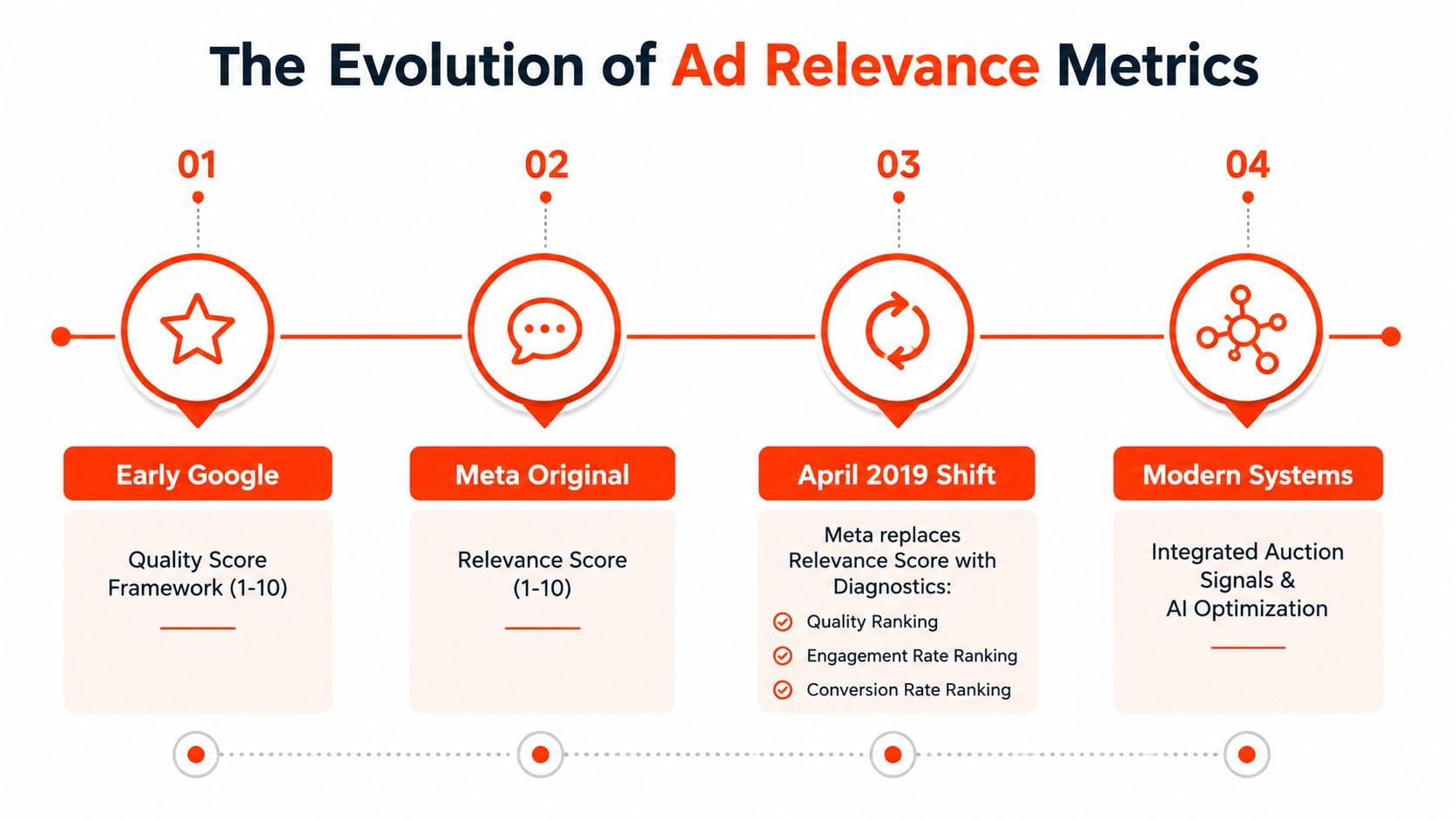
A campaign can look healthy on the surface and still be fighting the platform's own reading of relevance. That is why the metric changed. As ad delivery became more automated, the old habit of treating relevance as a single score stopped being useful for day-to-day optimisation, especially for Australian advertisers working with smaller audiences, tighter privacy constraints, and uneven first-party data quality.
From broad score to diagnostic system
Google's Quality Score used to feel like a single verdict on the account. The current setup is more practical. Google split it into component signals, so advertisers can see whether the issue is weak copy, poor query matching, or a landing page that does not support the ad promise fast enough. That change turned Ad Relevance into something teams can diagnose and act on, instead of a loose best-practice label. For Australian advertisers, that matters because performance often has to be read against account noise, audience size limits, and the quality of the data going into bidding systems. Google documents the framework in Quality Score help for Australian advertisers.
Meta's path was different, but the same logic applies. Its original Facebook Relevance Score was a 1-to-10 score, with 10 as the highest, based on the positive and negative feedback an ad was expected to receive. Meta said the score updated as people interacted with the ad, and it appeared across reporting tools and the ads API. In practice, advertisers only saw it after an ad reached 500 impressions, which mattered because too many teams reacted before there was enough signal to trust the reading. Meta's own announcement remains the clearest reference for the shift away from one blended score and toward quality ranking, engagement rate ranking, and conversion rate ranking in Meta's relevance score update announcement.
Why old playbooks stopped working
The older single-score approach bundled too much together. The newer diagnostics split creative quality, expected engagement, and expected conversion performance into separate signals, which makes optimisation more precise and also less forgiving. A post from 2018 that still tells you to “raise your relevance score” on Meta is using outdated logic.
Google followed the same direction. Relevance is easier to inspect now, but also easier to misread if you only look at the top-line number. Meta's current system adds another layer of complexity because the platform evaluates your ad against competing ads for the same audience, not against a fixed universal standard. That is why modern optimisation starts with the diagnostic readout, then moves into the actual cause.
CTR is one of the clearest examples of how platform prediction and marketer assumption can diverge, which is why click through rate calculation examples is a useful companion reference here. If the audience, the message, and the destination do not line up, the platform will usually surface that mismatch before a human team does.
How Relevance Signals Shape Auction Outcomes
Think of the auction like a job interview. Your ad copy is the résumé, your landing page is the reference check, and the platform's expectation of engagement is the handshake. If all three line up, the system is more willing to hand you the impression. If they don't, you can still bid, but you're starting from a weaker position.
Google uses diagnostics, not a simple score at auction
Google's help documentation makes an important distinction. Quality Score is a diagnostic, not the live auction input itself. That means improving Ad Relevance helps because it shows better alignment between query intent and ad message, but the auction is still weighing a live estimate of quality at the moment the search happens. This is why a Below average rating should be treated as a warning, not a sentence. It tells you the platform sees misalignment, and that misalignment can reduce delivery or make the auction less efficient even when your bid is competitive. For a deeper breakdown of position mechanics, the internal reference on how Ad Rank works is worth reading.
Meta compares you against competing ads
Meta works differently. The newer diagnostics compare your ad against other ads competing for the same audience. That means your result isn't judged against a fixed universal scale in the same way a Google keyword score is. Instead, the platform asks whether your ad is more likely to earn quality interactions, engagement, and conversions than the alternatives.
A good relevance signal doesn't guarantee cheap traffic. It gives the system less reason to penalise you when it's deciding which ad to show.
That distinction matters in practice. A Google Below average Ad Relevance result usually points to a keyword-to-copy problem, while Meta's ranking categories point more toward how your creative performs relative to what else is in market for the same people. One is keyword-centric, the other is audience-centric. Both affect cost and delivery, but they do it through different mechanisms.
The other reason to care is that automation hasn't removed relevance. It's changed where relevance lives. AI bidding systems still rely on signals that look a lot like relevance, only now they're assembled across more data points, more placements, and more context than a human can manage manually. If the underlying signal is weak, the machine just gets confident faster about the wrong thing.
Google Quality Score Versus Meta Diagnostic Rankings
Google and Meta both talk about relevance, but they don't measure it the same way, and that difference shapes the optimisation work you should prioritise. Google's system is built around the keyword. Meta's is built around the audience and the competing ad set. If you manage both platforms with the same playbook, you'll miss half the problem.
A useful overview of Google's framework is the explanation of Quality Score, especially if you want a plain-English reminder that the score is a diagnostic, not a mystical badge.
Platform Relevance Diagnostics Comparison
| Dimension | Google Ads | Meta Ads |
|---|---|---|
| Core construct | Quality Score with Ad Relevance, Expected CTR, and Landing Page Experience | Former Relevance Score, now quality ranking, engagement rate ranking, and conversion rate ranking |
| Unit of analysis | Keyword level | Ad versus competing ads for the same audience |
| What the signal means | How closely the ad matches the intent behind a search | How the ad compares on quality, engagement, and conversion likelihood |
| Visibility | Inspectable in reporting columns for historical and current components | Old score shown after 500 impressions, now replaced by ranking diagnostics |
| Optimisation focus | Tighten query, ad, and page alignment | Improve creative quality, expected engagement, and conversion performance |
| Practical read of a weak result | Usually a message-match, structure, or landing page problem | Usually a creative or audience-performance problem relative to competing ads |
Why the difference matters in your account
Google is still more keyword-centric, even in a world of broad match and automated bidding. That means ad group structure, headline specificity, and landing page alignment still matter. Meta is more audience-centric, which makes signal quality, creative testing, and event quality more important than obsessing over a single blended number that no longer exists.
The biggest mistake I see is treating the two platforms as if they're just different interfaces for the same game. They're not. On Google, poor Ad Relevance often means your message doesn't map cleanly to the query. On Meta, poor diagnostics often mean the creative isn't stacking up well enough against the other ads trying to reach the same person. That's a different problem, and it needs a different fix.
A Diagnostic Workflow for Identifying Relevance Issues
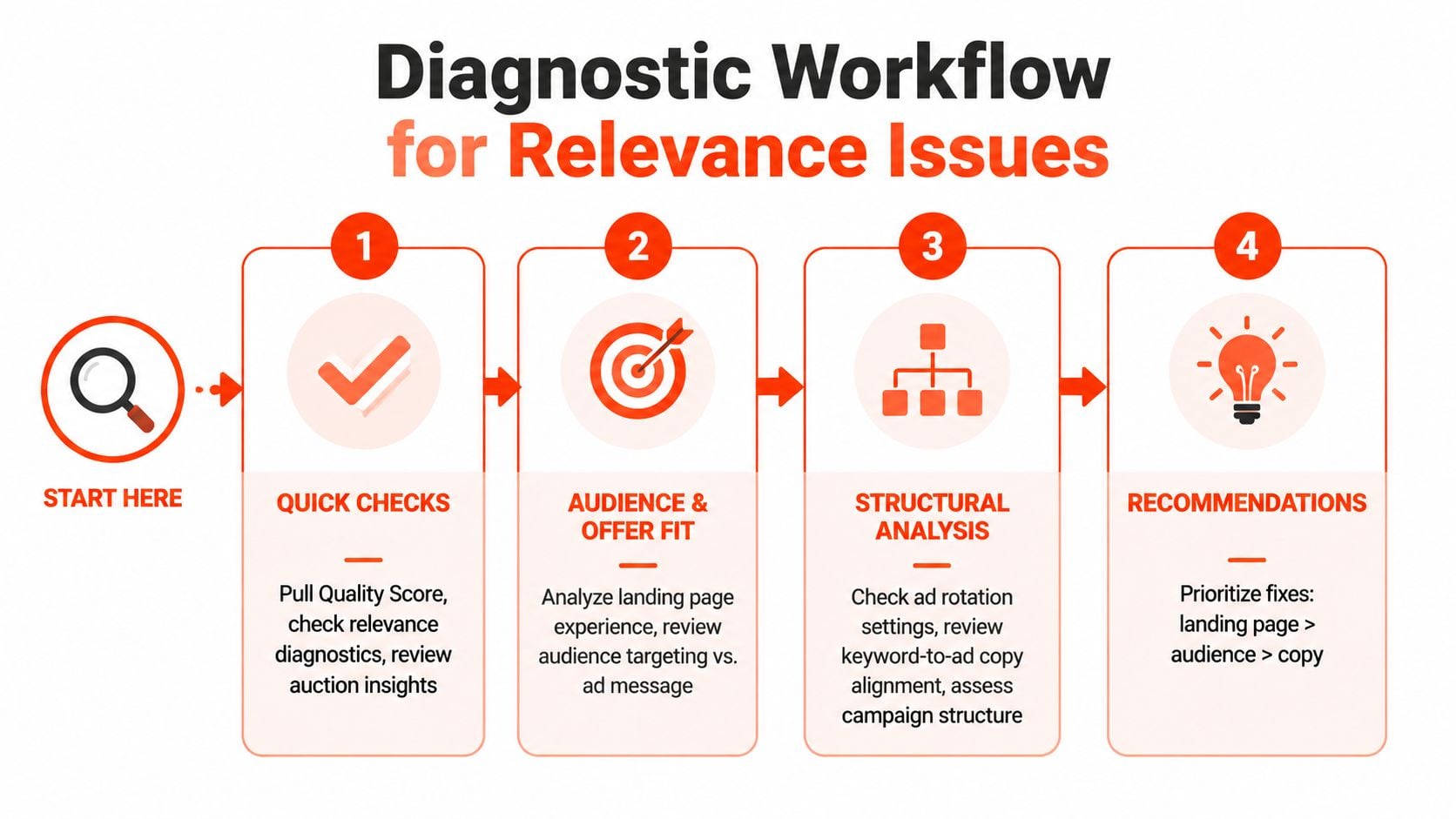
When performance slides, teams jump straight to creative rewrites. That's too narrow. A better audit starts with the platform diagnostics, then checks whether the problem sits in the copy, the audience, the landing page, or the tracking system feeding the algorithm.
For teams that like a broader measurement lens, the ad performance metrics framework is a useful companion, because relevance is only one part of the performance picture and it needs to be interpreted alongside conversion quality and efficiency.
Start with the visible diagnostics
Pull the Quality Score columns in Google Ads and check the three component ratings. In Meta Ads Manager, review the quality, engagement rate, and conversion rate rankings. Don't look only at averages, look for patterns by campaign, ad group, audience, and landing page.
Then ask one blunt question. Is the platform complaining about the message, the audience, or the outcome? If you can't answer that quickly, the account is too noisy to optimise well.
Separate the real cause from the symptom
- Ad copy problem: the headline and description don't line up with the search intent or offer.
- Audience problem: the right ad is showing to the wrong people, or the audience is too broad to sustain strong delivery.
- Landing page problem: the page answers the query too vaguely, too slowly, or with the wrong promise.
- Tracking problem: the system is learning from weak conversion events, stale customer lists, or incomplete first-party data.
Useful habit: if the page and the ad are aligned but performance still falls apart, inspect conversion tracking before you rewrite the creative again.
Make the audit monthly, not reactive
A monthly review catches relevance drift before it becomes expensive. That matters more in Australia than many teams realise, because fragmented privacy conditions and smaller addressable audiences in some markets make weak signals harder to recover from. If your conversion events are noisy, your audience lists are stale, or your first-party data is thin, the algorithm can only optimise what you feed it.
Use the internal Google Ads optimisation checklist to structure the audit, then decide whether the fastest fix is copy, page, or signal quality. That order matters. In many accounts, the page or the data feed is the bottleneck, not the ad headline.
Relevance Tactics by Business Type and Campaign Goal
The right relevance fix depends on what you're selling and how long it takes to convert. An e-commerce retailer, a B2B lead gen team, and an SMB with a tight budget are not fighting the same battle, even if they're all looking at similar diagnostics. The metric is shared, the response isn't.
E-commerce needs feed and page consistency
For e-commerce, relevance usually starts upstream in the product feed. If the product title, variant, price, and landing page don't line up, the ad has to do too much repair work after the click. Google Shopping and Meta catalogue campaigns both benefit from tighter product data, because the platforms can only match users to products as accurately as the data allows.
Dynamic ad customisation helps, but only if the destination mirrors the offer. A user clicking on a specific product variant shouldn't land on a generic category page that forces them to re-locate the product. That's not just a UX issue, it weakens the relevance signal that drives delivery.
B2B needs downstream signal quality
B2B teams need to think beyond form fills. A lead form is only useful if the conversion tracking reflects real pipeline quality, not just early-stage clicks. If your system optimises toward the easiest conversion event, it will happily fill the CRM with names that never progress.
For long sales cycles, ad relevance is partly a messaging issue and partly a measurement issue. The copy has to match the stage of the buyer, but the platform also needs cleaner downstream events so it learns which leads are worth finding again. That's where lead form extensions, CRM integration, and offline conversion imports become more important than yet another headline variant.
SMBs should prioritise the highest-leverage fixes
SMBs rarely have the luxury of chasing every signal at once. Tight keyword-to-ad grouping still matters on Google Search, because broad ad groups dilute the message and make relevance harder to maintain. Responsive Search Ad asset diversity matters too, but only when the asset set is distinct enough to test.
A small budget also demands discipline around audience exclusions. Wasting spend on the wrong people hurts faster when the account has less room to learn. I'd rather see a modest SMB fix the structure, the exclusions, and the conversion signal quality than spend weeks polishing copy that the algorithm barely trusts.
Practical rule: the smaller the account, the more expensive irrelevant learning becomes.
When Ad Copy Is Not the Real Problem
A lot of advertisers still assume the main relevance lever is the headline. That used to be a sensible starting point. It isn't always the highest-impact one now.

Signal quality often matters more than more copy
In Google's AI-bidding environment, and in Meta's dynamically assembled delivery system, the platform's learning improves or degrades based on the inputs it receives. That means conversion tracking quality and audience signal integrity can matter more than another round of headline rewriting. If your conversion event is firing on a low-value action, the system will optimise toward the wrong outcome with confidence.
This is especially true for Australian advertisers dealing with smaller addressable audiences in some states and greater dependence on first-party data after privacy changes. A stale customer list, an overbroad event definition, or a broken offline import can distort the model far more than a slightly weaker ad line ever will. In those cases, the right move is to review server-side tracking, audience list hygiene, and incrementality testing before you touch the ad copy again.
Use copy where it still earns its keep
That doesn't mean creative no longer matters. It still matters when the ad and the query are close, when the audience is broad but well-formed, or when you're testing a new offer and need a clean message. It just shouldn't be treated as the only relevance lever in the room.
For teams managing Google Search, the negative keyword process is still one of the cleanest ways to protect relevance. The guide on using negative keywords in Google Ads is relevant here because it prevents the account from paying for traffic that would damage the diagnostic signals in the first place. When the wrong terms keep entering the auction, the platform gets a noisy picture of what your ad is meant to do.
If you're deciding where to spend effort next, use this sequence. Fix tracking first if the conversion signal is weak. Fix audience quality second if the system is learning from the wrong people. Fix ad copy third if the message still isn't matching intent after the data and targeting are clean. Click Click Bang Bang also provides PPC management and optimisation services that include relevance and performance signal work, which makes sense if you want an external team to audit the full stack rather than just the creative.
If your campaigns need a proper relevance audit, Click Click Bang Bang can help you map the weak point instead of guessing at it. Their PPC and AI-first SEO work is built around campaign structure, conversion tracking, and ongoing optimisation, which is exactly what matters when the ad relevance score is drifting and the platform is learning from noisy signals. Visit Click Click Bang Bang to get a practical review of where your Google Ads or Meta account is leaking efficiency.
Read NeXt
Or Read Our Latest
- Push vs Pull Marketing: A 2026 Decision Guide
- Ad Relevance Score Explained: How It Impacts PPC Performance
- Best ROI Digital Marketing: 10 Channels Ranked for 2026
- Localization Strategy: How to Win in Any Market
- Phone Call Tracking: Methods, Metrics, and Best Practices
- Supplier Relationship Management: Strategic Guide 2026
Click. CLick. Subscribe.
Get our best PPC insights, industry updates, and power moves delivered straight to your inbox. No fluff, just high-caliber strategies that actually work.
Don’t Leave Just Yet
Try Us For 30-Days,
Risk Free!!
We guarantee that you’ll love our work within the first 30 days, if not you’ll get your money back.
What have you got to lose?