

Push vs Pull Marketing: A 2026 Decision Guide
Last Updated
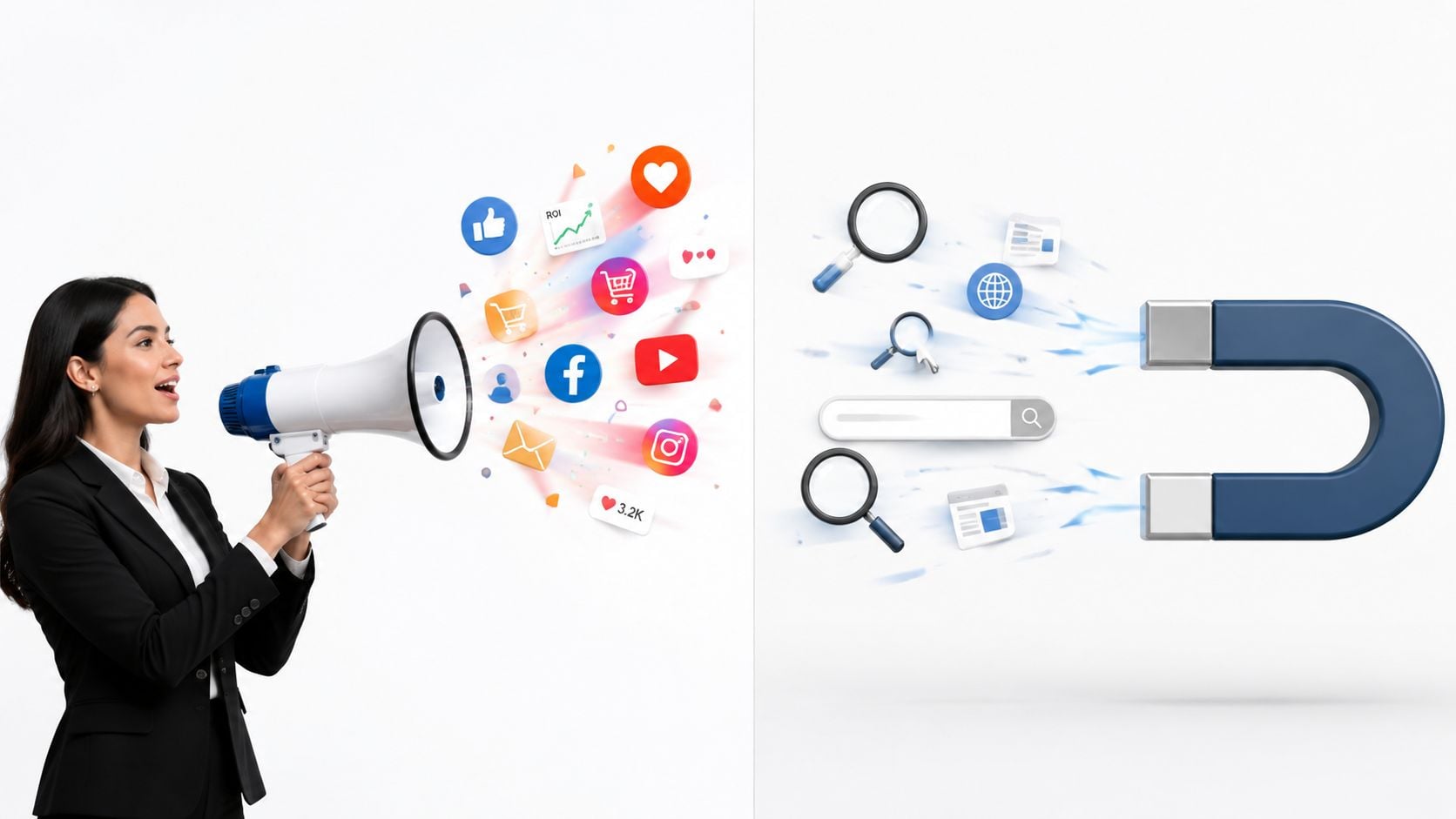
You're staring at the same budget split every quarter. One side wants paid social, faster traffic, and something the sales team can feel this month. The other side wants SEO, content, and a compounding asset that won't disappear the moment ad spend stops. That tension is at the heart of the push vs pull marketing decision, and in Australia it matters even more because buyers tend to discover brands through recommendations, reviews, social media, and online search rather than by being interrupted Figaro Digital's 2021 study.
A common mistake is treating this as a philosophical debate. It isn't. It's an allocation problem, and the right answer depends on whether you need immediate demand capture, long-term demand creation, or both. For AU businesses, the practical edge comes from matching channel choice to how people buy, then measuring each channel on the right time horizon.
| Strategy | What it does | Best use case | Primary KPI lens |
|---|---|---|---|
| Push marketing | Puts a message in front of people who may not be looking yet | Launches, promotions, rapid visibility | CPA, ROAS, CTR, conversion rate |
| Pull marketing | Draws in people already searching for a solution | SEO, content, reputation building, qualified leads | Organic traffic, rankings, engagement, LTV |
Push and Pull Marketing Explained
A marketing manager usually feels this choice under a live deadline. Sales wants more leads this month, the product team wants the launch to land, and finance wants spend tied to revenue. At that point, push vs pull stops being a theory exercise and becomes a budget decision.
Push marketing puts the offer in front of an audience before they have asked for it. Pull marketing brings in people who are already searching, comparing, or researching. That distinction affects budget allocation, creative, channel mix, and how performance gets judged.
For Australian businesses, the pull side fits discovery behaviour closely. Trust signals carry real weight, and buyers often rely on search, reviews, and recommendations before they enquire. That makes search visibility, useful content, and a clear value proposition more than branding extras, they are part of how demand turns into qualified leads.
When AI-assisted search tools summarise answers before a click, and retail media placements sit closer to the point of sale, the line between push and pull gets blurrier. A sponsored product ad can interrupt attention and still capture high intent. A search result can feel pull-driven, yet still depend on paid visibility. The practical question is how each channel contributes to ROI, lead quality, and the speed of conversion.
Practical rule: if the buyer is not searching yet, push creates the first touchpoint. If the buyer is already comparing options, pull helps win the decision.
The question is not which one is better. It is which one is doing the right job at the right moment. Push suits interruption with purpose. Pull suits discovery with intent. When those jobs get blurred, teams waste budget on awareness that cannot convert, or on content that never creates enough demand to matter.
The Core Concepts Megaphone vs Magnet
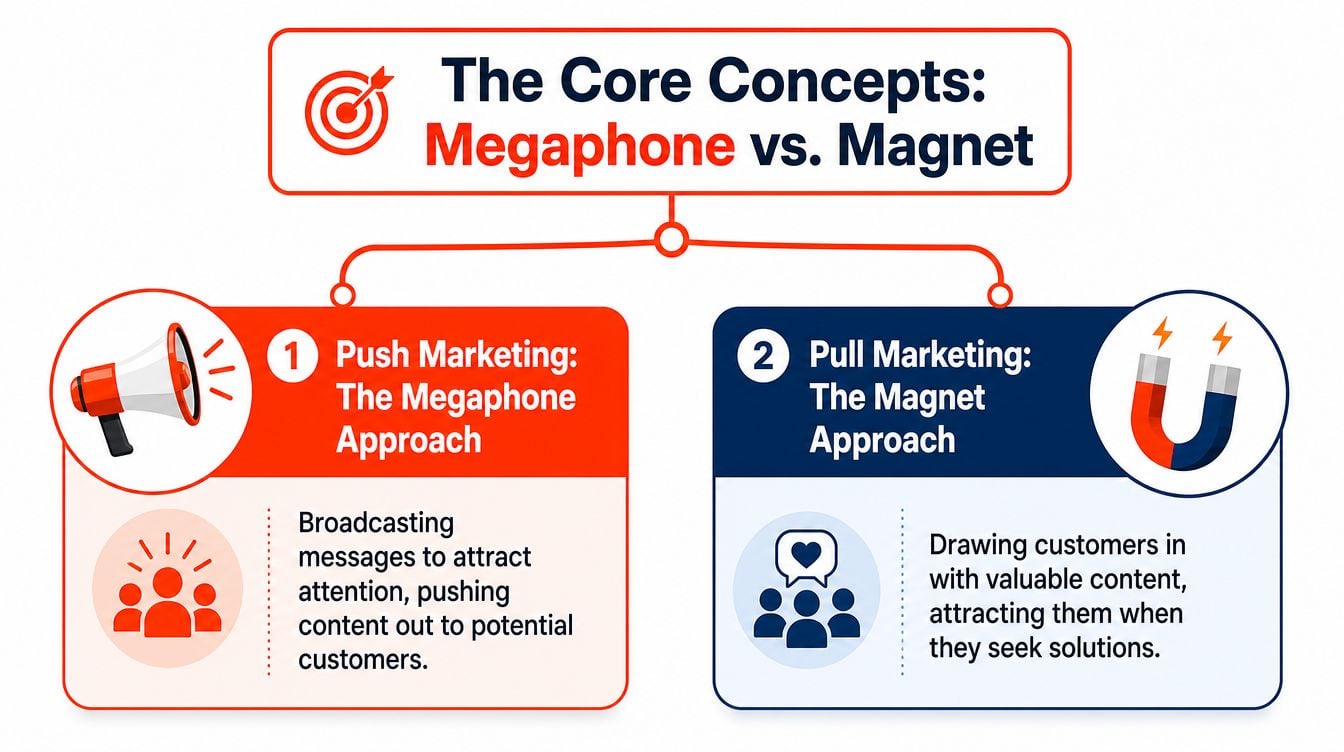
Push marketing works like a megaphone. You send a message outward to an audience that may not be looking for you yet. That approach is useful when a new offer needs visibility quickly, but it only pays off when the audience, the creative, and the timing align.
Pull marketing works like a magnet. You publish something useful, show up for the right search, build trust, and let the buyer come to you. The attraction comes from relevance, not noise. A magnet pulls because it helps at the exact moment a person needs a clearer answer, while a megaphone relies on reach and repetition to get attention.
The strategic distinction lies in demand creation versus demand capture. Push is strongest when you need to create the first spark, or when a new product has no search history and no established intent. Pull is strongest when people already have a problem in mind and are using search, reviews, or content to narrow their options. For Australian businesses, that distinction matters because the offer has to be obvious before attention turns into action, which is why a sharp value proposition should sit behind both sides of the strategy.
Push starts the conversation. Pull carries it through the decision.
That is why the offer itself matters so much. If the message is vague, the megaphone becomes background noise. If the offer is clear, the magnet has something worth attracting people with, and the path to qualified leads is easier to build. A useful reference for sharpening that message is this value proposition guide.
A good push campaign creates awareness. A good pull system creates the reason to believe.
A Detailed Strategic Comparison
Objective and audience state
A retail brand is launching a new offer in market, while a B2B service provider is trying to fill a pipeline with qualified leads. Those two scenarios usually call for different channel mixes, because push and pull solve different problems.
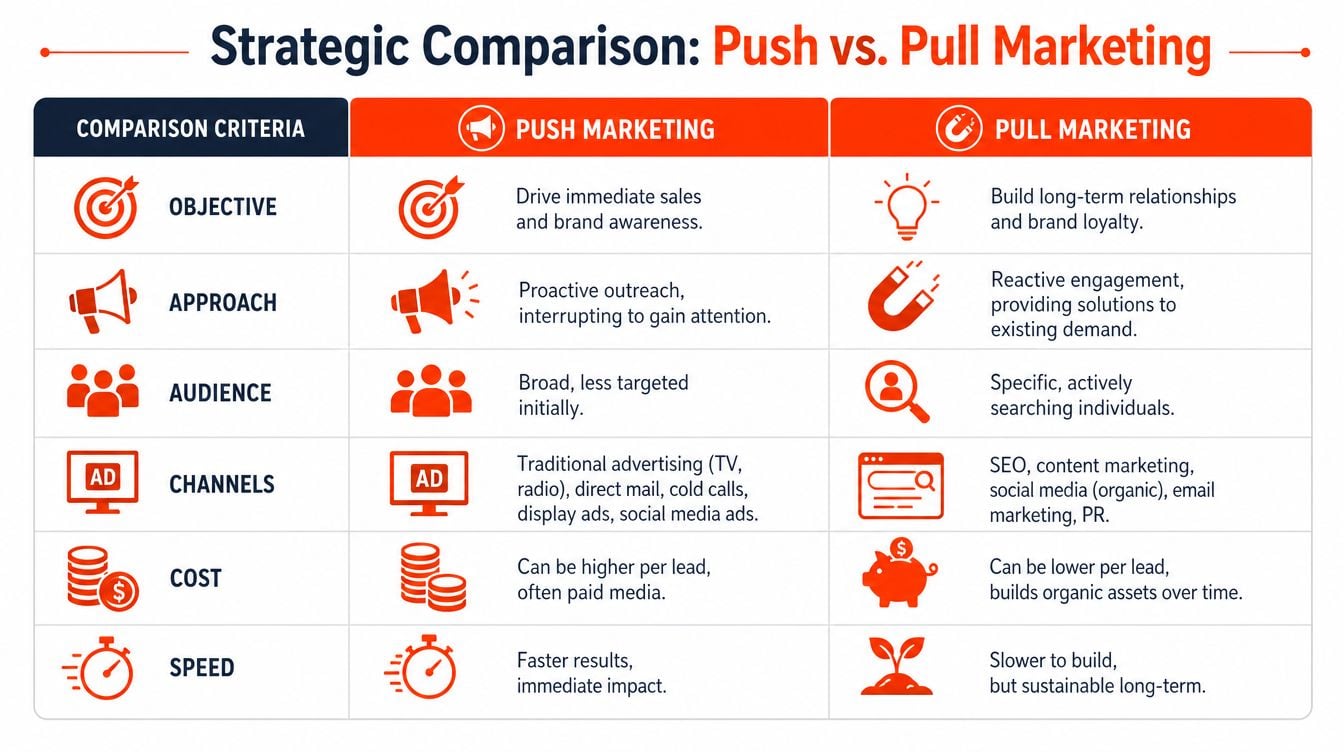
Push is built for immediate awareness, traffic, and sales interest. Pull is built for durable demand, stronger preference, and a steady flow of inbound interest. Push fits situations where the market has not formed intent yet, while pull works better once people are already searching, comparing, or trying to narrow options.
Audience state is the cleanest dividing line. Push reaches people in a passive state, or at least a non-searching one. Pull reaches people in an active state, which is why it often produces better lead quality. Morningscore's analysis reported that 53% to 60% of website traffic typically comes from search engines, while organic search converts at 1.7% to 1.8% and SEO leads convert at about 14.6% Morningscore. Those figures will not map perfectly to every account, but they show why search-led intent matters when the buyer is close to action.
Channels and timing
Push usually lives in paid social, paid search, remarketing, display, direct response email, and other outbound placements. Pull usually lives in SEO, educational content, organic social, brand search, reviews, and the assets that keep earning traffic over time. If the goal is visibility for a launch or promotion, push is the faster lever.
Timing changes the economics. Pull takes longer to build because it depends on content quality, indexing, rankings, and trust. That slower ramp is the trade-off for better durability. For Australian advertisers, Google still dominates search behavior in many categories, which is why search-led planning remains so important.
Retail media has blurred the old split as well. Sponsored placements on marketplace and retailer platforms can act like push at the point of discovery, then behave like pull once the shopper is actively comparing products. AI-driven search is also changing how discovery works, because the buyer may get a summarised answer before they ever click a traditional result. That shifts more value toward content that answers the next question cleanly and quickly.
Measurement and budget logic
Push should be judged on CPA, ROAS, CTR, and conversion rate, because those metrics show whether paid spend is producing immediate outcomes Umbrex. Pull should be judged on organic traffic growth, search rankings, content engagement, lead generation from organic sources, session depth, and customer lifetime value. If you need to understand how search performance supports that side of the strategy, you can understand SEO for performance ads.
Budget rule: if the board wants results this month, do not hide behind traffic charts. Use push and report on paid efficiency. If the goal is to reduce reliance on paid media over time, invest in pull and track the quality of demand, not just the volume.
The mistake is using the wrong scorecard. A pull programme judged only on click volume gets underfunded before it compounds. A push programme judged only on impressions gets praised while it wastes spend. Keep the measurement framework aligned to the job the channel is meant to do, and use Google Ads best practices to keep the paid side disciplined.
Tactical Implementation for PPC and SEO

A push campaign starts with a tight offer and a narrow objective. For a Meta launch, I'd use one clear product angle, one primary audience segment, and creative built for scroll-stopping speed rather than explanation. The campaign's job is not to educate the market in depth. It is to create enough momentum that people click, land, and convert while the offer is still fresh.
The performance lens stays short. ROAS, CPA, CTR, and conversion rate matter because they show whether spend is turning into immediate revenue. For paid search, the same discipline applies, and the account structure has to stay clean if you want the data to be useful. A practical place to start is Google Ads best practices, because disciplined setup makes the paid side easier to scale and easier to audit.
For pull, the campaign shape is different. A strong SEO content hub starts with high-intent topics, supporting subtopics, and pages that answer the buyer's next question before they ask it. That means content briefs built around search intent, internal linking that guides readers deeper, and a technical baseline that lets the pages index properly. The same logic applies when AI-driven search surfaces summaries before a click, because the page still has to earn the visit and give the next answer quickly. It also matters for retail media, where product discovery and intent capture often sit closer together than they do in classic search.
If you need to understand how SEO fits into performance advertising work, a useful external primer is understand SEO for performance ads. It helps teams stop treating SEO and PPC as separate silos and start using them as different stages of the same demand engine.
A good tactical split is simple. Push campaigns should be built to win attention quickly, while SEO should be built to win authority and capture demand over time. In practice, paid media can test messages fast, then SEO can turn the winning themes into durable pages, guides, and brand assets. That gives Australian businesses a cleaner way to compare short-term paid efficiency against the slower payoff from organic demand.
One more practical point, content only works if the conversion path is ready. If you publish useful pages but the landing experience is weak, the traffic will not matter. The same is true in the other direction, a sharp paid campaign will underperform if the offer, tracking, or post-click experience is vague. Paid and organic planning should sit in the same performance conversation, because the strongest ROI usually comes from matching the message, the page, and the measurement model.
Choosing Your Strategy for Different Business Cases
A push-first approach makes sense for an e-commerce brand introducing a new product line. If the product has no search equity, no review history, and no market familiarity, paid social, Shopping, and remarketing create the first discovery path. Organic work still matters, but it is building the next layer of demand while paid media generates the first response.
A B2B tech company usually needs the opposite mix. Buyers want explanation, proof, and repeated touchpoints before they are ready to speak with sales, so pull becomes the main driver. Educational articles, comparison pages, and search-led resources qualify interest before the pipeline team spends time on poor-fit leads. Short interruption tactics can still create awareness, but pull does more of the heavy lifting for lead quality.
A bootstrapped startup faces a tighter constraint, cash flow. It cannot keep buying attention forever, so pull deserves priority early, with selective push reserved for launch spikes, quick testing, or immediate feedback. That usually means organic search, founder-led content, and a focused paid test budget rather than trying to scale reach before the message is proven.
Measurement should match the job each channel is doing. Push campaigns are best judged on short-horizon efficiency metrics like CPA, ROAS, CTR, and conversion rate, while pull marketing should be tracked through organic traffic growth, search rankings, content engagement, and customer lifetime value. If those metrics get blended together, teams end up optimising for the wrong outcome.
For Australian businesses, trust sits across every scenario. Buyers often want proof before they commit, so review-led discovery and credible content matter as much as the media plan. That is why channel choice should sit beside the conversion path, the offer, and the reporting model, whether the team is building from search, paid social, or a combined SEM and SEO plan through Click Click Bang Bang's SEM and SEO approach. The same logic also applies to profitable Amazon advertising, where product visibility and decision support have to work together for ROI to hold.
The Hybrid Model Blending Push and Pull
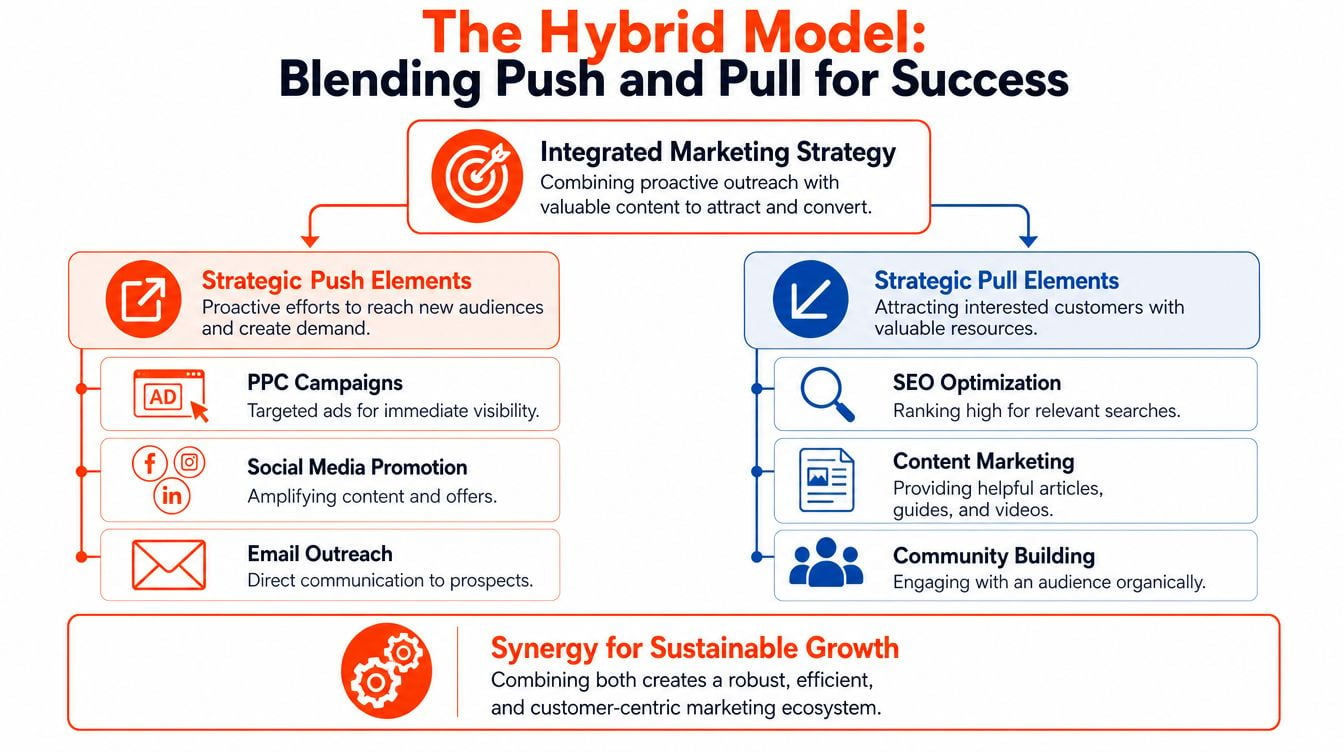
A strong account rarely wins with one channel alone. A launch campaign can create the first wave of attention, search and content can turn that attention into trust, and retargeting can bring back the people who needed more proof before they were ready to buy. In Australian markets, that mix matters because buyers often compare reviews, search results, and brand signals before they commit.
Simple decision matrix
- Startup + short sales cycle: start with push, then add pull assets once the message begins to convert.
- Startup + long sales cycle: build pull first, because the buyer needs education before paid media can scale efficiently.
- Established brand + short sales cycle: run both, with push for speed and pull for efficiency.
- Established brand + long sales cycle: give pull more weight, then use push for launches, remarketing, and offer testing.
That matrix works because it maps to how people buy, not how agencies package channel services. A business with an immediate demand gap needs reach. A business with a complex buying process needs authority. Many businesses need both, but rarely in the same proportion.
Retail media has made the old split less tidy. Marketplace placements, shopping ads, and onsite retail inventory often sit close to purchase intent, so they behave more like demand capture than pure interruption. The labels still help with planning, but modern commerce media sits between the two.
For teams planning Amazon-style catalogue campaigns, the same logic still applies. If you want a practical view of how paid search and organic visibility support each other in commerce, profitable Amazon advertising is a useful reference point. Paid media can create momentum, while organic assets reduce dependence on constant spend.
The cleanest operating model is simple, use push to open the door, use pull to earn the sale, and use retargeting to finish the job. That is the hybrid system worth building when you care about revenue now and acquisition economics later. For a structured build across both disciplines, SEM and SEO marketing gives you a practical way to keep the two sides connected.
Read NeXt
Or Read Our Latest
- Push vs Pull Marketing: A 2026 Decision Guide
- Ad Relevance Score Explained: How It Impacts PPC Performance
- Best ROI Digital Marketing: 10 Channels Ranked for 2026
- Localization Strategy: How to Win in Any Market
- Phone Call Tracking: Methods, Metrics, and Best Practices
- Supplier Relationship Management: Strategic Guide 2026
Click. CLick. Subscribe.
Get our best PPC insights, industry updates, and power moves delivered straight to your inbox. No fluff, just high-caliber strategies that actually work.
Don’t Leave Just Yet
Try Us For 30-Days,
Risk Free!!
We guarantee that you’ll love our work within the first 30 days, if not you’ll get your money back.
What have you got to lose?