

What Is Ad Rank Formula? Boost Ad Performance
Last Updated

You've raised bids, tightened budgets, and still your ad sits below a competitor that doesn't seem to spend as aggressively. That usually means you're looking at Google Ads through the wrong lens.
The auction isn't a simple highest-bid-wins system. It's closer to a weighted scorecard where Google asks one practical question: which ad is most useful for this search right now? That scorecard is Ad Rank.
If you're searching for what is ad rank formula, the useful answer isn't just the formula itself. It's knowing which levers you can pull to improve position without turning every auction into a bidding war. For Australian advertisers, that matters even more because competition is tighter in many categories, mobile behaviour shifts by location, and wasted CPC compounds fast across the month.
Why Your Competitor Is Outranking You With a Lower Bid
Most marketing managers hit the same moment. You open the campaign, compare average position trends and impression share, and ask a fair question: “How are they above us when our bid is higher?”
The short answer is that Google doesn't rank ads on bid alone. It ranks them on expected value in the auction. That means a competitor can bid less and still beat you if their ad is more relevant, more clickable, and sends traffic to a better landing page.
Think of Ad Rank like a tender process, not a cash auction. The highest price matters, but it isn't the only factor. If one supplier is cheaper and clearly more reliable, they often win. Google works the same way.
Many teams make the mistake of auditing only bids. That misses the core battleground. A better starting point is competitor intent mapping, ad copy patterns, and keyword overlap. If you need a structured way to do that, Emulous Media Inc's competitor research guide is a useful reference for spotting where rivals are winning through alignment rather than brute-force spend.
Practical rule: If a competitor keeps outranking you across the same terms, assume there's a quality advantage before assuming there's a bigger budget.
The most common weak points are predictable:
- Loose keyword grouping means one ad is trying to answer too many search intents.
- Generic copy lowers click appeal because the message doesn't mirror the query.
- Thin landing pages tell Google the post-click experience is weak.
- Poor CTR history drags future auctions because Google expects fewer clicks.
If your ads aren't getting enough engagement, improving click appeal is usually the fastest lever to test. This guide on how to improve Google Ads CTR is worth reviewing because CTR pressure usually shows up upstream in Ad Rank before it appears in cost or conversion data.
The Core Ad Rank Formula Explained
Ad Rank decides two commercial outcomes in every auction. Whether your ad appears at all, and how much pressure you face on cost if it does.
The old shortcut is still useful:
Max CPC bid × Quality Score
It explains the basic relationship well enough for day-to-day decision-making. Higher bids help. Better quality helps more than many advertisers expect. But Google's actual auction uses extra signals, including the expected impact of ad assets and the context of the search, as outlined in Google Ads documentation on Ad Rank.
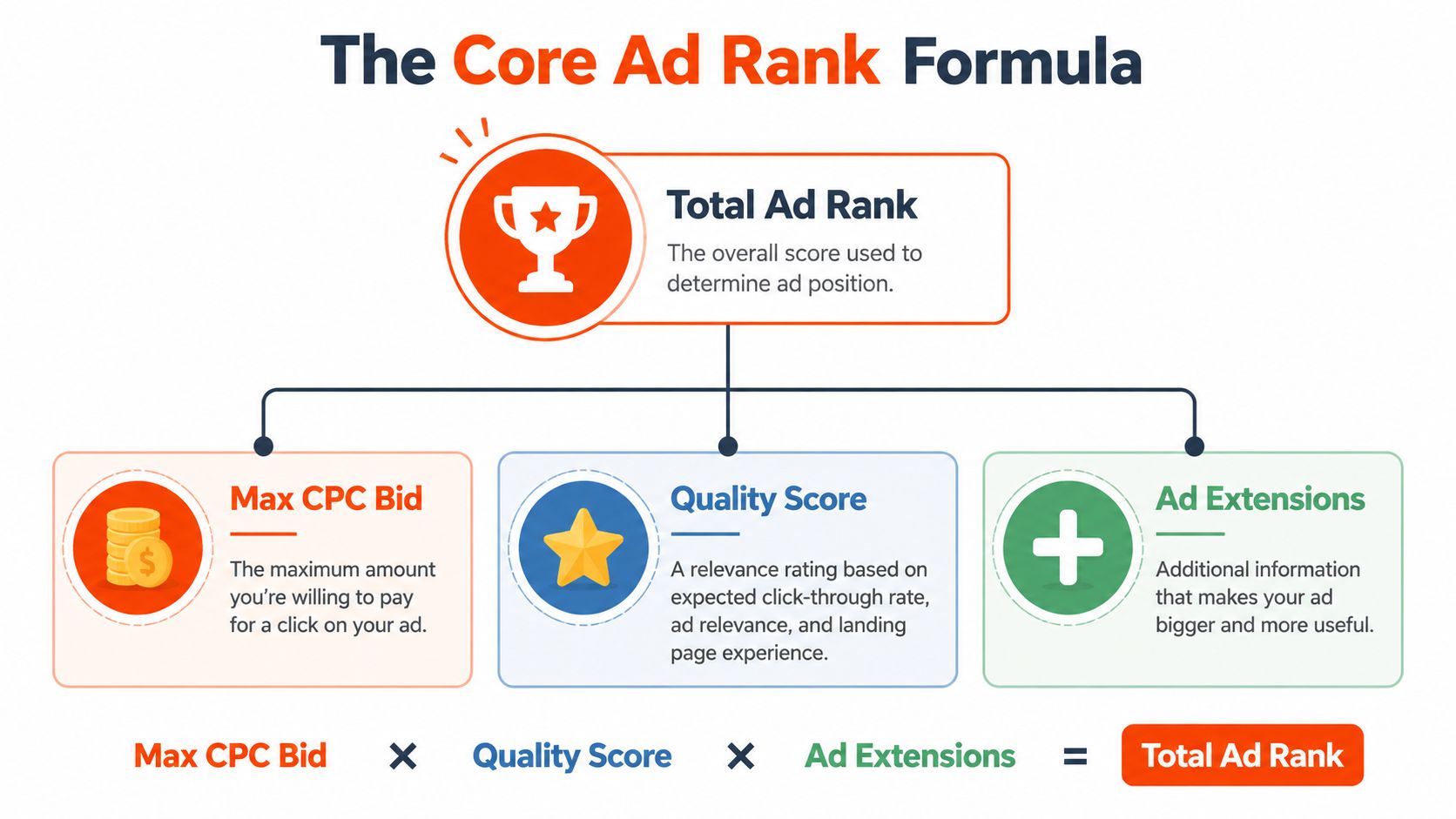
What the formula means in practice
Treat Ad Rank as a weighted score, not a pure price contest. Your bid sets how aggressive you are willing to be. Quality Score affects how efficiently that budget turns into visibility. Thresholds decide whether your ad is even competitive enough to enter stronger positions.
That distinction matters in Australian accounts because the same keyword can behave very differently by city, device, and time of day. A mobile search in Sydney for a high-intent service term can be a much tighter auction than a desktop search for the same term in regional Queensland. If you only raise bids, you often pay more for the same weaknesses.
The parts that actually change your outcome
-
Max CPC bid
Your bid is a ceiling. It signals how much you are prepared to pay, not what you will automatically be charged. -
Quality Score
This is the efficiency factor inside the auction. Stronger relevance and expected performance let you compete harder without matching every rival dollar for dollar. -
Ad Rank thresholds
Google applies minimum standards for showing ads and for accessing stronger positions. If your ad falls short, higher bids can become an expensive workaround rather than a fix. -
Auction context
User intent, device, location, and query specifics can all shift the competitive bar for that impression. -
Ad assets
Sitelinks, callouts, snippets, prices, and other assets can improve expected performance and strengthen Ad Rank.
The best ROI usually comes from improving the multiplier before increasing the bid ceiling.
That is the strategic angle many teams miss. A $12 bid attached to loose ad groups and weak copy often loses margin fast. A $7 bid attached to tight intent matching, stronger assets, and a better landing experience can win more profitably. That is why good PPC and Google AdWords management focuses on the auction inputs you can control, not just the number in the bid column.
If you manage spend across multiple ad platforms, comparing auction logic is useful. Clickstera Solutions Amazon bid strategy is a helpful contrast because it shows the same core trade-off. Paying more can buy reach, but efficient ranking comes from matching the platform's quality and intent signals as closely as possible.
Deconstructing the Quality Score Components
If Ad Rank is the final score, Quality Score is the part most advertisers can improve fastest without paying more. It reflects how relevant and useful Google expects your ad experience to be.
That's why Quality Score work tends to deliver two wins at once. You improve position pressure, and you reduce wasted spend. A 2015 study by Australian digital marketing firm WebSavvy found that AU campaigns improving Quality Score from 5/10 to 8/10 achieved an average 42% reduction in CPC while gaining 28% higher ad positions on SERPs for competitive retail keywords, as summarised in Jellyfish's Ad Rank article.

Expected CTR
This is Google's prediction of how likely someone is to click your ad when it appears.
It's not just historical CTR. It's expected clickability in context. Google looks at the relationship between the query, your copy, and prior behaviour patterns in similar auctions.
A good setup usually looks like this:
- Keyword-specific headline that reflects the user's search
- Clear commercial intent such as pricing, delivery, demo, trial, or quote
- Strong message match between keyword and offer
- Competitive framing without vague filler
A weak setup often looks like one generic RSA trying to cover an entire category. If you're bidding on “women's trail runners” and your ad mostly talks about “quality footwear”, Google gets a weaker relevance signal and users often do too.
Ad relevance
Ad relevance is simpler than people make it. Does the ad answer the search?
When it doesn't, you feel it immediately in account structure. Search terms broaden, CTR softens, and the ad starts paying a tax in the auction.
Here's a quick comparison:
| Search | High relevance ad | Low relevance ad |
|---|---|---|
| buy office chairs australia | Office Chairs in Australia, Fast Delivery | Modern Furniture for Every Workspace |
| crm software for small business | CRM Software for Small Business Teams | Smarter Digital Tools for Growing Companies |
| emergency plumber sydney | Emergency Plumber Sydney, 24 Hour Service | Trusted Home Services Across NSW |
The fix is rarely glamorous. It's account hygiene. Break broad ad groups into tighter clusters. Write ads around intent, not category labels. Cut keywords that pull in mixed commercial intent unless you can support them with dedicated copy.
The fastest Quality Score lift often comes from deleting ambiguity.
Landing page experience
Many otherwise competent campaigns fall apart at this stage. The ad gets the click, but the page doesn't confirm the promise.
Google wants the landing page to feel like the natural next step from the search and the ad. Users want the same thing. When they land and hesitate, bounce, or hunt for the offer, the auction eventually punishes you.
Strong landing pages usually share a few traits:
-
Message match
The headline reflects the keyword theme and the promise in the ad. -
Clear conversion path
Users can see what to do next without scrolling through clutter. -
Relevant content
The page addresses the searched product, service, or problem. -
Mobile usability
Buttons, forms, and layout work cleanly on phones.
Ad assets support this too. If you're reviewing how assets affect visibility and interaction, UFO Performance Marketing's guide to ad extensions is helpful for understanding how those extra layers influence user behaviour around the ad itself.
What usually works and what usually doesn't
What works
- Tight ad groups with shared intent
- Ad copy that mirrors search language
- Landing pages built for one offer, not five
- Regular search term pruning
- Assets that add useful information, not noise
What doesn't
- One campaign trying to serve every product variation
- Sending all paid traffic to a generic homepage
- Writing “brand-safe” copy that says nothing specific
- Letting broad match run without close search term review
- Assuming a high bid can compensate for a weak page
How Ad Rank Determines Position and Actual Cost
The part most advertisers care about isn't the theory. It's the financial consequence. Ad Rank decides both where you show and, indirectly, what you pay.
The key idea is this: your max bid is not usually your final CPC. Google uses the advertiser below you in the auction to determine the minimum amount you need to pay to hold your position.
The formula for actual CPC is:
Actual CPC = (Ad Rank of advertiser below / Your Quality Score) + AUD 0.01
That means Quality Score does double duty. It helps you climb and helps you pay less to stay there.
Sample Ad Auction Calculation
Below is a simple auction example to show the mechanic. The numbers are illustrative, not market benchmarks.
| Advertiser | Max Bid (CPC) | Quality Score | Ad Rank (Bid x QS) | Ad Position | Actual CPC Calculation | Actual CPC |
|---|---|---|---|---|---|---|
| Advertiser A | AUD 8.00 | 4 | 32 | 3 | (27 / 4) + AUD 0.01 | AUD 6.76 |
| Advertiser B | AUD 5.00 | 8 | 40 | 1 | (36 / 8) + AUD 0.01 | AUD 4.51 |
| Advertiser C | AUD 6.00 | 6 | 36 | 2 | (32 / 6) + AUD 0.01 | AUD 5.34 |
| Advertiser D | AUD 9.00 | 3 | 27 | 4 | Determined by threshold below | Varies |
What this table shows
Advertiser D bids the most, but lands in fourth because the ad quality is weak.
Advertiser B doesn't have the highest bid, yet wins first position because the Quality Score is strongest. That's the core answer to “what is ad rank formula” in real commercial terms. The formula rewards relevance and efficiency, not just spending power.
Advertiser B also pays less than the top bid ceiling. The actual CPC is based on the Ad Rank directly below. Because the Quality Score is high, the cost required to beat Advertiser C is lower than many advertisers expect.
A better Quality Score doesn't just improve rank. It changes the economics of every click you buy.
Why this matters in daily account management
This is why bid increases often disappoint. If the underlying quality signals are mediocre, a higher bid may move you a little, but it usually makes the account less efficient.
In practice, I'd treat auction pressure in three stages:
-
Check whether quality is the blocker
Look at keyword-level Quality Score, ad relevance, and landing page fit. -
Check whether threshold pressure is blocking premium visibility
Some auctions won't give you top placement unless the ad clears a baseline quality bar. -
Only then adjust bids
Increase bids when the ad experience is already sound and the economics still work.
Where teams get this wrong
Many teams treat all low visibility as a budget problem. Sometimes it is. Often it isn't.
If you're paying inflated CPC to hold a middling position, the account is telling you something. Usually one of these:
- The keyword is too broad for the current ad
- The landing page is too generic
- The ad isn't competitive enough to earn the click
- The account is trying to buy position instead of deserve it
That's why two advertisers can target the same keyword and have very different cost structures. One is paying a premium for weak relevance. The other has aligned intent, creative, and page experience well enough to buy traffic more efficiently.
Strategic Levers to Optimise Your Ad Rank
A common account scenario looks like this. You increase bids, CPC rises, and position barely improves. Then a competitor with a smaller budget keeps showing above you. That usually means the account has a quality problem, not a bidding problem.
Ad Rank optimisation works like tuning a race car. More fuel helps only if the tyres, engine, and steering are already working together. In Google Ads, your practical levers are bid, structure, creative, landing page fit, assets, and conversion signals. ROI improves when those levers are pulled in the right order.

Pull the bid lever carefully
Bids still have a job. They just work best after relevance and user experience are in good shape.
If a keyword already converts profitably and impression share is being lost due to rank, a bid increase can be justified. If search terms are loose, ads are generic, or the landing page is weak, higher bids usually buy the same traffic at a worse margin. That is the trade-off many Australian advertisers miss. More visibility can easily mean less profit.
A practical rule:
- Raise bids when intent is proven and the traffic already produces acceptable CPA or ROAS
- Hold bids steady while new ad groups, keywords, or assets are still collecting enough data to judge properly
- Reduce or split bids when performance changes sharply by device, location, audience, or match type
Automated bidding helps only when conversion tracking is clean. If leads are duplicated, offline sales are missing, or low-value actions are counted as wins, the system will chase the wrong users with confidence.
Optimise for threshold clearance
The goal is not just to appear one spot higher. The goal is to clear the quality bar that lets the ad compete efficiently in stronger positions.
That changes account priorities. A landing page with a vague headline, slow mobile load, or weak commercial intent can block Ad Rank improvement even if the bid is aggressive. In competitive Australian verticals such as legal, finance, trades, and B2B services, I would usually fix the page before touching bids again.
Use this order when deciding where to spend time:
- Landing page first if the offer, headline, and CTA do not closely match the search
- Ad copy next if impressions are healthy but CTR is soft
- Keyword structure after that if ad groups are too broad to support specific messaging
- Bid changes last once the account has earned the right to pay more
One practical option for businesses that want outside support is Click Click Bang Bang. The team runs PPC campaigns across Google, Meta, LinkedIn, and Shopping with conversion tracking and reporting built into setup. That matters because Ad Rank work is hard to judge without a clean view of lead quality and revenue.
Operational test: If your team cannot explain why one ad group should win more auctions than another, the structure is probably still too broad.
Use assets as conversion aids, not decoration
Assets should help a searcher make a decision before the click. Sitelinks, callouts, snippets, call assets, and location assets all add context. That improves the ad's usefulness in the auction, and it often lifts click-through rate at the same time.
For Australian campaigns, the best assets usually answer commercial objections quickly. Delivery times, local service areas, finance options, pricing paths, trust signals, and category shortcuts all reduce friction. A generic callout such as "great service" rarely does much. "Same-day Sydney dispatch" or "NDIS plan-managed accepted" gives the user a concrete reason to choose your ad.
Here's a practical checklist:
- Sitelinks to pricing, service pages, demos, quote forms, or best sellers
- Callouts for proof points such as local support, warranty, fast dispatch, or accredited staff
- Structured snippets to show product lines, service types, or brand ranges clearly
- Location and call assets when local intent is high and the next step is direct
A quick explainer on bidding and auction pressure is useful here:
The highest-ROI optimisation sequence
If the goal is stronger Ad Rank without wasting budget, I would usually work through the account in this order:
-
Clean search terms
Cut wasted spend and add negatives before buying more traffic. -
Tighten ad groups
Group keywords by intent so the ad can answer the query directly. -
Rewrite RSAs
Build stronger headline coverage around the actual search themes and buying triggers. -
Fix the landing page
Match the promise in the ad with the page headline, offer, proof, and CTA. -
Add or improve assets
Give searchers more reasons to click and more paths to convert. -
Adjust bids only after quality improves
Let the account earn cheaper auctions before paying a premium.
That sequence protects budget efficiency because it fixes the causes of weak Ad Rank before increasing cost. It also gives automated bidding better inputs, which matters more as auction-time systems rely more heavily on predicted performance. If you want context on that shift, this overview of AI in digital advertising is a useful companion.
The Future of Ad Rank AI and Platform Differences
Ad Rank isn't standing still. Google is moving more of the decision-making into auction-time systems that evaluate intent, context, and predicted performance in real time.
Post-2025 updates to Google Ads in Australia have integrated AI-predicted user signals into real-time Ad Rank calculations. A November 2025 Google AU Ads Transparency Report said AI factors influence 78% of Ad Rank variance in AU auctions, up from 45% in 2024, and that shift particularly boosted Performance Max campaign impression share by 27% for SMEs, according to Google's Ads update on AI-driven ranking. Because that source is future-dated, treat it as an announced platform direction rather than a settled long-term benchmark.
The practical implication is simple. Manual bidding and keyword sculpting still matter, but they matter less if your inputs are poor. Creative assets, audience signals, conversion quality, and landing page relevance are becoming the raw materials the system uses to make ranking decisions.
That's why advertisers need to think less like bid managers and more like signal managers. If you want a deeper look at that shift, this page on AI in digital advertising is a useful companion.
Platform differences matter too. Microsoft Ads uses a similar quality-based auction logic, but Google's scale, automation depth, and campaign types like Performance Max make Ad Rank behaviour feel more dynamic. The principle holds across both: the platform rewards advertisers who make the click more likely to satisfy the search.
If your campaigns are stuck in a cycle of higher bids and uneven returns, Click Click Bang Bang can help you diagnose whether the issue is bid pressure, Quality Score, landing page fit, or auction structure, then turn that into a clearer PPC strategy.
Read NeXt
Or Read Our Latest
- Manual vs Automated Bidding for PPC Success
- Conversion Tracking Setup: A Complete AU Guide
- Instagram Advertising Australia: Complete 2026 Guide
- Pay Per Click: A Beginner’s Guide for Australian Marketers
- Display Advertising on Google: The Complete Australian Guide
- Stakeholder Communication Plan How to Build One That Works
Click. CLick. Subscribe.
Get our best PPC insights, industry updates, and power moves delivered straight to your inbox. No fluff, just high-caliber strategies that actually work.
Don’t Leave Just Yet
Try Us For 30-Days,
Risk Free!!
We guarantee that you’ll love our work within the first 30 days, if not you’ll get your money back.
What have you got to lose?