

Best ROI Digital Marketing: 10 Channels Ranked for 2026
Last Updated
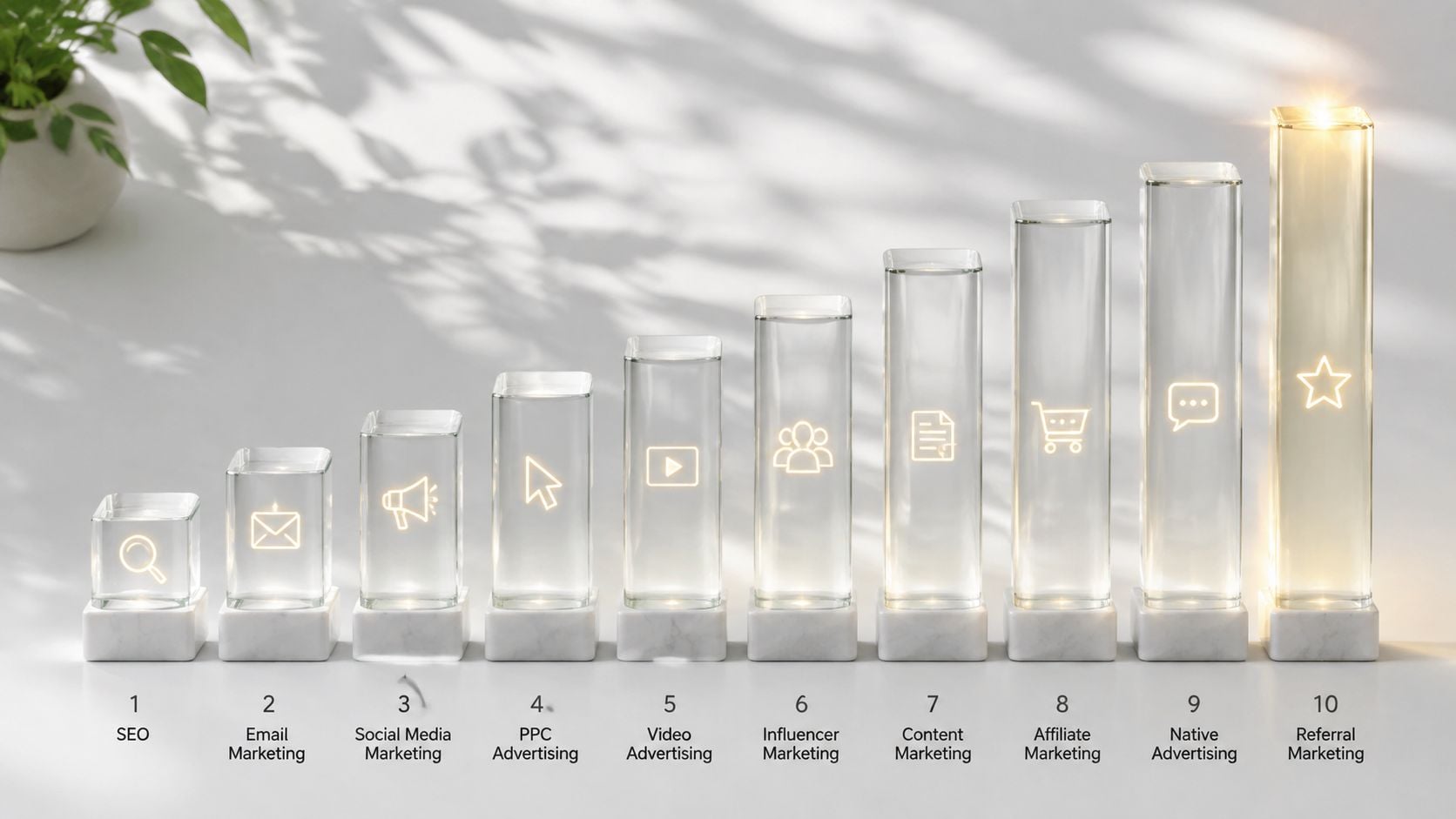
Email marketing still stands as the clearest best ROI digital marketing benchmark, with independent industry guidance putting returns at roughly $36 to $42 for every $1 spent, or about 3,600% to 4,200% ROI (ROI benchmark guide). For Australian businesses, that matters because the same logic applies across the wider channel mix, measurable conversion tracking, low marginal delivery costs, and repeatable optimisation usually beat broad awareness spend when the goal is revenue or qualified leads. A business that spends A$10,000 on a well-run email program could benchmark against a gross return of roughly A$360,000 to A$420,000 before product, fulfilment, and overheads, if performance tracked to those cited averages.
That's the lens for this ranking. The channels below are ordered by the ROI they usually produce when they're set up properly, not by popularity, buzz, or how easy they are to explain in a pitch deck. Each one is framed by expected return range, best business fit, quick-win tactics, and the budget leaks that kill performance.
Australia's market is large enough that small efficiency gains matter. The country had about 26.8 million internet users in early 2025, social media penetration was around 77.9%, and major platforms such as YouTube, Facebook, Instagram, and LinkedIn all had meaningful scale for paid acquisition (AU digital market context). That's why a disciplined channel mix still wins, especially for businesses that want a practical marketing ROI playbook instead of vague channel optimism. Click Click Bang Bang fits that operational need, especially for teams that want PPC and AI-first SEO turned into live campaigns with reporting they can use.
1. Search Engine Marketing with AI-Optimised Bidding
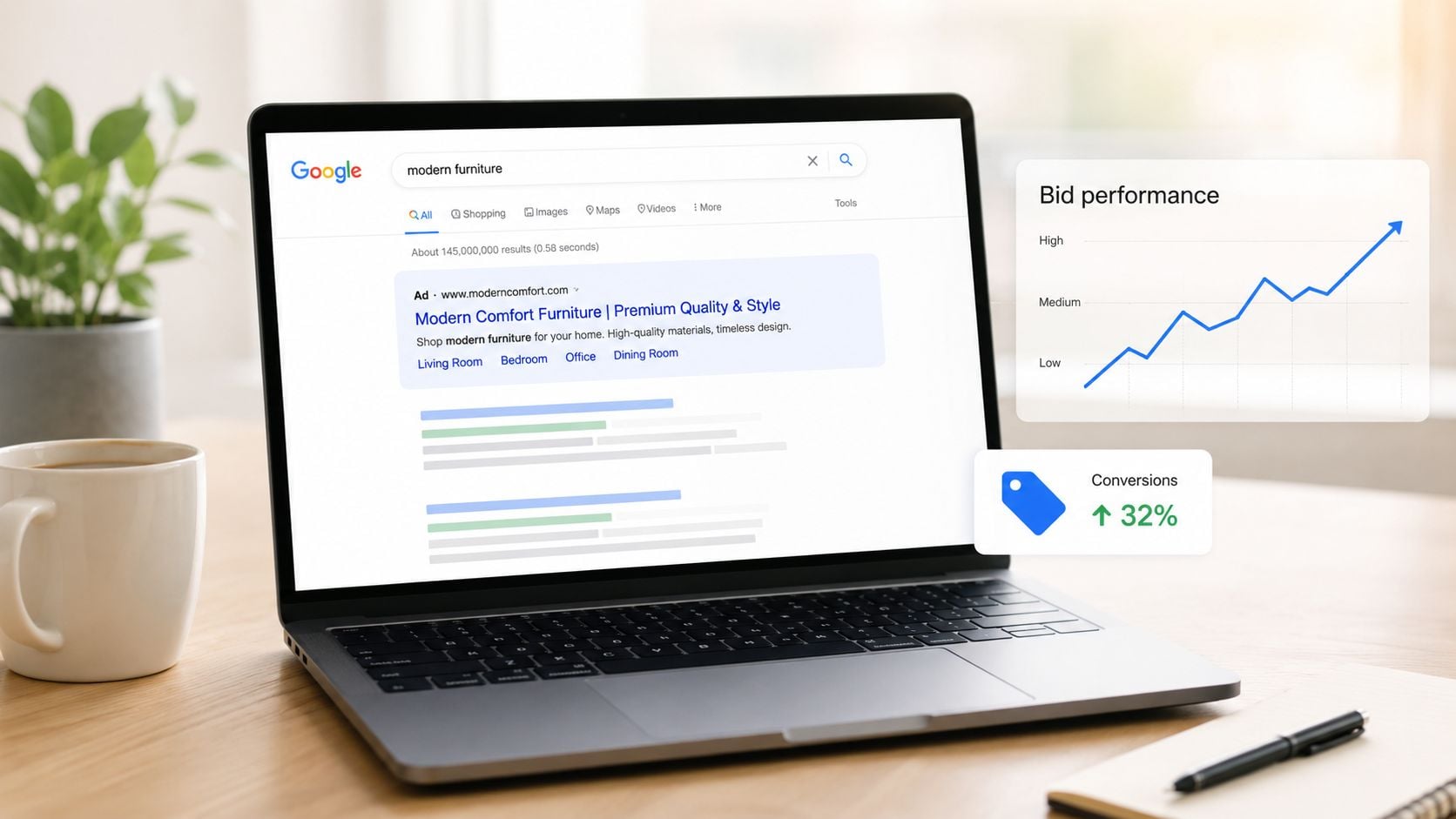
Search engine marketing is still one of the cleanest places to find measurable return because it captures people already showing intent. For many businesses, that makes it the fastest path to proving whether a keyword, offer, or landing page can produce revenue. Google Ads is commonly benchmarked around $2 returned per $1 spent on average, so even modest improvements in targeting and bidding discipline can change the numbers quickly (digital marketing ROI statistics).
Where SEM fits best
Ecommerce retailers use search ads to catch shoppers at the point of comparison, B2B SaaS teams use Smart Bidding to chase qualified leads, and local service businesses use location-based search ads to win urgent bookings. The channel works best when the searcher already knows what they want, because the click arrives with intent attached. If the keyword is vague, the economics usually get messy fast.
Practical rule: launch SEM only after conversion tracking and value tracking are live. Without them, Smart Bidding is optimising toward clicks, not profit.
Quick wins are straightforward. Clean out irrelevant terms with Search Term Reports, segment campaigns by product category or service line, and test multiple ad copy variations so Quality Score doesn't get dragged down by weak relevance. Once you have enough conversion history, Target CPA bidding becomes far more usable, which is why a setup like Target CPA bidding matters more than broad “set and forget” management.
The biggest leak is mismatch. A broad keyword, a generic ad, and a slow landing page can burn budget even when the platform says traffic is cheap. SEM works when the search term, message, and page all point to the same outcome.
2. Remarketing and Retargeting Campaigns
Remarketing earns its place because most first visits don't convert. That's not a channel failure, it's normal buying behaviour, especially for higher-consideration ecommerce, SaaS, and service offers. Retargeting keeps the conversation alive after the first click, which is why it usually improves total account efficiency rather than replacing acquisition entirely.
For ecommerce, dynamic product ads are the obvious use case. Someone browses a bag, leaves, and then sees that exact product again across the Google Display Network or YouTube. For SaaS, the same logic applies to free trial users who started but didn't finish onboarding, while service businesses can re-engage quote requests that stalled before booking.
Retargeting is strongest when the audience is small, specific, and already warmed up. Broad display prospecting with a retargeting label is just cheap exposure.
The quick wins come from audience discipline. Build separate lists for abandoned carts, product viewers, and past customers, then exclude converters so you don't pay to advertise something already sold. Frequency capping matters too, because ad fatigue can set in quickly if the same person keeps seeing the same offer.
A frequent mistake is using one message for every stage. Someone who viewed a product once should get a different ad from someone who added it to cart, and both should differ from a lapsed customer win-back. If you want the technical side done properly, the dynamic remarketing setup is where feed quality, audience logic, and sequencing either make or break the campaign.
3. LinkedIn Ads for B2B Lead Generation
LinkedIn is expensive in feel, but not always in outcome. For B2B brands, it often becomes the most efficient place to reach the right person, not the cheapest person. That distinction matters, because a cheaper click from the wrong audience usually ends up costing more downstream.
The channel works best for software, consulting, professional services, and enterprise sales teams that care about role, company size, seniority, and industry. Lead Gen Forms are especially useful because they remove friction from the click path and keep prospects inside the platform long enough to convert. For companies chasing high-value accounts, that speed can matter more than raw traffic volume.
What improves quality
- Tight audience filters: target role, industry, and company size with intent, not guesswork.
- Separate buyer-persona campaigns: executives, managers, and practitioners rarely respond to the same angle.
- CRM integration: send form leads straight into the sales workflow so quality is tracked, not assumed.
- Sponsored InMail for priority targets: use it sparingly for accounts that justify the higher cost.
LinkedIn campaign quality rises when the offer is specific. “Book a demo” is weak if the buyer isn't ready. A useful lead magnet, a strong case study, or a diagnostic can move the needle more reliably than generic brand language.
The quiet budget killer here is overreach. If the audience is too broad, LinkedIn will happily spend against people who fit the title but not the buying stage. That's why careful account definition and a LinkedIn ad management approach matter so much for B2B ROI.
4. Google Shopping Ads for E-Commerce
For ecommerce, Google Shopping often outperforms plain text search because buyers can see the product, price, and ratings before they click. That pre-qualification does a lot of heavy lifting. It reduces wasted traffic and improves purchase intent long before the landing page loads.
Shopping is especially strong for fashion, home goods, and electronics because visual comparison is part of the buying process. If the feed is accurate and the product page is competitive, the channel can become one of the most dependable revenue drivers in the account.
Feed quality is the real lever
Shopping campaigns are only as good as the product feed behind them. Prices, availability, descriptions, and titles need to stay aligned with the site, or the system starts sending poor-quality traffic. Product titles should include the terms buyers use, not internal catalogue language.
A few tactics usually pay off fast:
- Use category segmentation: split campaigns by margin or product group so budget follows profit.
- Add negative keywords early: keep irrelevant traffic out of the feed.
- Push reviews and ratings: social proof helps the ad stand out in a crowded results page.
- Test promotion annotations: shipping offers and time-sensitive discounts can improve click interest.
The main pitfall is treating Shopping like a fully automated slot machine. It still needs active feed management, category structuring, and margin awareness. If you sell low-margin items and high-margin items in the same bucket, the platform may optimise for volume while your profit gets squeezed.
5. Meta Conversion Ads with Pixel Optimisation
Meta conversion ads deliver results when the objective is conversion rather than vanity reach. Facebook and Instagram work best when the pixel and Conversion API are configured correctly, because the platform needs reliable event data to learn who is likely to buy or enquire. Without that signal, the algorithm is forced to make weaker decisions.
This channel suits ecommerce, D2C brands, local services with visual proof, and lead-gen offers that need scale. It also performs well when the product benefits from emotion, aspiration, or strong creative. If the offer is visually flat, performance often slips because the feed has to do more of the selling.
What usually moves performance
- Use server-side tracking: Conversion API helps reduce signal loss after privacy changes.
- Start with high-value lookalikes: build from customers who spend or stay, not the whole list.
- Refresh creative regularly: fatigue is one of the most common hidden drains in Meta accounts.
- Track real conversion events: purchases, bookings, and qualified leads matter more than clicks.
Dynamic product ads are useful for cart recovery and browse abandonment, while video often outperforms static when the story matters. That is especially true for beauty, fashion, and wellness, where showing the product in use usually beats listing features.
The main trap is over-relying on interest targeting. It can still help, but it is usually too blunt compared with lookalikes, custom audiences, and conversion event optimisation. Meta's strength is scale, but only if the account is fed clean data and fresh creative.
6. AI-First SEO with Entity Optimisation and E-E-A-T
SEO remains one of the strongest ROI channels because it compounds. You do the work once, then the page can keep earning if it stays relevant and technically sound. Organic search is consistently ranked as a top-return channel in industry benchmarks, and it also serves as the long-horizon asset that reduces reliance on paid media (organic search and channel ROI context).
AI-first SEO focuses on helping search engines understand meaning, entities, and trust rather than stuffing pages with keywords. That means content clusters, credible authorship, and consistent topical depth. It also means improving strong pages instead of endlessly publishing thin new ones.
A useful way to judge the channel is by the kind of work it rewards. Pages built around clear entities, real expertise, and useful internal structure tend to hold value longer, while generic content usually fades fast. If the goal is durable acquisition, that trade-off matters more than chasing quick ranking wins.
What a strong AI-first SEO program looks like
- Author credibility: show real expertise through bios, credentials, and subject knowledge.
- Topic clusters: build a core page and supporting pages that answer adjacent questions.
- Original research: use your own data or field observations wherever possible.
- Quality backlinks: earn mentions from relevant, authoritative sites.
- Regular refreshes: update top performers so they don't decay.
B2B SaaS companies often use SEO to scale qualified inbound over time, while service businesses can own local intent without paying for every click. Ecommerce can also benefit when category and product content is structured well. The fit depends on whether the business can publish useful content that answers intent better than the average result.
The biggest mistake is expecting SEO to act like paid search. It moves more slowly, but once it gains traction, the economics can be far better because the traffic is not metered by impression cost every day. The best teams use PPC for immediate demand capture and SEO for compounding CAC reduction over longer windows.
7. Audience Lookalike and Custom Audience Campaigns
Audience strategy is where some accounts get sharper and others just keep paying for noise. Lookalike audiences help platforms find people who resemble your best customers, while custom audiences let you reach people who already know the brand. Used together, they can improve acquisition efficiency without making every campaign start from zero.
The source audience matters more than the audience size. High-LTV buyers, repeat purchasers, retained users, and top accounts usually give the model better signals than a broad customer file. If you feed the platform weak patterns, it will keep finding more of the wrong people.
How to get more from the data you already own
- Build from high-LTV segments: use your best buyers, not your entire list.
- Separate audience tiers: VIP, high-value, and standard groups should not be mixed.
- Refresh source data often: stale lists weaken the model.
- Layer with remarketing: warm audiences plus lookalikes usually perform better than one layer alone.
Custom audiences are especially useful when the journey is longer or the purchase decision needs more than one touch. Ecommerce brands can use them to bring back abandoned visitors and recent buyers. SaaS teams can use them to re-engage product users, trial signups, and dormant leads. Hybrid direct-response brands often get the strongest results because they have enough first-party data to segment cleanly and enough conversion volume for the platform to learn from.
The trade-off is simple. Better audience modeling can lower wasted spend, but it cannot rescue a weak offer or a broken conversion path. If the product page, lead form, or pricing structure is off, the campaign just reaches the problem faster. The channel works best when the page already converts and the task is to find more people who are likely to do the same.
8. Account-Based Marketing with Precision Targeting
ABM shifts B2B teams from broad lead volume to account quality, targeting the companies that matter most. It coordinates messaging across LinkedIn, email, display, and sometimes direct mail, so the outreach feels consistent across the buying journey. For long sales cycles, that alignment can change the economics of the whole funnel because sales and marketing are working the same list with the same priorities.
It fits best when the target list stays narrow and the revenue from each win can justify the setup. Enterprise SaaS, consulting, and specialist tech providers usually get the most value here because the deal size can support the extra planning, the tighter segmentation, and the slower pace of account-level follow-up.
A practical ABM program starts with the account list, then moves outward.
What makes ABM pay back
- Limit the account list: focus on a small number of high-fit targets instead of spreading spend across accounts that will never buy.
- Tailor by buying committee: decision-makers, technical evaluators, and internal champions need different messages and proof points.
- Use intent signals: reach out while accounts are actively researching, so the campaign meets live demand instead of guessing at it.
- Track account engagement: opportunities, pipeline movement, and revenue matter more than clicks or form fills.
The strongest ABM programs look more like a sales system than a media buy. Landing pages speak directly to the account, the email sequence matches the stage of the deal, and sales knows which companies are seeing which messages. That coordination reduces waste because every touchpoint has a clear job.
The trade-off is budget discipline. ABM can outperform generic lead gen when the offer is complex and the account value is high, but it can also burn money fast if the creative stays generic or the follow-up is slow. Good ABM narrows focus, keeps the message specific, and treats account selection as part of the strategy rather than a setup detail.
9. Performance-Based Affiliate and Partner Marketing
Affiliate marketing is attractive because the payout is tied to results. Partners promote products for commission, which keeps the channel performance-based. That doesn't make it effortless, but it does shift more acquisition risk away from the brand.
This channel suits ecommerce, subscriptions, digital products, and any offer that can be tracked cleanly through unique links or codes. It also works well when the brand can support partners with landing pages, creative assets, and clear conversion terms. Micro-influencers often fit better than large creators because the audience alignment can be tighter.
The best affiliate programs are built like partnerships, not coupon dumps. If the only thing a partner sells is discounting, the channel usually attracts low-value traffic.
A few operational details matter a lot. Tiered commissions can reward higher-performing partners, recurring commissions can suit SaaS or membership models, and fraud monitoring is essential because low-quality traffic can distort the channel fast. Unique discount codes help with tracking, but they also make conversion quality easier to review.
The biggest weakness is dependence on third parties you don't control. If the partner audience gets tired, the content gets repetitive, or the messaging turns too promo-heavy, performance can fall without warning. The channel still works, but only when the brand actively manages partner quality instead of waiting for passive sales.
10. Video Advertising Across YouTube, TikTok, and Instagram Reels
Video is usually where attention is won fastest, especially when the product or service needs demonstration. YouTube, TikTok, and Instagram Reels all give brands a visual stage, but the format only works when the hook lands early and the message stays clear. If the opening is weak, people scroll before the value appears.
Video is a strong fit for ecommerce demos, B2B explainers, and brand-led campaigns that need trust built quickly. It also pairs well with remarketing because viewers who watched part of a video are already warmer than a cold prospect. That makes video a useful bridge between reach and conversion.
What makes video ads convert
- Hook immediately: the opening seconds decide whether the rest matters.
- Use captions: many people watch without sound.
- Match the format to the placement: vertical for mobile-heavy feeds, horizontal for YouTube, square where needed.
- End with one action: one CTA is enough if the offer is clear.
User-generated content and testimonials often outperform polished but generic brand ads because the message feels more believable. For ecommerce, demonstration videos can show fit, texture, or use case. For B2B, a short explainer can reduce friction before the first call.
The main failure mode is producing a beautiful video that doesn't say anything useful. High production value doesn't fix a vague offer. Strong video ROI usually comes from clarity, repetition, and retargeting, not cinematic flair.
Top 10 ROI-Driven Digital Marketing Strategies
| Campaign | Complexity 🔄 | Resources ⚡ | Expected Outcomes 📊 | Ideal Use Cases | Key Advantages ⭐ | Tips 💡 |
|---|---|---|---|---|---|---|
| Search Engine Marketing (SEM) with AI-Optimized Bidding | Moderate–High; continuous bid & conversion optimization | Requires ad budget, tracking infrastructure, analytics expertise | Fast qualified traffic; high ROAS (≈200–500%) | Immediate demand capture, e‑commerce, B2B lead gen | Intent-driven targeting; measurable ROI; flexible budgets | Implement conversion tracking; use Search Term Reports; start Target CPA after 30+ conversions |
| Remarketing & Retargeting Campaigns (Display & Video) | Low–Moderate; setup pixel/audiences and dynamic creatives | Low-to-moderate spend; creative assets; sufficient audience size | High conversion lift; mature programs 300–700% ROAS | Recover abandoned carts, re-engage site visitors, video remarketing | Cost-efficient re-engagement; higher conversion rates | Use frequency caps; exclude converters; employ sequential messaging and dynamic ads |
| LinkedIn Ads for B2B Lead Generation | Moderate; campaign + Lead Gen Forms + CRM integration | Higher CPCs; recommended monthly budget ($1k–2k); sales follow-up | Higher-quality leads; ROI ~150–400% depending on conversion | Enterprise B2B, ABM, recruiting, high-value lead generation | Precise professional targeting; access to decision-makers | Use Lead Gen Forms, narrow targeting, integrate CRM for lead scoring |
| Google Shopping Ads for E‑Commerce | Moderate–High; requires clean product feed & feed optimization | Product feed maintenance, Merchant Center, inventory sync | Very high purchase intent; ROAS ≈400–1000% when optimized | Retail/e‑commerce product discovery and high‑ticket goods | Visual product preview; higher conversion rates than text ads | Ensure 100% accurate feed; segment by margin; use Smart Shopping & promotions |
| Meta (Facebook & Instagram) Conversion Ads with Pixel Optimization | Moderate; pixel + Conversion API and frequent creative updates | Creative production, audience data, ongoing ad spend | Scalable e‑commerce growth; ROAS ≈250–600% for mature campaigns | D2C brands, high-volume e‑commerce, younger demographics | Powerful lookalikes; dynamic ads; rich behavioral signals | Implement CAPI; use high-value lookalikes; refresh creatives every 2–3 weeks |
| AI-First SEO with Entity Optimization & E-E-A-T | High upfront; strategy, content, and authority building | Content creators, subject experts, SEO tools; time investment | Compounding organic traffic; long-term ROI (≈800–2000% over 12+ months) | Long-term lead generation, thought leadership, sustainable growth | Zero ongoing ad spend; compounding organic returns | Build E-E-A-T, create topic clusters, publish original research and refresh content regularly |
| Audience Lookalike & Custom Audience Campaigns | Low–Moderate; data onboarding and platform audience setup | First-party data (CRM/email), platform budgets, privacy compliance | Lower CPA; ROAS ≈200–400%; 30–50% reduction in acquisition cost vs cold | Scale from best customers across Meta/Google/LinkedIn | Efficient scaling using best-customer signals | Start with high-LTV source audiences; use 1% lookalikes first; refresh quarterly |
| Account-Based Marketing (ABM) with Precision Targeting | High; multi-channel personalization and sales–marketing alignment | Significant human resources, intent tools, personalized creative | Higher conversion rates and deal sizes; ROI ≈300–600% per account | Enterprise/mid-market B2B with long sales cycles and high contract value | Higher win rates; larger average deal size; aligned teams | Target 20–50 accounts, personalize messaging, use intent data and account-level metrics |
| Performance-Based Affiliate & Partner Marketing | Moderate; partner recruitment, tracking and fraud management | Commission budget, affiliate platform, onboarding materials | Performance-only spend; ROAS ≈200–400% (pay per conversion) | E‑commerce, digital products, subscription referrals | Low upfront risk; scalable via partners; pay-for-results | Recruit niche micro-influencers, provide optimized assets, use tiered commissions and fraud monitoring |
| Video Advertising (YouTube, TikTok, Instagram Reels) | Moderate; production + platform testing and optimization | Video production budget, platform ad spend, editing resources | High engagement; conversion ROAS ≈300–500% for conversion campaigns | Brand awareness, product demos, social-first creatives across demographics | Highest engagement and storytelling power; strong remarketing performance | Hook in first 3s, use captions, test formats/lengths, include clear CTAs and remarket viewers |
From List to Action Building Your 2026 ROI Engine
The best ROI digital marketing mix isn't the same for every business. Ecommerce brands should usually start with Google Shopping and Meta conversion ads, because product-led demand and retargeting can produce the fastest commercial feedback. B2B teams usually get better results from LinkedIn Ads and ABM, because the value sits in account quality and deal size, not raw traffic. SMBs often do best starting with SEM and AI-first SEO, because one gives immediate demand capture while the other compounds over time.
That mix only works if measurement is honest. If attribution is weak, every channel starts to look better or worse than it really is. Google's own ecosystem, including Search, Maps, and YouTube, helps Australians discover local businesses, but ROI still depends on tying spend to revenue, customer lifetime value, and the full funnel, not just last-click reporting (ROI and attribution best practices).
The practical next step is simple. Audit your current attribution, pick two or three channels that match your business model, and set measurable CPA and ROAS targets before you spend another dollar. If a channel can't be tracked cleanly, it shouldn't get a large budget until the measurement is fixed.
For many businesses, the right move is a managed test rather than a full rebuild. SEM can validate messages quickly, SEO can reduce CAC over time, and remarketing can recover demand you've already paid to generate. If you want a partner that works across Google, Meta, and LinkedIn with PPC and AI-first SEO, Click Click Bang Bang offers transparent reporting, no long-term commitments, and a 30-day risk-free trial, which makes it easier to operationalise the strategy without locking yourself into a blind retainer.
If you want help turning this channel mix into something measurable, visit Click Click Bang Bang and map your current spend against the channels that fit your sales model. Their PPC and AI-first SEO setup is built for businesses that want transparent reporting, fast launch timing, and a clearer path to ROI across Google, Meta, and LinkedIn.
Read NeXt
Or Read Our Latest
- Best ROI Digital Marketing: 10 Channels Ranked for 2026
- Localization Strategy: How to Win in Any Market
- Phone Call Tracking: Methods, Metrics, and Best Practices
- Supplier Relationship Management: Strategic Guide 2026
- Reporting Portal Login: Access Your Client Dashboard Fast
- How to Calculate Sample Size for A/B Tests and Campaigns
Click. CLick. Subscribe.
Get our best PPC insights, industry updates, and power moves delivered straight to your inbox. No fluff, just high-caliber strategies that actually work.
Don’t Leave Just Yet
Try Us For 30-Days,
Risk Free!!
We guarantee that you’ll love our work within the first 30 days, if not you’ll get your money back.
What have you got to lose?