

Supplier Relationship Management: Strategic Guide 2026
Last Updated

47% of ANZ respondents had developed an SRM value proposition, but only 42% reported financial benefits of more than 4% from supplier relationship management, and that gap tells you the story. 98% segment suppliers, yet only 68% build treatment strategies, so many teams are classifying suppliers instead of managing the relationship to create value.
That's why supplier relationship management shouldn't be treated as a procurement control function. In Australia, it's increasingly framed as a value-creation discipline, because the payoff comes from better collaboration, lower risk, and clearer governance, not just tougher buying.
Why Supplier Relationship Management Matters More Than Cost Savings
A procurement manager can look at a supplier record and see nothing alarming. The price is competitive, the contract is in place, and the monthly review looks calm. Then the operational problems arrive, late deliveries, quality escapes, planner frustration, and a steady stream of expediting calls that drain time from the whole team.
That is the weakness of treating suppliers as a transaction only. You may win a lower unit price and still lose money through disruption, rework, and poor coordination. Supplier relationship management takes the clearer view, because it treats the supplier relationship as something to shape on purpose, not just something to administer after the fact. For teams already using formal order-to-pay controls, the next question is how how procure to pay automation works in a way that supports supplier governance instead of replacing it.
From control to value creation
Australian and New Zealand research shows why the conversation has shifted. Most organisations can segment suppliers, but fewer have a treatment strategy that tells them what to do with each tier. That is the difference between sorting names in a spreadsheet and running a supplier model that changes outcomes. The same research also shows that many teams still rely on manual tools, which makes it harder to keep supplier actions consistent as volumes rise. State of Flux ANZ SRM research
A treatment strategy is a practical decision, not an abstract policy. It answers questions such as how often a supplier should be reviewed, who owns the relationship, what escalation path exists when performance slips, and where collaboration is worth the effort. That is why the better analogy is not a filing cabinet, it is a tiered operating model. The bottom 80% of suppliers still need structure, but they do not need executive attention, high-touch workshops, or relationship plans that cost more than the business they represent.
That distinction matters in Australian businesses because over-investing in low-complexity suppliers creates noise without value. Under-investing in strategic suppliers creates risk and missed opportunity. The strong middle ground is a tiered SRM approach that gives each supplier the right level of governance, keeps routine relationships efficient, and reserves deeper collaboration for the relationships where it can change service, resilience, or commercial performance.
A useful way to test your current setup is to ask whether your SRM process changes behaviour. If it only records status, it is administration. If it shapes contact frequency, issue resolution, and improvement priorities, it is management.
Defining Supplier Relationship Management
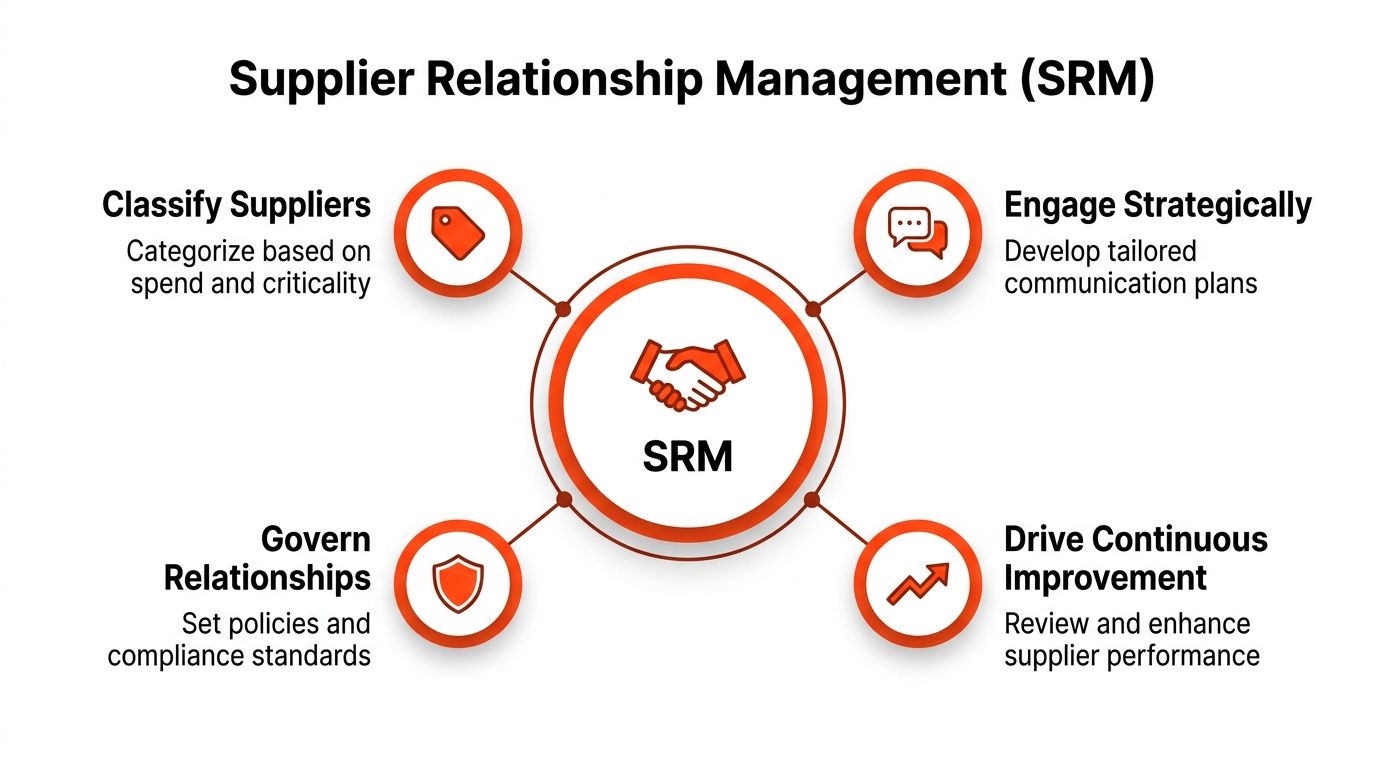
Supplier relationship management is the discipline of classifying suppliers, deciding how much effort each relationship deserves, and governing those relationships so they deliver the right kind of value. It sits closer to customer relationship strategy than to traditional purchasing, except the focus is on the organisations that supply your goods or services.
A clearer way to see it is through tiers. Some suppliers call for close collaboration, others need standard controls, and many only need efficient, repeatable administration. The mistake many teams make is assuming every supplier deserves the same level of attention. That approach is slow, costly, and usually unnecessary.
The gap between segmentation and treatment
The ANZ research gives a useful signal about where programmes stall. Many companies can segment suppliers, but far fewer turn that segmentation into a real treatment strategy. That gap is the difference between knowing who matters and acting accordingly. State of Flux ANZ SRM research
A treatment strategy answers a practical question. What do we do with this supplier now that we have placed it in a tier? For a strategic supplier, the answer might include joint planning, executive governance, and shared improvement targets. For a routine supplier, it may mean standard contracts, automated compliance checks, and a clear escalation path. The point is to match the operating model to the relationship, not to treat every supplier like a special case.
What the main supplier tiers mean
- Strategic suppliers: These relationships affect business continuity, differentiation, or innovation. They need deliberate governance, regular reviews, and clear ownership.
- High-spend suppliers: These suppliers matter because of spend or market alternatives. They often benefit from structured performance management and competitive pressure.
- Bottleneck suppliers: These are the suppliers you cannot easily replace. SRM here is about risk visibility, contingency planning, and lead-time discipline.
- Routine suppliers: These should be managed efficiently, with standardised onboarding, contracts, and exception handling.
The same logic applies to the systems behind procurement. how procure to pay automation works shows how transaction work can be stripped of unnecessary friction, while SRM removes friction from relationships once you have decided which suppliers merit hands-on management. For teams that need a practical operating view of customer-style segmentation, a customer data platform approach to supplier information can help make that distinction more consistent across categories.
Core Components and the SRM Maturity Model
Good SRM doesn't start with a software purchase. It starts with five building blocks that work together, segmentation, governance, performance management, collaboration, and risk management. If one of those is missing, the rest of the programme tends to wobble.
The five components that actually matter
Segmentation decides where effort goes. A business that groups suppliers only by spend will miss the ones that are operationally critical but not expensive. A better approach is to combine spend, criticality, and partnership potential so the supplier tier matches the business impact.
Governance defines who decides what. If procurement, operations, finance, and legal all think someone else owns the supplier, small issues linger. Strong governance creates decision rights, escalation paths, and review cadence that fit the tier.
Performance management turns supplier behaviour into visible outcomes. That means more than looking at a scorecard once a quarter. It means tracking quality, delivery, cost, risk, and collaboration in a way that supports action.
Collaboration is where SRM moves beyond compliance. This is the space for joint problem-solving, forecast sharing, and improvement work, but only where the relationship justifies that effort.
Risk management keeps the business honest. It asks whether a supplier is resilient, whether claims are verified, and whether dependency is becoming dangerous.
What maturity looks like in practice
At the initial stage, teams react to problems after they surface. At the defined stage, they standardise basic rules and roles. At the managed stage, they monitor the right KPIs and use those signals to steer intervention. At the optimised stage, they use supplier data to improve planning, resilience, and collaboration continuously.
The key is not to force every supplier into the same maturity level. A strategic partner may sit at a high level of collaboration, while a routine supplier only needs defined processes and clean data. That's where customer data platform thinking is useful, because the principle is the same. You don't over-engineer every record, you manage data according to business value.
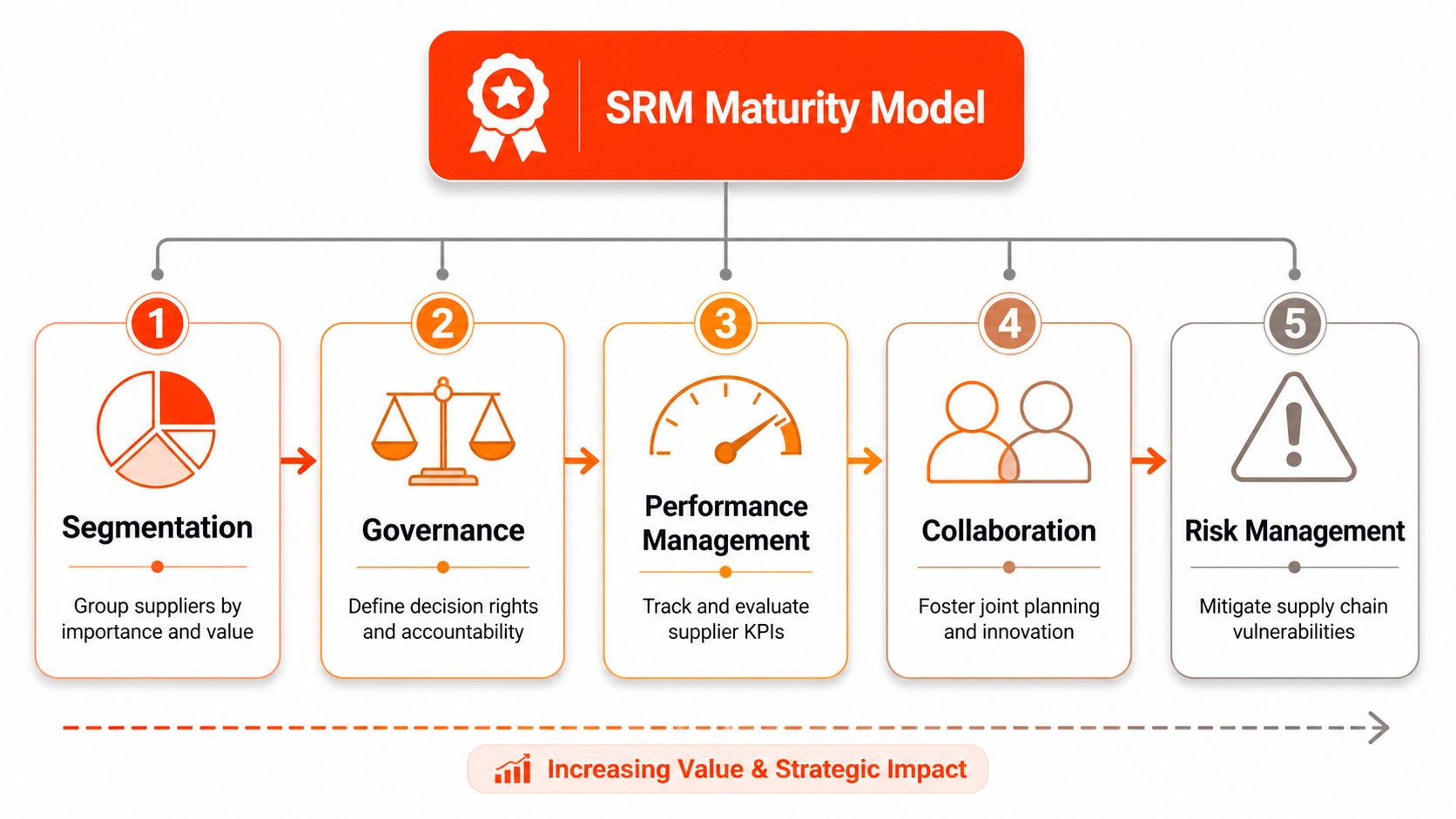
Supplier maturity isn't about perfection. It's about matching effort to criticality so the business gets stronger without wasting time.
Building Your SRM Implementation Roadmap
A workable SRM programme starts small, but it has to be deliberate. The biggest mistake is creating heavy governance for routine suppliers and then running out of energy for the suppliers that move the business.
Start with the supplier tiers, not the committee
The first move is to map the supplier base into practical tiers and then write down what each tier is supposed to achieve. If the tier doesn't change behaviour, it's probably too vague. If it creates more meetings but no clearer decisions, it's too heavy.
Next, set the minimum operating model for each group. Strategic suppliers might need monthly or quarterly business reviews, shared improvement plans, and executive visibility. Routine suppliers should have standard onboarding, simple compliance checks, and issue escalation only when something breaks.
Make the dashboard useful before you make it pretty
For AU-region supplier governance, a stronger design is to pair segmented tiers with KPI dashboards that track delivery, quality, cost, risk, and collaboration in real time. Control-band monitoring and exception alerts help teams spot drift earlier than periodic scorecards, so problems can be contained before they grow into stockouts or SLA breaches. ASCM guidance on data analytics for SRM
That matters because a dashboard that sits untouched is just decoration. The point is to build a rhythm where procurement, operations, and finance know which supplier signals trigger a conversation, a corrective action, or a change in tier.
A practical 90-day path looks like this:
- Days 1 to 30: Clean the supplier list, identify critical suppliers, and agree on the tier definitions.
- Days 31 to 60: Assign owners, define the minimum governance for each tier, and decide which KPIs belong on the dashboard.
- Days 61 to 90: Launch the review cadence, test escalation paths, and strip out any process that adds burden without improving control.
Rule of thumb: if a routine supplier needs the same governance as a strategic one, the design is wrong.
Measuring SRM Success with the Right KPIs
Most supplier dashboards look impressive and answer nothing. The useful ones show whether the relationship is making the business faster, safer, and easier to run.
Lead time first, because it drives operations
For Australian businesses, the most operationally useful SRM metric is supplier lead-time performance. Australian Bureau of Statistics business-survey methodology shows that supply disruption and delayed replenishment affect inventory adequacy, service continuity, and working-capital intensity, so lead time is not a soft metric, it's an operational signal. AGR Inventory on SRM data use
That's why SRM teams should segment suppliers by lead-time criticality and track lead-time variance, on-time-in-full, and escalation response time. Invoice data tells you what you paid. Annual reviews tell you how people felt. Neither one tells you whether the supplier is keeping the business supplied.
Three metrics that answer real questions
On-time-in-full shows whether the supplier is meeting the delivery promise in a way operations can use. It's especially useful when service levels depend on a steady inbound flow rather than just occasional large shipments.
Risk exposure is your way of measuring dependency, fragility, and verification quality. It's not about creating a scary number for the board, it's about knowing where the supply chain is vulnerable and where contingency work is needed.
Lead-time performance becomes the decision trigger. If the trend worsens, the business can adjust safety stock, escalate with the supplier, or change sourcing strategy before the issue turns into a service failure.
Make the metric drive action
A good dashboard asks one question. Is this supplier relationship making us more competitive? If the answer can't be read from the top row of the screen, the dashboard probably needs less noise and more decision logic.
If you're deciding how to connect SRM data to the rest of your systems, SCM vs ERP explained for AU firms is a useful way to separate operational execution from broader planning and governance. SRM works best when those boundaries are clear.
Technology, AI, and the Future of SRM
Technology helps SRM when it reduces friction, improves visibility, and makes escalation easier. It hurts SRM when teams buy tools before they have agreed on the rules, the ownership, and the review cadence.
Many Australian and ANZ teams still manage supplier information in spreadsheets, and satisfaction with SRM technology remains low, which says more about process maturity than software quality. The lesson is simple. Technology cannot fix a supplier operating model that has not been defined properly. State of Flux ANZ SRM research
What modern tools can do
A good SRM platform can centralise supplier records, show live performance, flag exceptions, and keep compliance documents in one place. AI can help surface suppliers that are drifting off track earlier, scan documents for missing fields, and reduce the admin load that makes SRM feel repetitive.
For teams thinking about predictive signals in supply chains, Logivo's predictive analytics guide is a useful reference for how analytics can support earlier intervention without pretending to replace human judgement.
What tools still can't do
Software will not build trust with a supplier. It will not settle a commercial disagreement, and it will not decide whether a relationship deserves deeper collaboration or tighter control. Those calls still need experienced people who understand the commercial context and the trade-offs between service, cost, and risk.
That is why the safest adoption path is staged. Start with clean supplier data, then move to dashboards and exception management, then add risk scoring and document checks once the process is stable. If you jump straight to advanced AI before the basics are in place, you automate confusion instead of control.
The same caution applies to governance and privacy. Supplier data often includes sensitive commercial and compliance information, so data privacy compliance needs to sit alongside any technology rollout. Tools should support the operating model, not outrun it.
Real-World SRM in Practice Case Examples and Common Pitfalls
One Australian manufacturer built a tiered SRM model and kept its routine suppliers on standard controls while giving its critical suppliers tighter governance and regular improvement reviews. The team stopped wasting time on low-value relationships, and procurement spent more energy where service failures would have hurt the business most.
A second business took the opposite route. It created high-touch processes for almost every supplier, built elaborate review meetings, and buried the team in administration. The programme looked mature on paper, but it was too expensive to sustain and too slow to matter.
The mistakes that break programs
- Treating every supplier the same: This creates wasted effort and makes the team blind to true criticality.
- Collecting data without acting on it: A dashboard that never triggers a decision becomes background noise.
- Lacking executive sponsorship: SRM needs visible support when it changes how teams prioritise time and risk.
- Ignoring routine supplier governance: The bottom 80% still needs structure, just not heavyweight relationship management.
- Letting technology replace judgement: Tools can surface signals, but people still need to decide what those signals mean.
Recent SRM guidance also shows the direction of travel. Supplier onboarding is increasingly tied to documentation, certifications, ESG data, and compliance checks, so the next phase of SRM is less about squeezing price and more about improving resilience, data quality, and verified performance. The businesses that get this right won't just manage suppliers better, they'll make their operating model harder to disrupt.
If your procurement team wants supplier relationship management that works beyond the strategic few, Click Click Bang Bang can help you turn complex supplier programs into clearer digital journeys and sharper visibility. Visit Click Click Bang Bang to see how a data-led approach can support the systems, content, and lead generation work behind a stronger operating model.
Read NeXt
Or Read Our Latest
- Localization Strategy: How to Win in Any Market
- Phone Call Tracking: Methods, Metrics, and Best Practices
- Supplier Relationship Management: Strategic Guide 2026
- Reporting Portal Login: Access Your Client Dashboard Fast
- How to Calculate Sample Size for A/B Tests and Campaigns
- How to Fix Google Merchant Center Errors Step by Step
Click. CLick. Subscribe.
Get our best PPC insights, industry updates, and power moves delivered straight to your inbox. No fluff, just high-caliber strategies that actually work.
Don’t Leave Just Yet
Try Us For 30-Days,
Risk Free!!
We guarantee that you’ll love our work within the first 30 days, if not you’ll get your money back.
What have you got to lose?