

Your Guide to Finding an AdWords Management Company
Last Updated

So, what exactly is an AdWords management company? Think of them as a specialist agency that lives and breathes pay-per-click (PPC) advertising on Google Ads. They handle the entire process for you—from digging into keyword research to tracking every click and conversion.
Essentially, they become your strategic partner, making sure your advertising budget isn't just being spent, but is actively generating real, measurable growth and a solid return on your investment.
Why Smart Businesses Hire an AdWords Management Company

Ever found yourself staring at your Google Ads dashboard, wondering where all the money went? You're definitely not alone. Many business owners jump into Google Ads expecting a straight line to new customers, only to discover a complex, unforgiving system where budgets can vanish with very little to show for it.
The real challenge is turning that ad spend into actual profit. Most self-managed campaigns stumble because of the platform's constant updates, inefficient budget allocation, and the sheer amount of time it takes to truly master the art and science of PPC. This is exactly where a professional AdWords management company changes the game.
The Value of Specialised Expertise
Don't think of an expert agency as just another service provider. They're more like a specialist financial advisor, but for your digital advertising portfolio. Their entire job is to navigate the complexities for you, using their deep industry knowledge to steer you away from expensive mistakes.
This dedicated focus means they can:
- Maximise Your Budget: They ensure every dollar is spent targeting the right people with the right message, cutting out the waste from irrelevant clicks.
- Stay Ahead of Changes: Google Ads is in a constant state of flux. An agency’s job is to master every update so your campaigns don't just survive, but thrive.
- Provide Strategic Insight: They’re experts at turning raw data into actionable strategies, spotting growth opportunities you might otherwise miss.
The need for this kind of professional oversight is backed by the numbers. By 2025, an estimated 65% of Australian SMBs will be running active PPC campaigns—a massive jump from just 26% back in 2016. But running a campaign doesn't guarantee success. A shocking 88% of keywords in typical accounts generate zero sales, leading most SMBs to waste around 61% of their budget on poor targeting.
Hiring an agency is about reclaiming your most valuable asset: time. It pulls you out of the technical weeds of managing campaigns and lets you get back to what you do best—running and growing your business.
Of course, when you're thinking about bringing in an AdWords management company, the first question is often whether to hire externally or build a team in-house. Getting your head around the In-House vs Agency Marketing debate is a crucial first step to making a decision that truly fits your company's resources and long-term goals.
What a Top AdWords Agency Actually Does
Jumping into Google Ads for the first time can feel a bit like trying to pilot a jumbo jet with only a car licence. You know where you want to go, but the dashboard is a dizzying mess of dials, switches, and acronyms. This is exactly where a top-tier AdWords management company comes in. They're not just there to push buttons; they’re your expert flight crew, navigating your campaigns to a profitable destination.
So, what are they really doing behind the scenes? It's a constant cycle of strategy, execution, and relentless tweaking, all designed to turn your ad spend into a powerful growth engine. It starts with getting under the hood of your business and ends with real, measurable results that hit your bottom line.
A professional agency doesn’t just manage ads; they build entire customer acquisition machines.
Strategic Campaign Architecture
Before a single dollar of your budget is touched, an expert agency lays the groundwork. This isn't about guesswork. It's a methodical process of designing campaigns that are perfectly aligned with your business goals. They don't just ask, "Who is your customer?" They dig deeper, asking, "What problem does your customer need solved right now?"
This foundational work is crucial and includes:
- Deep Keyword Research: This goes way beyond the obvious search terms. It's about uncovering high-intent, low-competition keywords that your competitors have completely missed. Think of it as finding untapped oil reserves while everyone else fights over the same crowded wells.
- Competitor Analysis: Systematically pulling apart what your rivals are doing, finding their weaknesses, and building a strategy to outsmart them where it counts.
- Network Selection: Deciding the right mix of Google Search, Shopping, Display, and YouTube campaigns. A local plumber needs to be front-and-centre in local search results, while an e-commerce brand might get all its traction from highly visual Google Shopping ads. The strategy always dictates the platform.
Flawless Execution and Creative Development
With the blueprint locked in, the agency shifts to execution. This is where the art of persuasion meets the science of data. They craft every single element of your campaign to grab attention and drive action, making sure the journey from that first click to the final sale is as smooth as possible.
This phase is all about precision:
- Compelling Ad Copy: Writing ads that speak directly to a user's pain points and aspirations. A great ad doesn't just list a product's features; it sells a solution and creates an urgent need to click.
- Landing Page Optimisation: Making sure the page someone lands on after clicking an ad is a perfect continuation of that ad's promise. A clunky, disjointed experience is one of the fastest ways to waste ad spend.
- Conversion Tracking Setup: Putting sophisticated tracking in place to measure every valuable action, from a form submission to a phone call or an online purchase. Without this, you’re flying completely blind.
An AdWords management company turns abstract business goals into tangible digital actions. They connect the dots between a user's search query and your company's revenue, making every click count.
Continuous Optimisation and Growth Scaling
Launching a campaign is just the start. The real value of an AdWords management company comes from the ongoing process of refining and optimising. The digital marketplace is never static, and your campaigns shouldn't be either. It’s a continuous loop of testing, learning, and improving.
An agency is constantly working on:
- Strategic Bid Management: Using a mix of automated and manual bidding strategies to ensure you're paying the right price for every click, maximising your budget's impact.
- A/B Testing: Relentlessly testing different ad headlines, descriptions, and calls-to-action to discover the combinations that deliver the highest click-through and conversion rates.
- Performance Reporting: Translating complex data into clear, actionable insights. A great report doesn’t just show you numbers; it tells you a story about what’s working, what isn’t, and what the next strategic move should be.
This whole process is so much more than simple administration. If you're looking to understand the full scope of what this kind of partnership can offer, exploring detailed Google Ads management services can provide much deeper clarity. Ultimately, a top agency transforms your Google Ads account from a cost centre into a predictable and scalable source of new business.
Decoding Agency Pricing and Your Expected ROI
Let's talk money. Understanding how an AdWords management company charges is the first step, but it's only half the story. You can't just look at the monthly fee; you have to connect that cost directly to the results it can deliver for your business.
Think of it this way: agency pricing isn't an expense. It's an investment in a predictable growth engine. The most common pricing models you'll come across are actually designed to align the agency's success with yours. The right one for you will depend on your budget, your goals, and how aggressively you want to scale.
This flowchart maps out the decision-making process, showing exactly when and why a business decides it's time to call in an expert.
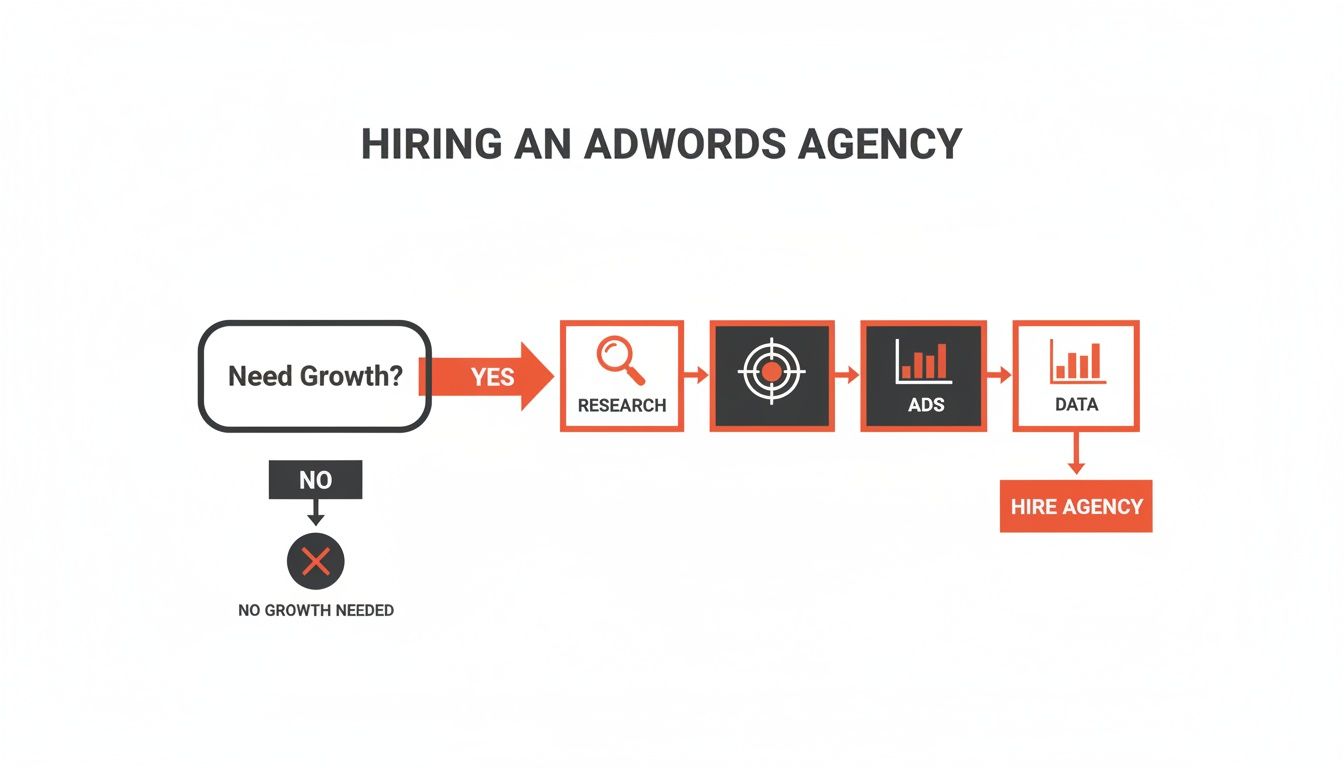
As you can see, getting real growth from paid ads hinges on a solid process of research, ad creation, and data analysis—which, not coincidentally, are the core functions an agency takes off your plate.
Common Agency Pricing Models
Once you start getting proposals, knowing the logic behind the numbers makes everything clearer. Most agencies use one of three main structures, or sometimes a hybrid that blends elements from each.
Here’s a quick rundown of what you’ll likely see:
- Percentage of Ad Spend: This is probably the most common model out there. The agency’s fee is a set percentage—usually 10-20%—of your monthly ad budget. It scales up or down with your spend, which is great for businesses that are planning to ramp up their investment over time.
- Flat-Rate Retainer: Simple and predictable. You pay a fixed monthly fee, no matter what your ad spend is. This is a solid choice for businesses with stable budgets who need consistent, reliable management and reporting without any surprises.
- Performance-Based Pricing: This is the ultimate partnership model. The agency's fee is tied directly to the results they generate, like the number of qualified leads or sales. It’s the lowest-risk option for you, but it can also be the most expensive when the campaigns are firing on all cylinders (which is a good problem to have!).
Getting your head around these different structures is key to finding a partnership that feels both fair and motivating. For a deeper dive, check out our complete guide on PPC pricing models to see which one fits your financial strategy best.
Connecting Cost to Tangible ROI
The real question isn't "How much does it cost?" but rather, "What kind of return can I actually expect?" This is where professional management really proves its worth.
The Australian online advertising industry is massive—it hit $17.1 billion in 2025. But here’s the scary part: a staggering 45% of small businesses see their campaigns fail within 90 days because of a poor strategy. An expert agency is the antidote to all that wasted ad spend.
A top-tier firm consistently delivers returns that turn ad spend into a serious revenue driver. For example, we often see tradie businesses generate 50-60 qualified calls a month from a modest $1,200 budget. That works out to a super-efficient cost per lead of around $21.
Return on Ad Spend (ROAS) is the metric that matters most. An agency’s entire goal is to make sure that for every dollar you put into Google Ads, you get multiple dollars back in revenue. A well-managed campaign isn't a cost centre; it's a profit centre.
This shift in perspective is everything. Stop seeing the agency fee as a deduction from your budget. Instead, see it as the fuel required to unlock the full power of your ad spend. The right AdWords management company doesn't just tweak your account; they build a scalable customer acquisition machine that drives your business forward.
How to Choose the Right Agency Partner

Picking an AdWords management company is one of the biggest marketing decisions your business will make. This isn't just hiring a vendor; you're choosing a strategic partner who will have their hands directly on your growth engine.
Get it right, and you'll unlock scalable, profitable results. Get it wrong, and you could burn through thousands on a partnership that delivers nothing but frustration.
The good news? The best agencies leave a trail of clues. You just need to know what to look for and which questions to ask. A structured evaluation process helps you cut through the sales pitches and find a partner genuinely invested in your success.
Start with Their Digital Footprint
Before you even jump on a call, an agency's own website is your first piece of evidence. How they market themselves is a direct reflection of the quality and attention to detail they'll bring to your campaigns. A great agency always practises what it preaches.
Start by looking for these key signals:
- Clear Case Studies with Real Numbers: Vague success stories are a dime a dozen. You want case studies showing specific metrics, like a 30% reduction in Cost Per Acquisition (CPA) or a 250% increase in Return on Ad Spend (ROAS). Real results are always backed by real data.
- Google Partner Status: Look for the official badges, especially the Google Premier Partner badge. This isn't just a pretty logo; it means Google has recognised the agency for meeting tough requirements for client growth, ad spend, and team certifications. It’s a powerful third-party vote of confidence.
- Transparent Team Information: Can you see who actually works there? A professional agency is proud of its people and will often feature profiles of its account managers and strategists. Total anonymity is a huge red flag.
Critical Questions for Your Consultation
Once an agency passes the initial website sniff test, it's time for a proper chat. This is your chance to dig deep into their process, communication style, and strategic thinking. Don't be afraid to ask the tough questions—a confident, capable agency will welcome them.
Here's a checklist of questions you need to ask any potential AdWords management company.
Agency Evaluation Checklist Key Questions
To properly vet a potential agency, you need to go beyond surface-level questions. This table outlines the critical areas to probe and what a solid answer should sound like.
| Area of Inquiry | Critical Question to Ask | What a Good Answer Looks Like |
|---|---|---|
| Team & Expertise | Who will be my day-to-day contact, and what is their experience level? | You'll hear a specific name and title, not "a member of our team." They'll talk about the strategist's years of experience, certifications, and perhaps their background in your industry. |
| Onboarding & Strategy | What is your process for the first 90 days? | A structured, phased plan. It should cover account audits, competitor analysis, strategy development, campaign builds, and clear performance milestones. Vague answers are a warning sign. |
| Performance Measurement | How do you measure success beyond clicks and impressions? | The answer should immediately pivot to business metrics: leads, sales, cost per lead, ROAS, and customer lifetime value. If they focus on vanity metrics, they don't get it. |
| Transparency & Reporting | Can I see an example of a performance report? | Yes, absolutely. A good report tells a clear story, highlighting wins, challenges, and the strategic plan for the next month. It should be easy to understand, not a data dump. |
| Account Ownership | What level of access will I have to my Google Ads account? | "You will have full administrative access and ownership at all times." Any agency that insists on creating an account in their name is a massive red flag. You must always own your data. |
These questions help you separate the talkers from the doers. An agency that can answer these confidently is likely a contender.
A great partnership is built on trust and transparency. If an agency is evasive about its process, team, or reporting, it's a clear sign to walk away. The right partner will be an open book.
Red Flags to Watch Out For
Just as important as knowing what to look for is knowing what to run from. Some agencies use slick promises and high-pressure sales tactics to get you signed, only to disappear once the invoice is paid.
Be on high alert for any agency that:
- Guarantees #1 Rankings or Specific Results: This is simply impossible in PPC. No one can guarantee outcomes in a live auction environment where market conditions are always changing. It's a classic sign of someone who will say anything to close a deal.
- Uses Vague, Jargon-Filled Language: If they can't explain their strategy in simple, business-focused terms, they either don't understand it themselves or are trying to hide a lack of real substance.
- Locks You into Long-Term Contracts: Confident agencies prove their value every single month. While a minimum 3-6 month commitment is reasonable to allow time for strategy to work, anything longer right out of the gate should make you nervous.
- Lacks Industry-Specific Experience: While not always a deal-breaker, an agency with a proven track record in your sector will understand your market's nuances and get up to speed much, much faster.
Choosing the right agency is a process of careful due diligence. By using this framework, you can move beyond the sales pitch and find a true partner who will help you grow.
Your First 90 Days with a New Agency
Signing on the dotted line with a new AdWords management company is a great first move, but it’s really just the starting gun. The next 90 days are where the real work begins—it's all about building a solid foundation for long-term growth. This period is a flurry of deep-dive discovery, strategic planning, and careful setup, all designed to turn your business goals into campaigns that actually perform.
Think of it like building a custom home. You don't just show up and start hammering on day one. First, you sit down with the architect (your agency) to go over the blueprints (your business goals), survey the land (audit your existing accounts), and lay the essential groundwork (tracking and technical setup). This initial phase is about precision and planning, making sure what gets built is exactly what you need.
Month 1: The Discovery and Foundation Phase
The first 30 days are all about collaboration and deep learning. Your new agency partner is going to be like a sponge, soaking up everything they can about your business, your customers, and the competitive landscape. This goes way beyond just keywords; it's about understanding the core mechanics of what makes your business tick.
This foundational month usually involves:
- Kick-off and Discovery Call: A detailed sit-down where you'll get into the weeds of your target audience, unique value proposition, business objectives, and any past performance data you have.
- Comprehensive Account Audit: The agency will dive headfirst into your existing Google Ads account (if you have one) to sniff out quick wins, historical roadblocks, and untapped potential.
- Conversion Tracking Setup: This is absolutely non-negotiable. They will make sure every single valuable action—from a form fill to a phone call—is tracked with pinpoint accuracy. Without this data, optimising for profit is just guesswork.
This period is about aligning expectations and getting a solid technical and strategic base in place. Essentially, the agency is translating your business knowledge into the language of Google Ads.
Month 2: Strategy, Build, and Launch
With the groundwork laid, the second month is all about action. The insights gathered in month one are now used to construct and deploy your new campaigns. This isn't just about flicking a switch; it's about building a campaign structure designed for performance and scalability right from the get-go.
Key milestones during this phase include:
- Strategy Presentation: Your agency will walk you through a detailed campaign strategy. This will cover target keywords, ad group structures, ad copy themes, and budget allocation, all for your approval.
- Campaign Build-out: This is the nuts-and-bolts part where strategists meticulously build out the campaigns according to the approved plan.
- Campaign Launch: The new campaigns go live, and the first streams of real-world data start flowing in. This is when the real learning and testing begins.
The goal of the launch isn’t instant perfection; it's to gather clean, real-world performance data. This data is the raw material the agency will use to refine and optimise your campaigns in the coming weeks.
Month 3: Optimisation and Reporting Rhythm
In the third month, the focus shifts entirely to performance. The initial data provides clear signals on what’s hitting the mark and what’s falling flat. Your agency will now be in a constant cycle of analysing data, testing hypotheses, and refining campaigns to squeeze out better results.
This is where you'll see them:
- Adjusting Bids: Pushing budget towards high-performing keywords and ad groups while strategically pulling back from the ones that aren't pulling their weight.
- A/B Testing Ad Copy: Continuously running tests on new headlines and descriptions to improve click-through rates and, more importantly, conversion rates.
- Refining Targeting: Honing in on the most profitable audiences, geographic locations, and devices to maximise your return.
By the end of 90 days, you should have a stable, optimised campaign, a clear and consistent reporting rhythm, and a strong collaborative partnership with your agency. This structured start is what sets your investment up for sustained, long-term growth.
Measuring What Matters for Business Growth

Success with Google Ads isn't about chasing vanity metrics. Clicks and impressions might look good on a chart, but they don’t pay the bills. True success is measured in profit, and a skilled AdWords management company will always steer your focus towards the key performance indicators (KPIs) that directly impact your bottom line.
Think of it like this: clicks are people walking into your shop, but conversions are the ones who actually buy something. An agency’s real job is to bring you more buyers, not just window shoppers. They do this by obsessively tracking the metrics that connect ad spend to real-world business results, ensuring every dollar invested is pulling its weight.
This shift in focus from mere activity to tangible outcomes is the hallmark of a professional partnership.
KPIs That Drive Business Decisions
Forget drowning in a sea of data. A top-tier agency simplifies your reporting down to a handful of powerful metrics that tell the real story of your campaign's health and profitability. These KPIs are the language of growth.
The three most important metrics you should demand in every report are:
- Cost Per Acquisition (CPA): This is the ultimate bottom-line number. It tells you exactly how much you're spending to get one new customer or qualified lead. A low and stable CPA means your campaigns are running like a well-oiled machine.
- Return on Ad Spend (ROAS): For every dollar you put into Google Ads, how many dollars in revenue are you getting back? A ROAS of 4:1 means you're making $4 for every $1 spent. This is the clearest indicator of raw profitability.
- Conversion Rate: This is the percentage of people who click your ad and then take the action you want, like making a purchase or filling out a form. A high conversion rate is a sign that your ads and landing pages are perfectly aligned with what your audience is looking for.
To truly understand campaign effectiveness, you need to master key digital marketing performance metrics that go beyond just ad spend. For a deeper look, check out our complete guide on https://clickclickbangbang.com.au/how-to-measure-advertising-effectiveness/.
What a Valuable Report Looks Like
A genuinely useful performance report does more than just throw numbers at you; it tells a story. It should connect the dots between the actions your agency took, the results those actions produced, and the strategic plan for the coming month. It’s a roadmap, not just a rearview mirror.
A great report doesn't just show you data; it gives you clarity. It should answer three simple questions: What happened? Why did it happen? What are we doing next?
The good news is that with professional guidance, achieving a strong return isn't a long shot—it's highly attainable. In fact, research shows that 68% of Australian small businesses see a positive ROI after just six months of professionally managed Google Ads. They hit an average ROAS of 200%.
This is powerful proof of how an expert AdWords management company can overcome the initial hurdles that cause 62% of businesses to fail on their own. By understanding these core metrics, you can confidently evaluate your agency's performance and make informed decisions that fuel sustainable business growth.
Frequently Asked Questions
Even with a solid plan, it’s completely normal to have a few last questions before you bring an AdWords management company on board. Things like contracts, who owns the account, and realistic timelines are practical concerns every business owner thinks about. Here are the straightforward answers to the questions we hear most often.
We want to clear up any lingering uncertainties so you can move forward with confidence.
How Long Until I See Real Results?
This is the big one, and the honest answer is: it depends. You'll see data like clicks and impressions almost right away, but the results that actually matter to your business—like a steady stream of good leads or sales—take time to build.
As a general rule, you should plan for a 90-day period for the initial heavy lifting and optimisation.
- Month 1 is all about laying the groundwork. We’re gathering data, running initial tests, and getting everything set up correctly.
- Months 2 and 3 are for refining the strategy. We use the real-world performance data we’ve collected to improve efficiency and scale up what’s clearly working.
While quick wins are great and happen often, sustainable, profitable growth is a marathon, not a sprint. Any agency promising you the world overnight should be viewed with a healthy dose of scepticism.
Do I Own My Google Ads Account?
Yes, absolutely. You must always have full ownership and administrative access to your Google Ads account. This is non-negotiable and a standard practice for any reputable AdWords management company. Your account holds invaluable historical data that belongs to your business, period.
A massive red flag is an agency insisting on creating an account under their name that you can’t fully access. This effectively holds your data hostage, making it incredibly difficult to leave if the partnership doesn't work out.
Transparency is everything, and that starts with you owning your own assets. A professional partner works within your account, not locks you out of it.
Are Long-Term Contracts Required?
Most professional agencies won't try to lock you into a rigid, long-term contract from day one. A typical engagement kicks off with a 3 to 6-month initial commitment. This is a perfectly reasonable timeframe that gives the agency enough runway to implement their strategy, gather meaningful data, and show you some tangible results.
After that initial phase, many partnerships simply roll over to a month-to-month agreement. This model is great because it keeps the agency accountable; they have to keep delivering value to keep your business. Be wary of any company demanding a 12-month commitment right out of the gate without a proven track record with your business first.
Ready to see how a data-driven, AI-first approach can turn your ad spend into predictable growth? Click Click Bang Bang offers a 30-day, risk-free trial to prove our value. https://clickclickbangbang.com.au
Read NeXt
Or Read Our Latest
- How to Set Up Google Ads in Australia: Complete 2026 Guide
- Google Merchant Center Setup: The Complete 2026 Guide
- Business Manager Setup Facebook: The Complete 2026 Guide
- Google Ads Account Setup: Expert Guide for 2026
- Search Ads Optimisation: A Practical Guide for 2026
- Manual vs Automated Bidding for PPC Success
Click. CLick. Subscribe.
Get our best PPC insights, industry updates, and power moves delivered straight to your inbox. No fluff, just high-caliber strategies that actually work.
Don’t Leave Just Yet
Try Us For 30-Days,
Risk Free!!
We guarantee that you’ll love our work within the first 30 days, if not you’ll get your money back.
What have you got to lose?