

Best Seo Agency Australia Guide 2026
Last Updated

You're probably here because you've spoken to a few SEO agencies already, and they've all sounded strangely similar. Everyone says they'll improve rankings. Everyone says they understand Google. A few may have promised quick wins, page-one visibility, or a flood of leads.
That's where a lot of Australian businesses get stuck.
Choosing an SEO partner isn't like buying software or comparing printer quotes. It's closer to choosing a financial adviser or a builder. The work happens behind the scenes, the quality gap between providers is wide, and the wrong hire can waste months of budget while leaving you with little more than vague reports and excuses.
A good SEO agency helps you build a reliable source of qualified traffic and enquiries. A poor one sells activity, not outcomes. If you're evaluating a SEO agency Australia shortlist right now, the goal isn't to find the cheapest option or the loudest salesperson. It's to find a team that can connect search visibility to leads, sales, and commercial priorities in the Australian market.
Navigating the Australian SEO Agency Market
The Australian SEO market is crowded because demand is real. Businesses across retail, services, B2B, and healthcare all want the same thing. More qualified traffic without relying only on paid ads.
That demand has created a large and still-growing category. The SEO services market in Australia is valued at approximately AUD 1.5 billion and is projected to grow to $2.5 billion in 2025, according to this Australian SEO market analysis. The same source notes that this sits inside a broader digital advertising agency sector that reached $4.1 billion in 2026.

Why this decision matters more than it used to
SEO used to be treated as a side channel. Many businesses saw it as a nice extra after Google Ads, Meta, or email. That's no longer how smart operators treat it.
Search visibility now affects how buyers discover brands, compare suppliers, and short-list providers. If your site doesn't appear when Australians search for your service, a competitor gets that attention first. In practice, that means SEO isn't a line item you tack on later. It's part of your digital infrastructure.
Here's the trade-off most owners face:
| Decision | Likely outcome |
|---|---|
| Choose on price alone | You often get templated work, weak strategy, and reporting that doesn't connect to leads |
| Choose on promises alone | You risk buying fantasy metrics and unrealistic timelines |
| Choose on process, proof, and fit | You give yourself a realistic shot at sustainable growth |
Practical rule: If an agency makes SEO sound easy, instant, or guaranteed, they're usually skipping the hard parts that actually create value.
What makes Australia-specific SEO different
An Australian campaign isn't just a generic English-language SEO plan with “AU” sprinkled on top. Search behaviour differs by city, service area, and intent. A national e-commerce brand has very different needs from a tradie targeting Brisbane suburbs or a B2B firm selling into Sydney and Melbourne.
That's why the right agency doesn't just talk about rankings. They talk about location relevance, search intent, conversion tracking, and commercial outcomes.
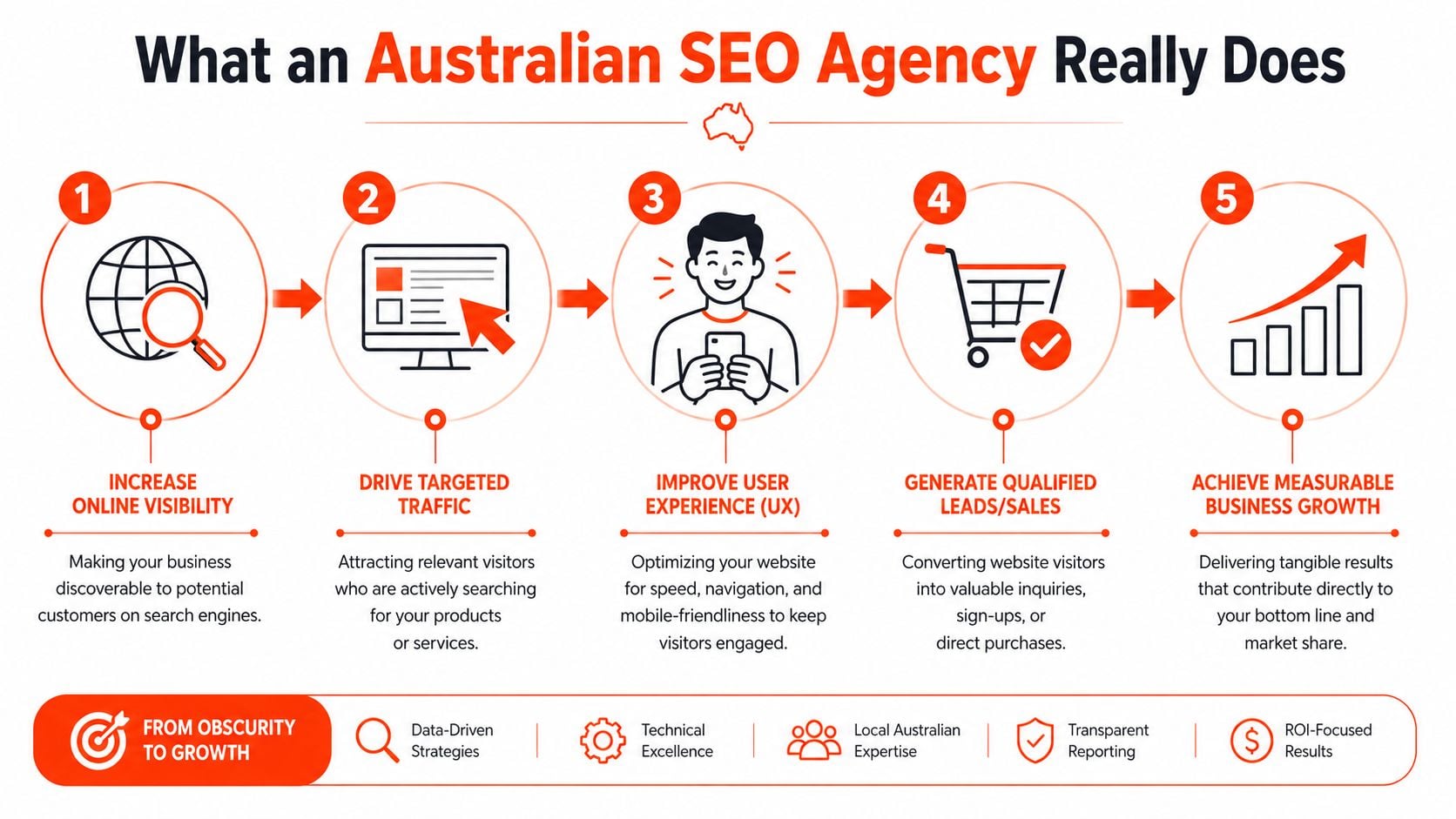
What an Australian SEO Agency Really Does
Most businesses don't hire an agency because they want “SEO”. They hire one because they want more profitable traffic from search.
A capable SEO agency Australia should function like the team responsible for making your best physical store easy to find, trustworthy to visit, easy to explore, and persuasive enough to generate sales. If your website were a flagship shop in a busy city centre, SEO would cover the building, the signage, the staff training, the product layout, and the reputation that gets people through the door.
The technical foundation
This is the part clients often don't see, but it affects everything. Agencies review crawl issues, indexing problems, site structure, internal linking, page speed, mobile usability, schema, redirects, and duplicate content. Tools like Google Search Console, GA4, Screaming Frog, and Ahrefs are standard here.
If the site has technical friction, content alone won't carry the campaign. Google has to understand your pages before it can rank them confidently.
The content and intent layer
Good agencies don't just publish blog posts for the sake of volume. They map pages to search intent.
That usually means work such as:
- Service page improvement so core commercial pages match what Australian buyers search for
- Category and product optimisation for retailers that need stronger non-branded traffic
- Content planning around comparisons, use cases, pricing questions, and problem-aware searches
- Content refreshes on ageing pages that have slipped or no longer reflect current search intent
For online retailers, this often overlaps with merchandising and category structure. If you sell products online, this guide to effective SEO for online stores is useful because it shows how search performance and store architecture affect each other.
Authority and trust building
Links still matter, but the way agencies talk about them tells you a lot. Credible teams focus on relevance, quality, and brand trust. Weak operators talk about volume.
Authority work can include digital PR, industry citations, local listings, strategic outreach, and reclaiming brand mentions. For local businesses, Google Business Profile management also plays a major role.
SEO work that improves rankings but sends the wrong visitors is incomplete. Traffic only matters when the visitor was likely to buy, enquire, or book.
Measurement that connects to revenue
The final pillar is the one too many agencies hide behind dashboards. Real SEO measurement ties visibility to business outcomes.
An agency should be able to explain:
- Which pages drive commercial intent
- Which keywords align with revenue goals
- How organic enquiries are tracked in GA4
- What changed on the site and why
- Whether the campaign is improving lead quality, not just traffic volume
If they can't explain that clearly, they're probably managing SEO as a checklist rather than a growth channel.
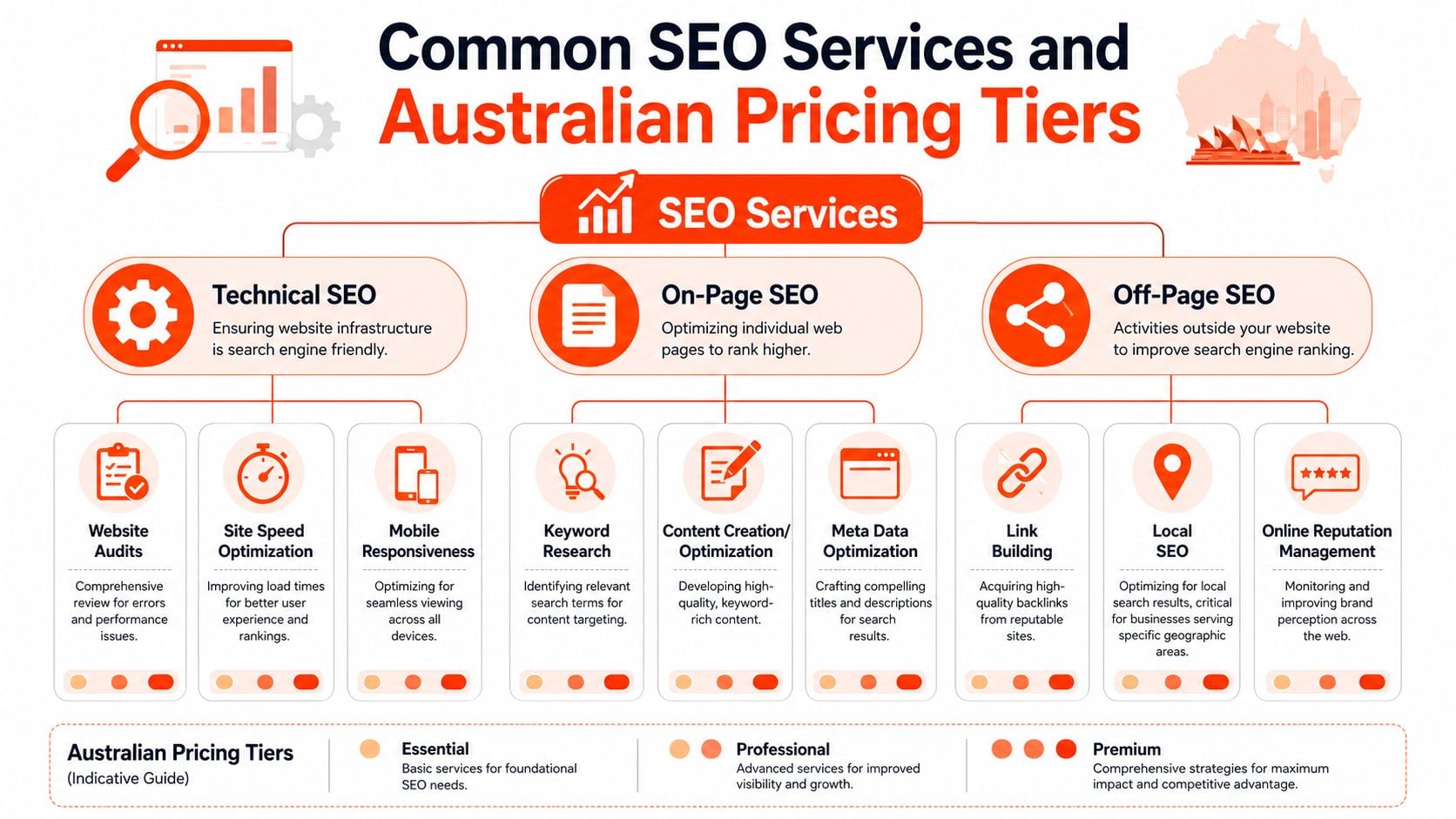
Common SEO Services and Australian Pricing Tiers
The first question most business owners ask is simple. What do I get each month, and what should it cost?
In Australia, pricing varies because scope varies. A local service business targeting one city doesn't need the same level of work as an enterprise site with thousands of pages, multiple regions, and a complex CMS.
According to this Australian SEO pricing guide for 2026, small businesses typically invest AUD $800 to $2,500 per month, mid-market firms spend $2,500 to $6,000, and enterprise clients pay over $6,000. The same source reports an average published entry-level retainer of around $1,496 per month, while 78% of agencies don't publish prices and instead rely on custom quotes.
What lower-tier retainers usually cover
At the lower end, businesses are often paying for a narrower scope. That can still work if the site is small, the market isn't heavily contested, and the goals are local.
Typical inclusions often look like this:
- Technical hygiene such as audits, indexation checks, and fixing obvious site issues
- On-page updates to titles, meta descriptions, headings, and internal links
- Basic local SEO including Google Business Profile work and citation clean-up
- Limited content production focused on a few priority pages each month
This tier can be enough for a small operator, but not if you expect enterprise-level output.
What mid-market budgets should buy
This is usually where strategy becomes more substantial. You should expect a clearer roadmap, stronger reporting, deeper technical input, and more active content development.
A mid-market engagement often includes:
| Area | What should happen |
|---|---|
| Technical SEO | Broader audits, implementation guidance, crawl analysis |
| Content | New service pages, supporting articles, refreshes, search intent mapping |
| Authority | Outreach, link acquisition strategy, local trust signals |
| Measurement | GA4 conversion tracking, clearer lead attribution, regular reporting |
If you want a broader view of how businesses assess budgets, this overview of SEO cost in Australia is a practical reference point.
Enterprise and complex campaigns
Once you move above the mid-market tier, the work usually becomes less about isolated fixes and more about coordination. Large websites often need input across development, analytics, content, UX, and governance. The agency may also be managing multiple stakeholder groups, product lines, or service regions.
That's why price alone can mislead. A cheap proposal might not be a bargain. It may exclude the work required to move the needle.
A fair SEO quote should show scope, not just a monthly fee. If you can't tell what work is happening, you can't judge whether the price is justified.
The Business Case for Hiring a Professional Agency
SEO looks deceptively simple from the outside. Publish content, add keywords, get links, wait for rankings. In practice, that approach usually creates uneven results because each part affects the others.
A professional agency earns its fee by combining disciplines that most businesses don't have in-house at the same level. Technical diagnosis, information architecture, keyword research, copy strategy, analytics setup, local optimisation, and link acquisition rarely sit with one person. When a company tries to force all of that onto a marketing manager or founder, corners get cut.
A useful benchmark comes from this overview of SEO services in Australia, which notes that credible SEO contracts in Australia range from $1,500 to $6,000 AUD per month and that this cost reflects the operational overhead needed to execute strategies that measure revenue or pipeline value from organic sessions, not vanity metrics.
What businesses underestimate about DIY SEO
The hidden cost of doing it yourself isn't just time. It's misdirected effort.
Common DIY patterns include:
- Writing content without search intent so pages attract readers who never convert
- Fixing surface issues only while crawl, internal linking, or template problems remain
- Tracking rankings but not enquiries which creates reporting without business context
- Chasing tactics from overseas markets that don't map neatly to Australian search behaviour
Where agencies create leverage
A good agency shortens the path between problem and action. They already know which issues matter, which tools to use, and how to prioritise work when resources are limited.
That advantage usually comes from:
- Tool access through platforms such as Ahrefs, Screaming Frog, Google Search Console, and GA4
- Pattern recognition from seeing what repeatedly works across different site types
- Process discipline so technical fixes, content, and reporting don't happen in isolation
If you're weighing structure as much as skill, this comparison of in-house and agency marketing teams is worth reading because it helps clarify where outsourcing makes sense and where internal ownership still matters.
The real ROI question
The right question isn't “Can an agency improve rankings?” Most competent teams can improve some rankings.
The better question is whether they can turn organic search into a more dependable source of leads or sales than your current setup. That's where professional SEO stops being a marketing expense and starts acting like an investment in growth capacity.
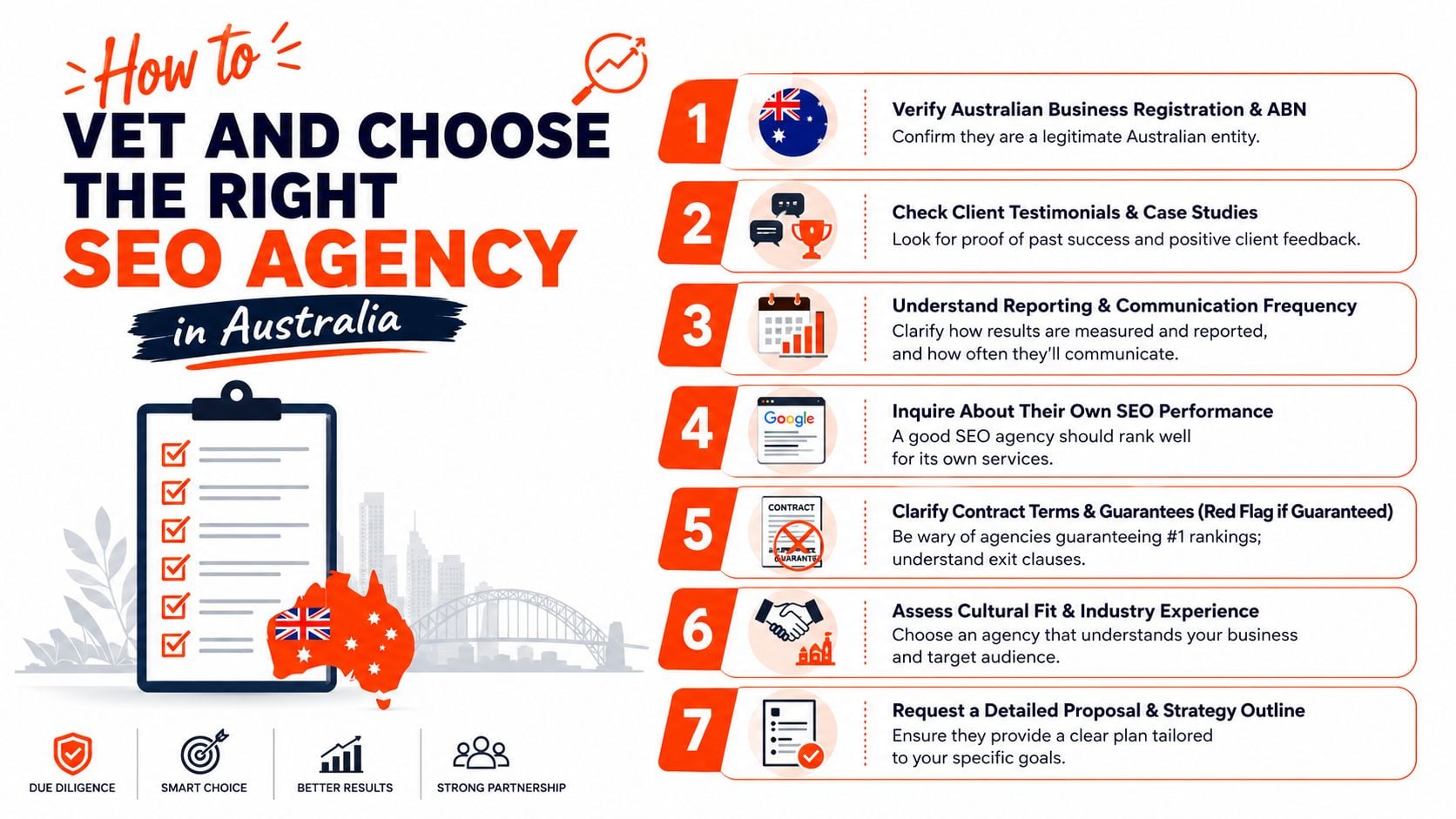
How to Vet and Choose the Right SEO Agency in Australia
Most hiring mistakes begin with a polished sales call, a professional-looking proposal, and an agency saying all the right words. Then three months later, you're staring at a report full of impressions, branded clicks, and vague “authority work”.
The Australian market gives you a reason to be cautious. A 2026 survey found that 74% of Australian small businesses felt misled by agencies promising unrealistic results, and 58% reported poor ROI linked to red flags such as guaranteed first-page rankings and opaque pricing, according to this Australia-focused SEO warning guide.
Red flags that should slow you down
Not every weak agency is a scam, but poor operators tend to repeat the same patterns.
Watch for these:
- Guaranteed rankings because no agency controls Google's results pages
- Fast backlink promises such as “hundreds of links quickly”, which usually signals low-quality placement tactics
- One-size-fits-all packages that ignore your location, site structure, or sales model
- Opaque reporting where you get charts but no explanation of business impact
- No discussion of conversions which usually means they're managing visibility in isolation
A reliable outsourcing partner should be able to explain process, scope, and accountability clearly. If you're comparing service models, this page on an SEO outsourcing company is one example of how to assess what's included versus what's merely claimed.
Here's a useful explainer to watch before your next agency call:
Positive signals that usually indicate substance
The best agencies aren't always the flashiest. They're often the clearest.
Look for signs like:
| Signal | Why it matters |
|---|---|
| Clear methodology | They can explain how technical, content, and authority work fit together |
| Commercial reporting | They track enquiries, calls, form fills, or revenue signals |
| Australian market fluency | They understand local search intent, suburb targeting, and national versus city-level campaigns |
| Tailored proposals | They prioritise based on your site and goals, not a fixed template |
| Implementation realism | They acknowledge trade-offs, dependencies, and timeline constraints |
If an agency can't tell you what they'll do in month one, they probably don't have a disciplined process.
Questions to ask on the sales call
Skip generic questions like “How long have you been around?” Start with the questions that expose thinking.
Ask these instead:
- How do you define success beyond rankings?
- What will you track in GA4 to show SEO is contributing to leads or sales?
- Which parts of the work depend on our developer, content team, or CMS limitations?
- How do you adapt local SEO for a single-city campaign versus a national campaign?
- What would you prioritise in the first ninety days on our site?
- How do you decide whether a page needs rewriting, consolidation, or technical fixes?
- Can you show examples of reporting that explain outcomes, not just activity?
The decision test that matters
By the end of the process, you should be able to answer one simple question. Do they sound like a vendor selling tasks, or a partner solving a growth problem?
That distinction matters more than branding, office location, or a glossy proposal.
What Real SEO Success Looks Like in Australia
Real SEO success isn't one universal story. It depends on the business model, the buying journey, and how well the agency measures commercial impact inside Australia rather than relying on broad global averages.
That last point matters. For proper benchmarking, agencies should filter Google Search Console data to the Australia country segment and use GA4 to track conversions from organic traffic. Without that local segmentation, it's impossible to attribute growth accurately to specific technical improvements, as explained in this guide to AU-specific SEO benchmarking.
A retail example with catalogue complexity
An e-commerce store can look healthy on the surface while leaking opportunity underneath. Category pages may be thin, filters may create crawl waste, and product pages may compete against each other.
In that situation, strong SEO work often looks like disciplined page consolidation, cleaner internal linking, improved collection copy, and tighter optimisation around product-led search intent. The business outcome isn't “more blog traffic”. It's stronger visibility on the pages that can convert.
A local service business with suburb-level intent
A plumber, electrician, or legal practice usually wins through geography and intent, not scale. The best-performing campaigns in this space tend to combine service-page clarity, Google Business Profile optimisation, local citations, review support, and location relevance.
The key is that success is measured by the right actions. Calls, booking requests, quote forms, and map visibility matter. General traffic growth doesn't mean much if the wrong suburbs or low-intent searches dominate the results.
Australian SEO reporting should answer a local business question clearly: did more ready-to-buy people from our service area contact us?
A B2B company with a longer sales cycle
B2B SEO often takes more patience because buyers research in stages. They search for problems first, then options, then vendor comparisons.
That's why a strong agency builds content around decision journeys rather than vanity topics. They might improve solution pages, create comparison content, tighten internal links between commercial and educational assets, and measure assisted conversions in GA4. If you want a broader lens for evaluating that performance, this piece on what counts as a good ROI for digital marketing helps frame the conversation properly.
What all three examples have in common
Different businesses need different tactics, but successful campaigns usually share the same foundations:
- A clear commercial goal
- Clean measurement
- AU-specific search analysis
- Technical and content work that reinforce each other
- Reporting that ties effort to leads, sales, or pipeline
That's what separates movement from progress.
Your Action Plan for Hiring an SEO Partner
If you've made it this far, you don't need more theory. You need a clean way to make the decision.
Start with your business, not the agency list. Be specific about what SEO needs to do for you. For one company, that means more qualified local enquiries. For another, it means better non-branded e-commerce revenue. For a B2B firm, it may mean stronger pipeline support from high-intent content.
Step one is define scope before you ask for quotes
Write down three things before you speak to anyone:
- Your commercial goal such as leads, bookings, or online sales
- Your site reality including platform limits, content gaps, and internal resources
- Your workable budget based on the level of support you need
That alone will improve the quality of proposals you receive.
Build a shortlist that's small enough to assess properly
Don't interview ten agencies. You'll hear the same talking points and create more confusion.
A tighter process works better:
- Shortlist a few Australian agencies that show clear process and relevant experience
- Review their service pages and reporting language for commercial clarity
- Check whether they discuss tracking, implementation, and accountability
One practical option in the market is Click Click Bang Bang, which offers PPC and AI-first SEO services with analytics and conversion tracking as part of its setup. That doesn't make it the default choice for every business, but it is the kind of operational detail you should look for in any agency.
Run better sales calls
Use the call to test thinking, not chemistry alone. You're listening for prioritisation, honesty about trade-offs, and whether they can adapt to your market.
A strong agency will usually do three things during that conversation:
- Ask about revenue goals, not just keywords
- Identify likely constraints such as CMS issues or weak conversion tracking
- Explain what happens first instead of jumping straight to long-term promises
Choose the partner you can measure
The best proposal is rarely the one with the most deliverables on paper. It's the one that makes it easiest for you to understand what will be done, how success will be tracked, and what happens if results stall.
That's the standard to use. Clarity, accountability, and fit.
If you want a practical second opinion before signing with an agency, Click Click Bang Bang can help you assess the scope, tracking, and commercial logic behind an SEO proposal so you can make a more informed decision.
Read NeXt
Or Read Our Latest
- Best Seo Agency Australia Guide 2026
- Cross Domain Tracking: A Practical Guide for GA4 in 2026
- Performance Max Campaigns: An AU Business Guide for 2026
- Pay for Advertisement: A Guide to Costs & ROI in 2026
- SEO Cost Australia 2026: Your Guide to Pricing
- Offline Conversion Tracking: Guide for AU Businesses 2026
Click. CLick. Subscribe.
Get our best PPC insights, industry updates, and power moves delivered straight to your inbox. No fluff, just high-caliber strategies that actually work.
Don’t Leave Just Yet
Try Us For 30-Days,
Risk Free!!
We guarantee that you’ll love our work within the first 30 days, if not you’ll get your money back.
What have you got to lose?