

Performance Max Campaigns: An AU Business Guide for 2026
Last Updated

If you're managing Google Ads in Australia right now, you've probably felt the shift. Search used to reward tight control: separate campaigns, clear levers, obvious reports. Then Google pushed harder into automation, and Performance Max landed as both an opportunity and a headache. It can open reach fast, but it can also blur where spend is going, muddy brand performance, and plateau sooner than many teams expect.
That tension is why Performance Max campaigns deserve a practical explanation, not another generic setup guide. For Australian businesses, the difference between a strong PMax account and a wasteful one usually comes down to signal quality, creative coverage, conversion tracking, and a few local realities that global articles tend to skip.
What Are Performance Max Campaigns
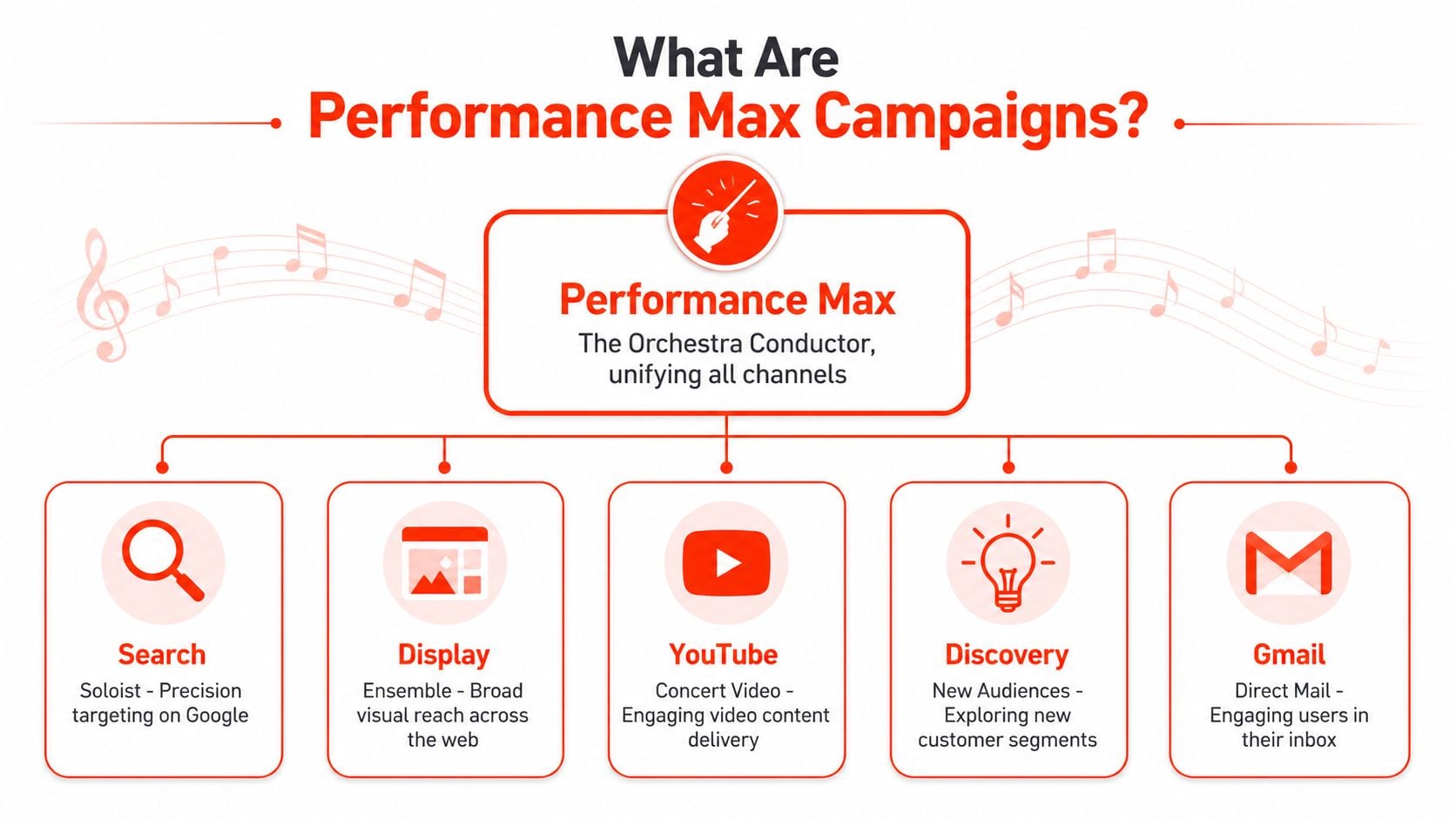
Performance Max is best understood as an AI campaign manager built around a goal, not a channel. Traditional campaign structures behave more like individual musicians playing separate parts. Performance Max acts more like the conductor, taking your creative assets, feed data, audience inputs, and conversion goals, then deciding how to serve ads across Google's inventory.
Why Google changed the model
Google launched Performance Max globally in November 2021, replacing Smart Shopping and giving advertisers access to Search, YouTube, Display, Gmail, Maps, and Discover from a single campaign, according to eTraffic's overview of Google Ads Performance Max. That change matters because it marked a move away from channel-by-channel management and towards system-led allocation based on business outcomes.
For many advertisers, the immediate attraction was expanded reach. The same source notes Google's ANZ insights from Q1 2025 showed advertisers using PMax achieved an average 35 to 40 percent lift in total impressions across all channels compared with their previous siloed campaigns. That doesn't mean every account becomes more efficient by default, but it does explain why PMax has become hard to ignore.
What it looks like in practice
A retailer that once ran separate Search, Shopping, Display remarketing and YouTube campaigns can now consolidate much of that effort into one campaign aimed at online sales. A local service business can use one campaign to chase leads, phone calls, and map-driven intent. A B2B advertiser can still use it, but only if conversion quality is clean enough for the system to distinguish a real opportunity from a junk form fill.
Practical rule: Performance Max isn't simpler because it removes strategy. It's simpler because it shifts your job from manual bidding and placement control to better inputs and tighter measurement.
That shift catches many teams out. The interface can make PMax look like a set-and-forget product. It isn't. It's a system that rewards disciplined setup and punishes vague goals.
Where it fits for Australian advertisers
In Australia, Performance Max often becomes most useful when a business wants broader coverage without building and maintaining a heavily fragmented account. That is especially relevant for e-commerce teams already using Merchant Centre. If your business relies on product-led demand, the thinking behind Google Shopping in Australia still matters because feed quality and product data remain central to how PMax performs.
The black-box reputation is real. Reporting isn't as transparent as old-school Search. But the core idea is straightforward. You give Google a business objective, the assets to advertise it, and the data to learn from. The system then decides where and when to compete.
The Core Components of a PMax Campaign
The accounts that do well with Performance Max usually get three fundamentals right. They build sensible asset groups, they supply meaningful audience signals, and they define conversion goals with more care than they used to in standard campaign types.
Asset groups do the delivery work
An asset group is the package of ad ingredients Google can assemble into different formats. That includes headlines, descriptions, images, logos, videos, and, for retailers, the product feed. Think of asset groups as strategic clusters rather than random creative buckets.
A common mistake is stuffing one asset group with unrelated products, offers, and audiences. That gives Google's system too many mixed signals. A cleaner build groups assets around one product category, one margin profile, one service line, or one clear buying intent. The tighter the theme, the easier it is to understand what message is resonating when performance shifts.
A few practical examples:
- Retail category split: One asset group for best-selling skincare, another for gift packs, another for subscription products.
- Lead gen split: One asset group for enterprise buyers, one for SMB buyers, one for a high-intent service offer.
- Local services split: One asset group for emergency jobs, another for planned installations, another for maintenance.
Audience signals guide the learning phase
Audience signals aren't hard targeting in the way many marketers expect. They don't fence PMax into only one group of users. They point the system towards the people most likely to convert early, which helps shorten the period where Google is still figuring things out.
Good signals usually come from data the business already owns or understands well:
- First-party lists: past customers, repeat buyers, qualified leads, high-value clients
- Remarketing pools: product viewers, cart abandoners, quote starters
- Custom segments: people searching competitor terms, category terms, or showing relevant browsing behaviour
- Business-specific intent cues: for example, users who viewed pricing pages or trade account pages
The strategic point is simple. You're not trying to limit reach. You're trying to improve the quality of the initial learning environment.
Weak audience signals don't just slow learning. They also make it harder to tell whether poor results are caused by bad creative, poor tracking, or the campaign chasing the wrong users.
Conversion goals decide what success means
Many PMax campaigns falter when Google optimises towards the wrong conversion. It will then get very good at delivering the wrong outcome. Newsletter signups, low-intent form fills, or unqualified calls can all look healthy inside the platform while the business sees little commercial value.
A stronger setup usually follows this logic:
| Business type | Better goal choice | Risky goal choice |
|---|---|---|
| E-commerce | Purchase value or profit-informed conversion value | Add to cart alone |
| B2B lead gen | Qualified lead, sales accepted lead, imported offline outcome | Any form submit |
| Local services | Booked job, confirmed call lead, high-value enquiry | Page view or click-to-call without verification |
The role of the marketer in PMax is narrower than it used to be, but it's more important. You don't micromanage bids all day. You define the commercial reality the machine is allowed to optimise towards.
Strategic PMax Use Cases for Australian Businesses
Performance Max isn't one tactic. It's a framework that behaves differently depending on the business model, the conversion cycle, and the quality of data flowing back into Google Ads. That matters in Australia, where teams are investing heavily in performance channels. Rocking Web's Australian paid advertising statistics note that businesses collectively spent approximately $9.4 billion on performance-based digital advertising in FY2024, with SMEs allocating roughly 58 to 65 percent of their marketing budget to performance channels like Performance Max. The same source says PMax campaigns have demonstrated a 78.15 percent average revenue increase after six months of continuous use.
E-commerce
For online retailers, PMax tends to work best when the product feed is clean, margins are understood, and the business has enough transaction volume to train the system properly. The strongest setups don't treat every SKU equally. They separate products by margin, stock reliability, seasonality, and strategic value.
A practical example is a retailer with three very different categories: staple products, high-margin accessories, and promotional bundles. Running all of that under one vague asset structure usually creates reporting noise. A more disciplined account gives each category its own logic, own message, and often its own target efficiency expectations.
What works:
- Using feed quality as a performance lever, not an admin task
- Aligning asset groups to commercial categories
- Optimising to conversion value, not just raw transaction count
- Refreshing promotional creative around local sales periods
What usually doesn't:
- Folding clearance stock and premium lines together
- Letting the campaign optimise around volume-only goals
- Ignoring brand overlap and assuming ROAS is fully incremental
B2B lead generation
B2B is where a lot of advertisers either dismiss PMax too early or trust it too much. It can drive lead volume, but lead quality is the whole game. If you feed the system lightweight form submissions, it will scale lightweight form submissions.
A better B2B setup usually imports offline outcomes. That means the platform learns which leads turned into sales conversations or pipeline, not just who completed a form. Long sales cycles don't disqualify PMax. Bad feedback loops do.
Three things matter more than is commonly overlooked:
- Value assignment: not every lead should carry the same weight.
- CRM connection: sales outcomes need to return to the ad platform.
- Offer clarity: generic whitepaper traffic often clouds intent.
Local SMBs
For local businesses, Performance Max can be useful when the objective is broader than just website traffic. Calls, map actions, store visits, and local intent can all sit inside one campaign structure. But local advertisers still need to shape the campaign around how people buy in their area.
An electrician, dental clinic, or multi-location retailer shouldn't rely on generic national creative. Local trust signals matter more than many templates acknowledge. Suburb names, location references, service urgency, and offer clarity help the system match intent with the right ad combinations.
The smartest local PMax campaigns don't look broad. They look locally specific, even though the system is buying inventory across multiple Google surfaces.
The lesson across all three use cases is consistent. Performance Max works when the campaign reflects the business model. It underperforms when advertisers treat it like a universal shortcut.
Asset and Audience Best Practices
Most weak PMax campaigns don't fail because the bidding model is broken. They fail because the inputs are lazy. The easiest place to see that is in assets. If the campaign doesn't have enough creative breadth to serve well across placements, Google's system can't manufacture quality from thin air.
Asset coverage needs to be deliberate
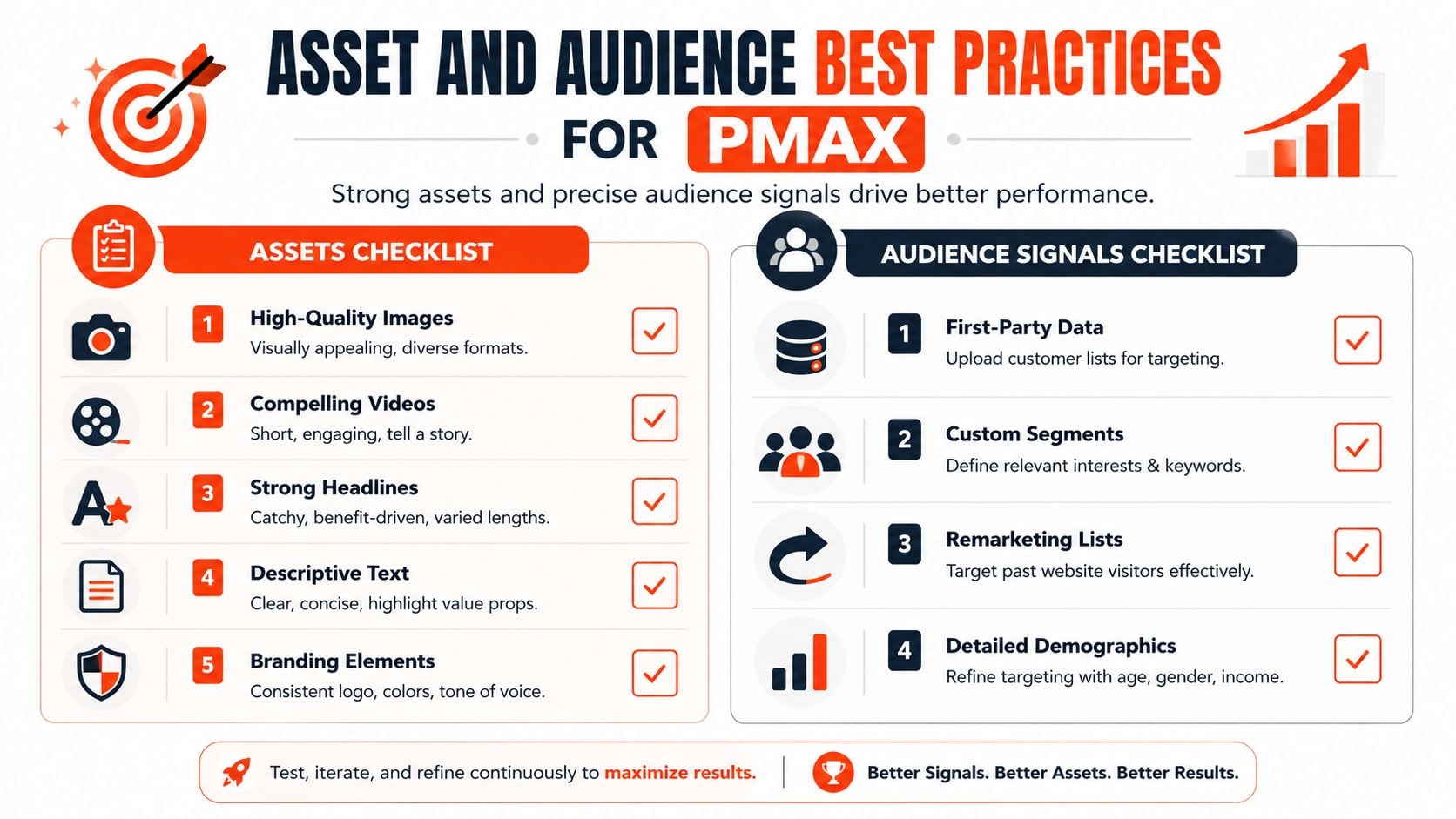
For AU e-commerce advertisers, Hawky's guide to Performance Max creative specs says achieving Excellent Ad Strength by including 15 to 20 high-resolution images across all three aspect ratios, horizontal at 1200×628px, square at 1200×1200px, and portrait at 960×1200px, correlates with an 18 to 25 percent higher conversion rate. The same source notes that including 3 to 5 custom videos of at least 10 seconds increases engagement by 22 percent by activating YouTube and Discover inventory.
That isn't a cosmetic detail. It changes where and how your campaign can appear.
If you skip a key aspect ratio, Google has fewer ways to render the ad well across placements. If you rely on auto-generated video, you're usually accepting weaker storytelling and looser brand control. For many advertisers, "Good" creative isn't neutral. It's a handicap.
A practical creative checklist
Use this as the baseline, not the stretch goal:
- Image coverage: include the required horizontal, square and portrait formats so the campaign can serve cleanly across surfaces.
- Product relevance: match visuals to the asset group's category or offer. Generic lifestyle images often dilute intent.
- Video ownership: create short videos specifically for PMax instead of relying on Google's generated versions.
- Headline variation: write distinct angles, not near-duplicates. Lead with offer, problem, and differentiator from different directions.
- Brand consistency: keep logos, colours, and tone aligned so machine-built combinations still feel like your brand.
For teams building stronger customer data foundations, this is also where first-party data activation becomes useful. The better your customer lists and audience segmentation, the less your campaign has to guess who matters.
Here's a useful explainer on how marketers think about creative and inputs in PMax:
Audience signals should reflect real buying patterns
Audience signals work best when they come from observed business behaviour, not wishful thinking. Many accounts underperform because someone selected broad in-market audiences, added a few interests, and called it strategy.
A better approach layers signals:
| Signal type | Best use | Common mistake |
|---|---|---|
| Customer lists | Reconnect with existing high-value users and seed similar intent | Uploading unsegmented lists |
| Remarketing lists | Speed up early learning with users who already engaged | Using tiny or stale audiences |
| Custom segments | Point Google towards category-specific search behaviour | Making segments too broad |
| Intent-based site visitors | Prioritise pricing, cart, or quote-page users | Treating all site visitors the same |
Field note: The asset group and the audience signal should tell the same story. If the creative speaks to premium buyers but the signal is broad bargain-hunter traffic, the campaign learns slowly and reports become harder to trust.
Measuring Success and Overcoming AU Challenges
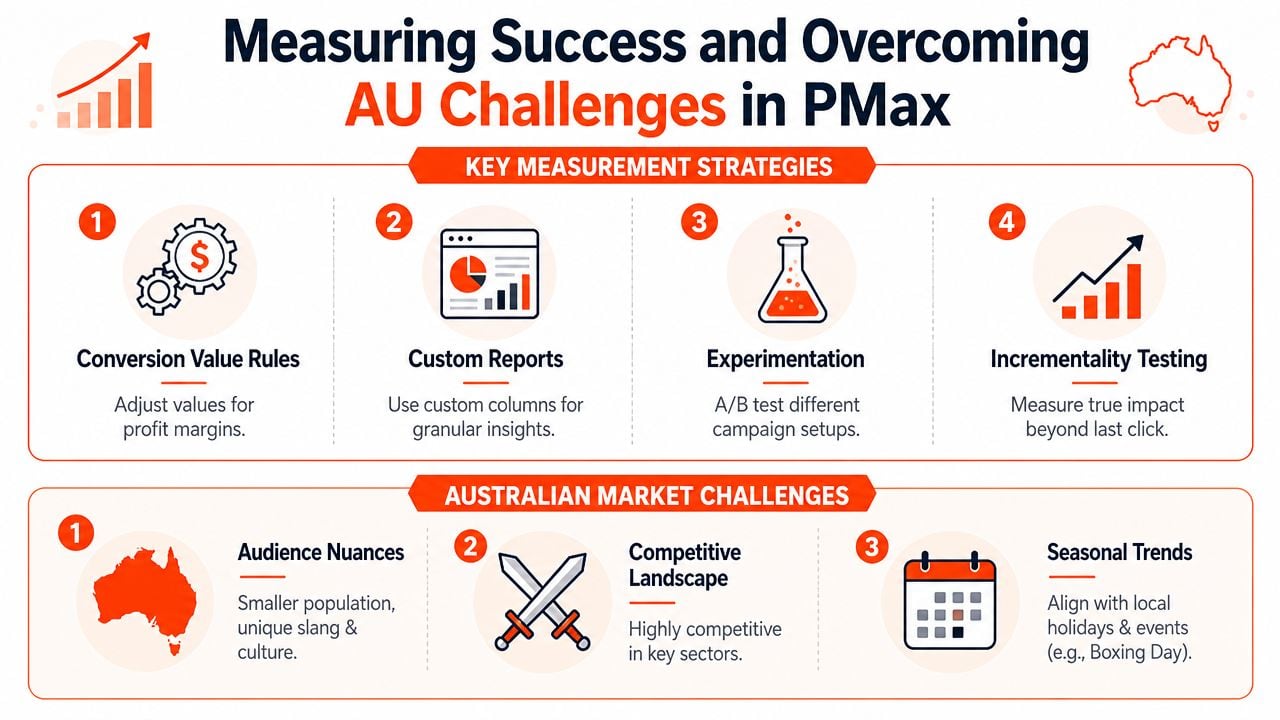
The hardest part of managing Performance Max isn't launching it. It's diagnosing whether it's genuinely helping the business or just absorbing demand that would have converted anyway. In Australia, two issues come up repeatedly: brand search cannibalisation and earlier performance plateaus.
Measure business quality, not just platform volume
The default dashboard won't answer every serious question. You need to combine asset reporting, search category insights, CRM outcomes, and commercial context. For lead generation, that often means pushing sales outcomes back into Google. For retail, it means looking beyond top-line ROAS and checking whether PMax is over-claiming branded demand.
If your business already runs Salesforce, it's worth understanding broader attribution mechanics around optimizing marketing ROI with Salesforce. That kind of thinking helps when you're trying to decide whether PMax influenced net-new demand or just sat close to the final click.
For lead-based accounts especially, proper offline conversion tracking changes the quality of optimisation. Without it, Google often favours easy leads. With it, the system can start distinguishing valuable opportunities from cheap noise.
Brand cannibalisation is a real Australian issue
Independent analysis from Savvy Revenue argues that excluding brand terms in PMax is often necessary to prevent ad spend leakage on low-margin branded traffic. That matters for AU retailers because branded searches often behave very differently from generic category searches. If PMax captures too much brand demand, performance can look better than it really is while incrementality weakens.
The practical problem isn't just reporting vanity. It affects budget allocation. A campaign that wins easy branded conversions can crowd out spend that should be finding new customers.
Signs to watch for include:
- Brand search suddenly looking weaker elsewhere while PMax efficiency looks unusually strong
- Conversion mix shifting towards returning users or already brand-aware traffic
- Little change in total business growth despite apparently strong in-platform results
Plateaus happen faster than many teams expect
The same Savvy Revenue analysis notes that AU PMax campaigns can plateau after 3 to 6 months due to creative fatigue, accelerated by Australia's high mobile dominance, with over 70 percent of searches occurring on mobile. That local context matters. Smaller inventory pools and more repeated mobile exposure mean weak assets wear out sooner.
When a campaign plateaus, the fix usually isn't just raising budget. Better recovery actions include:
- Refreshing creative themes, not just swapping one headline.
- Updating audience signals based on recent customer behaviour.
- Checking local intent cues, especially for mobile-first users.
- Reviewing brand contamination, because inflated branded performance can mask broader decline.
When PMax goes flat, treat it like a diagnosis problem, not a bidding problem. Creative fatigue, poor signal refresh, and brand leakage usually show up before budget is the real issue.
The Click Click Bang Bang PMax Method
Good Performance Max management doesn't come from touching the account every day. It comes from following a consistent operating method that gives Google's automation the right constraints, the right signals, and the right feedback.
Audit before build
A serious PMax rollout starts with the account and business model, not the campaign wizard. The first pass should answer a few unglamorous questions.
Is conversion tracking trustworthy? Are brand and non-brand economics clearly understood? Is the feed clean enough for retail? Are CRM stages usable for lead scoring? Does the existing campaign history contain useful learning or just messy data?
This stage matters because PMax amplifies what's already in the account. If the tracking is weak, the campaign scales weak outcomes. If the commercial priorities are vague, the system spreads spend in ways that feel random but are consistent with poor inputs.
Strategy should narrow the machine's choices
A disciplined build doesn't hand everything to Google in one bundle. It creates structure around business priorities.
That often includes choices like:
- Separating categories or offers by margin and intent
- Defining when brand control is needed
- Aligning asset groups to real demand segments
- Choosing the right primary conversion, especially for lead generation
- Planning audience signals around first-party data and recent behaviour
This is also where expectations get set. Performance Max isn't a magic switch. Some campaigns need room to learn. Some need stricter guardrails. Some shouldn't launch at all until data quality improves.
Build with enough depth to optimise later
The build phase should produce an account that can be diagnosed. That means clean naming, segmented asset groups, conversion actions that mean something, and creative assets with enough variation to learn from.
Weak builds create false confidence. The campaign starts spending, impressions come in, and the dashboard looks active. But if all the assets are generic and the conversion goal is broad, there isn't much to optimise later because the campaign was built without strategic depth.
A stronger management process usually includes:
| Stage | What matters most |
|---|---|
| Audit | Tracking, feed quality, CRM visibility, brand overlap |
| Strategy | Goal selection, campaign boundaries, audience plan |
| Build | Asset depth, clean structure, commercial alignment |
| Optimisation | Signal refresh, creative rotation, search insight review |
| Reporting | Business impact, not just platform metrics |
Optimise actively, not emotionally
The best PMax managers don't overreact to every short-term fluctuation. But they also don't leave the campaign untouched for months. Ongoing management should focus on patterns: asset fatigue, conversion quality drift, audience decay, and branded traffic inflation.
That means refreshing creative before performance falls off a cliff, testing audience signal quality, reviewing search category movement, and checking whether the campaign is helping the whole account or just taking credit inside one dashboard.
The point of a method like this isn't complexity for its own sake. It's control where control still matters.
Performance Max Frequently Asked Questions
Can I run Performance Max alongside standard Search campaigns
Yes, and many advertisers should. Standard Search is still useful when you need tighter query control, clearer ad messaging, or stronger visibility over non-brand and competitor intent. Performance Max is broader and more automated. Search is sharper when precision matters. The balance depends on your account structure, brand strength, and how much control you need over keyword-level strategy.
How much budget does Performance Max need in Australia
It needs enough volume for Google to learn from actual conversion behaviour. Moor Marketing's AU guide to Performance Max says campaigns require a budget that enables at least 10 to 15 conversions per week to trigger effective optimisation. The same source says accounts that fail this threshold often experience a 30 to 40 percent drop in conversion value and a 22 percent higher CPA because the system doesn't get enough machine learning signal.
That doesn't mean every business needs the same monthly spend. It means your budget has to be judged against your conversion rate, average CPC environment, and sales cycle.
What should I do if PMax is spending but lead quality is poor
Start with conversion definitions. If the campaign is optimising to easy, low-intent actions, poor lead quality is a predictable outcome. Tighten the primary conversion action, import offline outcomes where possible, and review whether asset messaging is attracting the wrong users. Broad creative paired with low-friction forms often causes this.
What if my campaign seems strong in Google Ads but the business doesn't feel the lift
Check whether branded demand is being over-credited. Then compare PMax performance with total account movement, CRM quality, and net business outcomes. A campaign can look efficient in-platform while delivering little incremental value if it leans too heavily on existing demand.
How long should I wait before making major changes
Give the system enough time to gather signal, but don't confuse patience with passivity. Major structural edits too early can reset learning. On the other hand, obvious tracking errors, brand leakage, or poor-quality conversion goals should be addressed quickly. The key is to change the right thing. Not just change something.
If you want a team that understands how Performance Max behaves in the Australian market, Click Click Bang Bang can help. From tracking and feed audits to asset strategy, offline conversion setup, and ongoing optimisation, they build PPC campaigns around commercial outcomes rather than surface-level metrics.
Read NeXt
Or Read Our Latest
- Performance Max Campaigns: An AU Business Guide for 2026
- Pay for Advertisement: A Guide to Costs & ROI in 2026
- SEO Cost Australia 2026: Your Guide to Pricing
- Offline Conversion Tracking: Guide for AU Businesses 2026
- How to Start Advertising on LinkedIn: 2026 Guide
- 7 B2B LinkedIn Ad Examples to Steal in 2026
Click. CLick. Subscribe.
Get our best PPC insights, industry updates, and power moves delivered straight to your inbox. No fluff, just high-caliber strategies that actually work.
Don’t Leave Just Yet
Try Us For 30-Days,
Risk Free!!
We guarantee that you’ll love our work within the first 30 days, if not you’ll get your money back.
What have you got to lose?