

SEO Cost Australia 2026: Your Guide to Pricing
Last Updated

Average monthly SEO costs in Australia typically sit between $1,800 and $2,200. That's the clearest benchmark for most businesses in 2026, but your actual spend can move sharply depending on your site, your market, and how aggressive your growth goals are.
If you're pricing your first serious SEO investment, you've probably already seen the problem. One provider offers a bargain package that looks too cheap to trust. Another sends a proposal that reads like a technical manual with a monthly fee that feels closer to a staff salary. That gap isn't random. It usually reflects scope, competition, and whether the provider is selling basic keyword work or a broader growth program.
A common issue with advice on SEO cost Australia is its limitation to price ranges. It rarely explains what work sits behind those numbers, what corners get cut at the low end, or why modern campaigns now carry extra costs when they include AI-first optimisation and cross-channel coordination with PPC.
A useful budget isn't just "what can I afford?" It's "what level of work does my business need to compete?" A local service business targeting one metro area doesn't need the same plan as an e-commerce store fighting for category terms across the country. A B2B company with a long sales cycle also needs different reporting, content, and conversion tracking than a trades business chasing phone calls.
The right way to approach SEO pricing is to treat it like resourcing. You're buying strategy, implementation, technical problem-solving, content production, and measurement. Sometimes that's a light monthly program. Sometimes it's a larger machine with technical SEO, digital PR, and paid search data feeding the whole strategy.
Navigating the Maze of SEO Pricing in Australia
Most business owners don't struggle because SEO is impossible to understand. They struggle because the proposals aren't written in plain business language.
One quote says $500 a month. Another says $5,000. Both claim they'll improve rankings. Without context, they can sound interchangeable. They aren't. The difference is usually the amount of actual work, the level of skill involved, and whether the provider is planning for sustainable growth or just selling activity.
Australian businesses are projected to spend $1.5 billion on SEO services in 2025, which is a 12% increase from 2024, showing how seriously the market now treats organic visibility as a commercial channel rather than a nice-to-have marketing extra. That spend tells you something important. Businesses aren't pouring more budget into SEO because it's fashionable. They're doing it because search visibility now affects lead flow, ecommerce revenue, and brand discovery.
Why cheap quotes often create expensive problems
Low-cost SEO usually strips out the hard parts. Technical fixes get delayed. Content is templated. Link acquisition becomes vague. Reporting focuses on impressions or rankings without tying anything back to enquiries, sales, or revenue quality.
Practical rule: If a quote is cheap enough that it can't realistically cover strategy, implementation, content, and reporting, something important has probably been removed.
That doesn't mean every business needs a large retainer. It means your budget needs to match the competitive reality of your market. For some businesses, a foundational campaign is enough. For others, underfunding SEO locks them into slow movement while better-resourced competitors keep taking market share.
What a sensible budget should answer
Before you compare providers, get clear on these questions:
- Business goal first: Are you trying to drive local leads, national ecommerce sales, or qualified B2B pipeline?
- Scope of work: Does your site need technical clean-up, new landing pages, category content, or authority building?
- Decision horizon: Can you invest patiently, or do you need SEO to work alongside paid media while rankings build?
- Internal capacity: Will your team write content and implement changes, or are you paying the provider to do everything?
Once those answers are clear, pricing starts to make sense. SEO stops looking like a black box and starts looking like a staffing plan for growth.
Decoding Australian SEO Pricing Models
A Brisbane business owner gets three SEO quotes in the same week. One is $900 a month, one is $2,500, and one is tied to rankings. The price gap looks irrational until you examine what is being bought: senior strategy, technical implementation, content production, authority work, reporting, and increasingly, AI oversight.
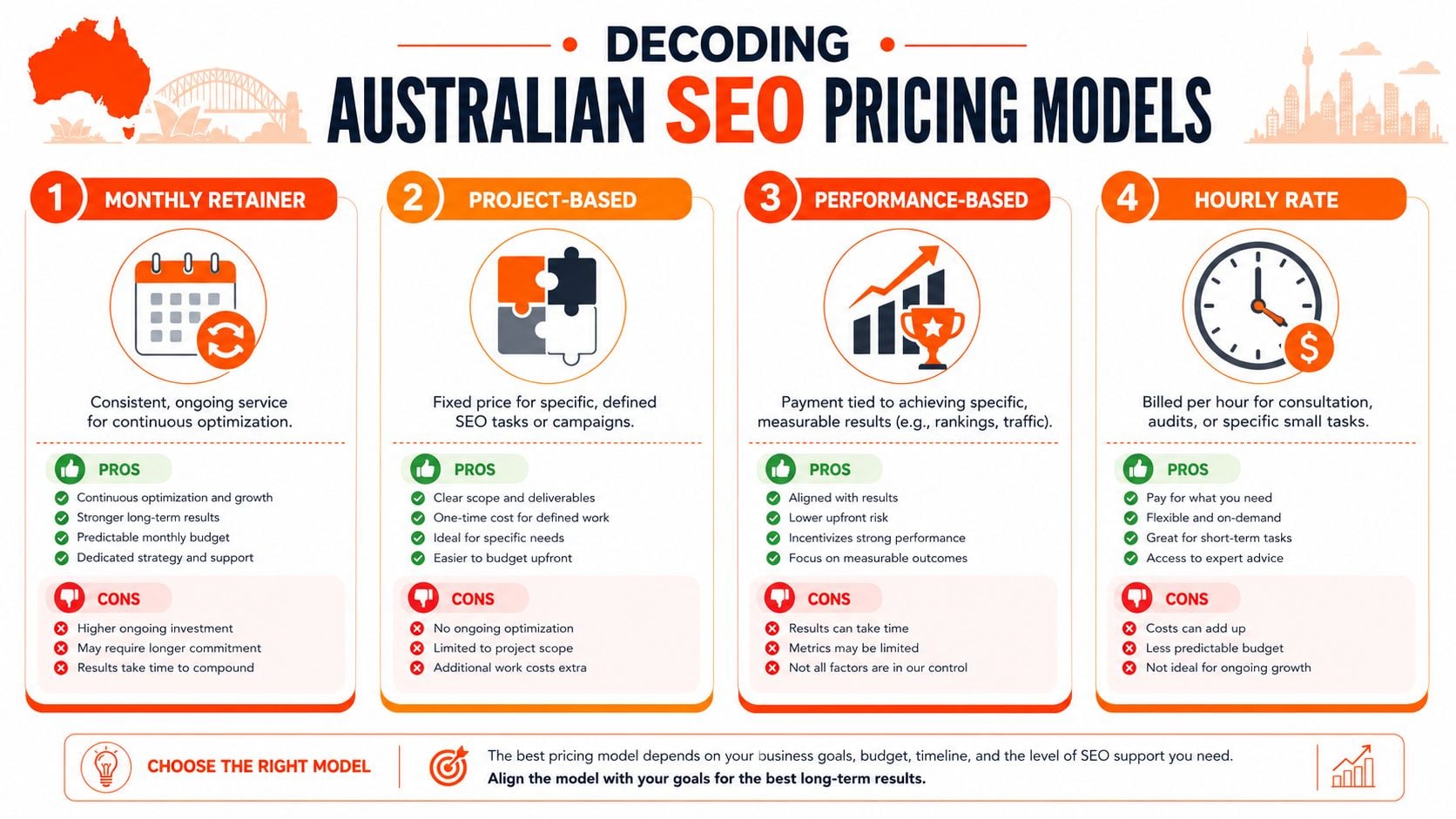
Australian SEO providers usually price work in four ways: monthly retainers, hourly consulting, project fees, and performance-based deals. Each model suits a different stage of growth. The mistake is choosing by price alone instead of matching the model to the job.
Monthly retainers
Retainers are the standard model because search performance improves through repeated work, not one-off effort. A good retainer gives you a team that can prioritise across technical fixes, content updates, internal linking, page improvements, and reporting without reopening scope every two weeks.
This model works well when the site needs steady progress and regular decisions. It also handles a reality many pricing guides skip past: modern SEO often includes AI-related workload. Teams now spend time reviewing AI-generated drafts, tightening brand and factual accuracy, improving entity coverage, and protecting against thin, repetitive content that can waste budget faster than it saves time. Cheap retainers often hide that labour by pushing low-quality AI content into the campaign.
Retainers also pair well with PPC. In practice, I often use paid search data to shorten the SEO learning curve. Search term reports can show which service angles convert, which locations deserve dedicated pages, and which offers attract low-quality leads. That can save months of publishing content around terms that never produce revenue.
Best fit: businesses that need ongoing execution, not just advice.
Hourly consulting
Hourly consulting suits businesses that already have people to implement recommendations. Common examples include migration planning, technical reviews, CMS changes, measurement setup, or a second opinion on an agency plan.
The upside is control. You buy targeted senior input without committing to a full retainer.
The downside is obvious too. Advice does not fix the site by itself. If your internal team is busy, hourly support can turn into a backlog of smart recommendations that never get shipped.
For owners weighing lower-scope options, this guide to realistic local SEO pricing for businesses is useful because it shows where a lighter engagement can work and where it usually falls short.
Later in the sales process, this explainer can help visualise how providers package those models in practice:
Project-based pricing
Project fees suit work with a clear deliverable and endpoint. Typical examples include a technical audit, a site migration plan, an information architecture review, or a content consolidation project.
This model is clean if the scope is defined. It becomes messy when the provider sells a project for a problem that needs ongoing execution. An audit can identify the blockers. It does not remove them.
A project can also be a smart first step before a retainer. It lets both sides assess fit, surface hidden technical debt, and set a realistic monthly plan based on actual findings instead of a generic package.
Performance-based pricing
Performance SEO sounds attractive because it appears to reduce risk. In reality, it often shifts risk somewhere less visible.
If payment depends on rankings alone, the provider has an incentive to target easier keywords, focus on low-value pages, or report wins that look good but do little for leads and sales. If payment depends on traffic, branded searches and weak-intent queries can inflate results without helping the business. If payment depends on leads, disputes usually start around lead quality and attribution.
Ask a simple question before signing: what exact business outcome triggers payment, and who verifies that outcome?
Which model usually makes sense
For a first serious SEO investment, the strongest setup is often a defined project followed by a retainer, or a retainer with a clear first-90-day plan. That structure gives you diagnosis first, then execution.
Hourly consulting works if your team can move quickly. Performance pricing rarely works in a way that stays commercially fair for both sides.
Key Factors That Influence Your SEO Cost
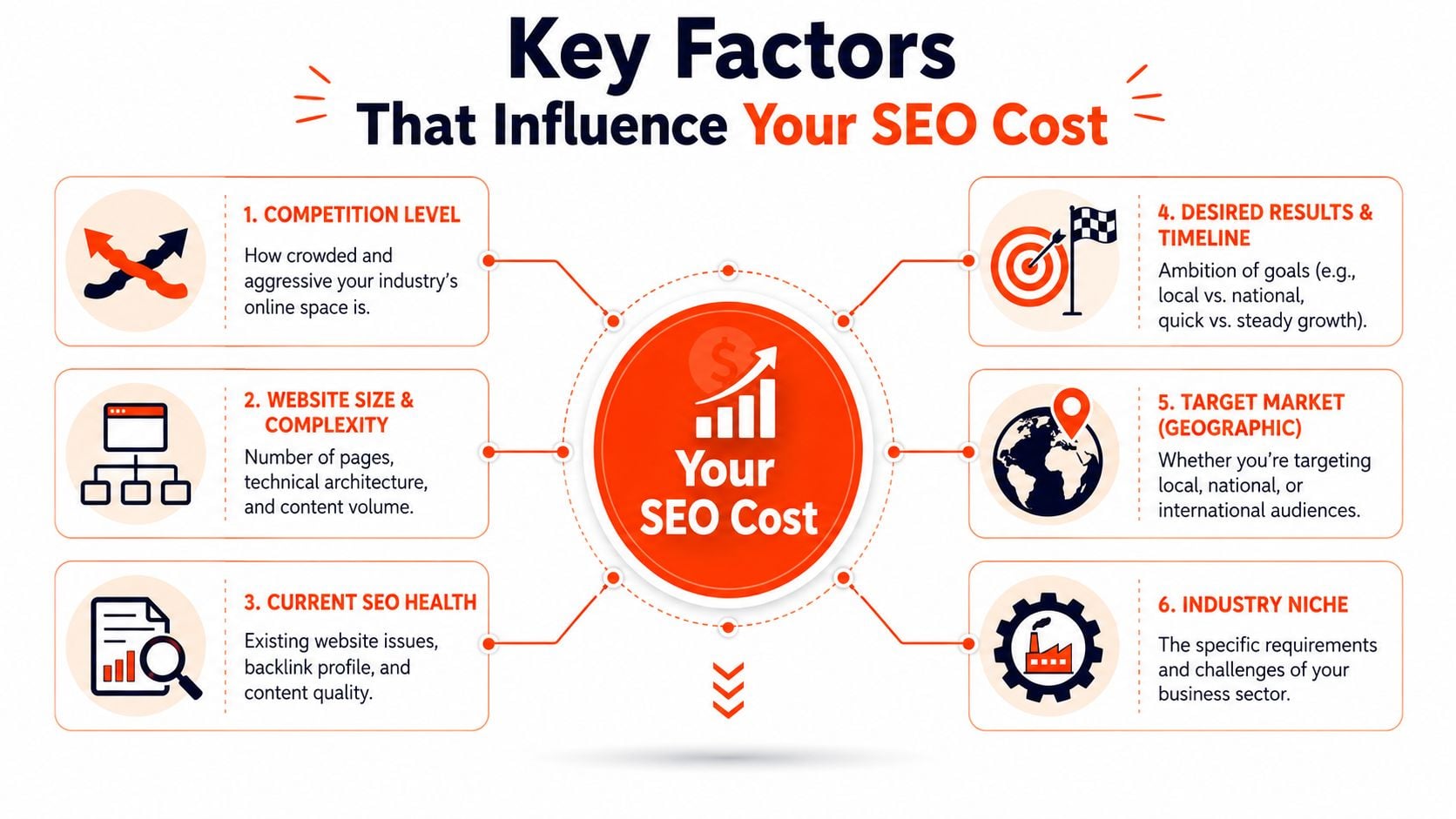
A Brisbane electrician and a national ecommerce brand can both ask for “SEO” and receive quotes that are thousands apart. The gap usually comes down to workload, technical difficulty, content demands, and how much competitive pressure exists in the market. SEO is priced around the amount of skilled work required to produce a commercial result, not around a fixed menu.
Competition sets the pace
The harder it is to displace entrenched competitors, the more time and specialist input SEO needs. A low-competition local service area may need better service pages, stronger local signals, and consistent review generation. Legal, finance, SaaS, and large ecommerce categories usually need far more. More content, stronger links, tighter technical execution, and sharper conversion paths.
City size also affects cost, but not because Sydney or Melbourne has a magic price tag. Bigger metro markets tend to have denser competition, more aggressive ad spend, and better-funded incumbents. That raises the standard required to win organic visibility.
Website size and technical debt
A simple ten-page site is usually straightforward to audit, map, and improve. A site with hundreds of service pages, location pages, products, or blog articles is not. The quote rises because the team has to diagnose more problems and coordinate more moving parts.
Common cost drivers include:
- Crawl waste: Search engines spend time on duplicate, filtered, or low-value URLs instead of priority pages.
- Poor page mapping: Key pages do not match the search intent behind the terms you want to rank for.
- CMS and developer constraints: Small SEO fixes become expensive when the platform is rigid or the dev queue is slow.
- Tracking problems: Weak attribution makes it harder to prove what SEO is contributing to calls, forms, and revenue.
This is also where many businesses underestimate AI-first search costs. Producing pages at scale is cheaper than it was a few years ago. Producing pages that are original, trustworthy, on-brand, and good enough to survive human review and AI-generated search summaries is not. Cheap content volume often creates a second bill later for pruning, rewriting, consolidating, and repairing index quality.
Geography and keyword breadth
The wider your target area, the larger the SEO build. A local operator targeting a handful of suburbs needs a tighter page set than a multi-location company or a national brand. More geography usually means more landing pages, more internal links, more local proof points, and more reporting complexity.
That is one reason affordable SEO for small businesses only works when the target footprint is realistic. A modest budget can perform well in a defined service area. The same budget gets stretched thin if the business expects statewide or national visibility across dozens of terms.
Goals, speed, and commercial model
Urgency changes the shape of the work. If the goal is steady growth over 12 months, an agency can phase technical fixes, content, and authority work in the right order. If the business wants faster gains in a competitive category, the provider often needs to front-load strategy, implementation, content production, and digital PR.
Business model matters just as much. Lead generation campaigns often depend on local landing pages, stronger calls to action, and reliable call tracking. Ecommerce SEO usually demands category architecture, faceted navigation control, product data, and merchandising input. B2B SEO often requires fewer pages but much tighter alignment between content, qualification, CRM stages, and sales feedback.
There is another pricing variable many Australian guides skip. SEO can cost less overall when it is planned alongside PPC. Paid search data can reveal which keywords convert before you invest months building SEO content around them. SEO can reduce paid reliance on high-cost terms over time. When those channels are run in isolation, businesses often pay twice for keyword research, landing page testing, and reporting, then wonder why acquisition costs stay high.
A good SEO quote explains these trade-offs clearly. If it does not show what work is being done, why it matters, and what variables could push cost up or down, the price is only a guess.
What to Expect for Your Budget with Sample SEO Packages
The easiest way to understand SEO pricing is to picture real businesses. Not hypothetical charts. Real operational situations with different margins, buying cycles, and search competition.
Australian SEO pricing is broadly tiered. Small businesses typically invest $1,400 to $2,500 per month for local SEO, medium businesses $1,600 to $7,500 per month, and large enterprises $2,500 to $10,000+ per month, based on Australian agency pricing benchmarks.
Three common package scenarios
A local plumber usually doesn't need a national content engine. They need service-page relevance, suburb targeting, Google Business Profile support, review strategy, and clean conversion tracking. In this tier, the work is often focused and practical. Fix technical basics, improve core pages, tighten internal linking, and support map visibility.
A national ecommerce store sits in a different category. Product and collection pages need stronger architecture. Faceted navigation can create crawl waste. Category copy has to support rankings without making pages harder to shop. Consequently, a higher monthly investment often goes into technical SEO, content planning, internal linking systems, and collaboration between SEO and merchandising.
A B2B software company usually needs fewer pages than a retailer, but each page carries more pressure. Sales cycles are longer, search intent is nuanced, and the content has to do more than rank. It has to qualify. A proper package here often includes service or solution page rewrites, comparison content, resource hubs, schema implementation, and reporting tied to demo requests or qualified leads.
Sample monthly package guide
| Investment Tier | Typical Monthly Cost | Best For | Core Deliverables |
|---|---|---|---|
| Foundational local SEO | $1,400 to $2,500 | Single-location small businesses | Technical clean-up, on-page optimisation, local landing pages, Google Business Profile support, reporting |
| Growth-focused SEO | $1,600 to $7,500 | Ecommerce stores, multi-location brands, growing B2B firms | Content production, technical SEO, internal linking, keyword expansion, authority building, conversion tracking |
| Enterprise or national SEO | $2,500 to $10,000+ | Large brands, high-competition sectors, complex sites | Full strategy, technical SEO at scale, content operations, digital PR, broader reporting and stakeholder support |
What you should actually look for in a proposal
Price matters less than the deliverables attached to it. A sensible proposal should tell you who is doing the work, what gets produced each month, and how priorities change over time.
Look for these signs of substance:
- Named deliverables: Not "ongoing optimisation", but page improvements, technical fixes, content pieces, and reporting outputs.
- Clear ownership: Who writes content, who implements changes, and who is responsible for technical recommendations.
- Measurement tied to business actions: Calls, form fills, sales, booked demos, qualified leads.
- Scope fit: The plan should match your market, not a canned package.
If you're a smaller business trying to sanity-check entry-level proposals, this guide to affordable SEO for small businesses is useful for comparing what a lower-budget program should and shouldn't include.
The most common mismatch I see is a business buying a local SEO package when it actually needs a content and technical growth plan. The package isn't bad. It's just solving the wrong problem.
Choosing Your Partner Agency vs Freelancer vs In-House
Once you've set a budget, the next decision is who should run the work. This choice affects cost, speed, communication, and the depth of expertise you get.
Freelancer
A freelancer can be a good fit when the scope is narrow and the business is simple. Local SEO, advisory support, content briefs, and one-off audits can all work well here. The upside is direct communication and lower overhead.
The limitation is coverage. One person might be strong in content and weak in technical SEO. Another might audit well but not implement much. If your site needs strategy, content, technical remediation, reporting, and stakeholder management, a solo operator can hit capacity fast.
In-house
In-house SEO makes sense when search is already a meaningful growth channel and the business can support the role properly. That usually means access to development resources, content support, analytics, and a manager who understands how SEO timelines work.
It's also worth remembering that SEO doesn't live in isolation. If your team is still budgeting for a rebuild, tracking setup, or platform changes, this comprehensive guide on website costs for businesses can help frame the broader investment around site performance and implementation readiness.
Agency
An agency usually suits businesses that need multiple disciplines at once. Technical SEO, content strategy, analytics, CRO input, and off-page work often sit with different specialists. That breadth is the main reason agencies often outperform cheaper generalist setups on more competitive campaigns.
The downside is that not all agencies are equally transparent. Some sell a big team and deliver junior execution. Some lock clients into reporting cycles without showing what work was performed.
Why integrated SEO and PPC often wins
The most overlooked pricing advantage in this market is the combined SEO and PPC model. Bundling PPC with SEO can reduce overall digital marketing costs by 20 to 30% through shared data infrastructure, and 72% of SMBs reported a 28% lower cost-per-lead from integrated campaigns.
That matters because search terms that convert in Google Ads often become the strongest candidates for SEO page development. At the same time, SEO landing pages can improve paid search efficiency by giving ad traffic a more relevant destination. Shared tracking, shared keyword intelligence, and shared conversion data make both channels sharper.
For businesses evaluating this route, a search marketing agency that handles both disciplines in one program can be easier to manage than separate vendors, provided the reporting stays transparent and channel-specific.
If you need immediate demand now and lower acquisition costs later, integrated search is usually the most commercially sensible setup.
Measuring Success and Calculating SEO ROI
SEO gets easier to justify when you stop treating rankings as the final outcome. Rankings matter, but only because they can produce qualified traffic, leads, and sales.

Start with business metrics, not vanity metrics
A proper SEO report should show what organic search contributed to the business. That means looking at enquiries, purchases, booked calls, qualified leads, and assisted conversions. Tools like Google Analytics 4, Google Search Console, Google Tag Manager, and your CRM should be connected well enough to follow the path from click to outcome.
Track these first:
- Organic conversions: Form fills, calls, checkouts, demo bookings
- Lead quality: Whether SEO leads are sales-ready or just informational
- Revenue or pipeline contribution: What organic search influenced or closed
- Page-level performance: Which landing pages generate business outcomes, not just traffic
If you need a cleaner framework for what to measure and how to report it, this guide to digital marketing performance metrics is a practical reference.
A simple ROI framework
Use a basic commercial lens. Take the value of sales or qualified pipeline generated from organic search over a period and compare it with your total SEO spend over that same period. Include agency fees, content costs, and any implementation support if relevant.
Then ask better questions:
- Which pages generated the strongest commercial outcomes?
- Which keywords drove buyers, not just visitors?
- Did organic search reduce dependence on paid channels in any category?
- Did the campaign improve lead quality, not just lead volume?
Good SEO reporting should help you decide where to invest next. It shouldn't just prove that traffic moved.
AI-first SEO changes what you measure
Top-tier agencies now charge a 15 to 25% premium for AI-first SEO packages. That premium usually reflects additional work such as structured content improvement, entity clarity, schema support, and content formatting that helps pages surface in newer AI-driven search experiences.
That doesn't mean every business should pay the premium automatically. It means you should ask what extra work is included and how success will be measured. If the proposal says "AI-first" but the reporting still focuses only on broad rankings, the label is ahead of the system.
Your Guide to Australian SEO Pricing FAQs
Why are guaranteed rankings a red flag
Because no provider controls Google. A guarantee often means one of three things. The agency is targeting easy keywords that don't matter, using risky tactics, or selling certainty where none exists. A better promise is transparent work, clear reporting, and accountability to commercial goals.
Why does quality SEO cost so much more than cheap SEO
Because real SEO is labour-intensive. Someone has to audit the site, prioritise fixes, improve page structure, coordinate content, analyse Search Console data, monitor conversions, and keep adjusting the plan. Cheap SEO often replaces those tasks with generic reports and low-value deliverables.
How long does SEO take to work
It depends on competition, site quality, and how much work gets done consistently. In practice, SEO usually rewards patience. Businesses that expect immediate returns often need PPC alongside SEO so they can generate demand while organic visibility builds.
Is the cheapest package ever worth buying
Sometimes, but only if the scope is small. A single-location business in a narrow niche may only need foundational support. The danger is assuming a low-cost package can solve a high-competition problem. It usually can't.
Should I pay extra for AI-first SEO
Only if the provider can explain what that means in operational terms. If the additional fee covers better structured content, schema work, stronger topical organisation, and adaptation for AI-driven search behaviour, it may be justified. If it's just a label added to a standard package, it isn't.
Is SEO better than PPC
That's usually the wrong question. SEO builds long-term visibility. PPC gives you immediate testing and demand capture. For many businesses, the stronger setup is both. Paid search reveals buyer intent quickly. SEO turns that insight into durable traffic assets over time.
If you're weighing SEO quotes and want a straight answer on what a sensible search strategy should cost, Click Click Bang Bang offers AI-first SEO and PPC with transparent planning, live reporting, and flexible monthly structures. It's a practical option for businesses that want one partner managing organic growth and paid search together, especially when cost efficiency across both channels matters.
Read NeXt
Or Read Our Latest
- Manual vs Automated Bidding for PPC Success
- Conversion Tracking Setup: A Complete AU Guide
- Instagram Advertising Australia: Complete 2026 Guide
- Pay Per Click: A Beginner’s Guide for Australian Marketers
- Display Advertising on Google: The Complete Australian Guide
- Stakeholder Communication Plan How to Build One That Works
Click. CLick. Subscribe.
Get our best PPC insights, industry updates, and power moves delivered straight to your inbox. No fluff, just high-caliber strategies that actually work.
Don’t Leave Just Yet
Try Us For 30-Days,
Risk Free!!
We guarantee that you’ll love our work within the first 30 days, if not you’ll get your money back.
What have you got to lose?