

Pay for Advertisement: A Guide to Costs & ROI in 2026
Last Updated
You've probably reached the point where organic growth feels too slow. Referrals are uneven, SEO takes time, and posting on social media feels like shouting into the wind. Paid ads look like the fast lane, but the first question is always the same: how much will this cost me, and how do I avoid burning cash?
That's the right question.
Pay for advertisement isn't just buying visibility. It's buying access to attention inside platforms that run on auctions, targeting rules, tracking systems, and billing mechanics. If you understand those moving parts before you launch, paid media can become a controlled growth channel. If you don't, it can become an expensive guessing game.
Your First Step into Paid Digital Advertising
Most Australian businesses don't start paid advertising because they love ad platforms. They start because they need something concrete: more online sales, more booked calls, more qualified enquiries, or more foot traffic. The problem is that “run ads” sounds simple until you open Google Ads or Meta Ads Manager and get hit with campaign types, bidding options, audiences, placements, and conversion settings.
That confusion matters because paid media is no longer a side channel. Australia's digital advertising market reached AUD $16.4 billion in calendar year 2024, with Search & Directories alone accounting for $7.2 billion, according to Australian digital advertising market data. That tells you something important without needing any fluff: your competitors are already paying for attention.
Why this matters for a business owner
If you sell a product people are already searching for, paid search puts you in front of demand that already exists. If you need to generate awareness first, paid social helps you interrupt the scroll and create that demand. Either way, the platforms reward businesses that are organised, measurable, and clear about what they want from each dollar.
A lot of first campaigns fail for a simple reason. The business owner thinks they're buying ads. In reality, they're buying a system.
That system includes:
- Platform costs tied to clicks, impressions, or actions
- Creative quality that affects whether people engage
- Landing page fit that determines whether traffic converts
- Tracking setup so you can tell what's working
- Ongoing optimisation because auctions shift constantly
Paid advertising works best when you treat it like inventory buying for demand, not like gambling on exposure.
If you want a broader view of channel selection and planning before opening an ad account, this guide to proven advertising strategies for businesses is a useful complement to the practical budget advice in this article.
The mindset that saves money early
The businesses that get traction fastest usually keep the first objective narrow. They don't try to do brand awareness, sales, lead generation, remarketing, and content promotion all at once. They pick one result that matters, build the campaign around it, and measure against that result.
That's the best first step. Not more complexity. More clarity.
Understanding How You Pay The Four Core Pricing Models
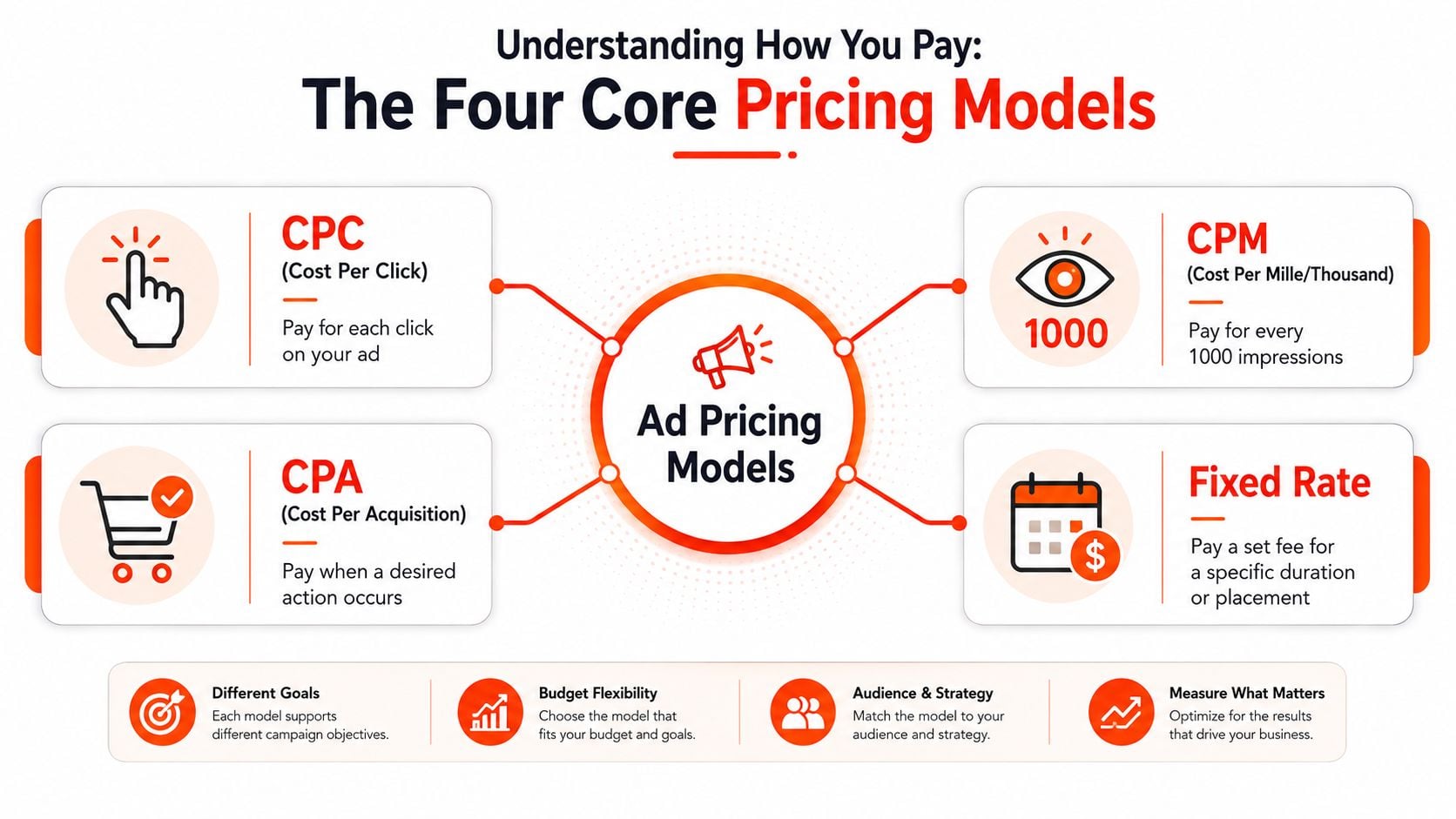
The phrase “pay for advertisement” sounds like one transaction, but there are several ways platforms can charge you. The model you choose changes the risk you carry.
CPC and CPM
CPC, or cost per click, is like paying a toll every time a car turns into your street. You don't pay because people saw the sign. You pay because they acted and entered.
That makes CPC useful when traffic quality matters more than raw reach. Google Search is the clearest example. Someone types a problem, sees your ad, clicks, and lands on your site. You're paying for an active signal of interest.
CPM, or cost per thousand impressions, is closer to renting a billboard on a busy road. You're paying for visibility, not for action. This works when your goal is reach, recall, or repeated exposure.
A simple distinction helps:
| Model | Best fit | Main risk |
|---|---|---|
| CPC | Search traffic, direct response, lead generation | You can buy low-quality clicks if targeting is weak |
| CPM | Awareness, remarketing, broad visibility | Lots of views can produce very little business impact |
CPA and Fixed Rate
CPA, or cost per acquisition, means you optimise around a completed action such as a sale or lead. Think of it as paying a salesperson only when they bring in a signed order or qualified form submission. In practice, platforms still need enough conversion data to make this work properly. If tracking is weak, CPA bidding can steer the campaign badly.
Fixed rate is common outside the large self-serve ad platforms. You pay a set fee for a placement, sponsorship, newsletter slot, or community publication. It's less like an auction and more like booking a stand at an industry event. You know the cost upfront, but performance depends heavily on the audience fit.
Which model suits which goal
If you want direct response, start by favouring intent-driven traffic or conversion-focused setups. If you need to get known first, impression-led buying can make sense. The trap is mixing the wrong pricing model with the wrong expectation.
For example:
- A local service business usually cares more about clicks and enquiries than broad impressions
- A new consumer brand may need visibility before search demand appears
- A niche B2B offer often needs a mix of awareness and later-stage lead capture
- A community publication buy may work better on a fixed placement than inside a standard platform auction
Practical rule: Don't judge a CPM campaign by click volume alone, and don't judge a CPC campaign by impressions alone.
A lot of wasted spend comes from that mismatch. The business wanted leads. The campaign was built for reach. The metrics looked busy, but revenue stayed flat.
Platform Billing How Google Meta and LinkedIn Take Your Money
The ad model tells you what you're paying for. Billing tells you when the platform charges your card and what can interrupt delivery.
Google Ads
Google Ads usually works like a running tab. You set up a payment method, the account accrues spend, and Google charges you based on its billing cycle and threshold system. If spend builds steadily, the platform may charge the card multiple times during a month rather than waiting until the end.
That catches some businesses off guard. They expect one neat invoice. Instead, they see several platform charges tied to threshold events and the monthly cycle.
The practical setup is straightforward:
- Primary payment method should be current and monitored
- Backup card helps prevent avoidable campaign pauses
- Billing access should sit with someone who can retrieve invoices quickly
- Account permissions matter if an agency or contractor is involved
Meta Ads
Meta usually feels more fluid because spend can rise and fall quickly based on audience size, placement mix, and campaign learning. Billing behaviour still follows platform rules around payment methods and account charging, but the operational lesson is simple: if your card fails, delivery can stop fast.
That matters because Meta campaigns often rely on momentum. A payment issue doesn't just pause impressions. It can interrupt learning, remarketing sequences, and lead flow.
LinkedIn Ads
LinkedIn is a different beast because the audience is more specific and the traffic is often more expensive in practical terms, especially for lead generation. Billing administration still looks familiar on the surface, but the business impact of errors tends to feel sharper. When each click is more valuable, wasted spend and payment interruptions hurt more.
For B2B teams, I usually recommend tighter internal controls around:
| Billing task | Why it matters |
|---|---|
| Invoice tracking | Finance teams often need cleaner monthly reconciliation |
| User permissions | Sales and marketing may both need visibility |
| Card monitoring | Failed payments can stall high-value lead campaigns |
| Campaign naming | Makes spend review much easier later |
A billing problem is rarely a media strategy problem, but it can still kill campaign performance.
The practical takeaway
Before launch, confirm the card, backup payment method, billing contact, invoice access, and account ownership. It's admin work, but it prevents the most irritating kind of failure: a campaign that was set up well and paused because nobody noticed a payment issue.
What Does It Actually Cost to Advertise in Australia
A Brisbane retailer can spend $1,500 on Google Ads and get enough clicks to judge product demand. A Sydney law firm can spend the same amount and barely gather enough data to tell which keywords are worth keeping. That gap catches a lot of Australian businesses off guard.
What Google Ads clicks commonly cost
In Australia, the average cost per click for Google Ads search campaigns ranges from $2 to $4 AUD across industries, based on Google Ads cost benchmarks in Australia. Use that as a starting reference only, not a budgeting rule.
The spread between industries is wide.
- E-commerce retailers often sit in a lower benchmark range of $1.40 to $1.82 AUD per click, according to these Australian Google Ads benchmarks by industry.
- Finance can reach $5.80 to $13.37 AUD per click in high-value lead generation, as outlined in this Proven SaaS guide to advertising.
- Legal services also tend to run high in Australia, often well above retail, because a single qualified matter can justify much more aggressive bidding.
That difference comes down to commercial value and competition. If a converted lead could be worth thousands of dollars, advertisers bid harder. If the category has broader search demand, lower average order values, or stronger product feed coverage, CPCs often stay more manageable.
I usually explain this to business owners like rent by suburb. You are still paying for space, but the price changes fast when the location is more competitive and the buyers are more valuable.
Cheap clicks waste money if they do not convert. Expensive clicks can still be profitable if the sales process and margin support them.
What that means for an Australian starting budget
Many first-time advertisers get budgeting wrong by planning around what feels affordable, rather than how much data the channel needs to make a sound decision.
If you sell online with a reasonably priced product, a smaller test budget can work because lower CPCs and higher conversion volume usually give the account more signal. If you are in B2B, finance, legal, or another lead generation category with expensive clicks, the same budget can disappear before patterns appear.
For many Australian B2B campaigns, monthly budgets of $2,000 to $5,000 AUD are often needed to gather enough meaningful data over a 60 to 90 day optimisation window, according to Megaphone's guide to Google Ads costs in Australia.
The practical lesson is simple. Budget for learning, not just launch. If the spend only buys a handful of clicks or a few low-quality leads, the campaign has not really been tested. It has only been turned on.
Setting Up Your Budget and Tracking for Success
A starting budget should do one job well. It should buy enough data to tell you whether the offer, audience, and landing page combination is viable. If it can't do that, you're not testing. You're sampling noise.
Start with a budget cap you can defend
Set a monthly budget that your business can sustain long enough to collect patterns, not just anecdotes. Daily budgets are useful operationally, but the monthly figure is the one that keeps decisions honest.
A clean way to think about it is:
- Pick one conversion goal such as an online sale, lead form, booked call, or add-to-cart progression.
- Match the budget to the likely traffic cost for that channel and category.
- Allow time for learning instead of judging the campaign off a handful of clicks.
Small budgets don't automatically fail. Split budgets do. If you spread a limited amount across too many campaigns, too many audiences, and too many messages, none of them gather enough signal.
Choose a bidding approach that fits the goal
Most new advertisers overcomplicate bidding. Keep it simple.
- If traffic is the immediate objective, a click-focused approach can help you learn what people respond to.
- If visibility matters first, impression-led delivery can make sense.
- If you already have clean conversion data, action-focused automation becomes more useful.
The mistake is handing control to automated bidding before the account has enough reliable tracking behind it. Automation is powerful, but it's only as good as the signals you feed it.
Install conversion tracking before spending seriously
A tracking pixel is a small piece of code or tag that tells the platform what happened after the click. Without it, the platform can count visits, but it can't properly understand sales, leads, or form completions.
That makes tracking essential.
For service businesses, don't stop at online forms. Phone calls, CRM-qualified leads, and closed deals often sit outside the ad platform unless you connect them back. If your sales happen partly offline, this guide to offline conversion tracking for PPC is worth reviewing before you scale.
If you can't track the result, you can't train the campaign to find more of it.
A simple setup checklist
| Setup item | Why it matters |
|---|---|
| Clear conversion action | Prevents vague reporting |
| One primary campaign goal | Makes optimisation possible |
| Pixel or tag installed | Connects ad clicks to business outcomes |
| Landing page match | Improves the odds of conversion |
| Budget held steady early | Gives the campaign time to learn |
That's where paid media stops being “buying ads” and starts behaving like a managed growth system.
Measuring ROI and Avoiding Common Money Pits
Clicks feel productive because they're immediate. Revenue is slower and less flattering. That's why so many first-time advertisers talk about traffic while subtly sidestepping the harder question: did the campaign make money?
Use a simple ROAS lens
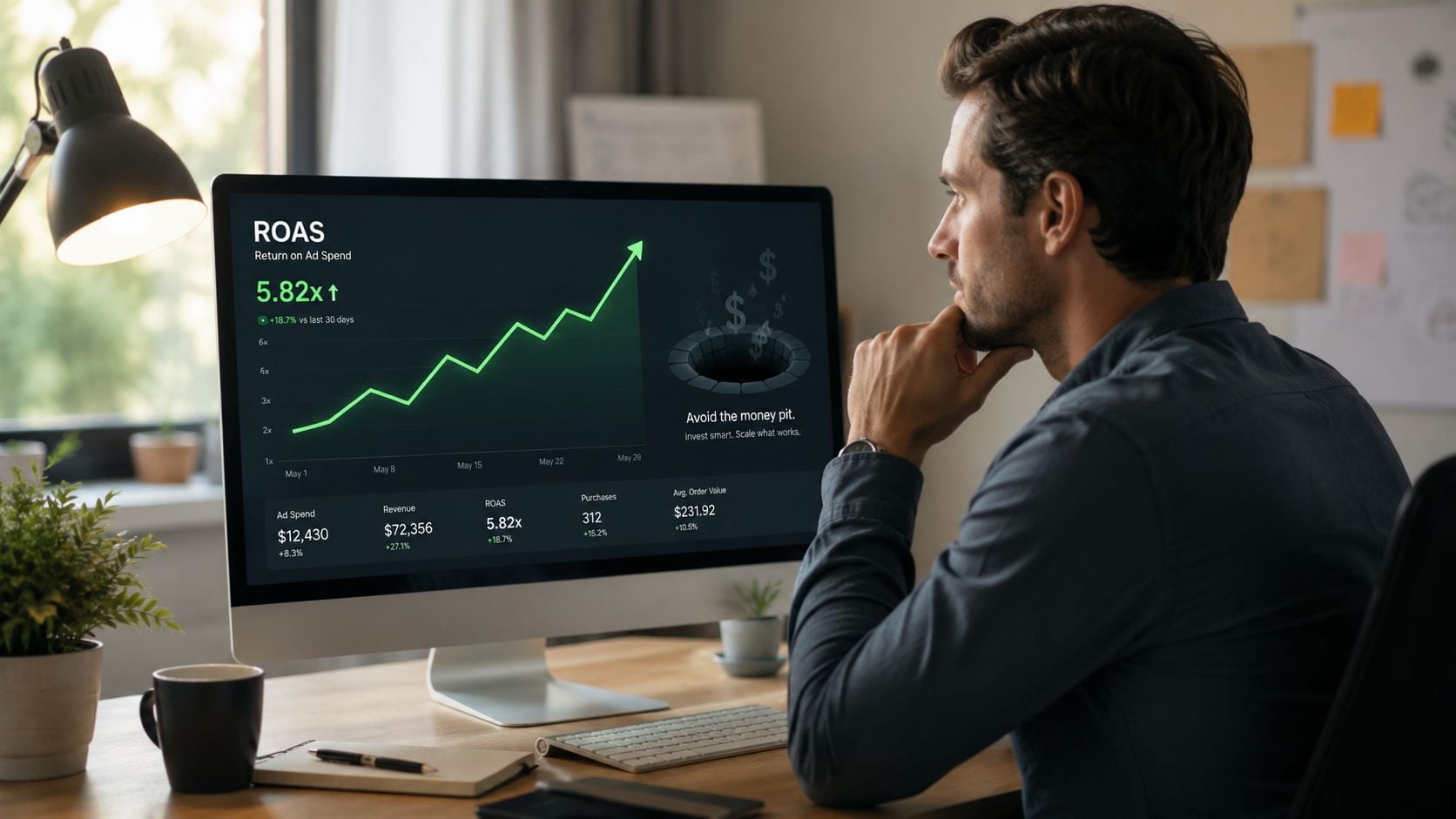
Return on ad spend (ROAS) is the revenue generated from ads divided by the ad spend required to generate it. It's a simple formula, but it forces discipline.
If one campaign brings in more revenue relative to spend than another, it's usually the stronger commercial asset, even if it produced fewer clicks. That's the shift many businesses need to make. Activity is not performance.
Take two common scenarios:
- Campaign A gets a lot of cheap clicks from broad targeting, but the landing page doesn't qualify visitors well.
- Campaign B gets fewer clicks, but the ad message and landing page are tightly aligned, so more of the right people convert.
Campaign A looks busier in the platform dashboard. Campaign B is usually the one worth keeping.
The money pits that drain first campaigns
The first waste point is vanity metrics. High impressions and click volume can look encouraging while sales stay flat.
The second is poor message match. If the ad promises one thing and the landing page talks about something else, users bounce. It's like inviting someone into a shop for running shoes and then walking them straight to formalwear.
The third is broad targeting with weak intent filters. Broad reach sounds efficient until you realise you paid for a large number of the wrong people.
A good campaign often looks less exciting than a bad one. It has fewer distractions and more profit.
A short explainer on reading performance the right way can help anchor that mindset:
What to check before increasing spend
Before you raise budget, look at these in order:
- Search intent or audience intent. Are the people arriving likely buyers?
- Landing page continuity. Does the page continue the exact promise made in the ad?
- Primary conversion quality. Are leads useful, or just easy to generate?
- Sales feedback. Does the pipeline confirm the traffic quality?
If those pieces are weak, more spend usually magnifies the problem. The campaign doesn't need fuel. It needs correction.
When to DIY vs Hire a Professional PPC Agency
A common starting point looks like this. An owner launches Google Ads on a $1,500 monthly budget, gets clicks in the first week, then realises nobody is checking search terms, conversion tracking is off, and the landing page is sending mixed signals. At that point, DIY is no longer cheaper. It is just hiding the labour cost inside your own time and missed sales.
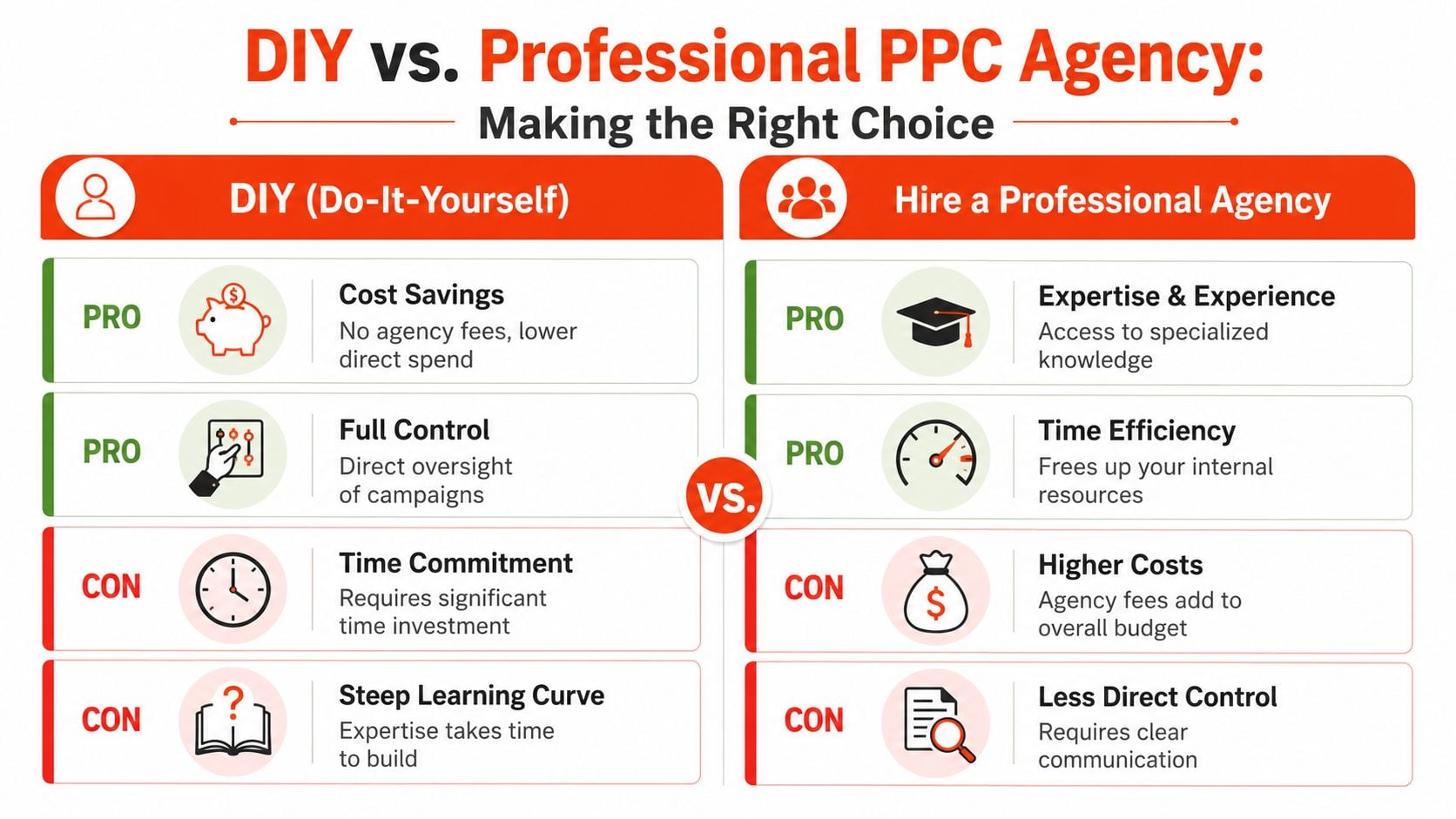
DIY can work well for an Australian business with a simple offer, a short sales cycle, and one platform to manage. A local service business running a tightly scoped search campaign is very different from an ecommerce brand splitting spend across Google, Meta, and LinkedIn. The first setup is often manageable in-house. The second usually gets expensive if nobody has time to maintain it properly.
The question is not whether you can press the buttons yourself. It is whether you can keep making good decisions every week.
DIY is realistic when:
- The account is small and focused, with limited campaigns, locations, and products
- The offer is easy to explain, and customers do not need much education before buying or enquiring
- Someone on your team can review performance regularly, including search terms, ads, audiences, and landing pages
- You are willing to learn the platform logic, not just write ad copy and set a budget
What catches businesses out is the ongoing work. PPC needs routine maintenance. Search terms need pruning. Ads need testing. Tracking breaks. Lead quality needs checking against what the sales team is hearing.
An agency starts to make financial sense once campaign mistakes are likely to cost more than the management fee. That usually happens when budgets increase, multiple channels are involved, or the business depends on lead quality rather than raw lead volume. In those cases, setup and optimisation matter more than getting ads live quickly.
Australian agency pricing varies, but the usual models are flat monthly fees, a percentage of spend, or a mix of both. Flat fees can suit smaller accounts because the cost is predictable. Percentage models can work once spend grows, but they need scrutiny. If an agency is paid more only when budget rises, you want clear controls around efficiency and lead quality, not just volume. For context on local pricing approaches, the team at Sparro outlines common PPC management fee structures in Australia.
If you are comparing options, it helps to know exactly what a PPC agency does. Good agencies do more than traffic buying. They handle account structure, tracking setup, testing plans, budget allocation, and the uncomfortable job of cutting waste before it drains another month of spend.
There is also a middle ground. Some businesses keep strategy, offers, and final approvals in-house, then hire a specialist for setup, tracking, and optimisation. That model works well when the owner knows the market well but does not want to spend Tuesday night fixing conversion tags or auditing search queries. And if your ad management needs extend into retail marketplace environments, a specialised option such as manage my ads on Target shows how platform-specific expertise can differ from general paid media support.
Click Click Bang Bang is one example of that specialist support model, managing PPC across Google, Meta, and LinkedIn on a fixed monthly fee structure.
If you are spending enough that mistakes hurt, expert help is usually cheaper than another quarter of avoidable waste.
Read NeXt
Or Read Our Latest
- Performance Max Campaigns: An AU Business Guide for 2026
- Pay for Advertisement: A Guide to Costs & ROI in 2026
- SEO Cost Australia 2026: Your Guide to Pricing
- Offline Conversion Tracking: Guide for AU Businesses 2026
- How to Start Advertising on LinkedIn: 2026 Guide
- 7 B2B LinkedIn Ad Examples to Steal in 2026
Click. CLick. Subscribe.
Get our best PPC insights, industry updates, and power moves delivered straight to your inbox. No fluff, just high-caliber strategies that actually work.
Don’t Leave Just Yet
Try Us For 30-Days,
Risk Free!!
We guarantee that you’ll love our work within the first 30 days, if not you’ll get your money back.
What have you got to lose?