

digital marketing agency: Find Your Perfect Partner
Last Updated
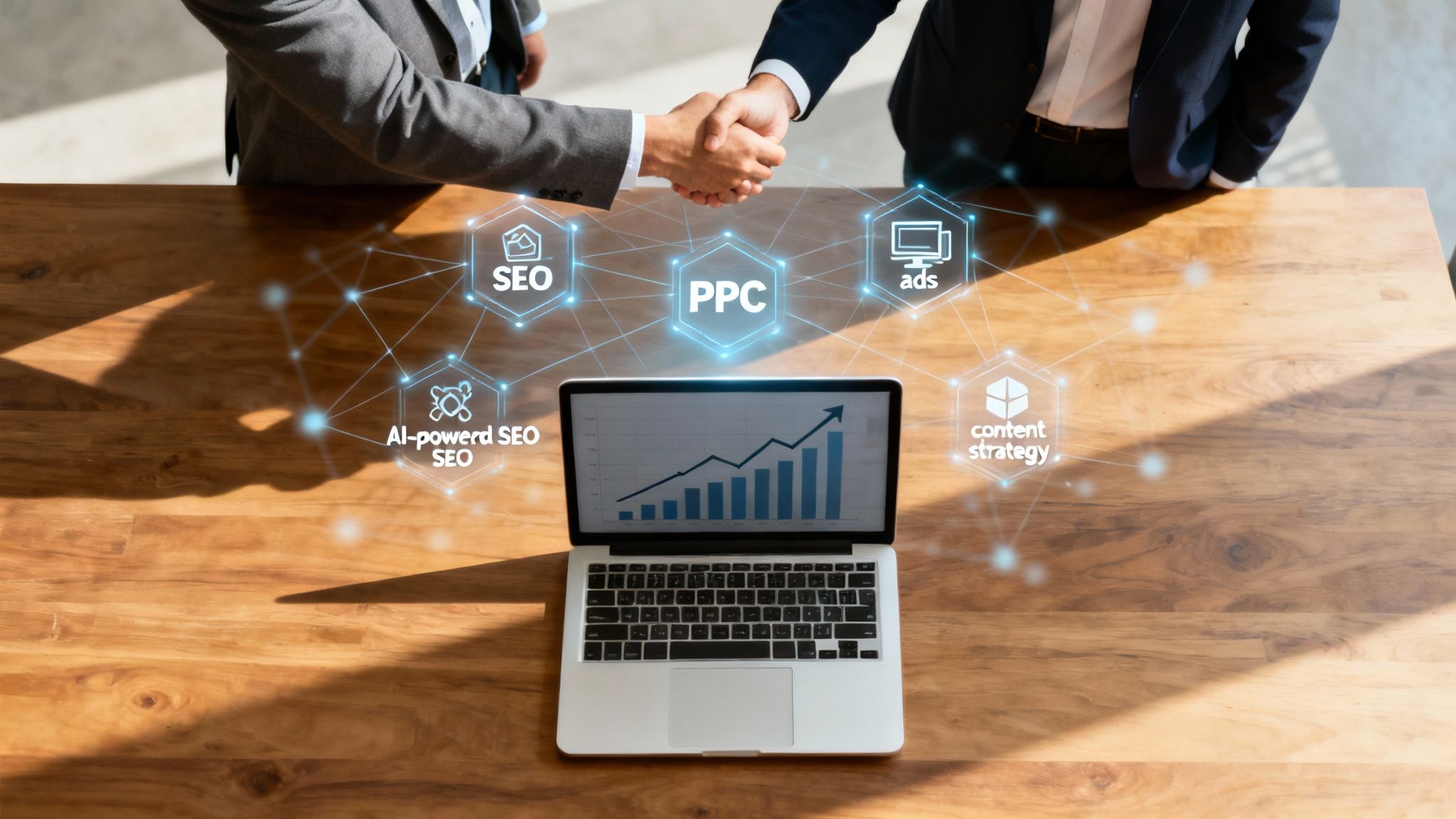
Finding your way through the maze of online marketing can feel overwhelming, right? That's where a digital marketing agency steps in. Think of them less as a service provider and more as a strategic partner—an expert extension of your team, dedicated to building a solid growth engine for your business.
Your Partner in Digital Growth
A good way to picture a digital marketing agency is as the specialised architect for your business's online presence. While you're busy perfecting your products or services, the agency is designing and building the digital pathways that bring customers straight to your door. This isn't just about slapping an ad up here or making a social media post there; it's about a unified, intelligent strategy.
These agencies pool together a team of specialists—strategists, search engine experts, creative writers, and data analysts—all working in sync to hit your specific goals. For a brand new company, that goal might be creating initial brand awareness. For an established e-commerce store, it could be all about bumping up the average order value.
Ultimately, the core mission of an agency partnership is to effectively generate business leads and grow sales, creating momentum that lasts. They make this happen by weaving different tactics into a single, powerful strategy.
The Modern Agency Ecosystem
Today's digital marketing is a multi-front battle. A top-tier agency doesn't just tick boxes; it provides the strategic oversight to ensure every single action pushes your bigger business objectives forward. This kind of partnership is what separates businesses that plateau from those that achieve scalable, long-term success. The industry's growth really tells the story here.
The digital marketing scene in Australia has exploded, hitting a market size of around USD 13.03 billion in 2024. Forecasts show that number is expected to climb to nearly USD 25.39 billion by 2034, which just goes to show how essential these services have become for businesses of every shape and size.
By weaving services like SEO, PPC, and content marketing together, an agency creates a growth flywheel. Each part strengthens the others, delivering results that are far greater than the sum of their parts.
For smaller businesses, just getting a handle on the fundamentals is the first big step. Our guide on digital marketing for small business is a great place to start wrapping your head around these powerful strategies. In the end, choosing the right agency is about finding a true partner—one who gets your vision and has the runs on the board to make it a reality.
So, What Does a Modern Marketing Agency Actually Do?
Walking into the world of a modern digital marketing agency can feel like stepping into a high-tech command centre. It’s a far cry from just posting on social media or sending out a newsletter. Today’s agencies are strategic hubs, coordinating a whole suite of specialised services designed to hit one primary target: your business’s growth.
Think of it like putting together a championship sports team. You don’t just hire one star player. You need a skilled quarterback (strategy), a powerful offensive line (SEO and content), and agile receivers (PPC and social). Each plays a distinct role, but their real power is unlocked when they execute plays in perfect sync. A digital marketing agency brings all these specialists under one roof and manages the entire game plan for you.
This map shows how core services like SEO, PPC, and content marketing are the foundational pillars of an agency's strategy.
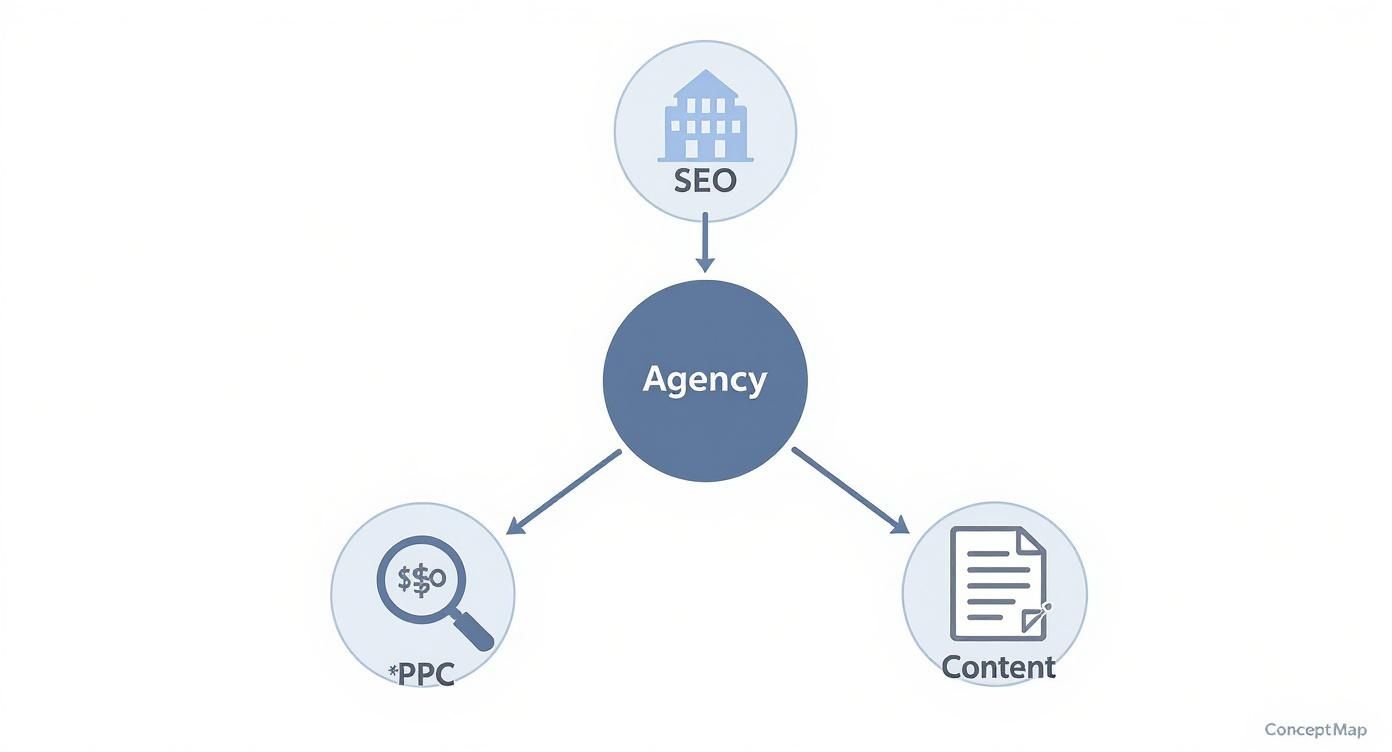
The key thing to grasp is that these aren't just isolated tactics. They're interconnected parts of a single, unified engine built to drive your business forward.
To give you a clearer picture, here's a quick breakdown of the core services you'll typically find, what they aim to achieve, and how success is measured.
| Service | Primary Goal | Key Performance Indicators (KPIs) |
|---|---|---|
| SEO (Search Engine Optimisation) | Increase organic visibility in search engine results. | Keyword rankings, organic traffic, conversion rate, bounce rate. |
| PPC (Pay-Per-Click) Advertising | Drive immediate, targeted traffic and conversions. | Click-Through Rate (CTR), Cost Per Click (CPC), Conversion Rate, Return on Ad Spend (ROAS). |
| Content & Social Media | Build brand authority, engage audiences, and nurture leads. | Website traffic, engagement rate (likes, shares, comments), lead generation, brand mentions. |
This table provides a high-level view, but let's dive into what each of these services really involves in a modern agency setting.
AI-Driven Search Engine Optimisation (SEO)
Search Engine Optimisation, or SEO, is the art and science of making your website more attractive to search engines like Google. The end goal is simple: show up on the first page—ideally in the top few spots—when potential customers are looking for what you sell. In the past, this was often a manual grind of guesswork and repetition.
But the game has completely changed. Today's top agencies use AI-first SEO, leveraging intelligent tools to analyse mountains of data. This allows them to find high-value keywords your competitors have totally missed, predict search trends before they happen, and automate technical website audits that would take a human weeks to finish. It’s all about working smarter, not just harder, to lock in those top rankings that deliver a steady stream of free traffic to your site.
The investment in this space is exploding. Australian businesses are clearly seeing the value, with SEO spending projected to hit a massive $1.5 billion in 2025. Even small businesses are now budgeting an average of $1,200 per month for SEO services, recognising it's a critical piece of the puzzle for building a sustainable online presence.
Omni-Channel Pay-Per-Click (PPC) Advertising
While SEO is your long game for organic growth, Pay-Per-Click (PPC) advertising gets you immediate visibility. Think of PPC as renting a billboard on the world's busiest digital highway. You pay a small fee every time someone clicks on your ad, which appears right at the top of search results or in social media feeds.
A modern agency's strength lies in omni-channel PPC. This means they aren't just running ads on Google. They're creating and managing perfectly synchronised campaigns across all the platforms where your customers hang out, including:
- Google Ads: To capture people with high buying intent, right at the moment they’re actively searching.
- Meta Ads (Facebook & Instagram): To reach audiences based on their specific interests, demographics, and online behaviours.
- TikTok Ads: To engage a younger, more dynamic audience with creative, short-form video content.
- LinkedIn Ads: To target professionals in a B2B setting based on their job title, industry, or company size.
This multi-platform approach ensures your message hits the right people, at the right time, maximising your return on ad spend. A huge part of an agency's job is proving that return through solid advertising effectiveness measurement.
Content and Social Media Management
If SEO and PPC are the engine, then content is the fuel. It’s the blog posts that answer your customers' burning questions, the videos that show off your product, and the whitepapers that cement your authority in the industry. An agency's content marketing service is all about creating valuable, relevant material that pulls in and keeps a clearly defined audience.
But this great content doesn't just exist in a vacuum. Social media management is the distribution network that gets it in front of real people. It's so much more than just scheduling posts; it’s about building a community, jumping into conversations, and turning casual followers into loyal advocates for your brand.
A great agency knows that content and social media are two sides of the same coin. Content provides the value, while social media provides the platform for connection and conversation. Together, they create a loyal customer base that trusts your brand.
Ultimately, all these services blend together to form a powerful, integrated strategy. SEO makes you discoverable, PPC drives instant traffic, and quality content builds the trust that turns that traffic into actual customers. It's this coordinated effort that a skilled digital marketing agency orchestrates to deliver measurable, sustainable growth for your business.
Finding Your Agency Fit by Business Type
Picking a digital marketing agency isn't about finding the "best" one out there; it's about finding the right one for your specific business. A one-size-fits-all strategy is a recipe for wasted ad spend and missed opportunities. The tactics that drive sales for a retail brand are worlds apart from those that generate qualified leads for a B2B software company.
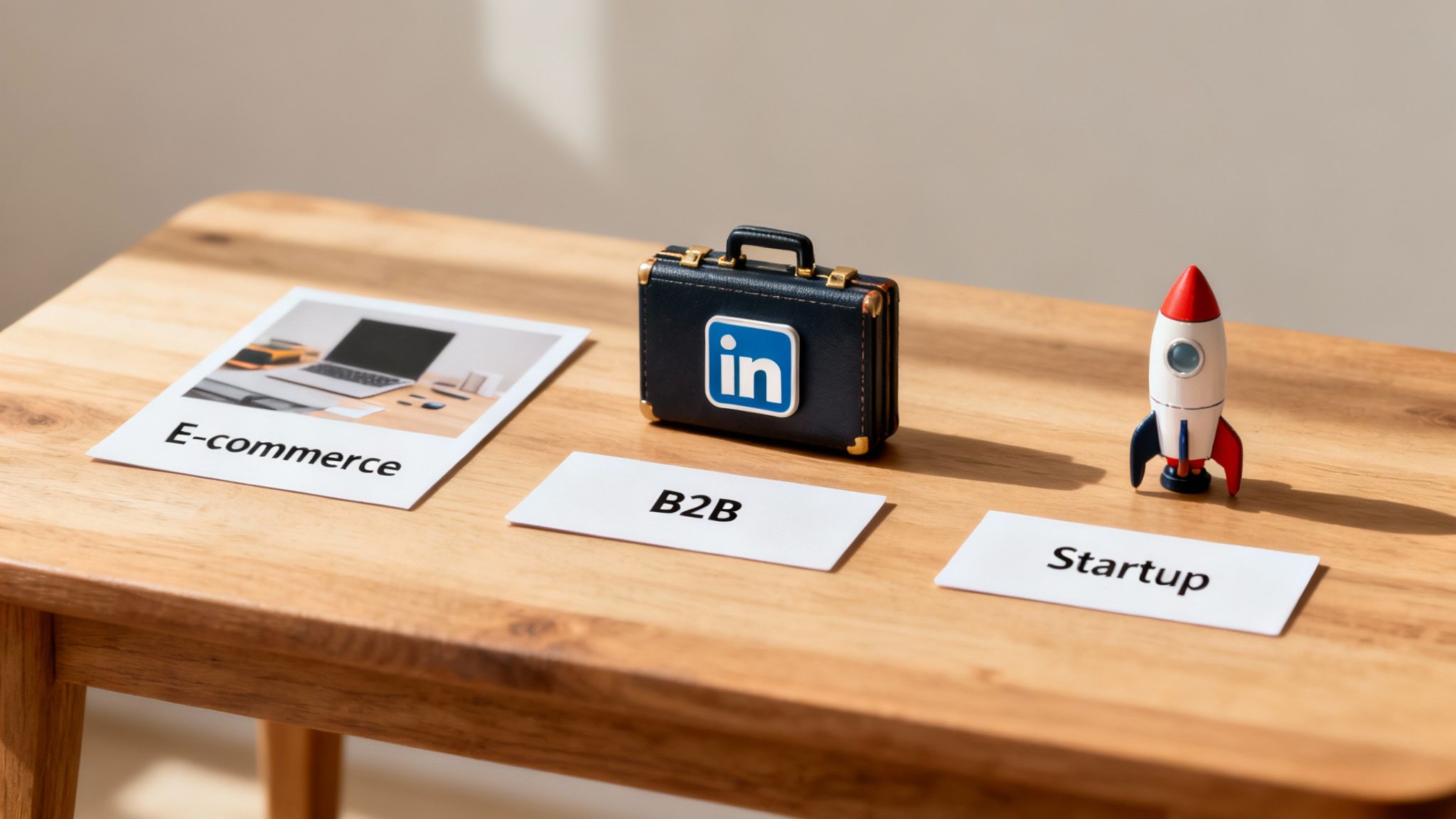
You need to understand how an agency tailors its approach to your unique DNA. Let's break down how a strategic partnership delivers specific, targeted benefits for e-commerce brands, B2B companies, and startups.
For E-commerce Brands Driving Sales
For an e-commerce business, every single click holds the potential to become a sale. The main goal is direct revenue, making the path from ad to checkout as short and seamless as humanly possible. An agency that specialises in e-commerce gets this unique pressure.
Their focus is laser-sharp and centred on immediate commercial outcomes. This means they move beyond fluffy brand awareness campaigns and execute strategies that directly fatten the bottom line.
A top-tier e-commerce agency will prioritise a specific set of services designed for online retailers:
- Precision-Targeted PPC: Campaigns on Google Shopping and Meta (Facebook & Instagram) are non-negotiable. They zero in on product-specific ads that capture high-intent buyers, optimising everything for metrics like Return on Ad Spend (ROAS).
- Conversion Rate Optimisation (CRO): The agency will dig into your website's user experience to find and fix friction points in the buying process. This could involve A/B testing checkout pages or simplifying navigation to slash cart abandonment rates.
- Product-Focused SEO: This goes way beyond general keywords to target long-tail search terms for specific products. Think optimising for "waterproof leather ankle boots for winter," not just "women's shoes."
For e-commerce, a successful agency partnership is measured in transactions. Their strategy should be a direct line connecting ad spend to completed orders, turning browsers into buyers with ruthless efficiency.
For B2B Companies Generating Leads
Business-to-Business (B2B) marketing operates on a completely different timeline. Sales cycles are longer, purchase decisions are made by committee, and the real game is about building trust and demonstrating expertise over time. The goal isn't an impulsive click-and-buy; it's about generating a high-quality lead for the sales team to nurture.
An agency with deep B2B experience understands the critical importance of professional credibility and lead qualification. Their campaigns are built to attract, educate, and convert decision-makers within specific industries.
Key strategies for a B2B-focused digital marketing agency typically include:
- LinkedIn Campaigns: This is the premier playground for B2B. A savvy agency will use advanced targeting to reach professionals by job title, industry, company size, and seniority, making sure ad spend is directed only at relevant prospects.
- High-Value Content Creation: B2B buyers crave information, not just ads. The agency will develop insightful content like whitepapers, case studies, and webinars that solve real business problems and position your company as a thought leader.
- Account-Based Marketing (ABM): Instead of casting a wide net, this hyper-targeted approach focuses marketing efforts on a select list of high-value companies, personalising outreach and content for maximum impact.
For businesses looking to sharpen their B2B approach, it's worth exploring proven B2B digital marketing strategies that focus on long-term relationship building and lead quality.
For Startups Building a Foundation
Startups face a unique challenge: they need to achieve rapid growth and build brand awareness from scratch, often with a shoestring budget and minimal market presence. An agency partner for a startup must be agile, resourceful, and obsessed with building momentum from the ground up.
The strategy here is less about optimising existing channels and more about creating them. The agency's job is to establish an initial user base and generate the early traction needed to attract investors and validate the business model.
A startup-savvy digital marketing agency will concentrate on:
- Brand Awareness Initiatives: Using cost-effective social media and content strategies to introduce the brand to its target audience and start building a community.
- Early User Acquisition: Employing lean and targeted PPC campaigns to acquire the first crucial users or customers, proving there's a real market for the product.
- Building Foundational SEO: Implementing a smart SEO strategy from day one to ensure the startup begins ranking for core keywords, setting the stage for long-term organic growth.
Ultimately, the right agency fit comes down to your business's DNA. Matching your model with an agency's specialisation ensures their efforts are perfectly aligned with the metrics that truly matter to your success.
Navigating Agency Pricing and Investment
Figuring out how a digital marketing agency structures its fees is the first step toward making a confident investment. Agency pricing isn't some dark art; it's simply a reflection of the value, expertise, and resources being poured into your business's growth. Once you demystify these models, you can align your budget with your goals much more effectively.
When you start talking to agencies, you'll generally come across three main pricing structures. Each one has its own perks and is better suited for different kinds of marketing engagements, so knowing the difference is key.
The Monthly Retainer Model
The most common structure you'll find is the monthly retainer. Think of it as putting a specialised marketing team on your payroll for a fraction of what it would cost to hire them in-house. You pay a fixed fee each month for an agreed-upon scope of ongoing work.
This model is a perfect fit for long-term strategies that need continuous effort and optimisation, like:
- SEO: Search engine optimisation is a marathon, not a sprint. It demands constant content creation, technical tweaks, and link building to see real results.
- PPC Management: Ongoing pay-per-click campaigns need daily monitoring, bidding adjustments, and ad testing to squeeze every drop of value from your ad spend.
- Content & Social Media: Building an audience and a brand requires a consistent rhythm of creating and sharing valuable content.
The biggest benefit of a retainer is predictability. You have a fixed marketing expense each month, which makes budgeting a breeze. On top of that, you build a deep, collaborative relationship with an agency that gets to know your business inside and out over time.
Project-Based and Performance Models
Of course, a retainer isn't always the right fit. A project-based fee is used for a one-off task with a clear start and finish line. This is perfect for deliverables like a complete website redesign, a brand strategy workshop, or a foundational SEO audit. You just pay a single, agreed-upon price for the finished product. Simple.
A performance-based model is another option where the agency’s payment is directly tied to the results they generate. This could mean they earn a percentage of ad spend or a fee for every lead they bring in. While it sounds great on paper, this model is less common for complex services like SEO, where results build up over time and are influenced by heaps of external factors. Our guide to PPC pricing models dives deeper into these structures specifically for paid advertising.
Choosing the right model isn't just about cost—it's about alignment. A retainer suits a long-term growth partnership, while a project fee is perfect for a specific, defined outcome.
The growing investment in digital channels really underscores how important it is to pick the right partner. In Australia, the internet advertising market surged to $4.2 billion for the March 2025 quarter alone, an 11.6% jump year-on-year. This growth is powered by sectors pouring money into search and online listings, showing a clear trend toward sustained digital investment. You can find more insights on this booming digital advertising market on influencermarketinghub.com. Understanding these pricing models ensures your investment is structured for success in this competitive environment.
A Practical Framework for Choosing Your Agency
Picking the right digital marketing agency is one of the most important decisions you'll make. This isn't just about hiring another supplier; you're choosing a partner who will be at the helm of your growth. A methodical approach is the only way to find a team that genuinely clicks with your vision, budget, and goals.
The point of this framework isn't to find a perfect agency, but the perfect agency for you. And that process starts by looking inward long before you start looking outward.
Define Your Destination Before You Start the Journey
You wouldn't get in a taxi and say, "just drive." The same logic applies here. Before you can even think about evaluating an agency, you need a crystal-clear picture of what success actually looks like for your business.
Start with your core business objectives. Are you trying to grow online sales by 30% over the next year? Or is the real goal to generate 50 qualified B2B leads every single month?
Once you have those big-picture goals, break them down into specific Key Performance Indicators (KPIs). These are the hard numbers an agency will live and die by.
- For E-commerce: You'll want to focus on metrics like Return on Ad Spend (ROAS), Conversion Rate, and Average Order Value (AOV).
- For B2B: It’s all about Cost Per Lead (CPL), Lead-to-Customer Rate, and Customer Lifetime Value (CLV).
- For Startups: Key metrics might be Customer Acquisition Cost (CAC), website traffic growth, and the volume of people searching for your brand name.
Having these numbers locked down gives you a powerful lens to assess every potential partner. It changes the conversation from vague promises to measurable results.
Vet Their Experience and See the Proof
Every agency out there will tell you they get results. The good ones will show you. Your job is to dig deep into their track record and make them prove it with real, tangible evidence.
Go beyond the shiny logos on their homepage and ask for specific, relevant case studies. If you're an apparel e-commerce brand, a case study about a B2B software company doesn't mean much. Look for proof that they've solved problems similar to yours.
A great case study is more than a simple success story. It should walk you through the initial problem, the strategy the agency built, the roadblocks they hit, and the specific, data-backed results they delivered.
And don't just stop at the polished case studies. Ask for client references you can actually speak to. A quick chat with a current or former client can give you priceless insights into an agency's communication, transparency, and whether they truly deliver on their promises.
Ask the Right Questions to Uncover Their Approach
Those initial calls and meetings are your chance to grill potential agencies on their process and strategic thinking. Generic, canned answers are a massive red flag. You want a partner who thinks critically about your business, not one who just slaps on a cookie-cutter template.
Here’s a quick checklist of questions you need to ask:
- Strategic Process: "Can you walk me through your process for building a strategy for a client like us?"
- Team Structure: "Who would be our day-to-day contact, and what's the experience level of the people who will actually be doing the work?"
- Reporting and Transparency: "What do your reports look like? How often will we see them, and what metrics do you focus on?"
- Communication: "What’s your preferred way to communicate, and what's your standard response time?"
Listen closely to how they answer. A confident, transparent agency will have clear, well-defined answers for each. If you get vague responses or they seem reluctant to detail their process, it should give you pause.
Choosing an agency is a huge decision, but it doesn't have to be a shot in the dark. By getting clear on your goals, digging into their history, and asking sharp questions, you’ll be in a much better position to make an informed choice that pays off for years.
Agency Evaluation Checklist
Finding the right fit often comes down to a side-by-side comparison. Use this table to score potential agencies on the criteria that matter most, making your final decision more objective and data-driven.
| Evaluation Criteria | Agency A | Agency B | Notes |
|---|---|---|---|
| Relevant Case Studies/Experience | How closely does their past work match our industry and goals? | ||
| Client References & Reviews | What did their other clients say? Any red flags? | ||
| Strategic Approach & Depth | Did they offer a custom strategy or a generic template? | ||
| Team Expertise & Structure | Who is on the team? Are they experienced seniors or fresh juniors? | ||
| Communication & Transparency | How clear are their reporting and communication processes? | ||
| Cultural Fit & Partnership Vibe | Do they feel like a true partner or just another vendor? | ||
| Pricing Model & Value | Does the cost align with the expected value and our budget? | ||
| Overall Score (out of 10) |
By the end of this exercise, you should have a much clearer picture of which agency not only talks the talk but is truly equipped to walk the walk with you.
What to Expect After You Sign the Contract

You’ve vetted the case studies, aligned on the strategy, and officially signed on with your new digital marketing agency. So, what happens next? This is where the real work begins, kicking off a structured onboarding process designed to build a rock-solid foundation for long-term success.
Think of this initial phase as the pre-flight check before a long journey. It’s less about seeing instant results and more about your team and the agency working closely together to get all systems ready for launch. This period is all about eliminating guesswork and getting everyone aligned on goals, expectations, and the practical steps to get campaigns off the ground.
Everything starts with an in-depth onboarding meeting. This isn't just a simple meet-and-greet; it’s a strategic deep dive where you’ll nail down final campaign objectives, confirm the KPIs that matter, and map out the first 90 days of activity.
The Kick-Off and Technical Setup
Once the strategy is locked in, the focus shifts to the technical nuts and bolts. To manage and measure your campaigns properly, the agency will need access to key business assets. This is a standard—and essential—part of any professional partnership.
Granting this access isn't just a formality. It provides the raw data your agency needs to make informed decisions. Without it, they're essentially flying blind.
You can typically expect to provide access to:
- Website Backend: To implement SEO tweaks or install tracking codes.
- Google Analytics: For tracking website traffic and user behaviour.
- Social Media Accounts: To manage posts, engage with your audience, and run ad campaigns.
- Ad Platforms: Such as Google Ads and Meta Business Manager.
A smooth onboarding process is the single best predictor of a successful long-term agency relationship. It establishes trust, clarifies roles, and ensures both parties are working from the same playbook from day one.
Establishing Communication and Reporting Rhythms
With the technical setup complete, the final piece of the onboarding puzzle is putting clear communication channels in place. Your agency will introduce your main point of contact and establish a regular schedule for updates and performance reviews. This might be a weekly email, a fortnightly call, or a monthly strategy session.
This structure is vital. It ensures you’re never left wondering what your digital marketing agency is working on or how campaigns are performing. From here, the relationship becomes a true collaboration. Your role is to provide industry insights and feedback, while the agency executes the strategy, analyses the data, and optimises for growth. A strong start really does set the stage for a productive and profitable partnership.
Got Questions? We've Got Answers
Stepping into a partnership with a digital marketing agency always brings up a few big questions. That's a good thing. Getting clear, honest answers from the get-go is the foundation of any great working relationship and sets the stage for real success.
Let's cut to the chase and tackle the queries we hear most often from businesses before they come on board.
How Long Until We See Results?
This is usually the first thing people ask, and the only honest answer is: it really depends on the strategy we build together. Digital marketing isn’t one magic button; it's a mix of different tactics, and each has its own timeline. Think of it like a sprint versus a marathon.
-
Pay-Per-Click (PPC) advertising is the sprint. You can see an impact—like more website traffic and fresh leads—almost immediately. We're often talking within the first week of a campaign going live. The trade-off? The moment you stop paying, the results stop coming.
-
Search Engine Optimisation (SEO) is the marathon. Building up your authority with search engines and ranking for valuable keywords is a steady, gradual process. You'll likely see some encouraging signs in the first 3-6 months, but the significant, game-changing results that drive consistent traffic typically take 6-12 months to really kick in. The reward for that patience is a powerful, long-term asset that keeps bringing in free traffic.
What Kind of ROI Should We Expect?
Return on Investment (ROI) is the ultimate scorecard, but it doesn't always look the same for every business. For an e-commerce store, it’s pretty straightforward: we measure Return on Ad Spend (ROAS). A 4:1 ROAS, for example, means you've made $4 in revenue for every $1 you spent on ads. Simple.
For B2B companies or service-based businesses, the picture is a bit more nuanced. We look at metrics like Cost Per Lead (CPL), but the real story is in the Customer Lifetime Value (CLV). A campaign might generate leads today that don't close for another three months. The immediate ROI might look modest, but the long-term value from that new client relationship could be massive. A good agency will sit down with you to define exactly what a win looks like for your business and set clear goals to measure against.
How Much Involvement Is Needed from Our Team?
You're hiring an agency to do the heavy lifting, but the best results always come from a partnership, not a hand-off. Your team's input is absolutely vital, especially at the start. You're the experts on your industry and your customers, and that's the knowledge we need to build a strategy that actually works.
Think of us as the expert pilots, ready to fly the plane. But you’re the one who provides the destination and the flight plan. Your insights on business goals, ideal customers, and what makes your product special are the fuel that gets us off the ground.
Expect to be most hands-on during the initial onboarding and strategy sessions. After that, your role usually shifts to giving regular feedback, signing off on creative, and joining us for monthly reviews where we break down the performance. Open communication and a true sense of collaboration are what turn a good campaign into a great one.
At Click Click Bang Bang, we build our partnerships on transparency and clear expectations from day one. If you’re ready for a data-driven SEO and PPC strategy that delivers results you can actually measure, let's talk. Explore our services at https://clickclickbangbang.com.au.
Read NeXt
Or Read Our Latest
- Manual vs Automated Bidding for PPC Success
- Conversion Tracking Setup: A Complete AU Guide
- Instagram Advertising Australia: Complete 2026 Guide
- Pay Per Click: A Beginner’s Guide for Australian Marketers
- Display Advertising on Google: The Complete Australian Guide
- Stakeholder Communication Plan How to Build One That Works
Click. CLick. Subscribe.
Get our best PPC insights, industry updates, and power moves delivered straight to your inbox. No fluff, just high-caliber strategies that actually work.
Don’t Leave Just Yet
Try Us For 30-Days,
Risk Free!!
We guarantee that you’ll love our work within the first 30 days, if not you’ll get your money back.
What have you got to lose?