

SEO for Small Business A Practical Guide to Rank Higher
Last Updated

For a small business, SEO is all about getting your website seen by more local customers in search engines like Google. It’s the art of tuning up your online presence—from your website right through to your Google Business Profile—so you’re the first result people see when they search for what you do. Done right, it drives a steady stream of traffic, leads, and sales without emptying your pockets on ad spend.
Building Your SEO Foundation
Before you even think about chasing rankings or getting tangled in complex strategies, you need to get the foundation right. It's just like building a house; you wouldn’t dare put up the walls before pouring the concrete slab. This initial setup is the absolute non-negotiable first step for any small business that's serious about real, sustainable growth from search.
It’s about ditching the guesswork and creating a clear, data-driven plan.
Jumping straight into writing blog posts or trying to get links without this groundwork is like driving blindfolded. Sure, you might be moving, but you have no clue where you're headed or what's in your way. The aim here is to nail the essentials from day one, giving you the tools and insights to make smart decisions moving forward.
Set Up Your Core Analytics Tools
First things first. You need to install two free and incredibly powerful tools from Google: Google Analytics and Google Search Console. Think of them as your eyes and ears, telling you exactly what’s happening with your website.
- Google Analytics (GA4) tracks how people behave on your website. It answers questions like: "How many people visited my site this month?", "Which pages are the most popular?", and "Where are my visitors actually coming from?".
- Google Search Console (GSC) gives you the inside scoop on how your site is performing in Google Search. It’ll show you the keywords people are using to find you, flag any technical problems, and let you track your search engine rankings over time.
Getting these set up is pretty straightforward and gives you the baseline data you need to measure what's working. Without them, you're just guessing whether your SEO efforts are paying off.
Conduct a Simple DIY Website Audit
Once your tracking is live, it’s time for a quick health check on your website. A simple DIY audit can uncover some quick wins and fix critical issues that might be holding you back. Don't worry, you don’t need to be a tech whiz for this part.
Start by looking at your site from a customer’s perspective. Is it a nightmare to use on a mobile phone? Do pages take forever to load? Can you find your contact details easily? These basic user experience factors have a huge impact on your SEO. A site that frustrates visitors is a site that Google is less likely to recommend. To get a better handle on the entire process, checking out our guide to search engine optimisation can fill in the gaps.
This flow shows how the foundational process works: you set things up, you audit, and you learn from the insights.
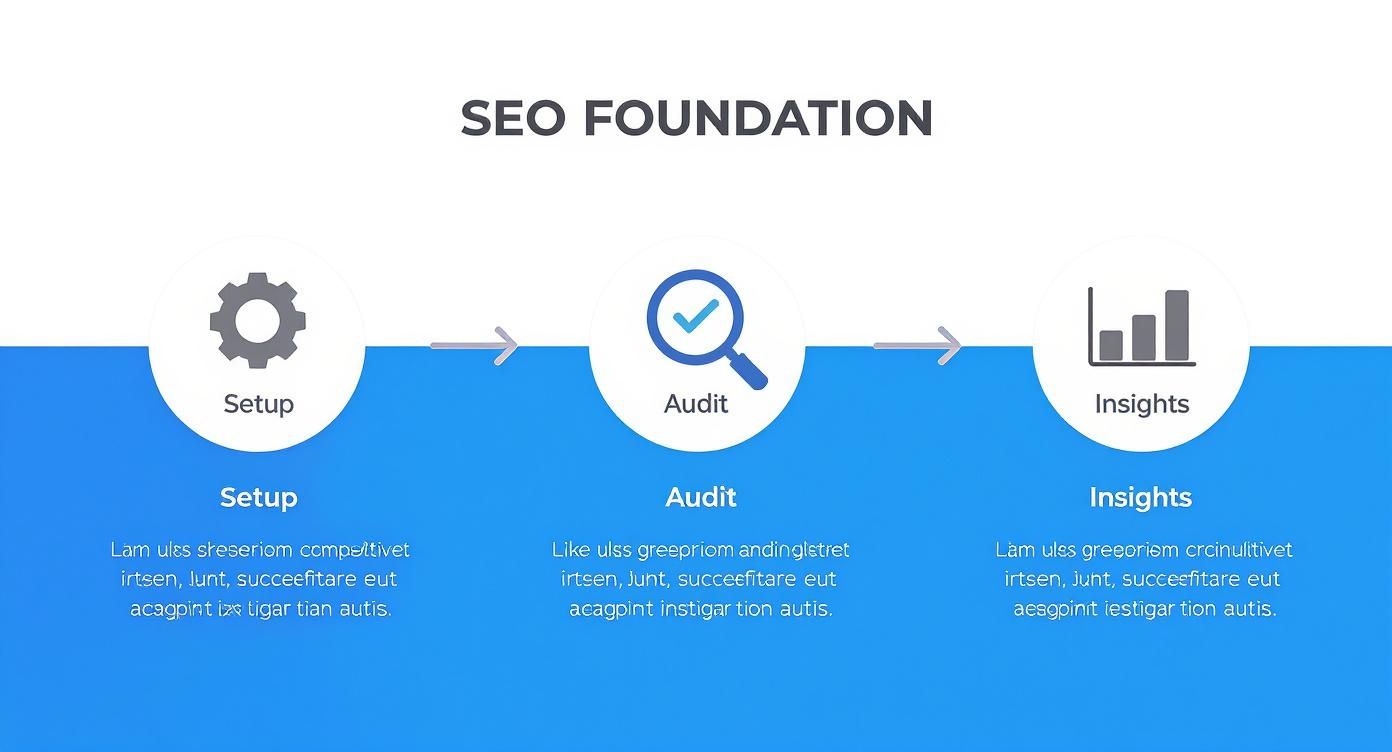
As the infographic shows, a winning small business SEO strategy is a constant loop of implementing, reviewing, and learning.
The biggest mistake I see small businesses make is skipping the foundational work. They’re so busy chasing 'quick wins' that they don’t realise their website has technical issues preventing them from ranking at all. Getting this right first saves months of wasted effort down the track.
After the user experience check, go a little deeper. Hunt for broken links, make sure your important pages have clear titles and descriptions, and double-check that your business name, address, and phone number are consistent everywhere. These small fixes can make a surprisingly big difference. For a complete roadmap to getting found online, this practical Small Business SEO Guide is a great resource.
By sorting out these foundational elements, you’re not just optimising for search engines; you’re building a better, more effective online storefront for your customers.
Winning the Local Search Battle
For a small business, your most valuable customers are often just around the corner. While some businesses chase national rankings, local SEO is your secret weapon to dominate your immediate area. It’s all about being the first and best answer when someone nearby searches for what you offer. This is where you can truly outmanoeuvre bigger, faceless competitors—by being the most visible, trusted choice in your community.
It all starts with your Google Business Profile (GBP). Think of it less as a simple online listing and more as your digital storefront. It’s often the first interaction a potential customer has with your business, popping up in Google Maps and the "local pack" in search results. A neglected profile is a huge missed opportunity, but a fully optimised one is a customer-generating machine.
Transform Your Google Business Profile
Your first job is to claim and completely fill out every single section of your GBP. Don't skip a thing. This means adding high-quality photos of your work, your team, and your premises. Make sure you select all relevant business categories and attributes—these are the details that help Google match you to specific customer searches.
Consistency here is non-negotiable. The name, address, and phone number (NAP) on your GBP must exactly match the details on your website and any other online directories. Any inconsistencies can confuse search engines and seriously harm your local rankings.
A complete and optimised Google Business Profile isn't just a 'nice to have'—it's a non-negotiable part of modern SEO for small business. It directly influences whether a local customer finds you or your competitor first.
Local SEO is especially powerful in Australia, where local search intent is tightly linked to actual buying decisions. Data shows that 46% of all Google searches in Australia have local intent, meaning nearly half of all searchers are looking for nearby products or services. Businesses with a complete profile can get 7 times more clicks, and a staggering 78% of local mobile searches result in a store visit within 24 hours. This stuff drives real foot traffic.
Cultivate a Five-Star Reputation
Reviews are the lifeblood of local SEO. They provide powerful social proof and are a major ranking factor for Google. Your goal should be to create a steady stream of positive, authentic reviews from real customers.
Don't be shy about asking for them! The best time to ask is right after you’ve provided a great service or product. You can make it easy for customers by creating a direct link to your GBP review page and sharing it via email or even a text message.
- Respond to every single review, good or bad. A thoughtful response to a positive review shows you appreciate your customers.
- A professional reply to a negative review demonstrates accountability and can often turn a bad situation around. More importantly, it shows potential new customers that you genuinely care.
And whatever you do, never, ever buy fake reviews. Google's algorithms are smarter than you think, and getting caught can lead to penalties that are incredibly difficult to recover from. Authenticity builds trust, and trust wins customers.
Engaging with Local Customers
Your GBP isn't a "set and forget" tool. It has features designed for active engagement, which signals to Google that your business is active, relevant, and worth showing to people.
Use Google Posts to share updates, offers, events, or new products. These posts appear directly on your profile in search results and are a fantastic way to capture a searcher's attention. Think of them as free, mini-adverts right where people are looking.
The Q&A feature is another goldmine. People often ask common questions here, so be proactive and answer them yourself to control the narrative and provide helpful information upfront. You'll also want to monitor this section regularly to answer new questions from potential customers promptly.
Target Hyper-Local Keywords
To connect with customers actively looking to buy, you need to think local with your keywords. Instead of just targeting "plumber," a much smarter approach is "emergency plumber Ballarat" or "blocked drain plumber Bendigo."
These long-tail, location-specific keywords have much higher buyer intent. Someone searching with a suburb or town name is usually looking for immediate help, not just browsing. Sprinkle these terms naturally throughout your website's service pages, in your GBP description, and within your Google Posts. This is a core component of any successful digital marketing strategy for small business.
By focusing on these local SEO tactics, you build a powerful presence in your service area. You stop competing with everyone on the internet and start winning the customers who matter most—the ones right in your own backyard.
Finding Keywords That Drive Real Business
Let's be honest, keyword research can feel like a total chore. It’s notorious for getting bogged down in endless spreadsheets and confusing metrics, leaving you wondering what on earth to do with all that data.
But it doesn't have to be that complicated. A smart approach to SEO for small businesses cuts through the noise. It focuses on one thing that truly matters: finding the exact phrases your ideal customers are typing into Google when they’re ready to open their wallets.
The goal here isn't just to get more traffic; it's about attracting the right kind of traffic. Ten visitors who are actively looking to buy are infinitely more valuable than a hundred just browsing. This means we need to shift our focus from vanity metrics to real business results—more calls, more quote requests, and more sales.
Beyond the Obvious Search Terms
Your first instinct might be to go after the big, popular keywords in your industry. A local cafe might think "coffee shop" is the ultimate prize. A plumber might aim for "plumbing services." And while these terms get a lot of searches, they are also fiercely competitive and often attract people who are still just kicking tyres.
The real gold is in what we call 'buyer-intent' keywords. These are the longer, more specific phrases that signal someone is much closer to making a decision. They've moved past general research and are now actively looking for a solution to their problem.
Think about the difference in mindset here. Someone searching for "coffee" is in a completely different headspace than someone searching for "best flat white near Central Station." The first query is vague, but the second is from someone who almost certainly wants to buy a coffee, right now, in a specific location. This is where you can win.
How to Uncover Buyer-Intent Keywords
You don't need a suite of expensive tools to start digging up these valuable phrases. In fact, some of the best insights come from simply putting yourself in your customer's shoes. How would you search if you had an urgent problem that your business solves?
Here are a few practical ways to get started using free tools:
- Google's Autocomplete and 'People Also Ask': Start typing a service you offer into Google. Pay close attention to the suggestions that pop up in the search bar—these are based on what real people are searching for. Then, scroll down and look at the "People Also Ask" box; it’s a goldmine of the exact questions your potential customers need answers to.
- Think Like a Customer: Get a pen and paper and brainstorm keywords that include transactional words. Think "buy," "quote," "cost," "near me," or "emergency." For example, instead of just "roof repair," you could target something like "emergency roof leak repair cost Sydney."
- Use Google Keyword Planner: While it's designed for Google Ads, this free tool is fantastic for SEO research. You can plug in a few seed ideas, and it will spit out hundreds of related keywords, complete with estimated search volumes. Your job is to sift through the list and pull out the longer, more descriptive phrases it suggests.
The secret to effective keyword research for a small business isn't about finding the terms with the highest search volume. It's about finding the terms that demonstrate the highest commercial intent. That’s how you turn clicks into customers.
Real-World Keyword Scenarios
Let's make this practical. Imagine you run a small business in Melbourne that specialises in custom-made timber furniture.
Instead of trying to rank for a super broad and competitive term like "furniture," you'd be much better off focusing on the specific, high-intent keywords your ideal customers are actually using.
Keyword Transformation Example
| Broad Keyword (High Competition) | Buyer-Intent Keyword (Lower Competition) | Why It Works |
|---|---|---|
| Timber furniture | Custom Tasmanian oak dining table | The user knows exactly what they want, including the material and product type. |
| Melbourne furniture store | Handmade timber bookshelf Melbourne | This specifies the craft ("handmade") and the product, targeting a niche audience. |
| Custom furniture | Quote for recycled timber entertainment unit | The word "quote" is a powerful buying signal, indicating a user ready for pricing. |
This targeted approach lets you compete far more effectively. Sure, you might get fewer visitors overall, but the ones who do find you are significantly more likely to become customers because your website directly addresses their very specific need. This is the essence of a winning SEO strategy for any small business: being the best answer for the most qualified searchers.
Creating Content That Connects and Converts
Once you’ve nailed down keywords that scream "I'm ready to buy," it's time to create the content that will actually rank for them. This is where the real work begins—and where you prove to both Google and your ideal customers that you’re the expert they’ve been searching for.
The goal isn't just to fill pages with words. It’s to build a library of genuinely helpful resources that solve problems, answer questions, and build unshakable trust. For a small business, this has to be strategic. You don't need a hundred blog posts; you need a handful of high-impact pages that are laser-focused on your audience's needs, turning your website into a reliable customer-generation machine.

Building Your Core Service Pages
Think of your service pages as your 24/7 digital sales team. Their one job is to convince a potential customer that you are the absolute best choice for a specific service, often in a specific location. These pages need to be built around those high-intent keywords we uncovered earlier.
A landscaper in Geelong, for example, shouldn't just have one generic "Services" page. That’s a huge missed opportunity. A much smarter approach is to create separate, dedicated pages for each core service, all optimised for local searches.
- Page 1 Title: Expert Paving Services in Geelong
- Page 2 Title: Professional Turf Laying Geelong
- Page 3 Title: Custom Garden Design for Geelong Homes
Each page needs to be a comprehensive deep-dive into that one service. Talk about your process, the materials you use, and answer the questions you get asked all the time. You'll want to naturally weave your target keyword and related terms (like "paving contractors Geelong" or "new lawn installation") into your headings and body text. This focused approach sends a crystal-clear signal to Google about what the page is about, massively improving its chances of ranking.
Writing Blog Posts That Solve Problems
While your service pages are there to capture people ready to buy, your blog is for everyone else—the people still in the research phase. The secret here is to stop selling and start teaching. A blog is your chance to demonstrate your expertise and build trust long before someone is ready to pull out their wallet.
This kind of helpful content is a cornerstone of any solid SEO for small business strategy. It positions you as the go-to authority in your niche.
Don’t just write about your services. Write about your customers' problems. Your blog is your opportunity to be the most helpful teacher in your industry, which builds a level of trust no advertisement can ever buy.
Let's stick with our Geelong landscaper. What are their potential customers Googling at 10 PM?
- How much does it cost to pave a driveway in Victoria?
- What is the best type of grass for Geelong's climate?
- When is the best time of year to plant a new garden?
Every single one of these is a perfect blog post. Answering them thoroughly provides huge value and attracts highly relevant traffic. Someone who reads your detailed guide on choosing the right grass is far more likely to remember your business when they're finally ready to get that new lawn.
Despite how critical this is, many Aussie businesses are falling behind. Recent surveys show only about 36% of Australian small businesses use SEO effectively. Worse, a worrying 42% of their websites saw major drops in search visibility recently. But there's good news: using advanced tactics like creating structured Q&A content can lead to a recovery in just 8 to 16 weeks. You can find more details in this in-depth analysis on small business SEO trends.
A Simple Content Checklist Before You Publish
Before you hit 'publish' on any page or post, give it a quick once-over with this checklist. This isn't just about ticking SEO boxes; it's about creating a better, more effective experience for your readers.
Content Publishing Checklist
| Checklist Item | Purpose |
|---|---|
| Clear, Engaging Title | Does it include the main keyword and make someone want to click? |
| Logical Structure | Is the content broken up with clear H2 and H3 subheadings so it’s easy to scan? |
| Natural Keyword Use | Is the primary keyword in the first 100 words, subheadings, and body text without sounding like a robot? |
| Internal Links | Have you linked to other relevant service pages or blog posts on your site? |
| Compelling Call-to-Action (CTA) | Is it dead obvious what you want the reader to do next (e.g., "Request a Quote," "Call Us Today")? |
Following this simple framework helps ensure every piece of content you create is working hard for your business—attracting the right people, answering their questions, and gently guiding them towards becoming a paying customer. Of course, attracting them is only half the battle. To make sure you’re turning that traffic into leads, you need solid tracking in place. Learning more about effective website conversion tracking is the crucial next step to measuring what truly matters.
How to Build Authority and Trust Online

Creating great content is a massive step forward, but to really make a dent, you need other websites to vouch for you. In the SEO world, we call these endorsements backlinks. It helps to think of each link from another site to yours as a vote of confidence, telling Google you’re a credible and trustworthy source of information.
For a small business, the term "link building" can sound daunting, bringing to mind complex, time-consuming outreach campaigns. But it doesn't have to be like that at all. We’re focusing on practical, achievable wins that build genuine local authority and boost your rankings, all without a huge budget or a dedicated team.
Start with Foundational Citations
The simplest place to begin building authority is by getting listed in key online business directories. These listings, known as citations, are absolutely critical for local SEO. They help Google verify that your business is legitimate and that its location and contact details are spot-on.
Your first priority here is consistency. Your business name, address, and phone number (NAP) must be identical across every single platform. Even a tiny difference, like using "St." versus "Street," can confuse search engines and water down your authority.
The goal of local link building isn't to get hundreds of links from just anywhere. It's to earn a handful of high-quality, relevant links from sources within your own community. These are the endorsements that Google values most for local businesses.
Earn Links Within Your Community
Beyond directories, the most powerful links often come from other businesses and organisations right in your own backyard. These local endorsements are pure gold for your SEO efforts. They signal strong community ties and local relevance, which is exactly what Google wants to see.
Here are a few low-effort ways to earn valuable local backlinks:
- Sponsor a local event: Many community fun runs, school fetes, or local sports teams list their sponsors on their website, complete with a link back to your site. This is a simple and effective win-win.
- Collaborate with a neighbouring business: Team up with a non-competing business in your area. For instance, a florist could write a guest post for a local wedding venue's blog about choosing seasonal flowers, with a link back to their own site.
- Join a local business association: Organisations like the Chamber of Commerce often have member directories that include a link to each business's website.
These tactics are all about building real-world relationships that translate directly into online authority.
Simple Outreach That Actually Works
While we're avoiding massive, complex campaigns, a little bit of simple outreach can go a long way. The key is to be genuine and offer real value.
Imagine you're a local accountant. You could write a definitive guide to tax deductions for tradies and then send a simple, friendly email to local electricians, plumbers, and builders. You're not just asking for a link; you're providing a genuinely useful resource their own audience would appreciate.
Building a credible and trustworthy online presence is paramount for any small business. To take it a step further, you can explore proven online reputation management strategies for small businesses to really solidify that trust.
By focusing on these practical, community-oriented strategies, you can build a strong backlink profile that enhances your reputation, improves your search rankings, and drives more local customers right to your door.
Got Questions? Here Are Some Real Answers
Jumping into SEO always brings up a few curly questions. It's totally normal. To wrap this guide up, I've put together some straight-up, no-fluff answers to the things I get asked most often by Aussie business owners.
Think of this as a quick chat to clear up those final bits of uncertainty so you can get started with confidence.
How Long Does SEO Take to Show Results for a Small Business?
This is the big one, and the honest answer is that SEO is a marathon, not a sprint. You're building a long-term asset for your business, not just flicking a switch.
Typically, you can expect to see some encouraging signs—like climbing from page five of Google to page two—within 3 to 6 months of consistent work. This initial movement is a great signal that you're on the right track.
But for the results that really matter, like a steady stream of phone calls and qualified leads hitting your inbox, you're usually looking at a 6 to 12-month timeframe. A few things can speed this up or slow it down:
- Your industry's competitiveness: A local plumber in a small town will likely see results faster than a financial advisor in Sydney.
- Your starting point: A brand-new website with no history is starting from scratch, while an established site with some authority has a head start.
- Your consistency: This is crucial. Chipping away at your SEO week after week is what builds momentum and gets you there.
One area where you can see faster wins is local SEO. If your Google Business Profile has been a bit neglected, giving it a proper optimisation can often lead to more calls and website clicks in just a matter of weeks.
Can I Do SEO Myself or Should I Hire Someone?
Another massive question. The answer really comes down to your two most valuable resources: your time and your willingness to learn. You can absolutely do your own SEO—this entire guide is built to help you do exactly that.
Going the DIY route is a fantastic, budget-friendly option if you have the hours to dedicate to learning and actually doing the work. It puts you in the driver's seat and gives you a powerful understanding of what makes your business visible online.
On the flip side, if you're in a cut-throat market or just flat-out don't have the time, bringing in a reputable SEO specialist or a small agency can seriously fast-track your results. They’ve already got the expertise and processes dialled in.
My advice? Start by tackling the basics yourself. Even if you only manage to optimise your Google Business Profile and write one blog post a month, getting your hands dirty with the fundamentals will make you a much smarter client if you decide to hire a pro later on.
What Is the Most Important Part of Local SEO?
For any local Australian business, your Google Business Profile (GBP) is, without a doubt, the most critical piece of the puzzle. It’s the first thing most potential customers see when they search for your services on Google Search or Maps.
A fully fleshed-out profile—with accurate details, glowing reviews, and recent photos or posts—can generate phone calls and customers walking through your door directly. Many people will contact you without ever even visiting your website.
While things like on-page SEO and creating content are vital for long-term success, a stellar GBP delivers the biggest and most immediate impact for local visibility.
How Much Should a Small Business Budget for SEO?
SEO budgets here in Australia can be all over the place. If you're going the DIY route, your biggest investment is your time, with only minimal costs for a few essential tools.
If you decide to hire some help, here’s a rough guide to what you can expect:
- Freelancer or small agency: Retainers usually sit somewhere between $500 to over $2,500 per month.
- Larger agencies: Costs can climb significantly higher, often starting in the several thousands per month and going up from there.
The most important thing is to stop thinking of SEO as a monthly expense and start seeing it as an investment. You are actively building a valuable asset that will continue to bring in leads and sales for your business long after the invoices are paid. It's about creating sustainable authority and visibility online.
Ready to stop guessing and start getting real results from your digital marketing? At Click Click Bang Bang, we specialise in AI-first SEO and precision PPC campaigns that drive growth for businesses just like yours. Let's talk about a strategy for your business.
Read NeXt
Or Read Our Latest
- Manual vs Automated Bidding for PPC Success
- Conversion Tracking Setup: A Complete AU Guide
- Instagram Advertising Australia: Complete 2026 Guide
- Pay Per Click: A Beginner’s Guide for Australian Marketers
- Display Advertising on Google: The Complete Australian Guide
- Stakeholder Communication Plan How to Build One That Works
Click. CLick. Subscribe.
Get our best PPC insights, industry updates, and power moves delivered straight to your inbox. No fluff, just high-caliber strategies that actually work.
Don’t Leave Just Yet
Try Us For 30-Days,
Risk Free!!
We guarantee that you’ll love our work within the first 30 days, if not you’ll get your money back.
What have you got to lose?