

Display Advertising Agency: Boost Your Brand with Proven Ad Strategies
Last Updated
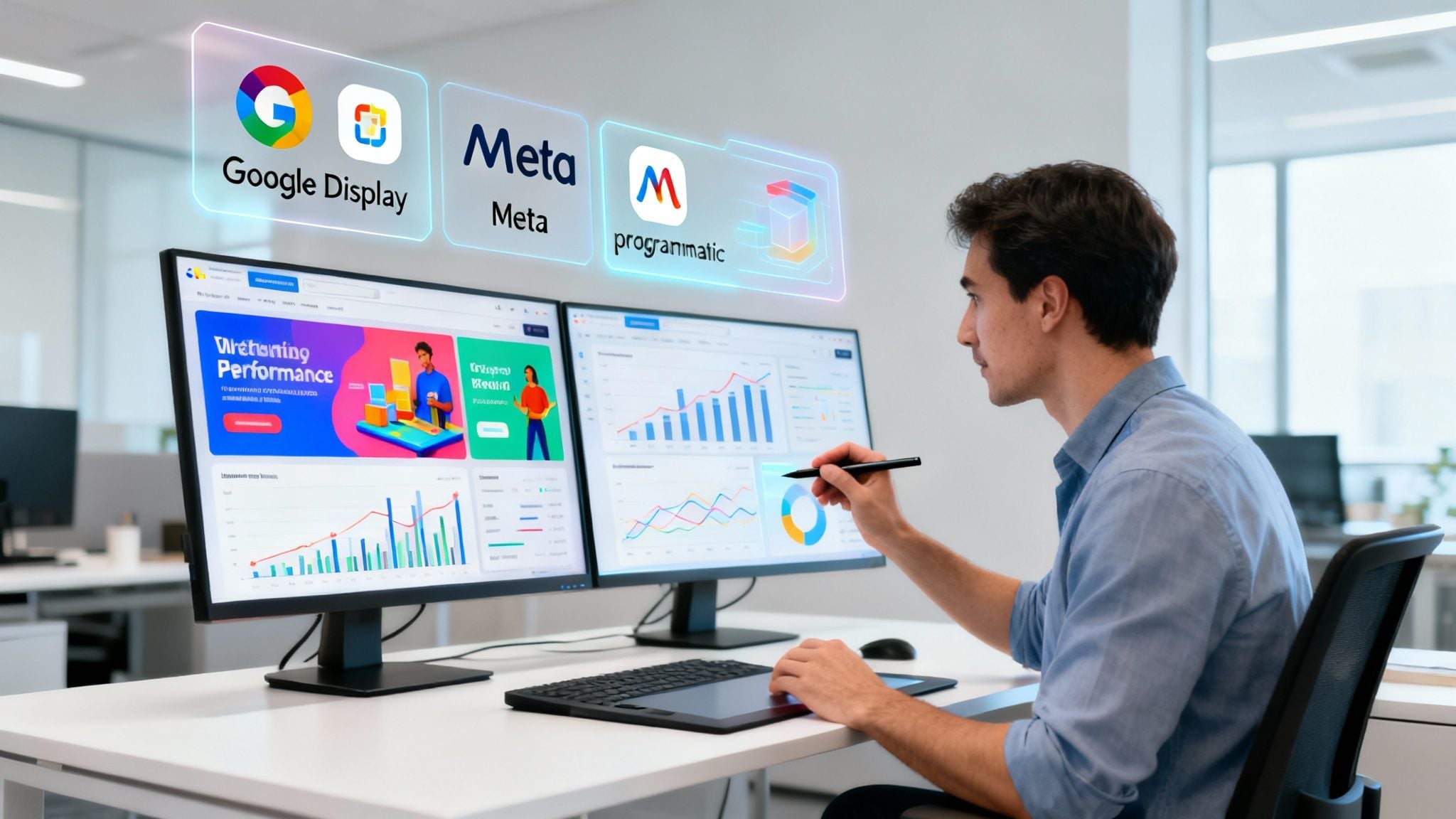
Think of a display advertising agency as a specialist architect for your brand's online presence. They’re the experts you bring in to design, build, and manage your visual ad campaigns across the web—from websites and apps to social media feeds. Their entire focus is making sure your ads don't just get seen, but get seen by the right people, at the right time, to actually grow your business.
What Exactly Does a Display Advertising Agency Do?

Let's stick with the house-building analogy. When you build a house, your general contractor oversees the whole project. But for the most critical, specialised parts—like the blueprints and aesthetics—you hire an architect. A display advertising agency is that architect, but for your brand's visual footprint.
They focus exclusively on designing and placing the "visuals"—the banner ads, videos, and interactive formats that create digital curb appeal and draw people to your brand.
But their job is much more than just slapping an image onto a website. It's a blend of art and science, mixing compelling creative with hard data to hit specific business goals, whether that’s brand awareness, lead generation, or sales.
The Specialist's Role in a Digital World
A general digital marketing agency often juggles everything from SEO and content to email marketing. A display advertising agency, on the other hand, goes deep into one powerful channel. Their expertise is laser-focused on platforms built for visual ads, like the Google Display Network, programmatic ad exchanges, and social media giants like Meta.
To help clarify what they bring to the table, here’s a quick breakdown of their core functions.
Core Functions of a Display Advertising Agency
| Function | Description | Business Goal |
|---|---|---|
| Strategy & Planning | They analyse your market, define target audiences, and map out a campaign blueprint to reach them effectively. | Ensure ad spend is directed where it will have the most impact. |
| Creative Development | This involves designing visually stunning and persuasive ad creatives (images, videos, HTML5) that stop the scroll. | Capture user attention and drive clicks or engagement. |
| Platform Management | They navigate the complex dashboards of DSPs, Google Ads, and social platforms, managing bids and budgets. | Maximise ad delivery and secure the best placements for your money. |
| Audience Targeting | Using data, they build precise audience segments based on demographics, interests, behaviours, and intent. | Get your ads in front of people most likely to become customers. |
| Testing & Optimisation | They constantly run A/B tests on creatives, headlines, and targeting to see what works best and improve performance. | Increase campaign ROI by doubling down on winning elements. |
| Reporting & Analysis | They track key metrics, analyse performance, and provide clear, actionable reports on what your ad spend achieved. | Provide transparency and data-backed insights for future strategy. |
As you can see, their role is comprehensive. They don't just launch a campaign and hope for the best; they manage every moving part to ensure it delivers results.
In essence, while search advertising captures existing demand (people actively searching for you), display advertising creates new demand by putting your brand in front of potential customers as they browse their favourite content online.
From Impressions to Impact
Ultimately, a display advertising agency's mission is to turn visibility into real business value. They oversee the entire campaign lifecycle, from the initial strategy and audience research all the way through to creative testing, placement optimisation, and detailed performance reports.
This hands-on management is essential. In FY2025, Australia's online ad market ballooned to an incredible $17.2 billion. While search took the lion's share, display advertising firmly held its ground, proving its value in a crowded market. In this environment, a top-tier agency delivers a clear ROI by showing you exactly how your budget is performing through meticulous testing and transparent reporting. For more details on these figures, you can explore insights about the state of Australia's online ad market.
A great agency doesn't just buy you impressions; they connect those impressions to tangible results like leads, sales, and measurable brand growth.
Decoding Agency Services and Platforms
Think of a skilled display advertising agency like a master chef with a fully stocked pantry. They don't just cook one dish; they understand every ingredient (the platforms) and every technique (the services) needed to create a winning campaign that hits the spot for your business. Their job is to pick the right tools and apply the right skills to get the results you're after.
At its core, their work splits into two key areas: the platforms they operate on and the services they provide. You can think of platforms as the different venues where your ads can show up, each with its own unique crowd and vibe. The services are all the expert actions the agency takes to make sure your ads are a hit, no matter the venue.
The Major Advertising Playgrounds
A modern display advertising agency doesn't just stick to one corner of the internet. They strategically operate across a bunch of different ecosystems, each offering unique advantages depending on what you're trying to achieve.
These are the three primary playgrounds:
- Google Display Network (GDN): The GDN is absolutely enormous, reaching over 90% of internet users worldwide. It’s like placing your ads on a massive, interconnected network of digital billboards—from popular news sites and niche blogs to YouTube and mobile apps. It’s the go-to for building broad brand awareness and keeping your business top-of-mind.
- Programmatic Advertising Platforms: This is where advertising gets incredibly precise. Programmatic advertising uses automated tech to buy and place ads in real-time. Agencies use various tools, including a sophisticated programmatic buying platform known as a Demand-Side Platform (DSP), to manage and automate campaigns with incredible efficiency. This approach allows for hyper-targeting based on detailed user data, making it perfect for reaching specific B2B decision-makers or niche e-commerce audiences with surgical precision.
- Social Media Networks: Platforms like Meta (Facebook and Instagram) and LinkedIn are what we call "walled gardens," each with a deeply engaged user base. An agency will use Meta for its powerful, visual-first environment, which is perfect for e-commerce brands wanting to show off their products. On the other hand, they’ll turn to LinkedIn to target professionals based on job title, industry, and company size, making it a goldmine for B2B lead generation.
Core Services That Drive Real Results
A true display advertising agency does much more than just place ads. They provide a full suite of hands-on services designed to squeeze the most value out of every dollar you spend. These services are the "how" behind a successful campaign, turning a simple ad into a powerful business driver.
A great agency knows the platform is just the stage. The real performance comes from the strategic services they execute—from crafting the perfect message to analysing the final applause.
Let's break down the essential services that make a real difference.
Strategy, Creative, and Optimisation
These aren't separate tasks but a constant, interconnected cycle of improvement.
- Audience Segmentation and Targeting: Before a single ad gets designed, the agency dives deep into the data to figure out who your ideal customer is. They build detailed audience segments based on demographics, interests, online behaviour, and buying intent. This makes sure your message reaches people who are genuinely interested, not just random internet browsers.
- Creative Development and A/B Testing: This is where art meets science. The agency's team designs a range of ad creatives—from static banners and animated HTML5 ads to short-form videos. But here’s the crucial part: they don't just guess what will work. They run constant A/B tests, pitting different headlines, images, and calls-to-action against each other to find the top-performing combinations and fine-tune the campaign over time.
- Performance Analytics and Reporting: Finally, a top-tier agency gives you complete transparency. They set up advanced conversion tracking and deliver clear, actionable reports. Instead of just showing you impression numbers, they connect ad performance to real business outcomes like Cost Per Acquisition (CPA), Return On Ad Spend (ROAS), and the number of qualified leads generated.
The Australian market really shows the power of this integrated approach. Display advertising down under is a vital part of the digital economy, with non-video display spend hitting $516 million in a recent quarter. Programmatic trading, which automates a whopping 82.4% of these buys, is the engine that drives this efficiency, allowing for pinpoint targeting for businesses in every sector. It’s this data-driven environment where a skilled display advertising agency truly shines, turning complex platforms into profitable results for your business. For deeper statistics on this trend, you can review key paid advertising statistics in Australia.
Mastering Audience Targeting and Creative Formats
Getting display advertising right boils down to two things: reaching the right people and showing them something that makes them stop and look. A great display advertising agency doesn't just master these two elements; they weave them together to turn a simple banner ad into a growth engine for your business.
It’s not about just spraying your ads across the internet and hoping for the best. It's about precision-guided delivery with real impact. Think of it like this: you wouldn't fish for marlin in a shallow pond. In the same way, a good agency uses smart targeting to find exactly where your ideal customers are online, making sure every dollar you spend is working as hard as it can.
Reaching Your Ideal Customer With Precision Targeting
Any decent agency has a whole toolkit of methods to pinpoint your audience. They move way beyond basic demographics like age and gender, focusing instead on user behaviour and intent—far more powerful signals of who is actually ready to buy.
A skilled agency will help you select the right mix of targeting strategies to match what you're trying to achieve, whether that's building brand awareness or driving immediate sales.
Matching Targeting Methods to Business Objectives
| Targeting Method | Best For | Example Use Case (E-commerce) | Example Use Case (B2B) |
|---|---|---|---|
| Contextual Targeting | Reaching users in a relevant mindset. | Placing ads for hiking boots on a blog about outdoor adventures. | Showing ads for accounting software on articles about small business finance. |
| In-Market Audiences | Capturing active buyers with high intent. | Targeting users actively searching for "new camera reviews" and browsing electronics retailers. | Targeting professionals researching "CRM software for sales teams." |
| Remarketing | Re-engaging warm prospects to drive conversions. | Showing an ad for the exact pair of shoes a user viewed on your site yesterday. | Displaying a case study ad to someone who recently visited your "pricing" page. |
| Custom Intent Audiences | Ultra-granular targeting for niche markets. | Building an audience of users who have searched Google for specific competitor brand names. | Creating an audience of people who have visited specific industry conference websites. |
By aligning your targeting with your goals, you move from just showing ads to strategically engaging the right people at the right time.
Designing Creatives That Convert
Once you know who you're talking to, the next question is what are you going to say? Your ad creative is your brand's first impression in a very crowded room, and it has to be a scroll-stopper.
A seasoned agency understands that a one-size-fits-all approach is a recipe for wasted ad spend. They'll pick the right format for the platform, the audience, and your specific campaign goal.
A winning display campaign isn't just about finding the right audience; it's about starting the right conversation. The creative is your opening line, and it has to be compelling enough to make them listen.
This is where an agency acts as the central hub, connecting all the pieces—the platforms, the services, and the strategies—to deliver the outcomes you’re looking for.
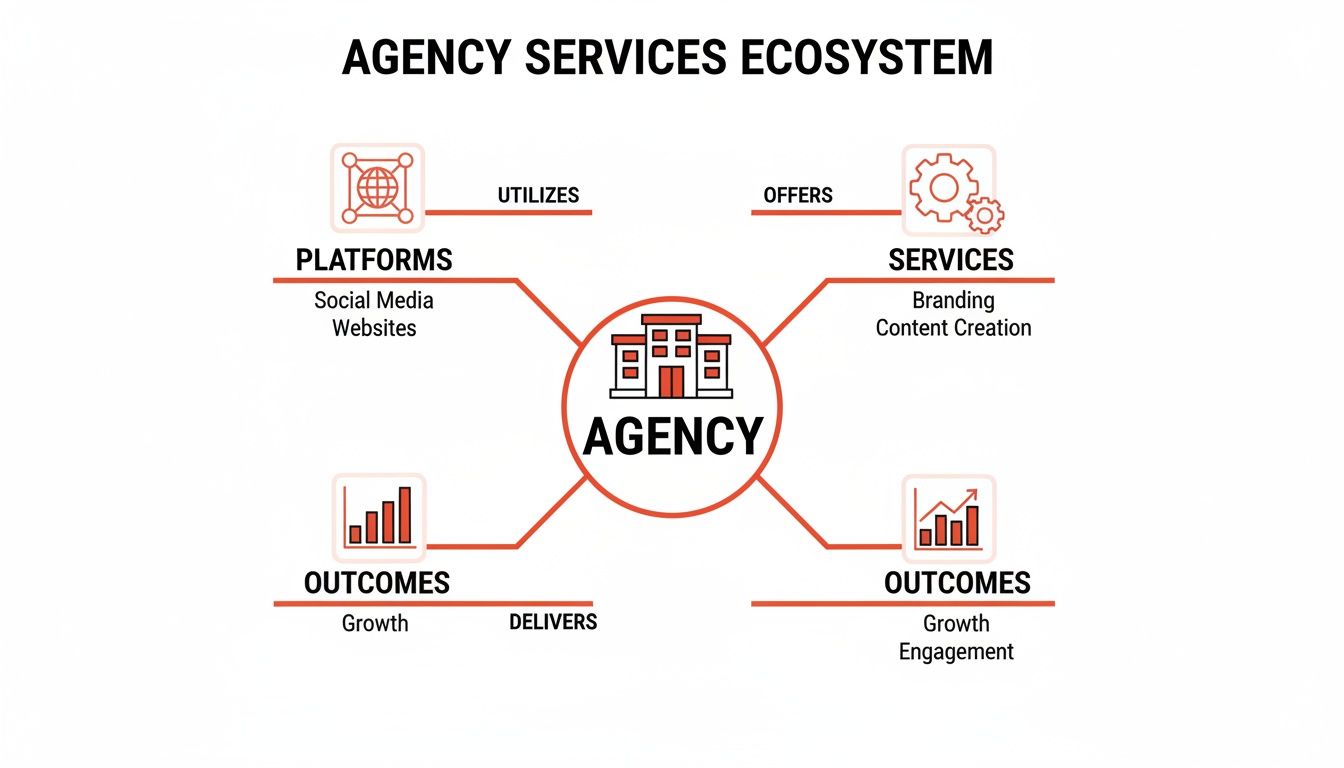
As you can see, the agency connects the dots, using its strategic know-how across different platforms to drive measurable results like more sales and stronger brand recognition.
Your Creative Arsenal Unpacked
Different ad formats are built for different jobs, from building top-of-mind brand awareness to pushing for that final click-to-buy. Here are the most common tools a display agency will have in its arsenal:
- Static Banners: The classic image ad. They might seem simple, but with strong visuals and a clear call-to-action, they are incredibly effective for brand recall.
- Animated HTML5 Banners: These ads use subtle movement and transitions to catch the eye, making them far more engaging than a static image. Perfect for telling a quick story or showing off a few product features.
- Responsive Display Ads: These are an absolute must for any modern campaign. They automatically resize and reformat to fit perfectly in any available ad space, ensuring your brand looks great on any website or device.
- Video Ads: Short-form video—think under 15 seconds—is a powerhouse for grabbing attention, especially on platforms like YouTube and social media. It’s the best way to show a product in action or let your brand’s personality shine through.
- Native Ads: These are designed to blend right in with the website they appear on, matching the look and feel of the surrounding content. Because they feel less like a jarring interruption, they come across more like a helpful recommendation. To see what we mean, check out these insightful native advertising examples that show how brands pull this off.
By skillfully combining sharp audience targeting with the right creative, a display advertising agency makes sure your campaigns don't just reach the right people—they actually connect with them and drive real, tangible results for your business.
How to Measure Success and Calculate Your ROI
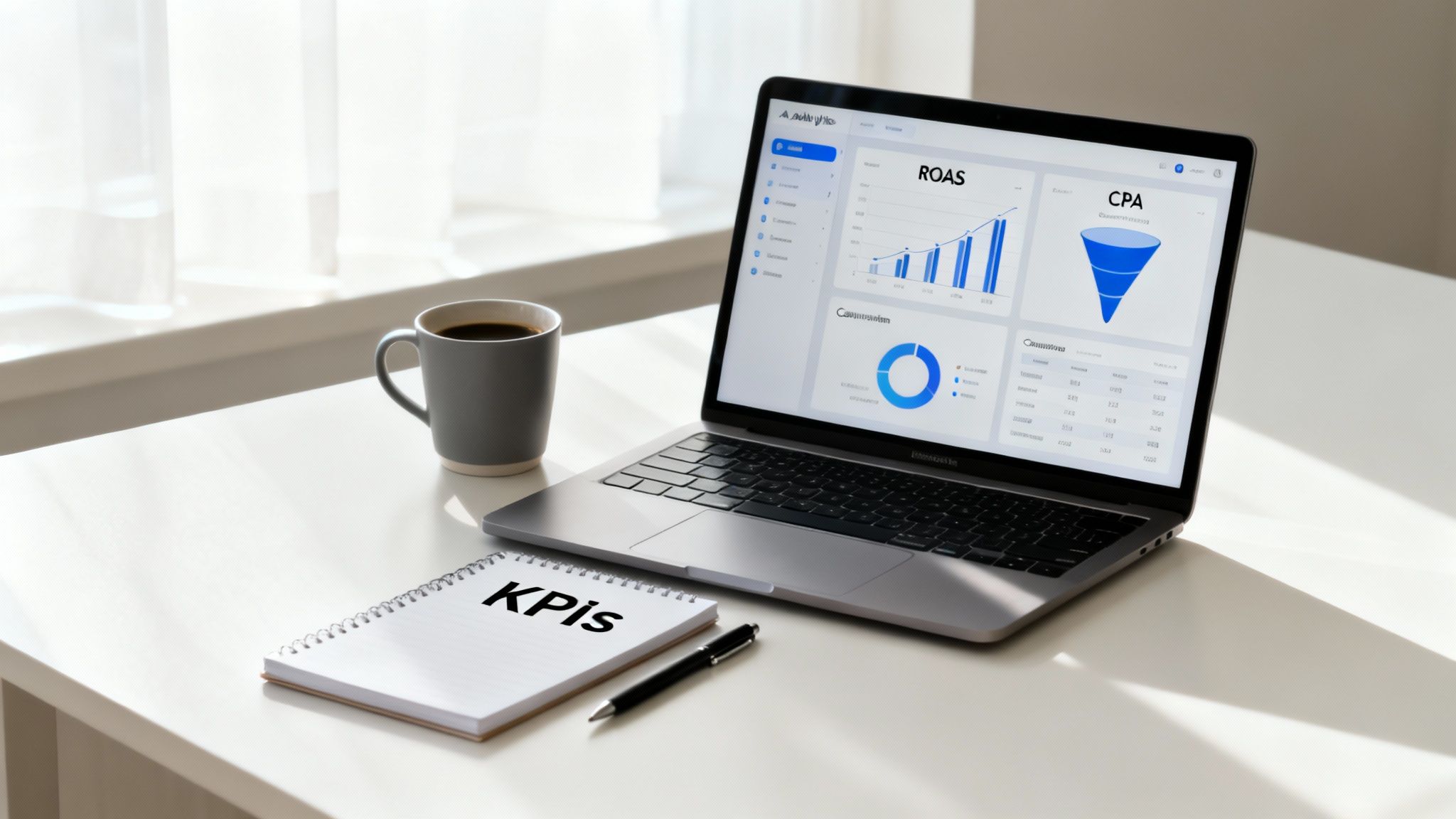
So, you've invested in a display advertising agency. How do you actually know if it's working? It’s easy to get lost in metrics like impressions and clicks, but those numbers don't pay the bills. The real measure of success is the impact on your bottom line—turning that ad spend into tangible business growth.
This is all about moving past the vanity metrics and zeroing in on the Key Performance Indicators (KPIs) that genuinely reflect what you're trying to achieve. Any decent agency will help you define these from day one, making sure every dollar spent is accountable to the goals that actually matter.
Aligning KPIs with Your Business Goals
The right KPIs are never one-size-fits-all. An e-commerce brand's definition of success looks completely different to a B2B software company's, and a good agency gets that.
For an e-commerce business, it's almost always about sales and profitability. The metrics that count are:
- Return on Ad Spend (ROAS): This is the big one. It tells you exactly how much revenue you're generating for every dollar spent on ads. A 4:1 ROAS means you made $4 for every $1 you invested. It's the ultimate measure of campaign profitability.
- Cost Per Acquisition (CPA): This is your cost to land a new customer. The lower your CPA, the more efficiently your campaigns are turning eyeballs into buyers.
For a B2B company, the game changes. You're not looking for an instant sale but building a pipeline of future clients. Here, the focus shifts to:
- Cost Per Lead (CPL): How much are you paying for a potential customer's contact details? This could be from a form submission, a whitepaper download, or a webinar sign-up.
- Lead Quality: Not all leads are created equal. A great agency will help you track which leads actually convert into qualified meetings or sales opportunities, ensuring your ad spend attracts high-value prospects, not just tyre-kickers.
The Non-Negotiables: Conversion Tracking and Attribution
To measure any of this accurately, two technical pieces are absolutely non-negotiable: conversion tracking and attribution modelling. Think of conversion tracking as the cash register for your campaigns—without it, you have no idea if an ad actually led to a sale or a lead.
Attribution modelling takes it a step further. It helps you understand the whole customer journey by assigning credit to the different touchpoints that influenced a conversion. Someone might see a display ad today, click a search ad next week, and then finally buy. Proper attribution ensures that first display ad gets the credit it deserves for kicking things off.
A top display advertising agency doesn't just throw data at you. They build a clear narrative connecting ad spend to business results. Their reporting should make it dead simple to see exactly how your investment is performing against your most important goals.
Translating Data Into Business Results
Your agency should give you access to a transparent, live reporting dashboard. This is your window into campaign performance, turning mountains of complex data into clear visualisations of your ROI. To truly get a handle on performance, mastering advertising effectiveness measurement is one of the most critical functions an agency provides.
This is the level of transparency and data-led optimisation that separates a good agency from a great one. The right partner uses this insight to drive serious returns. For example, businesses report an 88% success rate in acquiring new customers through digital marketing, and 44% use display advertising alongside channels like search and social to get there.
When it's done right, the results speak for themselves—AI-powered campaigns can deliver a 3.7x higher ROI. It's all about connecting the dots from clicks to cash.
Choosing the Right Display Advertising Agency
Picking an agency to manage your display advertising is one of the biggest marketing calls you'll make. Get it right, and you've got a powerful engine for growth. Get it wrong, and you can burn through your budget with painfully little to show for it.
The key is to look past the slick sales pitch. You need to dig into their strategy, their actual expertise, and how transparent they really are to find a partner who’s genuinely on your side.
This guide is your practical checklist to cut through the noise, ask the questions that matter, and spot the warning signs before you sign on the dotted line.
Essential Questions to Ask Potential Agencies
Before any contracts come out, treat this stage like a deep-dive interview. A top-tier agency will welcome tough questions and give you clear, straight answers backed by evidence. How they respond tells you everything about their strategic thinking, how they operate, and what it’s really like to work with them.
Here are the critical questions you need to be asking:
-
Industry and Business Model Experience: Have you worked with businesses like ours before? Can you show me case studies or real performance data from clients with similar goals, whether that’s e-commerce ROAS or B2B lead generation?
-
Strategic Approach: Let’s say our conversion rates are solid, but our click-through rates are terrible. What’s your first move to figure out what’s wrong and fix it? This question tests their problem-solving skills, not just their ability to set up a basic campaign.
-
Team and Workflow: Who will be my day-to-day contact? What’s their experience level? How often are you actually in the account, reviewing performance and making changes—daily, weekly, or just once a month?
-
Reporting and Transparency: What numbers will you be focusing on for our business goals? Can I see an example of a report or a client dashboard? And how do you track conversions beyond the very last click to show us the full picture of how our display ads are contributing?
A confident, results-focused agency will have no issue answering these in detail. If you get vague responses or they seem reluctant to share specifics, consider that a major red flag.
Red Flags and Green Lights
Knowing what to look for—and what to run away from—can save you a massive amount of time and money. Some agencies are brilliant at making big promises but have zero substance to back them up.
Keep an eye out for these warning signs during your chats.
Common Red Flags to Watch For
- Unrealistic Guarantees: No agency can guarantee a specific ROAS or a set number of leads, especially not from day one. Anyone promising things like, "We'll double your sales in 30 days" is either inexperienced or desperate.
- Opaque Pricing Models: If they can't clearly break down their fees, what's included, and any extra costs for things like creative or platform access, it’s a bad sign. Hidden fees are a classic trap.
- Long-Term Lock-In Contracts: Agencies that know they can deliver don't need to trap clients in 12-month contracts. Look for partners who are confident enough to offer flexible month-to-month agreements or a 30-day trial.
- One-Size-Fits-All Strategy: Does their pitch sound like they could be talking to any business? If it doesn’t mention your specific industry, audience, or goals, they haven't bothered to do their homework.
Positive Signs of a Great Partner
On the other hand, there are clear signals that an agency is a genuine performer. These are the green lights that tell you you've found a potential winner.
You're looking for a partner who shows they get your business and is committed to being open and honest. Our guide on evaluating different Google display advertising companies offers a more detailed checklist for that specific platform.
These positive signs are what really separate the best from the rest:
- A Portfolio of Relevant Case Studies: They can point to real, measurable results they’ve achieved for businesses similar to yours.
- A Focus on Business KPIs: The conversation quickly moves from vanity metrics like impressions and clicks to what actually matters: ROAS, CPA, and lead quality.
- Transparent and Customised Reporting: They give you access to a live dashboard and build reports that are tailored to your specific goals, not a generic template.
- A Clear Onboarding Process: They can walk you through exactly what will happen in the first 30, 60, and 90 days, setting clear expectations from the get-go.
Using this framework, you can evaluate any display advertising agency with confidence and pick a partner that will drive sustainable, profitable growth for your business.
Got questions about display advertising? You're not alone. When you’re thinking about bringing in an agency for the first time, it’s natural to have a few things you want to clear up.
We’ve put together this section to tackle the most common queries we hear from e-commerce brands, B2B companies, and growing businesses across Australia. We'll give you straight, clear answers on costs, timelines, and what you need to have ready to get a campaign off the ground. Think of it as your cheat sheet to demystifying the whole process.
How Much Does a Display Advertising Agency Cost in Australia?
This is usually the first question on everyone's mind, and the answer really boils down to how an agency structures its fees. In Australia, you'll generally come across a few common pricing models, each with its own pros and cons.
The most popular model by far is a percentage of your monthly ad spend, which typically sits somewhere between 10% and 20%. So, if your display ad budget is $10,000 a month, the agency’s management fee would be between $1,000 and $2,000. This model is great because it scales up or down with your advertising efforts.
Another common approach is a flat monthly retainer. This gives you total predictability, which is a big win for budgeting. Retainers can start from around $1,500 for a simple, single-platform campaign and go upwards of $7,500 for a complex, multi-channel strategy that includes things like programmatic buying and heaps of creative testing.
Any decent display advertising agency will be completely transparent about their fees. Always ask for a full cost breakdown, including any one-off setup fees for things like conversion tracking or initial creative work. The last thing you want are surprises down the track.
Some agencies also offer tiered plans, letting you pick a package that aligns with your budget and what you’re trying to achieve. Just make sure you get clear on what’s included in each model—strategy, creative, reporting, and platform management—so you can make a true apples-to-apples comparison.
What Is the Difference Between Display and Search Advertising?
The biggest difference between display and search advertising comes down to a single, simple concept: user intent. They’re two completely different ways of thinking about marketing—one is about creating demand, and the other is about capturing it.
Here’s a simple way to think about it:
-
Search advertising is 'pull' marketing. It targets people who are already actively looking for what you offer. They’re on Google, typing in a specific search query, which signals they have a problem or a need right now. Your ad shows up as the solution, capturing demand that already exists. It’s like setting up shop on a busy high street where people are already out looking to buy.
-
Display advertising is 'push' marketing. This is all about generating new demand. You’re putting your brand in front of potential customers while they're doing other things online—reading the news, scrolling through a blog, or using an app. You aren't waiting for them to come to you; you're building awareness and planting a seed for a future purchase. Think of it as a stunning, eye-catching billboard on a major highway.
While search ads are fantastic for converting people who are ready to buy, display ads are the engine that makes them aware of you in the first place. A smart digital strategy almost always uses both, with display campaigns building the top-of-mind brand awareness that eventually leads to more people searching for your brand by name.
How Long Until We See Results from Display Campaigns?
This is a really important question, and it's crucial to set the right expectations from the get-go. Unlike search ads, which can start bringing in leads almost straight away, display advertising is more of a long game. It's about building momentum.
The first 30 days of any new display campaign should be thought of as a "learning phase." During this time, your agency is gathering data, and lots of it. They're testing different audiences, ad creatives, messages, and placements to figure out what actually clicks with people. You'll see initial metrics like impressions and clicks, but this is really about data collection, not profit.
Real, tangible business results—like a consistent stream of conversions and a healthy Return on Ad Spend (ROAS)—usually start to show up within 60 to 90 days. Why? Because the insights gathered in that first month allow the agency to start optimising properly, pouring more budget into what’s working and cutting what isn’t.
The impact of display ads is cumulative; it works by building brand familiarity over time. A well-run onboarding process can definitely speed things up, but a bit of patience is key to seeing sustainable, long-term growth.
What Should I Prepare Before Onboarding with an Agency?
A smooth, fast launch really depends on how prepared you are. If you can get a few key things sorted before your official kick-off meeting, you'll empower your new agency to hit the ground running from day one.
Here’s a quick checklist of what to have organised:
- Clearly Defined Business Goals: Get specific. Instead of just "more sales," think "a 20% increase in online sales in the next six months" or "generate 50 qualified B2B leads per month." Concrete goals give your agency a clear target to aim for.
- A Solid Grasp of Your Target Audience: Who are you actually trying to reach? Customer personas, demographic data, and any insights you have on their pain points are pure gold for an agency. The more detail, the better.
- Your Brand Assets: Get your brand guidelines, logos, colour hex codes, fonts, and any high-quality product photos or videos together in one place. This lets the creative team start building on-brand ads right away.
- Admin Access to Key Accounts: Be ready to grant access to your website's backend (like Shopify or WordPress), Google Analytics, Google Tag Manager, and any ad accounts you already have, like Google Ads or Meta Business Manager. This is non-negotiable for setting up proper tracking.
A good agency will have a checklist and walk you through all of this. But having these things ready to go beforehand will seriously speed up your launch and set your campaigns up for a flying start.
Ready to turn clicks into customers? Click Click Bang Bang specialises in precision-driven display advertising campaigns that deliver measurable results. We combine data-focused strategies with compelling creative to help you reach your ideal audience and achieve your business goals. Start your 30-day risk-free trial today.
Read NeXt
Or Read Our Latest
- Manual vs Automated Bidding for PPC Success
- Conversion Tracking Setup: A Complete AU Guide
- Instagram Advertising Australia: Complete 2026 Guide
- Pay Per Click: A Beginner’s Guide for Australian Marketers
- Display Advertising on Google: The Complete Australian Guide
- Stakeholder Communication Plan How to Build One That Works
Click. CLick. Subscribe.
Get our best PPC insights, industry updates, and power moves delivered straight to your inbox. No fluff, just high-caliber strategies that actually work.
Don’t Leave Just Yet
Try Us For 30-Days,
Risk Free!!
We guarantee that you’ll love our work within the first 30 days, if not you’ll get your money back.
What have you got to lose?