

Demystifying Facebook Advertisements Cost in Australia
Last Updated

So, how much do Facebook ads really cost in Australia?
The short answer is that the average cost per click (CPC) usually lands somewhere between AUD 1.15 and AUD 3.20. But honestly, that figure isn't set in stone. Think of it less like a fixed price menu and more like a dynamic, real-time auction where your budget, goals, and audience all get a say in the final price.
What Do Facebook Ads Really Cost for Australian Businesses?
To get your head around the true cost of Facebook ads, you need to see the platform for what it is: a bustling marketplace where millions of businesses are all competing for a slice of user attention. There's no single price tag because you're not just buying an ad slot; you're bidding for the chance to pop up in front of a specific person at just the right moment.
It’s a bit like a real estate auction. The final price of a house depends on how many people are bidding, how desirable the neighbourhood is, and just how badly each person wants to win. In the same way, your Facebook ad cost is driven by how many other businesses are chasing the same audience and how valuable that audience is to them.
To play in this marketplace, you need to understand the local currency. For most Australian businesses, the key benchmark is the cost per click. The good news is that even a modest budget can be enough to start gathering some really valuable data.
A starting budget of just AUD 100, spent at AUD 20 per day over five days, is often all you need to run a small test campaign. This initial spend can give you powerful insights into which ad creatives and messages are hitting the mark with your audience, all without a major financial commitment.
Key Metrics to Know
To track your spending effectively, you'll need to get comfortable with two foundational metrics that really define Facebook advertising costs:
- Cost Per Click (CPC): This is the price you pay each time someone clicks on your ad. It’s a direct measure of how much it costs to get someone to your website or landing page. Simple as that.
- Cost Per Mille (CPM): "Mille" is just Latin for a thousand. So, CPM is the price you pay for one thousand people to see your ad (also known as impressions). This metric is your go-to for brand awareness campaigns where getting eyeballs on your ad is the main goal.
Recent industry data for 2025 shows that the average CPC for Facebook ads in Australia can swing from AUD 1.15 to AUD 3.20. Where you land in that range depends heavily on your industry, the audience you're targeting, and the quality of your ad creative.
If you're curious about how these figures stack up against other platforms, you can dive deeper in our detailed guide on social media advertising costs.
Australian Facebook Ad Cost Benchmarks at a Glance
To give you a clearer picture, here’s a quick summary of the typical cost metrics you'll encounter when advertising on Facebook in Australia. This table breaks down the key benchmarks to help you gauge your own spending.
| Metric | Average Cost (AUD) | Description |
|---|---|---|
| Cost Per Click (CPC) | $1.15 – $3.20 | The average amount you pay each time someone clicks your ad. |
| Cost Per Mille (CPM) | $10 – $25 | The cost for 1,000 ad impressions (views). |
| Cost Per Lead (CPL) | $20 – $80+ | The cost to acquire one new lead, often from a form submission. |
| Cost Per Action (CPA) | $25 – $100+ | The cost for a specific action, like a purchase or sign-up. |
These benchmarks are a great starting point, but remember they can vary wildly based on your specific campaign and industry. Use them as a guide, not a rule.
Ultimately, these metrics are more than just numbers on a dashboard; they’re signals that tell you how efficiently your budget is working. A low CPC might mean your ad is super engaging, while a high CPM could signal some stiff competition for your target audience. Mastering these basics is the first real step toward building a powerful and cost-effective advertising strategy.
How the Facebook Ad Auction Actually Works
Ever wondered why the business with the deepest pockets doesn't just automatically win all the best ad spots on Facebook? It’s because Meta’s ad system isn’t your typical auction where the highest cash bid takes the prize. It’s much more like a talent show, where the award goes to the contestant offering the most overall value, not just the one flashing the most cash.
When you launch an ad, you’re thrown into a lightning-fast auction against every other advertiser trying to reach a similar audience. An auction happens in the milliseconds it takes for a user to scroll their feed, deciding which ad they see next. But winning isn't just about how much you’re willing to pay. It’s about a clever combination of factors Meta uses to guess which ad will be most valuable to the user.
This whole system is designed to protect the user experience. After all, if our feeds were just clogged with boring, irrelevant ads from the highest bidders, we’d all stop scrolling pretty quickly. So, Meta gives a leg up to ads that people are likely to find genuinely interesting and engaging.
Understanding the Total Value Score
To pick the winner, Meta calculates a Total Value score for every ad in the running. This isn’t just one number; it’s a formula that balances three critical components. Think of it like a three-legged stool—if one leg is weak, the whole thing gets wobbly, no matter how strong the other two are.
Here are the three core components:
- Advertiser Bid: This is the straightforward part. It’s the maximum amount you’re willing to pay for your desired outcome, whether that's a click, a lead, or a sale. It’s your financial commitment to the auction.
- Estimated Action Rates: This is Meta’s secret sauce. It’s a prediction of how likely a specific user is to take the action you want after seeing your ad. It’s an educated guess based on that person's past behaviour, your ad’s historical performance, and a whole lot of data.
- Ad Quality and Relevance: This piece of the puzzle looks at how good your ad actually is. Meta checks out user feedback (both positive and negative), how often people hide your ad, and even the quality of your landing page experience. High-quality, relevant ads get a serious boost here.
The ad that gets the highest combined Total Value score wins the placement. This is the real secret to making your Facebook advertisements cost-effective.
This diagram helps visualise how the central auction machine influences whether you ultimately pay per click (CPC) or per thousand impressions (CPM).
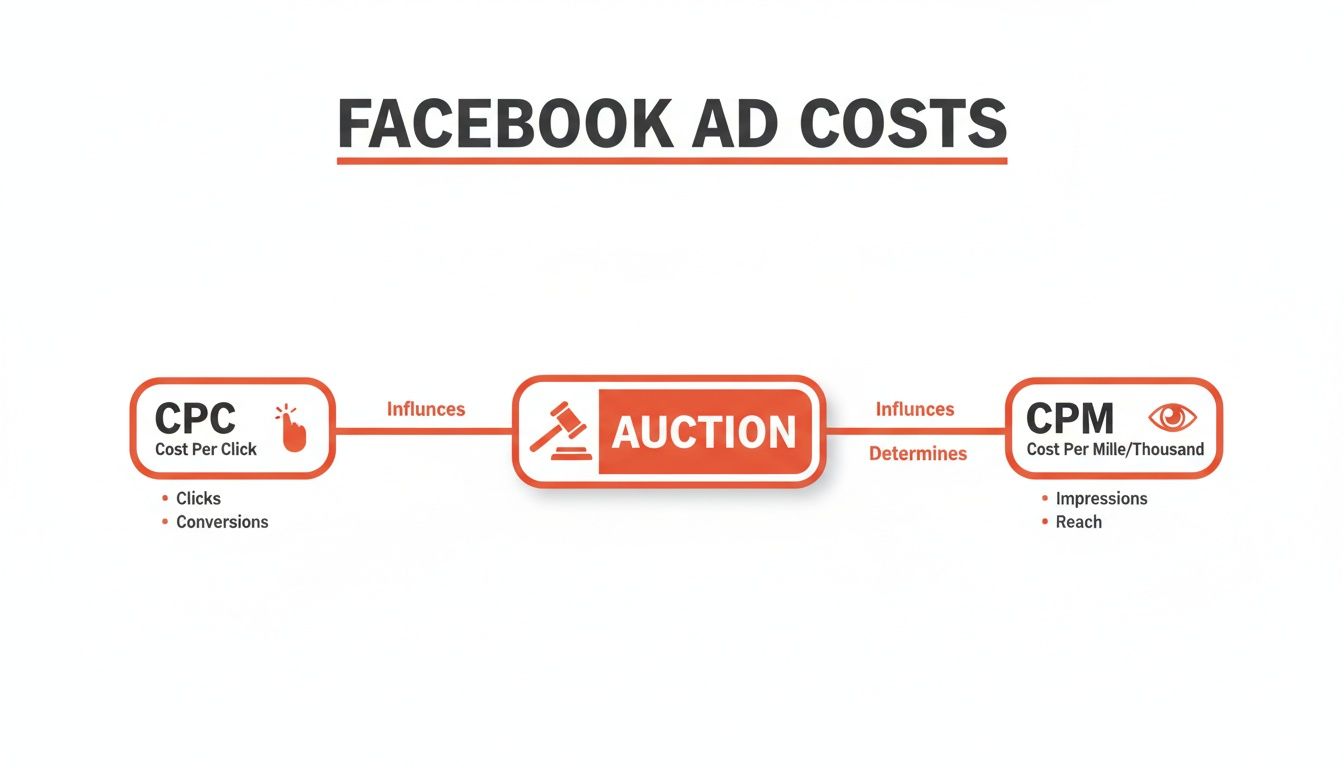
The key takeaway is that everything flows from the auction. Your final cost metric, be it CPC or CPM, is a direct result of how you perform in that auction.
Why a Better Ad Can Beat a Bigger Budget
This system creates a massive opportunity, especially for smaller businesses. A well-crafted, highly relevant ad can absolutely beat a competitor with a much larger budget but a dull, generic ad.
Imagine two businesses selling custom pet portraits. Advertiser A bids a hefty $3.00 per click with a generic photo ad. Advertiser B, however, bids only $1.50 but uses a captivating video of an artist bringing a portrait to life. Because Advertiser B's ad has a much higher estimated action rate and quality score, it can easily win the auction and end up paying less for that click.
This means you have direct control over your advertising costs by simply focusing on quality. When you create content that truly resonates with your audience and provide a seamless post-click experience, your ad quality score goes up. That improvement allows you to bid more competitively without actually having to spend more, giving you a powerful lever to manage your budget.
The Six Key Levers That Control Your Ad Spend
Your Facebook advertising cost isn't a fixed price tag you see on a shelf. It's a dynamic figure that dances to the tune of several powerful controls.
Think of your ad campaign like a sound mixing board. You have a bunch of sliders, and every tiny adjustment you make changes the final output. Learning to master these six key levers is the difference between burning through your budget with nothing to show for it and getting a fantastic, profitable return on your ad spend.
These factors directly influence how much you pay in the ad auction, shaping your final CPC and CPM. Some are in your immediate control, like your ad creative, while others, like seasonality, demand more strategic foresight. By understanding how each lever works, you can start making deliberate choices to drive your advertising costs down.
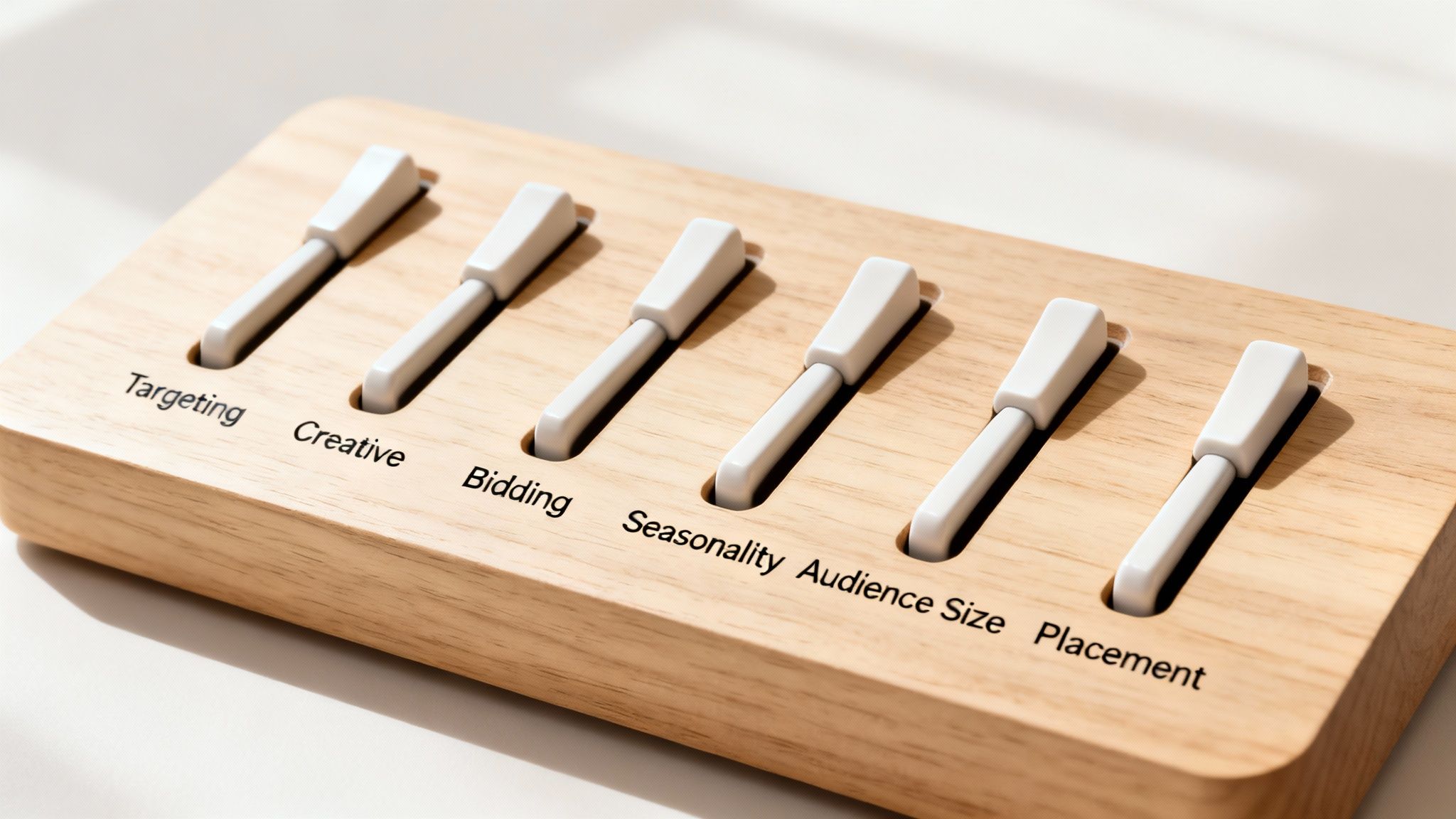
1. Your Target Audience
Who you choose to target is arguably the most significant factor that will swing your ad costs. A broad, high-demand audience is like trying to buy a house in a hot real estate market—competition is fierce, and prices are through the roof. On the flip side, a niche, highly specific audience can be far more affordable.
- Broad Targeting: Aiming for a massive group like "people interested in fitness" in Australia pits you against countless other brands, from major gym chains to local supplement shops. This intense competition drives up the price for every single impression and click.
- Niche Targeting: Focusing on a specific subgroup, like "women aged 30-45 in Melbourne interested in outdoor yoga," drastically cuts down your direct competitors. This smaller, more defined audience is usually cheaper to reach and often delivers a higher conversion rate because your message hits home.
2. Your Campaign Objective
The goal you pick in Meta Ads Manager is a direct instruction to the algorithm about what kind of user you want it to find. And that choice has a huge impact on your costs. Meta knows which users are happy to just watch a video versus those who are likely to click a link and pull out their credit card. You pay a premium for users who are closer to taking high-value actions.
A campaign optimised for Sales will almost always have a higher cost per result than one optimised for Awareness or Traffic. It's simple, really: a sale is far more valuable to your business than a simple impression. Meta charges more to find those high-intent users who are ready to buy.
3. Your Ad Creative and Relevance
Meta’s auction system actively rewards ads that create a positive user experience. This means high-quality, engaging ad creative isn't just a nice bonus—it's a core cost-saving tool. An ad with a high relevance score can actually win auctions even if its monetary bid is lower than a competitor's.
An ad with compelling visuals, clear copy, and a strong call-to-action will naturally earn higher engagement (likes, comments, shares). This sends a powerful signal to Meta that your ad is relevant, which in turn lowers its delivery cost. A low-quality or irrelevant ad gets penalised with higher costs to reach the same number of people.
Don't forget the technical side of your creative. Ensuring you're using the correct Facebook ad sizes and formats for each placement prevents your ad from looking sloppy and improves the user experience, which further boosts your relevance score.
4. Your Bidding Strategy
Your bidding strategy is your direct instruction to Meta on how to spend your money in the ad auction. While many advertisers start with "Highest Volume" (previously "Lowest Cost"), which lets Meta bid automatically, you have other options that give you more direct control over your spend.
Setting a Cost Per Result Goal or a Bid Cap allows you to tell Meta the maximum you're willing to pay for a specific result. This is great for preventing costs from spiralling during competitive periods, but be warned: it can also limit your ad's reach if your cap is too low to win enough auctions.
5. Seasonality and Timing
The advertising world has its own seasons, and they can be brutal. Demand for ad space skyrockets during major shopping events like Black Friday, Cyber Monday, and the entire Christmas period. During these times, more advertisers are all competing for the same audiences, which dramatically increases auction competition and sends costs soaring.
Understanding these cycles lets you budget accordingly. You might decide to allocate more spend during Q4 to capture holiday shoppers or strategically pull back during unexpectedly expensive periods to let the competition inflate prices while you save your money.
6. Industry and Competition
Finally, the industry you're in plays a huge role in determining your base advertising costs. Some sectors are just inherently more competitive and expensive than others. For example, industries with a high customer lifetime value—think finance, insurance, and legal services—often have much higher CPCs because businesses can afford to pay a lot more to acquire a single customer.
In Australia, the average Cost Per Mille (CPM) for Facebook ads hovered around AUD 11.04 in 2025. This positions the local market as competitive but still significantly more affordable than places like the US, offering a great advantage for Aussie businesses.
To really get your head around how ad spend is measured and controlled, it's worth understanding key advertising metrics like CPC, CPM, and CPA.
As you can see, these factors all work together to determine your final ad cost. The table below breaks down how your choices can either push your costs up or bring them down.
Impact of Key Factors on Facebook Ad Costs
| Factor | Tends to Lower Cost | Tends to Increase Cost |
|---|---|---|
| Audience | Niche, highly specific targeting; lookalike audiences of high-value customers. | Broad, general targeting; competing for high-demand demographics. |
| Objective | Awareness, Traffic, or Engagement goals. | Sales, Leads, or App Installs goals. |
| Creative | High relevance scores, strong engagement (likes, shares), clear call-to-action. | Low relevance scores, poor engagement, irrelevant or low-quality visuals. |
| Bidding | Automated bidding ("Highest Volume") focused on efficiency. | Manual bid caps that are too low to win auctions; bidding for high-value actions. |
| Seasonality | Off-peak periods like mid-year (e.g., February-March). | Major holidays (Christmas, Black Friday), Q4, and key shopping events. |
| Industry | Niche industries with lower competition (e.g., local services, hobbies). | Highly competitive sectors (e.g., finance, e-commerce, legal). |
Mastering these levers gives you incredible control. By making smart decisions about who you target, what you ask them to do, and the quality of the ad you show them, you can build a cost-effective advertising machine that drives real results for your business.
Smart Budgeting for Your Facebook Campaigns
Moving from the theory of ad auctions to actually planning your finances can feel like a huge leap. How do you turn concepts like bidding and audience targeting into a real-world budget that makes sense for your business? The trick is to start with your goals and work backwards.
This isn't about plucking a number out of thin air. It’s about building a strategic framework so your spending is predictable and has a clear purpose. To make this less intimidating, we've mapped out three common budget scenarios for Australian businesses, giving you a realistic snapshot of what your investment can achieve.
Scenario 1: The Cautious Startup Test
If you’re a new business or just dipping your toes into paid social, a small, controlled budget is the smartest way to begin. The goal here isn’t to drive massive sales overnight; it’s all about gathering crucial data. You're learning what messages click, which images stop the scroll, and who your most responsive audience is.
- Monthly Budget: $500 AUD (around $16 per day)
- Primary Objective: Traffic or Engagement
- Expected Clicks: With an average CPC of about $1.50, you could expect roughly 330 clicks to your website.
- Expected Impressions: Based on a CPM of $15, this budget could get you over 33,000 impressions, building that initial brand visibility.
- What This Achieves: This is the perfect budget for running A/B tests on your ad creative, finding your best-performing audiences, and building a small but valuable retargeting pool for later.
Scenario 2: The Growing Business Lead Generation
Once you’ve got some data under your belt and are ready to grow, your focus will likely shift from pure testing to actively generating leads. This budget is for businesses with a proven offer that need to consistently fill their sales pipeline. You'll be targeting more specific, higher-intent audiences.
- Monthly Budget: $2,500 AUD (around $83 per day)
- Primary Objective: Lead Generation
- Expected Leads: In Australia, a Cost Per Lead (CPL) can range from $20 to $80. If we aim for a mid-range CPL of $40, you could generate about 60-65 new leads per month.
- What This Achieves: An investment at this level lets you run dedicated lead campaigns using Meta's instant forms or drive traffic to a conversion-focused landing page. It provides a steady flow of potential customers to nurture through email or your sales process.
Strategic Insight: At this stage, your budget is big enough to support multiple ad sets. A smart approach is to allocate 70% to prospecting for new leads and 30% to retargeting warmer audiences who have already shown interest. This seriously maximises your efficiency.
Scenario 3: The Scaling E-commerce Brand
For established e-commerce brands laser-focused on direct sales, the budget needs to be substantial enough to power a full-funnel strategy. This means reaching cold audiences, retargeting warm prospects, and converting those hot leads who abandoned their carts. The goal is a direct, measurable return on ad spend (ROAS).
- Monthly Budget: $10,000+ AUD (approx. $333+ per day)
- Primary Objective: Sales (Conversions)
- Expected Purchases: The Cost Per Action (CPA) for a purchase can vary wildly depending on the product. Assuming an average CPA of $50, this budget could drive around 200 sales per month.
- What This Achieves: A budget this size unlocks sophisticated campaign structures. You can run top-of-funnel video ads for brand awareness, mid-funnel carousel ads for product consideration, and bottom-of-funnel Dynamic Product Ads to close sales. You're building a complete customer journey that fuels serious growth.
Actionable Strategies to Reduce Your Ad Costs
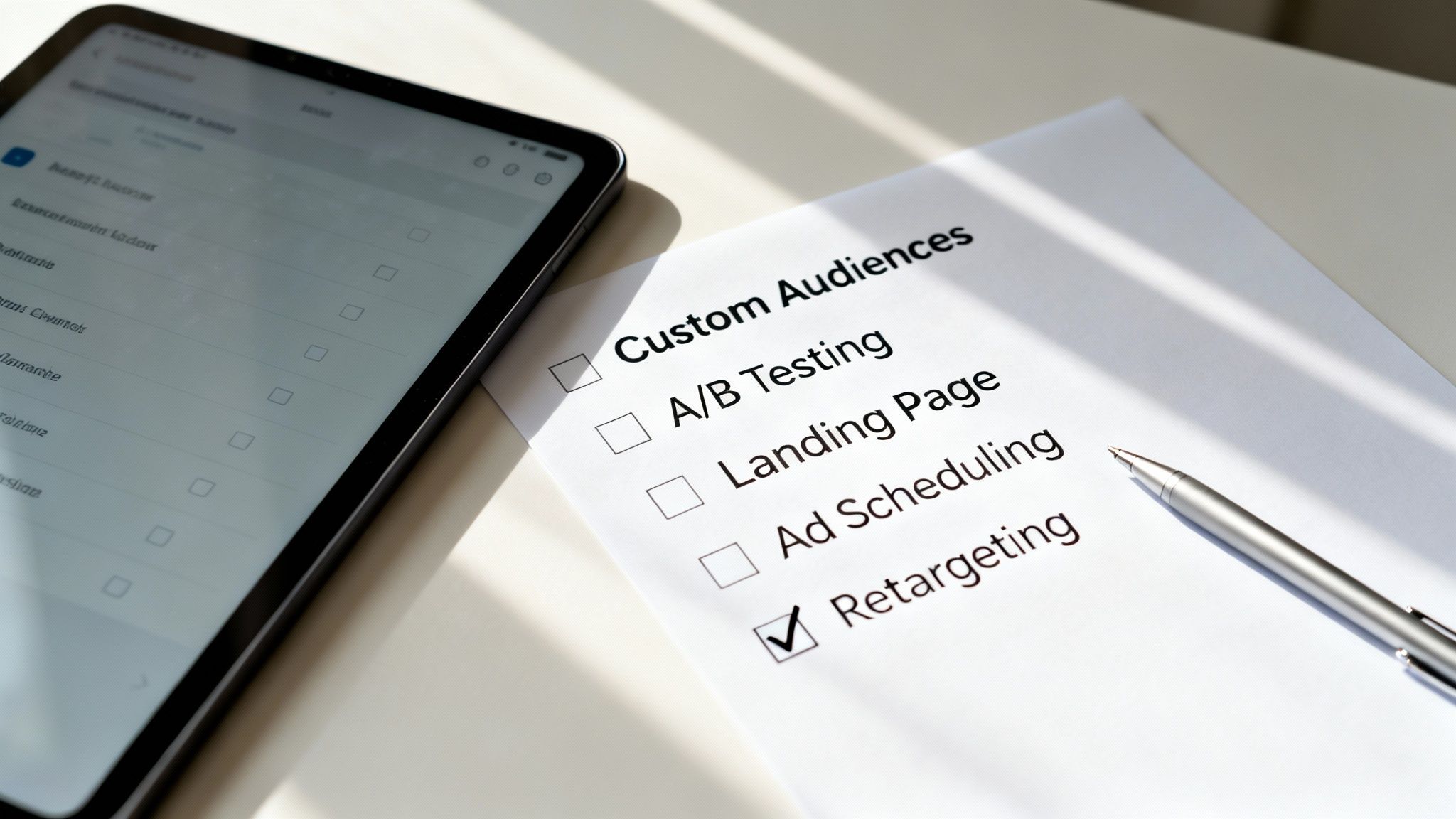
Knowing how Facebook's ad pricing works is one thing. Turning that knowledge into actual savings? That's where you start seeing a real difference in your bottom line. Think of this as your hands-on toolkit for cutting costs, right now. We're moving past the theory and into proven techniques you can apply directly inside Meta Ads Manager to make every dollar stretch further.
These strategies aren't just about spending less—they're about spending smarter. By sharpening your targeting, relentlessly testing your creative, and smoothing out the entire user journey, you can dramatically lower your costs while often boosting your results at the same time.
Master Advanced Audience Targeting
The bedrock of any cost-effective campaign is reaching the right people. Wasting your budget showing ads to users who couldn't care less is the quickest way to burn through your cash. Instead of just relying on broad interest targeting, it's time to build audiences of high-intent users who are much more likely to convert.
Start by creating Custom Audiences. These are your "warm" audiences, made up of people who already have some kind of relationship with your business. You can pull them from several sources:
- Website Visitors: Target people who’ve visited specific pages, like a product page or your pricing section.
- Customer Lists: Upload your email or phone list to find your existing customers on Facebook and Instagram.
- Engagement: Build an audience from people who have watched your videos or interacted with your Facebook or Instagram page.
Once you have a solid Custom Audience, you can create a Lookalike Audience. Meta's algorithm analyses the common traits of your source audience and then goes out to find brand-new people who share those same characteristics. It's one of the most powerful ways to find new customers who behave just like your best ones, often at a much lower cost.
Relentlessly A/B Test Your Creatives
You should never assume you know which ad image or headline is going to be the winner. The only way to know for sure is to test it. A/B testing, or split testing, is all about running multiple versions of an ad to see which one delivers the best results for the lowest price.
Key Insight: Even tiny changes can have a massive impact on your ad costs. Testing a vibrant, colourful image against a minimalist one, or a direct call-to-action against a question-based headline, can uncover surprising audience preferences and sometimes cut your cost per result in half.
Inside Meta Ads Manager, setting up A/B tests to compare different elements is straightforward. To get clean, reliable data, start by testing just one variable at a time. For a deeper dive into implementing proven tactics and optimising your campaigns to directly impact your ad spend, check out this comprehensive guide to Facebook ads that convert.
Here are a few elements you should be testing constantly:
- Images vs. Videos: Does your audience engage more with a static visual or dynamic video content?
- Headlines: Test a benefit-driven headline against one that piques curiosity.
- Ad Copy: Try short, punchy copy versus a longer, more detailed paragraph.
- Call-to-Action (CTA) Button: Does "Shop Now" outperform "Learn More"?
Optimise Your Landing Page Experience
Your ad's job is to earn the click; your landing page's job is to secure the conversion. A poor post-click experience will absolutely torpedo your conversion rates and inflate your true cost per acquisition. Meta’s algorithm even factors in landing page quality when calculating your ad's relevance score.
A slow-loading, confusing, or mobile-unfriendly page will have users hitting the back button in seconds. This sends a negative signal to Meta that your ad is providing a poor experience, which can lead to higher delivery costs.
Make sure your landing page is:
- Mobile-Friendly: The overwhelming majority of Facebook users are on their phones.
- Fast-Loading: Every extra second of load time sends your bounce rate soaring.
- Consistent: The message on your landing page must perfectly match the promise you made in your ad.
Implement Strategic Retargeting
It is always cheaper to convert a warm lead than it is to acquire a brand-new customer. Retargeting campaigns focus your budget on people who have already shown interest in your business, like website visitors or users who have engaged with a previous ad.
This strategy is incredibly effective because you're talking to an audience that already knows who you are. These users are much further down the purchasing funnel, making them far more likely to take the plunge. A simple but powerful retargeting campaign could show a special offer to users who added an item to their cart but didn't check out, recovering what would have been lost revenue for a fraction of what it costs to find a new customer.
Knowing When to Partner With a PPC Agency
Let's be honest, managing Facebook ads effectively can quickly turn into a full-time gig. While going the DIY route is a fantastic way to get started, there often comes a point where growth stalls, your ad spend starts creeping up without a clear return, or you simply run out of hours in the day for all the daily tweaks and tests.
These aren't signs of failure; they're growing pains. They’re the classic signals that it might be time to bring in an expert.
Partnering with a professional agency shifts your ad spend from just another expense into a strategic investment in growth. Agencies bring a depth of expertise, advanced tools, and a data-obsessed approach that’s tough to replicate in-house, especially when you’re also trying to run a business. They live and breathe platform updates, auction dynamics, and optimisation tactics that can make a serious difference to your bottom line.
Are You Hitting These Roadblocks?
See if any of these sound familiar. Recognising these challenges is the first step toward figuring out if professional management is your next best move.
- Stagnant Results: Your campaigns have hit a frustrating ceiling, and you’re not sure how to break through and scale further.
- Wasted Spend: Your Cost Per Action (CPA) is climbing, but you’re struggling to pinpoint which levers to pull to bring it back down.
- Time Constraints: You just don't have the time for the constant monitoring, testing, and adjusting that successful campaigns demand.
- Keeping Up: You feel like you're playing catch-up with the endless algorithm changes and new features Meta keeps rolling out.
If you’re nodding along, exploring a partnership could be a game-changer. A dedicated agency takes on the heavy lifting, freeing you up to focus on running your business while they focus on getting the most out of every dollar you spend.
A great agency doesn’t just manage ads; they become a strategic partner dedicated to achieving your specific business goals. They translate complex data into actionable insights, helping you navigate the competitive landscape and scale efficiently.
If you're thinking about getting professional help to manage your campaigns and lower your overall facebook advertisements cost, learning more about a dedicated social media ads agency can give you a clear picture of what to expect. Finding the right partner means finding a team that gets your vision and has the expertise to make it happen, ensuring every dollar you spend is working as hard as possible to grow your brand.
Frequently Asked Questions
Got a few nagging questions about Meta ad costs? You're not alone. Here are some quick, straight-to-the-point answers to the most common queries we hear from Australian businesses trying to get their ad spend right.
What Is a Good Daily Budget for Facebook Ads in Australia?
For a small business just dipping its toes in the water, a daily budget of around AUD 20-50 per campaign is a great starting point. This gives Meta's algorithm enough data to start learning and optimising without you having to bet the farm.
Think of it as your testing budget. It’s enough to trial different ad sets and creatives, figure out what clicks with your audience, and then scale up what works. For those in more competitive industries or with ambitious growth goals, you’ll likely need to start at AUD 100+ per day to cut through the noise and see meaningful results.
Why Are My Facebook Ad Costs Suddenly Increasing?
Seeing your ad costs shoot up overnight is frustrating, but there's usually a logical reason. The most common culprit is ad fatigue – your audience has simply seen your ad too many times and is tuning it out. Another big one is a sudden spike in competition, especially around busy periods like Black Friday when everyone is trying to target the same eyeballs.
It could also be that Meta thinks your ad is becoming less relevant. Jump into your Ads Manager and check the 'Frequency' metric. If that number is climbing, it's time to refresh your creative. Also, take a peek at the auction competition and audience saturation metrics to get the full picture.
Pro Tip: A frequency score creeping above 3 is a strong signal that your audience is getting tired of your ad. Swapping out the image or headline can often be enough to bring your costs back down.
Is It Cheaper to Advertise on Facebook or Instagram?
This is a classic "it depends" question. Costs can swing wildly based on your audience and ad format. Generally, Instagram can have a higher Cost Per Click (CPC), but it might also deliver much higher engagement, especially if you’re selling visual products in niches like fashion, beauty, or food.
Facebook, on the other hand, often has a lower CPC and works brilliantly for a broader range of goals, like generating leads or driving traffic to a blog post. Honestly, the best approach is to stop guessing and use Automatic Placements. This lets Meta's algorithm do the heavy lifting, allocating your budget to whichever platform is getting you the cheapest results for your specific goal.
Ready to stop guessing and start getting real results from your ad spend? The team at Click Click Bang Bang specialises in creating data-driven PPC campaigns that lower costs and maximise your return. Find out how we can help you scale your business by visiting our website.
Read NeXt
Or Read Our Latest
- Manual vs Automated Bidding for PPC Success
- Conversion Tracking Setup: A Complete AU Guide
- Instagram Advertising Australia: Complete 2026 Guide
- Pay Per Click: A Beginner’s Guide for Australian Marketers
- Display Advertising on Google: The Complete Australian Guide
- Stakeholder Communication Plan How to Build One That Works
Click. CLick. Subscribe.
Get our best PPC insights, industry updates, and power moves delivered straight to your inbox. No fluff, just high-caliber strategies that actually work.
Don’t Leave Just Yet
Try Us For 30-Days,
Risk Free!!
We guarantee that you’ll love our work within the first 30 days, if not you’ll get your money back.
What have you got to lose?