

How to Generate SEO Leads That Convert
Last Updated

Generating leads with SEO isn't about chasing traffic or vanity rankings. It’s about building a predictable, reliable system that turns searchers into prospects and, eventually, customers. The goal is to create a machine that consistently attracts the right kind of visitor with search-optimised content and then converts them.
Building Your SEO Lead Generation Engine
Shifting your website from a simple online brochure into a powerhouse for qualified leads means looking beyond the usual metrics. It's time to stop obsessing over keyword rankings and start focusing on a strategic framework. This isn't about a single "hack" or quick win; it's about putting a sustainable process in place that produces prospects actively looking for what you offer. For this engine to run smoothly, mastering organic search engine optimisation is absolutely non-negotiable.
So, how do we build this machine? It all comes down to a few core pillars that work together.
To get a clearer picture of how these pieces fit together, let's break down the core components of a successful SEO lead generation strategy.
Core Pillars of an SEO Lead Generation Strategy
| Pillar | Objective | Key Tactic Example |
|---|---|---|
| Audience & Intent | To deeply understand who your ideal customers are and what problems they're trying to solve with their searches. | Creating a detailed Ideal Customer Profile (ICP) and mapping their pain points to specific search queries. |
| Content Creation | To develop valuable articles, guides, and tools that directly answer your audience's questions at every stage. | Writing a comprehensive "how-to" guide for a problem your ICP faces at the top of the funnel. |
| Conversion & Capture | To make it easy and compelling for visitors to exchange their contact details for something of value. | Offering a downloadable checklist or template as a lead magnet within a relevant blog post. |
Each pillar builds on the one before it, creating a system where every part supports the others. This strategic approach ensures your efforts are focused and effective.
The Foundational Process
At its heart, the process is a simple, logical flow: attract the right people, give them what they need, and then capture their details. It’s a three-step dance from discovery to conversion.
This infographic breaks down those three essential stages perfectly.
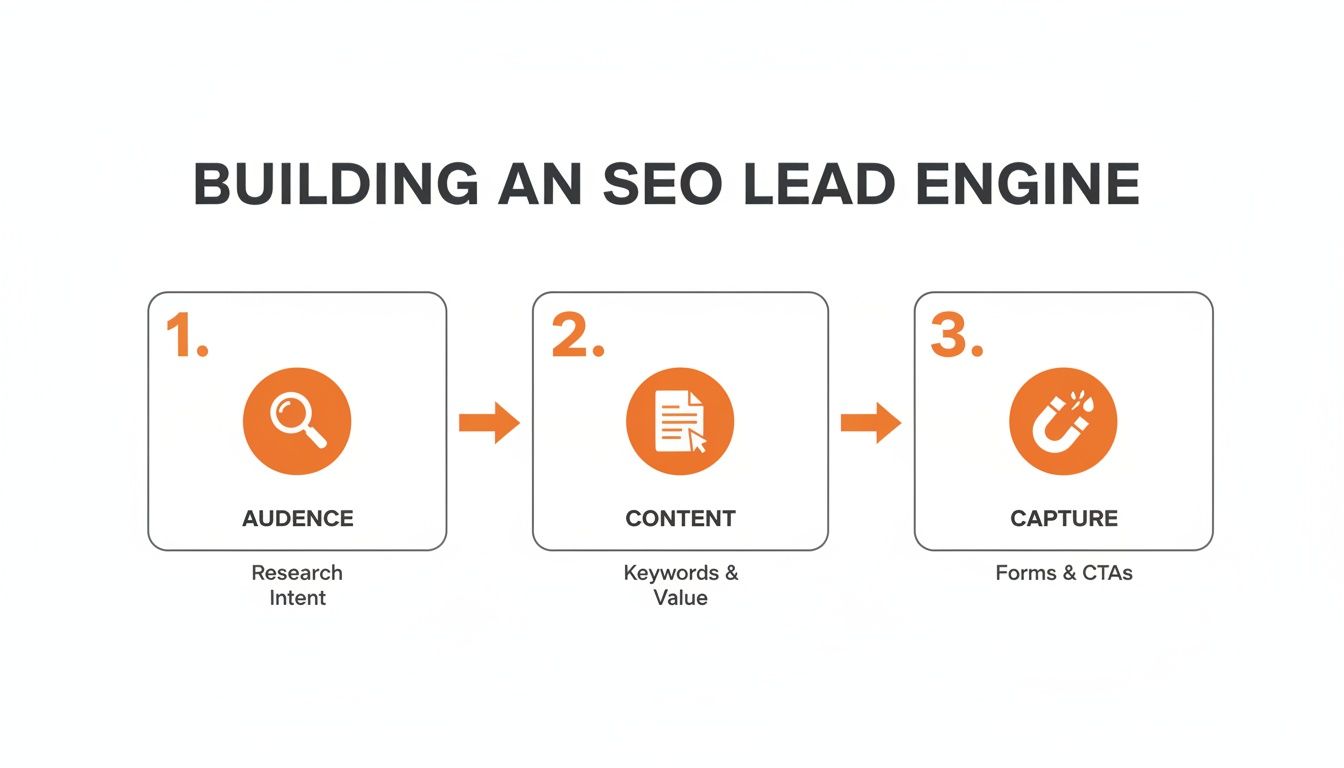
As you can see, it all starts with the audience. Get that right, and creating targeted content becomes much easier. With great content in place, capturing leads feels natural, not forced.
SEO lead generation is a marathon, not a sprint. Every component builds on the last, creating a compounding effect over time. A strong audience foundation makes your content more effective, and great content makes lead capture almost effortless.
This guide is your playbook for constructing this engine, piece by piece. We'll dive into actionable frameworks for each stage, turning these concepts into concrete steps that lead to predictable, scalable growth for your business.
Find Your Ideal Customers and Their Search Intent
Before you can generate a single qualified lead with SEO, you need to know exactly who you're talking to. Firing off content at broad, high-volume keywords without a clear picture of your ideal customer is like shouting into a void. It might make a lot of noise, but no one who matters is listening.
Real success in SEO starts with a deep, almost obsessive, understanding of your audience.
This goes way beyond basic demographics. I'm talking about getting inside their heads. What are their biggest professional headaches? What frustrations are keeping them up at night? Critically, what exact language do they use to describe those problems? Answering these questions is how you build a powerful Ideal Customer Profile (ICP).
Your ICP isn't some document you create once and then file away. It's a living, breathing guide that should inform every single piece of content you create. For example, a software company might realise their ideal customer isn't just "a small business owner." It's actually "a non-technical founder of a retail startup who's struggling to manage inventory." That level of specificity is where the magic happens.
Uncovering Search Intent
Once you’ve got a crystal-clear ICP, the next job is to figure out search intent—the underlying "why" behind every search query. What someone types into Google is a massive clue about where they are in their buying journey. Getting this right is crucial for creating content that meets them at the perfect moment.
The process of consumer decision making isn't a straight line, and mapping your keywords to each stage ensures your content serves a purpose, guiding people from initial curiosity to the final purchase.
This visual from Ahrefs nails how different types of content align with the customer journey.
As you can see, someone in the "Awareness" stage is just looking for information. They're not ready for a sales pitch. But someone in the "Decision" stage is actively comparing solutions and wants to see product specs and pricing. Your keyword strategy has to cater to all of them.
From Keywords to Conversations
Modern keyword research isn't about finding single, standalone terms; it's about finding conversations. This means you need to be thinking about long-tail keywords and question-based queries. These longer, more specific phrases might have lower search volume, but they pack a much bigger punch in conversion potential because they signal incredibly strong intent.
Think about the different flavours of search queries:
- Informational Intent: These are top-of-funnel searches from people looking for answers. Think "what is SEO lead generation" or "how to improve website traffic."
- Commercial Intent: Here, the user is weighing up their options. They're searching for things like "best SEO agency for small business" or "Ahrefs vs Semrush." They're getting close.
- Transactional Intent: This is the bottom of the funnel. Phrases like "SEO agency pricing" or "get a free SEO audit" signal an immediate need and a readiness to buy.
The Australian search market is fiercely competitive. Organic search drives 53% of all website traffic, and for 57% of B2B marketers, SEO generates more leads than any other channel. The real kicker? A massive 70% of all searches are long-tail. That's a huge, often-ignored opportunity to connect with your most motivated prospects.
By aligning your content with the specific intent behind a search query, you stop simply attracting traffic and start attracting potential customers. Every piece of content should have a job to do, guiding the right person one step closer to becoming a lead.
Ultimately, your goal is to map these specific, intent-driven keywords to each stage of your customer's journey. This creates a seamless content experience that builds trust and naturally guides people from being casual searchers into becoming genuinely qualified leads for your business. It’s the foundational work that makes everything else you do so much more effective.
Build a Content Funnel That Nurtures Leads
Driving traffic is a great start, but let's be honest—traffic alone doesn't pay the bills. The real goal here is to generate SEO leads, and that demands a smarter approach to your content. Just churning out random blog posts and hoping for the best is a recipe for failure. You need a structured content funnel, a deliberate pathway designed to guide visitors from their first curious click all the way to a confident conversion.
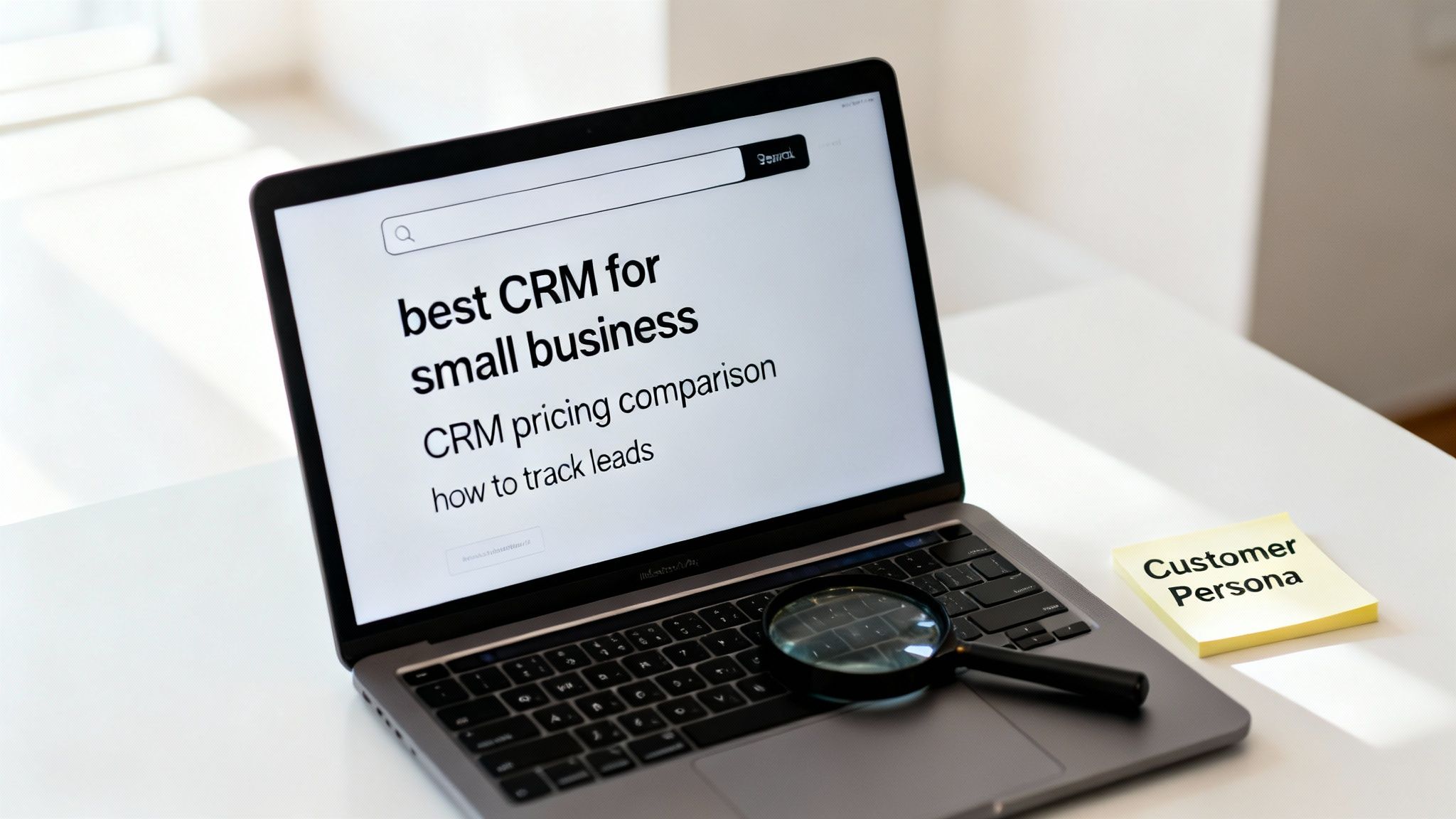
Think of it like laying down a path. Each piece of content is a stepping stone, placed just so, to lead a potential customer closer to you. This pathway is usually broken down into three stages: Top of Funnel (ToFu), Middle of Funnel (MoFu), and Bottom of Funnel (BoFu). By creating specific content for each stage, you meet people exactly where they are in their journey.
Attract a Wide Audience with Top-of-Funnel Content
At the top of the funnel (ToFu), people aren’t looking to buy anything just yet. They’re in the awareness stage, just starting to realise they have a problem or simply looking for information. Your job here is to be the helpful, authoritative resource that answers their initial questions without a hint of a sales pitch.
The workhorse for this stage is the informative blog post. These articles should target broader, problem-aware keywords and deliver genuine value.
Here’s what makes for great ToFu content:
- An Educational Focus: Your goal is to teach them something useful. Think "How to…" guides, "What is…" explainers, and in-depth listicles.
- Broad Appeal: The content needs to resonate with a large chunk of your ideal customer profile, even those who have never heard of you.
- No Sales Pressure: This is all about building trust and authority. Any mention of your solution should be light and contextual, if it’s there at all.
For example, a digital marketing agency might publish a post like, "10 Proven Ways to Increase Website Traffic for a New Business." It hits a major pain point for their ideal customers head-on without trying to sell them a service package on the first date. The goal is simple: attract, educate, and establish your credibility.
Nurture Prospects with Middle-of-Funnel Content
Once someone has digested your ToFu content, they’re sliding into the middle of the funnel (MoFu). They now understand their problem and are actively looking for solutions. This is your chance to properly introduce your brand as a contender.
MoFu content is all about helping people compare and decide. It's much more specific than ToFu content and often targets keywords that signal commercial investigation. If you want to get a better handle on how this journey works, understanding the mechanics of what is a sales funnel is a great place to start.
Killer MoFu content types include:
- Case Studies: Show, don’t just tell. A detailed case study demonstrating how you solved a similar problem for another client is incredibly persuasive.
- Comparison Guides: Create articles that pit your product against competitors or different solution types (e.g., “In-House SEO vs. Agency: Which is Right for You?”).
- Webinars and Ebooks: Offer deep dives into specific topics in exchange for an email address. This is where you turn an anonymous visitor into an actual, trackable lead.
This is the content that bridges the gap between initial awareness and the final decision, positioning your business as the logical choice.
The leap from ToFu to MoFu is where the magic happens. You go from being a helpful stranger to a trusted advisor. Your content has to prove your expertise and show a clear path to solving their problem.
Convert with Bottom-of-Funnel Content
Finally, we have the bottom of the funnel (BoFu). The people here are ready to pull the trigger. They have high commercial intent and are just looking for that final piece of information to push them over the line. Your BoFu content needs to make it as easy and compelling as possible for them to take that final step.
This content targets transactional keywords—think "SEO agency prices" or "request a marketing consultation." It’s direct, clear, and unashamedly conversion-focused.
High-impact BoFu assets include:
- Detailed Service/Product Pages: These pages must answer every conceivable question a prospect might have about your offerings, from features and benefits to pricing and process.
- Free Trial or Consultation Forms: Give them a direct path to engage with you. Keep forms simple and make the value proposition crystal clear.
- Testimonials and Reviews: Social proof is a powerful motivator. Seeing that other businesses have found success with you can be the final nudge someone needs.
By building out this structured funnel, you create a complete, intentional journey for your audience. Every piece of content has a job to do, systematically nurturing visitors and turning your hard-won SEO traffic into a reliable source of qualified leads.
Optimise Your Website for Lead Capture
Getting targeted traffic to your website is a huge win, but let's be honest—it's only half the battle. To actually generate SEO leads, you need to turn that hard-won traffic into real, tangible prospects. This is where on-page SEO and conversion rate optimisation (CRO) join forces, transforming your site from a digital brochure into a lead-generating machine.
Think about it: every little element on your page plays a part. A compelling title tag and meta description get the click from Google. Well-structured headers (H1, H2, H3) guide the reader through your content and make it easy to digest. And smart internal linking creates a clear pathway, nudging visitors from an informational blog post right over to a page where they can convert.
Designing Pages for Conversion
A page that gets a ton of traffic but a zero percent conversion rate isn't really working, is it? The whole point is to make the user's journey seamless and the decision to become a lead an absolute no-brainer. This means every single touchpoint needs to be meticulously designed to encourage action.
A massive part of this is the strategic placement of lead magnets—those valuable resources you offer in exchange for an email address. You don't just randomly drop them on a page; you integrate them where they make perfect sense.
- Checklists: These are perfect for embedding within "how-to" guides. They offer a practical, bite-sized summary of the steps you've just walked them through.
- Ebooks or Whitepapers: Got a really in-depth article? Link out to an ebook that dives even deeper. The reader is already engaged, so it's a natural next step for them.
- Webinar Sign-ups: When you're explaining a complex topic, a webinar sign-up is a great fit. It promises a more interactive and detailed learning experience.
And don't forget your calls-to-action (CTAs). Vague buttons like "Submit" are conversion killers. Be specific and focus on the benefit. Something like "Download Your Free Checklist" or "Get Your Custom SEO Audit" works so much better. For a deeper dive into this, check out our guide on how to create a landing page.
Building Trust and Reducing Friction
When someone lands on your page, you have just moments to earn their trust. One of the most powerful ways to do this is with social proof. Testimonials, case studies, and reviews from real customers provide that crucial third-party validation, reassuring prospects that they're in the right place.
Just as important is cutting down the friction in your lead capture process. Long, complicated forms are a major turn-off. Seriously, only ask for what you absolutely need right now. A name and email are usually enough to get the conversation started. You can always gather more details later on.
A visitor should never have to think hard about what to do next. Your layout, copy, and CTAs should create an intuitive path that naturally guides them toward conversion. Remove any obstacle, no matter how small, that stands in their way.
For businesses here in Australia, local optimisation is an absolute game-changer. A staggering 46% of all Google searches in Australia have local intent, and an incredible 78% of these mobile searches lead to an in-store visit within a day. Dialling in your Google Business Profile and local keywords can give your qualified leads a massive boost.
Testing and Iterating for Better Results
Here’s the thing about conversion optimisation: you're never really "done." What works today might not work as well tomorrow. That’s why continuous A/B testing is so essential for bumping up your lead capture rates. You can test almost anything on your page to see what truly resonates with your audience.
This is a great example of a simple but powerful A/B test. Just a small change in the headline is being tested to see how it impacts conversions.
The insights you get from tests like this are invaluable. They can reveal how minor tweaks to copy, a button colour, or page layout can lead to a significant jump in leads. By systematically testing elements and rolling out the winners, you create a powerful feedback loop that constantly improves your website's performance.
Integrate B2B SEO with Social Platforms

For B2B companies, the path to generating quality SEO leads rarely ends on the corporate website. The decision-making process is longer and way more complex, often involving a whole committee of stakeholders. Your SEO strategy has to follow them into the professional spaces they live in every day.
This is where smashing your SEO efforts together with social platforms—especially LinkedIn—gives you a serious advantage.
Your high-value SEO content, like those comprehensive white papers and original industry reports, should be pulling double duty. First, it needs to rank on Google for valuable business searches. Then, you need to get it in front of decision-makers where they’re already networking and consuming content.
Amplify Your SEO Content on LinkedIn
Think of your SEO content as the fuel and LinkedIn as the distribution engine. Just dropping a link to your latest blog post and hoping for the best isn’t a strategy. You need a deliberate plan to turn those hard-earned SEO assets into conversation starters and lead magnets on the world’s biggest professional network.
The trick is to atomise your content. Let's say you have a 5,000-word industry report that’s ranking well on Google. You can break that single piece down into a whole suite of LinkedIn assets:
- Carousel Posts: Pull out the key stats and takeaways and turn them into a slick, visually engaging carousel. Each slide can highlight one powerful data point.
- Video Snippets: Film a short, punchy video of a team member discussing the report’s most surprising findings. These are perfect for grabbing attention in a cluttered feed.
- Text-Only Posts: Grab a compelling quote or a provocative question from your content to spark a discussion. Pose it to your network and tag a few relevant industry leaders to get the conversation rolling.
This approach gives your existing SEO work a second life, driving highly targeted traffic from a high-authority platform right back to your lead capture pages.
Optimise Your LinkedIn Presence for Search
Here’s something many people forget: LinkedIn isn’t just a social network; it’s a powerful search engine in its own right. Decision-makers use it constantly to find experts, solutions, and potential partners.
Your company page and the personal profiles of your key team members need to be optimised for that search visibility.
Start treating your profile headline and "About" section the way you’d treat a webpage's title tag and meta description. Weave in the same keywords you’re targeting with your main SEO strategy. For instance, if you're trying to rank for "supply chain management software," make sure that term appears naturally in the profiles of your sales leaders and executives. If you're looking for a blueprint, a proven guide to LinkedIn for B2B lead generation can provide some incredibly valuable, actionable strategies.
Your team's LinkedIn profiles are individual landing pages. Each one is an opportunity to reinforce your company's expertise and capture the attention of prospects searching for solutions on the platform.
A Multi-Channel Lead Generation System
In Australia, this integrated approach is particularly potent. LinkedIn is the undisputed king of B2B, powering 80% of all social media leads in the sector. And while 57% of B2B marketers name SEO as their top source of leads, combining the two creates a synergy that produces exceptionally high-quality inbound prospects.
This creates a powerful, closed-loop system. A prospect might find your white paper through a Google search, check out your website, but not convert right away. A few days later, they see a targeted LinkedIn ad or a post from one of your team members discussing that very same paper.
This multi-touchpoint journey builds trust and keeps your brand top-of-mind, dramatically increasing the odds they’ll eventually become a lead. It’s how you turn a simple SEO strategy into a sophisticated, multi-channel machine for driving pre-qualified B2B leads.
Measure and Scale Your Lead Generation Efforts
Look, a successful SEO strategy isn't something you just set and forget. It’s a living, breathing system that needs constant data to evolve and grow. If you really want to scale your ability to generate quality leads from SEO, you have to move beyond vanity metrics like traffic and rankings. Sure, those numbers feel good, but they don't tell you if your strategy is actually making you money.
The real, game-changing insights come from homing in on the Key Performance Indicators (KPIs) that connect your SEO work directly to business outcomes. It’s time to shift your attention from what looks impressive to what truly matters.
Focus on What Truly Matters
Instead of just counting website visitors, we need to start measuring the efficiency and quality of the leads you're generating. This paints a much clearer picture of your return on investment and helps you make smarter decisions about where to put your time and money.
Your primary focus should be on these core lead generation KPIs:
- Lead Conversion Rate: This is the percentage of visitors who actually take the next step, like filling out a form or downloading a guide. It’s a direct measure of how persuasive your content and landing pages are.
- Cost Per Lead (CPL): To figure this out, you divide your total SEO investment (think content, tools, salaries) by the number of leads you generated. It puts a real dollar value on your lead acquisition efforts, which is a number your boss will definitely understand.
- Lead-to-Customer Rate: This is the big one. It tracks how many of your SEO leads eventually become paying customers. A high number here is the ultimate sign that you're attracting the right, high-quality prospects.
Tracking these numbers gives you a powerful diagnostic tool. A low conversion rate might signal a problem with your calls-to-action. A sky-high CPL could mean you’re chasing keywords that don't have strong commercial intent, bringing in tyre-kickers instead of serious buyers.
Setting Up Your Measurement Framework
To track these KPIs with any accuracy, you need a solid measurement setup. This isn't optional; it's the foundation of any data-driven SEO campaign. Your command centre for this is going to be Google Analytics 4 (GA4).
The very first step is to set up conversion tracking for every single lead magnet and contact point on your website. In GA4, this means creating events for key actions like form submissions, phone number clicks, and ebook downloads. By flagging these events as "conversions," you can directly attribute leads back to the specific pages and organic search terms that brought them to you.
Data tells a story. When you can see that a specific blog post has a 12% lead conversion rate while another has less than 1%, you know exactly where to double down on your efforts and which content needs a serious rethink.
By digging into this conversion data, you can pinpoint your most profitable content and keywords with absolute certainty. You'll discover which articles are not just driving traffic but are consistently delivering high-quality prospects ready for a conversation. This is how you stop guessing and start making strategic decisions, funnelling your budget and creative energy into the areas that produce real results and truly accelerate your ability to generate SEO leads at scale.
A Few Common Questions About SEO Lead Generation
Diving into SEO for lead generation always brings up a few key questions. It's totally normal to wonder about timelines, costs, and what a "good" lead actually looks like. Let's clear the air on some of the most common ones we hear.
How Long Until I See SEO Leads?
This is the big one, and the honest-to-goodness answer is: it depends. Unlike paid ads where you can flip a switch and see traffic, SEO is a long game. It's an investment.
Generally, you can expect to see some initial traction and a trickle of early leads within 3 to 6 months. This is especially true if you're smart about targeting long-tail keywords that have less competition.
But for the really competitive, high-value terms, you're likely looking at 6 to 12 months or more to get a significant, steady flow of leads. The speed of your results really hinges on a few things:
- Your website's authority: An established site with a solid history will get results much faster than a brand-new domain.
- How competitive your industry is: If you're in a crowded market, it's just going to take more time and elbow grease to climb the ranks.
- The consistency of your effort: SEO isn't a "set and forget" thing. Regular, high-quality content and consistent link-building are what separate the winners from the laggards.
Think of it like planting a tree. It takes a bit of consistent effort upfront, but over time it grows into a valuable, lead-producing asset that works for you around the clock.
What Makes an SEO Lead a Good Lead?
This is where the magic of SEO really shines. A qualified SEO lead isn't just some random person; they're someone who found you organically because they were actively looking for a solution to a problem you can solve. That's a world away from a cold lead.
A high-quality SEO lead arrives with built-in intent. They've already identified their need and have taken the initiative to find an answer, making the subsequent sales conversation warmer and more effective.
These leads come to the table better informed and more prepared for a real conversation. They didn't just stumble upon your ad while scrolling; they sought you out. This built-in pre-qualification is precisely what makes the effort to generate SEO leads so incredibly worthwhile.
SEO vs PPC: Which Is Better for Leads?
This isn't really a "better or worse" question. It’s about what you need right now versus what you're building for the future.
SEO builds a sustainable, long-term asset. Over time, it generates "free" traffic and leads, but you have to be patient. PPC, on the other hand, delivers immediate traffic and leads the second you turn the campaign on—but you pay for every single click, and the leads stop the moment you turn off the spend.
Honestly, the most successful strategies use both. They leverage PPC for quick wins, valuable keyword data, and immediate lead flow while the SEO foundation is being built. That way, you get the best of both worlds: instant results and sustainable, long-term growth.
Ready to stop waiting and start converting? Click Click Bang Bang specialises in creating integrated SEO and PPC strategies that deliver measurable results. Explore our services and start building your lead generation engine today.
Read NeXt
Or Read Our Latest
- Manual vs Automated Bidding for PPC Success
- Conversion Tracking Setup: A Complete AU Guide
- Instagram Advertising Australia: Complete 2026 Guide
- Pay Per Click: A Beginner’s Guide for Australian Marketers
- Display Advertising on Google: The Complete Australian Guide
- Stakeholder Communication Plan How to Build One That Works
Click. CLick. Subscribe.
Get our best PPC insights, industry updates, and power moves delivered straight to your inbox. No fluff, just high-caliber strategies that actually work.
Don’t Leave Just Yet
Try Us For 30-Days,
Risk Free!!
We guarantee that you’ll love our work within the first 30 days, if not you’ll get your money back.
What have you got to lose?