

How to Find a Great Google Ads Agency
Last Updated

Before you even think about searching for a Google Ads agency, you need to answer one fundamental question: what does success actually look like for your business?
This is the most critical first step. I’ve seen countless partnerships go sour simply because expectations were misaligned from day one. If you can't get more specific than "I want more leads," you're setting yourself up for a tough time finding a partner who can deliver real, tangible results.
Defining What Success Looks Like for You

Your first conversation with any potential Google Ads agency shouldn't be about their services; it should be about your business objectives. Without a clear target to aim for, even the most brilliant agency will be flying blind, unable to build a campaign that actually moves the needle on your bottom line.
Your goals are the blueprint for the entire strategy, influencing everything from keyword selection to ad creative.
The trick is to translate your big-picture business needs into concrete, measurable outcomes. This process essentially creates a clear brief that any decent agency can understand and build a winning strategy around.
- For eCommerce Stores: Your world revolves around direct sales. The metric that matters most is Return On Ad Spend (ROAS). A solid objective sounds like this: "Achieve a 5x ROAS within the first 90 days."
- For Local Service Businesses: Success here is all about qualified leads pouring in. A plumber, for instance, might aim for "50 qualified phone calls and 20 form submissions per month from our service area."
- For B2B Companies: The name of the game is feeding a hungry sales team. A specific goal could be: "Generate 100 marketing-qualified leads (MQLs) per quarter at a cost per acquisition (CPA) under $150."
Knowing your goals is one thing, but you also need to know what they mean in terms of tangible Google Ads metrics. This helps you speak the same language as a potential agency right from the start.
Matching Business Goals to Google Ads Metrics
Here's a quick reference guide to help you translate your business objectives into the KPIs you'll want to discuss with any agency you're vetting.
| Business Goal | Primary Google Ads KPI | Example Scenario |
|---|---|---|
| Increase Online Sales | Return On Ad Spend (ROAS) | An online clothing store wants to ensure their ad spend directly generates profitable sales. They aim for a 4:1 ROAS, meaning $4 in revenue for every $1 spent on ads. |
| Generate Qualified Leads | Cost Per Acquisition (CPA) | A local law firm needs new client enquiries. Their goal is to acquire each qualified lead (a completed contact form) for under $100. |
| Drive In-Store Traffic | Store Visit Conversions | A retail shop wants to use online ads to get more people through their physical doors. They track how many ad viewers visit their location within 30 days. |
| Boost Brand Awareness | Impressions & Reach | A new tech startup is launching and wants to get its name in front of as many relevant people as possible. They focus on maximising the number of times their ads are seen. |
| Increase Phone Enquiries | Call Conversions | A tradesperson, like an electrician, relies on phone calls for jobs. They track how many calls are generated directly from their ads. |
Having this clarity allows you to walk into a meeting with an agency and lead with your desired business outcome, not just a vague request for "more traffic."
Matching Goals to Budgets
Once your goals are crystal clear, you can start thinking about a realistic budget. The good news is that for smaller businesses and local service providers in Australia, Google Ads is still one of the most effective and accessible marketing channels out there.
Industry benchmarks suggest a monthly ad spend between $500 and $1,000 AUD is a solid starting point for small local businesses to generate leads and build visibility. Moving up to $1,000–$5,000 AUD can help you achieve strong coverage locally and even nationally, with a focus on high conversion rates. For companies ready to invest over $10,000 AUD per month, Australian agencies can deliver aggressive growth strategies and sophisticated, multi-channel campaigns.
If you want to dig deeper into what kind of results you can expect at different budget levels, the team at Digital One Agency provides some great insights on Australian Google Ads budgets.
By defining your desired outcomes upfront, you're not just hiring an agency to run ads; you're commissioning a partner to achieve a specific business result. This clarity is the foundation of a successful and profitable relationship.
How to Vet and Shortlist Potential Agencies

Alright, you know what you want to achieve. Now comes the hard part: sifting through the crowded marketplace of agencies all fighting for your business. It’s a real challenge to separate the genuine experts from the ones with a slick sales pitch but not much else under the hood.
This means you’ve got to move beyond surface-level promises and dig into their actual track record. Your initial search will probably throw up dozens of options. To start whittling down that list, focus on three core pillars: verifiable results, industry specialisation, and absolute transparency.
Look For Proof Beyond Vanity Metrics
Any agency can pull up a chart showing that impressions went up. So what? You need to see case studies that connect their work directly to tangible business outcomes. We're talking about things like a 30% reduction in cost per acquisition or a 2x increase in qualified leads for a client in an industry like yours.
When you're reviewing their work, keep an eye out for:
- Specific Numbers: Vague claims like "we boosted their traffic" are massive red flags. You want concrete data, something like, "we increased their conversion rate from 1.5% to 4% in six months."
- Client Testimonials: Are there real, named clients willing to put their name to the agency's work? Even better, are there video testimonials or detailed case studies you can sink your teeth into?
- Long-Term Partnerships: Agencies that hang onto clients for years are usually doing so for one reason: they consistently deliver value. Don't be shy about asking for their average client retention rate.
A great Google Ads agency won't just show you what they did; they'll explain why they did it and how it directly impacted their client's bottom line. Their results should tell a clear story of problem, strategy, and solution.
Prioritise Industry Specialisation
While plenty of agencies are generalists, finding one with deep experience in your specific niche can be a game-changer. An agency that already gets the nuances of the B2B SaaS sales cycle or the fiercely competitive landscape for local tradies will get up to speed much, much faster.
This kind of specialisation means they already know which keywords are likely to convert, what ad copy resonates with your audience, and which bidding strategies are proven to work. They aren't learning your industry on your dime. That expertise can easily shave months off the initial testing and learning phase, fast-tracking your path to profitability.
Demand Absolute Transparency
Transparency isn't just a nice-to-have; it's non-negotiable. You’re looking for a partner, not a black box where your money disappears and a report occasionally pops out. A trustworthy Google Ads agency will be upfront about its processes, pricing, and performance right from day one. When vetting potential agencies, be sure to inquire about their approach to implementing Google Ads best practices, which are absolutely essential for achieving unbeatable ROI.
This transparency extends to who owns the account—you should always, always retain primary ownership of your Google Ads account. If an agency insists on creating the account under their own name, that’s a signal to walk away.
For an even deeper analysis of an existing account, a professional audit can uncover hidden opportunities and weaknesses. You can learn more about what a thorough Google Ads audit entails to better prepare for these conversations.
Australia’s digital advertising agency industry is seeing some serious growth, with total revenue tipped to hit $3.7 billion in 2025. A huge chunk of this is driven by search engine marketing, which just goes to show the vital role Google Ads plays in the local market. This growth means more choices for you, but it also makes it even more important to vet agencies carefully.
Critical Questions to Ask Before You Commit
The initial discovery call is your single best chance to look under the bonnet of a potential Google Ads agency. This is where you cut through the sales pitch and get to the real heart of their process, their expertise, and their philosophy.
Going in prepared with sharp, insightful questions is the difference between starting a fruitful partnership and making a very costly mistake.
Forget the easy questions like "What's your pricing?". That comes later. Your first mission is to figure out if they have genuine strategic depth. A top-tier agency will welcome detailed questions and fire back with confident, specific answers.
Probing Their Strategic Process
Start by digging into how they think. The goal here is to see their methodology for building and managing a campaign from scratch. You need to know if they rely on a proven framework or just wing it.
Good questions to kick things off include:
- How do you approach keyword research? You’re listening for answers that go beyond just naming a tool. Do they mention analysing competitor strategies? Digging for long-tail opportunities? Understanding user intent?
- What is your process for writing and testing ad copy? A strong response should involve structured A/B testing, a focus on unique value propositions, and a clear process for aligning copy with specific landing pages.
- Can you describe your optimisation routine? Get specific. Ask how often they review accounts and what exact metrics they use to make adjustments.
These questions force them to open up their day-to-day playbook. Vague, generic responses are a massive red flag. You want to hear about a structured, repeatable process that’s geared towards continuous improvement.
The most telling question you can ask is this: "Walk me through a campaign that underperformed at first, and tell me the exact steps you took to turn it around." This reveals their problem-solving skills, their honesty, and their resilience—qualities far more valuable than a perfect sales pitch.
Clarifying Logistics and Ownership
Once you're confident they have the strategic chops, it's time to nail down the practical details. These questions are designed to prevent the most common frustrations and ensure a smooth working relationship down the line. Getting these points wrong is a frequent source of friction.
Key logistical questions should cover account access, contracts, and communication:
- Who will own the Google Ads account? The answer absolutely must be you. The agency should work within your account, not create one they control. This ensures you keep all your historical data if you ever decide to part ways.
- What are your contract terms? Are you getting locked into a 12-month commitment, or do they offer a more flexible month-to-month arrangement? Frankly, the best agencies are confident enough in their results to not need long-term lock-ins.
- What does your reporting look like, and how often will we meet? Establish a clear communication rhythm from day one. Will you get a weekly snapshot and a detailed monthly report? Who is your dedicated point of contact?
Getting clear, unambiguous answers to these questions is non-negotiable. It establishes transparency and sets the right expectations for the entire partnership, ensuring you feel in control and informed every step of the way.
Understanding Agency Proposals and Pricing
Once you’ve shortlisted a few agencies, their proposals will start landing in your inbox. This is where things get real, moving from conversations to concrete offers. Knowing how to read between the lines here is absolutely critical.
A great proposal from a top Google Ads agency isn't just a price list. It’s a preliminary strategic plan, a sign that they’ve actually listened to your goals and thought about your business.
On the flip side, a generic, copy-paste proposal is a massive red flag. If it feels like they could’ve sent the same document to a hundred other businesses, they probably did. Look for specific mentions of your industry, your competitors, and the KPIs you talked about. A tailored proposal shows they’ve done their homework and are genuinely invested.
Decoding Common Fee Structures
Agency pricing isn't one-size-fits-all, and each model comes with its own set of pros and cons. Getting your head around them is key to finding a structure that lines up with your budget and growth plans.
You'll most likely come across these models:
- Percentage of Ad Spend: The agency takes a cut of your monthly ad budget, often around 10-20%. It’s straightforward, but be aware that it can sometimes incentivise agencies to simply ramp up your spend rather than focusing on efficiency.
- Flat Monthly Retainer: You pay a fixed fee each month for their management services. This gives you predictable costs and works well when your ad spend is stable, letting the agency focus purely on getting you the best results.
- Performance-Based Fees: The agency’s fee is tied directly to results, like a percentage of revenue generated or a fixed cost per lead. This sounds amazing on paper, but it often comes with higher base fees and some pretty complex contract terms.
Choosing the right structure really depends on your business. It's worth exploring a detailed breakdown of these PPC pricing models to figure out what truly fits your financial planning.
Watch out for proposals that make outrageous promises like "guaranteed #1 rankings" or "double your sales overnight." Reputable agencies know Google Ads is all about continuous testing and optimisation. There are no magic bullets, and anyone promising them is more interested in your signature than your results.
What a Strong Proposal Includes
Beyond just the numbers, a comprehensive proposal should clearly spell out the scope of work. It needs to feel less like a bill and more like a blueprint for your first 90 days together.
A solid proposal will clearly define:
- Deliverables: What exactly are you paying for? This should cover campaign setup, keyword research, ad copywriting, landing page recommendations, and ongoing management.
- Onboarding Process: What are the first steps? Look for a clear timeline covering things like account audits, strategy sessions, and the actual campaign launch.
- Reporting Cadence: How and when will you get performance updates? It should specify which metrics will be tracked and how often you'll have review meetings.
By carefully dissecting each proposal, you can move past the price tag and really assess the value and strategic thinking each agency brings to the table. This is how you make sure you partner with a team that's genuinely equipped to deliver real business growth.
Setting Your New Partnership Up for Success
Choosing the right Google Ads agency is a huge milestone, but it’s only the beginning. The real work starts now, transforming that initial agreement into a powerful growth engine for your business.
A structured, collaborative onboarding process is the foundation for any successful long-term partnership. The first 30 to 90 days are absolutely critical. This period sets the tone for communication, establishes workflows, and gets all the technical fundamentals right. A top-tier agency will have a clear plan for this phase, moving from foundational setup to strategic execution without wasting a second.
The First 30 Days: Technical Setup and Alignment
The initial month is all about laying the groundwork. Your new agency will need deep access to your existing accounts to get started, which means granting permissions to your Google Ads, Google Analytics, and Google Tag Manager accounts.
This phase is highly technical and should focus on:
- Conversion Tracking Audit: Making sure every valuable action—like a form submission, phone call, or sale—is being measured accurately. Without this, you're flying blind.
- Pixel and Tag Implementation: Setting up or refining the tracking codes on your website to gather the data needed for optimisation and remarketing.
- Account Structure Review: Analysing your existing campaigns (if any) and planning a new structure that actually aligns with your business goals.
The onboarding phase is a two-way street. Your role is to provide the agency with everything they need—brand guidelines, customer insights, and access to key team members. The more context you give them, the faster they can deliver results.
This timeline shows a typical partnership kickoff, moving from the initial onboarding and data deep-dive to strategic planning and the final campaign launch.
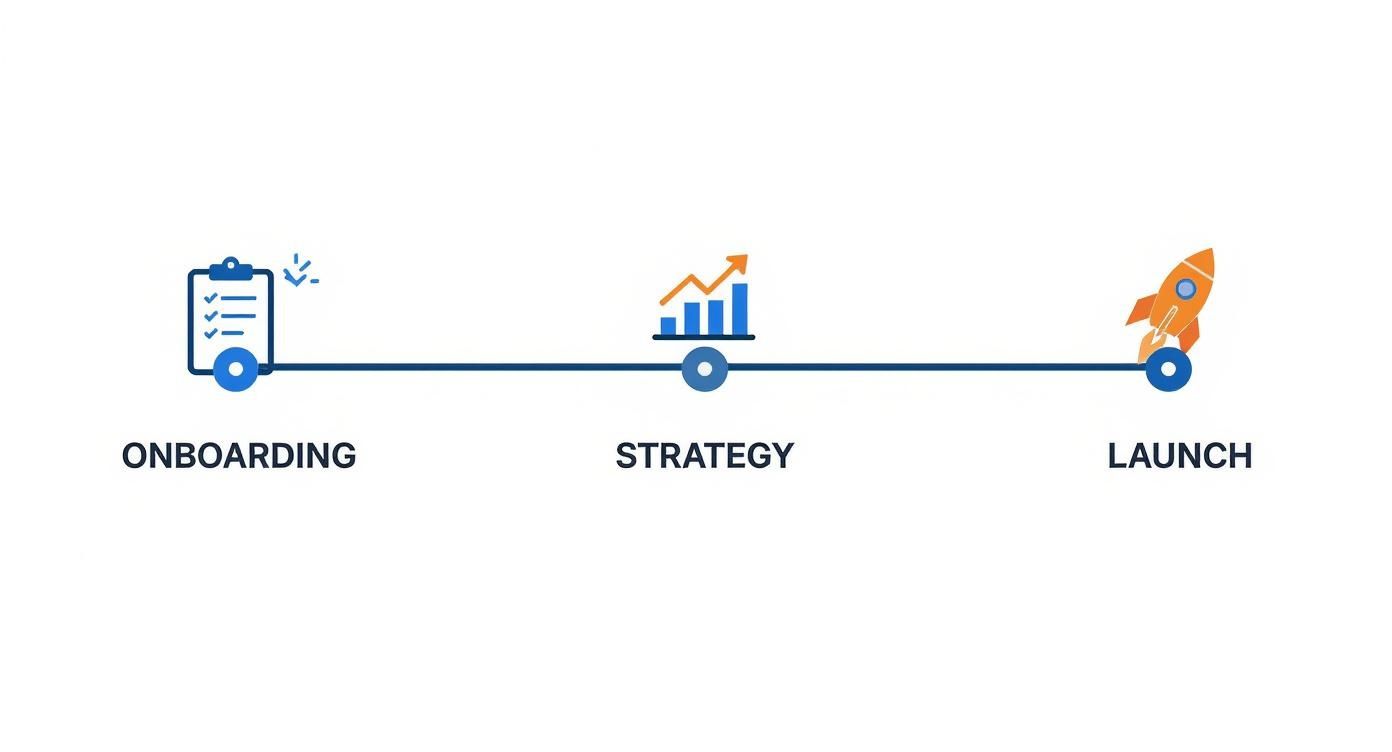
This visual roadmap underscores a key point: a successful launch is built on careful preparation, not a rushed start.
The 60 and 90 Day Milestones: Strategy and Optimisation
With the technical foundation solidly in place, the focus shifts to strategy and launch. Around the 60-day mark, your first new campaigns should be live and gathering precious data. Communication becomes even more important here, with regular meetings to review initial performance.
You should have a clear and consistent way to view results. Check out our guide on creating a streamlined PPC reporting template to see what effective reporting looks like.
By day 90, the partnership should be hitting its stride. Early data is being used to refine bidding strategies, test new ad copy, and reallocate budget to the best-performing campaigns. A strong agency will be able to demonstrate tangible progress within this timeframe.
For example, Adelaide-based agency CLIQ MC reports that their clients see an average 35% uplift in conversion rates within the first 90 days, a result they credit to a hands-on, data-first approach. Learn more about their methodology and how they achieve consistent Google Ads performance. This initial period is a strong indicator of an agency's ability to drive long-term growth.
Common Questions About Hiring a Google Ads Agency
Hiring a Google Ads agency for the first time? It’s normal to have a few big questions floating around. Getting clear, honest answers is the key to feeling confident and making sure there are no nasty surprises down the track.
Let’s run through some of the most common queries we hear from businesses.
What Is a Realistic Starting Budget?
This is usually the first question on everyone's mind, and thankfully, it's not a million-dollar one. For a small, local business here in Australia, a sensible starting point for your ad spend is usually between $1,000 and $2,500 per month.
Why that range? It gives an agency just enough fuel to gather meaningful data, test out different ad groups, and start optimising your campaigns for actual conversions.
If you go much lower, it gets incredibly tough to compete. The campaign might not get enough clicks to produce any statistically significant results, leaving you guessing. A good agency will work with you to land on a budget that fits your goals and the competitiveness of your market, making sure every dollar works as hard as possible.
How Long Until I See Tangible Results?
You'll start seeing data like clicks and impressions almost right away, but the results that really matter—qualified leads and sales—take a little more time to bake in. You should generally plan for a 90-day initial period for the agency to test, learn, and optimise.
Think of it like this:
- Month 1: This is all about setup, deep-diving into data collection, and launching the initial campaigns.
- Month 2: The focus shifts to analysing that early performance data and making the first round of strategic tweaks.
- Month 3: This is where you should start to see more consistent, predictable returns as the campaigns become dialled in.
A bit of patience during this ramp-up phase is essential. Any reputable Google Ads agency will be upfront about this timeline and manage your expectations from day one. If you're new to this world, getting a handle on Search Engine Marketing (SEM) helps you understand why this initial period is so crucial for long-term success.
Who Actually Owns the Google Ads Account?
This one is completely non-negotiable. You, the client, must always own your Google Ads account. The agency should simply be granted administrative access so they can manage campaigns on your behalf, but you need to retain ultimate ownership and control.
If an agency you're talking to insists on creating the account under their own name, treat it as a massive red flag. This shady practice is designed to lock you in, making it a nightmare to get your valuable historical campaign data if you ever decide to move on.
Should I Hire an Agency or a Freelancer?
The right choice between a Google Ads agency and a freelancer really comes down to your specific needs and scale. A freelancer can be a fantastic, cost-effective option for smaller businesses running fairly straightforward campaigns, and they often provide a very personal level of service.
An agency, on the other hand, usually brings a whole team of specialists to the table—think copywriters, data analysts, and senior strategists. That collective brainpower offers more robust support, deeper strategic thinking, and the capacity to manage more complex, multi-channel campaigns as your business grows.
Agencies also offer more stability and redundancy. If your main point of contact is away, you know your account is still being actively managed, which is a big plus for peace of mind.
Ready to partner with a Click Click Bang Bang that delivers results without the long-term lock-ins? We provide transparent, data-driven Google Ads management designed to grow your business. Explore our PPC plans and start your risk-free trial today!
Read NeXt
Or Read Our Latest
- Manual vs Automated Bidding for PPC Success
- Conversion Tracking Setup: A Complete AU Guide
- Instagram Advertising Australia: Complete 2026 Guide
- Pay Per Click: A Beginner’s Guide for Australian Marketers
- Display Advertising on Google: The Complete Australian Guide
- Stakeholder Communication Plan How to Build One That Works
Click. CLick. Subscribe.
Get our best PPC insights, industry updates, and power moves delivered straight to your inbox. No fluff, just high-caliber strategies that actually work.
Don’t Leave Just Yet
Try Us For 30-Days,
Risk Free!!
We guarantee that you’ll love our work within the first 30 days, if not you’ll get your money back.
What have you got to lose?