

What Is Search Engine Marketing and How Does It Work
Last Updated
Search engine marketing (SEM) is a fancy term for a simple idea: using search engines like Google to get your business in front of the right people. It’s the entire toolkit you use to get found, combining both paid advertising and organic (free) strategies to drive traffic and grow your business.
What Is Search Engine Marketing?
Think of Google as the world’s biggest, busiest marketplace. Every single day, millions of people walk through its digital doors, actively looking for products, services, or answers to their problems. SEM is your game plan for setting up shop in the best spot possible, making sure those motivated customers find you first.
SEM is the overarching discipline that covers every marketing effort on a search engine. Its goal is powerful but straightforward: connect your business with potential customers at the exact moment they’re searching for what you offer. This is what makes it so effective—you're not interrupting people, you're answering a need they've already expressed.
The Core Mission of SEM
At its heart, SEM is all about driving high-quality, high-intent traffic to your website. It’s not just about getting more clicks; it’s about attracting the right clicks. We’re talking about people who are genuinely interested in what you sell and are far more likely to become paying customers.
This is done through two main channels:
- Paid Search: Paying to place ads at the top of the search results for specific keywords.
- Organic Search: Optimising your website content and structure to rank highly in the non-paid results (this part is also known as SEO).
This two-pronged attack allows you to capture attention from multiple angles, building both immediate visibility through ads and long-term authority through organic rankings. It’s a serious business, too. The Australian search advertising market alone is expected to hit around USD 6.6 billion in 2025. That number shows just how critical a solid SEM strategy is for staying competitive online. You can read more on the search advertising market growth in Australia.
Before we dive deeper, let's break down the key ideas into a simple table.
SEM at a Glance: Key Concepts
This table provides a quick summary of the fundamental components of Search Engine Marketing and their primary goals.
| Component | Primary Goal | Method |
|---|---|---|
| Paid Search (PPC) | Generate immediate, targeted traffic by appearing at the top of search results. | Bidding on keywords to display ads (e.g., Google Ads, Microsoft Advertising). |
| Organic Search (SEO) | Build long-term visibility and authority by earning high rankings in non-paid results. | Optimising website content, technical structure, and building backlinks. |
| Keyword Research | Understand what potential customers are searching for. | Using tools to identify relevant search terms and their volume. |
| Conversion Optimisation | Maximise the value of the traffic by improving user experience and calls-to-action. | A/B testing landing pages, refining ad copy, and streamlining user journeys. |
Essentially, all these pieces work together. You use keyword research to inform both your paid ads and your organic content, and you optimise your website to make sure the traffic you get actually turns into business.
Ultimately, getting a grip on SEM is the first step toward building a powerful online presence that delivers real, measurable growth.
Understanding The Two Pillars of SEM
Every solid search engine marketing strategy is built on two distinct but powerful pillars: Search Engine Optimisation (SEO) and Pay-Per-Click (PPC) advertising. They both have the same ultimate goal—getting your brand seen on search engines—but they take completely different paths to get there.
Think of it like building a reputation in a new city. SEO is the long-term community engagement. It’s the slow-and-steady process of earning your visibility by being genuinely helpful and valuable. You write great content, make sure your website is a breeze to use, and build relationships (backlinks) with other trusted names around town. Over time, people start to recognise you as the go-to expert. That’s your organic, hard-earned presence.
On the other hand, PPC is like renting a massive billboard right in the city centre. It gets you immediate, guaranteed visibility for as long as your budget lasts. You can choose the exact neighbourhoods (keywords) and times of day to show your ad, putting your message in front of the right people, right now. It’s a direct, fast, and highly controlled way to buy attention.
The Organic Foundation: SEO
Search Engine Optimisation is all the foundational work you do to rank highly in the non-paid search results. It’s a marathon, not a sprint. The whole game is about building a credible and authoritative online presence that search engines like Google trust enough to recommend to their users. For a deeper dive into the nuts and bolts, our comprehensive guide to search engine optimisation is packed with insights for building a strong organic strategy.
The best part about SEO is that the results are sustainable and can even compound over time. Once you earn a top spot, you aren't paying for every single click, creating a cost-effective stream of traffic that keeps delivering value long after the initial work is done.
A key takeaway is that SEO builds a long-term business asset. Your rankings are earned, not rented, which creates a durable competitive advantage and enhances your brand's credibility with consumers.
The Paid Accelerator: PPC
Pay-Per-Click advertising, meanwhile, is all about speed and precision. Platforms like Google Ads let you place your ads right at the top of the search results page, often grabbing attention before anyone even sees the organic listings. You bid on specific keywords and, just as the name implies, only pay when someone actually clicks on your ad.
This approach offers some huge advantages:
- Speed to Market: You can launch a PPC campaign in a matter of hours and start driving targeted traffic to your site almost instantly.
- Granular Control: You have immense control over your budget, who you target (based on things like location and demographics), and the exact ad message they see.
- Predictable Results: The performance of PPC campaigns is highly measurable, making it easy to see your return on investment (ROI) and know exactly what’s working.
While SEO builds your brand’s enduring reputation, PPC gives you the immediate thrust you need to capture high-intent customers right now. The most powerful SEM strategies don't pick one over the other; they harmonise both, using PPC for quick wins and gathering valuable data while building a sustainable organic engine for long-term growth.
How Paid Search Advertising Actually Works
Paid search advertising is your ticket to instant visibility, but how does it really work behind the scenes? At its heart, this part of search engine marketing is like a lightning-fast, real-time auction. Every single time someone types a search into Google, an auction happens in milliseconds to decide which ads get the top spots.
It’s not as simple as the highest bidder wins, though. Platforms like Google Ads use a clever formula where your bid is only one piece of the puzzle. This is where a concept called Ad Rank comes in, which ultimately determines your ad's position on the page.
The Ad Auction and Quality Score
Your Ad Rank is calculated by multiplying your maximum bid by your Quality Score.
Think of Quality Score as Google's rating of how relevant and high-quality your ads and landing pages are. It's a score out of 10, and a higher score tells Google your ad is a fantastic match for what the user is looking for.
Here's the kicker: a high Quality Score can actually mean you pay less per click while securing better ad positions. It's a system designed to reward advertisers who create a genuinely helpful user experience, not just those with the deepest pockets.
Juggling all these moving parts can be tricky, but an expert in Google Ads management can streamline the process and help you get the best possible return on your investment.
The infographic below helps visualise how paid search (PPC) and organic search (SEO) work together as the two main pillars of SEM.
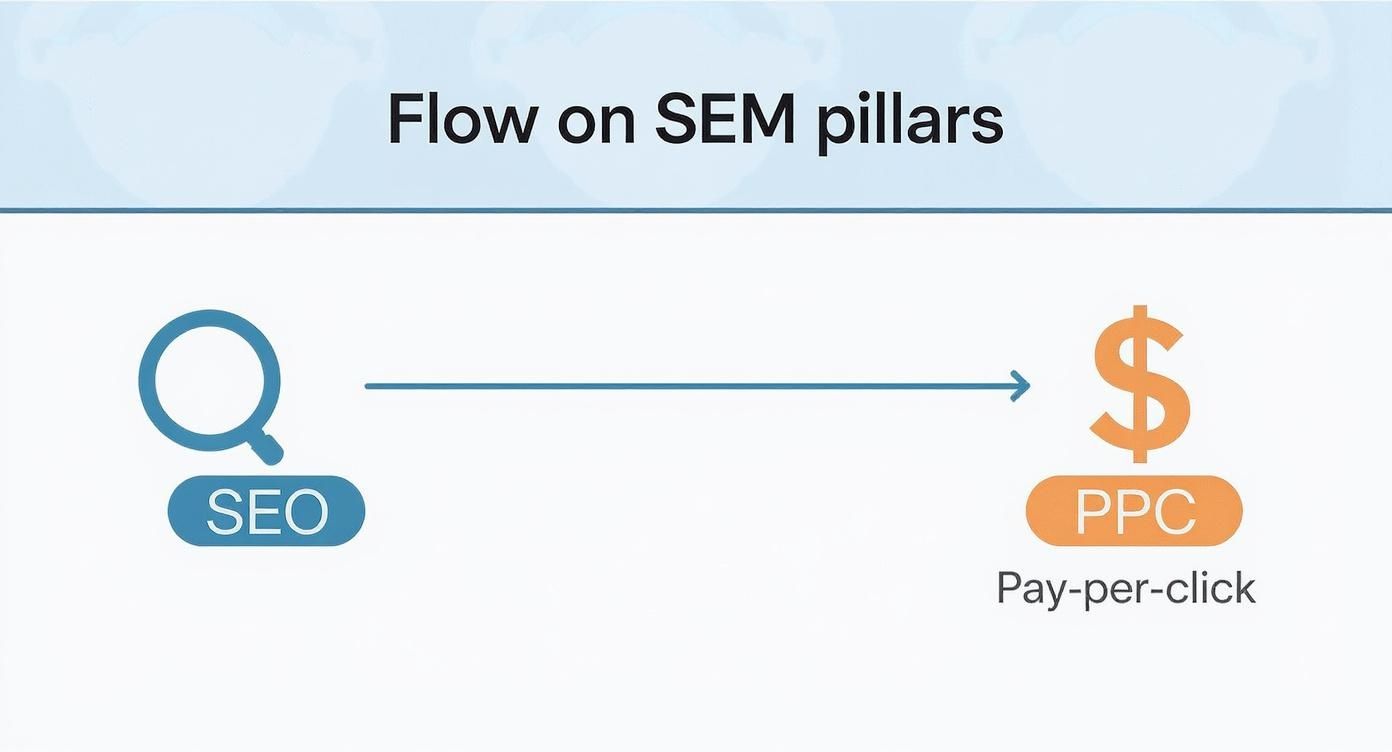
This flow shows that while SEO is a long game focused on building authority, PPC gives you an immediate and highly controllable stream of traffic.
Key Components of a Paid Search Campaign
To come out on top in the ad auction, you need to get a few key components right. Each one works with the others to make sure your ad spend is effective and drives real results for your business.
Here’s a look at what a typical campaign involves:
- Keyword Targeting: This is where you choose the specific keywords or phrases you think potential customers will use when looking for your products or services.
- Ad Creation: You’ll write punchy, compelling ad copy with a clear call-to-action that makes people want to click.
- Landing Page Optimisation: Once they click, the page they land on needs to be relevant, easy to use, and designed to get them to take the next step (i.e., convert).
- Budget Management: You set daily or monthly budgets to keep your ad spend in check, so you never pay more than you’re comfortable with.
The real magic of paid search is its precision. You can target users based on their search intent, location, device, and even the time of day, making it an incredibly powerful tool for reaching customers who are ready to buy.
This level of control is particularly important here in Australia. Google absolutely dominates the search engine market, holding onto a staggering 91% to 93% share heading into 2025. This means any effective SEM campaign has to be built and optimised for Google's platforms. By getting a handle on how the auction works and focusing on your Quality Score, you can turn those clicks into loyal customers.
Unlocking Long-Term Growth with SEO

While paid search delivers a quick hit of traffic, search engine marketing has another, more enduring side. This is where Search Engine Optimisation (SEO) comes in—the art of earning free, organic traffic by making your website the most helpful and authoritative answer to what people are searching for.
Think of it this way: paid ads are like renting a billboard on a busy highway. SEO is like owning the most popular, trusted store in town that everyone recommends. It's about building a valuable, long-term asset, not just paying for temporary visibility.
The Three Pillars of SEO
A solid SEO strategy is built on three core pillars. Get these right, and you're signalling to search engines that your site is a high-quality, relevant destination worth sending users to.
Here’s how they fit together:
- Technical SEO: This is the nuts and bolts of your website. It covers all the behind-the-scenes stuff that helps search engines find, crawl, and understand your site. Think site speed, mobile-friendliness, and a secure connection. A strong technical foundation is non-negotiable; without it, even the best content can go unseen.
- On-Page SEO: This pillar is all about your content. It involves optimising individual pages with the right keywords, writing compelling titles and descriptions, and structuring your content in a way that’s easy for both people and search engines to read. The goal is to make it crystal clear what each page is about and why it’s valuable.
- Off-Page SEO: This is your website's street cred. It’s built when other reputable, authoritative websites link back to yours. These backlinks act as votes of confidence, telling search engines that your content is trustworthy and worth recommending.
SEO is a marathon, not a sprint. The consistent effort you put into these three areas compounds over time, building a digital asset that delivers a steady stream of high-quality traffic without you having to pay for every click.
The Growing Investment in Organic Search
Businesses are catching on to the immense value of this long-game approach. In 2025, Australian businesses are projected to pour around AUD 1.5 billion into SEO services.
That huge number is driven by an incredible return on investment. Some studies show that for every AUD 1 spent on SEO, businesses can see a return of over AUD 22.
Unlike paid ads, the visibility you build through SEO doesn't just vanish the moment you stop paying. If you’re keen to dive deeper into boosting your organic rankings, this beginner's guide to Search Engine Optimization is a fantastic starting point. By investing in SEO, you’re not just renting ad space; you’re building a powerful, self-sustaining engine for business growth.
Why Your Business Cannot Ignore SEM
The true power of search engine marketing boils down to one simple word: intent.
Traditional advertising often feels like you're shouting into a crowded room, just hoping someone who needs you happens to be listening. SEM is the complete opposite. It’s like having a quiet, one-on-one conversation with a person who just asked for your specific expertise.
Instead of interrupting someone’s day with a TV commercial or a billboard, you’re meeting them at the exact moment they’re actively looking for a solution. This is what turns SEM from just another marketing tactic into a genuine business growth engine. It’s not just about getting seen; it’s about getting seen by the right people, at precisely the right time.
Capitalise on High-Intent Customers
When someone types "emergency plumber in Melbourne" into Google, their intent couldn't be clearer. They aren’t just browsing for fun; they have a burst pipe and need a solution, now. Search engine marketing puts your business directly in the path of this high-intent traffic, connecting you with customers who are not just interested, but ready to pull out their wallets.
This direct line to motivated buyers naturally leads to higher-quality leads and, ultimately, more sales. You're not trying to convince someone they have a problem. You're simply showing up as the best possible solution to a problem they already know they have.
The core benefit of SEM is its ability to capture demand that already exists. You are aligning your business with a customer's active search, leading to a much shorter and more efficient sales cycle.
This efficiency is what delivers tangible results, generating leads that are far more likely to convert than those from almost any other marketing channel out there.
Achieve Measurable and Transparent ROI
One of the biggest frustrations with old-school marketing is the murky data. How do you really know if that expensive magazine ad or billboard actually worked? With SEM, all that guesswork is gone.
Every single dollar you spend can be tracked, measured, and analysed. This total transparency allows you to see exactly which campaigns are driving results and which ones are just wasting your budget.
- Track every click: Know precisely how many people clicked on your ad and landed on your website.
- Measure conversions: See exactly how many of those clicks turned into sales, phone calls, or form submissions.
- Calculate your ROI: Understand the direct financial return from your marketing spend, which lets you make smart, data-driven decisions.
This level of insight is a game-changer. It empowers businesses of all sizes—from the local coffee shop to the huge enterprise—to compete effectively by optimising their strategies for maximum performance and profit. SEM truly levels the playing field, making precise, impactful marketing accessible to everyone.
How to Build Your First SEM Strategy
Jumping into search engine marketing without a clear plan is like setting off on a road trip with no map. Sure, you might get somewhere eventually, but it won’t be the most efficient or effective route.
A proper strategy ensures every dollar you spend and every ad you write has a specific purpose. It’s the difference between random acts of marketing and a coordinated campaign designed to deliver real business results from day one. This whole process starts by ditching vague ideas like "getting more traffic" and focusing on specific, measurable goals.
Define Your Business Objectives
Before you even think about keywords or ad copy, you need to ask the most important question: what are we actually trying to achieve here? Your SEM goals have to be tied directly to your core business objectives. Are you trying to boost online sales, generate qualified leads for your sales team, or just get your brand name out there in a new market?
Each of these goals demands a completely different approach:
- E-commerce Sales: Your world will revolve around product-specific keywords, eye-catching Shopping ads, and obsessing over conversion rates.
- Lead Generation: The strategy will centre on capturing contact details through valuable offers, targeting decision-makers with ad copy that speaks their language.
- Brand Awareness: Here, your campaigns might use broader keywords and focus on metrics like impressions and click-through rates to maximise visibility.
Getting this right is non-negotiable. It dictates your budget, your messaging, and how you’ll ultimately measure success.
Understand Your Audience and Keywords
Once you know your destination, you need to get inside the heads of the people you want to reach. Who are your ideal customers? What problems are they trying to solve? And critically, what words do they use when they search for solutions online?
This is where keyword research comes in. Use keyword tools to uncover the exact search terms your audience is typing into Google. Your job is to zero in on keywords that show clear intent. For instance, a search for "emergency plumber Sydney" shows way more urgency and purchase intent than someone just Googling "plumbing tips." You'll want to organise these keywords into tight, logical ad groups so you can write super-relevant, targeted ads for each.
The most successful SEM strategies are built on a deep understanding of customer intent. Your goal is to match your ads and landing pages perfectly with the needs expressed in their search query.
Finally, you need a killer landing page. This is the dedicated page a user lands on after clicking your ad. It must be a seamless continuation of the promise you made in your ad, with a clear call-to-action that makes it dead simple for visitors to do what you want them to do. The success of your entire campaign rests on this final step, which makes it essential to understand how to measure advertising effectiveness and make sure your landing pages are actually converting.
Common Questions About SEM Answered
Even when you've got a solid SEM strategy mapped out, a few questions always seem to pop up. Let's tackle some of the most common ones that clients ask when they're getting their heads around search engine marketing.
How Long Does It Take to See Results?
This is probably the number one question we get, and the answer really depends on which part of SEM we're talking about.
With Pay-Per-Click (PPC), the results are almost instant. You can get a campaign live today and see traffic flowing to your website within hours. It’s perfect for getting quick wins or testing a new offer.
On the other hand, Search Engine Optimisation (SEO) is a marathon, not a sprint. It’s all about building long-term trust and authority with search engines. You’re typically looking at three to six months before you start seeing real, meaningful movement in your organic rankings.
SEM vs. Social Media Marketing: Which Is Better?
Another classic question. The truth is, they aren't competitors—they're teammates that play different positions. SEM is all about capturing active intent. You're putting your business in front of people who are already searching for what you offer.
Social media marketing is more about discovery. You're reaching people based on their interests and behaviours, often before they've even realised they have a need. A truly powerful digital strategy uses both, letting them play off each other's strengths.
Think of it like this: SEM is pull marketing, reeling in users with an existing need. Social media is push marketing, getting your message out there to build awareness and create that need in the first place.
How Much Should I Spend on SEM?
Ah, the budget question. There's no magic number here, and if anyone gives you one without knowing your business, run the other way.
A smart starting point is to figure out your industry's average cost-per-click (CPC) and, more importantly, what a new customer is actually worth to you. Once you know that, you can set a test budget. The goal isn't to spend a certain amount, but to spend enough to gather meaningful data so you can make informed decisions and scale what works. Ultimately, your budget should be tied directly to your business goals and what you can handle in terms of growth.
Ready to stop guessing and start getting results? The team at Click Click Bang Bang specialises in creating precision-driven SEM campaigns that deliver measurable growth. Find out how we can build a strategy that works for your business by visiting us at https://clickclickbangbang.com.au.
Read NeXt
Or Read Our Latest
- Manual vs Automated Bidding for PPC Success
- Conversion Tracking Setup: A Complete AU Guide
- Instagram Advertising Australia: Complete 2026 Guide
- Pay Per Click: A Beginner’s Guide for Australian Marketers
- Display Advertising on Google: The Complete Australian Guide
- Stakeholder Communication Plan How to Build One That Works
Click. CLick. Subscribe.
Get our best PPC insights, industry updates, and power moves delivered straight to your inbox. No fluff, just high-caliber strategies that actually work.
Don’t Leave Just Yet
Try Us For 30-Days,
Risk Free!!
We guarantee that you’ll love our work within the first 30 days, if not you’ll get your money back.
What have you got to lose?