

Choosing Google AdWords Services A Complete Australian Guide
Last Updated

When you hear “Google Ads services,” what comes to mind? For a lot of people, it’s just someone pressing ‘go’ on a few ads. But that’s selling it way short.
Think of professional Google Ads management less like simply ‘running ads’ and more like hiring a master architect to build your digital storefront. Sure, anyone can throw up an ad, but a specialist service designs a sophisticated system engineered from the ground up to attract the right customers, guide them through your virtual doors, and get them to take valuable actions.
It’s the difference between a home cook and a master chef. The home cook follows a recipe and makes a meal. The master chef, on the other hand, strategically sources every ingredient (keyword research), applies precise technique (bid management), and uses artful presentation (ad creation) to deliver a result that consistently wows you.
In short, it’s about turning your ad spend from a simple expense into a powerful, predictable growth engine for your business.
What Are Google Ads Services, Really?
A managed service goes far beyond just turning campaigns on and off. It's a strategic partnership focused on hitting your specific business goals—whether that’s generating qualified leads, driving e-commerce sales, or getting your brand in front of more people. The core parts of a professional service all work together to make sure every dollar of your budget is used effectively.
Beyond Just Running Ads
Here’s what a proper managed service actually involves:
- Comprehensive Campaign Strategy: This is the foundational blueprint. It starts with understanding your business, defining your target audiences, checking out what your competitors are doing, and setting clear, measurable goals for your ads.
- Meticulous Keyword Research: Specialists dig deep to find the high-intent search terms your potential customers are actually typing into Google. This ensures your ads show up at the exact moment someone is looking to buy, not just browsing for information.
- Compelling Ad Creation and Copywriting: Crafting ads that grab attention and persuade people to click is both an art and a science. It involves writing engaging headlines, descriptive text, and clear calls-to-action that genuinely connect with your audience.
The Engine Room of Optimisation
Once the campaigns are live, the real work begins. This is where the expertise of a managed service truly shines, turning raw data into actionable insights and better performance over time.
The goal isn't just to get clicks; it's to get the right clicks from the right people at the right cost. Continuous optimisation is the process that makes this possible, ensuring your ad spend works harder for you over time.
This ongoing management involves a few critical activities. Technicians are constantly monitoring campaign performance, tweaking bids to make sure you're not overpaying for clicks. They’re also running A/B tests on ad copy and landing pages to figure out which messaging drives the highest conversion rates.
On top of that, a key part of any professional Google Ads service is robust conversion tracking. This technical setup is what accurately measures what happens after a user clicks your ad—did they fill out a form, make a purchase, or call your business? Without this data, you're just flying blind. With it, every decision is informed, strategic, and aimed squarely at maximising your return.
Choosing Your Path: In-House, Agency, Or Freelancer
Deciding who will manage your Google Ads campaigns is one of the most critical choices you'll make for your digital marketing. It’s not just about who’s clicking the buttons; it’s about putting a vital growth channel into the right hands. The decision really boils down to three main paths: building an in-house team, hiring a freelancer, or partnering with a specialised agency.
Each option comes with its own unique set of advantages and challenges. There’s no single “best” choice that works for everyone. The ideal path for you depends entirely on your business’s budget, resources, internal expertise, and long-term ambitions. Understanding the real-world differences between each model is the first step toward making a confident, strategic decision that lines up with your goals.
The In-House Team: An Investment in Control
Bringing your Google Ads management in-house is the path of maximum control. An internal team lives and breathes your brand every single day. They have unmatched access to your company culture, deep product knowledge, and internal teams, which can lead to incredibly authentic and tightly integrated campaigns.
However, that control comes at a serious cost. Building a capable in-house team requires a huge investment that goes far beyond just salaries. You’ll need to factor in ongoing training to keep their skills sharp, superannuation, benefits, and pricey subscriptions to enterprise-level marketing tools. An experienced PPC manager in Australia can easily command a salary well over $100,000, and that’s before you even think about supporting roles or technology.
This visual below breaks down the hierarchy of what needs to be managed—whether by an internal team or an external partner—to hit your main advertising goal.
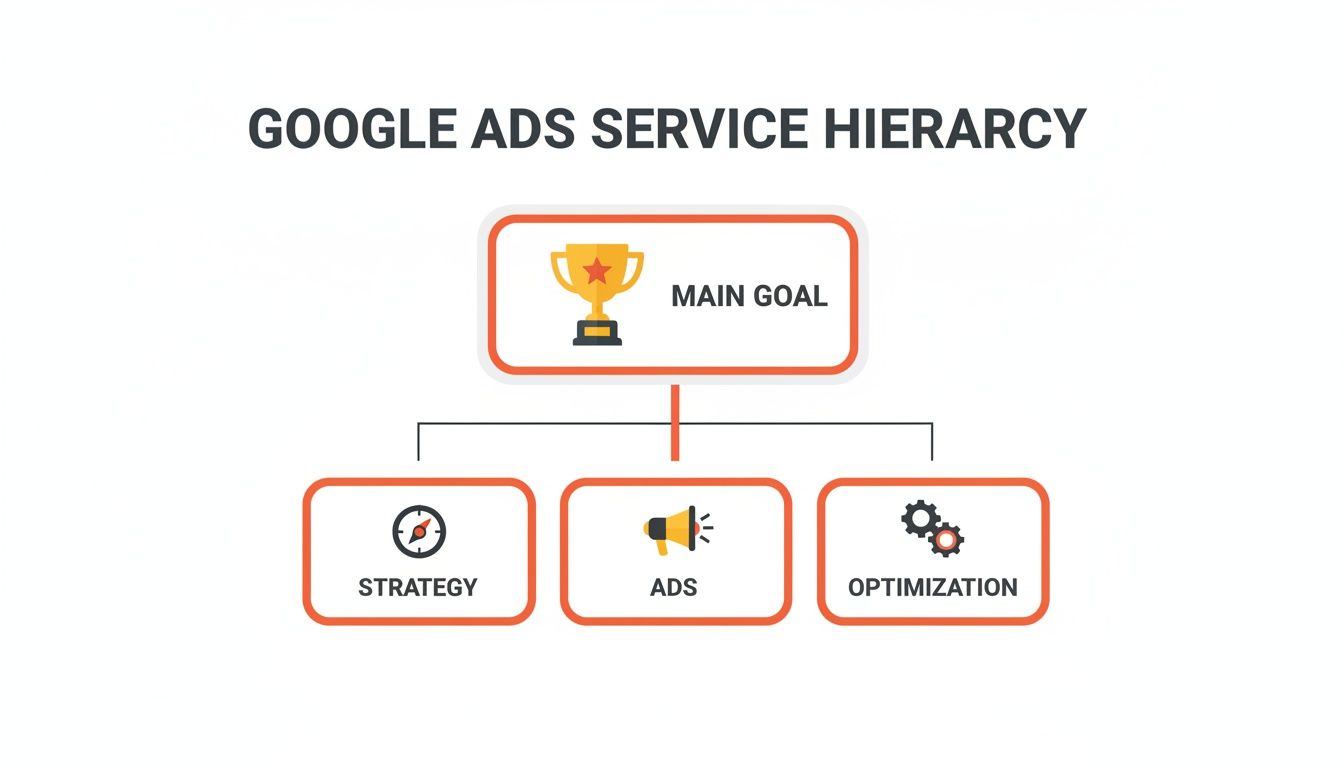
As the hierarchy shows, successful outcomes are built on layers of strategy, ad management, and constant optimisation, all of which demand dedicated expertise.
The Freelancer: A Specialist for Hire
Hiring a freelancer offers a compelling middle ground. You get access to a specialist’s skills, often at a more competitive price point than a full-time employee or a large agency. Freelancers can be incredibly flexible and are often a fantastic fit for businesses with specific, well-defined needs or smaller budgets.
The potential trade-off is in their availability and the breadth of their expertise. A freelancer is a single person juggling multiple clients, which can sometimes lead to communication delays or a narrower focus. They might be a master of Google Search ads but have less experience with Google Shopping or YouTube, which limits your ability to expand into new channels without hiring even more contractors.
A key consideration with freelancers is scalability. While they’re excellent for targeted tasks, their capacity is finite. If your business experiences rapid growth, you might quickly outgrow a single person's ability to effectively manage increasingly complex campaigns.
The Agency: A Comprehensive Partnership
Partnering with a Google Ads agency is like hiring an entire marketing department on demand. Instead of one employee or contractor, you get access to a dedicated team of specialists—strategists, copywriters, data analysts, and account managers—all working together on your behalf. This model completely removes the overhead and HR headaches of hiring in-house.
An agency brings several distinct advantages to the table:
- Access to Advanced Tools: Agencies invest heavily in enterprise-grade software for analytics, competitor research, and bid management that is often way too expensive for a single business.
- Diverse Expertise: The collective knowledge of an agency team means you benefit from experience across countless industries and campaign types. If you want to test a new platform, chances are someone on the team has already mastered it.
- Scalability and Flexibility: Agencies are built to grow with you. As your budget and needs expand, they can seamlessly allocate more resources to your account, ensuring you never hit a capacity ceiling.
This approach provides a scalable, comprehensive solution without the fixed costs and risks of building an internal team. You get the benefit of deep expertise and advanced technology, allowing you to focus on running your business while your agency focuses on driving results. For many Australian businesses, this blend of expertise, scalability, and cost-effectiveness makes an agency the most logical choice for managing their Google AdWords services.
Understanding Agency Pricing And What You Get
Let’s pull back the curtain on what you’re actually paying for when you hire someone for Google AdWords services. It's easy to get lost in the jargon, but it's not just about a monthly invoice. It’s about understanding the real value behind the numbers—the expertise, the deliverables, and the pricing model that will push your business forward. A good, transparent agency won’t just send you a bill; they’ll clearly break down what’s included, framing it as a strategic investment, not just another line item on your P&L.
This investment buys you specialised expertise across a whole range of activities. You're paying for the initial deep-dive audit of any accounts you already have, or the strategic build of brand-new campaigns from the ground up. It also covers the day-to-day grind of ongoing optimisation, performance reporting that actually makes sense, and the constant management needed to turn your ad spend into results you can measure.
Core Deliverables You Should Expect
When you partner with an agency, their management fee should cover a full suite of services designed to get you the best possible return on your investment. While the specifics can vary, any quality service will always include a few non-negotiable components.
Think of these as the foundations of any successful campaign:
- Initial Account Audit & Strategy: A thorough review of your current setup (if you have one) and a detailed strategic plan. This should map out your target audiences, campaign structure, and the key performance indicators (KPIs) that matter.
- Campaign Build & Launch: The complete creation of your campaigns. This isn't just flicking a switch; it includes keyword research, writing compelling ad copy, setting up audience targeting, and the technical setup of conversion tracking.
- Ongoing Management & Optimisation: This is the day-to-day work. It involves constant monitoring of performance, adjusting bids, A/B testing ads and landing pages, and managing your budget to make sure every dollar is working as hard as possible.
- Performance Reporting & Insights: Regular, easy-to-understand reports that do more than just spit out raw data. They should give you actionable insights and clear communication on what’s working, what’s not, and what the plan is for next month.
Common Pricing Models In Australia
In the Australian market, you'll generally come across a few standard pricing structures. Each has its pros and cons, and the right one for your business really depends on your budget, goals, and how hands-on you want to be. A big part of this is seeing how agencies handle Marketing Budget Allocation to get the most out of your spend.
Here’s a quick rundown of the most common models you'll see:
- Percentage of Ad Spend: The agency charges a fee that’s a percentage of what you spend on ads each month. It's a straightforward model that scales with your investment, but you have to be wary that it doesn’t just incentivise the agency to get you to spend more.
- Flat Monthly Retainer: You pay a fixed fee every month, no matter how much you spend on ads. This gives you predictable costs, which is great for budgeting, and lets the agency focus purely on performance without being influenced by spend levels.
- Performance-Based Pricing: The agency’s fee is tied directly to results, like the number of leads you get or a percentage of sales revenue. While this perfectly aligns your goals with theirs, it can be more complex to set up and track properly.
It's so important to understand the nuances between these pricing models. The best structure is one that creates a true partnership, where the agency is rewarded for hitting the goals that matter most to you—whether that’s generating leads, making sales, or just building brand awareness.
For a deeper dive, you can learn more about the pros and cons of these different PPC pricing models and figure out which one might be the best fit for your business goals.
Aligning Budget With Realistic Outcomes
Finally, we need to talk about connecting your budget to real-world, achievable results. In Australia, your budget is often the thing that makes or breaks a Google Ads campaign.
As a general rule of thumb, small businesses typically need to invest $1,000-$3,000 a month to compete effectively. For mid-market companies, that figure might be closer to $3,000-$15,000. The numbers don't lie: while 68% of small businesses see a positive return after six months, a massive 45% fail early simply because they didn't put enough fuel in the tank. This really highlights the need for flexible, no-commitment plans that let you find your footing.
Understanding these benchmarks helps you set a realistic budget from the get-go and evaluate agency proposals based on the actual value and expertise they're bringing to the table.
What A Great Onboarding Process Looks Like

A successful partnership with any Google AdWords services provider doesn't kick off the day your ads go live. It starts much earlier, with a rock-solid onboarding process that sets the stage for trust, transparency, and clear communication from the word go. This is where a top-tier agency proves its worth, long before the first click ever happens.
Think of it like building a house. You wouldn't want a builder rocking up and laying bricks without a detailed blueprint, a site survey, and a crystal-clear understanding of your vision. A great onboarding process is that strategic blueprint for your campaigns, making sure everyone is aligned and working toward the same finish line.
It’s a collaborative journey, designed to get your campaigns firing on all cylinders from day one and turn any initial ambiguity into a precise, actionable plan.
From Discovery To Strategy
The whole thing kicks off with a deep dive into your business. And I don’t mean a quick five-minute chat. This is an in-depth strategy session where the agency essentially becomes a student of your brand. They need to get their heads around everything—your core business objectives, target audience, unique selling points, and what has (or hasn't) worked for you in the past.
This initial discovery phase usually involves:
- A Comprehensive Discovery Call: This is the first major step. It’s a conversation to align on your business goals, nail down the key performance indicators (KPIs) that actually matter, and define what success looks like for you.
- An In-depth Strategy Session: Here, the agency team translates those business goals into a tangible campaign strategy. They'll map out the proposed campaign structure, targeting methods, and budget recommendations.
- Collaborative Creative Development: This is all about working together on ad copy and messaging. The goal is to make sure it hits the mark, reflecting your brand voice and resonating with your ideal customer.
The Technical Foundation And Launch
With a solid strategy locked in, the focus pivots to the critical technical setup. This is all the behind-the-scenes work that makes accurate measurement and optimisation possible. Without it, you’re basically flying blind, throwing money at ads without knowing what’s driving real business outcomes.
The technical setup is non-negotiable. Proper tracking is the difference between guessing what works and knowing what drives results. It ensures every decision is backed by data, not assumptions.
This is the phase where the agency gets everything dialled in for launch, handling the meticulous setup of all the analytics and measurement tools. For a detailed look at why this is so crucial for campaign success, you can learn more about professional Google Ads conversion tracking.
Once the tech is sorted and the creative is approved, your campaigns are ready to go live. A professional agency will have a streamlined process to get this done quickly, often within a week of that initial kickoff call.
Reporting And Ongoing Communication
After launch, the game shifts to performance monitoring and reporting. A great agency won't just dump a spreadsheet of numbers in your inbox; they deliver actionable insights. You should expect a combination of real-time access and strategic analysis.
This typically looks like:
- A Live Data Dashboard: This gives you 24/7 access to your key campaign metrics. You get full transparency into performance whenever you need it, no waiting around for a report.
- Strategic Monthly Reviews: Beyond the live data, you should get a monthly report that summarises performance, highlights key wins, and lays out the strategic plan for the coming month.
This dual approach means you're always in the loop and confident that your campaigns are being actively managed and optimised for the best possible results.
How To Spot The Signs Of A Winning Campaign

Theory and strategy are all well and good, but what does a successful campaign actually look like out in the wild? The real value of professional Google AdWords services isn’t found in a complicated spreadsheet; it shows up in tangible business results you can actually see and feel. It’s about turning clicks and impressions into real-world revenue and genuine leads.
Great success stories aren't just about posting big numbers; they're about solving real business headaches. They show how an expert touch can cut through the noise of a competitive market and deliver a clear, measurable return on your investment. Let’s look at what winning really looks like with a couple of scenarios that hit close to home for Australian businesses.
The E-commerce Peak Season Breakthrough
Picture an Aussie online retailer that sells outdoor gear. As the summer holidays crept closer, they were staring down the barrel of a familiar problem: brutal competition and ad costs that were going through the roof. Their old campaigns brought in traffic, sure, but they just weren't converting, leaving them with a pretty disappointing return on ad spend (ROAS).
A sharp agency partner came in with a two-pronged attack. First, they gave the client’s Google Shopping campaigns a complete overhaul, fine-tuning the product feeds and using smart bidding to zero in on buyers who were ready to pull out their wallets. Then, they fired up dynamic remarketing ads to bring back all those window shoppers who’d abandoned their carts.
The results were a game-changer:
- ROAS more than doubled right in the middle of their busiest quarter.
- The average cost per acquisition (CPA) dropped by a huge 35%.
- Online revenue shot up by 60% compared to the same time last year.
This story is a perfect example of how a winning campaign goes beyond just chasing traffic. It’s about capturing profitable sales when it counts the most. Success wasn't about throwing more money at the problem—it was about spending smarter with a strategy driven by data.
Halving Lead Costs For A Local Service Business
Now, let's think about a local plumbing business in one of Australia’s big cities. They were getting calls from their ads, but they were paying way too much for them. Their cost-per-lead (CPL) was painfully high because their ads were being shown to people outside their service area and for searches that were completely irrelevant.
An expert in Google AdWords services spotted these leaks straight away. They rolled out a hyper-local targeting strategy, making sure the ads only appeared within the specific postcodes the business actually served. They also brought in a massive list of negative keywords to stop wasting money on searches like "plumbing courses" or "DIY plumbing tips."
The core of a winning local campaign is precision. It's about eliminating wasted spend to ensure your budget is exclusively focused on attracting customers who can actually hire you, driving down acquisition costs and maximising profitability.
The effect was immediate and massive. The business saw its qualified leads go up while its CPL was cut in half, which meant they could book more jobs without touching their marketing budget. Knowing how to spot a winning campaign often comes down to a deep dive into analytics and tracking, a process covered well in this guide on measuring marketing campaign effectiveness. This just goes to show how targeted tweaks can lead to huge improvements in efficiency and ROI for local businesses.
Navigating Rising Costs With Smarter Optimisation
These examples are more relevant than ever right now. The average cost per click (CPC) for Google Ads in Australia has climbed to $5.26, which is a hefty 12.88% increase year-over-year. But here's the good news: smart advertisers are using AI tools and their own first-party data to keep their cost-per-lead (CPL) growth down to just 5.13%. It proves that clever optimisation can beat rising costs.
In fact, 68% of small businesses see a positive return on their investment after six months, hitting an average 200% ROAS. These stories show that with the right expertise, businesses can do more than just survive—they can thrive, even when things get competitive. For a closer look at how different industries are performing, check out our guide on Google Ads benchmarks by industry.
Finding The Right Google Ads Agency For Your Business
Choosing the right partner for your Google Ads services is a massive business decision, not just another marketing expense. Get it right, and the agency becomes a genuine extension of your team—a strategic partner who is as invested in your growth as you are.
But let’s be honest, the market is flooded with options. How do you cut through the noise and separate the real experts from those just making empty promises? It all comes down to asking the right questions and knowing which red flags to run from.
Think of it like hiring a new CFO. You wouldn’t bring them on without thoroughly vetting their credentials, understanding their financial philosophy, and making sure you can actually have a decent conversation with them. The same level of diligence applies here. You're looking for a modern, trustworthy partner whose approach clicks with your business values and long-term vision.
Critical Questions To Ask Any Potential Agency
Before you even think about signing a contract, you need to go in armed with a checklist. These questions are designed to peel back the sales pitch and reveal an agency's true capabilities, processes, and character. Their answers (or lack thereof) will tell you everything you need to know.
Here are a few essential questions to get the ball rolling:
- Industry Experience: "Can you show me some case studies or real results from businesses in my industry, or ones that faced similar challenges to us?"
- Strategy and Data: "What's your process for building a campaign strategy from scratch? How do you handle the initial keyword research and audience targeting?"
- Team Structure: "Who will be my day-to-day contact? And more importantly, what’s the experience level of the person actually in the trenches managing my campaigns?"
- Communication Protocols: "What does your reporting look like, and how often will we connect for strategic meetings? I need to know how we’ll stay on the same page."
This is especially crucial in the Australian market, where 77% of consumers use Google every week to research local businesses. A staggering 80% of those local searches convert, making expert management the difference between thriving and just surviving. Discover more insights into the Australian digital market.
Red Flags You Cannot Ignore
Just as important as asking the right questions is knowing how to spot the warning signs of a bad partnership. A slick sales deck can easily mask a shoddy service, so keep your eyes peeled for these classic red flags.
An agency that guarantees "#1 rankings" or specific results is a major red flag. PPC is an auction-based system influenced by countless factors; no one can guarantee outcomes without controlling all the variables.
Here are a few other deal-breakers to watch out for:
- Unrealistic Guarantees: Any promise of instant, guaranteed results is a tell-tale sign of inexperience or, worse, deliberately misleading sales tactics.
- Long-Term Lock-in Contracts: A confident agency doesn't need to trap you in a 12-month contract. Look for flexible, month-to-month agreements or risk-free trials that show they’re willing to earn your business.
- Lack of Transparency: If they get cagey about their process, refuse to give you full access to your own ad account, or send you vague, fluffy reports, it's time to walk away. Fast.
Frequently Asked Questions
Jumping into the world of Google Ads services can feel like you're learning a new language. You've probably got a bunch of questions, especially when you're trying to make the right call for your Australian business. Let's clear up some of the most common ones we hear.
How Long Until I See Results From Google Ads?
This is the big one, isn't it? While you'll see data like clicks and impressions almost right away, the results that actually matter—leads and sales—take a bit of time to build up. Generally, a well-run campaign will start showing real positive momentum within the first 30 to 90 days.
Think of that initial period as a critical intelligence-gathering mission. Your agency is busy testing ad copy, dialling in the targeting, and figuring out which keywords are actually bringing in valuable customers. The consistent, predictable returns come from building on that foundation, so a little patience in the first quarter pays off big time.
What Is A Good Return On Ad Spend?
A "good" Return On Ad Spend (ROAS) really depends on your industry and margins. That said, a common benchmark for a healthy campaign is a 4:1 ratio—that means for every $1 you put into ads, you get $4 back in revenue. For many Aussie e-commerce brands, hitting that number is a great sign.
But if you're chasing leads, the game changes a bit. Success is measured more by your Cost Per Acquisition (CPA). The main goal is simple: make sure the cost to get a new customer is comfortably lower than the value they bring to your business over their lifetime.
At the end of the day, it all comes down to profitability. Whether it’s a sky-high ROAS or a rock-bottom CPA, the only thing that truly matters is that your ad spend is a profitable investment that helps your business grow.
What Are The Risks Of Managing Google Ads Myself?
Going the DIY route with Google Ads can feel like a smart way to save a few bucks, but it's loaded with risks. Without a deep understanding of the platform, it’s incredibly easy to burn through your budget on clicks that go nowhere, target the wrong audience entirely, or completely mess up your conversion tracking.
Google Ads is a complex beast, and beginners often make expensive mistakes without even realising it. Bringing in a professional service takes that risk off the table, ensuring your budget is in the hands of experts who live and breathe this stuff every single day.
Ready to stop guessing and start seeing predictable growth from your advertising? Click Click Bang Bang offers transparent, risk-free Google Ads services with a 7-day launch promise. Explore our tiered plans and get started today.
Read NeXt
Or Read Our Latest
- Manual vs Automated Bidding for PPC Success
- Conversion Tracking Setup: A Complete AU Guide
- Instagram Advertising Australia: Complete 2026 Guide
- Pay Per Click: A Beginner’s Guide for Australian Marketers
- Display Advertising on Google: The Complete Australian Guide
- Stakeholder Communication Plan How to Build One That Works
Click. CLick. Subscribe.
Get our best PPC insights, industry updates, and power moves delivered straight to your inbox. No fluff, just high-caliber strategies that actually work.
Don’t Leave Just Yet
Try Us For 30-Days,
Risk Free!!
We guarantee that you’ll love our work within the first 30 days, if not you’ll get your money back.
What have you got to lose?