

A Guide to Legal SEO Services for Australian Law Firms
Last Updated

So, what exactly are legal SEO services? Think of it as a specialised game plan for getting your law firm seen online. It's about fine-tuning your website and digital presence so you show up right when potential clients are frantically searching for legal help. In today's world, it’s the equivalent of having your office on the busiest, most prestigious street in the city.
Why SEO Is Non-Negotiable for Modern Law Firms

The days of relying on a phone book listing to keep the phones ringing are long gone. Your firm's most valuable real estate isn't a physical address anymore—it's digital. When someone is facing a legal crisis, their first move is almost always to grab their phone and search online. A strong online presence isn’t just a nice-to-have; it's a core part of your business development strategy, absolutely essential for survival and growth.
This is where legal SEO services come in. They are the architect and builder of your digital storefront. Without a solid SEO strategy, your firm is practically invisible, tucked away on a digital side street where nobody can find you. A well-planned campaign ensures you’re not just on the map but front and centre on the main digital thoroughfare where your ideal clients are actively looking for you.
The Client Acquisition Engine
A great SEO strategy is much more than a marketing expense; it's an investment in a sustainable client acquisition engine. It works around the clock, 24/7, to bring qualified leads straight to your website. This engine is built on several key pillars all working together.
To give you a clearer picture, here’s a breakdown of the core components that make up a successful legal SEO campaign.
Core Pillars of a Successful Legal SEO Strategy
| Pillar | Objective | Example Tactic |
|---|---|---|
| Technical Website Health | Ensure your website is fast, secure, and easily understood by search engines like Google. This is the structural foundation. | Implementing SSL, optimising site speed, and fixing broken links or crawl errors. |
| Local Search Dominance | Make your firm the top choice for searches within your specific city, suburb, or service area. | Optimising your Google Business Profile, building local citations, and getting client reviews. |
| Authoritative Content | Answer potential clients' questions and establish your firm as a trusted expert in your practice areas. | Writing blog posts on legal topics, creating service pages, and developing FAQ sections. |
| Strategic Link Building | Earn high-quality backlinks from other reputable websites to build your site's authority and credibility in Google's eyes. | Guest posting on legal publications, getting listed in reputable directories, and creating link-worthy content. |
The real magic happens when these elements work in synergy, transforming your website from a passive online brochure into an active, lead-generating machine. You can dive deeper into the local component by reading our guide on SEO for local businesses.
SEO is no longer a choice for ambitious law firms; it is the critical infrastructure that connects your expertise with the people who need it most. It builds a lasting asset that generates returns long after the initial investment.
The numbers don't lie. In the fiercely competitive Australian market, a staggering 73% of legal consumers kick off their search for a law firm online. Firms that regularly publish blog posts as part of their strategy see 97% more backlinks and 434% more indexed pages, which massively expands their digital footprint. And the payoff? The average three-year ROI for a well-run law firm SEO campaign is an incredible 526%, blowing traditional marketing methods out of the water. For any Australian law firm that wants to thrive, not just survive, ignoring your online presence simply isn't an option.
The Three Pillars of Effective Legal SEO

Effective legal SEO isn’t about some secret handshake or a single magic trick. It's about building a strong, multi-faceted digital presence for your firm. Think of it like constructing a courthouse. You need a rock-solid foundation, well-designed rooms that serve a clear purpose, and a respected reputation in the community. If any one of those is weak, the entire structure is compromised.
At its core, successful SEO for law firms is built on three distinct pillars: Technical SEO, On-Page & Local SEO, and Off-Page SEO. Each plays a unique yet deeply interconnected role in attracting high-value clients and cementing your firm as an authority. Let's break down exactly what these are and why each is non-negotiable for your firm's growth.
Pillar One: Technical SEO – The Digital Foundation
Technical SEO is the architectural blueprint for your website. It’s all the work that happens behind the scenes to make sure search engines like Google can easily find, crawl, and understand your website’s content. Get this wrong, and even the most brilliantly written legal content will go completely unnoticed.
Imagine your website is a meticulously organised law library. Technical SEO makes sure the doors are unlocked, the lights are on, and there’s a clear directory so the librarian (Google) can quickly find the exact book (your content) it’s looking for. Without this, Google might not even know your library exists.
Core components of technical SEO include:
- Site Speed: Your website must load quickly for visitors. A slow site is a fast way to frustrate potential clients and a major red flag for search engines.
- Mobile-Friendliness: Your site has to function perfectly on smartphones and tablets. A huge chunk of legal searches happen on mobile devices, often by people in urgent need of help.
- Crawlability and Indexability: This is about making sure there are no broken links or technical dead-ends preventing search engine bots from accessing and cataloguing your pages.
- Secure Connection (HTTPS): A secure website protects user data, builds trust, and is a non-negotiable ranking factor for Google.
Pillar Two: On-Page and Local SEO – Putting Your Firm on the Map
While technical SEO builds the structure, On-Page and Local SEO is about what you put inside and where you place it on the map. This pillar is all about optimising the actual content on your website and sharpening your presence in local search results to attract clients in your specific service area.
This is how you signal to both people and search engines exactly what you do and where you do it. It's the digital equivalent of putting a clear, professional sign on your office door that reads, "Expert Conveyancing Solicitors, Sydney."
Think of On-Page SEO as the art of making every page on your website perfectly clear and relevant. It tells Google precisely what each page is about, ensuring you show up for the right searches.
For instance, a family law practice in Melbourne would create a dedicated service page optimised for the keyword "family lawyers Melbourne." This page would need:
- A clear, descriptive title tag (e.g., "Expert Family Lawyers Melbourne | Child Custody & Divorce").
- Well-written content that genuinely answers common questions about family law.
- Properly structured headings (H1, H2, H3) that organise the information logically for readers and search engines.
Local SEO takes this a step further by drilling down on your geographic relevance. This is absolutely critical for law firms, as most clients are looking for help "near me." A robust Local SEO strategy involves optimising your Google Business Profile with accurate information, actively encouraging client reviews, and ensuring your firm’s name, address, and phone number are consistent across the web.
Pillar Three: Off-Page SEO – Building Your Online Reputation
The final pillar, Off-Page SEO, is all about building your firm's authority and reputation across the wider internet. It covers all the activities you do away from your website to raise its profile. The most significant part of this is link building.
Think of a link from another website to yours as a professional referral or a vote of confidence. When a reputable website links to your content, it signals to Google that your firm is a credible and trustworthy source of information. The more high-quality "votes" you collect, the higher your website will rank.
For a law firm, valuable backlinks might come from:
- Local business associations or the Chamber of Commerce.
- Reputable legal industry directories or publications.
- Guest articles written for well-regarded legal blogs.
- Sponsorships of local community events that get you a mention online.
This process is about earning trust, not just placing links. A quality backlink from the Law Society of New South Wales, for example, is far more powerful than a hundred low-quality links from irrelevant websites.
By building a strong technical foundation, optimising your local presence, and earning a stellar online reputation, you create a powerful, sustainable system for attracting a steady stream of qualified potential clients.
How AI and PPC Amplify Your SEO Efforts
Modern legal SEO services have moved far beyond the old pillars of just content and links. To really make a mark in the hyper-competitive legal space, the smartest agencies now weave in powerful tools like artificial intelligence (AI) and the instant impact of pay-per-click (PPC) advertising. This creates a client acquisition machine that’s both intelligent and incredibly responsive.
Think of SEO as the slow, steady work of building your firm’s reputation—it’s a marathon that establishes long-term authority and trust. It's the foundational effort that ensures clients can find you organically, year after year. In this marathon, AI acts as your strategic advisor, sharpening every step you take with deep insights.
PPC, on the other hand, is the sprint. It’s built to grab immediate attention and generate leads right now, which is perfect for those urgent legal matters where clients need a solicitor without delay. When you put them together, SEO, AI, and PPC work in concert to cover every possible angle of a potential client's journey.
Using AI to Sharpen Your Competitive Edge
Artificial intelligence isn’t some far-off concept anymore; it's a practical tool that gives your SEO strategy a serious advantage. AI-powered platforms can chew through enormous amounts of data at speeds no human team could ever hope to match, uncovering opportunities your competitors are completely missing.
Here’s how AI gives your firm an edge:
- Competitor Weakness Analysis: AI tools can systematically crawl your top competitors' websites, pinpointing gaps in their content, keywords they’ve overlooked, and technical SEO flaws that you can exploit.
- High-Intent Keyword Discovery: AI moves beyond basic keyword research. It identifies the exact questions and phrases potential clients use when they’re actually ready to pick up the phone and hire a solicitor, ensuring your content connects with people at the most critical point in their decision-making.
- E-E-A-T Compliance: Google’s standards for Experience, Expertise, Authoritativeness, and Trust (E-E-A-T) are non-negotiable for legal websites. AI helps make sure your content is comprehensive, accurate, and structured to meet these tough quality guidelines, signalling to Google that your firm is a credible authority. You can find out more about how agencies are using these tools in our article on the applications of AI for SEO.
By bringing AI into the mix, your legal SEO services become laser-focused. Instead of broad guesswork, every move is backed by solid data, making sure your marketing budget is spent on activities with the highest possible return.
The Powerful Synergy Between SEO and PPC
Treating SEO and PPC as two separate channels is a common—and costly—mistake. The most effective strategies use them as complementary forces, where the insights from one directly fuel the performance of the other. This creates a powerful feedback loop that speeds up growth.
Think of your PPC campaign as a real-time testing ground for your SEO strategy. The data you gather from paid ads provides invaluable, immediate insights into what messaging and keywords truly resonate with your target clients.
This integration works in a few key ways:
- Validating Keywords: Before you spend months trying to rank for a competitive legal keyword with SEO, you can test its true value with a PPC campaign. If a keyword brings in high-quality leads through paid ads, you’ve just confirmed it’s worth chasing with your long-term SEO efforts.
- Refining Ad Copy and Meta Descriptions: The ad copy that gets the highest click-through rate in your PPC campaign is a proven winner. You can adapt that successful messaging for your website’s title tags and meta descriptions to give your organic click-through rates a serious boost.
- Total Search Page Domination: When you rank organically for a keyword and also run a paid ad for it, your firm can own multiple spots on the first page of Google. This massively increases your visibility, builds brand credibility, and quite literally pushes your competitors further down the page.
Ultimately, integrating AI and PPC into your legal SEO services creates a dynamic, data-driven system. SEO builds your firm's foundational authority, PPC captures immediate demand, and AI ensures both are executed with maximum intelligence and efficiency.
Decoding Pricing and Calculating Your Return on Investment
Let's talk money. Investing in professional legal SEO is a big step, and you absolutely need to understand the financial side of things. But this isn't about finding the cheapest quote; it's about making a smart investment that delivers real, profitable results for your law firm. The conversation shouldn't just be about cost, but about the value and return a well-executed campaign brings to your bottom line.
Just like legal fees change based on how complex a case is, SEO pricing reflects the scope of work, the level of competition, and the expertise needed. A campaign for a local conveyancer in a small town will naturally require a different budget than one for a personal injury firm in a major city like Sydney.
Common Pricing Models in Legal SEO
Most reputable agencies you'll encounter work on a monthly retainer. This structure makes the most sense because it allows for a consistent, long-term strategy that builds on itself month after month. SEO isn’t a one-and-done task; it’s an ongoing process of technical tweaks, content creation, link building, and performance analysis. A retainer means your agency is a dedicated partner in your firm's growth.
So, what influences these retainers? Several key factors come into play:
- Your Practice Area: Highly competitive fields like personal injury or family law demand more aggressive and sophisticated strategies to cut through the noise.
- Your Geographic Target: Ranking across a major city is a much bigger challenge than targeting a smaller regional area.
- The Scope of Services: A full-service campaign including technical audits, content marketing, and link building will naturally differ in price from a more focused local SEO package.
This ongoing commitment allows your SEO partner to adapt to Google's algorithm changes and what your competitors are doing, making sure your firm maintains and improves its visibility over time. To get a better feel for how these costs are structured, check out our in-depth guide on search engine optimisation costs.
Typical Investment Levels for Australian Law Firms
Alright, so what should you actually expect to budget? For Australian law firms, the investment can vary quite a bit. Small business packages typically range from $1,200 to $2,500 per month. Mid-sized practices often find themselves in the $1,500 to $5,000 monthly range, while firms in highly competitive fields can see enterprise-level campaigns run from $5,000 to over $20,000.
These figures reflect the dedicated expertise involved, with expert teams often dedicating at least 20 hours per client each month to ensure compliance and deliver results. It's a significant investment, but it can yield an impressive return. Some studies show a value of $1.42 to $2 per visitor brought in through SEO. You can find more data on these figures by reviewing these Australian SEO agency insights.
Specialised legal SEO commands a premium for a very good reason. It requires deep knowledge of legal marketing ethics, compliance standards, and the unique way people search when they're looking for legal help. This isn't generic marketing; it's a precise discipline.
Moving from Cost to ROI
The most important mental shift is to stop seeing SEO as a cost and start seeing it as an investment with a measurable return on investment (ROI). The ultimate goal isn't just to rank higher on Google; it's to generate new, qualified client enquiries that actually grow your firm's revenue.
The true measure of SEO success isn't rankings or traffic—it's the direct impact on your firm's growth. A successful campaign connects your investment directly to new client consultations and signed cases.
To calculate your ROI, you need to track the key performance indicators (KPIs) that really matter to your business. It's time to move beyond vanity metrics and focus on what drives revenue:
- Increase in Organic Traffic: A steady rise in visitors from non-paid search results is the first clear sign your strategy is working.
- Growth in Contact Form Submissions: Keep a close eye on how many potential clients are reaching out directly through your website's forms.
- Rise in Inbound Phone Calls: Use call tracking to measure exactly how many phone enquiries are coming from your organic search traffic.
- Cost Per Acquisition (CPA): By tracking new clients from SEO, you can calculate how much it costs to acquire each one. This is how you prove the campaign's financial efficiency.
When you connect these KPIs to your actual client intake and the value of your cases, you can clearly see the financial benefit of your legal SEO services. This data-driven approach transforms your marketing from a simple expense into a predictable, profit-generating engine for your firm.
What to Expect from Your SEO Campaign Timeline
One of the biggest questions we get is, "How long until we see results?" It's a fair question. Unlike a paid ad that puts you on the map instantly, SEO is more like building a strong legal reputation in your community. It takes time, a strategic plan, and patience. The reward, however, is sustainable, long-term growth and a steady stream of the right kind of clients.
A common mistake is expecting to see page-one rankings for competitive terms like "personal injury lawyer" in just a few weeks. While some quick wins are definitely on the table, achieving dominant visibility is a marathon, not a sprint. The journey is best broken down into distinct phases, each with its own set of activities and expected outcomes.
The infographic below lays out the typical investment timeline for a legal SEO campaign, showing how it moves from getting the foundations right to establishing your firm as a market authority.
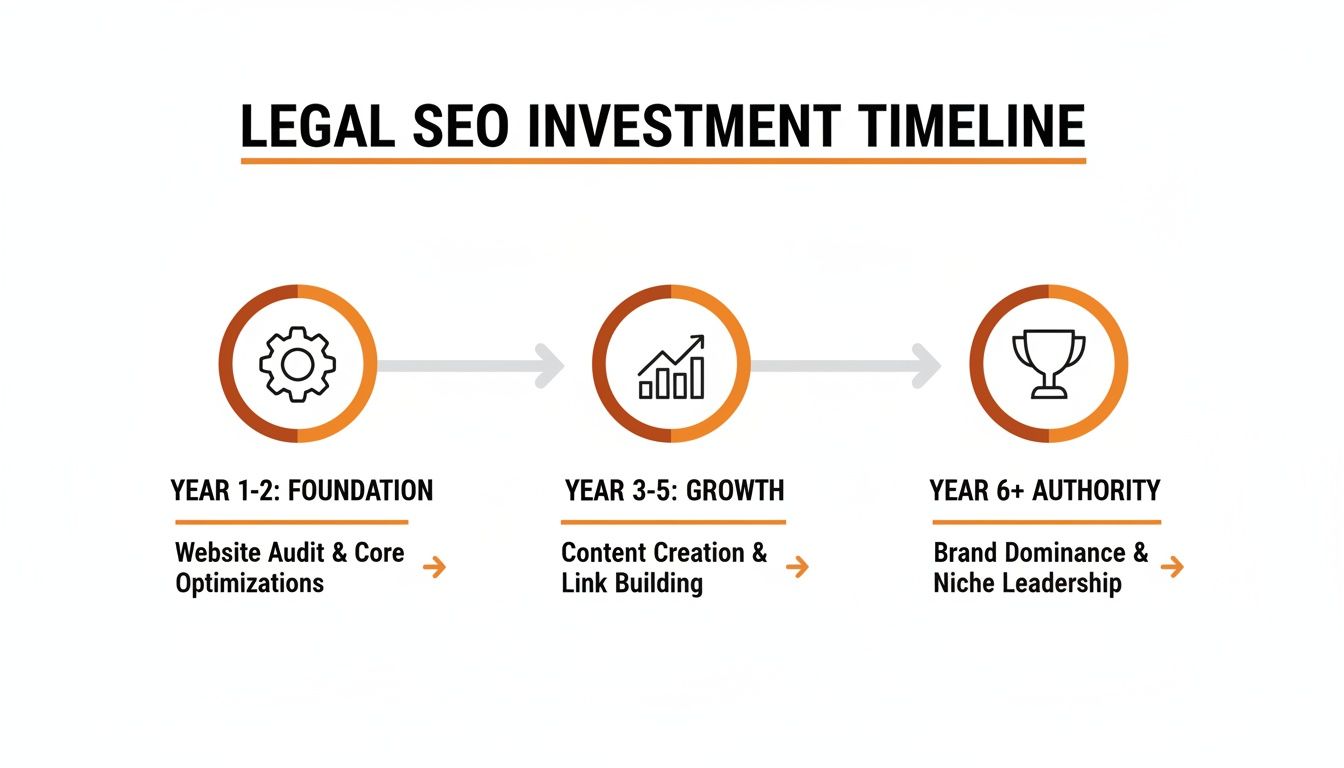
As you can see, the initial heavy lifting is all about technical fixes and beefing up your local presence. This groundwork is what supports the longer-term goals of creating great content and building genuine authority.
Months 1-3: The Foundational Phase
The first 90 days are all about laying a solid groundwork. Your SEO team will be deep in analysis, strategy, and fixing any underlying issues that could be holding your website back. Think of this as the discovery phase of a legal case; it’s where all the essential research and preparation happens before you even think about going to court.
During this period, you should expect deliverables like:
- A Comprehensive Technical Audit: Pinpointing and fixing issues like slow page speed, broken links, and mobile usability problems.
- Keyword Research and Strategy: Mapping out the high-value keywords your firm should target, from broad practice area terms to the specific, long-tail questions potential clients are actually typing into Google.
- Google Business Profile Optimisation: This is a goldmine for quick wins. A fully optimised profile can lead to a noticeable jump in local map visibility and phone calls, often within a few weeks.
- On-Page SEO Implementation: Tweaking the title tags, meta descriptions, and content of your core pages to align perfectly with your new keyword strategy.
Months 4-9: The Growth and Content Phase
With a strong foundation in place, the focus now shifts to building your firm's authority. This is done through high-quality content and strategic link building. It's in this phase that you'll begin to see tangible movement in search rankings, especially for less competitive keywords. Your website starts to gain real traction as Google recognises it as a valuable resource.
Key activities in this phase include:
- Consistent Content Creation: Regularly publishing well-researched blog posts, articles, and service pages that answer your clients' most pressing questions.
- Strategic Link Building: Earning high-quality backlinks from reputable legal directories, industry publications, and local websites to build your site's credibility in the eyes of search engines.
SEO is not a "set and forget" task. It’s an ongoing process of refinement and adaptation. The consistent effort during this growth phase is what separates firms that climb the rankings from those that stagnate.
Months 10-12+: The Authority and Dominance Phase
This is where the cumulative effort of your SEO campaign truly starts to pay off. After nearly a year of consistent, strategic work, you can expect to see significant rankings for more competitive, high-value keywords. At this stage, your website is becoming a trusted authority in your practice area and geographic location.
While 78% of Australian law firms have used paid search, many are now adopting hybrid strategies that prioritise long-term SEO. Legal SEO services often take 6-12 months for initial ranking movements and 12-18 months for truly substantial results.
However, early wins from Google Business Profile optimisation can boost local visibility quickly, capturing a large share of the 50-60% of calls that originate from the Google Maps Pack. For competitive markets, a professional SEO campaign can demand $3,000 to $10,000+ monthly to meet Google's rigorous E-E-A-T-G standards. You can explore more insights on Australian SEO budgets to get a better handle on these figures.
By understanding this timeline, you can partner with your SEO agency with confidence, knowing that you are investing in a powerful, long-term asset for your firm's future.
How to Choose the Right Legal SEO Agency
Choosing a partner is arguably the most important decision you'll make when you invest in legal SEO services. Get it right, and the agency becomes an extension of your firm—a genuine partner committed to your growth. Get it wrong, and you can waste your budget and set your digital presence back months, if not years.
Making the right choice comes down to good old-fashioned due diligence and asking the right questions. Your main goal is to find a team that doesn't just get SEO but gets the unique challenges and ethical lines of marketing a law firm. That specialised knowledge isn't just a "nice-to-have"; it's non-negotiable. It's time to look past the slick sales pitch and dig into their actual track record.
Look for Proven Legal Industry Experience
A generic SEO agency just won't cut it. The legal field has specific compliance rules and a client acquisition journey that’s completely different from any other industry. Your potential partner has to show they live and breathe this stuff.
When you’re vetting an agency, you need to see specific, verifiable results they've achieved for other law firms.
- Case Studies: Ask for detailed case studies from firms in similar practice areas and locations to yours. You’re not looking for fluffy metrics; you want proof of what matters—increases in qualified leads, phone calls, and new client consultations.
- Client References: A confident agency will have no problem connecting you with current or past law firm clients. Take them up on the offer. Ask about their experience, the communication, and the tangible business results they’ve seen.
This is the best proof you’ll get of their ability to deliver on their promises. If they're cagey about providing legal-specific case studies, that's a massive red flag.
Scrutinise Their Strategy and Transparency
Vague promises are another dead giveaway of an agency you don't want. An expert should be able to clearly walk you through their strategy for your firm. They should explain how they plan to get results, not just what results they're promising. Be very wary of anyone guaranteeing a #1 ranking on Google. No ethical SEO professional can make that promise, as Google's algorithm is completely out of their control.
A trustworthy SEO partner operates with complete transparency. Their reporting should connect every single activity directly back to your firm's business goals, making it easy to see the direct impact of your investment.
Insist on clear, transparent reporting that is laser-focused on business outcomes. A good report goes way beyond vanity metrics and shows you the data that actually moves the needle: organic traffic growth, conversion rates, and, most importantly, the number of new client enquiries generated. The right partner gives you a clear window into their work, empowering you with the data you need to see your return on investment.
Before you sign on the dotted line, it's crucial to ask a series of targeted questions to ensure you're partnering with an agency that truly understands your needs and can deliver results. The table below outlines essential questions to help you evaluate potential SEO providers and identify the best fit for your firm.
Essential Questions to Ask a Potential SEO Agency
A checklist to help law firms evaluate and compare different legal SEO service providers effectively.
| Question Category | Specific Question to Ask | What a Good Answer Looks Like |
|---|---|---|
| Experience & Specialisation | Can you show me case studies or results from law firms in my practice area? | A confident "Yes," followed by specific examples with metrics like lead growth and client acquisition, not just rankings. |
| Strategy & Tactics | What is your process for keyword research and content strategy for a firm like mine? | A detailed explanation of how they identify high-intent keywords for specific practice areas and create content that addresses potential client pain points. |
| Technical SEO | How do you handle the technical SEO aspects for a law firm's website? | They should mention site speed, mobile-friendliness, schema markup for lawyers/law firms, and ensuring the site is easily crawlable by Google. |
| Link Building | What is your approach to building backlinks for a law firm? | A focus on quality over quantity. They should talk about earning links from reputable legal directories, local publications, and industry-relevant sites—not buying links. |
| Communication & Reporting | What do your monthly reports look like, and how often will we meet? | They'll describe reports focused on KPIs that matter (leads, calls, conversions) and a regular meeting schedule (e.g., monthly or bi-weekly) to discuss progress and strategy. |
| Contracts & Guarantees | What are your contract terms, and do you offer any guarantees? | Transparent terms (e.g., a 6 or 12-month initial term) and a firm "No" to guaranteeing #1 rankings. They should guarantee effort and expertise, not specific algorithm outcomes. |
| Team & Expertise | Who will be the main point of contact and working on my account? | A clear answer introducing you to the account manager or strategist, detailing their experience in the legal marketing space. |
Taking the time to ask these questions will give you a much clearer picture of an agency's competence, transparency, and suitability for your firm. This process of careful vetting ensures you select a partner that aligns with your firm’s goals and operates with the integrity your practice deserves.
Common Questions About Legal SEO Services
It's only natural to have a few questions before diving into SEO for your law firm. Getting clarity on the process, the timeline, and the potential return is a crucial part of making a smart investment. Here are some of the most common questions we hear from legal professionals, along with some straight answers.
Think of this as the essential briefing you need before committing your firm's time and resources to a new growth strategy.
How Long Does It Really Take to See SEO Results?
Everyone wants new clients yesterday, but SEO is about building a long-term asset, not flipping a switch for instant traffic. You can expect to see some early movement within the first 1-3 months. This usually comes from fixing foundational issues or optimising your Google Business Profile, which can quickly lead to more local calls.
However, ranking for the really valuable, highly competitive keywords—think "family lawyer Sydney"—is a marathon, not a sprint. To achieve significant, lasting rankings for terms that drive serious business, you're typically looking at a 6-12 month timeframe of consistent, expert effort. The good news is that once you're there, the results compound over time.
Can Our Law Firm Handle SEO In-House?
While it’s technically possible to learn the basics, the legal space is one of the most competitive online arenas there is. Proper legal SEO isn't just about keywords; it demands deep expertise in technical SEO, creating content that satisfies Google's stringent E-E-A-T standards, and building authoritative, ethical backlinks.
Most firms simply don't have the specialised tools, dedicated hours, or the in-depth knowledge needed to go up against established competitors and win.
A professional agency brings a dedicated team with years of experience specifically in the legal industry. This ensures your strategy is not just effective but also compliant with marketing guidelines, freeing up your team to do what they do best: practise law.
Is SEO Better Than Google Ads?
This is a classic question, but it frames the choice incorrectly. It's not about "better" or "worse"—it's about using the right tool for the right job. They are two sides of the same coin and work best together.
- Google Ads (PPC) is fantastic for immediate results. You can generate visibility and capture leads from potential clients with an urgent need right now.
- SEO is your long game. It builds organic authority and trust, creating a sustainable flow of traffic that eventually reduces how much you need to spend on ads.
The most successful firms integrate both. Data from your PPC campaigns can provide invaluable insights to sharpen your SEO strategy, while a strong organic presence lends credibility that paid ads just can't buy on their own.
What Are the Most Important Metrics to Track?
It’s easy to get bogged down in "vanity metrics" like keyword rankings. While rankings are part of the picture, they don't pay the bills. The due diligence needed here is similar to learning how to pick a personal injury lawyer; you have to vet your options and ask the right questions about what truly matters.
You should be focused on the metrics that directly impact your firm's bottom line:
- Growth in qualified organic traffic (the right people finding your site).
- The number of contact form submissions.
- Phone calls that originated from an organic search.
- Ultimately, the number of new client consultations and signed cases.
At Click Click Bang Bang, we focus on the metrics that drive real growth for your firm. Our data-driven legal SEO services are designed to turn your online presence into a powerful client acquisition engine. Discover how our specialised approach can help your practice thrive.
Read NeXt
Or Read Our Latest
- Manual vs Automated Bidding for PPC Success
- Conversion Tracking Setup: A Complete AU Guide
- Instagram Advertising Australia: Complete 2026 Guide
- Pay Per Click: A Beginner’s Guide for Australian Marketers
- Display Advertising on Google: The Complete Australian Guide
- Stakeholder Communication Plan How to Build One That Works
Click. CLick. Subscribe.
Get our best PPC insights, industry updates, and power moves delivered straight to your inbox. No fluff, just high-caliber strategies that actually work.
Don’t Leave Just Yet
Try Us For 30-Days,
Risk Free!!
We guarantee that you’ll love our work within the first 30 days, if not you’ll get your money back.
What have you got to lose?