

How to Hire the Right Google PPC Company in Australia
Last Updated
So, you're wondering when it’s the right time to bring in a Google PPC company. It’s a big decision, and it’s not just about offloading a task. It’s a strategic choice you make when you realise your ad budget could be working a lot harder, and you’ve hit a wall trying to make that happen on your own.
When to Hire a Google PPC Company for Your Business

Most businesses reach out for expert help from a place of frustration. Does this sound familiar? You’re an e-commerce owner watching your cost per acquisition (CPA) slowly but surely creep up, taking a bigger and bigger bite out of your margins. Or maybe you're a B2B business getting plenty of clicks, but the "leads" are duds that waste your sales team's time.
These are classic signs that your DIY approach has run its course. The days of Google Ads being a simple 'set and forget' platform are long gone. It’s now a beast of complexity, packed with AI-driven bidding and an endless stream of updates. To get consistent results, you need a specialist in your corner.
Moving Beyond DIY Limitations
Lots of businesses start out managing their own PPC campaigns, and that’s a fantastic way to learn the ropes. But you’ll almost certainly hit a point where your time is better spent actually running your business, not trying to figure out Google's latest algorithm change.
Hiring a Google PPC company usually becomes a no-brainer in a few common scenarios:
- Your results have flatlined. You’ve pulled all the levers you know how to pull, but your return on ad spend (ROAS) or lead numbers just won't budge.
- You don’t have time for proper optimisation. Great PPC isn't a weekly task; it demands daily attention. You need to be monitoring bids, testing ad copy, and constantly refining your negative keyword lists.
- Your ad spend is getting serious. As you start spending more, the cost of a mistake gets a lot higher. Expert oversight isn't an expense at this point; it's an insurance policy.
The Australian digital advertising market is fiercely competitive. In a recent year, the industry hit $18.4 billion, with search advertising making up a whopping $8.0 billion of that. With so much money in play, having a specialist edge isn't just nice—it's essential.
A great agency doesn’t just manage your ads; they provide market intelligence. They see what’s working across multiple industries and apply those insights to your campaigns, giving you a competitive advantage you can’t get on your own.
Thinking about when to bring in outside help is a common strategic question, and it’s interesting to see the parallels in other fields, like why ambitious brands partner with a development company to scale their operations. Ultimately, partnering with a Google PPC expert is about buying back your time and investing in expertise that delivers reliable, scalable growth for your business.
Defining Your Goals Before Starting the Search
Before you even think about shortlisting your first agency, you need to get crystal clear on what success actually looks like for your business. Firing off a bunch of emails without a clear vision is a surefire recipe for wasted time and a stack of confusing proposals.
The very first step in finding the right Google PPC company is an internal one: figuring out exactly what you want to achieve. Vague ambitions like "more leads" or "better sales" just won't cut it. To have a productive conversation, you need to put real, measurable numbers behind your goals.
Setting Specific Business Objectives
The goals you set will be tied directly to your business model. What works for an e-commerce brand is worlds apart from what a local plumber needs. Nailing these specifics before you talk to anyone allows a potential agency to give you a strategy that's actually relevant.
Let's look at a couple of real-world examples:
- E-commerce Brand: Your main goal might be hitting a 4:1 Return On Ad Spend (ROAS). This is a simple but powerful metric: for every $1 you give Google, you want $4 back in revenue.
- Local Service Business: Here, the focus is on generating leads that turn into jobs. A solid goal could be getting 30 qualified phone calls per month at a cost per acquisition (CPA) of less than $100 each.
Knowing these numbers gives you a powerful yardstick. It transforms your search from a vague wish list into a strategic hunt for a partner who can hit tangible targets. If an agency's proposal doesn't speak to these goals, they aren't the right fit. Simple as that.
Don't just think about what you want to achieve; think about what you're willing to pay to achieve it. A realistic budget, with a clear separation between your ad spend (paid to Google) and the agency's management fee, is non-negotiable.
Documenting Your Core Requirements
Once your key performance indicators (KPIs) are dialled in, it's time to document the basics about your customers and your offer. This groundwork is invaluable, and you can learn more about how to define your target customer with our detailed guide.
Get ahead of the game by creating a simple brief that answers the following questions before you even start your search.
Your Pre-Search Checklist
- Who is my ideal customer? (Think demographics, pain points, where they hang out online)
- What's my realistic monthly budget? (Be clear on ad spend vs. potential management fees)
- What core products or services do I want to promote? (Start with your most profitable or popular ones)
- What are my absolute must-have outcomes? (e.g., sales revenue, qualified leads, brand visibility)
- What have I tried before and how did it go? (Share any past data you have, good or bad)
Having these details ready to go empowers you to communicate your needs clearly from the very first call. It helps you weed out the wrong agencies fast and ensures the proposals you get are built for your business, not just copied from a template. This bit of homework is the most important step you can take towards hiring a partner for the long haul.
Spotting the Signs of a High-Performing PPC Agency

When you’re vetting a potential Google PPC company, it’s incredibly easy to be swayed by a slick website or a confident sales pitch. The thing is, the best agencies don't just talk a good game; they back it up with cold, hard data.
Learning to spot the signs of a genuinely high-performing agency is probably the most critical skill you can develop in this whole process.
Forget about vanity metrics. I’m talking about things like "more impressions" or even just "higher click-through rates." Sure, a decent Click-Through Rate (CTR) matters—the average for search ads is around 3.17%—but it means absolutely nothing if those clicks don’t lead to sales or leads. A top-tier agency focuses relentlessly on the metrics that actually impact your bottom line.
Look Beyond Surface-Level Case Studies
Every agency has case studies, but not all are created equal. Your job is to pull them apart and look for meaningful results. When you review their past work, get specific and ask questions about the numbers.
For example, did they just increase website traffic, or did they achieve something more significant? You want to see hard evidence of real business impact.
- A lower Cost Per Acquisition (CPA): Can they show you how they reduced a client's cost to acquire a customer from $120 down to $75?
- A higher Conversion Value: Did they increase the average order value for an e-commerce client, and by how much?
- An improved Return On Ad Spend (ROAS): Did they take a client from a break-even 2:1 ROAS to a seriously profitable 5:1 ROAS?
A great Google PPC company will have this data on hand and will be proud to walk you through exactly how they did it. If their case studies are vague or only focus on top-of-funnel metrics, that’s a major red flag.
Verify Their Expertise and Data-Driven Approach
Anyone can call themselves a "data-driven expert." The proof is in their process. A truly high-performing agency will have a clear, repeatable methodology for everything they do, from campaign setup and keyword research to ongoing optimisation.
Start by checking their credentials. Look for the official Google Partner badge on their website. While this badge shows they meet a certain level of ad spend and certification, don't stop there. Ask about the certifications of the individual team members who would actually be working on your account. An agency is only as good as the people running your campaigns day-to-day.
A genuine data-driven approach is obvious in how they work. They should be able to clearly explain their process for:
- A/B Testing: How do they methodically test ad copy, headlines, and calls-to-action to find the winning combinations? What's their testing framework?
- Conversion Tracking: Do they have deep expertise in setting up advanced tracking, like enhanced e-commerce for online stores or offline conversion imports for B2B?
- Keyword Management: What’s their strategy for discovering new keyword opportunities and, just as importantly, relentlessly building out negative keyword lists to cut wasted spend?
Major Red Flag: Be extremely wary of any agency that guarantees results. If they promise a "#1 ranking" or a specific ROAS before they've even seen your account, run. PPC is an auction, and no outcome can ever be guaranteed. True experts promise a rigorous process, not an impossible outcome.
Finally, look for transparent client testimonials and clear, concise reporting. If you can't easily find reviews or get a sample report that makes sense to you, it suggests they might have something to hide. Ultimately, a top agency makes the complex simple, turning data into a clear story of your business's growth.
How to Compare Agency Pricing Models
Navigating the financial side of hiring a Google PPC company can feel like the most confusing part of the process. Agency pricing isn't standardised, and what you get for your money can vary wildly. Getting your head around the three main pricing models is the key to finding a structure that lines up with your budget and business goals.
It's less about finding the "cheapest" option and more about identifying the best value and partnership fit. Let's break down the common structures you'll run into.
The Flat Monthly Retainer
This is the most straightforward and predictable model out there. You simply pay a fixed fee every month for the management of your Google Ads account.
- Best for: Small to medium-sized businesses (SMBs) or companies with a consistent, stable monthly ad spend.
- Pros: It gives you complete budget predictability. You know exactly what your agency management cost will be, which makes cash flow planning much easier.
- Cons: The fee isn't directly tied to performance. If your ad spend or campaign complexity suddenly skyrockets, you might need to renegotiate the retainer.
As an example, a local electrician spending $2,500 per month on ads might pay a flat retainer of $1,000. It's simple and lets them budget effectively without any surprises.
Percentage of Ad Spend
In this model, the agency's management fee is a slice of your total monthly ad spend. This is a very common structure, especially for larger accounts or those in a growth phase.
- Best for: High-growth e-commerce brands and businesses that are actively scaling their ad spend.
- Pros: It naturally aligns the agency's incentives with your growth—as you spend more (and hopefully sell more), they earn more. The model scales seamlessly with your advertising efforts.
- Cons: This can create a potential conflict where an agency might be motivated to increase your spend, rather than focusing purely on efficiency and profitability.
A key question to ask is if the percentage is calculated on a sliding scale. For instance, an agency might charge 15% on spends up to $20,000 per month, but drop to 12% for any amount above that. This ensures you aren't penalised for scaling.
Performance-Based Pricing
Now, this is the most results-focused model. Here, an agency's fees are tied directly to specific, agreed-upon outcomes like cost per lead (CPL) or a target return on ad spend (ROAS).
- Best for: Businesses with very clear, trackable conversion goals and a solid baseline of historical performance data.
- Pros: You only pay for tangible results. It creates the ultimate alignment between your goals and the agency's work.
- Cons: This model is rarer and often comes with a higher base fee or a more complex contract. It requires extremely robust tracking, and can lead to disputes if goals aren't perfectly defined from the start.
To properly evaluate any proposal, you need some context. In 2026, the average cost per acquisition (CPA) on Google Ads in Australia is $66.69, with businesses typically earning $2 for every $1 spent. Knowing these figures helps you gauge whether an agency's proposed targets are realistic or just wishful thinking.
Regardless of the model, always ask what’s not included. Are there extra charges for building landing pages, setting up advanced analytics, or producing creative assets? Understanding these potential add-on costs upfront is crucial. To dig deeper into this, check out our comprehensive guide on different PPC pricing models to find the perfect fit for your business.
Nailing the Final Interview and Onboarding
You’ve done the hard work of shortlisting agencies, and now you’re down to the final few. This is where you separate the true professionals from the pretenders and find a long-term partner, not just a service provider.
It’s all about moving past the sales pitch and digging into their actual process. This final phase is your best chance to spot the difference between an organised, methodical agency and one that's just winging it.
Asking the Right Interview Questions
By this stage, you’ve probably had a few chats. This final interview isn’t about their glossy proposal; it’s about the ‘how’. You need to pressure-test their strategy and force them to demonstrate their day-to-day expertise.
Forget generic questions. It’s time to ask things that reveal their real-world process.
Here are a few questions I always recommend to get to the heart of their capabilities:
- "Walk me through your process for keyword discovery and, just as importantly, your strategy for building out negative keyword lists."
- "How do you structure your monthly reports to show progress against our specific goals? Can you show me a sanitised example?"
- "Describe a time a campaign underperformed and the exact steps you took to turn it around. What did you learn?"
- "What's your methodology for A/B testing ad copy and landing pages? How do you decide when a test is statistically significant?"
Their answers should be confident and full of specifics. If they start talking in vague marketing buzzwords or can’t outline a clear, step-by-step approach, that’s a massive red flag. A disorganised answer often points to disorganised execution.
You've likely already discussed pricing. Their answers to these questions should connect directly back to how they prove their value, whether they operate on a retainer, a percentage of spend, or a performance model.
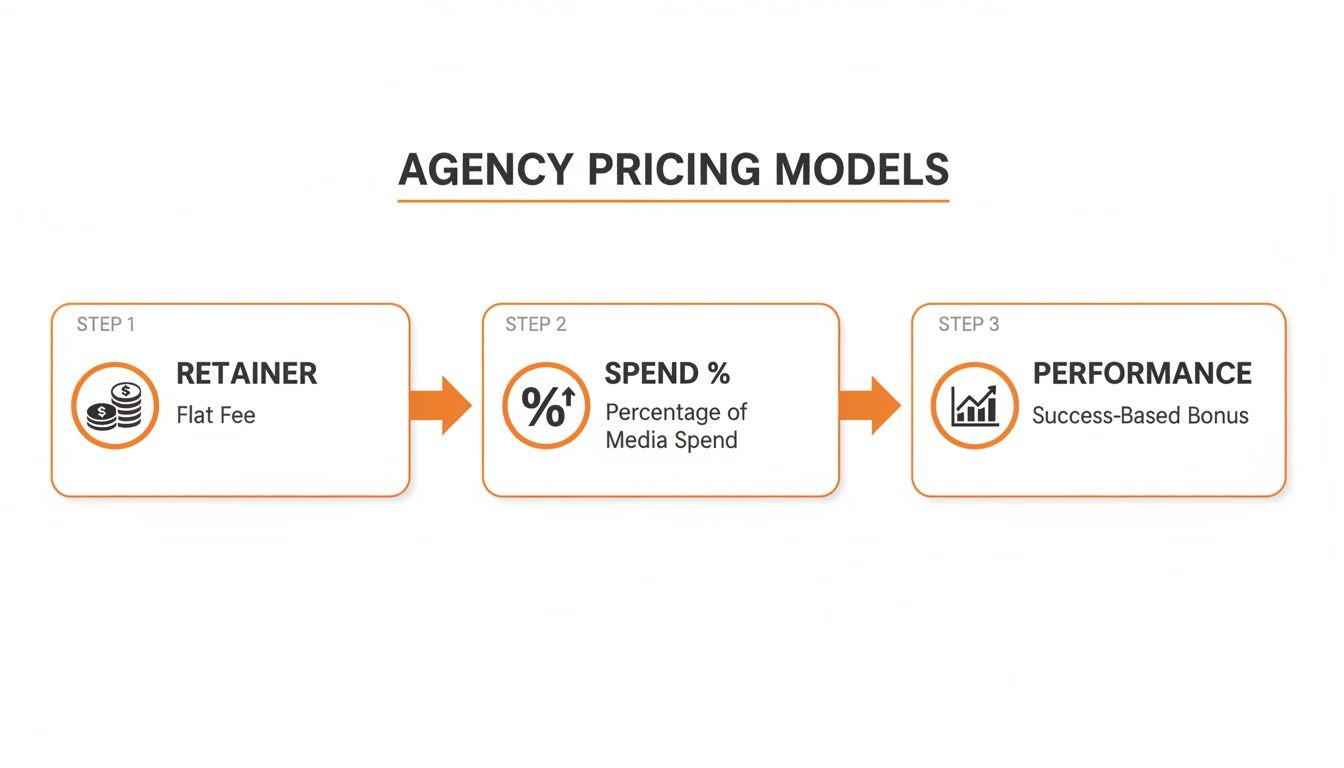
No matter the model, your final questions should make it crystal clear how they plan to justify their fee and deliver a return on your investment.
What a Professional Onboarding Looks Like
Once you’ve made your choice, the quality of their onboarding is the first real test of the partnership. A top-tier Google PPC company won’t just send an invoice and go quiet for a month. They’ll have a structured, transparent plan to get your campaigns set up for success from day one.
A great onboarding experience isn't just about technical setup; it's about deep alignment. The agency should be learning the nuances of your business, and you should be gaining a clear understanding of their plan and timelines.
A professional onboarding process will always have a few key milestones. Here’s what you should expect to see.
First, a kick-off call and strategy deep-dive. This is the foundation. You’ll introduce key team members, lock in the goals, and they should be grilling you on your target audience, business model, and unique selling points. A good sign is when they ask more questions than you do.
Next comes the technical setup and access. They should provide a clear, simple checklist of what they need. This typically includes access to your Google Ads account, Google Analytics, and Google Tag Manager. A truly professional agency will take charge of conversion tracking setup with absolute precision, ensuring every dollar and every lead is measured correctly from the start.
Finally, they must provide a clear timeline for launch. You should never be left guessing what’s happening next. A great agency will give you a detailed timeline for the first 30-60 days, mapping out key milestones like the campaign build, a review and approval stage, the official launch, and the initial optimisation phase.
By knowing what to look for in the final interview and onboarding, you can move forward with confidence. You’ll be able to clearly distinguish a highly organised partner from an amateur, ensuring your investment is in capable hands from the get-go.
Answering Your Top Questions About PPC Agencies
Even after you've done your homework, it’s completely normal to have a few last-minute questions before you sign on with a Google PPC company. These are usually the practical, nitty-gritty concerns that pop up right before you pull the trigger. Let's clear them up so you can move forward with confidence.
How Long Does It Take to See Real Results?
You’ll see data like clicks and impressions almost immediately, but don't mistake that for real business results. A flood of profitable sales isn't going to happen in the first week.
Think of the first month as the data collection and foundation-building phase. A good agency uses this time to get a feel for the landscape—testing audiences, refining keywords, and setting performance benchmarks. You should expect clear communication and some initial insights within 30 days. However, a stable, predictable ROI typically starts to show after the first 90 days as your campaigns mature and the algorithms get smarter.
A professional agency will set clear 30, 60, and 90-day expectations. They won’t promise instant riches; they’ll promise a methodical process that builds towards predictable growth.
What Is the Difference Between Ad Spend and Management Fees?
Getting this straight is absolutely crucial for your budget. These are two totally separate costs, and you need to understand how they work together.
- Ad Spend: This is the money that goes directly to Google. It's the fuel for your campaigns, paying for every click and impression.
- Management Fee: This is what you pay the agency for their expertise. It covers their time for strategy, campaign management, optimisation, creative work, and reporting.
Any reputable Google PPC company will be crystal clear about this. Your proposals and invoices should show two distinct figures: one for the ad platform and one for the agency. There should be zero ambiguity.
Do I Need a New Website Before Starting?
Probably not, but your landing pages have to be up to scratch. This part is non-negotiable. An agency can drive the best traffic in the world to your site, but if your landing pages are slow, confusing, or unusable on mobile, that traffic simply won't convert.
A good agency will audit your key landing pages as part of their initial discovery. They’ll pinpoint specific, high-impact improvements you can make. While a full redesign is rare, be prepared to invest in optimising your pages to get the most out of your ad spend. Just as important is effective reporting to track this. To see what that looks like, you can learn more about how to structure a PPC reporting template to monitor the right metrics.
What If I Am Unhappy with an Agency's Performance?
This is a question you absolutely must ask during your interviews. The last thing you want is to be trapped in a long, rigid contract with a partner who isn’t delivering.
Look for agencies that offer flexible agreements. Many of the best firms work on a month-to-month basis or offer an initial trial period, often around 30 days. This approach shows they're confident in their ability to get you results. A truly confident agency bets on its performance to keep you as a client, not on contractual clauses that lock you in.
Ready to partner with a data-driven Google PPC company that prioritises transparency and results? Click Click Bang Bang offers flexible, no-lock-in contract plans tailored to your business goals. Start your risk-free 30-day trial today.
Read NeXt
Or Read Our Latest
- Manual vs Automated Bidding for PPC Success
- Conversion Tracking Setup: A Complete AU Guide
- Instagram Advertising Australia: Complete 2026 Guide
- Pay Per Click: A Beginner’s Guide for Australian Marketers
- Display Advertising on Google: The Complete Australian Guide
- Stakeholder Communication Plan How to Build One That Works
Click. CLick. Subscribe.
Get our best PPC insights, industry updates, and power moves delivered straight to your inbox. No fluff, just high-caliber strategies that actually work.
Don’t Leave Just Yet
Try Us For 30-Days,
Risk Free!!
We guarantee that you’ll love our work within the first 30 days, if not you’ll get your money back.
What have you got to lose?