

Ecommerce advertising agencies: Scale Your Brand in 2026
Last Updated
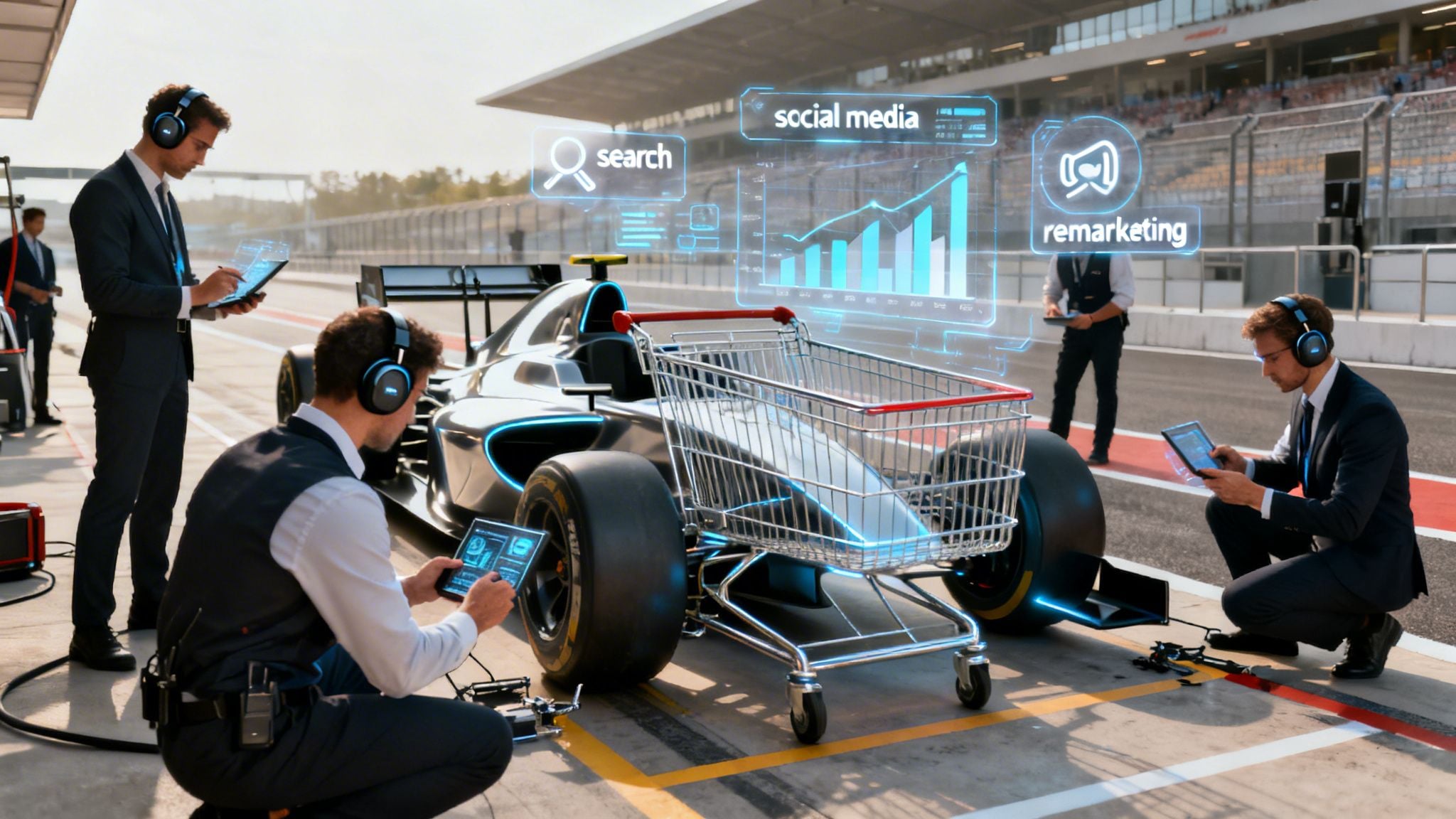
Let's be honest—trying to get noticed in the crowded online marketplace can feel like shouting into a hurricane. It’s noisy, chaotic, and most of the time, you just get lost in the wind. This is where a specialist ecommerce advertising agency comes into play. Think of them less like a general mechanic and more like a Formula 1 pit crew for your online store, obsessively fine-tuning every part of your advertising engine for maximum speed and performance.
Why Specialist Ecommerce Advertising Agencies Matter

The fundamental challenge for any ecommerce brand is simple, yet monumental: cutting through the digital noise. With the average person seeing thousands of ads every single day, a generic, one-size-fits-all approach is a surefire recipe for wasted ad spend. It’s not enough to just ‘run ads’ anymore; you need a partner who lives and breathes the specific nuances of online retail.
This is precisely where a specialist agency makes all the difference. Unlike a generalist marketing firm that might juggle ads for a local dentist one day and a software company the next, an ecommerce-focused agency genuinely understands your world. They are experts in the platforms, the metrics, and the customer behaviours that define success in online selling.
The Problem With a Generalist Approach
A jack-of-all-trades digital agency often just doesn't have the deep, specific knowledge needed for ecommerce to truly fire on all cylinders. They might know the basics of setting up an ad, but they'll almost certainly miss the critical details that turn a decent campaign into a wildly profitable one.
A generalist might get excited about broad metrics like clicks or impressions. An ecommerce advertising agency, on the other hand, is obsessed with what actually impacts your bottom line:
- Return on Ad Spend (ROAS): Making sure every dollar you put in generates a healthy, profitable return.
- Customer Acquisition Cost (CAC): Strategically driving down the cost to acquire each new customer.
- Customer Lifetime Value (LTV): Building campaigns that attract high-value, repeat buyers, not just one-off purchasers.
This specialist focus is more critical than ever. Australia's internet advertising market is set to explode to AU$18 billion in 2025, a solid 12% year-on-year growth. This surge means more competition and a much higher bar for effectiveness, making precision an absolute necessity. You can explore more on the booming Australian ecommerce market to grasp the full scale of this opportunity.
Think of it this way: a generalist agency can build you a functional go-kart. A specialist ecommerce agency will build you a high-performance racing machine, engineered from the ground up to win on the unique track that is your industry. They understand the entire journey, from the first ad click to the final checkout and everything that comes after.
Turning Data Into a Competitive Advantage
Ultimately, the right partner takes data from being a confusing spreadsheet and turns it into your most powerful competitive advantage. They don't just report numbers; they interpret them to pinpoint growth opportunities, sharpen your targeting, and perfect your creative. This data-driven approach is what separates the brands that merely survive from those that truly thrive and scale sustainably.
By partnering with an agency that specialises in your field, you're not just outsourcing a few tasks. You're bringing on a strategic ally who is 100% dedicated to a single goal: driving profitable growth for your online store. They bring the expertise, the tools, and the focus you need to navigate an increasingly complex advertising world, turning your ad budget into a reliable engine for sales.
Decoding the Services That Fuel Growth
An expert ecommerce advertising agency does more than just “run ads.” They command a whole arsenal of specialised services, each designed to attract, convert, and keep your customers coming back. Think of each service as a different tool in the toolbox, playing a unique part in your overall growth strategy.
Knowing what these services are and how they fit together is the first step toward building a profitable advertising engine. The best agencies orchestrate robust multi-channel marketing campaigns that reach customers wherever they are. Instead of betting everything on one platform, this blended approach ensures you’re connecting with buyers at every single stage of their journey, from that first flicker of awareness right through to the final purchase.
Let’s break down the main channels these agencies have mastered.
Capturing Intent with Google Ads
Think of Google as the world's biggest shopping centre. When someone types something into the search bar, they’re actively looking for a product or a solution right now. An agency's job is to make sure your store is the first one they see.
They do this in two main ways:
- Google Search Ads: These are the text ads you see perched at the top of the search results. They are incredibly effective for driving immediate sales because they capture high-intent customers who are literally typing in keywords related to what you sell.
- Google Shopping Ads: These are the visual product listings, complete with images and prices, that look like a digital shop window. They let users compare products at a glance and click straight to your product page. For most ecommerce brands, this is the single most powerful tool for turning searchers into buyers.
Creating Demand on Social Media
While Google is fantastic for capturing existing demand, platforms like Meta (that’s Facebook and Instagram) are where your agency goes to create new demand. This is your brand's social club, where you can introduce your products to millions of people who didn’t even know they needed them yet.
Key Insight: Meta's real power comes from its incredibly sophisticated audience targeting. An agency can build audiences based on demographics, interests, and online behaviours to put your products squarely in front of the exact person most likely to become a loyal customer.
Here, agencies use compelling images, scroll-stopping videos, and persuasive copy to pull users out of their feed and onto the path to purchase. It’s less about the instant sale and more about building brand awareness and desire that pays off down the track. For businesses selling to other businesses, LinkedIn's ad platform offers a similar, professionally-focused environment to generate high-quality B2B leads.
Re-Engaging Window Shoppers with Remarketing
Ever looked at a product online, only to see ads for it mysteriously follow you across the internet? That’s remarketing, and it's one of the most profitable services an agency can offer.
Remarketing campaigns are all about targeting users who have already visited your site but left without buying anything. It’s the digital version of a helpful shop assistant asking, “Hey, are you still thinking about that item?”
This tactic is brutally effective because you’re advertising to a warm audience—people who have already shown interest in your brand. As you can imagine, bringing back these "window shoppers" almost always leads to a much higher Return on Ad Spend (ROAS). If you want to dive deeper into how agencies deliver this kind of ROI, check out our guide on how performance marketing agencies operate.
Key Advertising Channel Comparison for Ecommerce
To help you see how these pieces fit together, here’s a quick comparison of the main channels and what they're best used for.
| Channel | Primary Purpose | Target Audience | Key Metric |
|---|---|---|---|
| Google Search & Shopping | Capturing existing demand | Users actively searching for products or solutions | Return on Ad Spend (ROAS) |
| Meta (Facebook & Instagram) | Creating new demand and building brand awareness | Users based on demographics, interests, and behaviours | Customer Acquisition Cost (CAC) |
| LinkedIn Ads | Generating B2B leads and professional networking | Users based on job title, industry, and company size | Cost Per Lead (CPL) |
| Google Remarketing | Re-engaging past website visitors and recovering lost sales | Users who have previously interacted with your site | Conversion Rate |
By strategically weaving these channels together, an ecommerce advertising agency ensures your brand stays visible and compelling at every touchpoint. They use intent-driven search to snag ready-to-buy customers, social media to build a pipeline of future buyers, and remarketing to close the deal.
Understanding Agency Pricing and Performance Metrics
Investing in an ecommerce advertising agency can feel like a huge leap of faith, but once you get your head around the numbers, the decision becomes a lot clearer. Let’s pull back the curtain on how agencies charge for their expertise and, more importantly, how they measure the success that actually impacts your bottom line.
Think of agency pricing models like different gym memberships. Some are pay-as-you-go, others are all-inclusive, and each one fits a different goal and budget. Knowing the pros and cons is the first step to building a healthy, transparent partnership.
Common Agency Pricing Models
The way an agency structures its fees says a lot about its incentives and how it approaches client relationships. Most fall into one of three buckets, and a good agency will be totally upfront about which model they use and why it’s the best fit for their clients.
Here are the most common structures you’ll come across:
- Percentage of Ad Spend: This is the classic model. The agency takes a set percentage of your monthly ad budget, usually somewhere between 10-20%. It’s straightforward and scales with you, but be aware that it can sometimes incentivise an agency to simply spend more, not necessarily more efficiently.
- Flat Monthly Retainer: With a retainer, you pay a fixed fee every month, no matter what your ad spend is. This makes your costs predictable and allows the agency to focus purely on hitting your performance targets. It’s a great fit for businesses looking for stable, ongoing campaign management.
- Performance-Based Fees: This is the "put your money where your mouth is" model. The agency’s fee is tied directly to results, like a percentage of the revenue they generate or a fee per lead. It perfectly aligns your goals with the agency's, but it can be more complex to track and is often paired with a base retainer to cover operational costs.
Moving Beyond Vanity Metrics
Impressions and clicks might look nice on a report, but they don’t pay the bills. A top-tier ecommerce advertising agency is obsessed with the numbers that connect their work directly to your revenue and growth. These are the metrics that tell the true story of your campaign’s profitability.
Getting familiar with this language is non-negotiable. It’s what allows you to have real, meaningful conversations with your agency and hold them accountable for delivering tangible results, not just a flurry of online activity.
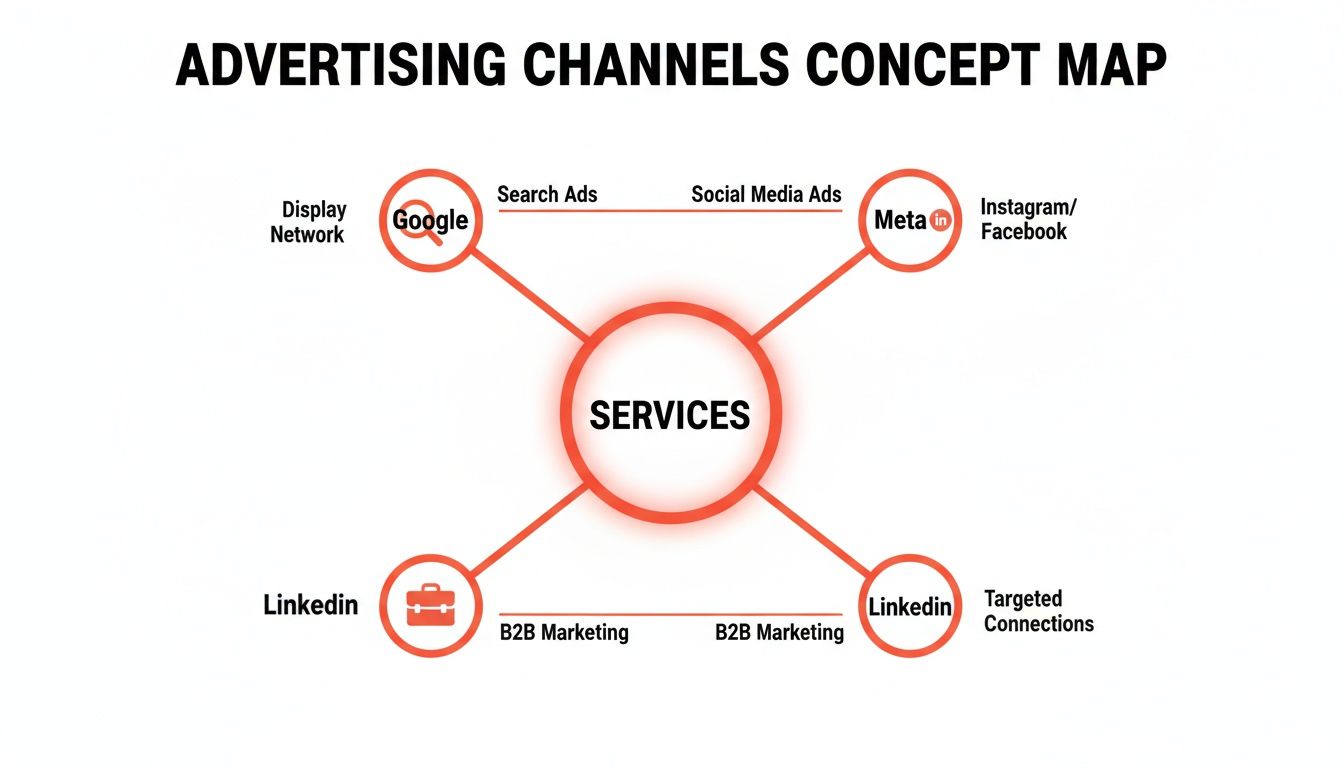
This map shows how channels like Google, Meta, and LinkedIn aren’t just isolated tactics. In the hands of a good agency, they become interconnected parts of a central strategy designed to drive real business growth.
The Metrics That Truly Matter
When you sit down to review your reports, these are the three core metrics you need to be laser-focused on. They cut through all the noise and show you exactly what return you're getting on your investment.
- Return on Ad Spend (ROAS): This is the holy grail. It tells you precisely how much revenue you’re generating for every single dollar spent on ads. A 4:1 ROAS, for instance, means you’re making $4 for every $1 you put in.
- Customer Acquisition Cost (CAC): This metric breaks down the average cost to win a new customer. A key goal for any agency worth its salt is to consistently drive this number down over time, making your growth more efficient and sustainable.
- Conversion Rate (CVR): This is the percentage of people who visit your site and actually do what you want them to do—usually, make a purchase. A rising conversion rate is a sign that your agency isn't just driving traffic, but the right traffic: people who are primed and ready to buy.
By focusing on these key performance indicators, you shift the conversation from "How much traffic did we get?" to "How much profitable growth did we achieve?" This is the foundation of a successful, long-term agency partnership.
Mastering these figures is essential for any business owner running ads. To get a more detailed breakdown, you can learn more about the most important digital marketing performance metrics in our complete guide. Ultimately, understanding both pricing and performance empowers you to choose an agency that will act as a true partner in your ecommerce journey.
How to Select the Right Agency Partner
Choosing an ecommerce advertising agency can feel a lot like finding a needle in a haystack. The secret is to shift your mindset: you’re not just outsourcing a task, you're hiring a critical business partner. That means you need a real vetting process, not just a quick glance at a homepage.
The Australian market has exploded alongside the global online retail boom. As of 2026, there are now 87 specialised ecommerce digital marketing agencies listed in Australia alone. You’ve got everyone from Melbourne's Clearwater Agency, with its 4.9-star reviews for driving multi-channel growth, to Perth's TwoTwoSix Pty Ltd, which offers PPC and SEO upskilling for any budget.
This growth is great news for your business, but it also makes your choice more important than ever.
The sheer volume of options means you need a clear framework to cut through the noise and find the right fit.
Dig Deeper Than the Case Study
Every agency website is a highlight reel. They’re all going to show you their best work, but you need to look past the flashy logos and big numbers. A glossy case study is just the start of the conversation, not the final word.
When they show you past wins, ask questions that get to the heart of their process.
Instead of just hearing, “We got a 5x ROAS for Brand X,” try asking:
- What was the starting point? A 5x ROAS is a lot less impressive if the baseline was already 4x.
- How long did it take to get those results? This gives you a realistic timeline and manages your expectations.
- What specific challenges did you have to overcome? This is where you’ll discover their real problem-solving skills.
- Can we speak to this client? A willingness to provide a reference is a massive green flag for transparency and confidence.
A truly great agency won’t just show you the trophy; they’ll walk you through the messy, hard-fought journey it took to win it.
Evaluate the Team and Their Expertise
You aren't hiring a brand; you're hiring the people who work there. It is absolutely essential to know who will actually have their hands on your account. Don’t get dazzled by a slick pitch from the company director, only to find out a junior account manager is running your campaigns day-to-day.
An agency’s true value lies in the hands-on expertise of the strategists managing your ad spend. Their ability to analyse data, spot trends, and make smart, real-time adjustments is what will ultimately drive your growth.
During your calls, ask to meet the team members who would be assigned to you. Dig into their specific experience in your industry or with businesses that have a similar model to yours. A team that has already navigated the challenges your business is facing will get you results much, much faster.
Ask the Right Questions During Consultation
Those initial calls with potential agencies are your chance to interview them, not the other way around. Don't let them control the entire conversation. You need to show up prepared with specific, probing questions that force them beyond their canned sales pitch.
The quality of their answers will reveal everything you need to know about their strategic approach.
Here’s a checklist of questions you should be asking:
- How do you approach campaign optimisation? Look for answers about structured testing, data analysis, and a clear process for improvement. "We monitor performance" isn't good enough.
- What does your onboarding process look like? A detailed, step-by-step plan is a sign of an organised and professional operation.
- How will you communicate results and what does your reporting include? Vague promises are a red flag. Insist on seeing a sample report so you know exactly what information you'll be getting.
- What is your experience with our specific product category? Niche experience is a huge advantage and can shave months off the learning curve.
- What level of access will we have to our ad accounts? The only right answer is full transparency. It’s your account, after all.
Finding the right agency is a journey of discovery. For instance, the lessons learned from finding the best full-service Amazon agency often apply to choosing a partner for any platform. A strong partner will welcome these tough questions, and their answers will give you the confidence you need to move forward.
To see how a specialised team can transform your advertising, read about our approach as a dedicated PPC agency for ecommerce.
The First 30 Days: What to Expect When Onboarding

The first month with a new agency is where the entire relationship is won or lost. Think of it like the first few laps of a Grand Prix—this is where you set your pace, find your line, and build the momentum you’ll need for the rest of the race.
A sharp, structured onboarding process is a non-negotiable. It clears up any confusion, settles nerves, and builds a solid foundation for a long-term partnership.
It's a lot like building a house. You can't just start putting up walls without a solid slab underneath. Those first 30 days are all about pouring the concrete: getting the technical setup perfect, locking in the strategy, and making sure everyone is working from the same set of blueprints. A messy start almost always leads to expensive problems down the track.
Week 1: Discovery and Technical Foundations
The first week is about total immersion. Your new ecommerce advertising agency should be kicking things off with a proper discovery session, whether that’s a deep-dive call or a seriously detailed questionnaire. This isn't just a quick chat; it's a strategic grilling on your business goals, target audience, profit margins, and past performance.
From there, it’s all about the technical plumbing. This is the behind-the-scenes grunt work that makes everything else possible.
- Account Access: This means securely granting access to your Google Ads, Meta Business Manager, and Google Analytics accounts.
- Tracking Pixel Installation: Making sure tracking codes like the Meta Pixel and Google Tag are installed correctly on your website. This is how you monitor user behaviour and measure conversions.
- Account Configuration: Setting up or auditing your ad accounts, which includes linking them to your analytics and sorting out billing details.
This phase is critical. If your tracking isn't right, you’re flying blind and burning cash.
Week 2: Strategy and Initial Campaign Build
Once the technical foundation is solid, the agency shifts into strategy mode. They'll be digging through your historical data, sizing up your competitors, and pinpointing your most valuable audiences and products. All this research feeds directly into the first campaign structure they build.
A common mistake we see is brands rushing to launch ads without a clear plan. A top-tier agency will use this second week to methodically build out your initial campaigns, write killer ad copy, and pick out engaging creative. This careful approach ensures your first campaigns launch with a strong, data-backed strategy from day one.
This is also a huge week for communication. Your agency should be walking you through their strategic thinking, explaining why they’re choosing specific campaign types, targeting options, or messaging angles. That transparency builds trust and makes sure you’re both on the same page before a single dollar gets spent.
Week 3 & 4: Launch and Data Gathering
By the start of week three, it's go-time. Your first campaigns are launched, and the data starts trickling in. It's really important to understand that the goal of these first couple of weeks isn’t huge, immediate profit—it’s data acquisition.
Your agency is collecting essential information about:
- Which audiences are actually responding to your ads.
- Which creative and copy combos are getting the most clicks.
- What your starting Cost Per Click (CPC) and Conversion Rates look like.
The first month is all about learning. By the end of this period, your agency will have a baseline of performance data to start the real work: optimisation. This initial phase gives them the raw materials they need to begin cutting what doesn’t work and pouring fuel on what does.
Frequently Asked Questions About Ecommerce Agencies
Jumping into the world of ecommerce advertising agencies can bring up a lot of practical questions. To give you the clarity you need to make a confident decision, we’ve tackled some of the most common queries we get from business owners.
What Is a Realistic Budget for an Ecommerce Advertising Agency?
This is the big one, and the honest answer is: it depends. Your starting budget hinges on your goals, how competitive your niche is, and your revenue targets. As a ballpark, many small to medium-sized businesses start with a monthly ad spend between $2,000 and $5,000, plus the agency’s management fee on top of that.
A good agency won’t just pull a number out of thin air. They’ll work with you to land on a starting budget that’s geared towards hitting a positive Return on Ad Spend (ROAS). The smartest play is often to start with a tightly focused campaign, prove the model works, and then scale up your investment as the profits roll in.
How Long Does It Take to See Results From Ads?
You’ll see surface-level data like traffic and impressions almost immediately, but the results that actually matter—sales and a stable ROAS—take a bit longer. Typically, you're looking at around 60 to 90 days for things to really stabilise and show consistent returns.
Think of that first month as a critical data-gathering phase. Your agency is in the trenches, testing audiences, figuring out which creative hits the mark, and optimising campaigns based on what the real-world data is telling them. That groundwork is absolutely essential for building long-term, sustainable success. Patience is a virtue here, and a transparent agency will keep you in the loop from day one.
Can I Run Ecommerce Ads Myself Instead of Hiring an Agency?
You absolutely can, but don't underestimate the commitment. Platforms like Google and Meta are constantly changing, and managing them effectively requires deep technical know-how, a serious time investment to analyse data, and the ability to make adjustments on the fly.
Hiring professional ecommerce advertising agencies brings specialised expertise, access to advanced tools, and a strategic framework that’s tough to replicate on your own. For most businesses, the cost of an agency is easily covered by the performance gains they deliver and the valuable time you get back to focus on what you do best—running your business.
What Is the Difference Between PPC and SEO?
It’s useful to think of PPC and SEO as two sides of the same coin—different, but powerful when used together to attract customers.
- PPC (Pay-Per-Click) is all about immediate traffic. You pay for top spots in search results or social media feeds. It’s like renting a massive billboard on the busiest highway to get instant visibility.
- SEO (Search Engine Optimisation) is the long game. It’s the process of improving your site’s ranking to earn "free" organic traffic over time. This is more like building your own flagship store on the main street—it takes time and effort, but it becomes a valuable, sustainable asset that keeps paying you back.
A truly dominant digital strategy uses both. PPC drives immediate sales and provides priceless data, while SEO builds a strong, cost-effective foundation for your brand's future growth.
Ready to see what a precision-driven PPC and AI-first SEO strategy can do for your brand? At Click Click Bang Bang, we specialise in creating data-focused campaigns that deliver real results. We’ll help you navigate the complexities of digital advertising with transparent reporting and no long-term commitments.
Read NeXt
Or Read Our Latest
- Manual vs Automated Bidding for PPC Success
- Conversion Tracking Setup: A Complete AU Guide
- Instagram Advertising Australia: Complete 2026 Guide
- Pay Per Click: A Beginner’s Guide for Australian Marketers
- Display Advertising on Google: The Complete Australian Guide
- Stakeholder Communication Plan How to Build One That Works
Click. CLick. Subscribe.
Get our best PPC insights, industry updates, and power moves delivered straight to your inbox. No fluff, just high-caliber strategies that actually work.
Don’t Leave Just Yet
Try Us For 30-Days,
Risk Free!!
We guarantee that you’ll love our work within the first 30 days, if not you’ll get your money back.
What have you got to lose?