

Define Target Customer: define target customer insights for PPC and SEO success
Last Updated

Defining a target customer means creating a crystal-clear picture of the specific group of people most likely to buy what you're selling. This is way more than just a vague idea. It’s about zeroing in on shared traits like age, location, and interests that make them the perfect match for your product or service.
Frankly, it's the foundational first step to stop guessing and start marketing with intention.
Why Knowing Your Customer Is a Marketing Superpower
Picture a master archer. They don't just fling an arrow into the air and hope it lands somewhere useful. They study the wind, gauge the distance, and fix their eyes on the bullseye. Marketing without a defined target customer is a lot like shooting in the dark—it’s expensive, unpredictable, and you'll almost never hit the mark.
This knowledge transforms your marketing from a game of chance into a reliable engine for growth. When you really understand who you're talking to, every decision gets sharper and more effective. It directly impacts how efficiently your ad budget gets spent on platforms like Google and Meta, making sure you aren't just throwing money at people who will never convert.
From Wasted Spend to Precision Impact
So many businesses are bleeding money from the same wound: a fuzzy, out-of-focus idea of who their customer actually is. This single issue leads to a bunch of common, costly problems:
- Wasted Ad Budgets: Burning cash to reach massive, uninterested audiences who just scroll right past your ads.
- Poor Engagement: Pushing out content and offers that fall flat, leading to dismal click-through rates and minimal interaction.
- Low-Quality Leads: Attracting prospects who are a terrible fit, which wastes your sales team's precious time.
By clearly defining your target customer, you create a filter that sharpens your entire strategy. It ensures every dollar you spend and every piece of content you create is aimed squarely at the people most likely to become loyal, high-value customers.
The Advantage in PPC and AI-First SEO
In the world of pay-per-click (PPC) advertising and modern SEO, this kind of clarity isn't just a "nice-to-have"—it's non-negotiable.
For PPC, a well-defined customer profile lets you build hyper-targeted ad campaigns that speak directly to a person's specific needs and motivations. You can learn more about how this plays into the process of consumer decision making in our detailed guide.
When it comes to AI-first SEO, understanding your customer is all about matching user intent. Search algorithms today are incredibly sophisticated; they reward content that gives a searcher the best possible answer. If you know your target customer's pain points and the exact questions they're asking, you can create content that search engines recognise as the most relevant and valuable solution. This is how you boost your rankings and drive qualified organic traffic.
This isn't just a best practice anymore; it's the very core of a successful modern marketing strategy.
Building a Complete Picture of Your Ideal Customer
If you want to define your target customer properly, you can't just rely on a single data point. You need to build a multi-dimensional portrait. Think of it like creating a character for a story—the more detailed their profile, the more real and predictable they become. This whole process rests on four essential pillars that, when combined, create a vivid, actionable picture of exactly who you're trying to reach.
Getting this right is the key to unlocking some serious returns. In the competitive Aussie digital marketing space, businesses that truly master the customer experience see 1.6 times higher satisfaction and 1.9 times greater revenue growth. For local e-commerce brands and SMBs trying to scale their PPC on Google or Meta, that means getting in front of the right slice of the 17.1 million online shoppers driving the market.
The Four Pillars of Customer Profiling
Each of these pillars answers a fundamental question about your audience, giving you a complete view from every angle. It's only when you bring them all together that you create a profile that's far more powerful than the sum of its parts.
-
Demographics (The Who): This is your foundation—the objective, quantifiable data. It covers things like age, gender, income, occupation, and education level. For a B2B company, this might look like "Marketing Managers at mid-sized tech firms." It's the basic sketch.
-
Geographics (The Where): This pillar pinpoints their physical location. It can be as broad as a country or as specific as a postcode, and can even include details like whether they're in an urban or rural setting. Simple, but crucial for local businesses.
-
Psychographics (The Why): Now we're getting into the good stuff—the internal drivers. This is where you explore their values, attitudes, interests, lifestyle choices, and most importantly, their pain points. It’s what motivates them to even start looking for a solution like yours in the first place.
-
Behavioural Data (The How): This one is all about their actions. It covers their purchasing habits, brand loyalty, how they interact with your website, and the specific benefits they're looking for from a product. A great way to get this information is by understanding what is first-party data.
By layering these four pillars, you transform a vague concept like "small business owner" into a detailed persona like "a 35-year-old Melbourne-based cafe owner who values sustainability and is actively looking for time-saving inventory management software." See the difference?
This diagram shows how a clear customer definition becomes the engine for your marketing success, driving better growth, efficiency, and connection with your audience.
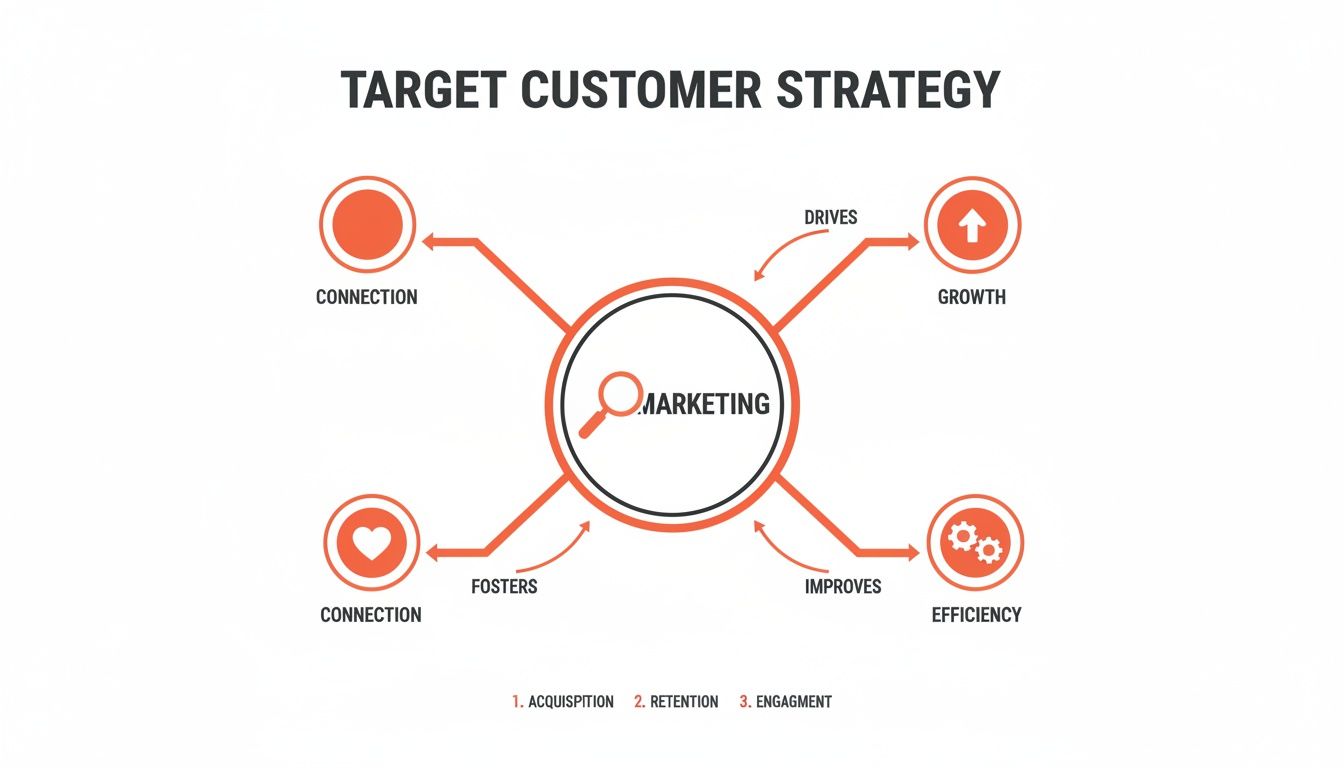
As you can see, defining your target customer isn't just a research task to tick off a list. It's the central hub for your entire strategy.
Combining Pillars for a Clearer View
No single pillar tells you the whole story. Demographics alone are way too broad, and psychographics without any context can be pretty vague. The real magic happens when you see how they all intersect and influence one another.
Let's take an e-commerce brand selling high-end outdoor gear. They might start with demographics: high-income individuals aged 30-50. Adding geographics narrows it down to people living near mountainous regions in Australia or New Zealand.
Then, psychographics reveal they're adventurous, environmentally conscious, and value durability over flashy features. Finally, behavioural data shows they research extensively online before buying and are incredibly loyal to brands that share their values.
Just like that, you have a complete, actionable picture to guide every single marketing decision you make.
Your Step-by-Step Guide to Defining Your Target Customer

Figuring out who your target customer is shouldn't feel like throwing darts in the dark. It’s a methodical process, all about swapping out vague assumptions for cold, hard data.
This five-step framework is your roadmap. It’s an actionable, repeatable workflow that will guide you through building customer profiles from the ground up, giving you the kind of clarity that makes marketing feel less like a gamble and more like a science.
Step 1: Start With Your Existing Customer Data
Your most valuable intel is often hiding in plain sight. Before you even think about looking elsewhere, dive into the information you already have. Your current customer base is an absolute goldmine for spotting the common threads that tie your most profitable and loyal fans together.
Crack open your Customer Relationship Management (CRM) system and your website analytics. Look for patterns in demographics, their buying history, and how they behave on your site. Who keeps coming back for more? What traits do they share? This initial data dive gives you a rock-solid, factual foundation for everything else you do.
Step 2: Conduct Competitor and Market Research
Once you have a handle on your own audience, it’s time to look over the fence. Analysing your competitors tells you who they’re chasing and, more importantly, where the gaps in the market are.
Take a close look at their messaging, their ad campaigns, and their social media game. Who are they talking to? This isn't about copying their playbook. It’s about spotting the underserved niches or pain points they might be completely ignoring, which helps you sharpen your position in the broader market.
Step 3: Uncover Insights From Social Media
Social media analytics are a real-time window into the minds of your potential customers. Tools like Meta Business Suite or the native insights on Instagram offer a treasure trove of demographic and interest-based data about who follows and engages with you.
But don’t just get hung up on follower counts. Pay close attention to the content that sparks the most comments and shares. What questions are people asking? What topics get them talking? These clues give you invaluable context that raw numbers just can't provide.
The goal is to move beyond what people do and start understanding why they do it. Social listening reveals their motivations, frustrations, and the exact language they use, allowing you to craft messages that truly connect.
Step 4: Gather Direct Qualitative Feedback
Data analytics are great for telling you what’s happening, but only direct feedback can tell you why. This is where you add depth, nuance, and a bit of human emotion to your profiles.
- Surveys: Use tools like Google Forms or SurveyMonkey to ask targeted questions. Get specific about their goals, their biggest challenges, and what they really value about what you offer.
- Interviews: Honestly, a 15-minute chat with a handful of key customers can be more enlightening than a thousand data points. Ask open-ended questions and let them tell you their stories.
This is the secret sauce for building personas that feel less like a spreadsheet and more like a real person.
Step 5: Weave Data Into Compelling Personas
Alright, it's time to bring it all together. The final step is to synthesise all that research into clear, actionable customer personas. Think of a persona as a semi-fictional character who represents your ideal customer, combining all the demographic, psychographic, and behavioural data you’ve collected into a memorable story.
This process is absolutely vital in the current Aussie market, where over 91% of us are online and businesses are pouring money into SEO and digital ads. To get a practical, step-by-step guide on this, check out this excellent resource on how to create an Ideal Customer Profile that actually drives sales.
By creating detailed personas, you ensure your marketing budget is spent with laser precision—a massive advantage when so many marketers are turning to AI for content and research. You can read more about what's happening right now in these Australian digital marketing statistics.
Activating Your Customer Profiles for PPC and SEO
So, you’ve done the hard yards and built a detailed customer profile. Fantastic. But if it's just sitting in a folder on your server, it’s not much more than research. Its real value is only unlocked when you put it to work.
This is the bridge between knowing your customer and seeing real, tangible results in your marketing. Activating these insights will completely change how you approach your most important channels, turning that hard-earned data into genuine performance.
Your profiles are basically the ultimate cheat sheet for crafting irresistible PPC ad copy. Instead of pumping out generic, one-size-fits-all messages, you can now write ads that speak directly to the specific pain points, desires, and even the language of your ideal customer. This deeper connection immediately boosts relevance and, you guessed it, click-through rates.
Precision Targeting in Your Ad Campaigns
With a crystal-clear definition of your target customer, you can build hyper-focused audiences on platforms like Google and Meta. Forget about targeting broad, vague interests. Now you can layer demographic, behavioural, and psychographic data to reach only the most qualified people.
This precision is absolutely vital. You're not just throwing money at the wall anymore. This focused approach comes with a few key benefits:
- Reduced Wasted Spend: Your budget is spent only on people who actually fit your ideal customer profile, maximising every single dollar.
- Higher Conversion Rates: It’s simple, really. Reaching a more relevant audience naturally leads to more conversions and a much stronger return on investment.
- Improved Ad Quality Scores: The ad platforms reward highly relevant ads with better placements and lower costs-per-click. It's a win-win.
Fuelling a Smarter SEO Strategy
Your customer personas are also the engine behind a modern, AI-first SEO strategy. At their core, search engines are designed to reward content that perfectly matches what a user is looking for. By understanding your customer’s core problems and the exact questions they’re typing into Google, you can create content that the algorithms recognise as the best possible solution.
A great piece of content doesn’t just rank for a keyword; it answers a specific question for a specific person. Your customer profiles tell you exactly who that person is and what they need to know.
This insight guides everything from your keyword strategy to the very structure of your content. You'll know which topics resonate most deeply, what format they prefer (are they blog post readers, video watchers, or guide downloaders?), and the tone of voice that builds genuine trust. To go a bit deeper on this, check out our guide on how your personas inform Google Ads keyword research.
Finally, these profiles also shape your website’s user experience (UX). By understanding how your target customer thinks and navigates online, you can design a seamless journey that guides them from their first click to the final conversion, making every single interaction feel intuitive and helpful.
Once you've developed these detailed profiles, you can take it a step further by using AI-powered tools for customer profile activation to manage your campaigns with even greater effect.
Customer Persona Examples You Can Use Today
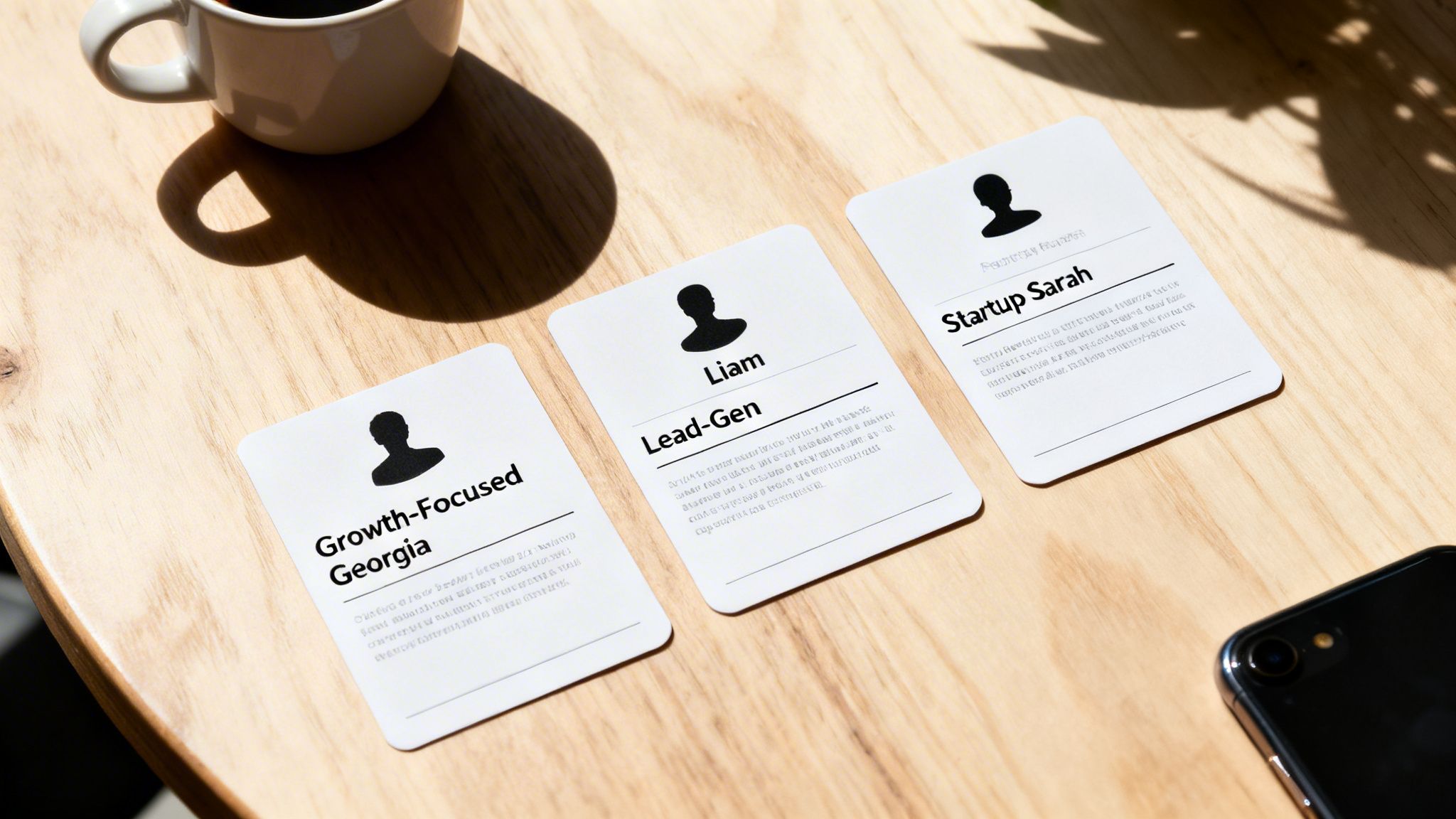
Theory is one thing, but seeing a target customer come to life is what makes these concepts really click. To make everything crystal clear, let's walk through three realistic customer persona templates.
These examples are designed to be instantly relatable and easy to adapt. Think of them as a solid blueprint you can tweak for your own business. Each profile gets a name, a backstory, and the core goals and challenges that shape their buying decisions.
E-Commerce Example: Growth-Focused Georgia
Let's meet Georgia. She’s the founder of a growing online sustainable fashion brand. She's ambitious and wants to scale her e-commerce business using Google Shopping, but she feels completely swamped by the platform's complexity and the never-ending algorithm updates.
- Backstory: Georgia is 32 and a solo entrepreneur who bootstrapped her business from the ground up. She’s incredibly passionate about her products but isn't a digital marketing expert.
- Core Goal: To hit a 3x return on ad spend (ROAS) and boost her monthly online revenue by 40% within the next six months.
- Major Challenge: Burning cash on Google Ads campaigns that don't convert and wrestling with product feeds that keep getting disapproved.
- Winning Message: "Scale your e-commerce brand with a proven Google Shopping strategy. We handle the complexity so you can focus on your passion."
See how this level of detail helps you figure out exactly what Georgia needs to hear? A generic "we do Google Ads" pitch would get ignored. But an offer that speaks directly to her ROAS goals and feed management headaches? That will grab her attention instantly.
B2B Example: Lead-Gen Liam
Now for Liam. He's a B2B marketing manager for a mid-sized SaaS company, and he's under immense pressure to generate more qualified leads for the sales team. His go-to channel is LinkedIn, but his current campaigns are pulling in prospects who just aren't the right fit.
Liam's biggest fear is missing his quarterly MQL (Marketing Qualified Lead) target. He needs a solution that promises not just more leads, but better quality leads that the sales team will actually thank him for.
That little insight is gold. It tells you that any messaging focused on lead quality over sheer quantity will resonate deeply with him.
- Backstory: Liam is 38, has a marketing degree, and has been in the B2B tech world for seven years. He reports directly to the Head of Sales, which adds to the pressure.
- Core Goal: To generate 50 high-quality leads per month from LinkedIn Ads while keeping his cost-per-lead under $150.
- Major Challenge: His ads are hitting too broad an audience, resulting in unqualified demo requests that waste the sales team’s time and damage his credibility internally.
- Winning Message: "Stop wasting your budget on unqualified leads. Our targeted LinkedIn campaigns deliver decision-makers who are ready to talk."
SMB Example: Startup Sarah
Finally, let’s meet Sarah. She’s the founder of a brand-new local service-based business. Her budget is tight, but her ambitions are huge. She needs an efficient, high-impact digital marketing strategy to build her brand and land her first 100 customers.
Sarah is on the hunt for a partner who can deliver clear results without a massive upfront investment or a confusing long-term contract. For her, transparency and flexibility are everything.
How Precision Targeting Maximises Your ROI
Defining your target customer isn't just a fluffy marketing exercise; it's a core business strategy that directly fuels your bottom line. Every single concept we've covered so far circles back to one critical outcome: maximising your return on investment.
Put simply, precision is profit.
When you stop shouting at everyone and start having a meaningful conversation with the right someone, your entire marketing machine becomes more efficient. This focus dramatically cuts down on wasted ad spend because every dollar is aimed at prospects who are genuinely interested in what you have to say. It’s the difference between buying a single, perfectly placed billboard on their daily commute versus scattering thousands of flyers into the wind and hoping for the best.
This data-driven approach pays off in a big way:
- Boosted Conversion Rates: When your message lands with the right audience, it just clicks. Relevant messaging that speaks directly to their needs naturally leads to more sales and sign-ups.
- Stronger Customer Loyalty: Customers who feel truly understood stick around. They develop a deeper connection to your brand, which in turn increases their lifetime value.
- A Decisive Competitive Edge: While your competitors are busy wasting resources on broad, scattergun campaigns, your focused strategy allows you to dominate your chosen niche.
Ultimately, a deep, authentic understanding of your target customer is the most reliable path to sustainable growth. It ensures your marketing isn't just another expense on the P&L, but a predictable, high-performing investment.
This precision is exactly what turns a marketing budget into a profitable, well-oiled machine. Now, it's time to put these principles into practice, define your ideal customer, and start seeing those returns for yourself.
Got a few questions still buzzing around? Here are some straight-to-the-point answers to the most common queries we get about defining your target customer and putting those insights to work.
How Often Should I Update My Customer Personas?
Markets shift, and so do people. We recommend giving your personas a good refresh at least once a year.
It's also a smart move to revisit them anytime there's a major shake-up in your market or you pivot your business strategy. This keeps them from going stale and ensures they’re still hitting the mark.
What Is the Difference Between a Target Market and a Target Customer?
Think of it like the difference between a crowd and an individual.
A target market is the broad group of people you're aiming for (e.g., small business owners in Australia). A target customer, on the other hand, is a super-detailed, specific profile of one person within that crowd (e.g., 'Startup Sarah,' a Melbourne-based founder juggling product development and her first marketing budget).
That level of detail is exactly what you need to write marketing messages that actually land.
Can a Business Have More Than One Target Customer?
Absolutely. In fact, most successful businesses do.
It’s common to have one primary persona and a couple of secondary ones. The trick is to avoid a one-size-fits-all approach. Prioritise your marketing efforts and create separate, tailored campaigns for each distinct customer segment. That’s how you get the best results.
Ready to stop guessing and start targeting with precision? The team at Click Click Bang Bang specialises in data-driven PPC and AI-first SEO to connect you with your ideal customers. Learn more and start your risk-free trial today at https://clickclickbangbang.com.au.
Read NeXt
Or Read Our Latest
- Manual vs Automated Bidding for PPC Success
- Conversion Tracking Setup: A Complete AU Guide
- Instagram Advertising Australia: Complete 2026 Guide
- Pay Per Click: A Beginner’s Guide for Australian Marketers
- Display Advertising on Google: The Complete Australian Guide
- Stakeholder Communication Plan How to Build One That Works
Click. CLick. Subscribe.
Get our best PPC insights, industry updates, and power moves delivered straight to your inbox. No fluff, just high-caliber strategies that actually work.
Don’t Leave Just Yet
Try Us For 30-Days,
Risk Free!!
We guarantee that you’ll love our work within the first 30 days, if not you’ll get your money back.
What have you got to lose?