

How Can You Trademark a Name in Australia A 2026 Guide
Last Updated

So, you want to trademark your business name. The short version? You need to do a thorough search to make sure your name is actually unique, file a formal application with IP Australia spelling out exactly what you do, and pay the government fees.
If your application gets the green light and no one objects, you’ll earn that coveted ® symbol. This gives you exclusive legal rights to use that name for your specific goods or services, right across Australia.
Why Trademarking Your Name Is a Foundational Business Move
Before you pour a single dollar into marketing or spend a minute sketching a logo, we need to talk about securing your brand name. Trademarking isn't just a pile of legal paperwork; it's one of the smartest strategic moves you can make. It’s what turns a simple business name into a valuable, legally protected asset.
Frankly, operating without a registered trademark is like building on shaky ground. Another business could come along, register a similar name, and potentially force you into a costly and gut-wrenching rebrand. Getting registered with IP Australia gives you a legal shield—an exclusive right to your identity and a powerful tool to stop competitors in their tracks.
The Power of Exclusive Rights
Registering your name officially transforms it from a simple identifier into a piece of intellectual property you legally own. This ownership brings some serious advantages to the table:
- Nationwide Protection: A registered trademark grants you the exclusive right to use your name for your specific goods or services across all of Australia.
- Deterring Competitors: That little ® symbol is a clear warning shot. It tells everyone else that your brand is legally protected, making them think twice before using a similar name.
- Building Trust and Value: Customers see registered trademarks as a mark of a legitimate, established business. Over time, this builds incredible brand trust and turns your name into a tangible asset on your balance sheet.
It’s a lesson Australian businesses are learning fast. In 2025, IP Australia was flooded with a staggering 85,945 trade mark applications, a 2.8% jump from the previous year. With Australian residents filing 56.5% of these, it's clear that local businesses are no longer seeing IP protection as optional, but as a core part of their growth plan. You can dig into the data yourself in the official Australian IP Report 2026.
The Australian Trademark Process At a Glance
The journey to registration has a few key stages. To give you a bird's-eye view, here's a breakdown of what to expect, from start to finish.
| Stage | What Happens | Estimated Timeline (Unopposed) |
|---|---|---|
| Phase 1: Pre-filing | You conduct searches to check if your name is available and prepare your application details. | 1-4 Weeks |
| Phase 2: Examination | An IP Australia examiner reviews your application to ensure it meets all legal requirements. | 3-4 Months from filing |
| Phase 3: Acceptance & Opposition | If accepted, your trademark is advertised. Others have two months to oppose it. | 2 Months |
| Phase 4: Registration | If there’s no opposition (or it’s unsuccessful), your mark is officially registered. | 7.5+ Months from filing |
This table shows the typical path, but remember, every application is different. A well-prepared application is your best bet for a smooth ride.
Your Roadmap to Registration
The path to getting your name trademarked in Australia follows a clear and logical sequence. This infographic gives you a simple visual of the main steps involved.
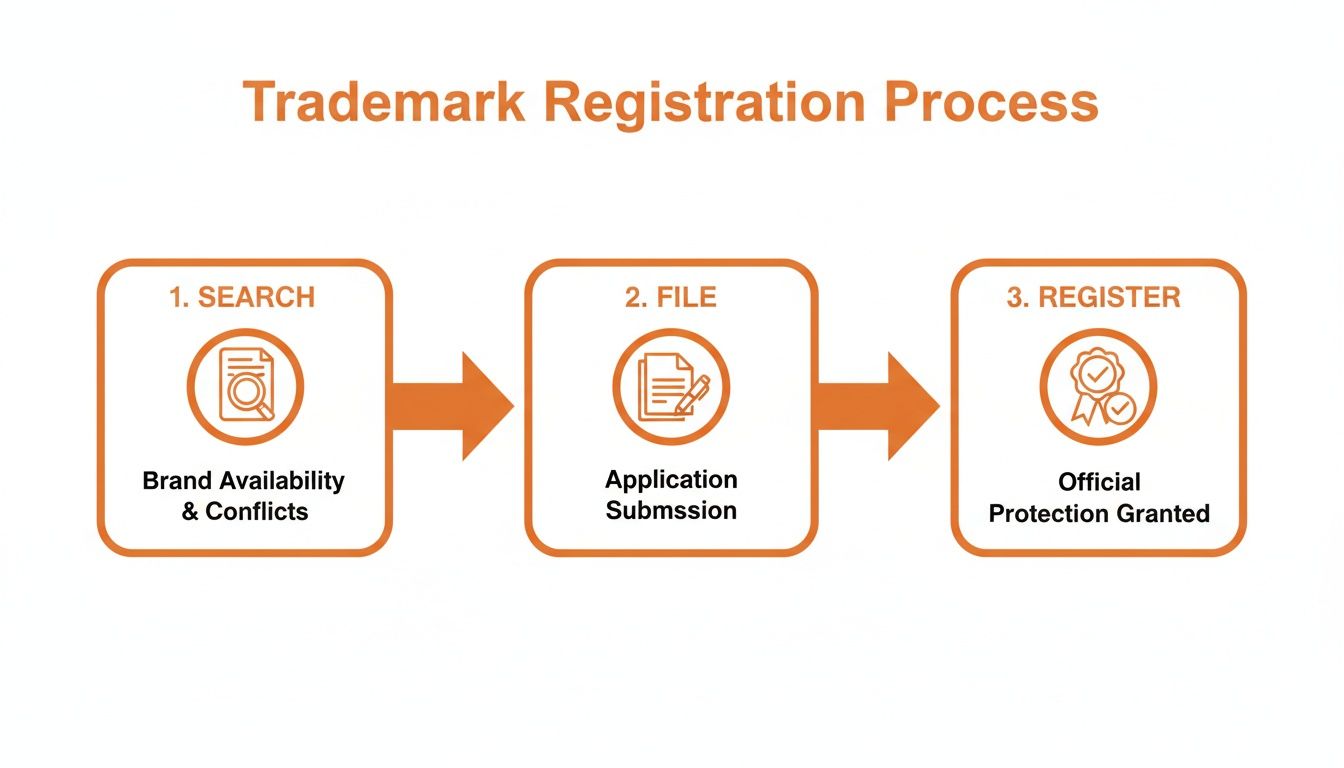
As you can see, it boils down to three core phases: searching, filing, and, finally, registration.
Key Takeaway: Trademarking isn't an expense; it’s an investment in your brand's future. It gives you the legal foundation to build recognition, customer loyalty, and a real market presence without the constant fear of copycats.
This protection means you can invest in your marketing and brand identity with confidence, knowing that every bit of effort is building an asset that is legally and exclusively yours. And speaking of brand identity, securing your name is the first step, but defining your company’s voice is just as important. You might find our guide on how to develop a unique brand voice helpful for that next step.
Don't Skip This Step: How to Do a Proper Trademark Search Before You File

So you’ve landed on the perfect name. It’s catchy, it looks fantastic on your mockups, and you’re ready to start building a brand around it. Before you get too attached or spend a single dollar on a logo, you need to hit pause and search.
Filing an application without a deep, comprehensive search is one of the most common—and costly—mistakes I see entrepreneurs make. It's like buying a block of land without checking the title. If IP Australia finds a conflicting trademark, they will reject your application, and you'll lose your application fee and a whole lot of time.
Going Beyond a Quick Google Search
A simple Google search is a decent first sanity check, but it's nowhere near enough. Your real search needs to be systematic, covering the official databases to get a clear picture of what’s already claimed. The goal isn't just to find identical names; it's to uncover any existing trademarks that are deceptively similar to yours.
You have to start thinking like a trademark examiner. This means looking for names that sound alike (phonetic similarity), look alike, or create a similar overall commercial impression. For instance, an examiner would likely find “XCELerate Fitness” and “Excel Fitness” confusingly similar, even with the different spelling.
Using the Australian Trade Mark Search Tool
Your most important resource here is IP Australia’s free database, the Australian Trade Mark Search. This is the official register, the single source of truth for every pending and registered trademark in Australia. Getting comfortable with this tool is absolutely critical.
To get started, you'll need to run a few different kinds of searches:
- Word Marks: Search for your exact name, plus any creative spellings, plurals, and variations you can think of.
- Image Marks: If you have a logo, the image search function can help you find visually similar designs that might conflict.
- Phonetic Searches: The database has a feature to find names that sound like yours. This is crucial for catching potential conflicts that a simple text search would miss.
Let's run a real-world scenario. Imagine you want to launch a fitness apparel brand called "AURA FIT". Your search can't just be for that exact phrase. You'd also need to check for "Aura," "Ora Fit," and "Aura Fitness."
If you find a registered trademark for "AURA Activewear" in the same class of goods (Class 25 for clothing), your "AURA FIT" application is almost certainly dead on arrival. Why? Because of a concept called likelihood of confusion.
The core question an examiner asks is: "Would an average consumer be confused, mistaken, or deceived into thinking these two brands are related?" If the answer is yes, your application will face an objection.
This 'likelihood of confusion' principle is the bedrock of trademark law. It's not just about stopping direct copies; it’s about protecting consumers from being misled about who is behind a product or service.
Analysing Your Search Results
Finding no exact match for your name is a great start, but the work isn't over. When you find potentially similar marks, you need to analyse the actual risk they pose.
For each potential conflict, dig a little deeper and consider these factors:
- Similarity of the Marks: How close are the names in sound, appearance, and meaning? Are they easy to mix up?
- Similarity of Goods/Services: Are the existing marks used for products or services closely related to yours? "Aura" for accounting software is no threat to your "AURA FIT" clothing line. The context is completely different.
- Status of the Mark: Is the mark you found still pending, is it officially registered, or has it lapsed? A lapsed trademark might open a door for you, but you need to tread carefully and understand why it lapsed.
A thorough search puts you in control. It gives you the insight to either move forward with confidence, tweak your name to avoid a clear conflict, or head back to the drawing board. While it can feel like a roadblock, this step saves countless businesses from the financial drain and heartache of a trademark rejection—or worse, an infringement lawsuit down the line.
Choosing a Registrable Name and The Right Classes

After your initial search, the next crucial part of trademarking a name is ensuring the name itself is actually registrable. In the eyes of IP Australia, not all names are created equal. The legal strength of your trademark hinges almost entirely on how distinctive it is.
A name that’s too descriptive of your goods, services, or where you operate is considered weak and will almost certainly be rejected. The reasoning is straightforward: your competitors need to be able to use those same descriptive terms to talk about their own offerings. An examiner will argue you can’t monopolise common language.
For example, trying to trademark "Sydney Web Design" for a web design agency in Sydney is a complete non-starter. It simply describes the service and its location, giving you no unique brand identity to protect.
The Spectrum of Distinctiveness
To get your application across the line, your name needs to sit on the stronger end of the trademark spectrum. Think of it like this:
- Generic: These are common, everyday words for a product (e.g., "Phone" for a mobile phone). They can never be trademarked for that product.
- Descriptive: These describe a quality or characteristic (e.g., "Quick" for a delivery service). They are incredibly difficult to register.
- Suggestive: These hint at a quality without directly describing it (e.g., "Netflix" suggests movies viewed over the internet). These are good, solid marks.
- Arbitrary: These are real words with no logical connection to the product (e.g., "Apple" for computers). These are very strong marks.
- Fanciful: These are completely invented words created just for the brand (e.g., "Kodak"). These are the strongest marks you can get.
Your goal should be to land on a name that is at least suggestive, but ideally arbitrary or fanciful. This distinctiveness is what gives your brand its legal muscle.
Selecting the Right Goods and Services Classes
Once you have a strong name in your sights, you need to correctly classify your business activities. A trademark only protects your name for the specific goods and services you nominate in your application. This is done by selecting from a list of 45 internationally recognised classes.
This step is absolutely critical and a common point of failure. Choosing the wrong classes can leave your brand dangerously exposed, while picking too many is just a waste of money.
Imagine you're selling t-shirts online. You need to consider at least two classes:
- Class 25: For the physical goods themselves (clothing, footwear, headwear).
- Class 35: For the service of selling those goods online (advertising; business management; retail services).
If you skip Class 35, someone else could potentially register a similar name for an online store, creating massive confusion for your customers and diluting your brand.
To ensure your chosen name is unique and registrable, a thorough preliminary search is indispensable. For a dedicated resource on how to perform an effective IP Australia Trademark Search, this guide can be a great help.
Expert Tip: Think about where your business is heading. If you're a coffee roaster (Class 30) but you're planning to open a café (Class 43) in two years, it’s often smarter and more cost-effective to secure both classes from the get-go.
This strategic classification also lays the groundwork for potential international growth. Securing a local AU trademark is often the first step for international filings, a path many Australian businesses are taking. In 2023, Aussie businesses lodged 17,407 overseas applications, with top destinations being the US, New Zealand, and the UK. You can explore the latest insights from the 2025 IP Australia report to learn more about these trends.
Ultimately, correctly identifying your classes requires a deep understanding of your current business model and your future ambitions. This is where you connect your brand name to the commercial activities it represents—a process that relies heavily on understanding your ideal customer. If you haven't already, take a moment to read our guide on defining your target customer; it can bring valuable clarity to this step.
Your Guide to Filing an Application with IP Australia
Alright, you've done the groundwork. Your searches are clear, you know your classes, and you're ready to lock in your brand name. This next step—filing the actual application with IP Australia—is where things get real. It might feel like a bit of admin, but getting this part right is absolutely critical.
The whole thing is done online through the IP Australia portal. It's a pretty good system, but there are a few forks in the road where a wrong turn can cause major headaches later. A simple mistake, like putting your own name down as the owner instead of your company’s, can create months of delays and cost you extra fees to fix.
Your first big choice is between two different filing pathways. They each serve a different purpose and come with their own costs and timelines.
Standard Application vs TM Headstart
The Standard Application is the direct route. You fill out the form, pay the full fee, and your application gets slotted into the examination queue. It's a straightforward path if you're very confident that your trademark is unique and registrable.
Then there's the TM Headstart service. Think of this as a pre-flight check. For a lower initial fee, an examiner takes a look at your application and gives you feedback within about five business days. This is an incredibly valuable opportunity to find out if there are any obvious red flags before you commit to the full process. If you get the green light, you pay a second fee to move into the formal examination queue.
Here’s a practical look at how the two options compare for a filing in 2026.
IP Australia Filing Options and Costs in 2026
Choosing between these two services really comes down to your confidence level. The Standard Application is faster if you're certain, but TM Headstart is a smart investment if you have any doubts.
| Feature | Standard Application | TM Headstart Service |
|---|---|---|
| Initial Cost per Class | $250 | $200 |
| Process | File application directly into the examination queue. | Get pre-assessment feedback from an examiner within ~5 days. |
| Key Benefit | Simple and direct path for strong, clear-cut applications. | Identifies potential problems early, letting you fix them before formal filing. |
| Best For | Applicants who are confident their trademark is registrable and has no conflicts. | Applicants wanting an early, professional opinion on their chances of success. |
| Total Cost (Part 2) | N/A | An additional $150 per class to proceed to formal examination. |
For the sake of an extra $100 per class, TM Headstart can save you from losing your entire application fee if an issue pops up. It's the option I recommend for most first-time filers.
Common Filing Mistakes to Avoid
The online portal is precise. A small typo or a wrong click can be enough to get your application flagged by an examiner. After seeing countless applications, a few common slip-ups appear again and again.
1. Listing the Wrong Owner
This is easily the most frequent—and most frustrating—mistake. If your business is a company (e.g., a Pty Ltd), the company must be the owner. You, as an individual, cannot own a trademark on behalf of your company. If you get this wrong, you'll have to do a formal assignment to transfer ownership later, which means more paperwork and more fees.
2. Incorrect Representation of the Mark
Be crystal clear about what you're trying to protect. If you're trademarking a logo, you need to upload a clean, high-resolution image of exactly how it will be used. If you're protecting a word mark (the name itself), just type the words. Don't upload a fancy image of the words unless you want to protect that specific stylised version only.
3. Vague or Incorrect Goods/Services Descriptions
You’ll need to describe your goods or services within your chosen classes. Don't be lazy here. Vague terms like "consulting" or "marketing" will almost certainly be questioned. Instead, get specific: "business management consulting," "digital advertising services," or "social media marketing advisory services." Ambiguity is an examiner's worst enemy.
Key Takeaway: Treat the application form like the legal document it is, not just another online form. Precision is everything. Double-check every single field, especially the owner's details and the mark itself, before you hit that submit button. An extra hour of review now can literally save you months of delays and hundreds of dollars down the track.
What Happens After You File? Examination and Life as a Trademark Owner
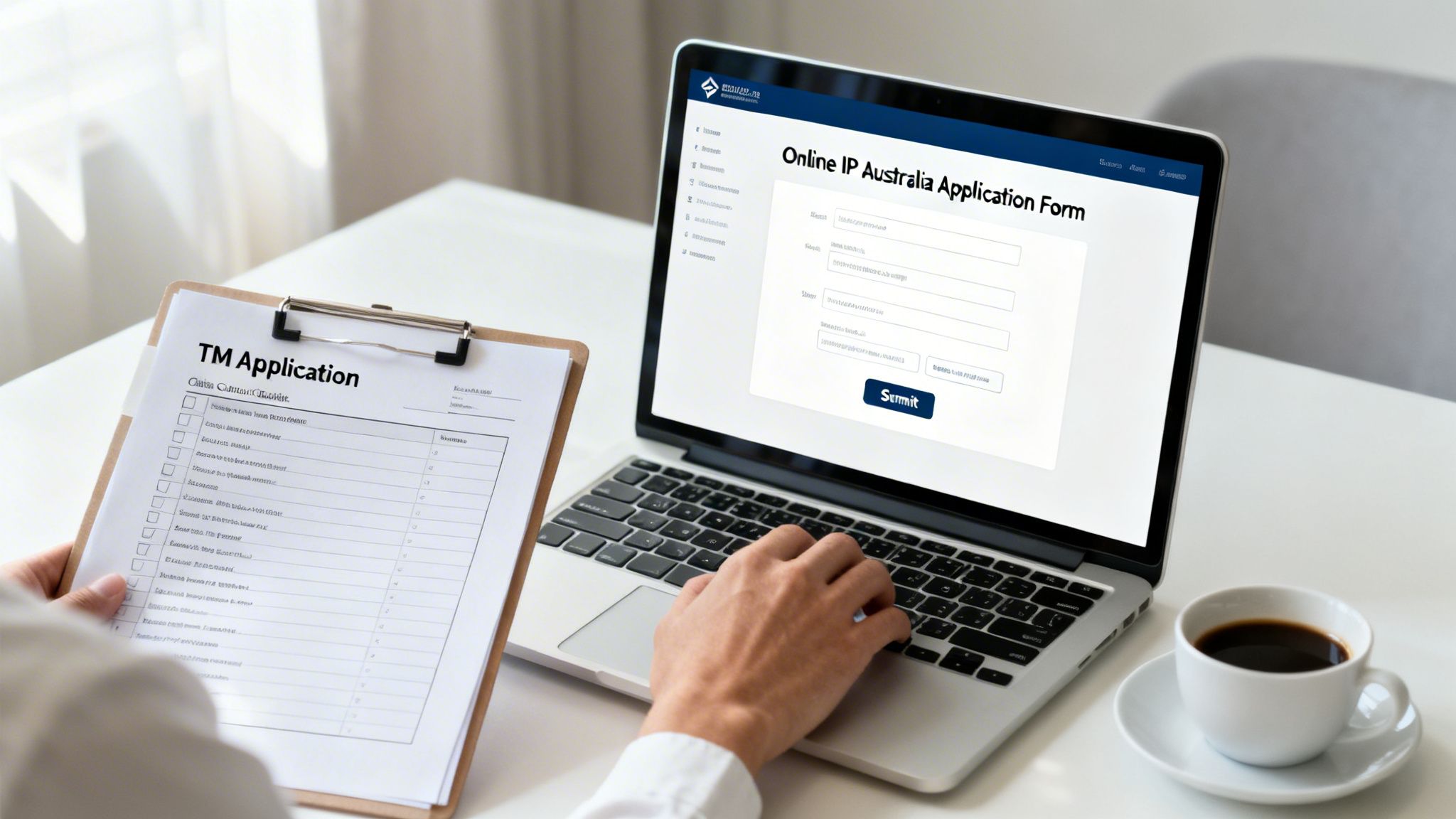
Hitting ‘submit’ on your trademark application feels like crossing the finish line, but in reality, you’ve just started the next leg of the race. Your application now lands on the desk of an IP Australia examiner, who will scrutinise it to make sure it ticks all the legal boxes. This is where you find out if all your prep work paid off.
If the examiner flags an issue, you don’t get an instant rejection. Instead, they’ll send you a document called an Adverse Examination Report. Getting one can feel like a punch to the gut, but it's an incredibly common part of the process, so don't panic. Think of it as an invitation to clarify your case.
Decoding and Responding to Examination Reports
An examiner’s report will spell out the objection and give you a deadline to respond, which is usually a generous 15 months. The trick is to dig into why your application was flagged. Most objections fall into a few familiar buckets, and your comeback strategy will depend entirely on the specific problem.
Some of the most common reasons for an adverse report include:
- Your name is too descriptive: The examiner thinks your name just describes what you sell, what you do, or a key feature of it.
- A similar mark already exists: They've unearthed a pre-existing trademark that they believe is deceptively similar to yours.
- Something’s not quite right: You've made a procedural slip-up, like putting in the wrong owner details or being too vague about your goods and services.
Your response has to be a formal, written argument that tackles the examiner’s points head-on. If the issue is descriptiveness, you might need to argue that your name is suggestive, not descriptive. Or, you could show evidence that your name has already built a solid reputation in the market. If there's a conflicting mark, your best bet might be to argue that the goods and services are so different that no consumer would ever get confused.
Crucial Takeaway: A well-reasoned, evidence-based response is your only real tool here. Vague arguments or emotional pleas won't get you anywhere. You need a logical case that directly addresses the legal sticking points raised by the examiner.
Life After Registration: Your Ongoing Duties
Congratulations! You’ve navigated the examination maze, survived the opposition period, and your name is now an officially registered trademark. You'll get a shiny certificate of registration in the mail, and you can finally use that coveted ® symbol. But this isn't a "set and forget" asset.
To keep your legal protections iron-clad, you have ongoing responsibilities as a trademark owner. If you get lazy with managing your trademark, you could find its power diluted or, even worse, see it cancelled down the track.
Your main duties boil down to three things:
- Use It or Lose It (Correctly): You must use your trademark exactly as you registered it. If you registered a specific logo, that's the logo you have to use. Make any significant changes, and you might be looking at a whole new application.
- Police the Marketplace: It's your job to be the sheriff. You need to keep an eye out for competitors using a similar name, which could water down your brand's unique identity. Setting up a few alerts can help automate this process.
- Keep Your Registration Alive: A trademark registration is good for 10 years. You have to file for renewal with IP Australia to keep it active. Miss that deadline, and your registration will lapse, taking all your hard-won legal rights with it.
The examination and post-registration phases can be heavy on admin. This is where Legal assistants can be a huge help, managing deadlines and paperwork to keep everything on track. Staying organised is absolutely key to protecting your brand in the long run.
Of course, a trademark is only as strong as its presence in the market. Effective content marketing is vital for proving your trademark's continuous use in commerce. If you're looking for smart ways to build your brand, check out our expert content marketing services and see how we can help.
Alright, let's tackle some of the most common questions we hear about trademarking a name in Australia. Getting your head around the intellectual property world can feel like a mission, but knowing the key details upfront will help you make smarter moves for your brand.
This section gets straight to the point, answering the big questions about costs, timelines, and the hurdles you might encounter on the way to getting your name registered.
Having this info ready lets you budget properly, set realistic expectations, and walk into the process with confidence. Let's get into the specifics.
How Much Does It Actually Cost To Trademark a Name in Australia?
In 2026, a standard online application with IP Australia kicks off at $250 per class of goods or services. This is a critical detail, as a typical small business often needs to file in one or two classes, which directly impacts your total cost.
For instance, if you're running an online clothing store, you'd likely file in Class 25 (for the clothing itself) and Class 35 (for your retail services). Right there, your initial government fee is $500.
There's also the TM Headstart pre-assessment service. That'll set you back $200 per class for the initial report, plus another $150 per class if you decide to go ahead with the full application. Just remember, these are purely government fees—they don’t cover any legal advice. If you need professional help, especially to deal with an examiner's report, that can add anywhere from a few hundred to thousands of dollars to your final bill.
How Long Does The Australian Trademark Process Take?
You'll need to be patient. If your application is straightforward and sails through without any objections, you're looking at a timeline of roughly 7 to 9 months from filing to official registration.
This window breaks down into a couple of key stages:
- Examination: An examiner will review your application, which usually takes about 3-4 months.
- Opposition Period: Once your mark is accepted, it's advertised for two months. This gives anyone else the chance to oppose it.
If an examiner flags issues or another party decides to oppose your application, the timeline can easily blow out to 18 months or even longer. The TM Headstart service can give you feedback within about five business days, but it doesn't actually speed up the total registration time.
Can I Trademark a Name Someone Else Is Already Using?
This is a common question, and the answer is almost always a hard "no." It really hinges on whether the other business has registered that name as a trademark.
If another business is using a similar name for similar services but hasn't registered it, you might be able to get the trademark. The catch? They could have already built up "unregistered" or common law rights simply by using the name first. In that case, they could oppose your application or try to have your registration cancelled later on.
The Bottom Line: If another business already holds a registered trademark for a similar name in a related field, your application is almost certain to be rejected. This is exactly why doing a thorough, comprehensive search is the single most important thing you can do before spending a cent.
What Do I Do If Someone Infringes On My Trademarked Name?
Once your trademark is officially on the books, you've got some serious legal firepower. You now have the exclusive right to use that name for your specific goods and services, and you can take action to stop others from ripping it off.
The first step is usually to have a lawyer send a formal "cease and desist" letter. This is an official notice that lays out your registered rights and demands the other party stop using your mark without permission.
A lot of the time, this letter is enough to solve the problem. But if they ignore it or refuse to stop, your registration gives you the legal grounds to take them to court for trademark infringement. This could lead to a court order forcing them to stop and potentially even making them pay you for any financial damages your business has suffered.
At Click Click Bang Bang, we specialise in building powerful brand presences through precision-driven SEO and PPC. While we secure your visibility online, make sure your brand itself is secure in the real world. Explore our services at https://clickclickbangbang.com.au.
Read NeXt
Or Read Our Latest
- Manual vs Automated Bidding for PPC Success
- Conversion Tracking Setup: A Complete AU Guide
- Instagram Advertising Australia: Complete 2026 Guide
- Pay Per Click: A Beginner’s Guide for Australian Marketers
- Display Advertising on Google: The Complete Australian Guide
- Stakeholder Communication Plan How to Build One That Works
Click. CLick. Subscribe.
Get our best PPC insights, industry updates, and power moves delivered straight to your inbox. No fluff, just high-caliber strategies that actually work.
Don’t Leave Just Yet
Try Us For 30-Days,
Risk Free!!
We guarantee that you’ll love our work within the first 30 days, if not you’ll get your money back.
What have you got to lose?