

Voice & Tone: Define Your Brand voice & tone for SEO and PPC Success in 2026
Last Updated

Struggling to stand out in a crowded market? Your brand's voice and tone are the secret ingredients. It's easy to mix them up, but think of your brand voice as your core personality—it's who you are, and it stays consistent. Your brand tone, on the other hand, is the mood you adopt for different situations.
Getting this right isn't just a fluffy branding exercise; it's a strategic move that directly impacts your marketing performance. Let's break it down.
The Power of a Consistent Voice and Tone in Marketing

Let's unpack that with a simple analogy. Think about a friend who's known for being witty and optimistic. That's their personality, their underlying voice. It never really changes.
But their tone shifts depending on the context. When they share great news, they'll use an excited, upbeat tone. If you're having a rough day, they'll switch to a gentle, supportive tone to comfort you. The person is the same, but their emotional expression adapts.
This distinction is absolutely crucial in marketing. Your voice is the foundation of your brand identity, while your tone adapts to the channel, the audience, and the specific message. A consistent voice builds familiarity and trust, making your brand instantly recognisable across every platform.
To make this crystal clear, here’s a quick reference table breaking down the key differences between voice and tone.
Voice vs Tone Quick Reference
| Element | Definition | Analogy | Example |
|---|---|---|---|
| Voice | Your brand's unique, consistent personality. Who you are. | Your unchanging personality. | Witty, Authoritative, Playful, Inspiring. |
| Tone | The emotional inflection or mood applied in a specific context. How you feel. | Your mood in a particular conversation. | Humorous, Empathetic, Formal, Urgent. |
This table shows how your brand can maintain its core personality (voice) while intelligently adapting its emotional expression (tone) to suit any situation.
Why It Matters for SEO and PPC
So, how does this connect to driving traffic and sales? When your messaging is consistent from a Google Ad right through to your landing page, you create a cohesive and seamless user experience. That continuity builds trust and encourages people to stick around, which sends all the right signals to search engines.
A strong, recognisable voice makes your content more memorable. When users trust and remember your brand, they are more likely to click on your search results and ads—even when competitors are ranking right next to you.
This consistency has a direct influence on your most important performance metrics. By building a reliable brand identity through a well-defined voice and tone, you'll start to see:
- Higher Engagement: Content that genuinely resonates with your audience encourages more likes, shares, and comments.
- Improved Brand Recognition: A unique voice cuts through the noise, making your brand the one people remember.
- Better Conversion Rates: Trust is a massive driver of purchasing decisions. A consistent, authentic voice builds that trust with every interaction.
For instance, a humorous tweet might use a playful tone to grab attention. But an email responding to a customer complaint from that same brand will adopt an empathetic and serious tone. Both communications stem from the same core brand voice—perhaps one that is helpful and approachable—but the emotional delivery is tailored to the situation.
This adaptability is what makes a defined voice and tone so powerful. It gives you a framework to be dynamic and responsive without ever losing your brand’s core identity. Mastering this balance is essential for creating genuine connections that fuel better SEO performance, more effective PPC campaigns, and ultimately, a healthier return on your investment.
How Voice and Tone Directly Impact SEO and PPC Results
It’s easy to think of voice and tone as a fluffy branding exercise, but it’s far more than that. A well-defined voice has a direct, measurable impact on your SEO and PPC performance. Think of it as the crucial link between your brand's personality and your bottom line.
When your messaging is consistent everywhere a customer finds you, it builds a cohesive experience that search engines like Google actually recognise and reward. It’s not an abstract idea; it leads to tangible improvements you can see in your analytics.
A consistent voice makes your content predictable and trustworthy. When someone clicks from a Google search to your website and finds the exact language and style they were expecting, they're far more likely to stick around, click through to other pages, and engage with what you have to say.
This positive user behaviour sends powerful signals to Google. Important metrics like bounce rate (how quickly people leave your site) and dwell time (how long they stay) are directly affected. A low bounce rate and high dwell time tell search engines your content is valuable, which is a key ingredient for climbing the search rankings.
Boosting Your Organic Search Performance
Imagine your website as a conversation. If your blog posts are friendly and casual, but your product descriptions are stiff and formal, the conversation feels disjointed and jarring. This kind of inconsistency erodes trust and confuses people, often causing them to hit the back button.
By sticking to a consistent voice, you create a seamless user journey. This builds your authority and encourages visitors to read more of your content, which in turn feeds those positive SEO signals back to Google.
A predictable and authentic voice can turn a one-time visitor into a loyal reader. When users know what to expect from your content—and they like and trust it—they are far more likely to click on your search results, link back to your articles, and share your pages.
A strong voice also helps you align your content with what people are actually searching for. If your voice is authoritative and expert-led, you'll naturally attract users looking for in-depth information. If it's fun and quirky, you’ll connect with audiences searching for entertainment or unique products. This synergy between your voice and tone and user intent is fundamental to modern SEO. You can learn more about how powerful writing fuels search success by exploring our guide on SEO and copywriting.
Elevating PPC Campaign Effectiveness
The impact is just as significant in the world of paid ads. Your PPC campaigns, from Google search ads to social media promotions, are often the very first interaction someone has with your brand. Getting the voice and tone right can dramatically improve your results.
When your ad copy, landing page, and even your checkout process all speak the same language, you create a frictionless path to conversion. This consistency boosts user confidence at every single step of the journey.
Here’s how that plays out in practice:
- Higher Click-Through Rates (CTR): Ad copy that reflects a distinct, appealing voice stands out on a crowded search results page, earning you more clicks.
- Improved Quality Score: Google rewards ads that lead to a relevant and high-quality user experience. A consistent voice from ad to landing page is a huge factor in achieving a high Quality Score, which directly lowers your cost-per-click.
- Increased Conversion Rates: A landing page that continues the conversation started by the ad makes the user feel understood and builds trust. This makes them much more likely to take that next step, whether it's making a purchase or filling out a form.
This isn't just limited to text. The power of a consistent voice extends to audio channels, too. In Australia, commercial radio reaches 12.4 million people every week. Campaigns that establish a strong share of voice through audio investment see nearly double the business impact, boosting new customer acquisition from 22% to 40%. Whether it's read or heard, a consistent voice is a powerful asset for growth.
How to Define Your Unforgettable Brand Voice
Alright, let's move from theory to practice. This is where the real work of defining your voice and tone begins. A powerful brand voice doesn't just materialise out of thin air; it’s something you discover and build through a deliberate process. When you craft a voice that’s authentic and memorable, you're not just creating fluff—you're building a strategic asset that aligns your entire team and connects deeply with your audience.
The goal here isn't to invent a personality from scratch. It's to dig up the one that already exists in your company’s DNA and put it into words. That process starts by looking inward at your core values and then outward, with a deep understanding of who you’re actually talking to.
Start with Your Core Values and Mission
Your brand voice needs to be a direct extension of why your company exists. What do you actually stand for? What principles guide your business decisions? If your company champions transparency and simplicity, for example, your voice should be straightforward and clear, cutting through the jargon and corporate-speak.
Start by gathering your mission statement, value propositions, and any internal culture documents you have. Then, ask your team to describe the company in just three words. The patterns that pop up from this exercise are the real building blocks of your authentic voice.
A brand voice rooted in your core values feels genuine because it is. It's not a marketing mask; it's an honest expression of who you are as a business, which builds unshakable trust with your audience.
To really nail this, it helps to understand and explore what is brand voice and how to build one that resonates. A voice that feels disconnected from your values will always ring hollow. Authenticity is your most powerful tool here.
Understand Your Ideal Customer
Once you know who you are, you have to know who you're talking to. A great brand voice speaks to someone, not just at them. If you haven't already, now is the time to build out your ideal customer personas. For a detailed walkthrough, check out our guide on how to define your target customer to get started.
Go deeper than basic demographics. What are their goals and frustrations? What kind of humour do they respond to? What other brands do they admire? The more intimately you understand your audience, the more effectively you can craft a voice that actually connects with them.
This isn't just a branding exercise; it directly impacts the performance of your key channels, like SEO and PPC.
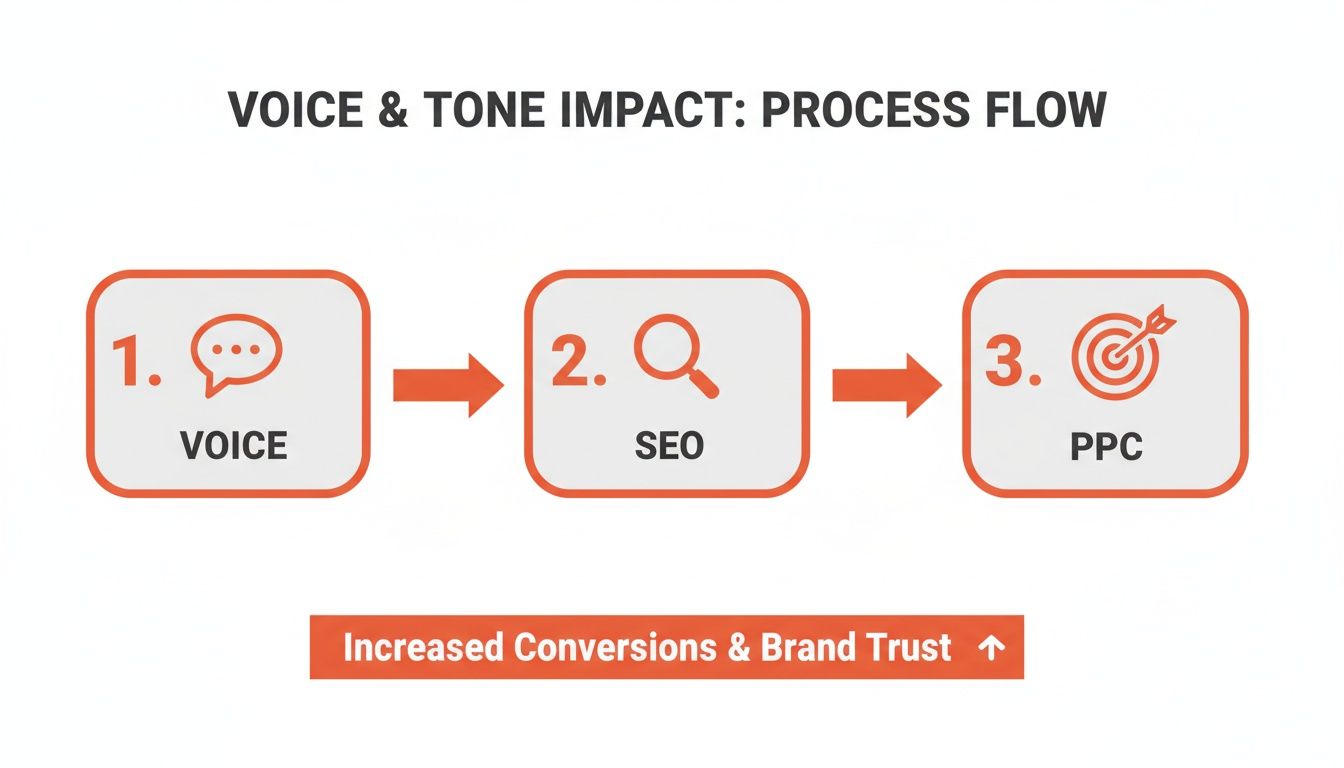
As you can see, a strong, consistent voice is the foundation. It leads to clearer messaging in your ads and content, which in turn drives better engagement and, ultimately, more conversions.
Create Clear Boundaries with a "This, Not That" Chart
Sometimes, the best way to define what your brand is can be clarified by defining what it is not. A "This, Not That" chart is a brilliantly simple but effective tool for setting clear boundaries for your voice and tone. This little exercise helps your entire team—from marketing to sales to support—grasp the nuances of your communication style.
For each voice characteristic you've identified, create a column for "We Are" and a column for "We Are Not." This forces you to get specific and eliminate any grey areas.
Here's a quick example for a brand aiming to be 'Expert but Accessible':
| Voice Characteristic | We Are (This) | We Are Not (That) |
|---|---|---|
| Confidence | Authoritative, knowledgeable, clear | Arrogant, condescending, boastful |
| Language | Simple, direct, easy-to-understand | Overly academic, jargon-filled, simplistic |
| Humour | Witty, clever, relatable | Sarcastic, silly, unprofessional |
| Friendliness | Helpful, approachable, encouraging | Over-familiar, bubbly, syrupy |
This framework gives concrete guardrails to anyone creating content for your brand. It turns your voice from a vague concept into a practical, actionable guideline that ensures consistency across every single touchpoint. By following these steps, you can craft a voice that is not only unforgettable but also a powerful driver of business growth.
Creating Practical Tone of Voice Guidelines for Your Team
A brilliant brand voice is useless if it’s just a slide in a marketing deck. To make it a real asset, you have to translate that high-level concept into practical, actionable tone of voice guidelines your entire team can actually use.
This document becomes your single source of truth for communication. It bridges the gap between the idea of your voice and the daily reality of writing an email, a social post, or handling a customer query. The goal is a guide that gets everyone, from your newest hire to your sales director, speaking the same brand language. That consistency is what builds recognition and trust.
Essential Components of Your Guidelines
A great set of guidelines is more than a list of "do's and don'ts". It’s a proper manual that covers principles, real-world applications, and clear examples. As you build it, remember to account for different communication styles at work to ensure the message lands, no matter who's writing or reading it.
Your document should always include:
- Core Voice Characteristics: Start with the "This, Not That" chart you created. Put this front and centre to define the pillars of your brand voice (e.g., "Expert, not Arrogant").
- Communication Principles: Outline the big-picture goals. Are you trying to educate, inspire, or entertain? This gives your team the ‘why’ behind the words they choose.
- Grammar and Mechanics: Get specific. Set clear rules on things like the Oxford comma, title case vs. sentence case for headlines, and spelling preferences (e.g., "organise" vs. "organize").
- Industry and Brand Terminology: Create a glossary for terms specific to your industry or brand. Define exactly how to write your company name, product names, and any other proprietary language.
This structure turns an abstract idea into a concrete tool. It removes the guesswork and gives your team the confidence to apply the right voice and tone every time.
Mapping Voice to Specific Tones
This is where the theory gets real. Your voice is the constant, but your tone must adapt to the situation. Your guidelines need to show your team exactly how to make that shift. The best way to do this is with a matrix or a set of scenarios that map your core voice to the emotional tones needed in different contexts.
A powerful brand voice doesn’t mean you sound the same everywhere. It means you sound like yourself everywhere. The key is teaching your team how to modulate their tone for the situation without losing the core personality.
For instance, show how your "Playful and Witty" voice translates into different tones:
- Scenario: A product launch announcement.
- Tone: Celebratory and Exciting.
- Example: "It's finally here! Get ready to say goodbye to boring Tuesdays. Our new widget is about to change everything."
- Scenario: Responding to a customer complaint.
- Tone: Empathetic and Reassuring.
- Example: "We're so sorry to hear you've had this issue. That's definitely not the experience we want for our customers, and we're here to make it right."
This kind of practical mapping is crucial. It gives your team clear, repeatable examples they can follow, ensuring consistency across channels—a factor that's becoming vital in emerging formats like digital audio. In Australia, digital audio ad spend hit $339 million, with 69% of ad buyers planning to boost their podcast ad investment by 2026, driven by high audience attention. You can read more about Australian digital audio ad spend on ppc.land.
How to Adapt Your Tone Across Different Marketing Channels

If you've nailed down your brand voice, that’s a huge win. But the real test begins when you start applying it. Think of it this way: your voice is your fixed personality, but your tone is the mood you bring to different conversations. You wouldn't talk to your best mate at a barbie the same way you’d speak in a job interview, right? The same logic applies to your marketing.
Failing to adapt your tone for each channel is a common mistake. You risk sounding out of place, like showing up to a casual get-together in a full tuxedo. Your core personality—your voice—doesn't change, but your delivery has to.
A person scrolling through Instagram is in a completely different headspace than someone typing a specific problem into Google. Your tone needs to meet them where they are, in the context of that platform. Let's break down how to do this for the channels that matter most in performance marketing.
H3: Nailing the Tone for Search Ads
On Google Search, you're talking to people with a problem who are actively looking for a solution. They have high intent, and you have very little space to make your point. This is not the place for storytelling or subtle wit.
Your tone needs to be direct, confident, and packed with value. Forget the fluff. Every character has to earn its spot by highlighting a benefit or creating a sense of urgency. You're trying to answer the user's unspoken question: "Why should I click your ad and not the others?"
In search ads, your tone isn’t a floodlight; it’s a laser beam. It needs to be precise, clear, and drive a single action: the click.
Let’s take our "Expert but Accessible" voice as an example.
- Objective: Drive clicks for "AI-powered SEO services".
- Adapted Tone: Confident, Direct, Urgent.
- Example Copy: "Smarter SEO Starts Here. AI-Driven Results. Get Your Free 30-Day Trial. Boost Rankings Fast—Book a Demo!"
See how it works? The copy is confident ("Smarter SEO") and telegraphs expertise ("AI-Driven"), but it's also direct and accessible with a clear, time-sensitive call to action. For a deeper dive, check out our guide on ad copy best practices.
H3: Connecting on Social Media
Social media is a different world entirely. People are there to connect, be entertained, and scroll, not necessarily to be sold to. This is where the more personable side of your brand voice can really come out to play.
Your tone here should feel more like a conversation. It should be engaging, helpful, and human. For our "Expert but Accessible" brand, the tone on a professional platform like LinkedIn might be more insightful, while on Instagram it would likely be friendlier and more visual.
- Objective: Build community and share a useful tip.
- Platform: Instagram.
- Adapted Tone: Helpful, Engaging, Personable.
- Example Copy: "Struggling with your ad copy? 🤔 Quick tip: Focus on one clear benefit per ad. What's your go-to trick for writing great copy? Let us know in the comments! 👇 #PPCTips #DigitalMarketing"
This post is immediately helpful, uses emojis to feel native to the platform, and asks a question to invite interaction—all while staying true to the brand's accessible-expert personality.
H3: Persuading on Landing Pages
A landing page is your digital handshake after the initial introduction. Someone has clicked your ad, which means they're interested. Now, you have to convince them to take the next step. Your tone needs to build on the promise of your ad, but with more detail, reassurance, and persuasive power.
You have more room to move here, so you can expand on the benefits, tackle potential objections head-on, and use social proof like testimonials to build trust. The tone should guide the user smoothly and logically towards that all-important conversion button.
- Objective: Convince visitors to sign up for a free trial.
- Adapted Tone: Persuasive, Reassuring, Informative.
- Example Copy: "Stop guessing and start growing. Our AI-powered platform gives you the data-driven insights you need to dominate search rankings. We handle the complex analysis so you can focus on what you do best. Ready to see the difference? Start your risk-free 30-day trial today."
This copy is persuasive ("dominate search rankings"), reassures the user ("risk-free"), and informs them of the value ("we handle the complex analysis"). It’s a natural continuation of the conversation that started with the ad, creating a seamless journey for the user. It's proof that a consistent voice, adapted with the right tone, makes for powerful marketing.
The table below gives a few more examples of how a single brand voice can flex its tone depending on the channel and the goal.
Channel-Specific Tone Adaptation Examples
| Channel | Objective | Adapted Tone | Example Copy |
|---|---|---|---|
| Google Search Ad | Generate qualified leads | Direct, Benefit-Driven | "Expert B2B Marketing. Drive Qualified Leads & Revenue. Get a Free Strategy Call. Book Now." |
| LinkedIn Post | Share industry insight | Professional, Insightful | "Many B2B marketers struggle with attribution. Our latest guide breaks down a 5-step process for tracking ROI in Salesforce. Link in comments. #B2BMarketing #MarketingROI" |
| Instagram Story | Build brand affinity | Casual, Engaging, Fun | "Office debate: Is it 'data' or 'dah-ta'? 🤔 Vote in our poll! 📊 #OfficeLife #MarketingAgency" |
| Landing Page | Convert trial sign-ups | Persuasive, Trustworthy | "Tired of marketing that doesn't deliver? See how our proven frameworks have helped businesses like yours achieve an average 40% increase in MQLs. Start your free trial." |
As you can see, the core personality remains consistent, but the expression changes to fit the environment. Getting this right is what separates brands that connect from those that just make noise.
Right, you’ve defined your brand voice, mapped out your tones, and built the guidelines. That's a huge step. But the real challenge isn’t creating the rules – it’s making sure they stick.
Without a process to keep everyone on track, even the best guidelines end up gathering digital dust. New team members, looming deadlines, and shifting priorities can slowly chip away at your brand’s personality until it’s unrecognisable. Consistency is a discipline, not a one-off project.
The fix isn't more red tape or another bloated process. It’s a simple, repeatable system for quality control and team education that protects your brand identity and makes sure your investment in voice and tone pays off.
Maintaining Consistency with a Simple Governance Process
You’ve defined your brand voice, built your guidelines, and mapped out your tones. Fantastic. Now comes the most critical part: protecting that hard work from slowly eroding over time.
Consistency is a discipline, not a one-off project. Without a simple governance process, even the best guidelines will gather dust. New hires, tight deadlines, and competing priorities can all lead to your carefully crafted voice and tone weakening until it’s unrecognisable.
The solution isn't about creating more bureaucracy. It's about building a simple, repeatable system for quality control and team education. This protects your brand identity and ensures your investment in voice and tone continues to pay dividends across all your marketing efforts.
The Power of a Feedback Loop
At the heart of good governance is a consistent feedback loop. This doesn't need to be complicated. It’s really just a structured way to review copy before it goes live, offer constructive feedback, and use those moments to coach the team.
This simple process makes sure everyone—from a junior copywriter to a seasoned PPC specialist—gets how to apply the brand voice in the real world. It also catches any slip-ups before they reach your audience, maintaining the cohesive experience that builds trust and authority.
A strong governance process transforms your voice guidelines from a document into a living, breathing part of your company culture. It’s the mechanism that ensures your brand sounds like itself, day in and day out.
To get this rolling, you can start with a few simple steps:
- Assign a Voice Guardian: Pick one person (usually a content lead or marketing manager) to be the final checkpoint for brand voice. Their job isn’t to rewrite everything, but to be the guardian of consistency.
- Centralise Your Resources: Create a single, easy-to-find spot for your guidelines, the "This, Not That" chart, and a swipe file of great examples. This should be a non-negotiable part of onboarding for any new team member.
- Conduct Regular Audits: On a regular basis, use a simple checklist to spot-check a sample of live content—from blog posts and social updates to Google Ads—to make sure everything is aligned.
A Simple Voice and Tone Audit Checklist
To make these regular reviews quick and painless, lean on a straightforward checklist. This helps your Voice Guardian or marketing manager assess any piece of content against your standards without getting bogged down.
Here’s a lightweight checklist you can steal to get started:
- Personality Match: Does this piece reflect our core voice traits (e.g., "Expert but Accessible")?
- Tone Alignment: Is the tone right for the channel and this specific message (e.g., helpful on a landing page, direct in a search ad)?
- "Not That" Check: Does the copy steer clear of the traits we listed in our "We Are Not" column?
- Word Choice: Does it use our preferred brand terms and avoid banned words or jargon?
- Rhythm and Flow: If you read it aloud, does it actually sound like us?
Think of this simple governance process as your insurance policy. It guarantees that the powerful, authentic voice and tone you worked so hard to build remains a sharp and effective asset for your brand.
Frequently Asked Questions About Brand Voice and Tone
It’s one thing to define your brand voice and tone, but making it stick is a whole other challenge. We’ve answered a couple of the most common questions that pop up once the strategy work is done, helping you put your guidelines into practice with confidence.
Can My Brand Voice Evolve Over Time?
Absolutely. Think of your brand like a person. As it grows and gains experience, its voice will naturally mature. A startup’s cheeky, disruptive voice might evolve into a more assured and established one as it becomes a market leader. Your voice isn't set in stone.
The key is to make sure this evolution is a deliberate choice, not an accident. You should be guiding its growth. We recommend revisiting your voice guidelines every year or two—or after any major shift in your business—to make sure they still align with your company values, audience, and market position.
How Do I Get My Whole Team to Use the Guidelines?
This is often the biggest hurdle. Simply creating a guide and dropping it in a shared drive won't cut it. To get company-wide buy-in, you need to embed the voice into your team's daily habits and culture.
- Launch and Train: Don’t just email the document. Hold a proper training session to launch the new guidelines. Critically, explain the why—connect a consistent voice back to real business goals, like better-performing ads and stronger SEO rankings.
- Make it Accessible: Put the guidelines somewhere central and ridiculously easy to find. A pinned file in your team chat, a link in your email signatures, or a dedicated page on your company intranet all work well.
- Lead by Example: All marketing materials and, crucially, all communications from senior leadership must use the voice. If the leaders aren't committed, nobody else will be.
Consistency starts from the top. When your team sees leadership taking the brand voice seriously, they are far more likely to adopt it themselves—from sales emails and social media replies to internal memos.
Turning your guidelines into second nature takes time and consistent reinforcement. But when your team sees the positive impact a unified voice and tone has on the brand's success, it starts to click.
Ready to build a powerful brand voice that drives real results? Click Click Bang Bang specialises in creating data-driven SEO and PPC strategies that get you noticed. Start your risk-free trial today and see the difference a consistent, compelling voice can make. Learn more at https://clickclickbangbang.com.au.
Read NeXt
Or Read Our Latest
- Manual vs Automated Bidding for PPC Success
- Conversion Tracking Setup: A Complete AU Guide
- Instagram Advertising Australia: Complete 2026 Guide
- Pay Per Click: A Beginner’s Guide for Australian Marketers
- Display Advertising on Google: The Complete Australian Guide
- Stakeholder Communication Plan How to Build One That Works
Click. CLick. Subscribe.
Get our best PPC insights, industry updates, and power moves delivered straight to your inbox. No fluff, just high-caliber strategies that actually work.
Don’t Leave Just Yet
Try Us For 30-Days,
Risk Free!!
We guarantee that you’ll love our work within the first 30 days, if not you’ll get your money back.
What have you got to lose?