

How to Calculate Customer Acquisition Cost: Aussie Guide
Last Updated

Understanding Customer Acquisition Cost in Australia
For any business, understanding the cost of acquiring a new customer is crucial. This is especially relevant in Australia, where the market presents distinct challenges and opportunities. Customer Acquisition Cost (CAC) refers to the total expenses involved in convincing a customer to purchase a product or service. Knowing your CAC is like having a financial roadmap, guiding your marketing budget and ensuring efficient spending. Without a solid understanding of this metric, businesses risk overspending on marketing, potentially impacting profitability.
Why CAC Matters for Aussie Businesses
CAC is more than just a number; it’s a vital health check for your marketing effectiveness. A high CAC could signal ineffective campaigns or misdirected targeting. On the other hand, a low CAC suggests your marketing is resonating with your target audience. This information empowers businesses to make strategic decisions regarding resource allocation.
For instance, understanding your CAC can guide decisions about entering new markets, adjusting pricing, or refining existing campaigns. This leads to better return on investment and a healthier bottom line.
Accurately calculating CAC is also essential for sustained growth. In Australia, calculating CAC is particularly crucial for businesses looking to optimize their marketing strategies. Customer acquisition remains a top priority, with 54% of buyers expecting to increase their performance advertising budgets by 2025. This emphasis on performance-based marketing underscores the importance of using clear metrics to measure ROI, especially given the ongoing challenges in accurately assessing marketing effectiveness. For more detailed Australian marketing statistics, check out this resource: https://eloquent.com.au/marketing-statistics-australia/
The Impact of CAC on Business Strategy
Understanding your CAC has profound implications for strategic planning. It allows you to set realistic growth targets. Knowing the cost of acquiring each new customer enables you to calculate how many new customers you can realistically acquire within budget constraints, preventing overspending and ensuring sustainable growth.
Furthermore, CAC analysis helps identify the most cost-effective marketing channels. By comparing the CAC across various channels like social media marketing, email marketing, or paid advertising, you can prioritize those yielding the best results. This strategic resource allocation maximizes your marketing impact.
Finally, a well-defined CAC is crucial for attracting investment. Investors seek businesses with a strong grasp of their financials. A clear CAC demonstrates sound financial management and a commitment to sustainable growth, making your business more attractive to potential investors.
The Essential Formula: Step-By-Step CAC Calculation
Calculating your Customer Acquisition Cost (CAC) isn't about complex equations. It's about understanding where your marketing budget is going and how effectively it attracts new customers. This understanding is crucial for any business, particularly in Australia's competitive market. Let's break down the CAC calculation process into simple steps.
Understanding the Core CAC Formula
The fundamental formula is straightforward:
CAC = (Total Marketing and Sales Costs) / (Number of New Customers Acquired)
This infographic visualizes the three-step process:
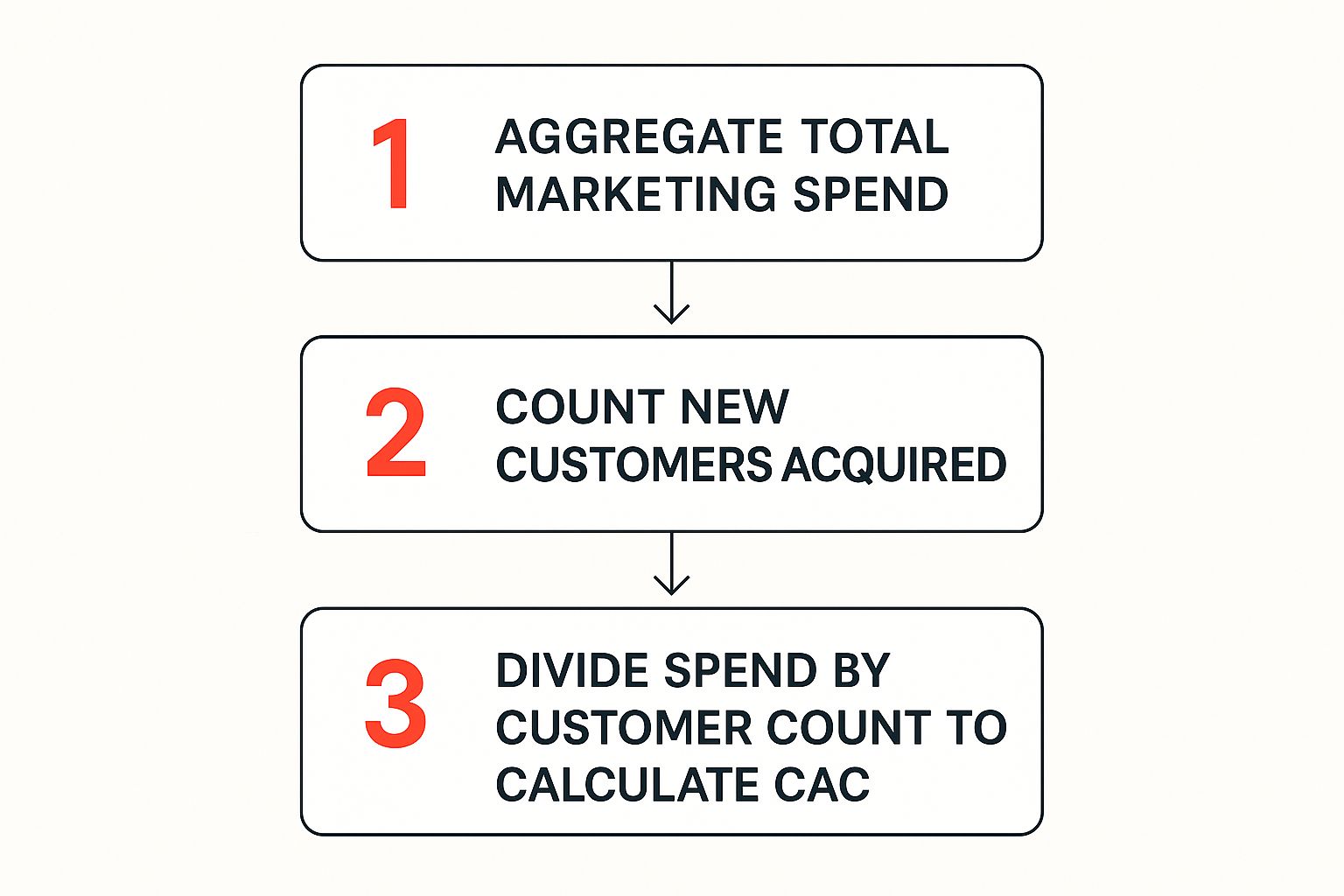
As shown, calculating CAC involves a continuous cycle of evaluating spending, counting new customers, and using this data to refine future campaigns. This ongoing feedback loop is essential for optimizing your marketing ROI.
Identifying Your Marketing and Sales Costs
Accurate CAC calculation hinges on correctly identifying all related costs. This extends beyond just your advertising expenses. Consider the following:
- Advertising Costs: These include expenses from platforms like Google Ads, social media campaigns, and print advertising.
- Marketing Team Salaries: Include the portion of salaries allocated to customer acquisition.
- Marketing Software Subscriptions: Account for the cost of tools like CRM systems, email marketing platforms, and analytics dashboards.
- Content Creation Costs: Factor in expenses related to blog posts, videos, and other marketing content.
- Sales Team Salaries and Commissions: Include the portion specifically tied to acquiring new customers.
- Travel and Entertainment: If your sales team travels for client meetings or events, incorporate these costs.
- Overhead: Allocate a portion of overhead costs like rent and utilities to your marketing and sales departments.
To further illustrate these cost components, let's examine a detailed breakdown in the following table:
CAC Calculation Components Breakdown: A comprehensive breakdown of all cost elements that should be included when calculating customer acquisition cost
| Cost Category | Examples | Frequency | Calculation Method |
|---|---|---|---|
| Advertising Costs | Google Ads, Social Media Ads, Print Ads | Daily/Monthly | Sum of all ad spend |
| Marketing Team Salaries | Salaries, Bonuses, Benefits | Monthly/Annually | Percentage allocated to customer acquisition |
| Marketing Software Subscriptions | CRM, Email Marketing Platforms, Analytics | Monthly/Annually | Subscription fees |
| Content Creation Costs | Blog Posts, Videos, Infographics | Project-Based | Cost per asset |
| Sales Team Salaries & Commissions | Base Salaries, Commissions, Bonuses | Monthly/Annually | Percentage/Amount tied to new customer acquisition |
| Travel & Entertainment | Client Meetings, Events | As Incurred | Expenses related to sales activities |
| Overhead | Rent, Utilities, Office Supplies | Monthly/Annually | Percentage allocated to sales & marketing |
This table clarifies how various costs contribute to your overall CAC calculation, emphasizing the importance of a comprehensive approach. By meticulously tracking each element, you gain a more accurate picture of your acquisition costs.
Practical CAC Calculation Examples
Let's explore two scenarios:
-
Scenario 1: E-commerce Startup: An online retailer spends $10,000 on advertising, $5,000 on marketing staff salaries, and $1,000 on software subscriptions. They acquire 200 new customers. Their CAC is ($10,000 + $5,000 + $1,000) / 200 = $80.
-
Scenario 2: Service-Based Business: A consultancy firm spends $2,000 on advertising, $8,000 on sales staff salaries and commissions, and $500 on travel and entertainment. They acquire 50 new clients. Their CAC is ($2,000 + $8,000 + $500) / 50 = $210.
Interpreting Your CAC
Calculating your CAC is just the first step. Analyzing it is crucial. A low CAC isn't inherently positive, and a high CAC isn't necessarily negative. Context is key. Consider your industry, profit margins, and customer lifetime value (CLTV). Compare your CAC to your CLTV to understand your overall profitability. This analysis is essential for making informed decisions about your marketing budget and strategy.
Australian Market Realities: Why Your CAC Runs Higher

Calculating your Customer Acquisition Cost (CAC) is crucial for any business. However, relying solely on global benchmarks can be misleading for Australian companies. Our market possesses unique characteristics that often lead to a higher CAC compared to other regions. This isn't necessarily a sign of inefficiency; it's about recognizing the distinct nature of the Australian market. Let's delve into the key factors.
The Tyranny of Distance: Population Density and Logistics
Australia's expansive landmass coupled with concentrated population centers presents significant logistical hurdles. Reaching potential customers scattered across the country can be considerably more expensive. This is particularly relevant for businesses utilizing traditional advertising methods or those dealing with substantial shipping costs.
Consider the implications: a national campaign in Australia covers a vastly larger area than a comparable campaign in a smaller, more densely populated country like the UK. Reaching remote customers often necessitates the use of premium freight options, adding to the overall cost. This geographical reality directly impacts the CAC for many Australian businesses.
Competitive Digital Landscape: Bidding Wars and Saturation
The Australian digital advertising market is intensely competitive. With widespread adoption of online marketing, businesses are vying for the same keywords and ad space. This heightened competition drives up bidding prices on platforms like Google Ads, directly influencing your CAC.
Certain industries, such as finance and insurance, experience particularly fierce online competition. This necessitates a more strategic and data-driven approach to digital marketing for Australian businesses to manage their CAC effectively. For those looking to refine their PPC strategies, this guide might be helpful: How to master PPC in Australia.
Higher Labour Costs: The Price of Expertise
Australia's relatively high minimum wage and robust worker protections contribute to higher labour costs across the board. This affects CAC because marketing and sales salaries are factored into overall acquisition expenses. The cost of specialized marketing professionals can be significantly higher in Australia compared to other regions.
This emphasizes the need for efficiency and automation within marketing and sales teams to optimize spending. Businesses need to carefully evaluate their staffing structures and explore opportunities to leverage technology to streamline labour-intensive processes.
The Aussie Consumer: Savvy Spenders and Brand Loyalty
Australian consumers are known for being discerning and price-conscious. They are less susceptible to generic marketing messages and more likely to conduct thorough product research before making a purchase.
Building trust and brand loyalty in this environment requires greater investment, potentially influencing your CAC. Businesses must focus on providing excellent customer experiences to cultivate loyalty. This often translates to a longer and more resource-intensive customer journey.
The Australian market sees higher customer acquisition costs compared to other regions. For instance, the average customer acquisition cost in the ecommerce sector in Australia is reportedly 20-35% higher than the US average. This difference highlights the need for tailored marketing strategies to achieve cost efficiency. Companies are increasingly leveraging data analytics to optimize their marketing efforts. For more detailed statistics, see: https://www.upcounting.com.au/blog/average-ecommerce-customer-acquisition-cost. Understanding these market nuances is essential for crafting impactful acquisition strategies that resonate with the Australian consumer.
Advanced CAC Analysis: Beyond Basic Numbers
Basic CAC calculations are a good starting point. But to truly maximize your marketing budget, you need a deeper dive. This means going beyond simple formulas and using more sophisticated analytical techniques. This is how you turn raw CAC data into actionable business intelligence.
Segmenting Your CAC
Breaking down your overall CAC into smaller segments offers invaluable insights. This helps you identify specific areas for improvement and allocate your budget strategically.
-
By Channel: Compare CAC across different marketing channels like paid search, social media, and email. This highlights which channels offer the best return on investment. For example, if your Facebook Ads CAC is much higher than your Google Ads CAC, you might shift resources to the more efficient platform.
-
By Customer Type: Different customer segments may have different acquisition costs. Pinpointing high-value customer groups allows you to focus your efforts on attracting these profitable customers. For instance, you might find that customers acquired through referrals have a lower CAC and higher lifetime value.
-
By Time Period: Tracking CAC over time (monthly or quarterly) reveals trends and seasonal changes. This helps you understand how market shifts and seasonality impact your acquisition costs, so you can adapt your strategies. For example, many retail businesses experience higher CAC during the holiday season due to increased competition.
Beyond Segmentation: Advanced Techniques
Advanced CAC analysis also involves more nuanced techniques:
-
CAC-to-Lifetime-Value Ratio: Comparing your CAC to your Customer Lifetime Value (CLTV) reveals the long-term profitability of your customer acquisition efforts. A healthy ratio indicates that you're earning more from customers than you're spending to acquire them.
-
Cohort Analysis: Analyzing the behavior of specific customer groups acquired during a particular time reveals insights into customer retention and lifetime value. This provides a deeper understanding of long-term profitability.
-
Seasonal Adjustments: Adjusting your CAC calculations for Australian buying patterns allows you to forecast acquisition costs more accurately. This is particularly important for industries affected by seasonal fluctuations.
Forecasting and Visualisation
Looking ahead is crucial. This means forecasting future acquisition costs and using reporting tools.
-
Forecasting Future CAC: Predicting future acquisition costs based on market trends and your marketing plans allows you to proactively adjust your budget and strategy. This helps maintain profitability despite increasing competition or other factors.
-
CAC Dashboards: Visual dashboards representing your CAC data across all marketing initiatives provide at-a-glance insights. This allows you to monitor performance, identify trends, and make data-driven decisions quickly.
To help you choose the right approach for your business, the following table compares different CAC analysis methods:
CAC Analysis Methods Comparison: This table compares different analytical approaches for measuring and interpreting customer acquisition cost data.
| Analysis Method | Best Use Case | Complexity Level | Key Insights Provided |
|---|---|---|---|
| Channel Segmentation | Evaluating channel effectiveness | Low | Identifying high-performing and underperforming channels |
| Customer Type Segmentation | Targeting high-value customers | Medium | Understanding CAC variance across different customer groups |
| Time Period Analysis | Tracking seasonal trends | Low | Revealing CAC fluctuations over time |
| CAC-to-CLTV Ratio | Assessing long-term profitability | Medium | Determining the return on customer acquisition investment |
| Cohort Analysis | Understanding customer behavior | High | Gaining insights into customer retention and lifetime value |
This table summarizes key differences and similarities between the various methods, allowing you to choose the most appropriate technique for your specific needs. By incorporating these advanced analysis techniques, you can transform your CAC from a simple metric into a powerful tool for driving profitable growth.
Optimising Your Customer Acquisition Strategy
Knowing your Customer Acquisition Cost (CAC) is just the first step. The real value comes from using this knowledge to refine your acquisition strategy and boost profits. It's a balancing act between short-term expenses and the long-term value a customer brings, along with consistently improving conversion rates throughout their journey.
Refining Your Approach for the Australian Market
Australian businesses navigate unique hurdles, from vast distances to highly informed consumers. This calls for a precise strategy. Successful companies consistently lower their acquisition costs by focusing on what resonates with the Australian market.
-
Targeted Digital Advertising: Forget broad strokes. Zero in on specific customer segments with highly targeted digital advertising. This minimizes wasted ad spend and boosts conversion rates. Need a hand? Check out our guide on How to master Google Ads.
-
Referral Programmes: Word-of-mouth is powerful. Implement referral programmes that reward loyal customers for bringing in new business. Australians value recommendations from trusted sources.
-
Content Marketing that Resonates: Create valuable content that addresses the needs and concerns of Australian consumers. This builds trust and positions your brand as an authority, fostering strong customer relationships and reducing reliance on pricey advertising.
-
Community Engagement: Get involved in online and offline communities relevant to your target audience. Building genuine connections with potential customers drives organic growth and lessens the need for paid acquisition.
Balancing Short-Term Costs and Long-Term Value
Lowering your CAC shouldn't mean sacrificing customer quality. Attracting customers cheaply is tempting, but it’s not sustainable if they don’t generate long-term value.
-
Focus on Customer Lifetime Value (CLTV): Draw in customers who are likely to stay with you. Understand their needs and deliver exceptional experiences that build loyalty.
-
Calculate Your CLTV to CAC Ratio: A good CLTV to CAC ratio (aim for 3:1 or higher) means you're earning more from customers than you’re spending to acquire them. This is crucial for long-term profitability.
Practical Techniques for Improving Conversion Rates
Boosting your conversion rate at each touchpoint is key to lowering your CAC. Consider these strategies:
-
Optimise Landing Pages: Make your landing pages clear, concise, and tailored to your audience. A smooth, user-friendly experience makes a big difference.
-
A/B Test Everything: Test different elements of your marketing campaigns, from headlines and calls to action to images and landing page designs. Figure out what resonates with your audience and optimize for conversions.
-
Personalise the Customer Journey: Tailor your messages and offers to the individual needs and preferences of your prospects. Personalisation boosts engagement and improves conversion chances.
Automation for Efficiency and Scale
Automation is essential for reducing manual acquisition costs and scaling your efforts effectively.
-
Marketing Automation Tools: Use marketing automation tools like Hubspot to handle repetitive tasks, nurture leads, and personalize communications, freeing up your team for strategic work.
-
Sales Process Automation: Automate parts of your sales process, such as lead qualification and follow-up, so your sales team can concentrate on closing deals and building relationships. Consider tools like Salesforce.
By applying these strategies, Australian businesses can optimize customer acquisition, reduce CAC, and achieve sustainable growth in the competitive Australian market.
Tracking and Reporting CAC for Business Growth
Calculating your Customer Acquisition Cost (CAC) is a crucial first step. However, consistent tracking and reporting are what truly empower data-driven decisions for sustainable growth. This involves building systems that transform raw CAC data into usable business insights, guiding strategic choices.
Setting Up Automated Tracking
Manually tracking CAC is not only tedious but also susceptible to errors. Automating this process allows your team to focus on strategic planning and analysis. Numerous tools are available that can automate CAC tracking for Australian businesses. These often integrate with existing CRM and advertising platforms, simplifying data collection and calculation. Automation not only saves time but also enhances accuracy.
For example, some platforms automatically pull data from your ad campaigns and sales records, eliminating manual data entry. Learn more in our article about How to master Google Ads conversion tracking. This real-time monitoring makes it easier to identify and address rising costs promptly.
Choosing the Right Tools
Selecting the right tools for the Australian business landscape is essential. Consider factors like GST implications, local payment gateways, and integration with Australian accounting software. Choosing tools tailored to the Australian market ensures compliance and accurate reporting.
Some tools may offer features specifically for Australian businesses, such as reporting in Australian dollars or adhering to Australian privacy regulations. This localized functionality streamlines financial processes and ensures legal compliance.
Establishing Relevant Benchmarks
While industry averages offer a general starting point, establishing benchmarks specific to your business and target audience is vital. A small business targeting a niche regional market will likely have a different CAC than a large national corporation.
Analyze your historical data and consider specific market conditions to set realistic targets. These tailored benchmarks provide more relevant insights than broad industry averages, allowing you to accurately assess performance.
Integrating with Other Metrics
Integrating CAC reporting with other key metrics, such as Customer Lifetime Value (CLTV) and return on investment (ROI), provides a more holistic view of your business performance. A high CAC might be acceptable if it corresponds with a high CLTV.
This interconnected reporting framework reveals how your acquisition strategies impact your overall profitability. By understanding the interplay of these metrics, you can make more informed decisions.
Regular CAC Reviews and Actionable Alerts
Establish a routine for regular CAC reviews. Schedule monthly and quarterly analyses to identify trends and potential issues. Set up alerts to notify you if CAC exceeds pre-defined thresholds.
This proactive monitoring helps you address cost increases before they significantly impact your bottom line. Early detection and intervention can save your business valuable resources.
Key Takeaways for Australian Businesses
Successfully managing your Customer Acquisition Cost (CAC) is crucial for sustainable growth in the Australian market. This section provides actionable steps to calculate, interpret, and optimize your CAC.
Practical Steps for CAC Calculation
-
Identify all relevant costs: This includes marketing and sales expenses like advertising, salaries, Salesforce subscriptions, content creation, and even overhead allocated to these departments.
-
Calculate total marketing and sales costs: Sum up all the costs identified in the previous step for a given period (e.g., monthly, quarterly).
-
Determine the number of new customers acquired: Accurately count the number of new customers acquired within the same period.
-
Apply the CAC formula: Divide the total marketing and sales costs by the number of new customers acquired.
Interpreting Your CAC in the Australian Context
-
Compare with industry benchmarks: While generic benchmarks exist, focus on comparing your CAC to those of similar Australian businesses operating within your specific niche. Remember the Australian market realities – factors like higher labor costs and logistical challenges can contribute to a higher CAC.
-
Analyze CAC alongside CLTV: Assess your CAC in relation to your Customer Lifetime Value (CLTV). A healthy CLTV to CAC ratio (3:1 or higher) signifies profitable customer acquisition.
-
Consider market dynamics: Be mindful of the unique challenges and opportunities in the Australian market. Factors like population density, competition, and consumer behavior can influence your CAC.
Optimizing Your CAC for Sustainable Growth
-
Channel-specific strategies: Tailor your acquisition efforts to each channel. For example, focus on targeted digital advertising and referral programs that resonate with Australian consumers.
-
Conversion rate optimization: Improving conversion rates at each stage of the customer journey can significantly reduce your CAC. A/B testing and personalized experiences are effective strategies.
-
Automation and efficiency: Leverage automation tools to streamline your marketing and sales processes, reduce manual tasks, and scale your acquisition efforts cost-effectively.
For expert assistance in optimizing your PPC campaigns and reducing your CAC in the Australian market, consider partnering with Click Click Bang Bang. We offer tailored strategies and transparent reporting to help your business grow. Learn more about our services at Click Click Bang Bang.
Read NeXt
Or Read Our Latest
- Best ROI Digital Marketing: 10 Channels Ranked for 2026
- Localization Strategy: How to Win in Any Market
- Phone Call Tracking: Methods, Metrics, and Best Practices
- Supplier Relationship Management: Strategic Guide 2026
- Reporting Portal Login: Access Your Client Dashboard Fast
- How to Calculate Sample Size for A/B Tests and Campaigns
Click. CLick. Subscribe.
Get our best PPC insights, industry updates, and power moves delivered straight to your inbox. No fluff, just high-caliber strategies that actually work.
Don’t Leave Just Yet
Try Us For 30-Days,
Risk Free!!
We guarantee that you’ll love our work within the first 30 days, if not you’ll get your money back.
What have you got to lose?