

What Is a Good ROAS? Australia’s Marketing Return Guide
Last Updated

What ROAS Actually Means for Your Marketing Success

Return on ad spend (ROAS) is a crucial metric for assessing the effectiveness of your digital advertising campaigns. It shows how much revenue you earn for every dollar invested in advertising. This information is essential for any business aiming to optimize its marketing budget. Understanding what constitutes a good ROAS and its impact on your success is paramount, especially in the competitive Australian market.
A strong ROAS demonstrates that your marketing activities are yielding a positive return. For instance, a ROAS of 4:1 indicates that for every dollar spent, you generate four dollars in revenue. This directly boosts your profits and enables further investment in business expansion.
However, it's important to consider the context. An apparently high ROAS might not always equate to actual profitability, particularly if your profit margins are slim.
Understanding ROAS in the Australian Context
Performance-based marketing is gaining significant traction among Australian businesses. In fact, 54% of buyers anticipate increasing their budgets for paid performance advertising by 2025. This focus on quantifiable results has elevated ROAS to a core key performance indicator (KPI) for Australian marketers. More detailed statistics on the Australian marketing landscape can be found at: Eloquent
This shift underscores the growing recognition of data-driven marketing. Businesses are realizing the need to meticulously track and analyze their marketing performance to guarantee a positive return on investment. This trend is especially prominent in the fiercely competitive Australian market, where businesses are always looking to optimize their spending.
The Importance of Setting Realistic ROAS Goals
A high ROAS is naturally desirable. However, it's vital to establish achievable goals tailored to your industry, business model, and stage of growth. A startup, for example, might prioritize brand building and customer acquisition, even if it means a lower initial ROAS.
On the other hand, an established brand may target a higher ROAS to maximize profits. This is because the cost of acquiring new customers can differ substantially between emerging and established businesses.
Ultimately, a good ROAS transcends mere numbers; it's about achieving sustainable growth and building a thriving business.
Real ROAS Benchmarks Across Australian Digital Channels
What's a "good" ROAS (Return on Ad Spend)? It depends on several factors, and understanding Australian benchmarks is a good starting point. Achievable ROAS can change drastically depending on which platform you’re using. Let’s dive into the data, starting with well-established platforms like Google Ads and Meta (Facebook and Instagram) and then exploring some newer advertising channels.
Platform-Specific ROAS in Australia
Australian marketers are seeing success on a variety of platforms, but returns aren’t uniform across the board. This highlights that a winning strategy on one platform may not automatically work on another.
-
Google Ads: Google Ads, especially Search campaigns, often deliver higher ROAS due to their intent-driven nature. People actively searching for particular products are primed to purchase.
-
Meta Platforms (Facebook and Instagram): Meta platforms excel at brand building and retargeting. However, compared to Google Ads, the ROAS can be lower because purchase intent isn't always as direct.
-
Emerging Channels: Consider platforms like TikTok or Pinterest. These can be great for reaching specific demographics, especially for early adopters.
It's important to remember that no single platform is universally "better." The optimal platform for your business depends on your target audience and campaign goals. A good resource for Google Ads is: How to master Google Ads.
Let's delve into Australian ROAS trends to gain further insights.
Deciphering Australian ROAS Trends
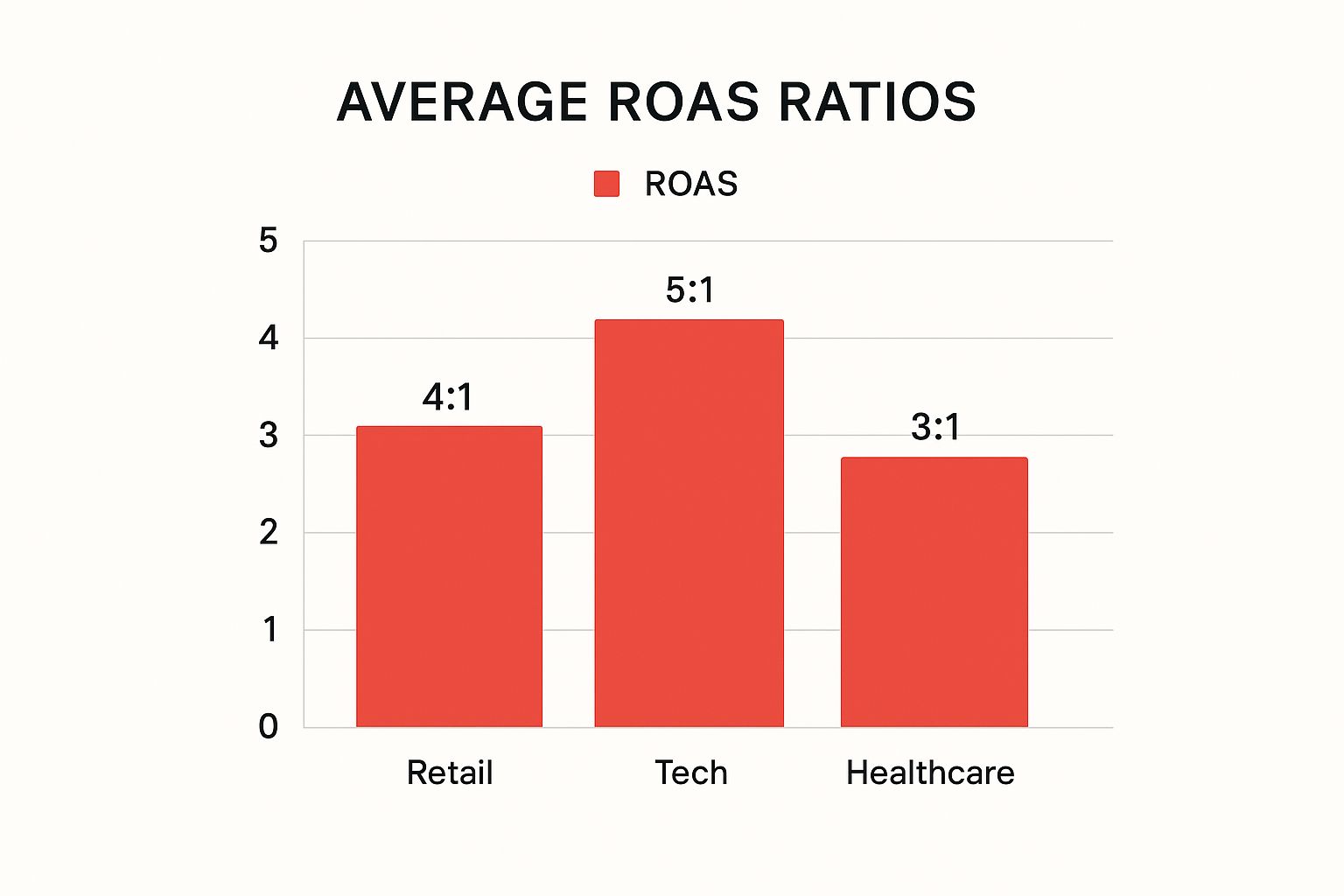
The chart above showcases average ROAS across three key Australian industries: Retail, Tech, and Healthcare. The Tech industry boasts the highest average ROAS at 5:1, followed by Retail at 4:1, with Healthcare at 3:1. These differences demonstrate how industry dynamics, profit margins, and customer lifetime value all contribute to defining a “good” ROAS.
Australian digital ad spending is projected to reach AU$31 billion by 2025. Current data suggests the average ROAS for paid channels typically falls between 1.5 and 3.5, varying by platform. For example, Facebook Ads in Australia often see a ROAS around 1.8. Statista provides more in-depth advertising statistics: Find more detailed statistics here.
To understand this further, let's explore why simply applying overseas benchmarks isn't always the best strategy.
Why Overseas Benchmarks Don’t Always Apply
While international data offers valuable context, the Australian market has unique characteristics. Consumer behavior, economic factors, and competitive landscape all influence ROAS. Success in other countries doesn't guarantee the same results here.
Seasonal trends also impact ROAS significantly within Australia. Retail often sees a spike during the holiday season, while other industries might peak at different times. Understanding these nuances within the Australian market, and your specific industry, allows for more realistic ROAS benchmarks and more effective strategies.
To help you navigate the Australian digital advertising landscape, we've compiled a table summarizing key ROAS benchmarks by channel.
Australian ROAS Benchmarks by Digital Channel
| Channel | Average ROAS | Performance Level | Best Use Case |
|---|---|---|---|
| Google Search Ads | 4:1 – 8:1 | High | Driving direct conversions from users actively searching for products/services |
| Google Display Ads | 2:1 – 4:1 | Medium | Building brand awareness and retargeting website visitors |
| Meta Ads (Facebook/Instagram) | 1.5:1 – 3:1 | Medium | Brand building, retargeting, and reaching specific demographics |
| TikTok Ads | 2:1 – 5:1 | Medium-High | Reaching younger demographics and leveraging trending content |
| Pinterest Ads | 2:1 – 4:1 | Medium | Reaching specific interest groups and driving traffic to e-commerce sites |
This table provides a general overview, and actual results can vary based on factors such as industry, campaign objectives, and targeting. It's essential to continuously monitor and analyze your own campaign data to determine what constitutes a "good" ROAS for your specific business.
Industry Standards That Actually Make Sense
What constitutes a "good" Return on Ad Spend (ROAS) isn't a simple answer. It varies significantly depending on your industry. Understanding the norms within your specific sector in Australia is crucial for setting realistic ROAS targets and accurately assessing your campaign performance. For instance, a ROAS that's celebrated in retail might be underwhelming for a B2B enterprise.
How Industry Influences ROAS Expectations
Different industries operate with different ROAS benchmarks. These variations stem from several factors, including profit margins, customer lifetime value (CLTV), and the length of the average purchase cycle. A software company, enjoying high profit margins, might be satisfied with a lower ROAS. Conversely, a grocery store, dealing with thinner margins, requires a higher ROAS to remain profitable.
Businesses with longer purchase cycles often need a more nuanced approach to ROAS. A B2B software sale, for example, might involve months of lead nurturing, compared to an e-commerce purchase that can happen in minutes. This difference significantly impacts how quickly returns are expected and how success is measured.
ROAS in the Australian Food Sector: A Case Study
The Australian food sector provides a clear example of how industry influences marketing spend and performance measurement. Ad spend in this sector is increasing, reaching $414 million in 2024–2025, a 6% rise. For food brands, a ROAS above 2.0 is generally considered good, largely due to typically tight margins and the focus on repeat customers. More detailed statistics are available in this Nielsen Report.
This highlights how "what is a good ROAS" depends heavily on the industry context. Comparing your performance to vastly different sectors can be misleading.
Comparing Your ROAS: A Balanced Approach
While industry averages offer useful guidance, relying solely on them can be limiting. Focus on tracking your own ROAS over time and strive for continuous improvement. A rising ROAS trend, even if below the industry average, indicates your strategies are effective.
This means a "good" ROAS is a dynamic benchmark, based more on your individual business growth than a fixed number. It's about understanding your own performance and consistently aiming for improvement within your specific industry.
ROAS by Sector: Different Strokes for Different Folks
Consider the contrasting ROAS strategies between e-commerce and service-based businesses in Australia. E-commerce companies often target a ROAS of 4:1 or higher, due to shorter sales cycles and the potential for high-volume transactions. Service businesses, on the other hand, with longer sales cycles and a focus on client relationships, may prioritize metrics like lead generation and CLTV over immediate ROAS.
New and emerging sectors in Australia are establishing their own ROAS benchmarks. These evolving standards reflect the unique characteristics of these industries as they solidify their market presence and refine their business operations. This further emphasizes the importance of understanding your particular industry landscape for setting appropriate ROAS goals.
Why Context Beats Numbers Every Time

A good ROAS (return on ad spend) isn't just about hitting the highest possible number. It's about seeing the whole picture of your business. This includes understanding how your ROAS contributes to your overall goals, your current growth stage, and your position in the Australian market.
Beyond the Numbers: Qualitative Factors That Matter
Savvy marketers know there's more to the story than just ROAS. They also consider qualitative factors. These include brand awareness, the cost of acquiring new customers, and generating long-term value. For instance, a startup might prioritize brand building over immediate sales. This might mean accepting a lower ROAS at first to invest in broader reach and recognition within the Australian market.
In addition, customer acquisition cost (CAC) is critical. A high ROAS can look fantastic, but if your CAC is also high, your profit margins could be slim. This is where understanding the lifetime value of a customer comes into play.
Balancing Short-Term Gains and Long-Term Vision
Successful Australian businesses master balancing short-term performance with strategic long-term investments. Sometimes, a lower ROAS in the short term can actually be a good thing. This might happen when attracting new customers or testing a new marketing channel. Such a strategic approach can set the stage for substantial future growth.
For example, investing in a loyal customer base can generate repeat business and positive word-of-mouth referrals. This creates a strong brand, which, in turn, justifies higher prices and ultimately boosts future ROAS.
Talking ROAS With Stakeholders
Explaining these subtleties to stakeholders focused on immediate returns can be a challenge. Clearly connecting your ROAS strategies to overall business goals is crucial. Showing how short-term investments lead to long-term gains, using concrete examples and clear data, is essential for building trust and support.
This might involve demonstrating how a lower initial ROAS led to significant market share growth or boosted customer lifetime value. Highlighting the long-term value of these investments can make all the difference.
Making Tough Decisions: ROAS in Action
Imagine two campaigns: one with a ROAS of 5:1 and another with 3:1. The 5:1 campaign appears superior at first glance. But what if the 3:1 campaign targets a new, high-value customer segment? While the initial return is lower, the long-term value from these customers could be far greater. Strategic decisions like these, based on context not just numbers, are key to sustainable success in the Australian market. A higher ROAS isn’t always the right answer to the question, "what is a good roas?". The ROAS that best serves your business objectives is what truly matters.
Proven Tactics to Boost Your ROAS Performance

Want to see a better return on your advertising investment? Improving your return on ad spend (ROAS) is a top priority for marketers, and this section offers practical strategies used by Australian marketers to achieve just that. We'll cover how to optimise your audience, test your creative, and choose the right bidding strategies for maximum efficiency across different channels.
Refining Your Audience for the Australian Market
One of the most impactful ways to improve ROAS is by targeting the right people. This goes beyond simple demographics. To truly connect with your Australian audience, you need to be more precise.
- Detailed Targeting: Don't just stop at age and location. Dive deeper into interests, online behaviour, and activities to pinpoint your ideal customer. For example, if you're selling eco-friendly products, targeting Facebook users interested in "sustainable living" within Australia can be highly effective.
- Retargeting Campaigns: Re-engage users who have already shown interest in your brand. These individuals are more likely to convert, which directly contributes to a higher ROAS.
- Lookalike Audiences: Broaden your reach while maintaining targeting relevance. Lookalike audiences help you find new prospects similar to your existing high-value customers. This is a powerful way to discover potential customers who are likely to be interested in what you offer.
By concentrating your ad spend on the most receptive audiences, you'll minimise waste and see a much better return. This focused approach is significantly more effective than broad, untargeted campaigns. For more strategies on reaching the right audience, explore our keyword research guide.
Creative Testing: Finding What Resonates
Your ad creative plays a crucial role in capturing attention and driving conversions. Regular testing is key to understanding what resonates with your target audience.
- A/B Testing: Experiment with variations of your ad copy, visuals, and calls to action. By comparing the performance of different versions, you can identify what works best for your Australian audience.
- Video Ads: Engage users with the power of video. Video ads can be especially effective for product demonstrations and telling compelling brand stories.
- Interactive Ads: Increase engagement and capture attention with polls, quizzes, or playable ads. These formats encourage interaction and can lead to higher conversion rates.
Continuous testing and refinement ensure your ads remain fresh and relevant, leading to better click-through rates and a higher ROAS.
Bidding Strategies for Maximum Efficiency
Your bidding strategy has a direct impact on your ROAS. Choosing the right strategy is vital, and different approaches are suited to different goals.
- Target ROAS: If your main objective is to maximise return, automated bidding strategies, often powered by machine learning, can be incredibly helpful in optimising your bids for conversions. Platforms like Google Ads offer automated bidding strategies.
- Manual Bidding: For more precise control over your bids, manual bidding offers greater flexibility. However, it also requires ongoing monitoring and optimisation.
- Enhanced CPC: Combine the control of manual bidding with automated adjustments to optimise your bids for conversions.
Regularly evaluating your bidding strategy's performance is essential to ensure you’re making the most of your advertising budget. This focused approach helps fine-tune your campaigns for optimal results.
To help you choose the right strategy for your business, we've compiled a table outlining different tactics and their expected impact.
Introducing the "ROAS Improvement Tactics and Expected Impact" table below. This table summarizes proven strategies for improving ROAS performance, along with their estimated impact levels and implementation difficulty. This information will help you prioritise your efforts and select the tactics most suited to your resources and goals.
| Strategy | Expected ROAS Lift | Implementation Difficulty | Timeline |
|---|---|---|---|
| Detailed Targeting | Medium | Easy | Immediate |
| Retargeting Campaigns | High | Medium | Short-Term |
| Lookalike Audiences | Medium | Medium | Short-Term |
| A/B Testing | Medium | Easy | Ongoing |
| Video Ads | High | Medium | Medium-Term |
| Interactive Ads | Medium | Medium | Medium-Term |
| Target ROAS Bidding | High | Easy | Immediate |
| Manual Bidding | Medium | Hard | Ongoing |
| Enhanced CPC Bidding | Medium | Medium | Immediate |
| Attribution Modelling | Medium | Hard | Long-Term |
| Customer Journey Optimisation | High | Hard | Long-Term |
| Cross-Channel Coordination | High | Hard | Long-Term |
The table demonstrates a range of tactics available to boost your ROAS. While some offer a quick win with relatively easy implementation, others require more effort and a longer-term approach. Choose the strategies that align with your specific business needs and resources.
Advanced Tactics for Long-Term ROAS Growth
Looking beyond the immediate tactics, these advanced strategies can significantly boost your ROAS over time:
- Attribution Modelling: Gain a deeper understanding of the customer journey and how different touchpoints influence conversions. This allows for more accurate attribution and better budget allocation.
- Customer Journey Optimisation: Improve the customer experience at every interaction, from the initial ad click to post-purchase engagement.
- Cross-Channel Coordination: Create a seamless and consistent customer experience across all your marketing channels.
These strategies create a more comprehensive and efficient marketing approach, driving significant improvements in overall ROAS performance.
Avoiding the Traps That Sink ROAS Performance
Pursuing a strong return on ad spend (ROAS) is crucial for any business. However, there are common pitfalls that can derail even the most well-crafted campaigns. This section explores these traps and how Australian marketers can identify and avoid them to protect their marketing budget and drive real business growth.
The Peril of Unrealistic Expectations
Setting overly ambitious ROAS targets can harm team morale and campaign performance. While ambition is good, basing targets on unrealistic benchmarks can lead to frustration and undermine your strategy. This is particularly true when applying global averages to the Australian market.
For example, expecting a new e-commerce business to immediately hit an 8:1 ROAS, when the industry average is closer to 4:1, sets the team up for failure. A better approach involves gradual increases, starting with small, achievable targets and building momentum over time. This allows for learning and adjustments, leading to sustainable long-term growth.
Attribution Errors: Not Giving Credit Where It’s Due
Understanding where your conversions originate is crucial. Incorrect attribution can lead to poor decisions and wasted ad spend. This is often a problem for businesses using multiple channels.
Imagine a customer clicks on a Facebook ad, then later searches for your brand on Google before buying something. Attributing the conversion solely to Google ignores the initial Facebook ad, creating an inaccurate performance assessment.
This can be avoided by using comprehensive attribution modelling, which considers all touchpoints in the customer journey. By understanding how different channels contribute to conversions, you gain a clearer view of campaign effectiveness. You might be interested in: Check out our guide on Google Ads Audits.
Short-Term Thinking vs. Long-Term Growth
Focusing solely on immediate ROAS can hinder long-term success. Some strategies, like brand building or entering new markets, may not deliver high initial returns, but are essential for future growth.
For instance, a lower ROAS from a campaign targeting a new demographic in Australia might be acceptable if it expands your customer base and builds brand recognition for future returns.
ROAS Tunnel Vision: Missing the Bigger Picture
Focusing exclusively on ROAS can distract from other key business objectives. A high ROAS is great, but it doesn’t automatically mean increased profits if other metrics, like profit margins or customer lifetime value, are ignored. A profitable ROAS can look fantastic on paper but might not account for all costs, such as freight and logistics. It's essential to consider a variety of key performance indicators, and not fixate on a single metric.
By avoiding these pitfalls and focusing on realistic, long-term objectives, Australian marketers can achieve sustainable growth and maximize their returns.
Building ROAS Goals That Drive Real Growth
Setting the right return on ad spend (ROAS) goals is essential for meaningful growth in the Australian market. It's not about chasing arbitrary numbers. It's about establishing targets aligned with your business objectives, stage of development, and the competitive landscape.
Frameworks for Effective ROAS Goal Setting
A practical ROAS goal-setting approach considers several factors:
-
Business Stage: Startups often prioritize brand building and acquiring new customers, even with a lower initial ROAS. Established businesses might focus on maximizing profits with higher ROAS targets.
-
Competitive Landscape: Highly competitive industries often require more aggressive bidding, potentially lowering ROAS. Less competitive markets may allow for higher returns.
-
Growth Objectives: Aggressive expansion plans may require a different ROAS strategy compared to maintaining current market share.
Careful consideration of these elements helps create ROAS goals that truly support your overall business strategy.
Evolving Your ROAS Targets Over Time
Your ROAS goals shouldn't be static. As your marketing efforts mature and your business grows, your targets should adapt. This dynamic approach lets you respond to market changes, refine your strategies, and continuously improve your performance. For example, a successful campaign may allow you to gradually increase your ROAS target.
Practical Templates for ROAS Planning
Structured templates can simplify ROAS planning. A simple table can outline goals for different campaigns, platforms, and time periods, helping you stay organized and track progress.
| Campaign | Platform | Target ROAS | Time Period |
|---|---|---|---|
| Brand Awareness | Facebook/Instagram | 2:1 | Q1 2024 |
| Lead Generation | Google Search | 4:1 | Q2 2024 |
| Product Sales | Google Shopping | 6:1 | Q3 2024 |
This example demonstrates how to outline your ROAS targets by specific campaigns, the advertising platform, and the planned timeframe. You can customize the table with metrics specific to your business.
Key Milestones and Team Alignment
Clear milestones are crucial for tracking progress and keeping your team focused. These milestones should be measurable and align with your overall ROAS objectives. Regularly reviewing these milestones with your team helps maintain focus and identify any necessary strategy adjustments.
Balancing Short-Term Wins With Long-Term Value
Achieving immediate ROAS improvements is important, but it's essential to balance short-term wins with building long-term value. This could involve investing in brand building or customer loyalty programs, even if they don't immediately yield a high ROAS. These initiatives build a solid foundation for sustainable growth and future profitability. Focusing on immediate performance and long-term equity sets your business up for continued success in the dynamic Australian market. A good ROAS is one that drives lasting value.
Ready to improve your digital advertising campaigns? Click Click Bang Bang offers expert PPC management services tailored to the Australian market. Our data-driven approach helps you achieve your ROAS goals and maximize your return on investment. Start your free 30-day trial today.
Read NeXt
Or Read Our Latest
Click. CLick. Subscribe.
Get our best PPC insights, industry updates, and power moves delivered straight to your inbox. No fluff, just high-caliber strategies that actually work.
Don’t Leave Just Yet
Try Us For 30-Days,
Risk Free!!
We guarantee that you’ll love our work within the first 30 days, if not you’ll get your money back.
What have you got to lose?